Hitting ISIS In The Pocketbook

Mark Thompson remarks that strikes on ISIS’s oil refineries amount to America “going to war against oil, not for it”:

The fact that the U.S. and its allies attacked a financial hub of the Islamic State in Iraq and Greater Syria (ISIS) on Tuesday–the first day of strikes in Syria—and spent Wednesday and Thursday bombing its oil-production facilities, highlights ISIS’s predicament. Unlike a smaller terrorist organization—al-Qaeda, for example—ISIS now occupies, and purports to govern, a wide swath of desert straddling the Syrian-Iraqi border. It needs the estimated $2 million a day it’s grossing by smuggling oil because many, if not most, of its 30,000 fighters are in it for the cash, not the ideology. But the refineries represent only a small slice of ISIS’s oil revenues. It makes most of its money from crude oil, and the U.S. has refrained so far from attacking oil fields in the region. If the money eventually dries up, Pentagon officials believe, many ISIS fighters will head back home. The terrorists control about 60% of Syria’s total oil production, according to a Syrian opposition estimate.

But Jamie Dettmer calls cutting off ISIS’s oil wealth “a monumental task”:

Hitting a dozen rudimentary refineries isn’t going to undercut the group, according to analysts. They say the oil refined by ISIS inside Syria is for the militants’ own immediate transport needs and not for sale to dealers in Turkey, Jordan, and Iran. Revenue is generated from the sale of crude oil, according to Luay al-Khatteeb, an energy expert at the Brookings Doha Center.

To deprive ISIS of its oil revenue would require the U.S. and its allies to bomb nearly a dozen oilfields and hundreds of wells the group has seized in both Syria and Iraq—an operation that would require a huge commitment from the coalition’s air forces and if conducted would cause an environmental hazard. And the government in Baghdad has tied the Pentagon’s hands when it comes to oilfields seized by ISIS in Iraq; it has asked the U.S. not to bomb them, hoping to recapture them intact.

Even more than bombing, a key component in stopping ISIS from profiting from oil will be blocking militants from getting their oil to market by locking up the border with Turkey and Jordan and pressing Kurds to stop dealers in semi-autonomous Kurdistan from trading. The Turks have shown little enthusiasm for halting the trafficking in the past, although in recent weeks they have interdicted some tankers carrying illicit oil.

Goldman Sachs: As Bad As You Thought

Michael Lewis highly recommends the latest episode of This American Life:

I don’t want to spoil the revelations of “This American Life”: It’s far better to hear the actual sounds on the radio, as so much of the meaning of the piece is in the tones of the voices — and, especially, in the breathtaking wussiness of the people at the Fed charged with regulating Goldman Sachs. But once you have listened to it — as when you were faced with the newly unignorable truth of what actually happened to that NFL running back’s fiancee in that elevator — consider the following:

1. You sort of knew that the regulators were more or less controlled by the banks. Now you know.

2. The only reason you know is that one woman, Carmen Segarra, has been brave enough to fight the system. She has paid a great price to inform us all of the obvious. She has lost her job, undermined her career, and will no doubt also endure a lifetime of lawsuits and slander.

So what are you going to do about it? At this moment the Fed is probably telling itself that, like the financial crisis, this, too, will blow over. It shouldn’t.

Who Stands To Profit From Another War?

Good Sam Club 500

Dan Froomkin eyes defense contractors:

Now, with U.S. forces literally blowing through tens of millions of dollars of munitions a day, the industry is not just counting on vast spending to replenish inventory, but hoping for a new era of reliance on supremely expensive military hardware.

“To the extent we can shift away from relying on troops and rely more heavily on equipment — that could present an opportunity,” Jack Ablin, chief investment officer at BMO Private Bank, whose $66 billion portfolio includes Northrop Grumman Corp. and Boeing Co. shares, told Bloomberg.

Defense contractor stocks have far exceeded the performance of the broader market. A Bloomberg index of four of the largest Pentagon contractors rose 19 percent this year, compared to 2.2 percent for the S&P 500.

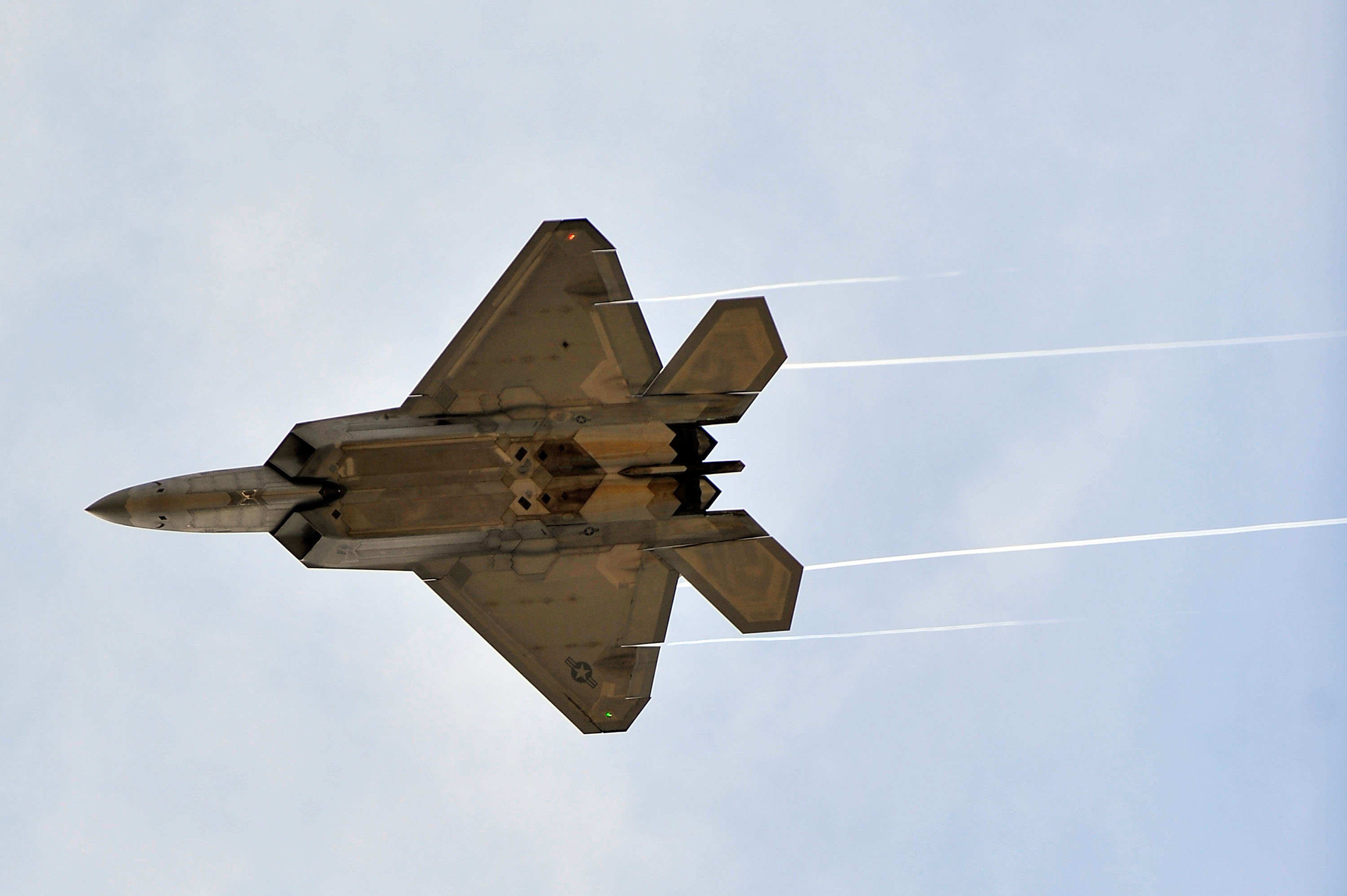
The pricey F-22 made its combat debut this week:

[T]he F-22 is extremely expensive to operate and difficult to maintain. In 2013 the Raptor cost the Air Force about $68,000 per hour to operate once maintenance and other factors are added in, according to documents provided by the Center for Defense Information.

Daniel Altman wonders “whether the arms industry put its thumb on the scale”:

Even a short involvement in Syria will be exceedingly profitable; the first round of air strikes this week reportedly cost $79 million, more than India’s mission to Mars. To “train and equip appropriately vetted elements of the Syrian opposition,” as the amendment voted on by the House states, could cost much more, perhaps as much as $500 million.

So the arms industry had a lot on the line in Roll Call Vote 507. In the end, it passed easily. But those who voted for the amendment may have been much more beholden to the industry than those who did not. On average, the “Yea” voters had received more than $36,000 in contributions from the defense sector during the last campaign cycle, according to the Center for Responsive Politics. The “Nay” voters had taken only about $22,000.

Relatedly, Tom Z. Collina questions the utility of our vast nuclear arsenal:

As the New York Times reported on Sept. 22, the United States plans to spend about $355 billion on nuclear weapons over the next 10 years, and up to $1 trillion over 30 years. As they say in Washington, that’s real money. Yet these weapons play essentially no role in responding to today’s highest-priority threats. U.S. nuclear weapons did not keep Russia from taking Crimea. They did not stop the Islamic State from rampaging through Iraq and Syria. And Ebola? Yeah, right.

A quarter-century after the Cold War, spending this much money on nuclear weapons is simply not justified. But even if it was, the harsh reality is that the country does not have the cash to pay the tab.

(Photo: An F-22 Raptor. By Jason Smith/Getty Images)

The Era Of Threatiness

Rosa Brooks parodies Obama’s speech to the UN:

PRESIDENT OBAMA: My fellow Americans, the Middle East today is frighteningly full of threatiness.

What, you ask, is threatiness? As my good friend Mr. Stephen Colbert will surely understand, threatiness is to threat as truthiness is to truth. By this, I mean that sometimes we cannot articulate why something is a threat, or offer evidence, but we still think it just feels, you know, threaty. We know it in our gut. And let me be clear: when there is enough threatiness floating around, America must take action.

Nicely done. It’s amazing that no one has yet identified any threat to the US to justify a return to war in Iraq, let alone Syria. Fisher finds Brooks’ coinage useful:

There are two ways to interpret the threatiness of the Obama administration’s case for Syria strikes. The sympathetic interpretation is that there is in fact a good case for intervening against ISIS to curb the danger it poses, but that this danger is difficult to sell politically, because it is too indirect, abstract, and/or complex for a prime time speech. For example, the administration may believe that ISIS is destabilizing an already unstable region in a way that, if left unchecked, really would lead to non-exaggerated threats to the US, not unlike what happened when the Taliban took over Afghanistan. And so, for the sake of political expedience, Obama is using the more palatable language of threatiness, even though that language is at least partly bullshit. That’s the sympathetic interpretation.

The unsympathetic interpretation is that the Obama administration felt pressured into strikes that it now has to justify, or it has no strategy and is trying to cover that up, or it earnestly believes its overstated language.

Take your pick. But none of the interpretations really add up, at least in my mind.

How The Clintons Hide In Plain Sight

International Leaders And Luminaries Attend Clinton Global Initiative

Matthew Continetti is tired of the Clintons’ “passive-aggressive, push-pull tactic of complaining about and condemning supposedly harsh media coverage even as she and her husband and their minions use access and connections to advance their preferred narratives, bullying reporters and outlets who do not conform, and responding to press inquiries with snark and insults and flip and mendacious retorts”:

What is more I am tired of the mainstream media’s complicity in the manipulation and goaltending, the manner in which reporters for establishment outlets accept the Clintons’ absurd regulations and spin, for reasons that are baffling and mysterious to me: whether it is out of ideological or partisan bias, or journalistic self-interest, or the calculation that one day bills will have to be paid, the scribbling will have to end, and jobs in the White House or at SKDKnickerbocker will have to be obtained. …

It will be the unabashedly ideological media that provides the best coverage of the corporatist “centrist” stalking her way back to power. And not just the conservative media: There is plenty of sublimated progressive grumbling at, and critical reporting of, the Hillary juggernaut. Alex Seitz-Wald of MSNBC wrote a fair-minded piece, “The agony and the ecstasy of the Clintons at CGI,” that was a much clearer analysis of the event than any in the major papers. Seitz-Wald went so far as to mention the “elitism problem” and “Wall Street problem” that dog the Clintons, whose idea of combating income inequality is to talk about it while vacationing in a multimillion dollar mansion in the Hamptons, then rub their chins at lavish uplit plenary sessions with Hollywood celebrities and foreign leaders and the head of Goldman Sachs.

My own view is that Clinton is a very establishment, corporate candidate in a very populist, restless era. Maybe the public mood will want some reassurance at the top in a troubled time – the restoration of a royal family to the throne. Or maybe the reverse. I just don’t see anyone out there capable of marshaling that kind of populist campaign against Clinton or against the GOP establishment either. You need exceptional talent to pull off what Obama pulled off in 2008. Cruz is too scary; Paul, alas, does not seem very presidential; Warren has no intuitive way to connect to white working class populism; Rubio looks like a high school debating kid, with a Reagan handbook.

I remember what Hitch once said: the Clintons are always the last people to leave a meeting. Their will to power is unstoppable. But that doesn’t mean others cannot protest as the bandwagon grinds relentlessly forward.

Earlier Dish on the Clinton’s press operation here.

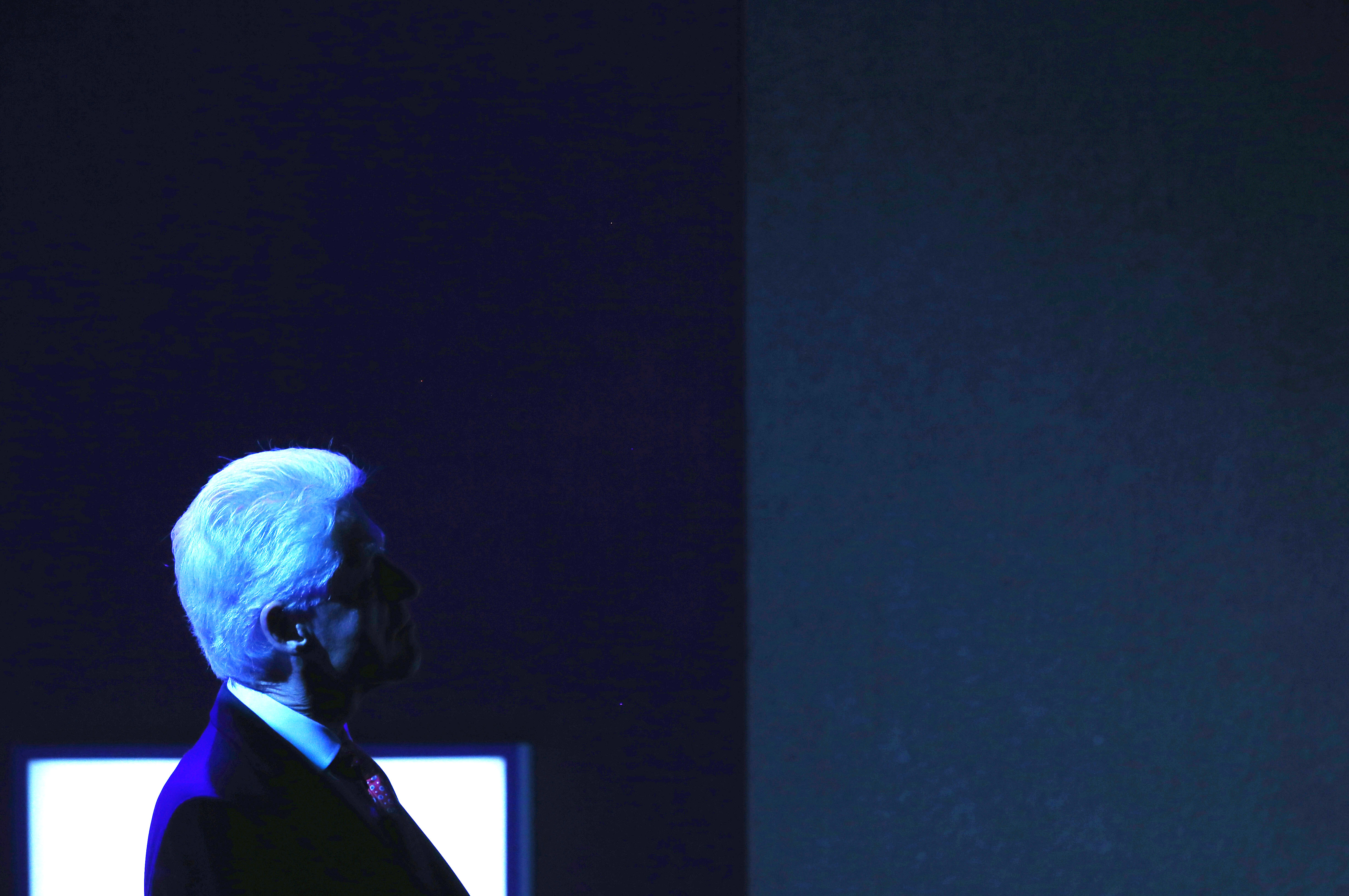
(Photo: Former U.S. President Bill Clinton watches a video at the opening plenary session of the Clinton Global Initiative (CGI), on September 22, 2014 in New York City. By John Moore/Getty Images)

Why Are We Suddenly At War Again?

US-POLITICS-CLINTON

Maybe it’s worth tackling one more time. Dougherty, channeling my own thoughts, thinks it’s basically on an emotion-driven whim:

Barack Obama’s exit from Iraq was as popular as his re-entry. America is against war in Iraq and then for it with the same non-committal “Um, okay.” The nation was founded by a people who made vows, who would “pledge to each other our Lives, our Fortunes, and our sacred Honor.” Now its wars are are on and off like a proposed take-out order: “Chinese or pizza? I mean, whatever you want.”

The pundits who say that President Obama has failed to demonstrate leadership have never considered whether the public is capable of following him, or even their own train of thought. The American public is not even capable of not following him in any recognizable way. We might have been dropping bombs in Syria against Assad to the benefit of ISIS a year ago had it not been for the hearty “No” vote in the British Parliament that denied Obama the fig leaf of multilateralism. A democratic people should be bewildered that their president was urging them to join one side of a civil war a year ago, and now joins them to another. But the American people are as responsive to this stimulus as a cattle herd is to the conclusion of a Dostoyevsky novel.

My own view is that any circumspection about this – indeed any sign of a working collective memory at all – can be suddenly driven from the American mind by the obvious fact of seriously foul actors doing horrifying things to Westerners. 200,000 Syrians died in a brutal civil war and there was no groundswell for intervention. And yet a handful of beheadings of white dudes in the desert (even by another Westerner!) provokes an immediate, Jacksonian rush to war.

But I don’t want to be reductionist here, and I’ve absorbed many good points from your emails. Other factors are clearly at work. Americans do not want to be the policeman of the world, but they like and are reassured by America’s untrammeled military might. And in the last couple of years, as the US has retrenched (only slightly) from its post-9/11 posture of offensive defense, there was a sense that other powers were filling the vacuum – especially Russia. This has spooked Americans, and they are conflicted about it. The resumed disintegration of Iraq – begun in 2003 – provoked further anxiety. Was this not becoming a classic Jihadist enclave from which terrorists could launch attacks on the US?

On the right, there was also a desire to pummel the president for anything and everything. So when he is not being a lawless tyrant, he is a total wuss and loser in foreign policy. And so the re-emergence of the decade-old Sunni insurgency in Iraq was too-perfect a bludgeon for them to resist. They got to trash Obama for “weakness”, cast the Iraq war as some kind of “victory” that Obama managed to turn into “defeat”, and generally use bad news from Mesopotamia as another brick to throw at the man’s head. Total American amnesia about the horrors and futility of the Iraq war helped matters – even as Obama refused to force the GOP to confront head-on the question of ground troops yet again in Iraq.

Then there is the utterly understandable revulsion at the moral abyss that ISIS represents. Fighting against evil has always stirred American hearts – even if we have come to learn that fighting it with brute force can sometimes make it stronger. And the cumulative effect of so many depressing developments – from Crimea to Donetsk to Erbil and Mosul – led to an impression of American drift and disengagement. So a call to action against evil was the natural response to the summer of our discontent.

And one also senses that the administration began to believe this summer that ISIS could actually take down the Baghdad government. They haven’t said this much in public, because it would be damaging. But John Kerry recently gaffed to Christiane Amanpour that “Baghdad could well have fallen.” Others have bruited that the situation in Iraq had approached a potential tipping point in the summer, as the uselessness of the Iraqi army in Sunni neighborhoods became clearer. For Obama, watching Baghdad fall – or be convulsed by serious sectarian urban warfare – was intolerable. So he has done what he often does: fashioned a reasonable, needle-threading strategy to prevent the worst from happening, forestall as much mission creep as possible, and attempt to rally the regional actors into action.

He has not done something obviously stupid. And I may simply be under-estimating the pressures on a president facing mid-terms when such a huge public consensus emerges that Something Must Be Done.

He has tried to do it in coalition with the Sunni Arab dictatorships – and is, in his usual way, trying to thread the needle with the other actors in the region, especially Iran. There is a good chance it might do some good in the very short term, although there is a stronger chance that it will generate ever-more unintended consequences in the long term, something the president openly conceded would be left to his successor.

My concerns are based on the notion that ISIS cannot be defeated in this manner; that the root cause is the irreparable disintegration of Iraq and the Sunni-Shiite struggle; that interposing the US in the middle of a Muslim civil war is likely to increase Jihadist terrorism against the West, without being able to remedy the situation; and that the way in which the US has had to corral the Arab dictatorships into defending themselves does nothing but perpetuate the dysfunctional relationship between the US and the Middle East – in which we are held responsible for everything and despised as a result.

But I’ve said my piece. Maybe I should end by saying that, of course, I hope I’m wrong and that Obama manages to pull off an extraordinary military and diplomatic coup over the next two years. I hope his newfound moxie against evil-doers ends up in a different place than his predecessor’s. I hope this doesn’t upend the negotiations with Iran. I hope it helps his party retain control of the Senate in November. And I hope his precedent doesn’t further empower the war machine, the CIA shadow government and the imperial presidency that drives so much of this. All I can promise readers is that I will be open to all those hopeful possibilities, even as I fear a much darker time ahead.

(Photo: Mandel Ngan/AFP/Getty.)
War Support With An Expiration Date

Cassidy makes an obvious but essential point:

At the start of the wars in Korea, Vietnam, and Iraq, fewer than one in four respondents to the Gallup survey believed it was a mistake to send in U.S. military forces. Thereafter, though, this number steadily increased. By the time the wars had been going on for two or three years, more than fifty per cent of respondents said that the decision to wage them had been an error. The one exception was Afghanistan, where, after three years of war, the percentage of people describing the decision to dispatch U.S. forces as a mistake was still pretty small. Since then, though, this figure has grown: by 2012, it was close to fifty per cent.

Larison wonders how Americans will support the war:

In most cases, the near-instant bipartisan consensus that congeals around an interventionist policy and the attendant media demands to “do something” tend to drown out countervailing arguments during the first few months of the campaign. This boosts public support for military action in the short term, but like any bait-and-switch trick it also causes people to sour on the intervention more quickly than they might have done otherwise. More Americans gradually become aware that the threat to the U.S. was overstated (or simply made up) all along, and they start to realize that the war they were originally told about at the beginning is not the one that the U.S. is actually fighting. Because presidents often set unrealistic goals for these interventions, there is usually even greater disillusionment because the war comes to be seen as “not working.” That is a trap that presidents set for themselves. They are the ones promising results that aren’t possible, and those results certainly aren’t possible at the very low cost that the public is willing to accept.

Can The Church Survive In America? Ctd

This embed is invalid


And so it continues:

Barbara Webb had been a chemistry teacher and volleyball coach at Marian High School in Bloomfield Hills, Mich., for nearly a decade — until last month, when Webb says administrators at the all-girl’s Catholic school learned Webb and her wife were expecting their first child … Webb says that she learned of her pregnancy in June, informed her employers in July, and was fired by mid-August.

Webb had already been married for six years – and so she was fired not for marrying, but for that other terrible sin: having a baby.This time, however, the nuns in charge have had some qualms:

The congregation of Catholic nuns that operates Marian High School have signaled they will re-examine policies that led to the controversial firing of a gay teacher who said she was let go because of her nontraditional pregnancy.

“Pope Francis has brought a sense of hope to our lives and encourages us to look at our Church with new eyes,” Sister Mary Jane Herb, president of the Monroe-based Sisters, Servants of the Immaculate Heart of Mary, said in a letter to alums that was shared on a Facebook page created to support the fired teacher. “No, it is not likely that doctrine will change, however the Pope emphasizes that the values of mercy, inclusion and compassion need to be included in our response to complex situations.”

Part of the message is clearly not getting through:

Of the 40-some employees who have lost jobs at Catholic institutions since 2008 because of their sexual orientation, marital status, pregnancies or personal views on homosexuality, nearly half have lost their jobs this year.

This is only 17 firings across the entire country this year – which is a minuscule fraction of the number of gay and lesbian employees at Catholic institutions. But the accelerating pace and the intensive news coverage certainly means it is becoming more and more a live issue.

And it comes down to this: does it seem Christian to you to fire people for marrying someone or for having a baby? When the next generation of Catholics comes to see their church as doing this, how will they reconcile that with the notion of the church as dedicated to universal love, social justice and compassion? The “sins” that gay Catholics are committing, after all, are no worse in theological terms than masturbation, pre-marital sex or the use of contraception within a marriage. And yet only the gays are really subject to these new censures, because they can be more easily identified in the public space.

However way you slice it, that means that the Catholic church is engaged in a very targeted campaign of discrimination against gay people for the very sins most straight Catholics commit all the time. This has to strike most people as wrong – deeply wrong. Even the most stringent church teaching on homosexuality opposes what it calls “unjust discrimination” against gays. And isn’t selective enforcement of morals against one tiny minority precisely the definition of “unjust”?

Chart Of The Day

Income Distribution

Drum flags the above one – and it is truly staggering:

The precise numbers (from Piketty and Saez) can always be argued with, but the basic trend is hard to deny. After the end of each recession, the well-off have pocketed an ever greater share of the income growth from the subsequent expansion. Unsurprisingly, there’s an especially big bump after 1975, but this is basically a secular trend that’s been showing a steady rise toward nosebleed territory for more than half a century. Welcome to the 21st century.

Jordan Weissmann chimes in:

Through mid-century, when times were good economically, most of the benefits trickled down to the bottom 90 percent of households. Then came the Reagan era and actual trickle-down economics. Suddenly, the benefits started sticking with the rich. Since 2001, the top 10 percent have enjoyed virtually all of the gains.

This isn’t a totally new story. But it is a vivid and visceral illustration of what we’ve basically known to be true for a while (the graph is updated from this paper).

Ryan Cooper adds:

Most staggering of all, during our current economic expansion, the bottom 90 percent is suffering declining incomes. Not only is the rising tide not lifting everyone equally, it’s actually submerging nine out of ten people.

So it seems that the theory behind trickle-down economics has been empirically refuted: its impact has been overwhelmingly trickle-up. It is also quite clear by now that huge tax cuts do not remotely pay for themselves – and the recent experience in Kansas only adds a final coda to this. And yet the GOP shows absolutely no sign of absorbing these facts, or having anything to say about the dangerous political instability of huge social and economic inequality and crippling debt that are their consequence.

This is why I have such a hard time with contemporary American conservatism. It is still incapable of moving on from Reagan, even as the world has changed beyond recognition.