Where Social Entrepreneurs Fall Short

Charles Kenny doubts that their brand of business ventures can accomplish much on their own:

The problems with the social enterprise approach start with the challenge of being small. Aspire is currently working in Mexico, where grasshoppers regularly appear on restaurant menus. At the moment, the insects cost six times more per kilogram than beef or chicken. The enterprise hopes that by significantly scaling production – factory-farming the insects – they can dramatically reduce that price.

That’s a significant hurdle. Small startups rarely go global. Not, at least, without governmental buy-in. … Fixing the infrastructure problems and low-quality health and education services takes more, better government – even if the services are contracted out. For all the valuable work they do, social entrepreneurs can’t replace the state’s role, and they can’t function nearly as effectively where governments are poor, incompetent, or corrupt.

Paternity Pays, Ctd

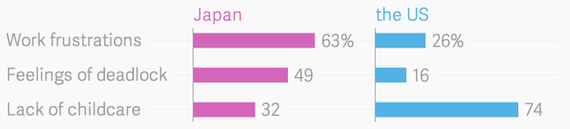
Dish alum Gwynn Guilford argues that Japan especially needs paid paternity leave:

Women in Japan are already paid only 73 percent of what men make for the equivalent jobs; the fact that this gap grows during childbearing years suggests what some call a “motherhood pay penalty.” The work women can find after having a child is often part-time, and usually less well paid, so they have less incentive to go back to work. It’s telling that the better educated a woman is, the more likely she is to stay out of the workforce.

Reasons Female College Grads Leave the Workforce

3fbf24898

Oddly enough, men don’t have it so great either. In return for job security, companies expect their male employees to work grueling hours that end in booze-drenched after-hours bonding sessions, week after week for their entire career. Until very recently, to test their commitment companies would deliberately transfer male workers away from their families. This peer pressure is also part of why Japanese men seldom take vacation days.

Gwynn has some hopes for reform but isn’t too optimistic:

To the government’s credit, in 2011 it launched the Ikumen Project (the word is a slangy play on ikemen, which means a “good-looking man,” and iku (育), which means “to raise”), an online community that 2011 encourages fathers to take a more active role in child-rearing.

Another cultural milestone occurred in Aug. 2014, when Masako Mori, the minister then in charge of the declining birthrate and gender equality, declared that she would promote men who take “paternity leave,” by which she probably meant parental leave. Abe now says he wants the number of men taking leave to rise from 1.9 percent to 13 percent by 2020.

However, it’s not clear that this is much more than rhetoric. The salary gap between men and women means it still usually makes more economic sense for fathers to keep working, especially given that they’re likely to get only half their wages during parental leave. So what the Japanese government ought to do is fix this disparity in how men’s and women’s time is valued. Instead, it’s considering making it worse, by extending maternity leave to three years. That would further entrench the traditional divide between men’s and women’s work, worsening Japan’s labor-supply problems and keeping GDP growth anemic at best.

Meanwhile, turning to the maternity front, Michelle Nijhuis reports on the slow road toward better breast pumps:

In the U.S., as Jill Lepore observed in the magazine in 2009, pumps have become a substitute for adequate maternal leave. Today, they provoke a sort of impotent consumer hatred—even high-end breast pumps are noisy, bulky, and awkward to use, and pumping is sometimes painful, often boring, and never dignified. Not surprisingly, many women who attempt to pump at work wean their infants before the six-month mark recommended by pediatricians. Research and investment into postpartum maternal health, including lactation and pumping, lags behind even other aspects of women’s health—perhaps in part because postpartum health lacks its own specialty, and is instead awkwardly partitioned into obstetrics, pediatrics, and general family medicine.

Nijhuis details a “hackathon” that stepped up to the plate. Elsewhere, on the subject of “the maternal-leave problem,” Darlena Cunha explains how women can end up fired for pregnancy, even at companies where that shouldn’t be the case:

A big challenge for women who want to take their claims to court is that discrimination can be very hard to prove, Colorado attorney Brian Stutheit says. In many states, videotaping inappropriate workplace behavior for evidence goes against privacy laws. And unless there’s a paper trail clearly indicating harassment or discrimination, the evidence is considered circumstantial. In Stutheit’s experience, eyewitnesses are hard to come by because they also work for the company and don’t want to jeopardize their own employment. …

Stutheit calls it the “halo effect”: After a complaint, the employee who filed is treated like an angel for six months or so, then fired for something unrelated. “Employers consider them troublemakers,” he said.

All recent Dish coverage of parental leave here.
The Other Coalition America Is Forming

ISIL’s rejection of Al Qaeda’s senior leadership weakened the latter group’s grasp on foreign fighter flows and donor cash. By striking both ISIL and Al Qaeda’s official arm in Syria, Jabhat al-Nusra, the United States may be encouraging ISIL and Al Qaeda to return to coordinating rather than competing against each other. There are already hints of this happening elsewhere.

Last week, Al Qaeda in the Arabian Peninsula and Al Qaeda in the Islamic Maghreb, two Al Qaeda affiliates losing manpower and momentum to the hot new kid on the block — ISIL — called for unity among jihadi groups in the fight against America. If Nusra and ISIL, rather than eroding each other’s support and competing for resources, join forces to combine ISIL’s resources and skill at insurgency in Iraq and Syria with Al Qaeda’s international terrorism knowhow, the danger to the United States and its interest around the world could multiply rapidly. In other words, the United States could win some tactical victories by hitting both groups hard in Syria, but might be committing a massive strategic blunder by uniting a jihadi landscape it desperately sought to fracture over the past decade.

Eli Lake heard a version of this argument earlier in the week.

An Actual War On Women, Ctd

The victims of ISIS are often raped, as we’ve detailed. But take issue with much of the reporting on these rapes:

Press reports and punditry about sexual violence in Iraq and Syria continually employ the phrases “weapon of war” and “tool of terror.” Without a doubt, some wartime rape is a weapon of war: Some commanders use rape or the threat of rape strategically to punish enemy communities, induce compliance, or demoralize opponents. But the “weapon of war” narrative is disastrously incomplete.

Research suggests that rape has multiple causes, and is more closely associated with fighting forces’ internal practices (like forced recruitment, training practices, or the strength of the military hierarchy) than with strategic imperatives, ethnic hatred, or other “conventional wisdom” causes. In short, to assume that wartime rape is always “rape as a weapon of war” is to ignore the majority of cases.

Moreover, to the extent that wartime rape is a weapon of war, policymakers who invoke the “weapon of war” narrative may actually strengthen belligerents’ strategic positions. Commentary about the Islamic State’s sexual “brutality” ­– exemplified in a recent policy recommendation aimed at “shaming” the organization – risks reinforcing the Islamic State’s intimidating reputation (which is already well-known on the ground and in the refugee camps). Reputations and rumors matter in conflict; recent research in Lebanon has suggested that fear of rape has become an important reason for refugees to leave Syria. Playing into combatants’ rhetorical strategies could result in increased refugee flows, contribute to efforts to diminish women’s involvement in public life, or even increase the incidence of wartime rape.

Why What Almost Happened Matters

Reviewing Richard Evans’ Altered Pasts: Counterfactuals in History, Cass Sunstein argues that what-if scenarios aren’t, as E. P. Thompson put it, “unhistorical shit,” but rather an integral part of the historical enterprise:

Here is another way to make the point. Social scientists test hypotheses. They might hypothesize, for example, that if people have to pay a small tax for plastic bags at convenience stores, they will use fewer plastic bags. To test hypotheses, social scientists usually like to conduct randomized controlled trials, allowing them to isolate the effects of the tax. Such trials create parallel worlds and hence alternative historiesone with the tax and one without it.

Historians cannot conduct randomized controlled trials, because history is run only once. Yet they nonetheless develop hypotheses, and they attempt to evaluate them by reference to the evidence. Evans is himself engaged in this enterprise. There is no difference between hypothesis-testing and counterfactual inferences. Any claim of causation, resulting from such tests, requires a statement that without the cause, the effect would 
not have occurred.

Evans appreciates the entertainment 
value of the most imaginative counterfactual narratives, but he doesn’t want them to be taken seriously, or to be seen as what historians do. With Thompson and Oakeshott (and countless others), he thinks that historians should explain what did happen, not what didn’t happen. The problem is that, to offer an explanation of what happened, historians have to identify causes, and whenever they identify causes they immediately conjure up a counterfactual history, a parallel world. Sure, there is a lot of distance between science fiction novelists and the world’s great historians, but along an important dimension they are playing 
the same game.

A 19th Century Frenchman Explains the 21st Century Middle East, Ctd

A reader writes:

Regarding the uses of Tocqueville to explain why the Middle East isn’t ready for democracy:

If we really want to know what Tocqueville thought about Islam and the Middle East, just skip the flattering portrait he gives us in Alexis_de_Tocqueville“Democracy in America” and read his enormous body of work on France’s 1830 colonization of Algeria — a colonization that didn’t come to an end until 1962. Surprise: Tocqueville the liberal was an early and vocal supporter of the invasion, conquest, and subjugation of Algeria. In fact, he was such a fan that he made two trips there himself to determine whether he and his brother ought to buy land and become settlers. He also read the Qur’an, considered taking Arabic lessons, and positioned himself in the Chamber of Deputies as an expert on the “Algeria Question”. The man was committed.

So what can Tocqueville tell us about how modern Middle Eastern politics got so messed up? Stop me when this starts sounding familiar.

He sets out with the best of intentions, to civilize the barbarous Arabs and introduce solid French virtues like liberty and fraternity. But that doesn’t last long. When the native population turns out to not appreciate France’s virtuous conquest, a full-scale counter-insurgency is launched. And when other politicians begin to question the French army’s tactics, Tocqueville pulls a full Cheney: “I have often heard men in France whom I respect, but with whom I do not agree, find it wrong that we burn harvests, that we empty silos, and finally that we seize unarmed men, women, and children. These, in my view, are unfortunate necessities, but ones to which any people that wants to wage war on the Arabs is obligated to submit.” (1846)

Likewise, some of his colleagues began to complain that French liberals were being hypocritical, demanding equality at home but promoting despotism abroad. In words that might as well have been spoken by Netanyahu, Tocqueville reminds us:

“There is neither utility in allowing, nor a duty to allow, our Muslim subjects exaggerated ideas of their own importance, nor to persuade them that we are obligated to treat them under all circumstances precisely as though they were our fellow citizens and our equals. They know that we have a dominant position in Africa; they expect us to keep it. To abandon it today would be to astonish and confuse them, and to fill them with erroneous or dangerous notions.” (1847)

And contra Mitchell’s argument about the roots of “Islamic fundamentalism”, Tocqueville never once believed that the problem in the Middle East was too much tribal or religious linkages. Rather, his claim was the exact opposite, that the roots of Algerian violence can be found in the destruction of native institutions, habits, and social connections — and, moreover, that this is entirely Europe’s fault. French rule, he writes, has made “Muslim society much more miserable, more disordered, more ignorant, and more barbarous than it had been before knowing us.” (1847) Such was his faith in the importance of empire for France, however, that even admitting this failure could not undermine his ultimate support for the Algerian conquest.

I could go on. Others have at length. My point is just that if we really want to get into the business of shaping our Middle Eastern policy according to the theories of a man dead more than a hundred and fifty years, we should be serious about looking at what he actually said and wrote on the topic. And when we do, we may find that we bear far more direct responsibility than Mitchell or you, Andrew, seem to allow.

How You Can Die From Ebola Without Getting It

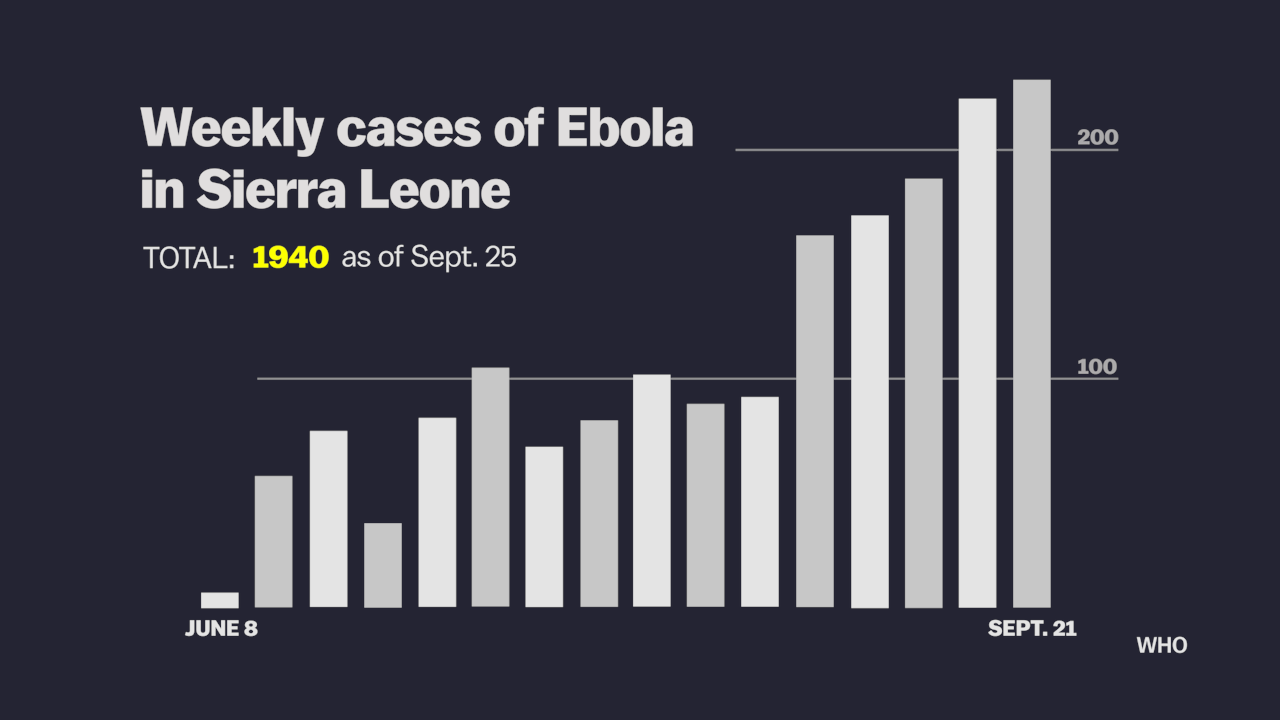
weekly_ebola_cases_SL.0

Julia Belluz explains that Sierra Leone is “imposing mandatory lockdowns on its citizens.” She provides the above chart showing the extent of the devastation:

The districts where Ebola is believed to be moving fast — Port Loko, Bombali, Moyamba — are now isolated. People won’t be able to leave their homes or go to school or work. During these periods, government and public-health officials will go door to door, educating people about Ebola and trying to identify patients who should be brought to containment facilities. Officials in Sierra Leone are worried that many Ebola victims are either going underground or simply unable to access care. And the death toll continues to surge — with nearly 600 estimated Ebola deaths in Sierra Leone this year.

Adam Taylor sees “numerous signs that pregnant women in Liberia, Sierra Leone and Guinea could be dying due to Ebola without ever getting the disease”:

Maternity hospitals are fearful of taking women in due to the risk of catching Ebola from a sick patient. That fear is understandable. Hundreds of health-care workers have been infected with Ebola recently, and many were infected by the patients they treat.

Bruce Aylward, assistant director-general for polio and emergencies at the World Health Organization, said that at first, most health workers who died were people working in “poorly run Ebola treatment centers.” However, as the disease spread, it began to affect the broader health community. “Now, if you look at [health-care workers infected with Ebola], they’re somebody who is delivering a baby in a clinic that had nothing to do with Ebola,” Aylward explained. The shift has affected both local and foreign doctors: Rick Sacra, one of the American doctors who contracted Ebola, was treating pregnant women in Liberia when he became infected (he has since made a full recovery).

Worse still, the fear of Ebola infection at medical facilities cuts both ways. Many pregnant women who need treatment are too scared to head to a health center, fearing a visit to a medical facility will actually increase their chance of catching Ebola. In countries where maternal mortality rates are so high than almost one out of every hundred women die, such a lack of treatment can have a deadly impact.

We featured one of those women here.

Putin vs The Internet

Well, this is unnerving:

Russian President Vladimir Putin and members of the Russian security council are reportedly considering a plan that would give the Kremlin the ability to cut off the Russian Internet from the rest of the world’s connection in the event of a national emergency. The plan, which officials say is necessary to protect Russian cybersecurity, has raised fears about tighter Kremlin censorship, though questions remain as to whether a national “kill switch” is even possible.

Reports first surfaced Friday in the Russian business newspaper Vedomosti, with sources saying, “Russian Internet service providers will be required to install equipment that would make it possible to shut off Russia’s access to the global Internet, in the event of an emergency.” The broadly defined “emergency” reportedly includes “military actions” or “serious protest actions,” possibly of the kind that came in the wake of Putin’s return to the presidency in 2012. The security council will also discuss a plan that gives Russia control of the country code top level domains (ccTLDs), the websites ending in “.Ru,” “.рф,” and to a lesser extent “.Su.”

Ilya Khrennikov and Henry Meyer contextualize the move:

Russia last month banned anonymous access to the Internet in public spaces and expanded the regulation of media to the blogosphere, requiring those with at least 3,000 daily readers to register their real names and contact information. In February the authorities had passed a law allowing them to close webpages without a court decision if material is deemed “extremist.”

Russian opposition leader Alexey Navalny, who used to criticize Putin and reveal corruption among his inner circle, was the first victim of that law when his blog on LiveJournal.com was shut in March. Recent legislation requires Internet companies to store Russian users’ information on servers in the country, similar to Chinese regulations.

Emily Parker adds:

According to Freedom House, from January 2012 to February 2013, the number of websites flagged for containing extremist material and blocked by the Ministry of Justice increased by around 60 percent. In 2012, Russia enacted a law allowing for the blocking of certain websites without judicial oversight. The law supposedly protects children and controls other harmful content but has been widely viewed as an attempt to clamp down on free speech. According to one study, in the year that followed, more than 83,000 websites were put on an Internet blacklist, and the vast majority was blocked “without a valid reason.”

In other Putin punditry, Benjamin Bidder worries that Putin’s successor will be even worse:

The fear is that someone could seize control of the Kremlin who thinks and acts more radically than Putin. The president created the preconditions of such a possibility with his own failed policies. If the Kremlin insiders want to find a successor, they will have to recruit him from the immediate circle of the current president. But Putin has reinforced hard-liners and pushed out the liberals.

The revolution scenario is no less disheartening. Power could be seized by forces from the extreme right and left. The boundaries between both are vague in Russia, as the name of such groups as the “National Bolsheviks” suggests.

Motyl disagrees:

In the final analysis, Bidder’s assessment amounts to an unwitting justification of dictatorial rule, repeating the self-serving claim that all dictators make: après moi, le déluge. In fact, world experience and both Russian and Soviet history suggest that Russia is likely to experience a better future if and when Putin finally goes. Getting rid of him, as quickly as possible, is a bet worth making—both by Russia and the West.