Jim Webb Flirts With A Run, Ctd

Jason Zengerle doesn’t think Webb’s presidential run is gonna happen:

While it’s possible that the Obama administration’s military campaign in the Middle East will continue to escalate, it’s hard to envision it turning into a catastrophe on the scale of Vietnam or the second Iraq Warand it’s equally hard to imagine Hillary Clinton, hawkish as she may be, morphing into a figure as loathsome, in Webb’s mind, as a draft-dodging Georgetown law student or George W. Bush. Absent those motivating factors, I just don’t see Webbthe rare politician who doesn’t crave the spotlightsustaining a presidential campaign. After all, he’d been in the Senate for only a couple months when he complained to GQ’s Ryan Lizza that “To me, government is a cage.” If Webb felt cooped up in the Senate, wait until he gets to spend a couple days on a campaign bus barreling across Iowa.

Ed Kilgore responds:

If [Zengerle’s] right, [Webb’s] anger with Obama over national security policy will burn out before 2016 votes are cast, and those who want a real challenger to Hillary Clinton could be disappointed. But on the other hand, for those who simply want to “keep Hillary honest” without denying her the nomination, maybe Webb is just the fiery tonic the doctor ordered.

But PM Carpenter argues that “if anybody has a shot at defeating Hillary, Webb does. The problem, though, is of course money”:

Yesterday, a Jim Webb-“intrigued” reader sent me a video of the former senator’s address to the National Press Club, and asked what I thought of his possible candidacy. My answer was that, in my opinion, “” Hillary will have a lock on it, and if Webb begins to threaten her in Iowa or elsewhere, she’ll unleash it on him with the ethical care of a Mitt Romney.  But, on occasion we do witness the impotence of big money. Lord knows Hillary’s head start in 2007’s graft-chase never did her much good, since as a presidential candidate, her irrepressible negatives outweighed her positive cash flow.

Jennifer Rubin feels Webb has a real shot:

Dems love a veteran who turns dove. (“John Kerry reporting for duty!” And don’t forget how they swooned over Chuck Hagel.) And he certainly will fulfill the left’s anti-interventionist yearnings.

Previous speculation here.

The Long, Twilight Struggle For Independent Journalism

Bill Simmons has about as much clout as an individual journalist as anyone out there. Immensely popular, he is one of the few individuals who managed to get a big media company – ESPN – to give him his own sandbox, Grantland, centered around his personality and style. Of all the writers/bloggers/podcasters out there, he has an enviable degree of independence. But that independence only goes so far:

Every employee must be accountable to ESPN and those engaged in our editorial operations must also operate within ESPN’s journalistic standards. We have worked hard to ensure that our recent NFL coverage has met that criteria. Bill Simmons did not meet those obligations in a recent podcast, and as a result we have suspended him for three weeks.

That suspension is one week more than the NFL originally gave Ray Rice for knocking his fiancée unconscious. Simmons’ transgression was to call the NFL chief, Roger Goodell, a liar, on his podcast, and then to dare ESPN to come discipline him for saying so:

I really hope somebody calls me or emails me and says I’m in trouble for anything I say about Roger Goodell. Because if one person says that to me, I’m going public. You leave me alone. The commissioner’s a liar, and I get to talk about that on my podcast … Please, call me and say I’m in trouble. I dare you.

Tony Manfred notes that Simmons has been suspended twice before:

In 2013 he got suspended from Twitter for calling a “First Take” segment “awful and embarrassing to everyone involved.” In 2009 he got a two-week Twitter ban for calling the ESPN radio affiliate in Boston “deceitful scumbags.”

But the notion that Simmons only got suspended because he was tough on ESPN doesn’t quite hack it.

Maybe Simmons is a little paranoid, but his quote assumes that there is indeed a close relationship between ESPN and the NFL, and there is subtle pressure not to rock the boat too wildly. ESPN’s statement also cites a failure to meet “ESPN’s journalistic standards,” –  presumably because Simmons out-and-out named Goodell as a liar – without proof. But it was clearly an impromptu remark on a podcast and well within the contours of the kind of trash talk common in sports radio. I see the whole thing as a reminder that Simmons is not actually completely independent – even as he has an amount of freedom most sports hacks would die for.

And this much is true: as journalism, including sports journalism, faces a truly tough and continuing transition, as its bottom line keeps going down, as “sponsored content” dominates everything, and as media entities charge over $100 grand for a piece of native advertising, the whole idea of writers being truly able to say whatever they think is under increasing pressure. You need enormous clout and independence to get away with it – which is why South Park remains such a vital part of our public discourse.

For myself, I remain simply immensely grateful for the support of reader-subscribers. Every day, I remain aware of the privilege you grant me and my colleagues in trying to figure out the world without these kind of pressures or threats hanging over us. But every day, I look around and see how many fewer writers can still say the same.

Chart Of The Day

enhanced-10738-1411482032-2

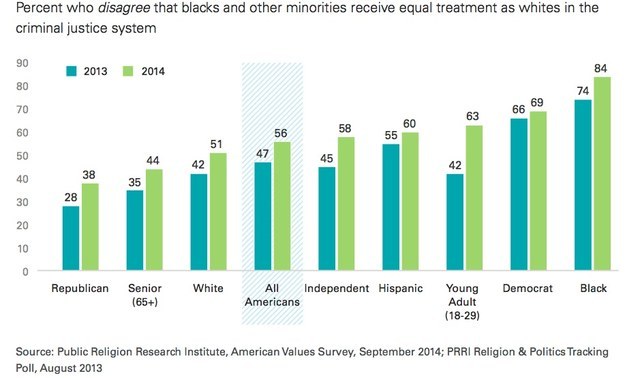
A new survey shows that a majority of Americans – including, for the first time, a majority of white Americans – believe the justice system is unfair to black people. Adam Serwer notes that opinions have shifted substantially across all demographic groups surveyed. German Lopez believes Ferguson changed the debate:

While young adults saw the most dramatic shift toward acknowledging racial disparities in the criminal justice system, everyone else — seniors and Republicans included — saw a significant change as well. Notably, a majority (51 percent) of white Americans now appear to agree that there are some racial disparities in the criminal justice system, up from 42 percent just one year ago. It’s possible that this is a temporary blip, especially since the survey was conducted a month after the events in Ferguson. But since some studies suggest it’s difficult to get white Americans to see and care about racial disparities in the criminal justice system, the survey could indicate the beginnings of a big change in public perspectives.

What Syrian Moderates?

Omar Kaddour searches in vain for them:

Opposition fighters are not moderate. By the same standards, they are not extremists, and it must be noted that the standard used to distinguish between them is Islamic in the first place. These fighters are in very harsh conditions, and their attempt to survive and overthrow the regime that has targeted them is more important than any ideological luxury that the majority of them possess.

In many instances, the members of moderate groups have fled to better-armed groups and more effective groups under the pressure of necessity. Entire groups have also become extremist to ensure their share of foreign funding. But the most important development that has happened is that tens of thousands of officers and soldiers who have defected from the regime’s army have been taken away and they have been placed in conditions resembling house-arrest in neighboring states. They have not been trained to become the kernels of an organized army independent of ideological projects.

In the real meaning of the phrase, there is no moderate armed opposition.

What Obama Said At The UN

UN-GENERAL-ASSEMBLY-US-OBAMA

Ed Krayewski heard echoes of Bush:

President Obama called ISIS a “network of death,” arguing that “there can be no reasoning,  no negotiation, with this brand of evil.” In making the case for the anti-ISIS campaign President Obama has adopted the language George W. Bush deployed when first formulating the war on terror. “We face a brand of evil, the likes of which we haven’t seen in a long time in the world,” President Bush told airline employees on September 27, 2001. Later, he would place Iraq, Iran, and North Korea in an “axis of evil,” a term that coud’ve been ripped from a comic book.

Bush was a fan of using the word “evil” to describe Islamist terrorists, and it shouldn’t be surprising that President Obama has found the strong, unequivocal, and emotional word useful in defending the anti-ISIS campaign.

Zack Beauchamp’s take on the speech:

[I]t was perhaps the clearest articulation yet of what he actually believes and how he sees the world, and yet it also showed how his policies do not line up with those beliefs. The UN address — purportedly written by the president himself— laid out Obama’s fundamental worldview in especially clear terms. He’s an inveterate optimist, deeply believing that we’ve built a world with a bright future. But he’s also willing to take aggressive, even cynical actions to secure that future. That’s why his rhetoric and policy so often feel at odds.

Cassidy considers the political calculus:

On Monday night, American forces bombed ISIS targets inside Syria and also blasted buildings and installations associated with another extremist group. On Wednesday, the Gallup tracker showed that Obama’s approval rating had risen to forty-four per cent.

“It’s certainly possible the president will get a bump from this and it looks like it may be happening because his rating is a bit higher than we’ve seen before,” Gallup’s Jeff Jones told the Fiscal Times. “We want to let it play out a few more days and see if it sustains itself, as opposed to being something really temporary.” I should stress again that I am not suggesting that President Obama consciously responded to the polls by deciding to expand the campaign against ISIS. He is, though, operating in an environment that rewards certain actions and punishes others.

Jeffrey Goldberg doesn’t think politics is playing a big role:

Obama’s critics will say that he has shed his public diffidence on matters related to the conflicts of the Middle East because pollsters have been telling him that Americans want a less professorial president. But my impression from watching him in recent weeks, and from talking to people who know him well, is that two sets of recent events in particular have actually shifted his thinking about the relative importance of “soft power”; about the nature of America’s adversaries; and consequently about the role the U.S. must play in the world, in order to keep these adversaries at bay.

Thomas Wright agrees the president’s perspective has changed:

Obama’s worldview has always allowed for this shift. Influenced by Niebuhr, he believes that malevolent forces exist in the world, including within ourselves. He believes that the United States must act on occasion to stop them. But, for the past few years he has not agreed that we are at such a moment in history. He has not agreed that the international order is facing fundamental challenges that require extraordinary action. Throughout the course of the past year, which has been full of destabilizing developments, he has resisted the notion that we are at a tipping point. Until now. Today, he told a world audience that he too is worried the international order is falling apart. Today, he sees the chasm ahead. Today, he agrees that without an American push, history may be headed in a tragic direction.

And David Rothkopf puts Obama’s remarks in context:

In short, if well-turned phrases defined history’s outcomes, we might be heading to a much better, safer Middle East. But if the men and women who are working behind the scenes to make that happen are to be believed, it is even more likely that further unrest and danger are on the horizon. We may enjoy early victories in the war against IS, we may even turn them back in the months ahead, but absent a commitment to address the broader, strategic issues with the same sense of urgency we are bringing to that fight — to battle for political gains as intently as we do those on the battlefield, or for leaders like Obama and Rouhani to devote as much of their attention to the work of the back room as they do to that at the podium — it looks like in the current Middle East there may be, in the famous words of the old song by Creedence Clearwater Revival, a bad moon rising.

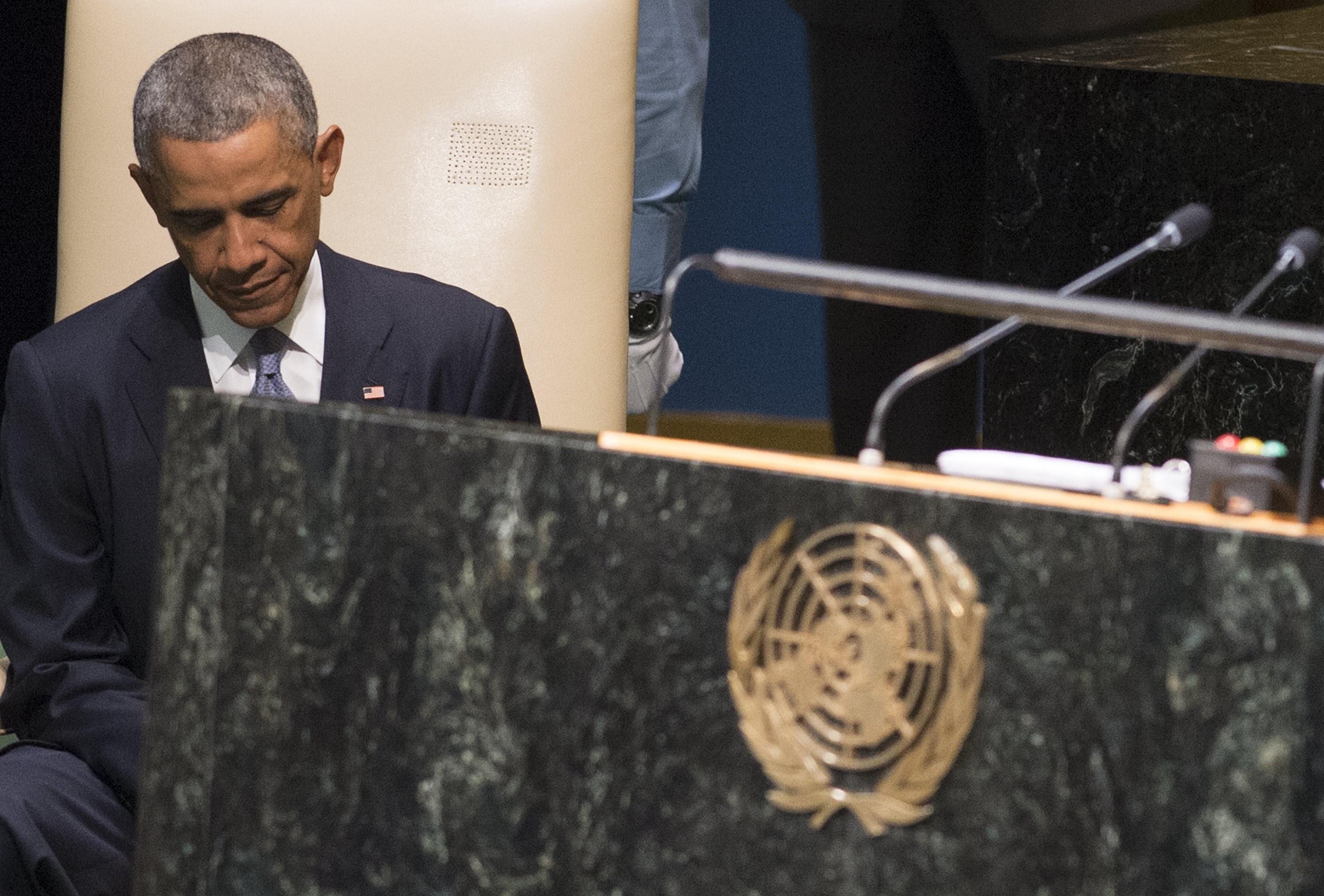
(Photo: US President Barack Obama sits after speaking during the 69th Session of the UN General Assembly at the United Nations in New York, September 24, 2014. By Saul Loeb/Getty Images)
Politics Beyond Black And White

Screen Shot 2014-09-23 at 4.52.45 PM

Syracuse political scientist Spencer Piston analyzes the relationship between skin color and political identity:

Recent research suggests that social exclusion can lead Asian Americans to identify as Democrats. The idea is that upon experiencing discrimination, Asian Americans decide to ally themselves with minority constituencies that also experience discrimination, as well as the party thought to represent those constituencies – the Democratic Party. By this logic, those ethnic minorities most likely to lean Republican should be those least likely to suffer discrimination: those with light skin.

Consistent with this line of thinking, the relationship between skin color and partisan preferences among Latinos and Asian Americans is illustrated [above].

He found that, “in the 2012 election for Senate, the darkest-skinned Latinos are estimated to have a 98-percent chance of voting for the Democrat, whereas the lightest-skinned Latinos are estimated to have a 43-percent chance.” Jamelle Bouie remarks, “Data like this is more evidence for the need for humility in long-term political forecasts”:

We don’t know if minorities will make up the majority in the United States in 50 years, as many people predict. Given rates of intermarriage, it’s possible we’ll have a large population of people who are Latino and Asian in the same way that Italian Americans are Italian. And if we do become a “majority-minority” country, there’s no guarantee minorities will hold their Democratic allegiance. But, regardless of how it looks, we’ll have a multiracial society. And this study–like others around color – raise larger questions of how it might develop over the next century. Indeed, if the strength and durability of color stigma is any indication, we might move to a country where we’ve eased the problems of racial discrimination, only to find ourselves – like our Latin American neighbors – in a new hierarchy of color prejudice.

A Terrorist Brand War

Vera Mironova worries that’s what we have on our hands:

The only way for Al-Qaeda to get back to the top of the list of terrorist organizations would be to outbid ISIS on its own field (excessive brutality), to prove that they are still the reigning terrorist organization. This does, unfortunately, look to be the plan of the Al-Qaeda. Although they have co-existed with the Yemen government for years, this “peace” however was shattered on August 9th in the southern Yemeni province of Hadramawt, when fourteen military personnel were brutally slaughtered for no reason. A group of armed men stopped and boarded a civilian bus, identified the military personnel, and proceeded to slit their throats. Following in the ISIS traditions, the armed men identified themselves as Al-Qaeda in Arabian Peninsula, videotaped the mass slaughter and published it online.

Although it is hard to predict the future, evidence would suggest that we can expect to see even more brutality in Middle Eastern conflict while Al-Qaeda tries to regain its title. And after the last incident in Hadramawt, Yemeni government pressed Al-Qaeda to look for a “refuge” in other Middle Eastern countries, like Syria and Iraq, the current strongholds of the ISIS. Therefore, the return of Al-Qaeda to the top of the list of terrorist organizations, an extremely violent scenario, is possible.

From Vanuatu To Vancouver

Port Vila-Vanuatu-130pm

Christopher Flavelle makes the case for rich countries welcoming “climate migrants” from the developing world:

Why should developed countries care if people in Tuvalu are forced from their homes? Take my home country of Canada: If we had never emitted a single gram of carbon dioxide, sea levels would still be rising almost as quickly. Why should we have to bear the cost of settling people with the bad luck to live on a sinking island?

The rebuttal is that Canada’s wealth derives in great part from selling the fossil fuels that are causing Tuvalu to sink. Partly as a result, Canada became the only country in the world to legally withdraw from the Kyoto Protocol, and has shown no particular interest in creating a replacement. And Canada emits more carbon per person than any large industrialized country save for Australia and the U.S. So Canadians, who according to one account enjoy the richest middle class in the world, have made money from an activity that disproportionately hurts others, and stymied efforts to curb that activity. The country also has space, resources and a history of incorporating newcomers into its social and political fabric – and not least, an aging population that needs new workers. The same could be said, to varying degrees, for many other developed countries.

“If rich countries would rather not invite in climate migrants,” he adds, “they can start by contributing money to the Green Climate Fund, whose goals include protecting people from extreme weather.”

(Photo by a Dish reader: Port Vila, Vanuatu, 1.30 pm)

Forget Footnotes, Ctd

A few readers sound off in detail:

Contrary to what Tim Parks may say, footnotes are not simply a “protocol for checking the quotation.” Rather they are the steel in a scholar’s argument. I’ve always imagined texts I read to be like a ship. Good scholars (the best ones I was lucky to know, anyway), like good shipwrights, need only “go below” into the notes to discover if the arguments have been put together thoroughly and whether the structure of the analysis is sound. Far from being pointless, over-long lists to “cover one’s rear end,”as Parks claims, a thorough footnote with a sizable number of sources can give away the game: has this person mastered the relevant literature, and if they have, whose design are they building on to navigate this topic? Are there any major sins of omission?

And, yes, the pesky details of publication matter.

The year of publication says a lot about what trends in the field influenced the writers’ intellectual development, and the state of their discipline at the time of publication. And presses have agendas: editorial directors and staffs at university presses are curators who sign books to build their press’ reputation in certain sub-fields (criticism of nineteenth century French literature, say). Seeing a press name in the notes makes a good shorthand for discerning biases and points of view. Even the city matters. Of course Oxford University Press is in Oxford, England, but if the footnote reads, Oxford University Press, New York, then that is a whole different shop within the organization.

Celebrity scholars like Doris Kearns Goodwin, who abandon the plodding craft of meticulous citation for the art of a ripping yarn, and then leave the details to their research assistants, who think footnotes are just hyperlinks to library databases, run leaky ships and get entangled in plagiarism accusations brought by eagle-eyed peers. Their academic reputations get sunk.

Another has a very different take:

Hear, hear to Tim Parks! Here’s my story: I completed an M.Litt degree (essentially 1/2 a Ph.D, or in other words a 50,000 word thesis of original research) in Medieval History (specifically 15th century English military history) at Oxford in 1999.

What, you may ask, was the most daunting aspect of my work? Finding and painstakingly unrolling yellowed muster rolls from the 15th century at the Public Record Office? Trawling the works of chroniclers long forgotten for tidbits on important events? Deciphering Latin or French as well as the handwritten shorthand of scribes working on horseback for an impatient Henry V of England?

No, the most daunting aspect of my work was keeping track of all of the footnotes. Here’s an example:

If I was to write a sentence such as “Henry V’s fleet left port on the morning of July 30th with approximately 600 ships and 50,000 men in his army” I’d need a footnote citing every source that substantiated those facts, and in addition explain those who varied (unless that explanation was of enough interest to require more main text). That was tough enough. But what if I broke that sentence apart? I would need to keep track of which sources confirmed it was July 30th, which mentioned it was in the morning, and which sources recorded the numbers of the ships and/or men.

For a 50,000 word these I ended up with over 600 footnotes, almost each one containing multiple citations. In many cases my prose was stilted due to a need to avoid breaking up sentences and having to review the footnote attached to place the references where they needed to be. Eventually, as I was writing, I developed a significant aversion to any revision of what had been written so far, probably to the detriment of the writing.

That’s not all. A mere 10 years before I did my work (i.e. predating the World Wide Web) it was considered adequate in my field for you to consult sources readily available in the Oxford and Cambridge libraries, the British Library, the Public Record Office and maybe the Biblioteque Nationale in Paris. But by the time I was working if an article was published or thesis pursued anywhere in the world that was even tangentially related to my area of study, I was expected to have considered it.

Here’s the kicker: once you are finished and have submitted your thesis for review, you are scheduled for what’s called a “viva”, where you are interviewed by, in my case, 2 fully-fledged experts in the field. In my case one professor was an Oxford don who was a 20th-century giant in the field. The other was a budding giant in the field. They spend the first 30 minutes asking minutiae questions to, as I was told, “confirm that you actually wrote the thesis” and then past that it’s a more congenial conversation regarding your findings.

I enjoyed my time at Oxford and will always be proud of the work I did and degree I obtained, but this was one of the many reasons I did not stay in academia. I hope the increased number of texts actually available online is making this work somewhat easier for the postgraduates of today, but I kind of doubt it.

The Best Of The Dish Today

Every now and again, the truth emerges from the cult:

For the past couple of weeks, I have been trapped in a dystopia of sorts. I am in New York, ostensibly on a sabbatical, during which I intended to rattle off a 400-page thriller and maybe have a romcom-style meet-cute in Central Park. Instead, I have found myself spiralling into hysteria, driven slowly mad by the New York subway. On first appearance, it is like the London underground – trains, tickets, announcements, the crush of bodies. But then, slowly, the entire system reveals itself to you. It is the work of a sadist, cooked up in a fever dream and delivered with a flourish and an unhinged grin …

Read the whole thing. I particularly loved this:

Where in London the Central line (red) is distinct from the Piccadilly (dark blue), which is markedly different from the Hammersmith and City line (pink), New York’s map has designated the same forest green to the 4, the 5 and the 6 lines. The B, D, F and M all rejoice in exactly the same shade of violent orange … But wait, there’s more! There are no live departure boards on the vast majority of the network’s platforms. It means you descend into the bowels of the city with no idea when your next train will be.

Lagos is more civilized.

Today, we analyzed the relatively tepid support for another Iraq war among Americans; and the sad Arab coalition against ISIS, even as the president banged the war drums at the UN; I wasn’t buying Michael Tomasky’s view that this war is utterly unlike any of Bush’s (oh yes it is!); and we noted how far Obama has come from his original mentor, Abraham Lincoln, when it comes to war and peace. We also covered yet another firing of another faithful Catholic for marrying the man he loves – and the grotesquery of the Archbishop who mandated it. Plus: koala fight!

Many of today’s posts were updated with your emails – read them all here.  You can always leave your unfiltered comments at our Facebook page and @sullydish. 22 more readers became subscribers today. You can join them here – and get access to all the readons and Deep Dish – for a little as $1.99 month. Gift subscriptions are available here. Dish t-shirts and polos are for sale here.

A reader writes:

I’m so honored you posted my photo of Palm Beach, Aruba. This is particularly meaningful because I traveled to Aruba to see my youngest brother marry his husband on that beach last Sunday. When we learned that strangers on the public beach would be able to observe the ceremony, we feared hostile reactions from the crowd (or boorish behavior by drunks). You will be pleased to know that when the onlookers of many ages and nationalities and races realized that a gay couple was marrying, they grew both hushed and excited to witness history changing (one woman urgently waved her children to her side to watch us). Many applauded and cheered at the ceremony’s end. A Chilean woman told my brother she was so glad he did this, as she has a gay son. So much to be joyful about.

See you in the morning.