A Poem For Wednesday

15478253_a28e399f92_o

“Cornkind” by Frank O’Hara:

So the rain falls
it drops all over the place
and where it finds a little rock pool
it fills it up with dirt
and the corn grows
a green Bette Davis sits under it
reading a volume of William Morris
oh fertility! beloved of the Western world
you aren’t so popular in China
though they fuck too

and do I really want a son
to carry on my idiocy past the Horned Gates
poor kid                        a staggering load

yet it can happen casually
and he lifts a little of the load each day
as I become more and more idiotic
and grows to be a strong strong man
and one day carries as I die
my final idiocy and the very gates
into a future of his choice

but what of William Morris
what of you Million Worries
what of Bette Davis in
AN EVENING WITH WILLIAM MORRIS
or THE WORLD OF SAMUEL GREENBERG

what of Hart Crane
what of phonograph records and gin

what of “what of”

you are of me, that’s what
and that’s the meaning of fertility
hard and moist and moaning

– 1960

(From Lunch Poems, Expanded 50th Anniversary Edition © 1964, 2014 by Maureen Granville-Smith, Administratrix of the Estate of Frank O’Hara. Used by permission of City Lights Books, San Francisco. Photo by Peter Organisciak)

Face Of The Day

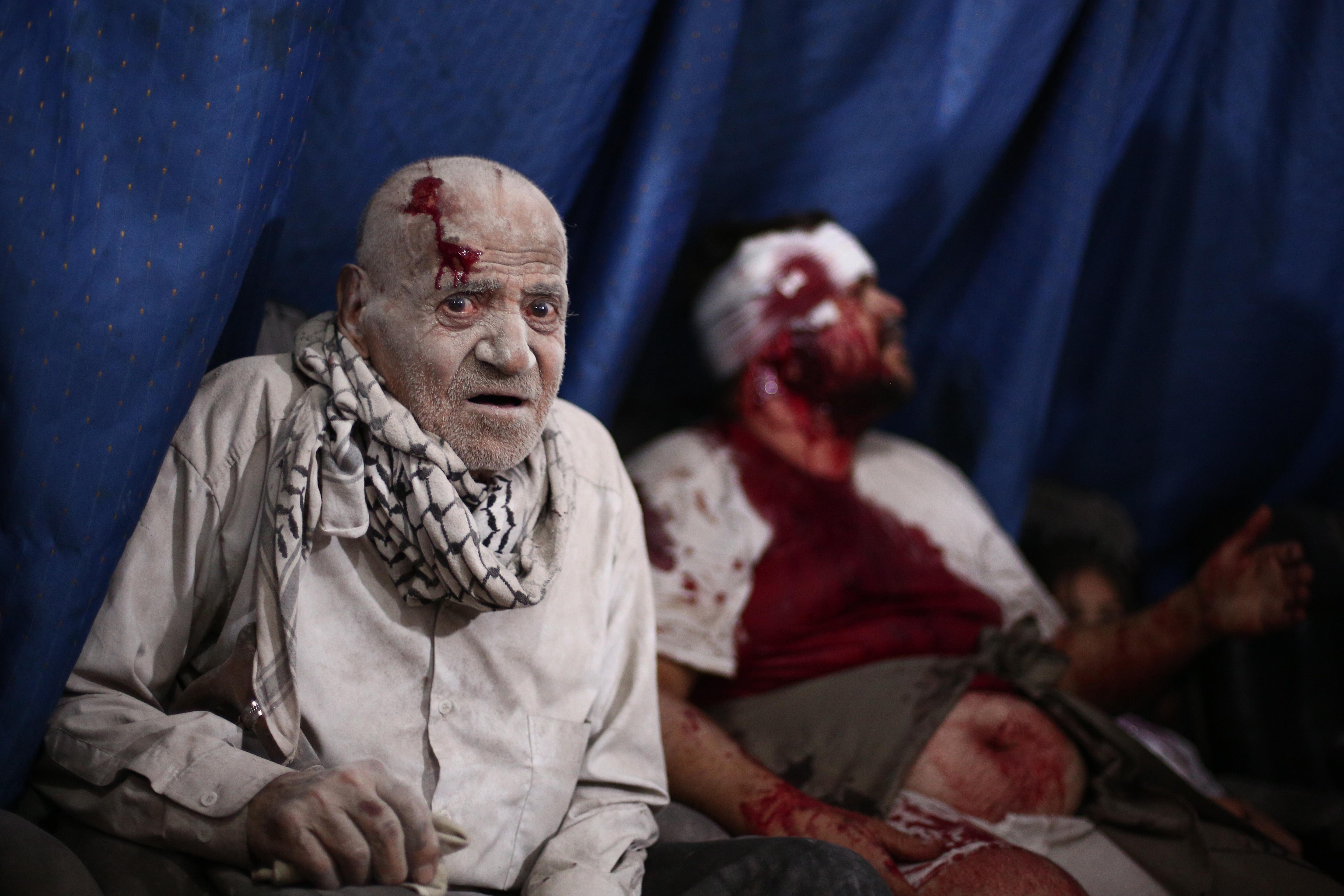
SYRIA-CONFLICT

An injured man looks on as he waits to be treated at a makeshift hospital in the besieged rebel bastion of Douma, northeast of the Syrian capital Damascus, on September 24, 2014, following reported airstrikes by government forces. Some 191,000 people have been killed since an uprising against President Bashar al-Assad’s rule erupted in March 2011. By Abd Doumany/AFP/Getty Images.

Gabbin’ About God

Republicans think pols aren’t doing it enough, according to a recent Pew poll (the same one showing how self-pitying white evangelicals are). Christopher Ingraham elaborates:

Fifty-three percent of Republicans say that political leaders are talking too little about their faith, compared to less than a third of Democrats. Again, while Democrats have remained consistent on this measure since 2010, Republicans have shifted nearly 10 percentage points. For reference, in September, the word “God” has been spoken on the House and Senate floors 75 times, “Christian” 65 times and “Jesus” 10 times. Democrats and Republicans seem to use these words at similar rates.

Paul Waldman remarks, “I actually don’t have a problem with it on an individual level, much as I might bristle at the endless Prayer Breakfasts”:

The reason politicians don’t do it more isn’t because there’s some kind of stigma associated with proclaiming your piety, because there isn’t. They don’t do it more because they know it comes off as exclusionary. If you ran a campaign under the slogan, “John Smith: Because we need more Baptists in the Senate,” everyone who wasn’t a Baptist would think you won’t care about them and their concerns, and that isn’t something too many candidates want to risk.

Politicians don’t want to draw those stark lines, which is why there are only a few (who come from homogeneous districts) who talk publicly in religious specifics, like mentioning “Jesus” as opposed to just “God.” Likewise, they want the churches’ help, but they could probably do without direct church endorsements, because then it would look like they’re the candidate of one particular sect. Which is to say that even if lots of voters express the opinion that they’d like to see more religious involvement in partisan politics, what they have right now is probably all they’re going to get. And that’s plenty.

Millennials Of The Mideast

Robert F. Worth reviews Juan Cole’s The New Arabs, which offers reasons to be hopeful about the future of the Middle East, focusing on the generation of young activists that “has already wrought deep social changes, and is likely—eventually—to reshape much of the Middle East in its own image: more democratic, more tolerant, and more secular”:

Cole describes a dedicated and influential group of Internet activists who came of age in the early years of this century in Egypt, Tunisia, and Libya (his book excludes other Arab countries where uprisings took place, conceding that young people had less impact there). Focusing especially on the Internet’s liberating effect, he traces figures like Lina Ben Mhenni and Sami Ben Gharbia in Tunisia, and Wael Abbas, Shahinaz Abdel Salam, and Amr Ezzat in Egypt. These young activists were less ideologically inclined than their elders, more willing to work with Islamists, and eager to form links with labor. Ahmed Maher, the charismatic and principled cofounder of Egypt’s April 6 movement, appears frequently throughout Cole’s book, as a kind of model figure of the “revolutionary youth” who helped focus the discontents that produced the 2011 uprisings.

Cole may be right that these people will continue to press for democratization, and that “as the millennials enter their thirties and forties, they will have a better opportunity to shape politics directly, so that we could well see an echo effect of the 2011 upheavals in future decades.”

The memory of 2011, and the glimpse of unity and civility it offered, can never be taken away, and surely it will inspire many young (and old) people in years to come. One line of thinking, often heard among liberal revolutionaries, holds that the current chaos across the Middle East is the result of a doomed, desperate ploy by the various Arab anciens régimes to cling to power and forestall the inevitable triumph of a new order. Like many others, Cole invokes a parallel with the European revolutions of 1848, suggesting that something like France’s relatively liberal Third Republic, established in 1870, is around the corner for the Arab world.

Another book Worth considers, however, suggests a more fraught way forward. He looks at Shadi Hamid’s Temptations of Power: Islamists and Illiberal Democracy in a New Middle East:

The secular youth movements of 2011 seemed so powerful and prophetic largely because they managed, briefly, to unify their efforts with those of Islamists and labor movements: a synthesis made possible by the catastrophic misrule of Zine el-Abidine Ben Ali in Tunisia, Muammar Qaddafi in Libya, and Mubarak, among others. (Several young people in Tahrir Square in 2011 told me earnestly that they were grateful to Mubarak for causing them to reconcile with their ideological rivals.)

The fissures reappeared soon afterward. But many remained optimistic because of a belief—more widespread in the West than among Arabs—that attaining power would necessarily moderate political Islamists, reining in their ambitions to impose sharia. What came to be known as the “pothole theory” was famously articulated a decade ago by George W. Bush, among others: being responsible to constituents makes you focus less on ideology than on day-to-day governance.

This hopeful doctrine, Hamid argues, is largely refuted by the experience of recent years. Islamist parties in Egypt, Jordan, and Tunisia grew more moderate over the past two decades during a period of renewed government repression, not democracy. “There was never any reason to believe that this process of moderation would continue indefinitely under an entirely different set of circumstances,” Hamid writes. “Some Islamist parties, such as in Tunisia, are more willing to come to terms with liberal democracy than others. But all Islamist parties, by definition, are at least somewhat illiberal.”

Quote For The Day

“Let me first state what I understand to be your position. It is, that if it shall become necessary, to repel invasion, the President may, without violation of the Constitution, cross the line and invade the territory of another country; and that whether such necessity exists in any given case, the President is to be the sole judge … But Allow the President to invade a neighboring nation, whenever he shall deem it necessary to repel an invasion, and you allow him to do so, whenever he may choose to say he deems it necessary for such purpose – and allow him to make war at pleasure….

If, to-day, he should choose to say he thinks it necessary to invade Canada, to prevent the British from invading us, how could you stop him? You may say to him, ‘I see no probability of the British invading us’ but he will say to you ‘be silent; I see it, if you don’t.’ The provision of the Constitution giving the war-making power to Congress, was dictated, as I understand it, by the following reasons. Kings had always been involving and impoverishing their people in wars, pretending generally, if not always, that the good of the people was the object. This our Convention understood to be the most oppressive of all Kingly oppressions; and they resolved to so frame the Constitution that no one man should hold the power of bringing this oppression upon us. But your view destroys the whole matter, and places our President where kings have always stood,” – Abraham Lincoln.

Obama is no Lincoln, is he?

(Hat tip Conor and Glenn)

The Ticket For Cricket

dish_cricket

According to the British philosopher David Papineau, it’s a sport where nurture trumps nature:

When it comes to environments … cricket and soccer are like chalk and cheese. Every kid gets plenty of chance to kick a football around. But cricket skills are by no means easily acquired. It’s not just that you need special equipment and facilities: there are deep-rooted habits to overcome. Both batting and bowling are very unnatural, all sideways and no swiping. So you need to be taught young; if you haven’t been initiated before your teenage years, it’s probably too late. … I’d be surprised to find any top-class cricketers without at least one enthusiastic club cricketer somewhere in their family background.

If environments matter more in cricket than in soccer, then this makes cricketing skills look less genetically heritable than footballing ones. In football, most of the differences come from genetic advantages just because there aren’t many environmental differences (if you live in a soccer-mad nation, opportunities to play are everywhere). But in cricket, there would still be a wide range of abilities even if everybody had exactly the same genetic endowment, because only some children would get a proper chance to learn the game. In effect, environmental causes are doing a lot more to spread out the children in cricket than they are in football. To sum up, cricket runs in families precisely because the genetic heritability of cricket skills is relatively low.

(Photo by Alden Chadwick)

How To Contain An Epidemic

Teju Cole shares a heartening report about Nigeria’s successful public health response to the Ebola crisis:

Meanwhile, Jon Cohen suggests that Ebola survivors could help stem the spread of the disease:

As far back as 431 B.C., the Athenian historian Thucydides recognized that people who survived the plague made for excellent caregivers. As Thucydides wrote: “It was with those who had recovered from the disease that the sick and the dying found most compassion. These knew what it was from experience, and had now no fear for themselves; for the same man was never attacked twice—never at least fatally.” Nicole Lurie, HHS’ assistant secretary for preparedness and response, is one of several doctors who suspect that people who survived Ebola may have developed immunity to that strain of the virus and could care for the infected with little risk to themselves. Lurie suggests that in these West African countries, where jobs are hard to find and Ebola carries such serious stigma with it that survivors sometimes are shunned, training survivors could be a win-win.

Michaeleen Doucleff notes that the CDC and WHO are on the same page when it comes to fighting the disease, but the horizon doesn’t look good:

Both agencies agree on how to turn the tide of this epidemic: Get 70 percent of sick people into isolation and treatment centers. Right now, [WHO’s Christopher] Dye says fewer than half the people who need treatment are getting it. If all goes well, Dye expects the goal of 70 percent could be reached in several weeks.

“Our great concern is this will be an epidemic that lasts for several years,” he says. The epidemic has hit such a size – and become so widespread geographically – that Ebola could become a permanent presence in West Africa. If that happens, there would be a constant threat that Ebola could spread to other parts of the world.

Rohit Chitale of the Armed Forces Health Surveillance Center calls the international spread of Ebola “a significant possibility,” leaving poorer countries at highest risk:

The [CDC and WHO] and many nations have established guidance for entry and exit screening (e.g., thermal or fever screening at airports), and many nations had put them in place weeks or even months ago. Regardless, some cases will probably be imported into other nations. However, [if] cases occur in nations with a strong medical and public health infrastructure, like the U.S., patients that are suspected for Ebola will be isolated, exposed patients will be quarantined, and we would expect little to no spread of cases locally. So this is really not a direct threat for nations with robust health systems. But where resources are lacking and health systems are inadequate (as in West Africa), and where initial cases are not quickly discovered and managed, there is a real threat of local spread in the community from imported cases.

James Ciment argues that Americans have a special obligation to help those suffering in Liberia:

Pioneers from America settled Liberia and established it as Africa’s first republic; they modeled its institutions after our own. If we are true to our values and obligations, we will not abandon Liberia again once the current crisis has passed. Our government has earmarked an unprecedented sum to reverse the epidemic in Liberia and its neighbors. But as Americans, we can and should give as individuals. There are any number of organizations doing sterling work in fighting Ebola and aiding its victims—Doctors Without Borders, Save the Children, Global Health Ministries. Find one online and send it money now.

Viewing America From The Outside

Linker feels that Americans need to hear “a little less about how important it is for us to blow other people to bits and a little more about what it’s like to live in a world in which a single nation has the power to strike a deadly blow wherever it wishes, anywhere on the planet”:

How would we feel, I wonder, if we lived in a world in which another country was so powerful that it could inflict military pain on any nation, including us, with impunity? Without an act of imagination, we can’t even begin to answer that question — because we are the only nation in that position, or even close to it. Russia, our nearest rival, may be flexing its muscles in Ukraine. But as with all of Russia’s post-Soviet military adventures, this one is taking place right next door. The United States, by contrast, hasn’t fought a war with a neighboring power since the mid-19th century, and it regularly (as in: every few years) starts wars many thousands of miles from its territory. In this sense at least, America truly is an exceptional nation.

I will never write a word in defense of ISIS and its bloodthirsty, homicidal ambitions. But if we wanted to understand some of what motivates people from around the world to join its seemingly suicidal cause, we might start with the very fact of America’s incontestable military supremacy and the cavalier way we wield it on battlefields across the globe.

Choosing “Yes” Ctd

More reactions are appearing to new efforts to combat campus rape. Megan McArdle writes of a new affirmative-consent law proposed in California:

It seems to criminalize most sexual encounters that most people have ever had, which (I hear) don’t usually involve multistep verbal contracts. It appears designed to be unequally applied to men and women or, alternatively, to create a lot of cases of “mutual rape.” And it doesn’t fix the actual thing that makes rape hard to prosecute, or stop, which is that there are often only two witnesses who know whether or not the sex was consensual, one of whom was often intoxicated.

A reader counters Freddie’s comments:

What bothers me is the twin rules that if a woman knowingly has any alcohol at all, a man cannot have sex with her without fear of being charged with rape, but while a woman’s ability to make decisions is degraded by alcohol, a man’s is never legally degraded.

Obviously if she was tricked into drinking alcohol or if she is so drunk that her speech is slurred or has lost her motor skills, let alone unconscious, she isn’t in a position to say no.  But that is different from willingly having a drunk hookup with an equally drunk dude, and the next morning regretting the whole incident, and by the end of the week, with the encouragement of some friends, deciding that the guy should have said no to her willing action so now it’s rape.  Makes me glad I’m married and don’t have to deal with the current situations on campus.

Responding to both Freddie and McArdle, Elizabeth Nolan Brown offers a class critique of the high-profile focus on campus rape:

[M]ainstream feminists have taken up the cause of affirmative consent on campus with vigor. It seems to epitomize critics’ charge that these feminists are only concerned with the problems of the privileged and middle-class. Only about one-third of Americans ever earn a college degree. Only about six percent of Americans are currently enrolled in college, and far less on traditional college campuses. Why are the intricacies of consent for this population so much more important than, say, finding funding to test the backlog of rape kits—something that could help catch existing rapists and protect people regardless of their educational attainment (or incapacitation) level?

Tara Culp-Ressler, meanwhile, talked to some college dudes about the White House campaign:

The college students who spoke to ThinkProgress said they welcome the shift away from approaching sexual assault as an issue that individual women need to protect themselves against. Targeting efforts toward men, they said, could eventually encourage more college guys to tell their friends that they shouldn’t take advantage of drunk people.

“Here at college, it means men on campus will set the precedent that sexual assault is not okay — and beyond that, that all of the microaggressions along the spectrum of harm that lead to rape culture are also not okay,” John Damianos, a sexual assault prevention activist at Dartmouth College who has been involved in advising the new White House Task Force, explained. Those microaggressions could range from making a rape joke, to suggesting that a sexual assault victim was “asking for it” because she wore a short skirt to a party, to catcalling a woman on the street.