The Best Of The Dish Today

First Day Of Autumn In Richmond Park

My friend Damon Linker didn’t take so well to Zeke Emanuel’s piece on why he hopes to die at the age of 75. Money quote from Damon:

Reading Emanuel’s essay, I began to despair — not just about the moral outlook it expresses, but about whether its readers will even recognize how monstrous it is. Emanuel has taken the ethic of meritocratic striving that currently dominates elite culture in the United States and transformed it into a comprehensive vision of the human good. Viewed in its light, the only life worth living is one in which you endlessly, relentlessly strive to look as smart and clever as possible in the eyes of other smart and clever people. The ultimate goal of such a life is to be considered the smartest and cleverest person of all. Once old age or any other misfortune gets in the way of continually striving for that goal, one might as well cease to exist.

I think that’s an over-reaction. One does not need to embrace the cult of “achievement” or “success” to find old age, especially really old age, to be increasingly burdensome, and therefore not worth extending indefinitely at the cost of everything else. I suppose you could come away from Emanuel’s piece thinking that it values human productivity as the sole human good and thereby tacitly endorses a “eugenic” point of view. But that’s not what I took from it.

Here’s what I took from it. Life is not a sprint; it’s a marathon for most of us. And it has a very different pace at the end than at the beginning. Accepting this slower pace does not mean we should end the race before it’s over; it merely means that toward the end, the kind of things we might have done to our bodies to keep them fully poised for the future should not be our top priority. I’ve long joked that if things get really bad for me in my 70s, I’ll just stop taking my AIDS meds. But it isn’t entirely a joke. A graceful acceptance of one’s ultimate term limit can be a source of joy and peace and freedom, as opposed to the desperate life-extending mentality that leaves so many of us to die in intensive care. It is a more natural and less hubristic way to live. And to die. I have a feeling Montaigne would approve.

Today, we witnessed the launch of yet another bombing campaign against yet another country in yet another war authorized neither by Congress nor the UN. We observed the power and endurance of golf in China; the self-pity of most minorities and especially white evangelicals; Tocqueville’s insights into the current Middle East religious wars; and Nicolas Sarkozy’s chutzpah when it comes to saving marriage from the gays. Plus: results from one of the toughest window view contests ever. One contestant writes:

It’s obvious I can never win the VFYW contest. I mean, this week I identified Iqaluit, of all places. I found the right apartment building. I found the right apartment. I even found the right window. But I didn’t find the right part of the window! Good grief, as Charlie Brown would say. It feels like Lucy has whisked the football away again.

In other news, I finally broke down, got over my cheap ways, and bought a subscription.

Join him and about 20 others today here, for as little as $1.99 a month. The top two posts today were Does The GOP Really Give A Shit About The Debt? and Can The Church Survive in America? Many of the other posts were updated with your emails – read them all here.  You can always leave your unfiltered comments at our Facebook page and @sullydish. Gift subscriptions available here. Dish t-shirts and polos are still for sale here.

See you in the morning.

(Photo: A red deer is seen through the morning mist in Richmond Park on September 23, 2014 in London, England. Tuesday marks the autumn equinox where day and night are of equal lengths. By Rob Stothard/Getty Images.)
Remembrances Of Things Freud

Michael S. Roth defends the Austrian’s relevance 75 years after his death:

Freud recognized that we are animals that respond to our biology through memory and story-telling. Psychoanalysis became a vehicle for telling those histories in ways that acknowledged our conflicting desires. Psychoanalysis isn’t a methodology to discover one’s true history; it is a collaboration that allows one to refashion a past with which one can live. The need to do so, and the impossibility of ever doing so definitively, has ensured the continued presence of Freud in our culture.

Seventy-five years after Freud’s death, we might well ask how we live with the intensity of these stories; how do we manage their meanings? Well, we now have culturally approved pharmaceuticals. The intensity and ambivalence of our desires have given rise to massive attempts to control them, and those controls have sometimes fueled these very desires. We may find that our medications create the desire for the feeling of intensity that they were supposed to protect us from.

Jon Kelly points out that “the gap between the pub Freud and what Freud actually wrote is often quite large”:

Although much of his body of thought – not least around “infantile sexuality” – was seen as dangerously radical during his lifetime, the more challenging aspects of his work were rarely dwelt on by the mass media. “From a historical perspective, he’s part of a general movement where people start to look more into themselves,” says Marianski. “There was a broad cultural shift in our culture – how you conceptualise the self?”

But there is much in Freud’s writing that makes the continued prominence of his terms appear incongruous. In particular, his theories of repression belong very much to a pre-sexual revolution world. “Now that young people seem to be at liberty to do whatever they want and talk about whatever they want, it’s very interesting that Freud would still be very interesting to them,” says James.

Better Reasons To Drop Bombs In Syria

Douthat identifies a few:

To the extent that these strikes have a limited military objective that either connects directly to the Iraqi front (by denying the Islamic State a secure rear) or targets groups plotting more actively against the United States, they trouble me much less than a more open-ended strategy in which we seek to conjure up a reliable ally (“you know, whatever the Free Syrian Army ever was,” to quote a U.S. official in Filkins’ piece) to be our well-armed boots on the Syrian ground.

Or put another way:

The idea that we can somehow hope to defeat ISIS outright in Syria, where we currently have no real allies capable of winning a war or securing a peace, without first seeing the Islamic State pushed back or defeated in Iraq — itself probably a long-term project — seems like the height of folly, and a royal road to another quagmire or bloody counterinsurgency campaign. But the possibility that strikes in Syria might modestly help our existing allies in Iraq seems at least somewhat more plausible, with a more limited worst-case scenario than a full-scale Syrian intervention if they don’t ultimately do much good.

But Larison fears that our limited involvement won’t stay limited:

Every step along the way, the administration has set down restrictions on what it would be willing to do, and it then cast those restrictions aside within days or weeks of imposing them. The administration is currently saying that there won’t be American forces on the ground engaged in combat, but as we should know by now every statement like this is entirely provisional and can be revoked at any time. Furthermore, because the administration persists in the lie that the 2001 AUMF covers this military action, it is very doubtful that the president will seek Congressional authorization for this war even if the war involves U.S. ground forces. I very much hope that Obama doesn’t yield yet again to the pressures in favor of escalation, but there is no reason to think that he will be able to resist them indefinitely.

Bill O’Reilly’s Dumb Plan To Defeat ISIS

Oreilly

Oy vey:

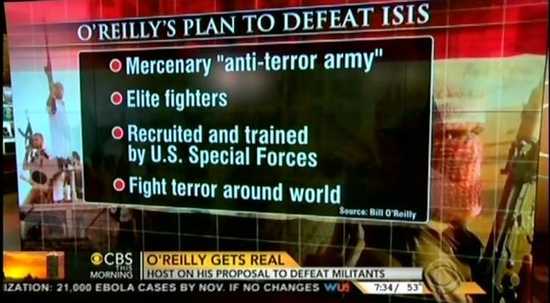
[O’Reilly] knows advocating for American troops to take up the fight themselves is extremely unpopular. O’Reilly, problem solver that he is, has a solution: “elite fighters who would be well paid, well trained to defeat terrorists all over the world.” Since that worked so well in Iraq last time around. What we need is more Blackwater. In the O’Reilly fantasy, the 25,000-person force would be English-speaking, “recruited by the USA and trained in America by our special operations troops,” and dubbed “the Anti-Terror Army,” because the Avengers is already taken.

Allahpundit dismantles O’Reilly’s pipe dream:

The flaw is that there’s no obvious next step if the mercenaries succeed in routing ISIS from Raqqa and eastern Syria. Who takes over and rules that half of the country if that happens? Assad? He’ll butcher the Sunni civilians there and the Sunnis know it. A new sectarian rebellion against the regime would spring up overnight. Some sort of multinational Sunni force of Saudi, Turkish, and Jordanian troops? Iran will never let the Saudis have that kind of foothold, and besides, none of those countries want the headache of pacifying radicalized Sunni Syrian civilians. NATO doesn’t want it either, of course; an army of western peacekeepers would be even more culturally estranged from Syrian Arabs than a multinational Sunni force would.

The theoretical virtue of Obama’s “arm the Syrian moderates” plan is that if the moderates were to defeat ISIS, they’d be comparatively well positioned to take over as rulers of eastern Syria. They’re natives and they’re Sunnis; they’re probably acceptable to the locals. But of course, the moderates aren’t going to defeat ISIS, which puts us back at square one.

(Image via Barbara Morrill)

Face Of The Day

John Key Photo Opportunity With Maori Party & Act Party

Newly elected New Zealand Prime Minister John Key greets Maori Party Co-leader Te Ururoa Flavell at The Beehive in Wellington, New Zealand on September 23, 2014. On Saturday evening, the National Party leader was re-elected after defeating Labour opposition leader David Cunliffe. By Hagen Hopkins/Getty Images.

Choosing “Yes”

Freddie responds to Vanessa Grigoriadis’s piece on campus rape:

I think that it’s a mistake to create different standards of consent for college students. The potential unforeseen consequences scare me, and besides, a central aspect of the fight against sexual assault is to insist that rape is rape. I think it sends a retrograde message to suggest that there is a different standard that is applied only to college students. I would argue that a clear takeaway from the New York piece is that the establishment of this entire separate legal system for campus sexual assaults, while undertaken with good intentions, has added a layer of complexity and lack of accountability that has backfired badly. …

I feel strongly that explicit consent laws actually undercut the absolute ownership by the individual over her or his own sexual practice.

One of the most important parts of the feminist project is insisting that women own their own bodies. This has application to abortion, where the pro-life movement seeks to take physical control of women’s bodies away from them. And it has application to rape. The insistence of those who work against rape is that only the individual has the right to define appropriate and wanted sexual practice. With the informed consent of all adult parties, no sexual practice is illegitimate. Without that consent, no sexual practice is permissible. This is a humane, moral standard that has the benefit of simplicity in application and clarity in responsibility.

But it stems first and foremost from the recognition of individual ownership. To define the exact methods through which individuals can request and give consent takes away that control and turns it over to the state, or even more ludicrously, to a dean or some academic grievance board. We should be expanding the individual’s control over their own sexual practice, not lessening it. And we should maintain the simplest standard that there is: that if a person rejects a sexual advance, or is in such an incapacitated state that they cannot rejected that advance, or is under the power of the other party to the extent that they feel compelled to consent, sexual contact cannot morally or legally take place.

Scaring Up Some Votes

The Republicans are already using ISIS as a wedge issue:

Sargent passes along a new Scott Brown ad that also hypes the ISIS threat:

It’s true that the President’s approval on terrorism has plummeted and the GOP now holds a huge advantage on foreign policy. Republican strategists have been pretty explicit in explaining that they see this as a way to exploit a general public sense that things have gone off the rails, and polls do show high wrong-track numbers and rising worry about terrorism. If things go wrong, which is certainly possible, this could well redound to the benefit of Republican candidates.

But for now, it’s hard to imagine that arguments such as Brown’s above are going to cut it. After all, if GOP candidates are really going to paint the U.S. response to ISIS as insufficiently realistic about the nature of the threat, then that should theoretically open them up to thequestion of whether they support sending in ground troops. You’d think that if the criticism continues now that operations are underway, it would be harder for them to duck that basic follow-up.

Waldman agrees that ISIS fear-mongering is unlikely to work:

Despite the surface similarity between political attacks like those and the ones we saw when George W. Bush was president, there’s a crucial difference. Back then, there was a Republican president taking actions against America’s enemies, while Democrats supposedly didn’t want to protect the country (even if, in reality, elected Democrats gave ample support to the wars in Afghanistan and Iraq and other elements of the “War on Terror”).

Today, however, it’s a Democratic president who is taking action against terrorists. Even if you believe that action is inadequate, it still creates a fundamentally different impression with the public when they see Tomahawks launching and jets taking off from aircraft carriers on Barack Obama’s orders.

Which may explain why Josh Green found that few GOP ads thus far have mentioned ISIS:

Now that the U.S. has begun bombing Syria, those ads may start to materialize. Then again, maybe they won’t. Republicans leaders such as House Speaker John Boehner (R-Ohio) have endorsed Obama’s latest campaign. “ISIL is a direct threat to the safety and security of the United States and our allies,” Boehner said of the group formerly known as Islamic State in Iraq and the Levant, according to a statement. “I support the airstrikes launched by the president, understanding that this is just one step in what must be a larger effort to destroy and defeat this terrorist organization. I wish our men and women in uniform Godspeed as they carry out this fight.”


Because More Bombing Is Always The Answer

Mohammed Alaa Ghanem, writing in Politico, wants the US to target Assad, not just ISIS:

Assad’s record presents clear evidence: If his regime somehow survives the current conflict, ISIL will mysteriously regenerate itself while Assad approvingly observes. Unless the United States wants to be striking ISIL in Syria yet again in another five to 10 years, America should hit Assad now.

Larison pulls his hair out:

Attacking Syrian regime forces would drag the U.S. into a much larger, riskier, and more ambitious campaign that could have very dangerous consequences for U.S. pilots and could create yet another crisis in U.S.-Russian relations. The war against ISIS already promises to be long and desultory, and a war against the Syrian regime would make everything harder, raise the costs of the ongoing campaign, and risk the possibility of regime collapse and the even greater chaos that would consume the country as a result. The war against ISIS is a serious mistake, but fighting both the regime and ISIS at the same time would be a disaster.

Quote For The Day

Syrians fleeing the war in their country wait to cross into Turkey

“We must begin by acknowledging the hard truth:  We will not eradicate violent conflict in our lifetimes.  There will be times when nations — acting individually or in concert — will find the use of force not only necessary but morally justified.

I make this statement mindful of what Martin Luther King Jr. said in this same ceremony years ago:  “Violence never brings permanent peace.  It solves no social problem:  it merely creates new and more complicated ones.”  As someone who stands here as a direct consequence of Dr. King’s life work, I am living testimony to the moral force of non-violence.  I know there’s nothing weak — nothing passive — nothing naïve — in the creed and lives of Gandhi and King.

But as a head of state sworn to protect and defend my nation, I cannot be guided by their examples alone.  I face the world as it is, and cannot stand idle in the face of threats to the American people.  For make no mistake:  Evil does exist in the world.  A non-violent movement could not have halted Hitler’s armies.  Negotiations cannot convince al Qaeda’s leaders to lay down their arms.  To say that force may sometimes be necessary is not a call to cynicism — it is a recognition of history; the imperfections of man and the limits of reason,” – Barack Obama, accepting the Nobel Peace Prize, December 10, 2009.

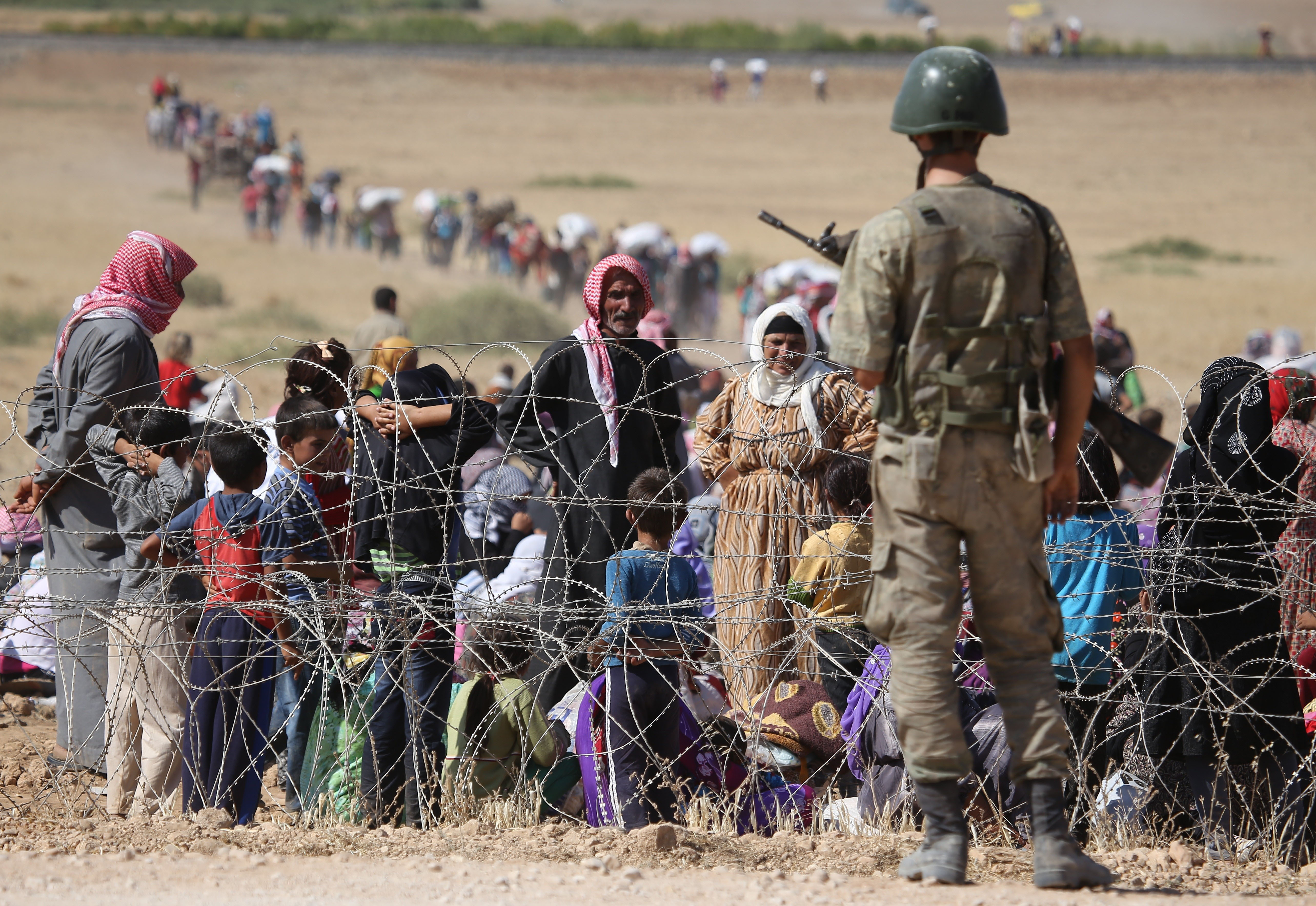
(Photo: Syrians fleeing from clashes between the Islamic State of Iraq and Levant (ISIL) militants and Democratic Union Party (PYD) forces in the Ar-Raqqah Governorate of Syria, wait at the Turkish-Syrian border to cross into Turkey on September 19, 2014 in Suruc district of Sanliurfa province of Turkey. By Orhan Cicek/Anadolu Agency/Getty Images.)