A colorful abstraction of what we look like from the inside:
Category: The Dish
Can The Church Survive In America? Ctd
A reader writes:
In your coverage of the Montana couple denied communion, the age of the priest (27) is important to note. My husband and I (then in our late 20s and very devout) left the Church in 2006 when our retired priest was replaced by a young (and very conservative) one. Pope Benedict had just been elected, and a new (and also relatively young) bishop was appointed to our Diocese making conservative issues his priority. For years we had “hidden” in our little liberal church where we worked to end the death penalty and served in homeless shelters. When a priest would make the national news for denying communion or protesting an abortion clinic, we’d shake our heads and be thankful – that Church was not our Church. But all that came into question when our new priest arrived and the progressive values of our congregation started to wane.
As with their actions against the Nuns on the Bus, American bishops have been dismantling little liberal congregations like mine – and their best weapons are young, conservative priests.
We realized that the priests and nuns we had grown up with – Baby Boomers who started their careers with Vatican II – were all retiring and dying. Their messages of peace, acceptance and mercy and their commitment to good works for the poor were dying with them. Though young Americans are much more progressive on social issues like gay marriage, the young American men becoming priests now are decidedly not, and their influence as leaders in the Church will be felt for decades to come.
We couldn’t find another progressive parish to “hide” in and be the kind of Catholic you continue to be. I wonder if you are coming closer to the same realization we had in 2006 – that the Church you belong to is the same Church that has turned away Paul and Tom. And that one day – as these young priests rise to higher ranks – the Church will eventually turn you away as well.
I know where my reader is coming from. I thank God daily for the Jesuits.
Busted With An Eggcorn, Ctd
One more round of reader eggcorns:
I’ve been enjoying the thread. And then earlier tonight during happy hour, a friend said: “My Mom has a heart on for Pope Francis.” I didn’t even bring attention to it, I just immediately thought, “I need to write the Dish!”
Another:
Someone said “Jew him down” around me when I was 15 and working in an antique store one summer. But I heard “chew him down.”
I figured it meant when you talk someone into giving you a lower price one something, when you haggle, your jaw is moving up and down. You’re chewing down the price. Chewing them down. Chew him down.
I didn’t have tons of cause to use the expression once I was no longer working in an antique store, but I did use it from time to time, as I like to go to junk sales and flea markets. I think I was nearly 25 when I used it in front of the right person – someone who gasped, looked me in the eye, and said, “I can’t believe you would say something like that.” I was completely mortified when she told me what I actually heard in that antique store when I was 15.
Another:
I once mentioned to my wife that there was a new tapas bar in town and that we should go there, to which she responded, “Why would you want us to go to a topless bar!”
Another:
I can’t believe it took me so long to remember my biggest eggcorn. I’ve been saying since I was a kid that, in cold weather, “It’s a bit nipply outside.”
And another:
Okay, I haven’t seen this one show up on The Dish yet. I work in a group that designs and operates cutting-edge satellite instruments. One of my co-workers is an engineer known for being the best worrier in our building that something might go wrong with the latest instrument. My favorite phrase he always uses whenever he wants to point out a possible problem with a design or plan we’ve come up with is to start by saying: “But the flaw in the ointment is … “
Another:
I’m a family law trial attorney and often hear clients complain about being “lamblasted” by their spouses, etc. in relation to their often caustic situations. I’ve always loved that, and I never correct them!
Another:
I’ve been greatly enjoying your threads on eggcorns, mostly because I feel like I’ve committed half of them myself. Here’s another: When I was a kid, growing up in DC in the ’80s, my parents were friends with a couple named Mary and Barry. They were always saying things like “we’re going out with Mary an’ Barry tonight,” etc. I spent a good portion of my childhood thinking my parents were great friends with the mayor!
Another:
As a physician, my all-time favorite eggcorn is “sick-as-hell anemia”.
One more:
Years ago my then three year old son was having a tantrum about something I have long since forgotten. Trying to make peace, I suggested he come join me for a nice bowl of chicken soup. “NO!,” he screamed. “OK, suit yourself,” says I. “No, YOU shoot YOUR-self!!,” came the outraged reply. Holy Moly. He has since grown into a kind and gentle young man.
Read all of the reader entries here.
“A Thousand Little Saddams”
Reviewing recent Iraqi literature in light of the ISIS uprising, Max Rodenbeck turns to Zaid al-Ali’s The Struggle for Iraq’s Future, which he calls a “well-researched study of how Iraq has gotten into its current, worsening, and possibly terminal mess”:
The departure of Maliki, whose overstay of his welcome made him a sponge for dissent, could offer a window for reconciliation. Mainstream Sunni and Kurdish leaders, as well as some Shiites, had long demanded his exit. Yet the litany of failure that Ali describes is simply too long and wide-reaching to leave much room for optimism. Ali’s own concluding suggestions for how to right things seem sadly perfunctory. He also betrays, in occasional oversweeping judgments and in a peculiar lack of sympathy with the Kurdish yearning for independence (which seems only more justified by the ugly facts he himself reveals), an impractical wistfulness for an imaginary, whole, and complete Iraq.
What came to mind as I closed the book was the damning remark of a distinguished Iraqi exile I met in Kuwait shortly before the 2003 invasion. His father had served as prime minister under the monarchy whose overthrow in the bloody coup of 1958 had led to Iraq’s long era of turbulence. Still, he took a dim view of the looming ouster of Saddam Hussein, and held no dreams of return. “Of course the Americans will get rid of Saddam,” he said. “But what will we have then? A thousand little Saddams.”
And we have set ourselves the impossible task of trying to kill them all. And then what?
How Many New Ebola Cases?
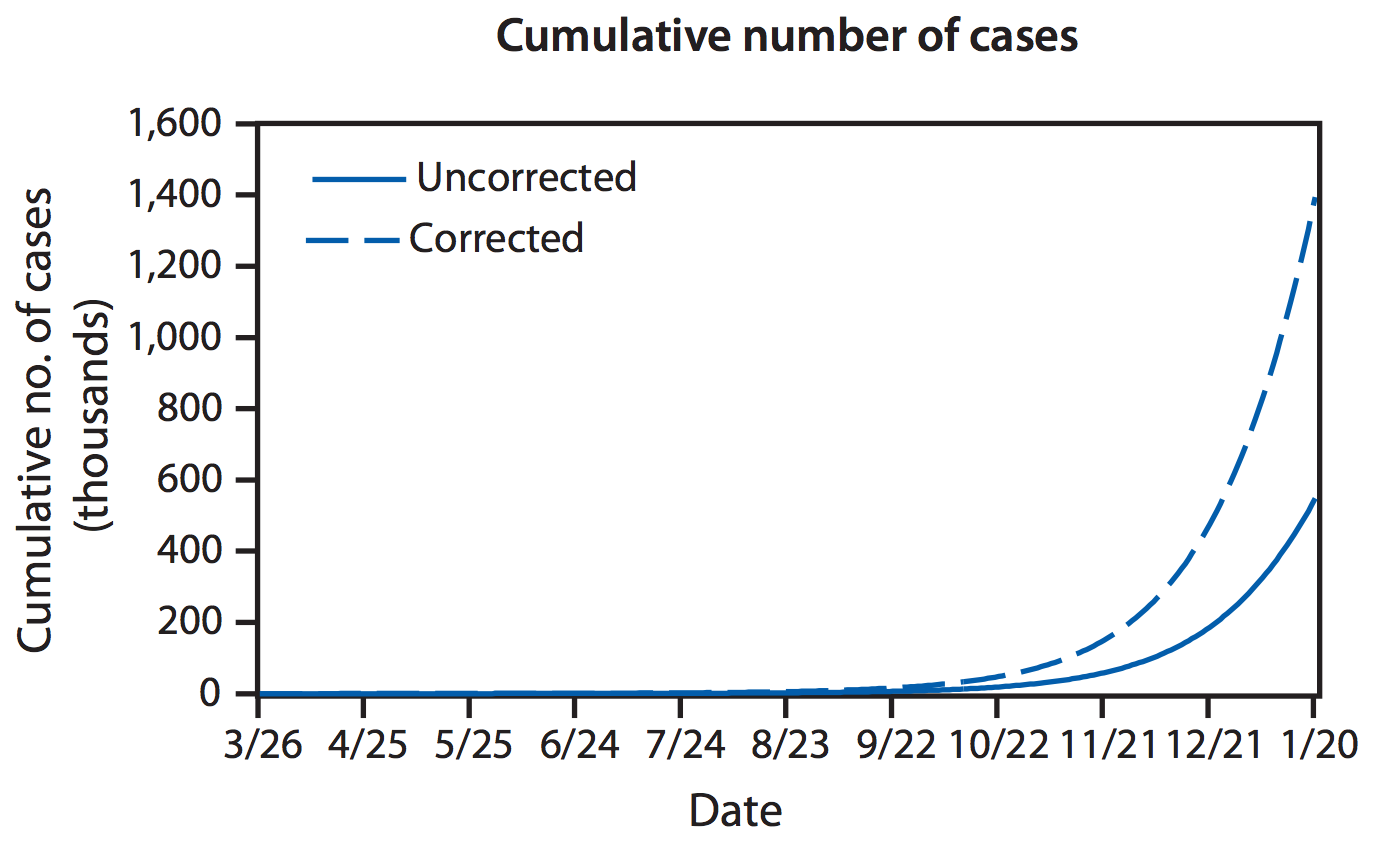
Lena Sun flags a new CDC report suggesting that 1.4 million West Africans could catch the virus by January:
The report released Tuesday is a tool the agency has developed to help with efforts to slow transmission of the epidemic and estimate the potential number of future cases. Researchers say the total number of cases is vastly underreported by a factor of 2.5 in Sierra Leone and Liberia, two of the three hardest-hit countries. Using this correction factor, researchers estimate that approximately 21,000 total cases will have occurred in Liberia and Sierra Leone by Sept. 30. Reported cases in those two countries are doubling approximately every 20 days, researchers said. “Extrapolating trends to January 20, 2015, without additional interventions or changes in community behavior,” such as much-improved safe burial practices, the researchers estimate that the number of Ebola cases in Liberia and Sierra Leone could be between approximately 550,000 to 1.4 million.
Meanwhile, Siobhán O’Grady points out a distressing pattern in aid distribution:
[A] United Nations Office for the Coordination of Humanitarian Affairs report released Monday sheds light on a different kind of neocolonialism taking form in the region’s Ebola crisis: Rather than coordinating an effort to combat the massive outbreak, the United States, the United Kingdom, and France are instead sending disproportionate amounts of aid to the territories they once controlled. This lack of coordination among the three largest donors to the fight against Ebola ignores the reality of borders between Liberia, Sierra Leone, and Guinea, where political lines are more a trace of colonialism than an accurate representation of modern-day relationships between the border communities of the three developing nations.
Zoe Chace compares the international community’s response to the Ebola outbreak to its actions following the 2010 earthquake in Haiti:
The response to the 2010 earthquake in Haiti was massive: Billions of dollars in donations poured in. “It had everything,” says Joel Charny, who works with InterAction, a group that coordinates disaster relief. “It had this element of being an act of God in one of the poorest countries on the planet that’s very close to the United States. … And the global public just mobilized tremendously.” People haven’t responded to the Ebola outbreak in the same way; it just hasn’t led to that kind of philanthropic response. From the point of view of philanthropy, the Ebola outbreak is the opposite of the Haiti earthquake. It’s far from the U.S. It’s hard to understand. The outbreak emerged over a period of months — not in one dramatic moment — and it wasn’t initially clear how bad it was. Donors like being part of a recovery story. In Haiti, buildings and lives were destroyed. The pitch was, let’s help them rebuild. In the case of Ebola, it’s been harder to make a pitch.
Not surprisingly, Tara Smith notes that the NGOs at the forefront are struggling:
Doctors Without Borders (also known by its French name,Médecins Sans Frontières, or MSF) has led the international battle against Ebola, and where its workers have had success in the past, they have been completely overwhelmed now for months. MSF International President Joanne Liu has made multiple appeals to the United Nations, begging for additional assistance, noting on Sept. 16:
As of today, MSF has sent more than 420 tonnes of supplies to the affected countries. We have 2,000 staff on the ground. We manage more than 530 beds in five different Ebola care centres. Yet we are overwhelmed. We are honestly at a loss as to how a single, private NGO is providing the bulk of isolation units and beds.
The plea has fallen on sympathetic ears, but the response has been slow and insufficient. The United States has answered the call to some extent, promising 3,000 military personnel and up to $750 million in aid. Even this massive amount is less than what the World Health Organization has called for: a minimum of $1 billion, and even that will only keep infections contained to the “tens of thousands.”
Why Do Doctors Kill Themselves So Much? Ctd
A reader writes:
While I think this is important question, I also find the suicide rates not at all surprising. In fact, it is about as surprising to me as the data about soldiers taking their own lives in record numbers (that is to say, not surprising in the least).
During the middle of my residency in surgery, which was before work hour restrictions, I would go months at time without seeing the sun. I would typically work 80-100 hours a week, take in-house call every second or third night, and deal with all manner of death, dying, stress, and trauma. I was single and had little time to date, much less start a family. Showing fatigue, stating you needed a break, or any other sign that you were suffering resulted in you being labeled weak or whiny.
I could look forward to 2-3 more years of the same before my residency was complete. After that, I could look forward to an average salary which seemed to be shrinking by the year unless I tacked on 1-2 more years of fellowship training. Furthermore, I could read in the paper everyday that physicians were losing respect and were perceived as a major source of our country’s health care woes.
I went to work everyday and suffered through nurses with clipboards asking why patient X and Y hadn’t been discharged yet, administrators telling us we had to use instrument A instead of instrument B because A was cheaper (even though B was better or safer), operating rooms that were understaffed (“your case will have to wait until 7 pm to get done because it’s after 2 pm and we’ll have to start paying nurses overtime if we start your case now.”), and patient’s family members who weren’t there at all for the first 10 days of a patient’s hospitalization but are now demanding to see the doctor at 8 pm at night.
So after one snowy February day, after treating a mother whose baby had been decapitated in a car accident and all other manner of horrors, as I was driving home I thought, “wouldn’t it be nice to drive up into the Cascades (my residency was in the Pacific Northwest), get out of my car, walk into the woods for about 30 minutes, find a nice tree, and sit down in the snow and drink a bottle of whiskey until I became numb and fell asleep? I would never wake up.”
The good news is, I didn’t. And I’m one of those older doctors now who has no interest in or thoughts of suicide. I make a good salary, and while I still work hard and treat all manner of horrible things that happen to people, I usually make them better. I have a lovely wife and two beautiful children.
But when I read this question, I think that, like our soldiers (I was one of those too, by the way), most people have no earthly idea about what many physicians experience in training and in practice every day, and how much stress, sleep deprivation, administrative nonsense, medico-legal threats, and continual erosion of autonomy we deal with. It adds up. Throw in a sudden lawsuit, marriage break-up, or other major stress and you have the potential for a physician imploding.
We have definitely tried to make things better for doctors in training, and that needed to happen. We haven’t made things better for new physicians out of training; if anything, things have gotten worse with all the upheaval in the health care system. We are constantly asked to deliver more with less. Patients are more demanding, not less. We have a incredibly skewed perspective on end of life care, a topic which has been previously covered at length in this blog. The future is uncertain for private practitioners. There are multiple factors in play, and what leads a troubled physician to take his own life is different for each one.
For many more stories on suicide, read our long discussion thread here. Update from a reader:
Your man Aaron Carroll, a doctor himself, has done a lot of pushback on the “it’s horrible being a doctor, we’re all going to quit” meme – here, here, here, and here.
One of Carroll’s readers had a great line:
Most people have to choose between doing God’s work and being in the 1%. Only doctors get to do both.
The Senate Races Chug Along
David Leonhardt figures that, “while the 2014 election is certainly is not the most important of our lifetimes, it is important in some stealth ways”:
Even if no major legislation is likely in the next two years, the people elected this November will be in the Senate for another four. The 2014 elections could well mean the difference between a Democratic Senate and a Republican Senate in 2017. (The map is more favorable to Democrats two years from now than this year.)
Imagine a Washington in 2017 in which President Marco Rubio and a Republican House want to cut top tax rates sharply — but Senator Bruce Braley, an Iowa Democrat who squeaked out a win in 2014, is part of a 51-member Democratic Senate caucus that stands in the way. Or imagine that President Hillary Clinton wants to push an immigration overhaul — but can’t get any momentum behind a bill in either a Republican-led Senate or House.
Nate Cohn maintains that “there’s plenty of time for Republicans to take the lead as undecided voters make up their minds”:
In most states, the Democratic candidates are still stuck in the mid 40s or even low 40s. Most undecided voters probably disapprove of President Obama’s performance. In the red states, a vast majority of the undecided voters probably voted for Mitt Romney. If the national generic ballot numbers are right, those voters probably prefer that Republicans control Congress as well.
This would be the easiest explanation. The Republicans could take a lead in states like Iowa, Colorado or even North Carolina as undecided voters make up their minds. It would give the G.O.P. an advantage commensurate with their edge in the generic ballot, especially in the red states.
Charlie Cook reads tea leaves:
The political environment is so bad, the playing field is so tilted in favor of Republicans, and the midterm election electorate has started to favor Republicans so much so that there are simply many more routes for Republicans to get to 51 seats than there are for Democrats to keep 50. Winning every purple state and picking off a state in enemy red territory obviously can happen, but it usually doesn’t with the other dynamics we see in play.
Cillizza chimes in:
In a series of poll released last week in places like Arkansas, Kentucky and even North Carolina, President Obama’s job approval rating never crested 40 percent. In the first two states, he was in the very low 30s. Ask any Democratic consultant what their side’s biggest problem is heading into November and they will tell you Obama. Ask any Republican consultant what their side’s biggest advantage is heading into November and they will tell you Obama. Bipartisanship! The reality is that for people like Pryor, Landrieu and Alaska’s Mark Begich, overperforming the president of their party by 15 or more points is a very tough thing to do. That’s true — to a lesser extent, but still true — for people like Jeanne Shaheen in New Hampshire, Bruce Braley in Iowa and Mark Udall in Colorado. The tough thing for Democrats is that it’s getting dangerously close to being too late for a change in Obama’s approval numbers to have a real impact on the political dynamic in their state.
Update from “one politically independent, liberal-to-libertarian man’s point of view from North Carolina” – a great description of a typical Dish reader:
I haven’t been polled, but if I were, I guess I would be counted as an “undecided” voter. Put bluntly, I find the race between Thom Tillis and (the incumbent) Kay Hagan as repulsive as it is boring. Tillis is running against President Obama, and Hagan is running against the NC legislature (of which Tillis is the outgoing speaker of the House). An outsider could be forgiven for not realizing that they are both running for a seat in the US Senate.
There was a time when I would find the arguments of my (mostly liberal) friends about the implications of who controls the Senate a compelling reason to hold my nose and vote for Hagan (again), but I just can’t bring myself to do it this time around. As much as I abhor nearly everything Tillis stands for, I have yet to hear Ms. Hagan articulate a single positive accomplishment that I should care about in the job she’s had for nearly six years.
There was also a time when I could have happily registered a protest vote for a candidate like Libertarian Sean Haugh, who clearly doesn’t want the job (the persistent problem with Libertarian candidates is that they aren’t actually interested in doing the jobs they seek) because at least his YouTube videos are entertaining. His electoral prospects (or rather, the lack thereof) don’t bother me, but campaigning as performance art (however much I share his sentiments and genuinely enjoy his delivery) is not something that I think merits encouragement.
But … if I vote for anyone at all, it will be for Haugh, if only because he’s the only candidate that voting for won’t leave me wanting to take a shower. More likely, I will write in “none of the above” and devote my attention to more local races, where my vote might matter (marginally) more.
If this is where someone as politically engaged as I am (I’ve voted in just about every election since I turned 18 in 1995, including ones for things like school board and sales tax referendums) finds himself, you know the system is fundamentally broken.
Sarkozy’s Unseemly Return
Nicolas Sarkozy says gays “humiliate” the traditional family. His first, second, and third wives were not available for comment.
— Gabe Ortíz (@TUSK81) September 22, 2014
Emily Tamkin furrows her brow at the former French president’s return to the political scene:
One might think that given [his] particularly expansive marital history, Sarkozy would decline to comment on supposed threats to the institution. But non. In a televised interview over the weekend, Sarkozy—who recently announced his intention to return formally to politics and lead his right-wing UMP party—criticized the policies of French President François Hollande, including the current president’s leadership on LGBTQ issues. The thrice-married politician believes that Hollande’s government, in introducing legislation allowing for same-sex marriage, is “humiliating families and humiliating people who love the family.”
Evan Mulvihill argues argued in 2012 that Sarkozy’s stance makes him a bad conservative:
Sarkozy said he supports inheritance rights for gay couples, but doesn’t want to create “civil unions” because they would “harm the institution of marriage.” France already has a sort of civil union called PACS. How a conservative politician can justify wanting less families on the planet, we do not know. Would that Sarkozy were more like British PM David Cameron, his neighbor to the west, who has said that he does not support gay marriage in spite of being a Conservative, but that he supports it because he is a Conservative.
Update from a reader:
Your post on Sarkozy’s statements includes misleading information:
– The referenced article by Evan Mulvihill is from 2012, when Sarkozy ran for re-election at the end of his term. Since then, gay marriage has been passed in France (the “loi Taubira”). The entire commentary and the specific point about civil unions are obsolete.
– The post implies that Sarkozy is currently against gay marriage. In fact, on Sunday, Sarkozy was not clear one way or another. He did not directly answer the question whether he would move to abolish gay marriage if elected again in the future. He did not say that “gay marriage humiliates families” (that’s what some commentators read into it); he said that, during the earlier debate, the family was humiliated (“on a humilié la famille”) and that he doesn’t want to approach the question in the same way again. He was taken to task by one side for not supporting gay marriage; he got as much flak from the anti-gay marriage side for not supporting its abolition.
Full video here (the part about gay marriage is near the end – around 43:00).
The Victimology Game – And The Empathy Of Atheists
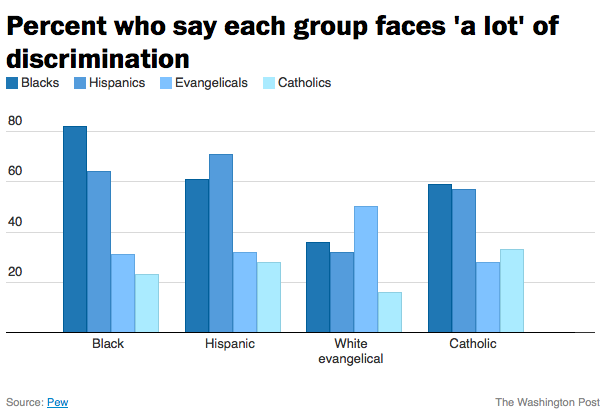
Here’s a fact you kinda know already if you watch Fox News, but it’s good to see it quantified in a new Pew poll. 50 percent of white evangelicals believe they are subject to a lot of discrimination, while only 36 percent of them believe the same thing about African-Americans. So it’s not just Bill O’Reilly who’s whining. White evangelical Fox News viewers really do believe they are subject to more discrimination than blacks. But this is not entirely about evangelicals; the belief that your own group is especially persecuted is pretty damn endemic:
While 61 percent of Hispanics say “there is a lot of discrimination against” blacks, 71 percent say the same of themselves … And while Catholics are less apt to see discrimination against their own, fully 33 percent agree that they face “lots” of discrimination. No other group sees Catholics facing even close to that amount of discrimination.
The data has some other little nuggets. When you look at the aggregate views, the balance seems about right to me. The victim pecking order goes like this, from the most victimized to the least: gays; Muslims; blacks; Hispanics; Jews; evangelicals; atheists; Catholics. The most empathetic group? The religiously unaffiliated. They believe that gays, Muslims, blacks and Hispanics have a harder time than they do. How ironic that it’s the faithless who are the most able to appreciate the struggles of other minorities.
What Nate Silver Hath Wrought
Philip Klein points out how “political coverage has moved from feverishly covering horse race polling, to hyping up daily fluctuations in predictive models of which party will control the Senate after 2014”:
Political news abhors a vacuum, and when trying to appeal to a broader audience, it’s inevitable that journalists will boil everything down to the question of “who is going to win?” Data journalism isn’t changing that. All that’s changing is that people are freaking out over fluctuations in statistical models instead of just daily polls.
And the election results won’t tell us which model is superior (at least not yet). John Sides makes that clear:
I will be pleased if our forecasts are correct — especially in races like North Carolina, where early predictions based on the underlying fundamentals were somewhat controversial. And some models might end up performing better in this particular election. But evaluating forecasting models will require many years of elections, not just November’s.
But you could say that this is simply a natural extension of greater and greater sophistication and data processing than anything we’ve done before. So why be surprised that we’re just as OCD now as we were before? We’ve just got more tools to work obsessively – as the interwebs try to capture your attention every second of the day.
 The Dish