The View From Your Window Contest: Winner #223

VFYWC_223

A reader throws up his hands:

We must congratulate you on lulling us in to a false sense of security. This is quite possibly the hardest “view” you’ve ever posted. Our best guess is my dad’s: Williams County, North Dakota. We base this on the mountains, and the look of the buildings, which seem to resemble an industrial mining or fracking operation.

Next time, perhaps something between “nondescript mountain range with weird building” and “stadium with identifiable flag”? Thank you as always for a fun contest!

Another anticipated a hard one after a few weeks of easy contests:

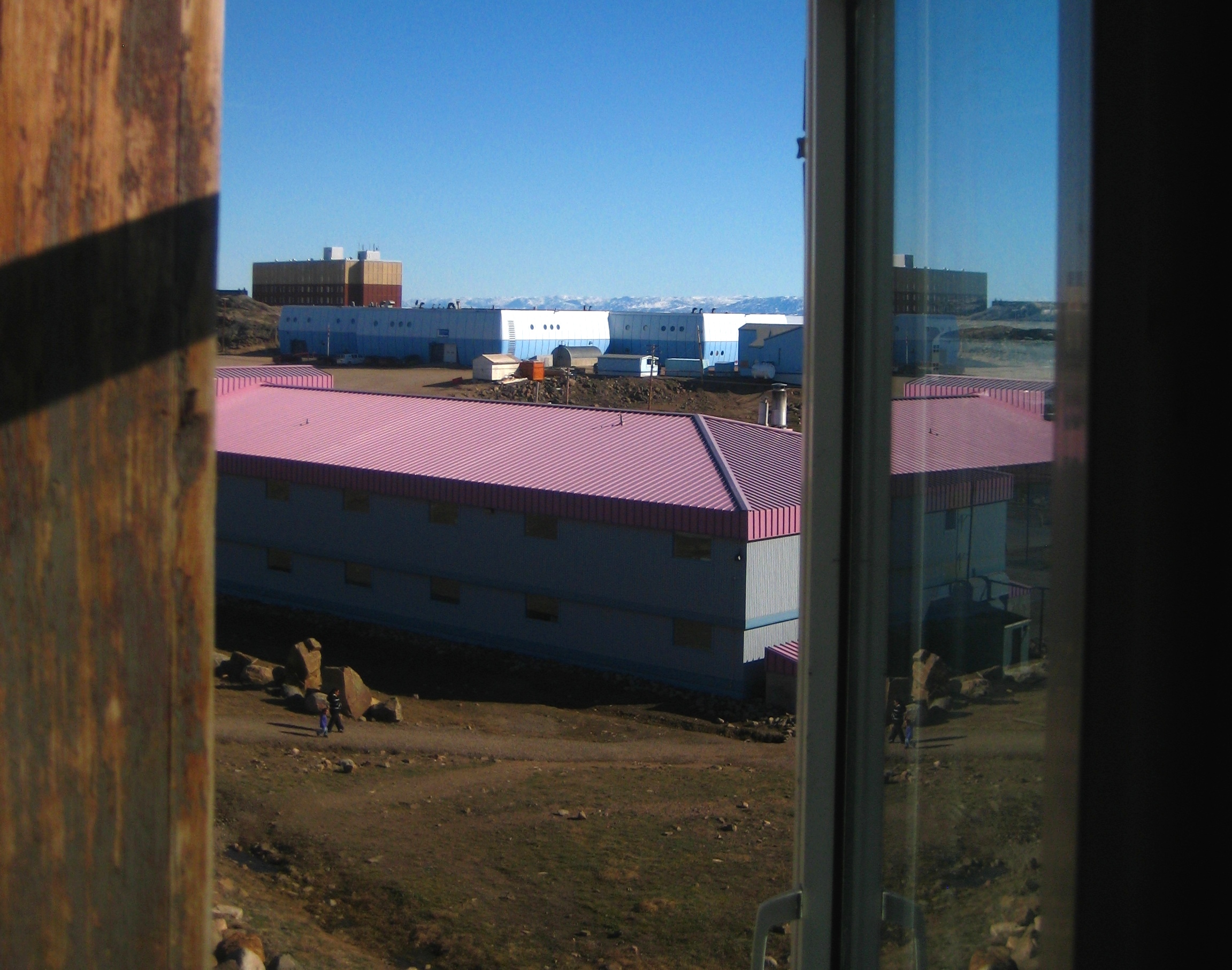
Well, we knew this was coming, didn’t we? We have what appear to be prefabricated buildings of recent vintage, on a rocky, barren, and otherwise undeveloped landscape, with snowy mountains off in the distance. Somewhere in the Arctic, during the summer. A woman and child walk in the foreground – Inuit, perhaps? So let’s say Alaska, somewhere along the North Slope, and for sake of specificity call it Barrow, even thought I cannot pin down these buildings on maps of the town.

Another gets fictional:

Taken from the office of Gustavo Fring at the Los Pollos Hermanos Compound, just outside of Albuquerque, New Mexico.

Another heads much farther south:

After spending a disconcertingly long time on Google Maps in Satellite View, I’m going to go with Potosí, Bolivia. It actually might be any other city in the Bolivian Altiplano, but I’m tired of satellite view and Potosí looks about the right amount of brown. Plus, it’s an important mining city, and the edge of that pit looks like a mine.

But for all I know, that’s a tar-sands operation in Alberta and I’ve just spent two hours in the wrong hemisphere. This might be the most challenging contest you all have done! I opened the photo today and said, “Ugh.”

Wrong hemisphere. Another gets the wrong planet:

Mars? There was a story on This American Life / Love + Radio last week about a Mars station to host 4 humans is 2023. This may be the terrestrial training ground. Looking in the arid, iron rich soils of greater Mongolia I worked my way to some disputed lands between China, Kyrgyzstan, Tajikistan. Is this an homage to Chini or a nose-thumbing after two easy weeks? I’m not sure what Aksai Chin is, but it showed up on my Google map, and one can only assume the people who live there would be the Chini. There don’t appear to be any roofs in the area, but just by name association alone, I hope this is close, and I hope Doug found it.

To the right country:

To me the picture said Northern Canada, or possibly Alaska. But I’m guessing it wouldn’t be the US three weeks in a row. So after some half-hearted googling, I guess somewhere in Yukon, Northwest Territories, Canada. A vague guess, because it was a gorgeous weekend and I went apple picking on Saturday and then simply had to make pies and crisp on Sunday. I’d send you one, but Internet.

Another reader nails the province and town:

I got lucky on this one. I zoomed in to see the people walking down the dirt road, and thought they looked Inuit. I then thought of Nuuk, Greenland, which vfywc_223is at least pretty small and unique. When it wasn’t Nuuk, I looked at the Chevy van in the photo thought “oh, maybe it’s Alaska” – in which case, game over, because Alaska is huge and has dozens of tiny little settlements. But then I remembered Nunavut, Canada’s newest territory. I hopped on over to Iqaluit, and lo and behold, there was the crazy modular spaceship form of the high school. (By the way, kudos for making sure the flag was illegible.)
Another wasn’t impressed with our promise to make this week more difficult:

I haven’t submitted to the contest in some time.  But I was excited when you said this week would be harder than than recent contests, so I thought I’d go for the challenge.  Some challenge. The landscape was unmistakably Arctic.  Nunavut was my first guess. I was in Iqualit, Nunavut before my coffee was cool enough to drink.

Reality TV helped out this reader:

Got it in a flash thanks to the wonderful BBC program “A Cabbie Abroad”.  In it, London cab driver Mason McQueen visits remote places – Mumbai, Bangkok, Fiji and Iqaluit, to ply his trade:

Whilst the set up is about learning to be able to drive there, the really interesting part is how he gets to appreciate the plight of the locals.  In the case of Iqaluit it was the dispossession of the land of the indigenous people and the poverty, health and alcohol problems in the community.  He approaches it with an open mind and a real honesty and humanity.

A funny footnote though. In the program he has to master the house numbering system of Iqaluit, where there is one set of house numbers for the whole town, and by the end he has it mastered.

I actually contacted Mason on Twitter about the contest … and his guess was Colorado!

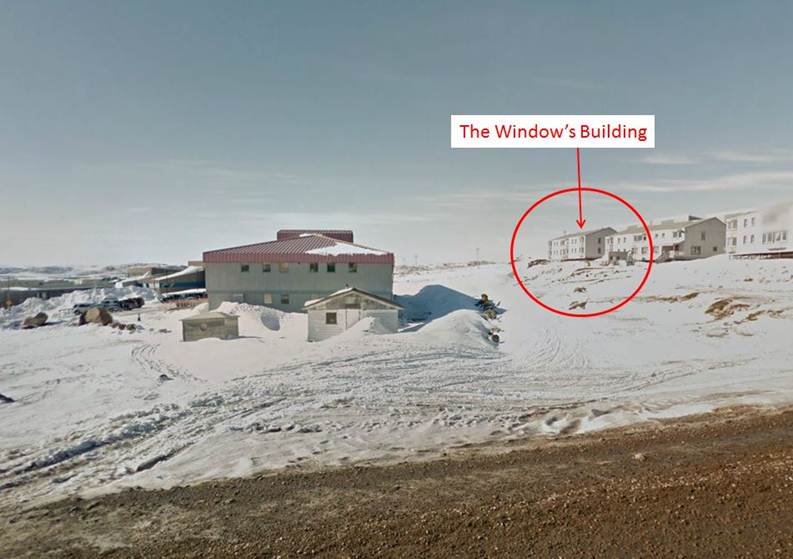
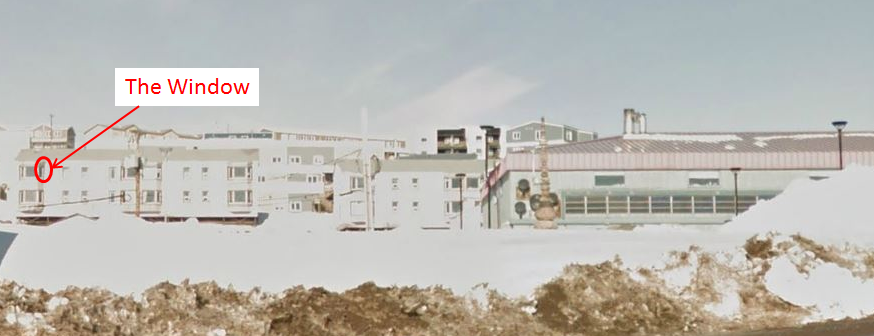
One reader has a fantastic visual walkthrough to nail the right apartment building:

Not a single legible sign. No automobile license plates. No distinctively styled lampposts or street signs. Now we’re talking!

First, I identified the key landmarks in the window’s view:

image019

Then I located those landmarks in the aerial image of Iqaluit:

image020

Here’s an alternative view of the apartment tower, seen from the east (rather than from the north):

image021

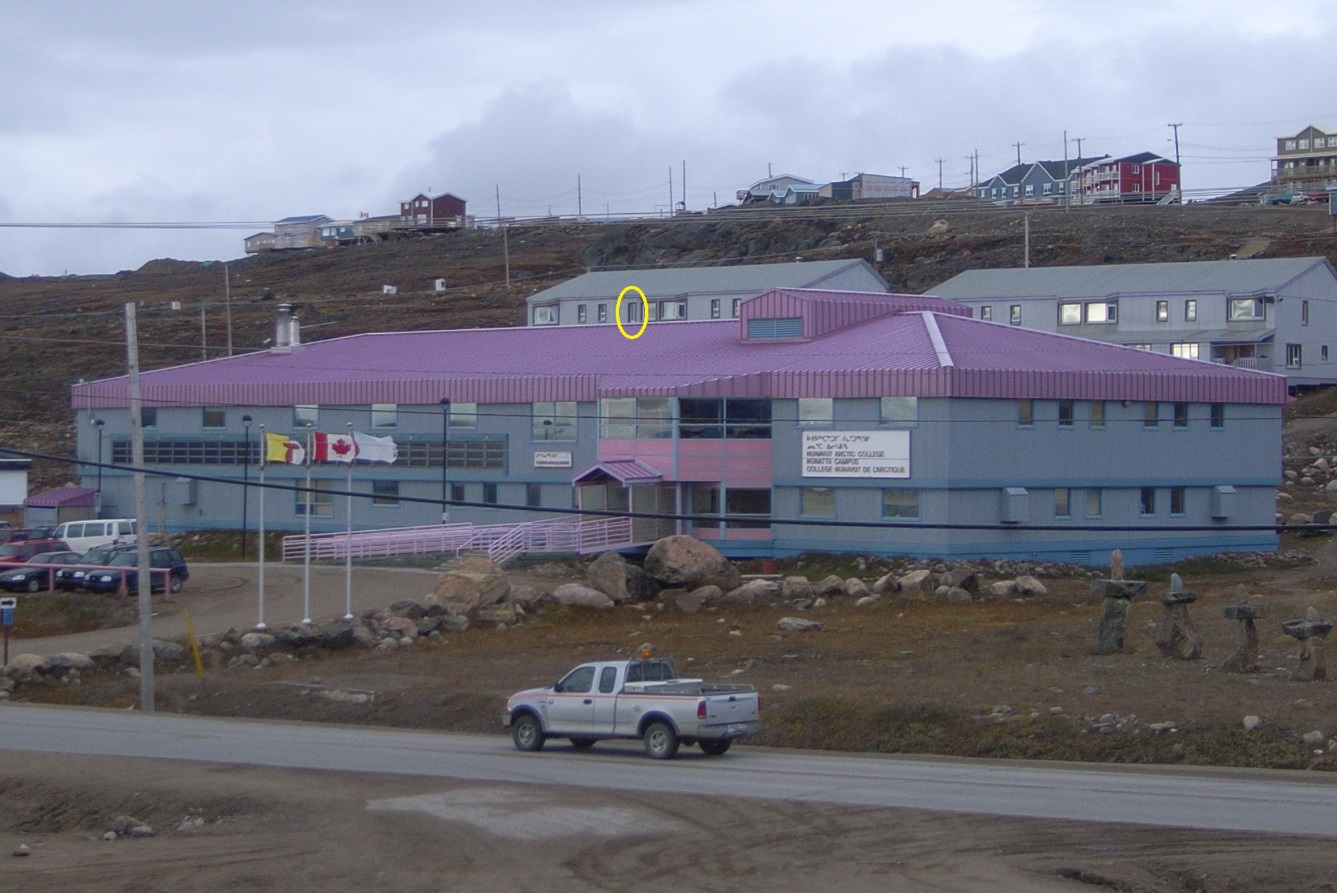
Given the line of sight, our window must be in the westernmost of 3 buildings on Qulliq Court, overlooking the Arctic College head office. (The qulliq, sometimes translated as kudlik, is a type of oil lamp used by the original Inuit inhabitants of Baffin Island.) Thanks to Street View, this building can be identified as 508 Qulliq Court.

image022

But which window? Given how much of the Arctic College’s roof that is visible in the VFYW, I believe that the photographer was on the second floor rather than the ground floor (even though the ground floor is itself higher than the roof). We also know that the photographer’s window opens. I surmise that it is one of the flanks of the building’s bay windows. Finally, given the angles from the landmarks to the window, I believe that the picture was taken from the westernmost bay of 508 Qulliq Court:

image013

Based on what I’ve read today, I believe that 508 Qulliq Court and its neighbors are housing belonging to Nunavut Arctic College. If I’ve identified the correct bay window, the VFYW picture was taken from Unit No. 27.

Another notes:

I’m actually rather impressed that there’s Google Street View for this city, given that it’s accessible only by plane and is the smallest and most remote of the Canadian provincial/territorial capitals.  And this was the first time that Street View wasn’t actually a lot of help since the snow banks are so high that it’s hard to get a good view in any direction.

The Street View story is pretty cool, as this reader discovered:

Having been to Alaska for work a few times, my gut reaction was somewhere in the North American Arctic. The signs are:

  • A lack of any foliage suggesting it gets very snowy and cold.
  • Large metal buildings which are fast to construct during summer, cheap to transport their raw materials, and big enough for the community to spend all winter inside
  • Lots of chimneys on roofs, curved over to prevent snow falling in.

That didn’t give me much to go on but searching for “Arctic Towns in Canada” I got lucky and came across a video by Christopher Kalluk – who took Google Street View images by walking around town carrying something like R2D2 on his back:

From that video I quickly found the three buildings shown, and the apartment complex.

Finding that was great fun.. even better was finding this Google Street View image of Christopher on a sled being pulled by dogs. Amazing!
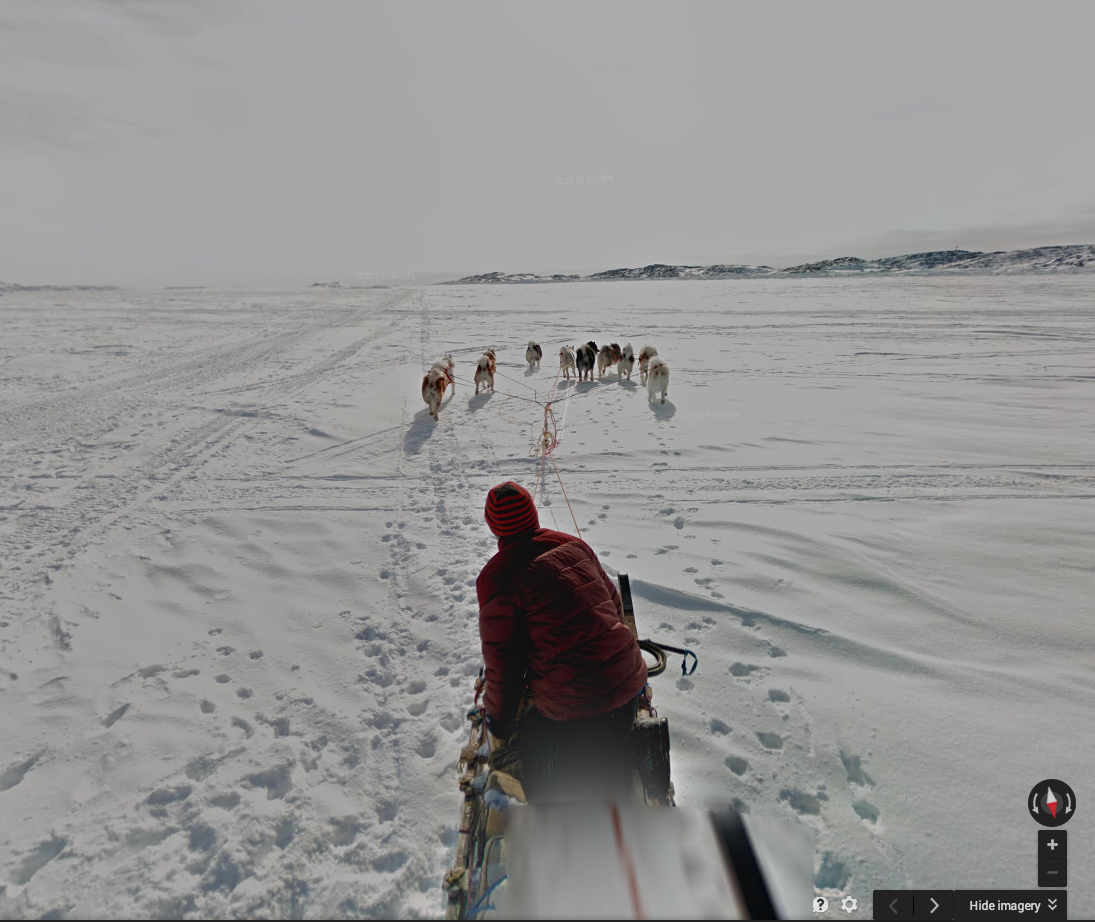
Screen Shot 2014-09-23 at 11.40.03 AM

Don’t forget the donuts:

To show just how thoroughly the Canadians have conquered the Arctic, consider this local establishment (notice the slogan written in Inuktitut syllabics):

timmys

As always, a reader informs us about the town:

Founded in 1942 as an American air base, accessible mainly by air (by boat in the summer, and dogsled and snowmobile in the winter), Iqaluit grew in the 1950s due to a NORAD radar station project. In 1958, there was a proposed plan to build the city under a giant concrete dome.  Seriously!  It was to be artificially lit, heated to -6°C (21°F) in the winter, and powered by nuclear energy. Thankfully the dome did not come to pass (Iqaluit is apparently a great place to see the Northern Lights), although it would have made for an excellent reality show today.

Notable Iqaluit current events include the opening of the first beer and wine store in 38 years (an attempt to quell the alcoholism made worse by prohibition), the extinguishing of a 4 month long town dump fire, and the ouster by the city council of the chief administrative officer. These incidents are supposedly unrelated.

Another reader connects the view to last week’s big story:

Iqaluit is an interesting choice just a week after Scotland’s vote for independence. Nunavut is in its 15th year of territorial quasi-self rule.  The split from the Northwest Territories was a major victory for Native sovereignty and self-government, even though it is still governed by Canada.  That fight continues in Canada and around the world. Here in the US, we have Native Hawaiians toying with taking the illegal overthrow of its monarchy to the UN, Akwesasne Mohawk insists it is sovereign territory straddling the US-Canada border (they issue their own passports), and the Navajo Nation is stretching its legs with the idea of becoming a “state” for Medicaid and Medicare purposes.

A previous winner provides a soundtrack:

This VFYW contest has a tenuous connection to the Dish’s new and sporadic cover song contest.  The White Stripes played Iqaluit (pop. 6,699) on there final tour in 2007.  The tour was a long trek across Canada.  Their movie about the adventure Under Great White Northern Lights contained footage of the Iqaluit stop and the accompanying album’s cover is a doctored picture of Jack and Meg walking near the shore in Iqaluit (about here; the old location for a Hudson Bay Company post).  The set list for their show at Iqaluit’s Arctic Winter Games Arena included their covers of Dolly Parton’s Jolene, Blind Willie Johnson’s John the Revelator, and Son House’s Death Letteramong others.  Although not a cover, I prefer Gillian Welch’s retort Time (the Revelator).

Another regular reader offers a dissent:

Could you please stop quoting from Chini’s responses every week? It’s like the guy in class who always raises his hand. Nobody wants to hear from him every time.

Perhaps, but plenty of other readers look forward to his little blockquote column every week, as do we:

VFYW Iqaluit Actual Window Marked - Copy

Bare dirt, tiny windows, thin grass; yep, we’re hell and gone from the equator. At first blush that might seem to make this one crazy hard but it’s actually helpful; there simply aren’t that many people living at these latitudes. Not to mention the dead giveaway at center left; once you saw it, this one became an insta-find (for myself and presumably quite a few others). Chini kuviasungitok!

This week’s view comes from Iqaluit, the capital of Canada’s Nunavut province. The picture was taken from a second floor window in residence building #508 on the campus of Nunavut Arctic College and looks almost due south along a heading of 170.21 degrees.

Here’s the location of two Iqaluit views that the Dish featured back in 2008/2010 alongside this week’s shot:
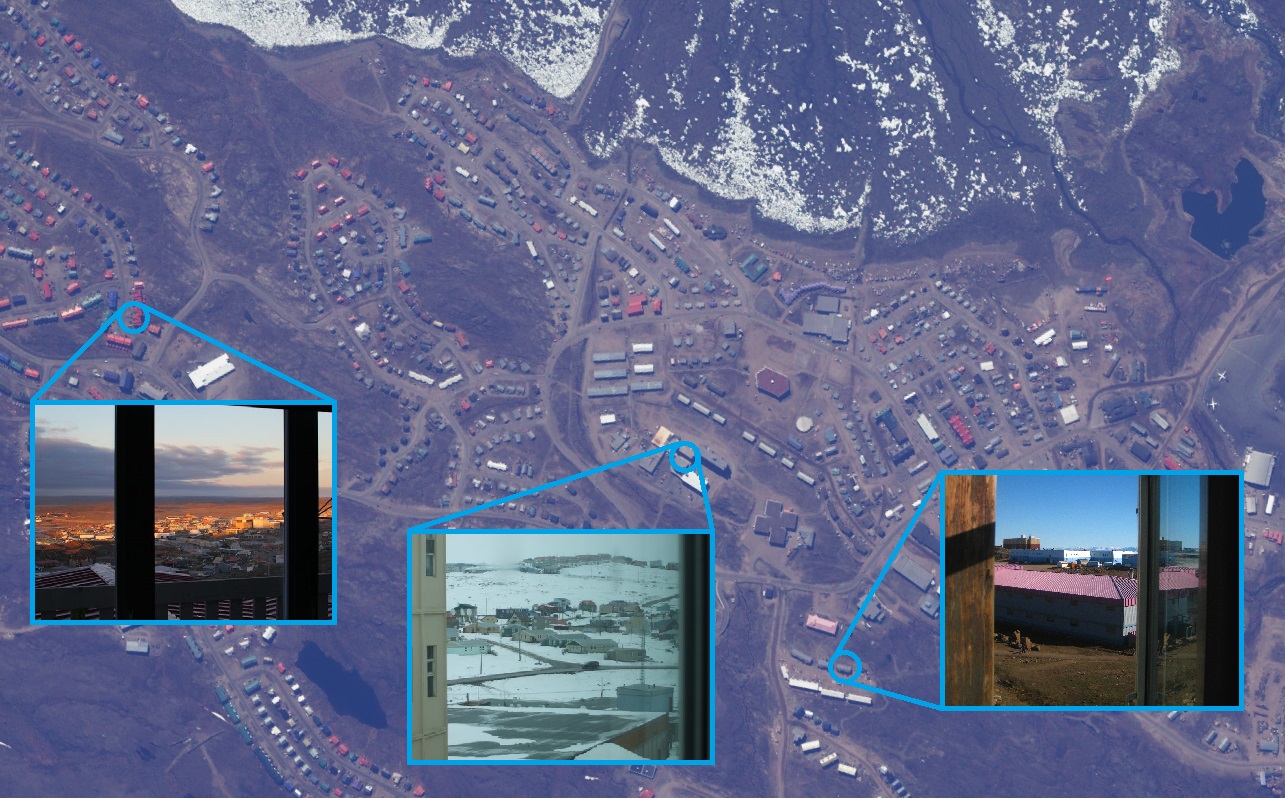
VFYW Iqaluit Other VFYWs 2 - Copy

And here’s this week’s winner, who also gives us a colorful architecture tour:

I’m not a world traveller, so each week I hope for a familiar view of Canada or the US. This time I identified the scene immediately: Iqaluit, capital of the territory of Nunavut, Canada. I was there a year and a half ago; you actually published my view from my sister-in-law’s window in the suburb of Apex.

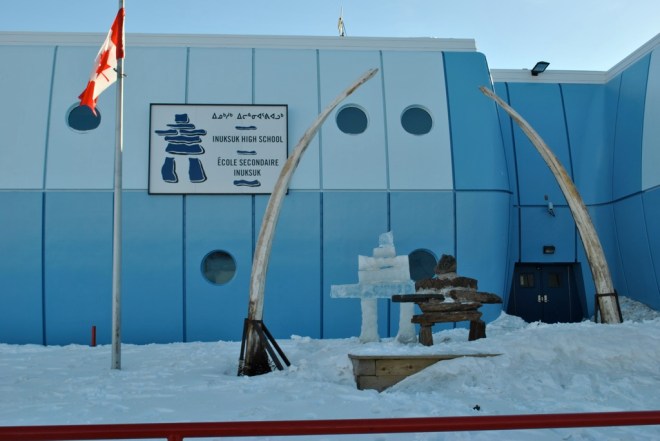
The giveaway is the two-tone blue Inuksuk High School, with its distinctive porthole windows and fibreglass panels, pictured here, behind an arch of bowhead whale bones:

Inuksuk HS

Behind it is the brown and tan Frobisher Inn. Anyone who has visited the city (population 7250) will recognize these landmarks. The architecture of Iqaluit can be quite striking, such as Nakasuk Elementary School, which could pass as a lunar research station:

dsc_1226

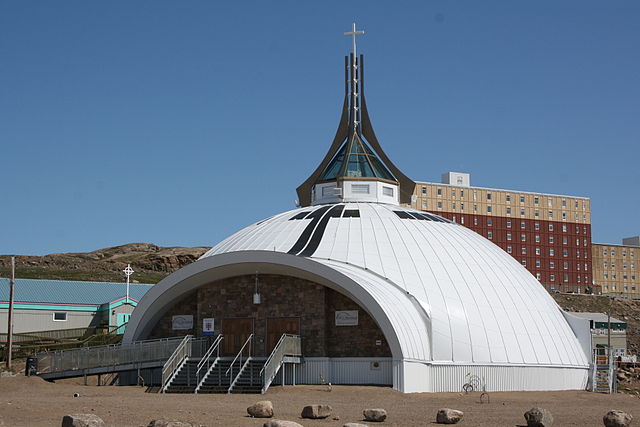
And the igloo-shaped St. Jude’s Anglican Cathedral:

640px-Iqaluit_St._Jude's_Anglican_Cathedral_2012

It’s also very colourful, which helps break up the white of winter. Bold colours are popular for residential buildings:

ii_i0eb2e3n2_1489f311693c6e5d

And the bright yellow of the Iqaluit Airport is easily spotted from a distance:

ii_i0eb625h3_1489f33b4c2365ce

I’m pretty confident the photo was taken from an apartment in the building I’ve indicated on the map below, based on the angle of the window opening to the hotel and high school, and the angle of the roof hip of the Nunavut Arctic College in the foreground.

ii_i0eb82hk4_1489f35221f23f08

I’m less certain about the exact window, but I believe it’s the left window of the second bay window unit from the left, on the southwest side of the building, on the second story. I chose this one because the perspective of the view appears to correspond roughly to the middle of the building, and since I assume the hinge of this swinging window would be on the wall side of the frame, not the side protruding from the building:
ii_1489f2b5d196e98a

We confirmed the above image with the reader who submitted this week’s view:

That’s absolutely the window! Facing out the right. I opened the right side of the bay window to get the shot. The Dish sleuths do it again.

The view is from an apartment (Apartment Q-26, QI Complex) that was made available to short term researchers associated with the Arctic College, part of which is seen in the foreground with the pink roof. The distinctive blue building with the portholes is the Inuksuk High School. The taller brown building beyond is a hotel with cafe and theatre, the tallest building in Nunavut and part of the Astro Hill complex.

Thanks to all for the many great entries this week. Many of them come to you in this collage:

VFYWC_Collage_223

(Archive: Text|Gallery)

A 19th Century Frenchman Explains the 21st Century Middle East, Ctd

A reader writes:

Mitchell had me until the final paragraph of your excerpt: “In the meantime, in the interludes of peace, diplomatic and cultural outreach and, above all, higher education initiatives intended to help the younger generation understand and thrive in the disenchanted world it will inherit offer perhaps the most constructive ways to engage the region.”

Empirical study of Islamist extremism, looking both at political and ideological commitment and at participation in violence, have shown that higher education correlates with higher, not lower, commitment dish_Tocqueville_by_Daumierto the dream of “returning to an enchanted world for which an imagined Islam provides a ready guide.” (See Krueger and Maleckova’s “Education, Poverty, and Terrorism: Is There a Causal Connection?” for an entry into the modern literature.)

Worse for Mitchell’s conclusion is that the correlation between education and Islamist radicalism is more pronounced among those who have earned advanced degrees in technical subjects rather than religious studies – and also more pronounced among those who have studied in the West.

This shouldn’t be a surprise to any reader of Tocqueville – his world was one that had only recently emerged from a generations-long spasm of violent religious extremism in which the best-educated and most entrepreneurial few fueled the violent radicalization of the many in the name of ever purer faith. The shadows of Reformation extremism and violence cast themselves across Tocqueville’s view of America, overtly in several chapters. When Weber wrote of the “Puritan work ethic” eighty years after Tocqueville, he was describing a continuity of habits of thought and conduct from the time when educated, industrious, entrepreneurial Protestants plunged Europe into maniacal religious terror.

Education, at least in the near term of a few generations, is not the answer. Or anyway, education for men will not solve the pathologies of the Middle East – better education and entrepreneurial spirit among Middle Eastern men may in the long run be necessary and virtuous, but in the short run, more educated and industrious men likely means more extremism, illiberality, and violence, not less.

It’s an American heresy to believe that education may not be the answer to everything. But it can be true. I think Mitchell’s core point is that violent Jihadism is a response to the bewildering terror that modernity evokes for many in the Arab and Muslim worlds. It is thereby reactionary in content but truly modern in form and style. We see this in a much milder fashion with American Christianists. Modernity for many Christianists is really a function of sin and decadence; and the more modern the world the more reactionary and pure must the religion be. And so we have seen a remarkable surge in fundamentalism in an era when the Founding Fathers assumed we’d all be deists at most.

Some liberals forget this. Liberals forget it because many find religious faith ludicrous and cannot quite internalize the fact that fundamentalism often has the strongest appeal to some of the most intelligent people around. Some conservatives don’t get this because they always assume that religion is a force for tradition and continuity, while in actuality it can become radically disruptive and, in its fanaticism, very modern indeed. Modernity emits the fumes that fundamentalists huff.

What does this mean about the Middle East?

To me, it means that this violent and radical psychosis we call Jihadism is not going to go away any time soon – and the attempt to stop it from the outside is almost certainly likely to energize and inspire even more anti-Western, anti-modern fundamentalism. My view is that we have to hang tight, keep calm and carry on. In so far as we can divert these powerful passions away from us, we should. The hope is that, just as Europe had to fight itself until it had become a bloody human abbattoir in the sixteenth and seventeenth centuries before turning away from theocratic madness, so too may the Arab and Muslim world in the century ahead. This is a stage that the Arab world has to go through. It will not be pretty, and it might not end well. But we cannot do much to control that. We merely have to limit the damage – to us and to humanity.

And in that respect, I remain of the view that the most under-rated achievement of this president in his second term was his deft maneuvering to get Syria’s WMD arsenal out of the country and destroyed. It’s the WMD issue that could truly make the long Muslim civil war an apocalyptic one. Obama achieved in Syria without a shot what Bush failed to achieve in Iraq with a grinding, lost war. Maybe one day, that will be better understood, and the wisdom of a minimalist approach to anti-terrorism better appreciated and understood.

(Sketch of Tockers by Daumier)

What The Hell Is Happening In Yemen?

Maria Abi-Habib explains how the Yemeni capital came to the brink of a coup this weekend during the worst fighting since the 2011 overthrow of former president Ali Abdullah Saleh:

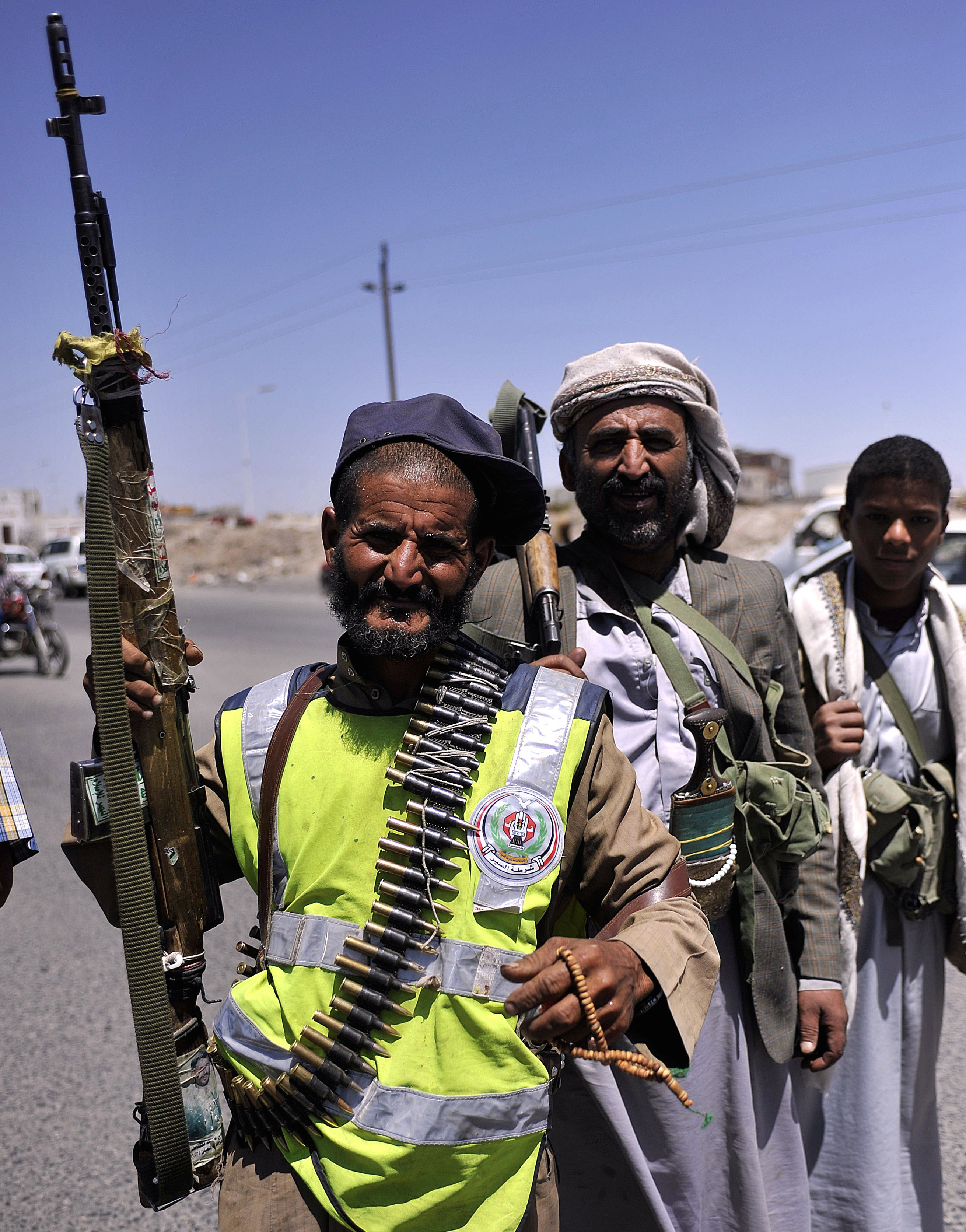
The militants known as Houthis have been protesting outside government ministries in the capital Sana’a since August, complaining about Houthi rebels take position around Yemeni Government TV in Sanaarising fuel prices and demanding the government quicken the pace of political overhauls. By Sunday evening, they had taken over the central bank and the defense, interior and finance ministries, adding to advances last week that included the airport.

Shortly after Sunday’s takeover, the Houthis, President Abed Rabbo Mansour al Hadi and most of the country’s major parties signed a United Nations-mediated cease-fire that included an agreement to form a new government. Mr. Hadi will choose the next prime minister but must consult with the parties that signed the agreement, details of which were scarce. The Houthis are likely to have an edge in those negotiations after their recent display of force.

Khalil Harb suggests that the Houthi movement acted “strangely” by inking a deal “while having all the makings for a successful coup d’état in their grasp.” Meanwhile, Peter Salisbury notes that many Sana’a are skeptical that the deal will hold:

“Considering the massive military victories the Houthis have gained in recent days, it’s quite hard to imagine they’d give up Amran and al-Jawf in the absence of massive concessions,” says Adam Baron, a London-based Yemen analyst who lived in the capital for three years. “Concessions that the government is unlikely to be willing, or able, to give,” Baron said.

Others argue that the Houthis clearly have their sight on Maj. Gen. Mohsen, a presidential military adviser who led successive campaigns against the Houthis in Sa’dah between 2004 and 2010.”I just don’t see the Houthis coming this close to him [Mohsen] and giving up,” says a Yemeni politician who spoke on condition of anonymity. “He devastated Sa’dah for years, and they think had [the Houthis’ founder] Hussein al-Houthi killed [in 2004]. It’s hard to believe they’ll take political gains over revenge and power.”

Ibrahim Sharqieh explains how it got to this point:

After Saleh was overthrown in 2011, the new transitional government acknowledged the past mistreatment of the Houthis, and officially apologized for the six wars Mr. Saleh waged against them between 2004 and 2010. But it did not address all of the historical grievances of the Houthis, who pressed on with their insurgency. Many Yemenis believe that the Houthis are acting as agents of Iran, which backs them. To legitimize their rebellion, the Houthis had to come up with popular proposals to address rising energy prices and incompetence in the government. It was the poor performance of Yemen’s transitional government that allowed them to succeed. President Hadi, and his government – including Prime Minister Mohammed Salem Basindwa, who just stepped down – failed miserably to deliver basic services, spur economic development and, most important, create jobs. Unemployment was one of the main drivers of the revolt against Mr. Saleh.

Gregory D. Johnsen notes that the Houthis have “moved far beyond their narrow sectarian origins” over the past two years:

They have broadened their appeal beyond their traditional power base of Zaydi Muslims – a branch of Shiite Islam that is relatively close to Sunni Islam – and in the process become Yemen’s primary opposition group. They are also, as the latest agreement makes clear, the closest thing Yemen has to a kingmaker. The Houthis may not have enough power to impose their will upon the rest of the country, but they now have enough supporters and weapons to act as an effective veto on Yemen’s central government. This is a remarkable turnaround for a group that once believed itself to be on the verge of political and religious extinction in Yemen.

Adam Baron agrees that the conflict shouldn’t be viewed through the prism of sectarianism, “even if the Houthis are largely followers of Zaidism, a northern Yemeni brand of Shia Islam, and their adversaries are overwhelmingly Sunni Islamists”:

The Houthis’ biggest achievement has been to transcend their roots in the mountains of the devoutly Zaidi far north to position themselves as a national movement. Notably, the Houthis’ ties with Iran notwithstanding, the Gulf Co-operation Council (GCC) has issued a statement welcoming the peace agreement. The Houthis themselves acknowledge that they have received political and media support from Iran, while their adversaries claim that they receive Iranian arms and funding, something that has long raised the suspicions of Yemen’s Gulf neighbors.

Meanwhile, Zack Beauchamp reminds us that the situation in Sana’a isn’t the only conflict roiling Yemen:

As if the Houthi movement wasn’t enough, southern Yemen plays host to an entirely separate Sunni Islamist rebellion. Al-Qaeda in the Arabian Peninsula (AQAP) is the driving force here, along with Ansar al-Sharia, a group that’s either simply an extension of AQAP or affiliated with it. The weakness of the Yemeni government and broad national insecurity, as discussed above, has allowed AQAP to fester here. While Yemeni government offensives and a US bombing campaign have pushed AQAP out the most populated areas in southern Yemen, the group still has a hold a lot of territory in the rural areas of the region. The US National Counterterrorism Center sees AQAP as the terrorist group “most likely to attempt transnational attacks against the United States.”

The two rebellions are not directly linked, but the Yemeni government’s inability to fight informs its failures against the other, and the weaker that the government gets, the easier it will be for both groups to grow unchecked.

(Photo: Houthi rebels take position around Yemeni Government TV during the clashes between Houthi rebels and government forces in al-Caraf north of Sanaa, Yemen on September 21, 2014. By Mohammed Hamoud/Anadolu Agency/Getty Images)

Militia Rule In Iraq

Omar el-Jaffal explains how Iraq’s militias feed off the country’s political dysfunction:

[The militias] cannot sustain themselves except through manufacturing sectarian fear mongering and cannot attract new fighters except through the new wars that they wage. The egregious economic situation, coupled with the rise of unemployment rate among youth, plays a significant role in the increase of those who enlist in the militias and in the expansion of their scope of activity both in Shi‘i and Sunni areas. This is particularly due to the fact that these militias receive international, regional, and local funding. …

Taking into account the high population growth in Iraq (estimated at 3.1 percent), Iraq will remain a fertile ground for militias in the near future if al-Abbadi government follows in the footsteps of previous governments. This in turn, will lead skilled Iraqis, especially the youth, to leave the country making Iraq a state officially ruled by militias. Currently, none of the dominant Iraqi parties are making an effort to build a state that respects the constitution and takes security into its own hands. All parties prefer to deploy militias, rather than official troops, to maintain security in conflict zones because militias extend the influence of parties in the society. Parties expand the scope of activity for militias because the latter constitute a guarantee for them to remain in power and a tool to intimidate those willing to oppose them, not to mention the fact that allegations of corruption are mounting up against political parties.

Now Will Turkey Tackle ISIS?

John Kerry - Recep Tayyip Erdogan

Turkey’s hostages were freed over the weekend:

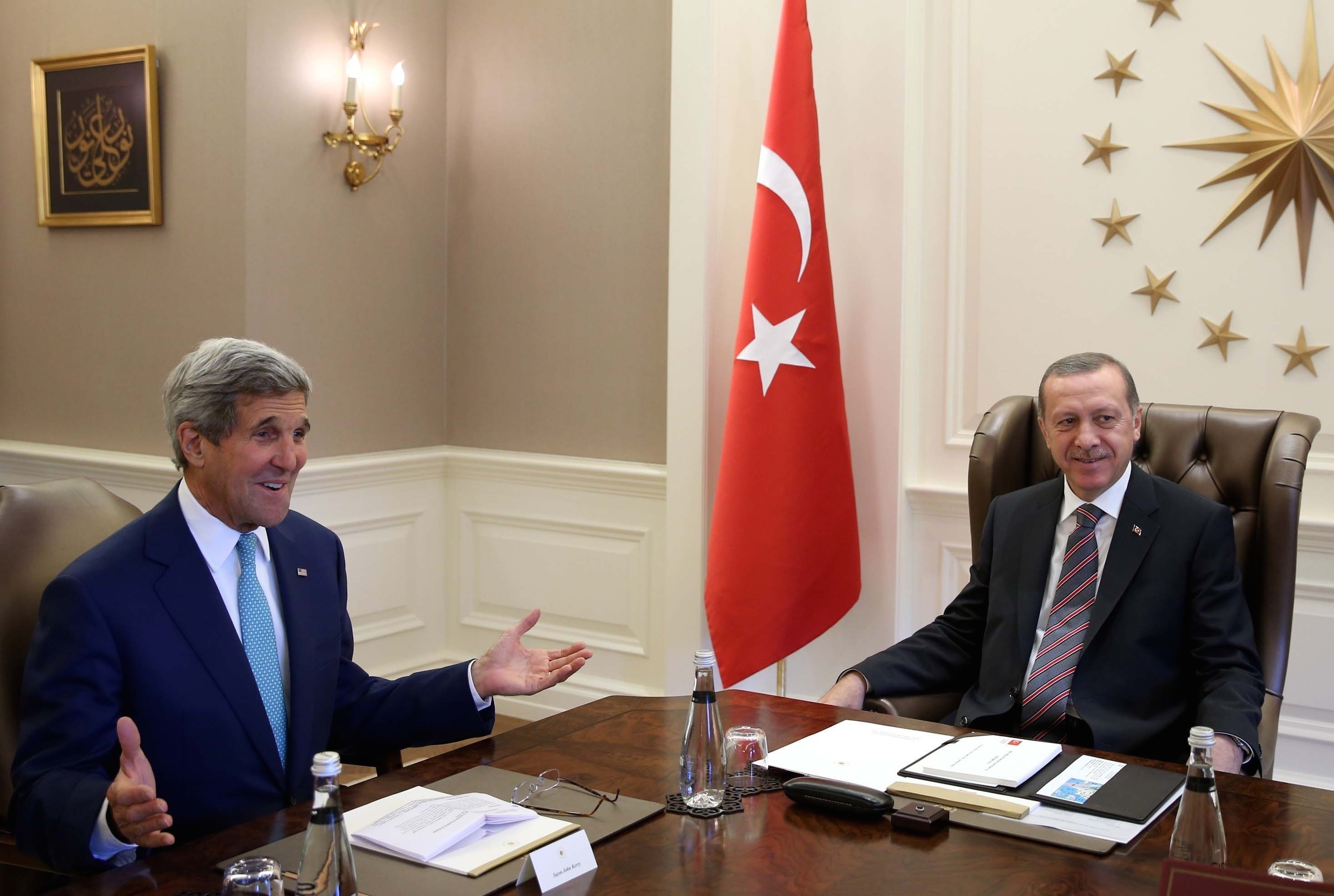
Turkey’s President Recep Tayyip Erdogan said Sunday that the release of 49 hostages held by Islamic State had removed the main obstacle to joining a U.S.-led coalition against the extremist group, spurring hopes that Ankara would take a more robust role.

The US is certainly eager for Turkey to join the fight. Joshua Keating explains:

The U.S. badly wants Turkey to take a prominent role in its anti-ISIS coalition, including allowing its bases to be used to launch airstrikes. Ankara has been reluctant to fully commit to the effort so far, due to fears of blowback and, in particular, concerns about the status of the Turkish hostages. Secretary of State John Kerry said today that now that the hostage situation has been resolved, he expects Turkey to commit its resources to the fight. “The proof will be in the pudding,” he said.

Joshua Walker encourages Turkey to act:

The alternative of Ankara remaining on the sidelines once again dooms Iraq to the same outcomes it faced the last time Turkey chose not to participate. Unlike last year when Erdogan bemoaned the lack of international consensus behind acting in Syria, he should seize the initiative that President Obama has already provided with airstrikes and increased surveillance against a universally acknowledged threat to galvanize an international response. Only time will tell if Washington can “reset” its Turkey policy by bringing Ankara into its coalition by a mix of private tough love and public flattery. Assuring Ankara that the anti-ISIS coalition will not harm its own national interest, but rather help eliminate a mutual threat that Turks are struggling to cope with further through economic assistance for the refugees already within their borders and potentially creating defactobuffer zones within existing ISIS territory would go a long way. Making Turkey the tip of the spear against ISIS would defuse any anti-Islamic theatrics and also help plan for a post-ISIS future that involves complicated questions about the status of the Kurds that Ankara is particularly worried about.

But Marc Champion foresees complications:

Erdogan aggressively committed himself to Assad’s demise soon after Syria’s military began slaughtering protesters in 2011. He opened Turkey’s borders and coffers to opposition groups willing to fight the Syrian dictator, including Islamist radicals. Whether or not Islamic State received any of this official support, it has been recruiting within Turkey and is embedded among the 850,000 Syrian refugees on Turkish soil.

(Photo: By Kayhan Ozer/Anadolu Agency/Getty Images)


Syrians Don’t Really Want Our Help?

That’s what Edward Dark reported last week:

[I]t would be foolish to believe that US military action against IS is popular here or will go down well, especially when civilian casualties start to mount. On the contrary, it will most likely prove counterproductive, stoking anti-Western resentment among the population and increasing support for IS, driving even more recruits to its ranks.

The terror group knows this well, which is why it is secretly overjoyed at the prospect of military action against it. In its calculations, the loss of fighters to strikes is more than outweighed by the outpouring of support it expects both locally and on the international jihadist scene. And its fighters are not afraid of martyrdom by US bombs. In fact, the chance for martyrdom is why many of them came to fight in Syria in the first place.

The Quantified Cop

Dara Lind suggests big data can help police departments identify racially-biased officers:

A growing body of research is showing how people subconsciously act on racial stereotypes without even realizing what they’re doing – a phenomenon known as implicit bias. (My colleagues and I have written about implicit bias in depth, especially as it influences policing and criminal justice.) Now, academics are working to figure out how to counteract those subconscious biases – and how to raise awareness of implicit bias in the real world, especially in police departments. UCLA’s Center for Policing Equity has been working with police departments to figure out whether, and when, cops are letting their implicit bias guide their decisions about who to stop and arrest.

In Denver, for example, researchers are tracking the arrest records of individual police officers, to see which officers might be arresting people of color disproportionately and why. And in San Jose, they’re working with a database of mugshots to check whether cops are more likely to arrest people with stereotypically African-American features — which are subconsciously associated with criminality and can even lead juries to give someone a harsher criminal sentence.

America’s Newest War Spreads To Syria

US launches air strikes against Isil in Syria

The Guardian is live-blogging the US airstrikes against ISIS in Syria. Juan Cole expects them to do little good:

The some 22 sorties flown on Monday will have killed some ISIL terrorists, blown up some weapons warehouses, and destroyed some checkpoints. But ISIL are guerrillas, and they will just fade away into Raqqah’s back alleys. The US belief in air power is touching, but in fact no conflict has ever been quickly brought to an end where US planes have been involved.

Mark Thompson agrees the airstrikes will have limited impact:

The new attacks, against fixed ISIS targets, undoubtedly did significant damage. But they also will force ISIS fighters to hunker down, now that their sanctuary inside Syria has been breached. This means that the jihadists, who have shown little regard for civilians, will move in among them in the relatively few towns and villages in eastern Syria, betting that the U.S. and its allies will not attack them there and risk killing innocents.

That could lead to a stalemate. While air strikes are likely to keep ISIS from massing its forces, and traveling in easy-to-spot convoys, air power can do little to stop small groups of fighters from billeting with and intimidating the local population.

Jeffrey Goldberg admits that “there exists no strategy for victory, and no definition of victory”:

The advantage of launching strikes against ISIS positions early in this fight is that its commanders now have to spend extraordinary amounts of time, energy and resources merely digging in, and protecting their human and materiel assets, rather than pushing on, toward Baghdad, Jordan and Saudi Arabia. A terrorist preoccupied with his own survival has less bandwidth to threaten yours. But these strikes will not bring about the end of ISIS. Like other terror groups, it can “win” this current round of fighting by surviving, and maximizing civilian casualties on its own side.

The relatively easy task for airpower—of blunting ISIS’s lightning offensives against Iraqi cities—may already be accomplished. ISIS has not captured major population centers in Iraq since the beginning of the air campaign and in some areas, such as Haditha and the Baghdad suburbs, it is contributing to modest counteroffensive gains. Tactically, ISIS’s efforts to offensively employ heavy weapons, mass forces on technicals, and stage large amounts of its infrastructure in the open are highly vulnerable to airstrikes. However, it is important to remember that even in Iraq, where the United States has multiple partners and embedded advisers, these airstrikes have yet to precipitate major counteroffensive gains by Iraqi security forces. ISIS has repelled two major counteroffensives in Tikrit using a variety of guerrilla tactics, suggesting that it remains formidable defensively, a strength airpower has rather more difficulty countering.

ISIS’s tactics and structure suggest that rather than hitting only massed ISIS forces in Iraq and its fixed infrastructure across both Iraq and Syria, an offensive campaign should target its battlefield leadership and the elements of the organization necessary for sustaining and coordinating its operations across the region.

But Julien Barnes-Dacey doubts we can defeat ISIS:

The respective positioning of non-IS rebels and Assad highlights an inconvenient truth: as long as Syria’s civil war rages, international attempts to defeat Islamic State militarily will be significantly hampered, particularly if regional allies are also pulling in different directions. While tactical lines may shift as a result of air strikes, they are unlikely to provoke significant strategic realignments. Given their likely inconclusive nature, they risk drawing the West into deeper intervention. While Obama has clearly stated that US intervention in Syria will remain limited, those calling for wider action may see the proposed initial strikes and arming of rebels as the thin edge of the wedge, with further escalation inevitable.

Significantly, narrow air strikes that inflict collateral damage and leave the regime unscathed also risk further empowering Isis, consolidating its self-declared position as the only legitimate defender of Syria’s Sunni population. Isis’s apparent goading of the US to intervene in Syria and Iraq through the public beheading of a number of hostages may appear misguided given the power that the American military can bring to bear. But blunt military intervention may help entrench local support behind the group.

Larison sighs:

Loose talk of “destroying” ISIS practically demanded expanding the war into Syria. Obama stated he would not hesitate to do this. However, there is even less reason to think that U.S. air power will have the desired effect there than it will have in Iraq. It will not be lost on Sunnis in Syria and Iraq (and elsewhere) that the U.S. didn’t intervene directly in the Syrian civil war until it came time to attack a group opposed to their sectarian enemies. Even if the U.S. is not actively cooperating with the Syrian regime in all of this, it will be perceived as siding with it in the current conflict, and that will be to the detriment of American security now and in the future. For the second time this century, the U.S. is fighting a war that will benefit Iran and its regional allies and proxies, and it is doing so in a way that seems sure to trap the U.S. into open-ended fighting for many years to come.

Greenwald piles on:

Six weeks of bombing hasn’t budged ISIS in Iraq, but it has caused ISIS recruitment to soar. That’s all predictable: the U.S. has known for years that what fuels and strengthens anti-American sentiment (and thus anti-American extremism) is exactly what they keep doing: aggression in that region. If you know that, then they know that. At this point, it’s more rational to say they do all of this not despite triggering those outcomes, butbecause of it. Continuously creating and strengthening enemies is a feature, not a bug, as it is what then justifies the ongoing greasing of the profitable and power-vesting machine of Endless War.

And Hayes Brown wonders what comes next:

So far, Washington is mum on just how long the United States plans to keep up the strikes in Syria, though reports indicate that they will not continue at the tempo seen last night. U.S. Central Command has said only that “the U.S. military will continue to conduct targeted airstrikes against ISIL in Syria and Iraq as local forces go on the offensive against this terrorist group.” As for the people living in the areas that are now the target of these airstrikes, residents are reportedly fleeing Raqqa as quickly as possible. “There is an exodus out of Raqqa as we speak,” one resident told Reuters. “It started in the early hours of the day after the strikes. People are fleeing towards the countryside.” As the civil war in Syria has already caused over half of its population to flee their homes, it can only be assumed that the new campaign against ISIS will only exacerbate the refugee crisis the region has struggled to contain.

(Photo: Syrian children stand on the ruins of a destroyed building during a search and rescue operation among the ruins of it, in a region of Idlib, a northwestern city of Syria, on September 23, 2014. The US launched air strikes against ISIS in Idlib. By AA Video/Anadolu Agency/Getty Images)

Slippery Borders

Chazimal_dispute_map_01

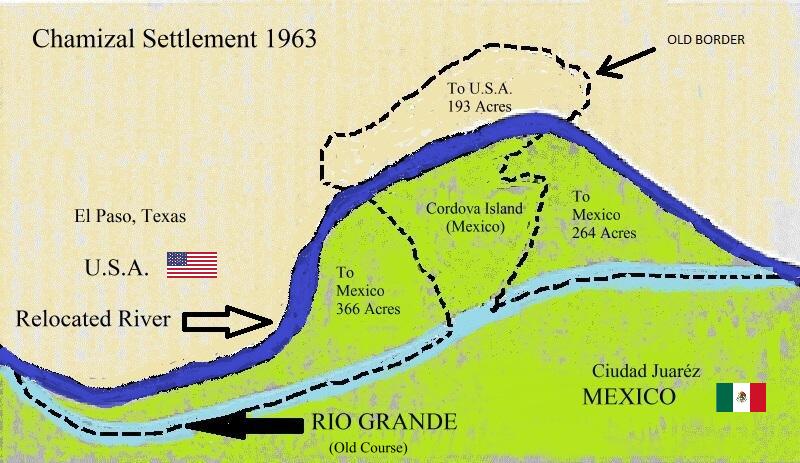
In a fascinating history of the Chamizal dispute, Paul Kramer considers what happens when nature refuses to respect national boundaries:

The whole point of setting the border between Mexico and the United States at the deepest channel of the Rio Grande was that the river was not supposed to move.

That was the thinking in 1848, when, following Mexico’s defeat by the United States and surrender of its vast northern lands, boundary surveyors from the two countries were tasked with reinventing the border. The choice of the river for the boundary’s eastern half had been obvious: its use as a territorial marker stretched back into the region’s Spanish colonial past, and it was hard to miss and often difficult to cross. But even as he filed his report on the completed boundary survey, in 1856, Major William Emory cautioned that the river might be an unreliable partner in border making. “The bed of the river sometimes changes,” he wrote, “and transfers considerable portions of land from one side to the other.”

Catastrophic floods in 1860 and 1864 demonstrated how fickle the river could be. The torrents were especially devastating where the river snaked between El Paso and Ciudad Juárez; here the south-moving current veered southeast and slammed into the southern bank, carving out new channels. … By the dawn of the twentieth century, the river’s recurring spring floods had dug a completely new bed for it farther south. About seven hundred acres of land that had once formed part of Mexico – the Chamizal, named for a scrubby plant that grew there – were now connected to the United States. Whether the border had shifted with the river, rounding out the war’s annexationist work, nobody knew.

He concludes:

It was unsurprising that boundary surveyors in the mid-19th century had turned to rivers, in awe and envy, to deliver their borders: the waters were more powerful than the governments that recruited them, and the demands placed on boundaries were light. Over time, the balance of power between states and nature shifted; by the mid-twentieth century, rivers that did not comply with states could be remade in their image.