Congratulations to Scotland on its Declaration of Dependence.
— God (@TheTweetOfGod) September 19, 2014
Category: The Dish
Live-Tweeting The Scotland Vote
Originally posted at 8.49 EST. Scroll down for the latest updates, in rough chronological order:
Will Scotland be the next country to join this list? http://t.co/9EmPmffRsw pic.twitter.com/QZuEhTkfJ3
— GlobalPost (@GlobalPost) September 18, 2014
Looking like turnout will end up around 87%. Yes would want that way higher ideally. #indyref
— Ben Riley-Smith (@benrileysmith) September 19, 2014
CNN reports that 110% of Scots definitely have an opinion on independence. pic.twitter.com/T0Vh9VVZUF
— JoeMyGod (@JoeMyGod) September 18, 2014
Looks like turnout could be reaching North Korean proportions. I can see why Kim Jong-un was intrigued. #indyref
— Armando Iannucci (@Aiannucci) September 18, 2014
Scottish turnout super high in part because *every vote counts equally*. Reason #625 to dump Electoral College in US.
— James Fallows (@JamesFallows) September 19, 2014
Better Together sources sounding confident, saying they’re certain they’ve got their vote out in droves. #indyref #Scotland
— James Cook (@BBCJamesCook) September 18, 2014
Loch ‘Yes’ Monster among those flocking to polling stations across the Lothians for #indyref http://t.co/Frq9VbCmmT pic.twitter.com/W1Xn8jDbsS
— Evening News (@edinburghpaper) September 18, 2014
Never thought I’d say this but a turnout of 75% in Glasgow is very disappointing. #indyref
— Stephen Daisley (@JournoStephen) September 19, 2014
Yes sources say data suggest Glasgow could be 54% yes, 46% no. Mood quite flat in the Yes camp though. #indyref #Scotland
— James Cook (@BBCJamesCook) September 18, 2014
Yes or No. Both bad options. #indyref pic.twitter.com/moRbXiGyoB
— dominic rushe (@dominicru) September 18, 2014
RESULT: Clackmannanshire. Yes: 16350 No: 19036 #indyref
— BBC Scotland News (@BBCScotlandNews) September 19, 2014
Ooft. Clackmannanshire was one of the Yes campaign’s bankers. Devastating. Bad omen for Yes. #indyref #indyts
— Kenny Farquharson (@KennyFarq) September 19, 2014
Alan’s drinking buddy, Frank, in the Green Tavern on first #indyref result http://t.co/4vWSXHJa5t
— Josh Halliday (@JoshHalliday) September 19, 2014
Can’t help noticing that NO campaigners smiling whilst YES campaigners refusing to speculate before votes counted
— Nick Robinson (@bbcnickrobinson) September 19, 2014
An experienced number cruncher tells me that No will win by more than 8 points. Looking like Better Together’s confidence was justified
— James Forsyth (@JGForsyth) September 19, 2014
@alexmassie lets not count our chickens just yet but…what the hell…wahey 😀 #VoteNo
— Scott Campbell (@gr3mlyn) September 19, 2014
@JustinWolfers betfair? people are actually gambling their money on the future of their nation? oh geez.. #indyref #scotland
— Matthew P (@matthewpa_to) September 19, 2014
£17.4m staked on Betfair over #indyref, making this the biggest political event the bookies have ever seen
— Martyn McLaughlin (@MartynMcL) September 19, 2014
And a sassy lion! RT @ezraklein: Scotland’s national animal is literally the unicorn: http://t.co/FQggZLQC1I pic.twitter.com/y6XW5v8gcb
— Joey Marburger (@josephjames) September 19, 2014
A firm NO vote for Orkney. #indyref 67% voter NO turnout is 83.7%
— LisaSummers (@BBCLisaSummers) September 19, 2014
Senior @UK_Together source has told me “this is not over yet…we are doing badly in Glasgow” #indyref #indyts
— David Maddox (@DavidPBMaddox) September 19, 2014
One in every four people in Glasgow couldn’t care less who governs them, from where, and to what effect. It totally eludes me. #indyref
— Stephen Daisley (@JournoStephen) September 19, 2014
Scotland #IndyRef – with 2/32 councils (1.3% of eligible voters) it’s: Yes 42.2% No 57.8% Turnout: 87.1% pic.twitter.com/faMFcx100W
— Guardian news (@guardiannews) September 19, 2014
Current Scotland odds from @PredictWise: 98.9% no, 1.1% yes. (Was ~80% no and ~20% yes in recent days.) http://t.co/YU3IcIuXFg
— David Leonhardt (@DLeonhardt) September 19, 2014
Western Isles is going to be a No majority
— Torcuil Crichton (@Torcuil) September 19, 2014
Shetland votes No, 36% yes
— Torcuil Crichton (@Torcuil) September 19, 2014
HANGOVER: These are the scenes of drunken disappointment in Edinburgh tonight http://t.co/8L8FuJm6fm pic.twitter.com/xoxxBXAnX0
— BI: Politics (@bi_politics) September 19, 2014
BBC reporting that Buckingham Palace believes the No side has won in #indyref, planning to make a statement tomorrow based on that.”
— Joy Malbon (@JoyCTV) September 19, 2014
Preparing for the world to laugh at us for sticking with Westminster’s pseudo-democracy, austerity, racism, and all the rest. Briefly.
— James Mackenzie (@mrjamesmack) September 19, 2014
How did Ewan McGregor vote today, and did he do his “Colonized by wankers speech” whilst? https://t.co/YdN9tuH9eO
— Jeremy Teigen (@ProfTeigen) September 19, 2014
#Goodnight zzzz “@rosschawkins: BBC reporter at W Lothian says SNP think No wins there 53/47 – no official result”
— Bahman Kalbasi (@BahmanKalbasi) September 19, 2014
If you’re beginning to feel sleepy, stay tuned: we’re expecting Glasgow’s declaration within the hour. http://t.co/7jr2YirOaL #indyref
— BBC Scotland News (@BBCScotlandNews) September 19, 2014
Some context – just 2.3% declared in #IndyRef: yes would need just 50.2% of the remaining votes to turn it around. Still early.
— Alberto Nardelli (@AlbertoNardelli) September 19, 2014
Mournful-looking Salmond at Aberdeen airport. (Via @Daily_Record). pic.twitter.com/bH8elc2FXm
— George Eaton (@georgeeaton) September 19, 2014
A huge shot in the arm for the Yes campaign in Dundee, with a 57% to 43% win #indyref
— Martyn McLaughlin (@MartynMcL) September 19, 2014
Scotland’s #indyref totals after 17 of 32 declarations: Yes 521,441 (43.8%) No 670,354 (56.2%) http://t.co/sIksviDzri
— BBC Breaking News (@BBCBreaking) September 19, 2014
Not ready to call #IndyRef until Karl Rove talks to the GOP chairman in Glasgow.
— daveweigel (@daveweigel) September 19, 2014
Glasgow votes a massive yes to independence –
— Tim Reid (@TimReidBBC) September 19, 2014
Scotland’s #indyref totals after 23 of 32 declarations: Yes 1,055,716 (45.7%) No 1,256,372 (54.3%) http://t.co/sIksviDzri
— BBC Breaking News (@BBCBreaking) September 19, 2014
It’s over. Sky have called it. No to independence
— Nico Hines (@NicoHines) September 19, 2014
Face Of The Day
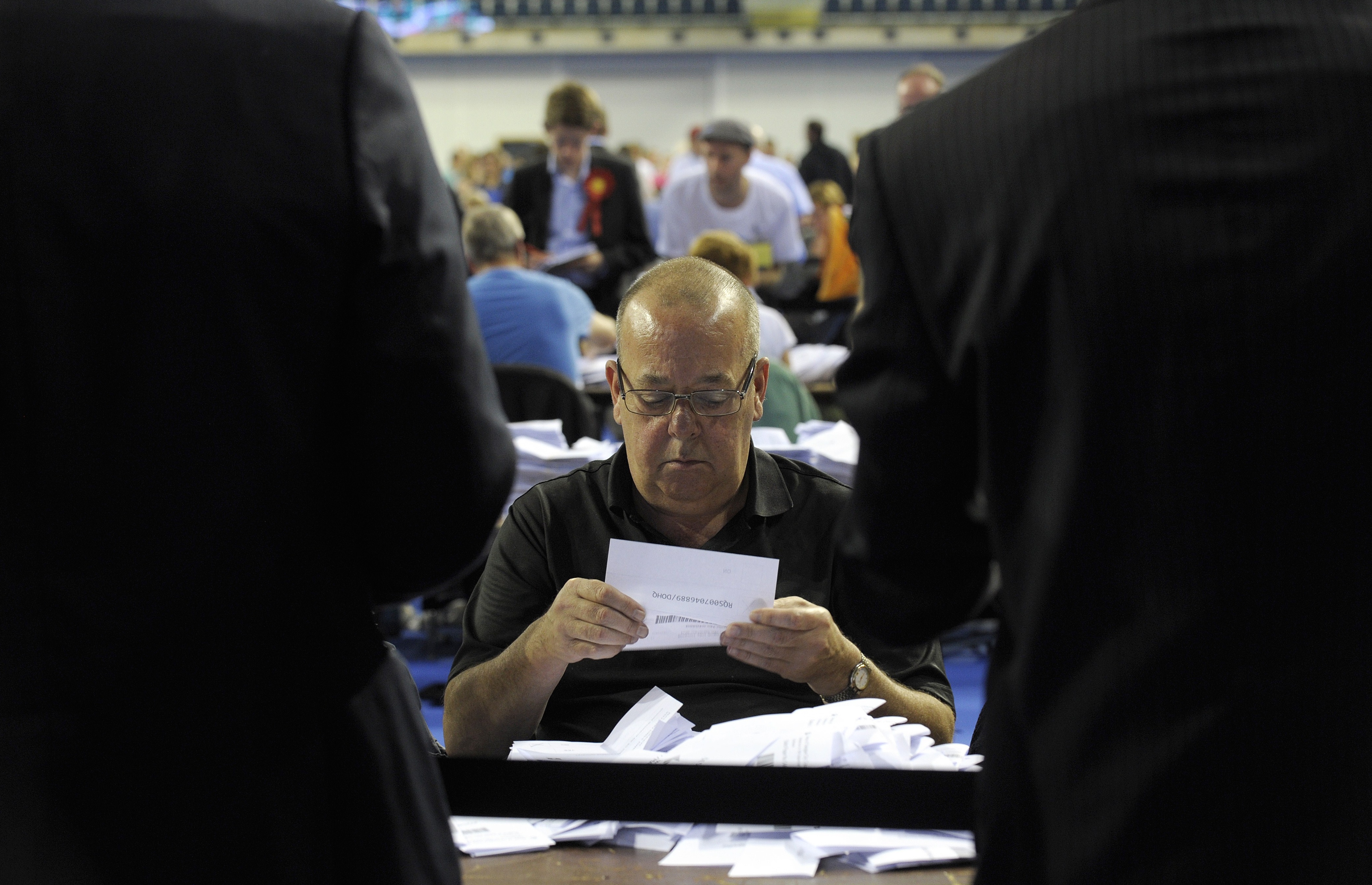
Ballots are counted at the Emirates Sports Arena in Glasgow on September 18, 2014, after the polls close in the referendum on Scotland’s independence. The question for voters at Scotland’s more than 5,000 polling stations is “Should Scotland be an independent country?” and they are asked to mark either “Yes” or “No”. The result is expected in the early hours of Friday. By Andy Buchanan/AFP/Getty Images.
Defaulting On Venezuelans
This article by Ricardo Hausmann and Miguel Angel Santos is getting attention from Venezuela-watchers (and President Maduro, who hated it – so you know they’re on to something). The pair argue that the country should default on its sovereign debt, because the government’s commitment to paying its creditors effectively means it’s defaulting on its citizens:
Severe shortages of life-saving drugs in Venezuela are the result of the government’s default on a $3.5 billion bill for pharmaceutical imports. A similar situation prevails throughout the rest of the economy. Payment arrears on food imports amount to $2.4 billion, leading to a substantial shortage of staple goods. In the automobile sector, the default exceeds $3 billion, leading to a collapse in transport services as a result of a lack of spare parts. Airline companies are owed $3.7 billion, causing many to suspend activities and overall service to fall by half.
In Venezuela, importers must wait six months after goods have cleared customs to buy previously authorized dollars. But the government has opted to default on these obligations, too, leaving importers with a lot of useless local currency. For a while, credit from foreign suppliers and headquarters made up for the lack of access to foreign currency; but, given mounting arrears and massive devaluations, credit has dried up.
Felix Salmon likes their way of thinking about defaults, which squares with his own formulation of last year’s US sequester:
America eventually cured its default, and never graduated to defaulting on Treasury bonds. But Venezuela’s problems are harder to fix. And at some point, it simply won’t make sense to spend desperately-needed billions on foreign bondholders any more.
Indeed, if you ask Ricardo Hausmann, he’ll tell you that not only is Venezuela there already, but that even the technocrats IMF would recommend a sovereign bond default at this point. For all that it’s embarrassing and politically perilous for any government to default on its sovereign debt, then, I suspect that a fully-fledged default in Venezuela is now only a matter of time. Right now bondholders are probably safe, or safe-ish. But if and when Citgo is sold, alongside Venezuela’s other foreign holdings, I can’t imagine that the country will continue to pay its coupons in full. Indeed, Venezuela owes it to its citizens not to.
Harold Trinkunas considers the political implications:
Venezuela’s economic crisis has led to speculation that the 2015 legislative elections will be the next flashpoint in its ongoing domestic political conflict. Support for the government in Venezuela tracks closely with economic performance and domestic consumption (PPT), both of which have tanked in the past year. In fact, the Venezuelan government was only able to reverse negative public opinion trends before the December 2013 elections through a forced-sale of private inventories of consumer electronics and home appliances. Former planning minister Jorge Giordani admitted that the government had spent vast amounts in 2011 and 2012 to ensure the re-election of Hugo Chavez in 2013. Current economic indicators do not bode well for the regime’s electoral prospects, and the Maduro administration lacks the financial reserves to use public spending to increase domestic consumption next year. Importantly, this is not a regime that has reacted well to losing elections in the past.
And Juan Nagel zooms in on the country’s collapsing healthcare system:
Venezuela imports most of its medicines. There is a local drug manufacturing industry, but they do little research and simply manufacture medicine using imported raw material. The country’s cash shortage is throwing a wrench in that process. As one drug manufacturer explained, “I have a backlog of requests for currency that have not been approved, and without [currency] I cannot import the raw material I need. When I manage to get a shipment of medicine out, much of it ends up in the black market.” The Central Bank said in March of this year that 50 percent of drugs are missing from the shelves. It has since stopped publishing the data.
Due to the country’s overbearing price controls, there is a thriving black market for Venezuelan drugs. A fraction of the country’s drugs ends up in neighboring countries, where they fetch market prices. Unsurprisingly, Venezuelans have started bartering drugs on Twitter and other social media.
Sleep Is For The Rich
Olga Khazan explains:
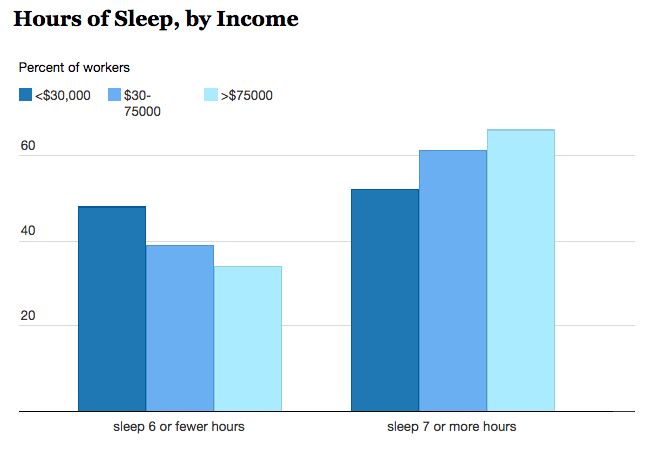
Though Americans across the economic spectrum are sleeping less these days, people in the lowest income quintile, and people who never finished high school, are far more likely to get less than seven hours of shut-eye per night. About half of people in households making less than $30,000 sleep six or fewer hours per night, while only a third of those making $75,000 or more do.
Unsurprisingly, shift workers face the greatest risk of sleep deprivation; they get two to four hours less sleep than average. The consequences can be dire:
Exposure to bright light when it’s time to sleep makes it harder for the body to produce melatonin, a sleep hormone. Over time, this sleep deprivation translates to an increased risk for heart disease, gastrointestinal problems, and reproductive issues. … For some, a sleep shortfall can lead to narcolepsy-like symptoms. One study found that 53 percent of night-shift workers report falling asleep accidentally on the job.
The Other American Expansionism
Julia Belluz flags new research showing that American waistlines continue to grow:
Researchers looked at waist circumference measurements taken from over 32,000 adults in 1999 and 2012. During that period, participants’ waists grew nearly a whole pants size, from 37.6 inches to 38.8 inches. Some groups gained an even more significant amount of abdominal girth. White women, aged 40 to 49, experienced a 2.6-inch expansion; the waists of black men, aged 30 to 39, got padded with 3.2 extra inches; Mexican-American men, aged 20 to 29, added 3.4 inches to their frames; Mexican-American women over the age of 70 packed on 4.4 inches; and black women between the ages of 30 to 39 increased their waists by 4.6 inches. (Abdominal obesity was defined as a waist circumference greater than 40 inches in men and 35 inches in women.) That racial minorities are experiencing greater gains maps on to the fact that they’re also disproportionately struggling with obesity compared to white people in the US.

Interestingly, Americans’ average body mass index has held relatively steady over the past decade. Or as Alison Bruzek puts it, “People haven’t been getting fatter, but their waistlines are still increasing”:
“We’re a little bit puzzled for explanations,” Dr. Earl Ford, a medical epidemiologist at the Centers for Disease Control and Prevention and lead author of the study, tells Shots. The two measures are closely related: While body mass index or BMI measures fat overall, waist circumference helps measure fat distribution. Stress, hormonal imbalances, environmental pollutants, poor sleep or medications that help pack on abdominal weight are possible causes, health and nutrition researchers speculate. And older adults typically lose muscle as they age, while fat continues to increase.
(Photo by myLoupe/Universal Images Group via Getty Images)
When Cannabis Is No Longer A Crime
Sam Kamin and Joel Warner expect that, “as marijuana prohibitions continue to weaken and an increasing number of states reconsider stringent drug sentencing rules, people could begin to lobby to remove more serious pot convictions from their rap sheets or even get out of prison”:
However, if either the courts or clemency boards take up the work of reviewing past marijuana convictions, they will have to tackle a very thorny issue: Convictions don’t always match the crime that was committed. Many of the low-level offenders who might seek clemency struck plea deals with prosecutors, and those negotiations can obscure the underlying crimes. UCLA drug policy expert Mark Kleiman offers an example: “It’s entirely possible that a guy was charged with possession with intent to distribute cocaine and cannabis, and the plea bargain he pled to was just the cannabis charge.” So how do you determine, sometimes many years later, whether a given conviction actually corresponds to a defendant’s true criminal culpability? And even if a marijuana conviction does in fact correspond to a marijuana offense, are all marijuana offenses created equal? Should it matter whether the 12 ounces of pot someone was busted with came from small-scale farms in Humboldt County, California, or were imported from Mexico by drug cartels?
Fascinating. At some point in the future, if and when cannabis is seen as the simple plant and medicine that it is, those behind bars – some for life – for non-violent offenses involving cannabis are going to seem awful victims of a regime long since discredited. Some relief will surely have to be granted – but I can sure see the complexities.
The North Profited From Slavery Too

In his new book, The Half Has Never Been Told: Slavery and the Making of American Capitalism, Edward E. Baptist details how “the commodification and suffering and forced labor of African Americans is what made the United States powerful and rich.” Excerpt from the book here. Yglesias puts Baptist’s approach in context, explaining that he is countering “a tradition which views slavery as a kind of archaic institution … a New World form of feudalism that was doomed by the growing tide of industrialization”:
First, he shows that the slave economy was as modern as any other aspect of the mid-19th Century. There were, for example, slave-backed mortgages and other sophisticated financial products. So the genre of social history which pits old-timey southern agrarianism against modernizing northern industrialism is simply mistaken — major proprietors on both sides of the Mason-Dixon line participated in the rise of modern financial institutions.
Second, he argues that the slave economy’s success was critical to the larger success of what we call the Industrial Revolution. This is commonly portrayed as a question of technology — spinning jenny, mechanical loom, etc. — but developing the modern textile industry also required an enormous amount of fiber as inputs. All that technology would have run into fundamental ecological limits if you’d tried to fuel the factories with British wool. There isn’t nearly enough space for all the sheep.
Riding to the rescue was American cotton. In the 70 years between the adoption of the Constitution and the outbreak of the Civil War, US production rose 2,000-fold from 1.2 million pounds to 2.1 billion pounds.
Update from a reader:
The North absolutely profited from slavery, but the United States as a whole became a whole lot richer by ending it. This post from Scott Sumner is a good summary for all the reasons why.
(Photo of a slave market in Atlanta, Georgia, 1864, via Wikimedia Commons)
A Lesbian Genius To Watch Out For II
Cartoonist and 2014 MacArthur fellow Alison Bechdel may be best known for her eponymous sexism screening tool, but Alyssa Rosenberg believes more people should be familiar with the comic strip that put her on the map:
“Dykes to Watch Out For” dives deep into a fictional lesbian community, considering the impact of transgender politics, marriage and even the death of independent bookstores on her characters. Pop culture as a whole has had an unfortunate tendency, upon telling the stories of white, affluent gay men (and, less often, lipstick lesbians), to consider its task of diversification complete. “Dykes to Watch Out For,” which ran from 1983 to 2008, when Bechdel put it on hiatus, is a testament to just how much material other projects and other media have left on the table.
Her characters were multi-generational, multiracial and in all sorts of relationships, including marriages to gay men and house-sharing arrangements. They also ranged up and down the class spectrum: Mo Testa, the main character, started out as a bookstore clerk and ended up as a reference librarian, Toni Ortiz was a certified public accountant and several other characters were academics.
I always enjoyed the strip – a dykey Doonesbury that also managed to convey the complexity and nuance of lesbian life. Tim Teeman takes the opportunity to revisit a 2012 conversation he had with Bechdel about “Dykes”:
She secretly nursed ambitions that Dykes would become a crossover success: “It never did, but it’s been absorbed, grandfatherly, into the canon.” The strip ran from 1983 to 2008, though Bechdel told me in 2012 she was planning to reunite the women for more adventures. She says she had fun “playing them all off against each other,” debating the political issues of the day—and as this was the 1980s and 1990s, far from the relatively sunny uplands of today’s increasing climate of lesbian and gay equality and acceptance, there was much to debate, laugh mordantly, and grizzle over.
The advance of lesbians and gay men in pop culture has a depressing price, Bechdel said. “When I see what’s on television, it’s sad that queerness has become as commodified as heterosexuality,” she said. “The rough edges have gone. I have nostalgia for the bad old days.”
Alex Abad-Santos praises her graphic memoirs, Fun Home: A Family Tragicomic and Are You My Mother?: A Comic Drama:
Bechdel’s works are introspective and personal. They are examples of how graphic novels and comic books can tackle serious themes and explore complex, chewy topics. In 2006, she published Fun Home, a graphic memoir about her turbulent relationship with her father … Bechdel was fearless in telling her story in Fun Home. The book interweaves timelines and characters before building to a devastating emotional climax. It’s as much a story of her own coming of age and coming to terms with her homosexuality as it is a story about how her father was unable to leave the closet — instead living a life as an ostensibly straight funeral home director.
Fun Home is also a smart take on how women learn to define themselves and create their identities as they grow up in a patriarchal society — and how all of that does and doesn’t differ for lesbians. And on top of all of that, it’s a story of coming to terms with one’s homosexuality in a world where such topics aren’t often discussed openly. Fun Home is Bechdel’s most significant work, and it’s where those who are curious about her comics should start.
Meanwhile, Dylan Matthews considers the MacArthur Foundation’s track record:
“The MacArthur Fellowship is not a lifetime achievement award,” the foundation writes. “We are looking for individuals on the precipice of great discovery or a game-changing idea.” The list of past grantees suggests this happens sometimes – and when it does, the Foundation’s prescience is striking. Cormac McCarthy had written four novels before receiving the grant, but the ones that would make his name — Blood Meridian, All the Pretty Horses, The Road — all came after. Henry Louis Gates was an assistant professor at Yale when he got the award, and went on to become a massively important public intellectual. Michael Woodford — now the world’s greatest monetary economist — got the grant while 26 and still in grad school. Stephen Wolfram, inventor of Mathematica and Wolfram Alpha, got the award at 21.
But far more common in the fellowship, in 1981 and afterward, are established academics, activists, and writers whose best work was already behind them. Robert Penn Warren wrote All the King’s Men a full 35 years before his grant. Stephen Jay Gould had already developed his theories of evolutionary spandrels and punctuated equilibrium, and become a prominent public intellectual through his war on sociobiology and his column in Natural History. Richard Rorty had become perhaps the most famous philosopher in America two years prior to his grant, with his Philosophy & the Mirror of Nature. David Foster Wallace wrote Infinite Jest the year before his grant. Tim Berners-Lee invented the World Wide Web eight years before his. Andrew Wiles proved Fermat’s last theorem four years before his. Marion Wright Edelman was perhaps the major outside player in debate over national child care in the early 1970s – more than a decade before her award.
You can’t really defend these kinds of grants on “investing in potential” grounds. These people had already made it.
It’s worth noting also that the list has long had a left-liberal bias – almost no conservatives are even considered, it seems to me. To some, it’s self-evident that a non-liberal could actually be a genius.
Why Do Doctors Kill Themselves So Much?
Alexandra Sowa McPartland describes a crisis in the medical profession:
Doctors commit suicide at a rate more than twice the national average. Every year approximately 400 physicians take their own lives. That is roughly one per day, or the equivalent of two entire graduating medical classes each year.
As a recent graduate of an internal-medicine residency, I know that physician depression and suicide are not routinely discussed in medical school or training. Significant time is given in medical education on how to recognize depression and suicidal thoughts in patients, but never once did I hear of my own increased risk of suicide.
One might expect that older physicians, after years in an emotionally and often physically taxing profession, bear the burden of an increased suicide risk. But it is really a phenomenon of young physicians. Suicide accounts for 26 percent of deaths among physicians aged 25 to 39, as compared to 11 percent of deaths in the same age group in the general population.
 The Dish
