This program break brought to you by Mike Myers’ Scottish dad:
Category: The Dish
Whither Now, Ukraine?
Michael Weiss’s overview of the situation in Ukraine today touches on several salient topics—corruption, nationalism, the economy, Russia—and is worth a full read. Here, he addresses the law the Ukrainian parliament passed this week granting a measure of autonomy to the country’s eastern regions:
There are already signs that Ukraine and Russia will interpret it differently. The Russian Foreign Ministry, for instance, said in a statement that the law grants the “development in certain regional districts of cross-border cooperation designed to deepen good-neighborly relations with the Russian Federation’s administrative and territorial units,” which is a pretty way of describing a breakaway autonomous zone removed in all but name from the central authority in Kiev. … For their part, the Ukrainians who elected Poroshenko largely on his campaign promise to ensure the territorial integrity of their country fear that this deal is another kind of sellout: the de facto ceding of the Donbass to Russia, or the perpetuation of an occupation in all but name. This is why protests objecting to the special status law have recently erupted outside the Rada.
“The mood at the ministry, specifically with the new foreign minister and his team, is to get it over with,” a Ukrainian diplomat told me, referring to a then-nascent cease-fire agreement. “There is one fear that we will have a new Transnistria. The other is that [the war] goes on indefinitely. The first is more awful.”
Alexander Motyl, however, argues that a frozen conflict “will actually be to Ukraine’s benefit”:
The [Donbas] enclave, which is where much of the region’s population and industry were concentrated, is in ruins. Hundreds of thousands of middle-class professionals have fled and will not return. Industry is shrinking. Infrastructure has collapsed. All these negative tendencies will accelerate, as Putin’s terrorist proxies, remnants of the (formerly ruling) Party of Regions and the Communist Party, the Kremlin, the Donbas oligarch Rinat Akhmetov, and the Russian Orthodox Church duke it out over influence. In a word, the Donbas enclave is finished, and, as deindustrialization continues, depopulation will proceed apace. Whoever inherits the mess caused by Putin and his proxies will have a ball and chain on his leg. Fortunately for Ukraine, it doesn’t—and in all likelihood will not anytime soon—control the enclave. Rightly or wrongly, justly or unjustly, legally or illegally, the burden of control, and the burden of governance, will fall on Putin. Bully for him. The day is not far off when the economic disaster that is the Crimea and the Donbas will burden Putin, and he will be hard-pressed to claim that his imperialism has served Russia well.
Chrystia Freedland warns against complacency now that the conflict has been, as it were, settled. After all, she writes, we still don’t know what Putin’s endgame is:
[W]e need to be careful not to confuse what we want with what we have. If Poroshenko’s wager pays out, we will be tempted to forget about Ukraine, as we forgot about Georgia after the hot summer of 2008. That would be a mistake. Putin won’t forget. And even if this compromise holds, his actions have shattered the European security order. With the annexation of Crimea and the invasion of eastern Ukraine, Putin has unilaterally declared himself to be above the rules of the post-1991 international system. He hasn’t yet told us what new rules he considers himself bound by. The post-Soviet peace is over: Whatever happens next week, next month or next year in the Donbass—the densely populated area of eastern Ukraine that Putin is seeking to dominate—this fundamental question will remain open.
Adrian Karatnycky argues that Mitt Romney was right in the 2012 presidential debate when he called Russia our greatest geopolitical threat:
A Russian occupation of large parts of Ukraine would clearly threaten the stability and security of our NATO allies on Ukraine’s western border. Further, Ukraine is home to three gigantic nuclear power plant complexes, which could become dangerous battlegrounds with unpredictable consequences for nuclear safety. War could disrupt or destroy Ukraine’s energy pipeline network, which is the central mechanism through which more than half of Russia’s exports of gas and oil to Europe travels. Successful Russian expansion into Ukraine would increase the chances of further adventurism in energy-rich Kazakhstan, where an elderly President will soon physically fade from power. And Russia would be emboldened to exert even stronger influence over the policies of energy-rich Turkmenistan. Would these developments not be as significant in impact as the fate of Saudi, Iraqi, and Qatari oil and gas reserves?
And what of recent, aggressive Russian canards about the alleged mistreatment of ethnic Russians in the Baltic NATO states? Would an aggressive and expansionist Russia not be more be willing to launch new efforts to threaten those states, engaging our Article 5 NATO treaty obligations to directly enter into military operations?
Ukrainian President Petro Poroshenko certainly encouraged that kind of thinking in his address to the US Congress this morning:
To roaring applause and whooping cheers, the Ukrainian candy mogul-turned politician likened Ukraine’s struggle against Moscow to a global battle for the preservation of the post-World War II international order. “Democracies must support each other,” he said. “Otherwise they will be eliminated, one by one.” … Poroshenko, clearly afraid that the Russian aid has already decisively turned the tide, implored politicians to stand up to Russia.
“Blankets and night-vision goggles are important. But one cannot win a war with blankets!” Poroshenko said, raising his voice for emphasis. “I understand that American citizens and taxpayers want peace, not war … However, there are moments in history, whose importance cannot be measured solely in percentages of GDP growth.”
The Racial Divide On Spanking Kids
In the wake of the Adrian Peterson case, various threads are emerging. Josh Voorhees investigates the race angle:
The perception that black parents are more likely to employ corporal punishment than their nonblack counterparts is borne out by academic research. In one study that examined 20,000 kindergartners and their parents, researchers at the University of Texas at Austin found that 89 percent of black parents had spanked their children, compared with 79 percent of white parents, 80 percent of Hispanic parents, and 73 percent of Asian parents. There is no single reason why blacks are more likely to turn to the rod for discipline, but the numbers are correlated with factors that include socio-economic status, religious upbringing, and even the heartbreaking feeling that, as it’s often put, “I’d rather my child get a beating from me than from police.”
Still, it’s important to note that while black parents might be more likely to spank their kids, they’re not alone in raising a hand to administer punishment—the rates for white, Hispanic, and Asian parents in that University of Texas study are all above 70 percent.
Michael Eric Dyson had a deeply moving piece today – on the roots of such violence in the slavery era. I learned a lot. Money quote:
The lash of the plantation overseer fell heavily on children to whip them into fear of white authority. Terror in the field often gave way to parents beating black children in the shack, or at times in the presence of the slave owner in forced cooperation to break a rebellious child’s spirit. Black parents beat their children to keep them from misbehaving in the eyes of whites who had the power to send black youth to their deaths for the slightest offense. Today, many black parents fear that a loose tongue or flash of temper could get their child killed by a trigger-happy cop. They would rather beat their offspring than bury them.
But the rates are not that much higher than for whites. Maybe it’s another function of the greater levels of and tolerance for physical violence in Jacksonian America. Aaron Blake has some data to back that up:
[A] funny thing happens when you look at race within the South. Then, you find, the gap between black and white is smaller. Here’s the eastern/Atlantic portion of the South:

Clarence Page brings a personal perspective:
Regardless of how much some of us look back with wistful nostalgia on our own spankings — as my Alabama cousins and I jovially recalled at a recent family reunion — corporal punishment poses more hazards than it is worth when compared to many nonviolent alternatives. …
I tried spanking our son in his preschool years, but he’s too much like me. He only grew more angry and defiant. But the kid was terrified of timeouts. The prospect of spending more than 10 seconds in solitary confinement — away from friends, TV, books, computer or video games — brought instant compliance.
I have to say that what surprises me is the joviality about it. Maybe that says something about the lack of permanent psychological scars; or maybe it’s a way of coping with them.
The Battle Lines Of The Culture Wars
Ramesh Ponnuru makes plain how they have and haven’t shifted:
On same-sex marriage and legalized marijuana, public attitudes have, in fact, changed. A majority has gone from opposing to supporting both of them. That doesn’t necessarily mean that opposing them is going to hurt Republicans: It depends on, among other things, whether there’s a large pool of voters who would be open to Republican candidates if only they supported gay marriage. It does, however, mean that Republicans are going to talk less about these issues.
On the other hand, the public has not shifted on abortion, which has been a politically important social issue for much longer than same-sex marriage or legal pot have been. When pollsters for CBS ask people whether abortion should be “generally available,” or Gallup asks whether it should be “legal only under certain circumstances,” the answers look nearly identical to what they were a decade ago. The same is true when Gallup asks whether people consider themselves “pro-life” or “pro-choice.”
Isn’t it obvious why? Marriage equality and legal cannabis cannot plausibly be described as harming anyone. They’re both classically libertarian, live-and-let-live initiatives. But abortion touches on something very different. Many people believe (and I am one of them) that abortion doesn’t just affect another human life, but ends it. The individual liberty argument – so potent with marriage and cannabis – is checked by a legitimate concern for the unborn child. That’s why the younger generation is close to unanimous on cannabis and marriage but still divided over abortion. Kevin Williamson is in agreement:
What conservatives often fail to emphasize, I think, is that abortion is simply in a different category of issues than is gay marriage or marijuana legalization.
Not that those latter issues are not important — they certainly are — but they are not life-and-death issues. The marijuana debate is about how much we think it is worth intervening in other people’s lives to police the use of a relatively mild intoxicant; the abortion debate is about what it means to be a human being. To that extent, the entire idea of “the social issues” is probably more harmful than helpful. Abortion and gay marriage are not even roughly comparable.
Putting abortion aside, Reihan argues “that Republicans are, in theory at least, in a stronger position than Democrats on a variety of other social issues.” For instance, he urges conservatives to take the lead on drug policy:
One can easily imagine conservatives arguing that the chief federal concern in regulating cannabis and other controlled substances is in containing the negative interstate spillovers associated with their use, and so if states succeed in containing these spillovers, they ought to be given wide berth to craft their own regulatory regimes — an argument I’ve gleaned from Mark Kleiman of UCLA and Will Baude of the University of Chicago Law School, in somewhat different forms. Similarly, conservatives might try experimenting with, say, empowering states to lower the drinking age, provided (again) they make a convincing case that they can contain negative spillovers. For example, a state might lower its drinking age while also increasing its taxes on alcohol in an effort to control binge use.
I can’t confidently say that being the first mover on one of these issues would necessarily redound to the GOP’s advantage. But it would certainly change the conversation, and break the GOP out of its defensive crouch.
I can’t say I’m very hopeful on that score. The Puritans remain very strong in the base of that party.
A Lesbian Genius To Watch Out For
After the travesty of Jo Becker’s alleged history of the marriage equality movement, and after Chad Griffin’s PR attempt to portray himself as Rosa Parks, and after Ted Olson and David Boies’ grandiloquent credit-hogging in their recent book, it comes as something of a massive relief to see one of the true architects of marriage equality finally getting her due. Mary Bonauto was fighting for gay marriage rights as a lawyer and organizer when very few others were. She started at the state level – because that’s where civil marriage is rooted in American politics and law. And she critically understood that it was vital to get a foothold somewhere, to prove we were not just fringe weirdos, and she saw Massachusetts and New England as the most favorable terrain.
And they were. One aspect of marriage equality in America that is sometimes missed is the role New England played. The gay and lesbian community in Boston in the 1980s and 1990s was remarkably advanced and organized. It was a community I was immensely lucky to grow up in. The self-confidence and self-esteem that this community helped spawn in its members broke through the fear and doubt and squabbling that cursed us elsewhere. It was a gay community big enough to make a splash, but small enough not to splinter. And Mary was a central component of that with her remarkably successful group, Gay And Lesbian Advocates And Defenders.
Let’s be clear: there would be no national surge in support of marriage equality without ten years of civil marriage equality in one state, and then several others. There would be none without Mary Bonauto.
Federalism was essential in helping us prove that, with this reform, the sky wouldn’t fall, that lives would actually be immensely improved, that families would be strengthened, and that all the scare tactics of the reactionary right were unfounded. Bonauto – along with Evan Wolfson – was absolutely integral to that strategy.
Both of them also understood that one state would not be enough, that if this issue rose up to the federal courts, it was vital that we would not merely be talking about one lone and allegedly rogue state. Bonauto made that happen. You can see her mild-mannered affect in the above video, but don’t be fooled. She was extraordinarily persistent and a ruthlessly methodical lawyer. She also helped dispel the myth that somehow marriage equality was a function of white male elitists (a charge so often leveled at me in the community at large). Of course it wasn’t. Lesbians had a huge amount at stake – especially in the safety and custody of their children and families – in ensuring that civil marriage could protect them. And lesbians – from Edie Windsor to Robbie Kaplan to Bonauto herself – were absolutely indispensable and central in this fight.
I’m in awe of Mary and the work she did. While some of us were busy writing and speaking and debating the issues, she gave us the actual empirical and legal progress that kept our arguments alive and relevant. Without her, we would be in an utterly different and darker world.
(Thumbnail image: MacArthur Foundation)
Busted With An Eggcorn, Ctd
A classic Dish thread continues:
I used to think people were saying they need to “make a piss stop” when going to the restroom at work, instead of pitt stop. One day I earnestly asked a female colleague, “Are they saying ‘piss stop’ or is it ‘pitt stop’??” And so she spit out her water and broke out on laughter, and then, you know how a woman will look at you like you’ve totally lost your mind again. But I really didn’t know.
Another eggcorn:
From a student paper, several years back: “It’s a doggie-dog world.”
Another:
My wife had, for the past 20+ years, always said “connipshit” instead of “conniption.” I finally made her repeat it to me after she said it two-three times in a day and verified she thought the word was “connipshit.” But I can’t say I blame her; people in a conniption are usually in a connipshit as well.
Another:
I recently wrote an email to a client where I said that allowing something to happen would set a “very bad president.” (For the record, it was not a Freudian slip; I’m an Obama supporter.)
That’s actually a malapropism, which many readers are still confusing for an eggcorn (though often the distinction can be tricky). Here’s Wiki again:
The unintentionally incorrect use of similar-sounding words or phrases in speaking is a malapropism. If there is a connection in meaning, it can be called an eggcorn.
Or:
I had a friend in college that swore up and down that it was a “greatfruit”. But in his defense, they are nothing like a grape and they are pretty great.
Another:
My wife likes to tell how when she was younger and watched Star Wars, they said the Jedi used a “Life Saver” instead of a Light Saber. They were trying to save people, after all.
And here’s a “gem of an eggcorn from my father, a reporter at a local newspaper”:
One of our writers on Tuesday was reporting on a homicide near a brothel. Or as he inadvertently put it, “a house of proposition.” (It did not get into print.)
Another paper doesn’t seem as diligent:
Here’s another eggcorn from yesterday’s WaPo: “Now, North Korea has decided to take a different tact.”
Another reader:
When I was a precocious youth, I thought that “&” was called a “standsforand” rather than an “ampersand”.
Another:
I hear this one often “This doesn’t jive with what he was saying” rather than “jibe”. I admit I prefer jive.
On a more colloquial note, when I was a child and asked for something that my mother thought I should get for myself, she would say “What are you? Lady Cement?”. Years later I realized she was saying “Laid in cement”. I never thought to question her use of “what” instead of “who”. Maybe I just liked being a “Lady”.
Another:
I grew up Catholic, when I was making my First Holy Communion and learning the prayers associated with the rosary. I asked my mother why we would say “Hell, Mary full of grace.” What can I say, I grew up in West Texas and “hell” sounded like “hail” to me.
Another:
I hear “butt naked” for “buck naked” all the time here in Utah.
Another:
I’m a marine biologist, and I was at a curriculum meeting last Friday where I said that we didn’t want students to be “floundering” in a poorly organized course. My colleague, a fish biologist, got a little smile on his face. He told me that I shouldn’t malign the flounders like that. I still didn’t get it until he and another colleague clarified that the word is “foundering”, like a ship founders (apparently, I haven’t read enough Horatio Hornblower…). Well, I won’t embarrass myself or insult the Pleuronectiformes again!
Update from a reader:
Your writer who was corrected by his colleagues actually used the word “flounder” appropriately. It’s definition (as a verb) is “to struggle clumsily or helplessly (e.g. “He floundered helplessly on the first day of his new job.”)” So his statement that “we didn’t want students to be ‘floundering’ in a poorly organized course” works just fine.
Another:
Until the day I die I’ll remember Archie Bunker from “All in the Family” saying “Groin Ecologist” when referring to Edith’s gynecologist.
Dish editor Chris chimes in:
I used to say “lacks-adaisical” instead of “lackadaisical” until my girlfriend corrected me one day. I guess I subconsciously made a connection between the similar meanings of “lax” and “lackadaisical”.
Several more eggcorns:
I’m sure at least one other reader has written to you about the affable British comedy duo Adam & Joe, who used to have a radio show on BBC 6 Music. They got a lot of mileage out of eggcorns from their listeners, ranging from funny but understandable: “the pot calling the kettle back” and “curled up in the feeble position” to the quite bizarre: “this room looks like a bombsy tit.”
Check out the above video for more. Another reader:
One of my favorite eggcorns (at least I think it is) was from my days at a large telecom company. An account manager wrote in an e-mail that went to several folks, including directors: “We expect our customers to pay us in the rears! [not ‘arrears’]” Heh. I knew our sales people were pains in the butt, but I had no idea they thought of our customers that way! (BTW: please withhold my name if you include this in your list)
Also, thanks for all you do and thanks for having this post. The news is killing me these days and this added a touch of sanity to the week.
If you need another mental health break in the future, check out the Eggcorn Database. Update from a reader:
Don’t you think the most fitting eggcorn for today is “Will Scotland succeed?”
See you in the morning, succession or not.
An ISIS Plot Down Under?
Australian police today arrested 15 people in connection with a terror plot, allegedly ordered by an Australian member of ISIS, to behead random citizens on video in the manner of Foley, Sotloff, and Haines. Some 800 police officers reportedly took part in the raid, the largest anti-terrorist operation in the country’s history:
Mohammad Ali Baryalei, a former Kings Cross bouncer and part-time actor, is understood to have made the instruction to kidnap people in Brisbane and Sydney and have them executed on camera. That video was then to be sent back to IS’s media unit, where it would be publicly released. Omarjan Azari, 22, from the western Sydney suburb of Guildford, was one of 15 people detained during the operation in Sydney and is accused of conspiring with Baryalei and others to act in preparation or plan a terrorist act or acts, court documents show. Commonwealth prosecutor Michael Allnutt told Sydney’s Central Local Court the alleged offence was “clearly designed to shock, horrify and terrify the community”.
Ishaan Tharoor puts the news in context:
The Soufan Group, a terrorism monitor, estimates that roughly 250 Australian nationals have joined the conflict in Syria. That number may be on the high end, though. Whatever the figure, a considerable proportion of the Australians jihadists are likely in the ranks of the Islamic State. The Herald Sun “unmasks” the identity of more than a dozen of them, including a former kickboxer and TV star. There are half a million Muslims in Australia and only the tiniest of minorities have anything to do with the networks connecting disaffected Muslims in the Antipodes to jihadist causes in the Middle East. Terror experts say the “jihadist scene” in the country is still very small. The worst attack suffered by Australia was in 2002: a set of coordinated bombings in the Indonesian island of Bali, linked to al-Qaeda, that killed hundreds, including 88 Australians.
Ed Morrissey reacts:
This is one reason why the rise of a terrorist state is not just a local issue, or a regional issue. Terrorist states do not want to just be “left alone,” but will spread their terror and destruction until stopped. There is plenty of room for rational and legitimate debate on the most effective way to deal with ISIS and its genocidal army, but ignoring it or shrugging it off as a problem for the Arabs to solve won’t do anything but make our options much more limited and much more costly when we finally do deal with the problem.
Jon Emont takes a look at ISIS’s recruitment efforts in nearby Indonesia:
As IS battles for territory in the Middle East, the group is also fighting for hearts and minds in Indonesia. In recent months, IS propaganda, urging Indonesians to support the militants’ cause in the Middle East, has spread throughout the archipelago via social media and local radical groups. The government has responded decisively. In early August, Jakarta enlisted Indonesia’s most respected Muslim authorities to denounce the organization, and has banned Youtube videos that endorse the jihadis. Outgoing President Susilo Bambang Yudhoyono has been outspoken in rejecting the group — he banned it, called it “embarrassing” to Islam, and arrested Indonesians suspected of providing support for IS.
In late August, the government tightened security around Borobudur, the world’s largest Buddhist monument, after intelligence suggested that militants linked to IS were targeting it. On Sept. 13, Indonesian police arrested seven suspected militants, including four foreigners, on suspicion that they were linked to IS. So far, the government’s efforts seem to have been surprisingly effective: Jakarta estimates that there are only 60 Indonesian fighters for IS.
Psilocybin vs Nicotine
The Dish has long covered and investigated the medical and spiritual dimensions of psilocybin, the active ingredient in “magic mushrooms.” Its potency for mental health, depression, PTSD, and the trauma of end-of-life treatment of cancer. Read it all in one place here. But today, there’s news of new research that examines the use of the drug for people who have found it impossible to quit smoking. Surprise! Its impact is powerful:
The abstinence rate for study participants was 80 percent after six months, much higher than typical success rates in smoking cessation trials, says Matthew W. Johnson, an associate professor of psychiatry and behavioral sciences at the Johns Hopkins University School of Medicine, and the corresponding author on the study.
Approximately 35 percent experience six-month success rates when taking varenicline, which is widely considered to be the most effective smoking cessation drug. Other treatments, including nicotine replacement and behavioral therapies, have success rates that are typically less than 30 percent, Johnson adds.

That’s not a slight improvement over current therapies; it’s a huge jump. And the gain in public health could be substantial.
But it’s important to note that
the hallucinogenic compound was administered as part of a comprehensive cognitive behavior therapy smoking cessation program that included weekly one-on-one counseling sessions and techniques such as keeping a diary before quitting in order to assess when and why cravings occur.
There are responsible and irresponsible ways to reap the benefits from substances too easily tarnished by culture war memories of the past. As with cannabis, psilocybin will make our future better.
Iraqi Militias Don’t Want To Be Our Frenemies
A day after Iraqi PM Haider al-Abadi ruled out allowing the US to re-station ground forces in his country, Juan Cole observes that the country’s Shiite militias, widely considered proxies of Iran, are also warning against American intervention:
Hamza Mustafa reports from Baghdad that Hadi al-Amiri, head of the Iran-backed Badr Corps, warned that the American plan is to take credit for the victories of the Iraqi armed forces and the popular militias. He called for a rejection of the plan and dependence solely on Iraqi military and paramilitary to defeat ISIL. … The Bloc of the Free (al-Ahrar) led by Shiite cleric Sayyid Muqtada al-Sadr called on al-Abadi to reject the US plan. Muqtada al-Sadr warned the US against trying to reoccupy Iraq and threatened, “If you return, we will return.” This was a reference to his Mahdi Army, which had subsided in importance after the US withdrawal. Muqtada boasted that the militia had inflicted heavy casualties on US troops and forced the US out. He also said that if the Mahdi Army “Peace Brigades” discovered an American presence in any province where they were fighting ISIL, they should immediately withdraw from the fight.
His conclusion:
It is difficult to tell how serious these militia leaders’ pronouncements are, since they might be attempting to save face with their followers even as they benefit from the US air cover. On the other hand, Asa’ib Ahl al-Haqq actually did in the past kidnap US troops, and the Mahdi Army fought them tooth and nail in spring of 2004, inflicting high casualties on them. Since President Obama’s air campaign requires Special Ops forces like Navy Seals or Green Berets to be on the ground with the Iraqi Army, they should apparently watch their backs. The people they are trying to help against ISIL don’t seem to appreciate their being there. And many of them seem to prefer Iran’s help.
So there are indigenous forces against ISIS that are telling us: we’ve got this. And we’re over-ruling them. Eli Lake, on the other hand, interprets these statements as evidence that Iran is working against us, noting that Tehran itself opposes US involvement in the conflict on the ground:
[Mohammad] Javad Zarif, Iran’s foreign minister, told an audience at the Council on Foreign Relations on Wednesday evening that Iran provides the militias with help organizing, some weapons, and military advisers. He also stressed they were disorganized. Nonetheless, Zarif said that any U.S. ground presence in Iraq would likely spur opposition. “The problem also when it comes to the United States is that the presence of foreign forces in any setting creates domestic opposition and domestic resentment,” he said. “And it is best, whether we support this or not—and we certainly do not support anybody engaging in anything that would complicate the situation—is to allow the Iraqis to fight this.”
Phillip Smyth profiles the resurgent Shiite militias, which he calls “highly ideological, anti-American, and rabidly sectarian organizations” and nearly as much of a security problem as ISIS itself:
Shiite militias have embedded themselves within the structures of the Iraqi government, which has become far too reliant on their power to contemplate cracking down on them. Together, they have committed horrifying human rights abuses: In early June, Shiite militias along with Iraqi security forces reportedly executed around 255 prisoners, including children. An Amnesty International report from June detailed how Shiite militias regularly carried out extrajudicial summary executions, and reported that dozens of Sunni prisoners were killed in government buildings. …
The growing power of these militias is a sign that, despite Maliki’s removal as prime minister, the Iraqi government remains beholden to deeply sectarian forces. These militias have generally retained their operational independence from Baghdad, even as they exploit the country’s nascent democratic system to gain support through their domination of official bodies. They are not simply addendums to the state — they are the state, and do not answer to any authority in Baghdad, but only to their own clerical leaders or Tehran.
All the same, Ben Fernandes argues that cooperating with Iran against ISIS carries fewer risks than not cooperating with Iran:
The current U.S. strategy to defeat ISIS unintentionally incentivizes Iran to build a nuclear weapon by increasing Iran’s perception of external threats and a need for the protection afforded by the possession of nuclear weaponry. The U.S. intent to arm “moderate” Sunni groups in Syria to fight ISIS will simultaneously (if inadvertently) increase the “Sunni threat” to Iran and Iranian allies like the Assad regime. Iran perceives all Sunni groups in the Levant as threatening regardless of a Sunni group’s views of the United States as the enemy. Just as Saddam Hussein prioritized potential threats from Iran and internal dissidents far above the threat of external attack from the United States, Iran acts similarly towards internal dissidents, Saudi Arabia, and other Sunni groups vis-à-vis the United States.
ISIS credibly threatens regional stability, Iranian interests, U.S. interests, Iraq, and many others. As such, there may be a way to find common ground with Iran in the fight against ISIS. Iran will not become a reliable U.S. partner, but can be a transactional partner for specific issues of mutual interest just as the U.S. partnered with the Soviets in World War II. A grand U.S.-Iran bargain over Syrian governance, ISIS, Iranian nuclear weapons, and sanctions may be more practical than dealing with each of these issues in sequence, per the current “ISIS first” approach discussed in GEN Dempsey’s testimony.
Back To The Bush Years … ?
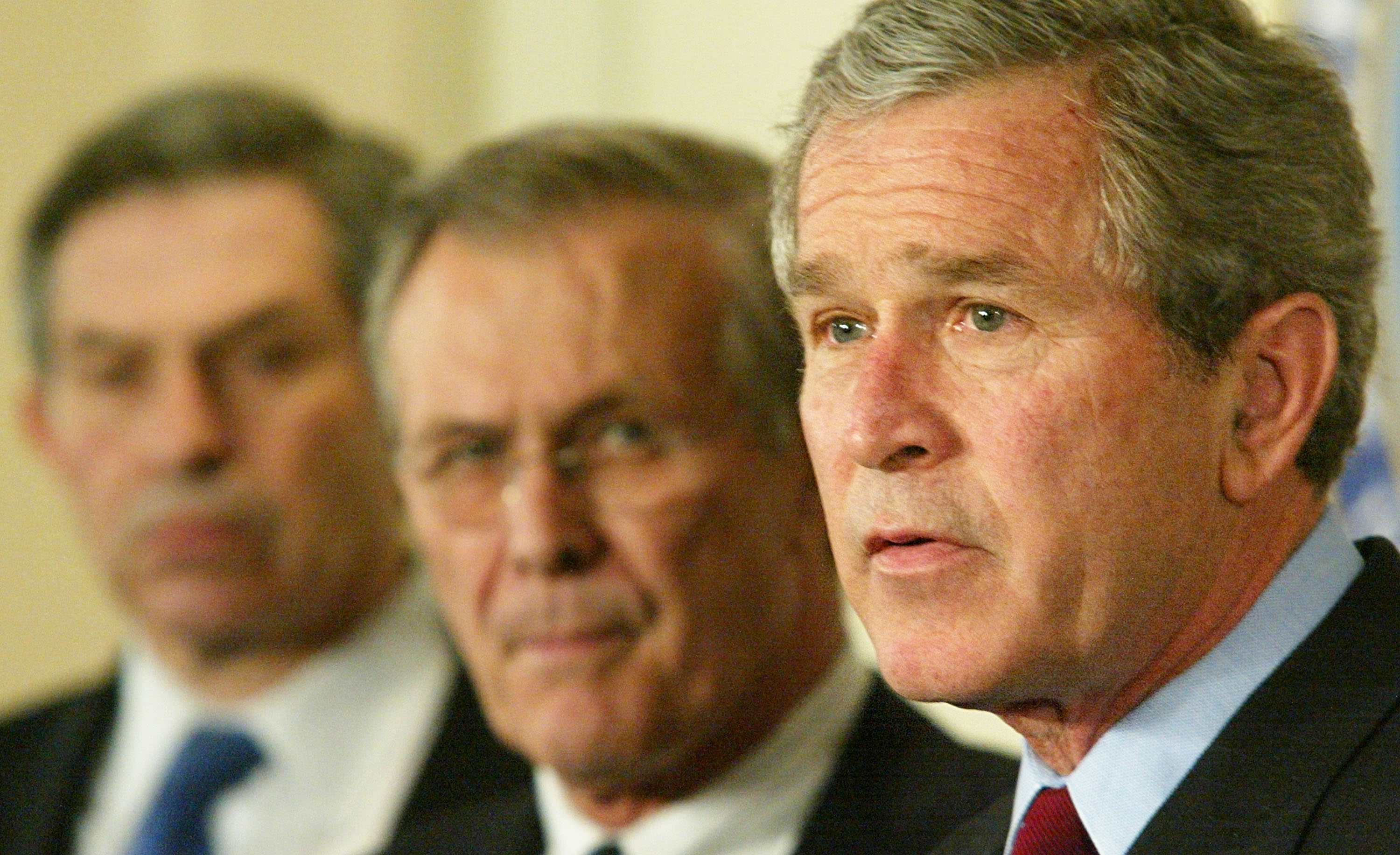
My own dismay (even bewilderment) at the current mood in America may well be because I was largely off-grid in August. But it’s still a truly remarkable shift. In a month, the entire political landscape has reverted to Bush-Cheneyism again. I honestly thought that would never happen, that the grisly experience of two failed, endless wars had shifted Americans’ understanding of what is possible in the world, that the panic and terror that flooded our frontal cortexes from 9/12 onward would not be able to come back with such a vengeance. I was clearly wrong. Terrorism does not seem to have lost any of its capacity to promote total panic among Americans. The trauma bin Laden inflicted is still overwhelming rationality. It would be harder to imagine a more stunning success for such a foul mass murder.
The party that was primarily responsible for the years of grinding, bankrupting war, a descent into torture, and an evisceration of many core liberties is now regarded as superior to the man originally tasked with trying to recover from that experience. The political winds unleashed by a few disgusting videos and a blitzkrieg in the desert have swept all before them. And we now hear rhetoric from Democratic party leaders that sounds close to indistinguishable from Bush or Cheney.
Is it merely panic? I doubt it. I think what’s also coursing through the collective psyche is the thought that Obama told us we were finally out of Iraq – and events have shown that assurance to be shaky at best. A core part of his legacy has had the bottom fall out of it. I don’t think most people – outside the Tea Party – really believe that all would be well if we’d just kept more troops in country the last couple of years. But the resurgence of the Sunni insurgency – now tinged with the most fanatical of theocratic barbarisms – is nonetheless blamed on Obama. Maybe it could have been contained without the beheadings. But they touched so many visceral chords that the Jacksonian temperament, always twitching beneath the surface of American life, simply bulldozed away every conceivable objection and doubt.
But will this last? I have my doubts. The Republicans are actually ambivalent about this war – largely because Obama is the president. For a while, they’ll bash him for not being “tough” enough – as if toughness has been shown to be the critical virtue in the fight against Jihadist terrorism. But when and if it actually comes to ground troops, my guess is that they’ll get cold feet. Apart from the unhinged McCain and Butters, few of them are so delusional to think we should re-occupy the place indefinitely. Maybe ISIS can do the neocons a favor and engage in some domestic terrorism to ratchet up the global stakes once again – in which case, we will very much be back where we started, our collective memory erased like those lab rats we covered earlier today.
My point is this: when they actually have to choose to go back to Bush-Cheneyism, and an endless, global civilizational war, Americans will not be as gung-ho as they now appear to be, in the wake of ISIS’ propaganda coups and the Beltway’s hysteria.
If the air-strikes do manage to contain the threat, and they don’t provoke another terror attack, Obama’s anti-terror minimalism might even appear the least worst option over time, and his caution admirable in retrospect. My worry, of course, is that the demonization of the president by the Fox News echo-chamber has rendered any sober judgment about his anti-terror policies moot. You can see the deep currents at work here: paranoia about border security, a bigoted belief that Obama actually favors Islamism, and the memes of racism, otherness and barbarism that ISIS both triggers and, in part, is designed to trigger. It doesn’t help that he is at the moment in a two term presidency when we are looking past him to the future, when discontent is inevitable, and in a time when the economy continues to pummel the working poor and the middle class.
Like me, Peter Beinart is alarmed by the change in the national mood:
The GOP’s advantage on “dealing with foreign policy,” which was seven points last September, is now 18. And the shift toward Republicans has been strongest among women. In August, women were 14 points more likely to support Obama’s foreign policy than men, according to a Wall Street Journal poll. Now the gap is down to two points. In August, white women favored a Democratic Congress by four points. Now they favor a Republican Congress by eight. As in 2002, Democrats are responding by becoming more hawkish. In October 2002, most Democrats in competitive Senate races voted to authorize the Iraq War. Last week, Obama announced a multi-year air campaign against ISIS.
But it doesn’t work. Almost all the imperiled Democrats in 2002 lost anyway. And there’s no evidence that Obama’s new hawkishness is helping him politically either.
The great error was Obama’s effective endorsement of the panic. Maybe if he hadn’t done so, the Democrats would be wiped out this fall. Maybe any president would have had to appear to do something as Americans are beheaded in a desert and the images flood the web. But maybe a determined stoicism and refusal to panic might have undergirded Obama’s core appeal, shored up his base, and in time, seemed far more responsible than Butters’ vapors.
No one said it’s an easy job. But I fear Obama’s pragmatism may have just made it even harder.
(Photo: U.S. President George W. Bush speaks next to Defense Secretary Donald Rumsfeld and Deputy Defense Secretary Paul Wolfowitz during a visit at the Pentagon on March 25, 2003. Bush asked Congress for a wartime supplemental appropriations of $74.7 billion to fund needs directly arising from the war in Iraq and the global war against terror. By Alex Wong/Getty Images.)
 The Dish