Email Of The Day

Jack09162014

The “newest member of Club Tripod in DC” will cheer you up:

The last few weeks have been so depressing news-wise, I thought I’d pass along something upbeat. Jack came back from Sierra Leone with me two years ago with a limp and arthritis due to an injury that had healed poorly (there’s only one vet in the entire country). When it got worse this summer, I visited an orthopedic surgeon who suggested a range of options, from physical therapy to arthroscopy. She didn’t mention amputation, but when I asked about it, she said that this was the best option, though pet owners tend to react poorly to the suggestion.

It’s been just three weeks since the surgery and she already moves as if her leg were never there. Dogs are amazingly resilient. On our walk this morning, a little boy pointed to her and told his mom to “look at how fast that dog is!”

When people see little Bowie charging like a bullet down the beach after her favorite yellow tennis ball (as seen below), they gawk in wonder:

bowie-running

Bowie remains utterly indifferent to the missing leg. It’s all about the ball. Even when she sometimes wipes out (it happens on stairs), she immediately tries again, and almost always succeeds.

And yes, when the world seems too grim, these are the things you live for. I can’t imagine getting through the day without her untrammeled joy at being alive.

Update from a reader:

If you aren’t familiar with it, you should check out the moving, beautiful story of Haatchi and Little B.  Haatchi was abandoned on railroad tracks, hit by a train, and left for dead.  He lost one of his rear legs and most of his tail.  After being rescued, he was adopted by Little B.’s family, and he really helped Little B., a disabled boy with a rare genetic disorder, come of his shell.

If you can watch this video without crying, you’re made of stone:

This Is What Passes For A War Authorization These Days

Yesterday, the House voted 273-156 to let the president arm the “moderate” Syrian rebels to help fight ISIS:

The administration’s request was an amendment to a must-pass, stopgap measure to keep the government running through mid-December. Although the amendment had the early support of House Speaker John Boehner, R-Ohio, and House Minority Leader Nancy Pelosi D-Calif., a number of lawmakers in both parties began defecting, prompting a last-minute push by party leaders to build support.

New York’s Steve Israel, chairman of the Democratic Congressional Campaign Committee, said a range of top Democrats worked to the last minute to gather votes for the president’s plan, which would train some 5,000 Syrian rebels in the first year at facilities in Saudi Arabia. … Having secured approval in the House, the bill now moves to the Senate, where it may receive a skeptical reception. In testimony Wednesday before the Senate Foreign Relations Committee, Secretary of State John Kerry came under intense questioning about the White House’s plan to train and equip moderate Syrian rebels.

The idea is as doomed now as it long has been. The US trained the entire Iraqi army in country for years – and they still scarpered. The problem is political; almost certainly unsolvable except in the long run by the parties themselves; and made utterly solvable by US intervention. The Senate is set to vote on the measure today. Weigel notes who voted “aye”:

Everybody in competitive races. Georgia Rep. John Barrow, Minnesota Rep. Collin Peterson, and West Virginia Rep. Nick Rahall are among the very last Democrats in districts that voted for the Romney-Ryan ticket in 2012. They went “aye.” So did Iowa Rep. Bruce Braley and Michigan Rep. Gary Peters, both Senate candidates in tough races. On the Republican side, Senate candidates Tom Cotton and Steve Daines voted “aye,” as did Colorado Rep. Mike Coffman and Florida Rep. Steve Southerland. They’re the only two Republicans in seats that appear now to be toss-ups, with strong Democratic challengers cutting through the headwind.

Most Democratic leaders. The top three Democrats in the House — Nancy Pelosi, Steny Hoyer, and Jim Clyburn — were ayes, as was DNC Chairwoman Debbie Wasserman Schultz. The only leadership figure to break with the president was Maryland Rep. Chris Van Hollen.

Every Republican leader. From John Boehner to the deputy whip team, the GOP was on board.

And Alex Rogers relays what the “nays” had to say:

Lawmakers who opposed the bill said the President’s strategy to arm so-called moderate Syrian rebels is misguided. The Obama Administration is hoping these fighters can help beat back the militant group Islamic State of Iraq and Greater Syria (ISIS). “I’ve never been satisfied that we’re not going to end up fighting people that we’ve armed at some point in the future,” Representative Mick Mulvaney, Republican of South Caroline, said. “No one ever defined victory to me that made any sense whatsoever.”

The bill even lost the support of Representative Chris Van Hollen, Democrat of Maryland, a top Democratic leader. “I support the President’s overall strategy; I support what he’s doing in providing air support for the Iraqi forces and the Kurdish rebels,” Van Hollen said. “I have misgivings about this piece because the priority of the so-called Syrian rebels is to defeat [Syrian strongman Bashar] Assad. And I understand that, but it’s hard at this point to see how defeating Assad strengthens the mission against ISIS.”

To Allahpundit, the vote doesn’t look like such a ringing endorsement:

Here’s the roll. Obama ended up getting many more Republican votes than Democratic ones (159 versus 114), including Kevin McCarthy, Steve Scalise, and Paul Ryan. It was tea partiers like Justin Amash, Michele Bachmann, and Louie Gohmert who ended up in the opposition. Truth be told, though, no faction within the House is keen on O’s train-the-rebels strategy; this resolution, in fact, will expire on December 11th, the same day that the new continuing resolution would expire. What the two sides are doing here is simply punting the issue until after the midterms, when the GOP won’t have to worry about any electoral blowback if they try to block O on a war effort that’s surprisingly popular for the moment.

Ryan Grim and Sam Stein pick up chatter in Washington that the CIA, which already tried arming the rebels, is not too sanguine about trying again:

One Democratic member of Congress said that the CIA has made it clear that it doubts the possibility that the administration’s strategy could succeed. “I have heard it expressed, outside of classified contexts, that what you heard from your intelligence sources is correct, because the CIA regards the effort as doomed to failure,” the congressman said in an email. “Specifically (again without referring to classified information), the CIA thinks that it is impossible to train and equip a force of pro-Western Syrian nationals that can fight and defeat Assad, al-Nusra and ISIS, regardless of whatever air support that force may receive.”

He added that, as the CIA sees it, the ramped-up backing of rebels is an expansion of a strategy that is already not working. “The CIA also believes that its previous assignment to accomplish this was basically a fool’s errand, and they are well aware of the fact that many of the arms that they provided ended up in the wrong hands,” the congressman said, echoing intelligence sources.

Francine Kiefer notes that the procedure the House followed allowed a fair amount of debate over the amendment:

For surer passage, the White House wanted the Syria authorization and the spending bill, known as continuing resolution, to be one piece of legislation. No one would want to shut down the government, and so Syria would pass. But House members strenuously objected: Because of its seriousness, Syria deserved to be debated and voted on separately. Leadership listened. Members got six hours of debate and a vote, passing the amendment 273 to 156. Then the amendment was attached to the spending bill and voted on as a package. It passed 319 to 108.

Alas, for procedural reasons, senators will not have that option and will have to vote on the welded package sent from the House. Some senators plan to vote no, but it is expected to pass.

By the way, Senator Tim Kaine has drafted an actual war authorization, but Waldman doubts it will go anywhere:

[E]verything Obama says he is committed to is incorporated in Kaine’s proposal. It even leaves the 2001 AUMF in place, which is either a sensible choice allowing for flexibility in fighting terrorism or a loophole you could drive a truck through, so long as the White House maintains that ISIS and al Qaeda are allied. Will it go anywhere? It may be too soon to know, but I’m guessing that the White House will say, privately if not publicly, that they don’t want to “tie the president’s hands.” Democrats will be responsive to that pressure (if it comes) from the White House, while Republicans will probably be uneasy about anything that could constrain the war-making ability of this president or a future one.

And the beat goes on …

Is Scottish Independence Irrational?

People Of Scotland Take To The Polls To Decide Their Country's Fate In Historic Vote

Adam Gopnik addresses the question:

Irrationalities are as essential to dissolving unions as they are to maintaining them. Scotland, which is just now voting on independence, is also, we’re told, acting against its self-evident economic interests—or, at the very least, acting with huge, unfunded optimism. Once again, as is so often the case in the twentieth century, the atavistic thrill of nationalism is ballooned up by the blithe certainty that it will somehow magically lead to a progressive paradise. As Canadians alone remember, the province of Quebec, in two referendums, did, or came close to doing, the same thing with the same unfounded belief.

It is easy to say that such a move makes no sense, but nationalism is almost always a more powerful drug than is the promise of continued prosperity. The irony is that many Scottish nationalists see the larger European Union as their alternative to the apparently stifling British one, though E.U. membership for an independent Scotland would be far from guaranteed, and would affect everything from the politics of emigration to the price of scotch. Nationalists in Quebec believed something similar, holding out the dubious hope that the United States would be a welcoming market for and partner with a monolingual French Quebec in ways that Canada somehow was not.

Michael Brendan Dougherty blames the EU for the increasing nationalism across Europe:

By creating a federated superstate with its own defense policies, currency, and central bank, the EU takes off the table some of the hardest questions a separatist or secessionist movement has to answer. The EU does a lot of the work of a nation-state for them. To some degree, extant and aspiring nationalisms are free-riding on an official internationalism.

The EU tends to be extremely generous in dignifying minority languages, regions, and even political movements with some kind of official status. Latvian, Irish, and Maltese are all recognized European languages, but good luck finding four million people who speak any of these fluently. Still, this kind of recognition is important to nationalists looking to maintain some kind of identity in the face of an overwhelming, powerful neighbor, or globalism more generally.

But Nicholas Shackel refuses to label Scotland’s Yes voters irrational:

It is certainly true that a lot of the time for a lot of people acting rationally does amount to acting prudently. But it is not generally true. Rationality requires acting in accord with what one care’s about. If you care most about your best interest it would be irrational to act against it, but when that isn’t what you care most about then it isn’t irrational to act against it.

So then the question of the rationality of voting for Scottish independence comes down to what the person voting most cares about. They may care more about freedom of association than about their self interest, and if for them not being ruled by the British state but being ruled by a Scottish state instead satisfied what they value in freedom of association, then voting for independence could be perfectly rational despite it being against their best interest.

Jonathan Tobin argues along the same lines:

Whether it is true or not, a great many Scots believe themselves to have been oppressed by the English and to have had their nation stolen from them. They may not be mad enough to wish to bring back a descendant of the Stuarts, but the longing for the return of Bonnie Prince Charlie, the last Stuart Pretender who led the Scots to disaster at Culloden in 1746 and then was forced to flee to European exile, left its mark on the country’s national consciousness. That fueled the romance of a separate Scots identity that was never entirely extinguished even during the heyday of Scottish involvement in the enterprise of the British Empire. So long as these myths are influential and can be buttressed by modern grievances, however insubstantial, independence will always have a constituency that will consider it worth a great deal of inconvenience if not hardship.

(Photo: An independence supporter sports a Scottish Saltire tie, badge and rosette as he stands outside a polling station on September 18, 2014 in Strichen, Scotland. By Peter Macdiarmid/Getty Images)

The Fed Is Getting Back To Normal

Ylan Mui has the details of yesterday’s Federal Open Market Committee meeting, in which Federal Reserve Chair Janet Yellen laid out a plan to draw down the Fed’s massive stimulus program in light of the economic recovery and the upward trajectory of the job market:

The improving outlook means that the recovery no longer needs as much support from the nation’s central bank.

Since the start of this year, the Fed has been slowly reducing the amount of money it is pumping into the economy. The central bank said Wednesday it will reduce its purchases of Treasuries and mortgage-backed securities to $15 billion in October, down from $85 billion a month last year. The Fed expects to end the program altogether when it meets next month.

Still, the Fed said it will maintain the size of its balance sheet for now –which stands at $4.4 trillion — by reinvesting maturing securities. The Fed holds more than four times as many assets as it did before the 2008 financial crisis. Though the central bank said Wednesday it is committed to shrinking the balance sheet to a more normal size, it formally announced it does not plan to sell any of its assets, a reversal of the plan laid out three years ago. Instead, the Fed said it will eventually stop reinvesting maturing securities and let them run off. However, the central bank said Wednesday that process will not start until after it has successfully raised its benchmark interest rate.

Neil Irwin rejoices at the prospect of a return to boring monetary policy:

For the last six years, Federal Reserve policy has been sexy, or at least as sexy as monetary policy can ever be. Leaders of the central bank have had to improvise answers to tremendously consequential questions. What should the Fed do to combat a severe financial crisis? (Pretty much anything they could think of, and then some, was the answer.) What should the Fed do to stimulate a depressed economy when interest rates are already near zero? (Buy trillions of dollars in securities and pledge to keep interest rates at zero for a really long time.) Should it consider more radical measures like lifting its target for inflation? (No.)

But now, the big questions of Fed policy have mostly been answered, all the more so after this week’s meeting of the Federal Open Market Committee and the news conference on Wednesday by Janet L. Yellen, its chairwoman. And that is terrific news.

Michael Grunwald is on the same page:

It’s true that our recovery from the Great Recession has been slower than previous recoveries from ordinary recessions. But it has been much stronger than previous recoveries in nations that endured major financial crises—and much stronger than Europe’s current recovery. The euro zone’s output has not yet reached pre-crisis levels; it’s still struggling with 12% unemployment and a risk of deflation.

We’re doing a lot better than that. We had more effective bank bailouts, more generous fiscal stimulus—until Republicans took over the House after the 2010 midterms and began demanding austerity—and much more accommodative monetary policy. It’s all worked remarkably well. We’ve faced some headwinds—the contagion from the near-collapse of Greece in 2010, the turmoil after we nearly defaulted on our debt in 2011—but the economy has continued its path of slow but steady growth. That’s why Yellen was able to discuss those mind-numbing “policy normalization principles,” the guidelines the Fed will follow as it starts raising rates and reining in its bloated balance sheet in 2015. We’re approaching normal. And the Fed’s forecast for the next few years also looks pretty decent.

But the Bloomberg View editors oppose ending the Fed’s extraordinary measures:

[T]he Fed has better tools than monetary policy to mitigate financial threats to the broader economy. It can require banks to fund themselves with more loss-absorbing equity, and it can pressure them to steer clear of obvious trouble spots. As a member of the Financial Stability Oversight Council, it can also push for better monitoring of risks that might be building outside the regulated banking system. For monetary policy, the biggest question is whether the Fed can get employment back to pre-recession levels without generating too much inflation. The concern is that structural changes such as shrinking labor-force participation and decelerating productivity might have made that goal impossible. If so, and without government action to combat stagnation, central bankers might have to write off the livelihoods of millions of people as a permanent loss.

So far, there’s little evidence that the Fed has reached the limit of what it can do. Giving up too soon would be a tragedy, even if inflation temporarily overshoots the Fed’s target. Hence, the central bank would do well to maintain room for maneuver.

And Andrew Flowers notes that the debate over the effectiveness of the third round of “quantitative easing” is not settled:

The latest Survey of Consumer Finances showed that the typical household’s income fell by 5 percent (after adjusting for inflation) from 2010 to 2013 — which covers all of QE2 and the bulk of QE3. And economic inequality rose. Because the rich tend to hold a greater percentage of their assets in stocks, and stock prices rose, 2013 saw a widening disparity in wealth.

Critics of QE3 have also worried about inflation. With the Fed effectively printing money to buy $1.6 trillion in bonds, and all this money sloshing around, the prices of all sorts of goods and services could increase, and nullify whatever stimulative effect the program was supposed to have. However, inflation rates have barely budged and remain below the Fed’s 2 percent target, and inflation expectations are stable. This “inflation hysteria” has not materialized, QE3 supporters say; not yet, say the critics.

He also observes that the Fed’s long-term growth projections are pessimistic:

Specifically, the midpoint forecast for real gross domestic product growth in the longer run was lowered to 2.15 percent, down from 2.20 percent in June. In early 2009, when the Fed first began releasing projections, the longer-run midpoint forecast was 2.60 percent. That’s a huge drop. … This “longer run” growth projection is equivalent to potential growth — defined as the economy’s growth rate when using all available resources but without leading to debilitating inflation. And the Fed is not alone in revising down its views of long-run growth: The nonpartisan Congressional Budget Office also revised down potential GDP this year.

West Africa’s 9/11?

The West African country of Liberia is crippled by a recent outbreak of the Ebola virus.

Compiling coverage of the Ebola epidemic from around the region, Margaret Hartmann points to a reflection by Liberian journalist Makanfi Kamara on how the outbreak, whose death toll is approaching that of September 11, 2001, is impacting her society in a similarly extreme way:

The Ebola virus has not only caused tragedy and changed the lives of people affected, but it has also drastically affected our life style. Liberians are so used to greeting each other by touch – a hand shake here, an embrace there, even a kiss. Where we used to share cups, bowls and spoons; beds, clothes and shoes; we now think thrice about potential threats of infection from our closest friends and relatives. Instead, we wash hands religiously at every door post, keep a distance beyond arm’s length and sometimes bow to greet each other like the Chinese. Some women have even put their male partners “on dryer” – a moratorium on sexual activity until the Ebola Season is over. And many men have admitted that, fearing for their own lives, they have decided to “abide by the rules of the game” – fidelity.

There are also direct and indirect psychological effects:

where members of households and families are infected with Ebola, the dichotomy of care vs. neglect persists, because of the fear of infection being transmitted. Where armed government forces go shooting at unarmed people contesting an imposed quarantine; or where family revenue streams get dried up because of epidemic-preventive regulations imposed by government or private employers; it gets really disturbing and forces people to find new ways to adapt to the situation. Then, there is the sight of dead bodies lying all over, in the streets; and the depression of thinking you could be next and the stigma it leaves you with.

Alex Park remarks on the chaos:

On Monday, Liberia’s legislature announced that the House of Representatives had canceled an “extraordinary sitting” to discuss the outbreak because its own chamber had been tainted by “a probable case of Ebola” and was being sprayed down with chlorine. The statement didn’t specify the source of the infection, but it noted that one of the chamber’s doormen had recently died after a “short illness.”

Liberia is ill-equipped to fight off the Ebola outbreak. Its entire national budget for 2013-2014 was $553 million, with only $11 million allotted for health care—about what Kanye West and Kim Kardashian are estimated to have spent on their Bel Air mansion in 2012. Despite its meager resources, last month Liberia’s legislature allocated $20 million to battle virus. But the nation had already burned through a quarter of that money by the first week of September.

James Gibney wants China to pitch in, considering its deep economic investment in Africa:

With much fanfare, China has said it will increase the number of its medical personnel in Sierra Leone to 174 and raise its total amount of assistance to roughly $37 million. I know, I know: Relative to the U.S., China remains a poor country, and its growing willingness to extend humanitarian assistance outside its borders is a good thing. But consider this: China has close to 20,000 citizens working and living in Guinea, Liberia and Sierra Leone. Setting aside U.S. money flowing into Liberia’s lucrative shipping registry, China’s investment in those three countries dwarfs that of the U.S. (In fact, China’s trading relationship with Africa overall is twice that of the U.S.) It recently signed deals for iron ore mining in the region that collectively run into the billions of dollars.

Laurie Garrett fears that the US military mobilization announced yesterday won’t be enough to curb the epidemic:

Nothing short of heroic, record-breaking mobilization is necessary at this late stage in the epidemic. Without it, I am prepared to predict that by Christmas, there could be up to 250,000 people cumulatively infected in West Africa. At least 30 nations around the world, I dare predict, will have had an isolated case gain entry inside their borders, and some will be struggling as Nigeria now is, tracking down all possibly exposed individuals and hoping to stave off secondary spread. World supplies of PPEs (personal protective equipment, or “space suits”), latex gloves, goggles, booties — all the elements of protection — will be tapped out, demand exceeding manufacturing capacity, and an ugly competition over basic equipment will be underway.

The great African economic miracle will be reversing, not just in the hard-hit countries but regionally, as the entire continent gets painted with the Ebola fear brush. Mortality due to all causes will soar in the region, as doctors, nurses, and other health care workers either succumb to Ebola, become full-time Ebola workers, or flee their jobs entirely.

But a reader objects to the doomsaying of Michael Osterholm, whose op-ed last week stoked fears of the virus mutating and becoming airborne:

Ebola is a horrible disease, but fear mongering over such an unlikely scenario hinders our ability to fight it properly.  We’ve already seen people raising concerns over flying patients back to the US for treatment when this is actually quite a safe scenario if proper precautions are taken.  The difficulty in Africa is they lack the healthcare infrastructure to take those kinds of precautions at a high enough level to prevent the disease from spreading.

It’s also worth keeping in mind that the forces of evolution not only push Ebola towards spreading more effectively but also towards being less lethal.  Dead patients don’t spread viruses very well.  So while random mutations could, in theory, make it airborne, what’s even more likely is random mutations would make Ebola non-lethal. What makes the virus scary is also what makes it evolutionarily unsound, and in the long run, that’s a good thing for all of us.

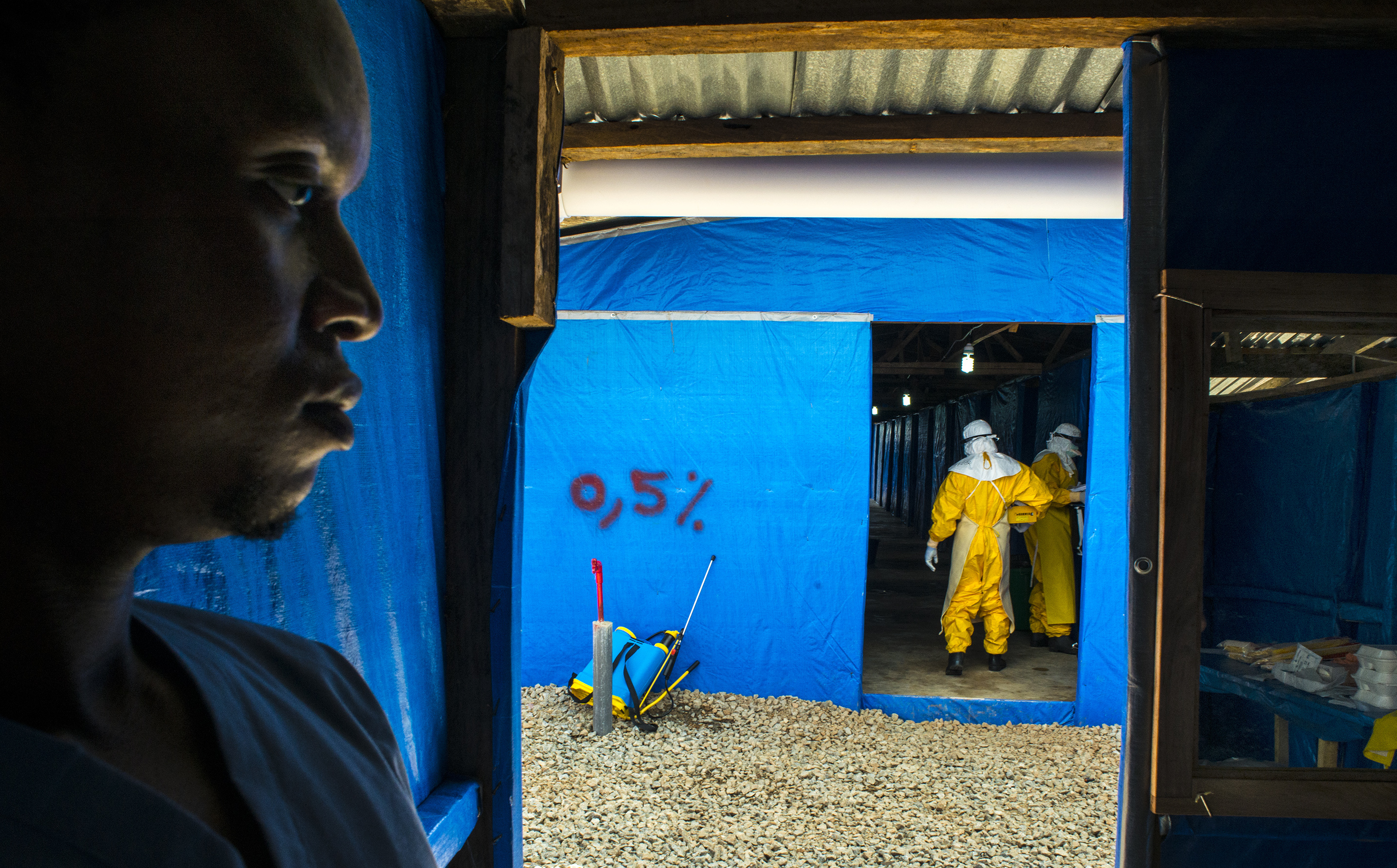
(Photo: James Momoh stands by as colleagues enter the suspected Ebola case ward Bong County Ebola Treatment Unit, on Tuesday September 16, 2014. The newly opened 50 bed unit is managed by International Medical Corp, and was built by Save the Children. By Michel du Cille/The Washington Post via Getty Images)

A Vote Against Inequality?

Katie Engelhart views the Scottish vote as a manifestation “of the increasingly hot debate about rising global inequality and what we should do about it”:

Scotland’s pro-independence movement differs from similar movements in places like Catalonia, Kurdistan, and eastern Ukraine in that it does not revolve around hard identifiers like language, religion, and ethnicity (or Russian military backing). What divides Scotland and England is a vocal lilt and a legacy of 14th-century clan warfare—seemingly surmountable obstacles to keeping a country together. As a result, Scottish nationalists have taken to claiming that London is to blame for all of Scotland’s economic ills. They contend that, with independence, Scotland can strike a different kind of compromise with its citizens. They argue that a vote for independence is a vote against inequality.

Reporting from Scotland, Noah Caldwell heard over and over again “the belief that Scots are fairer, more caring and more egalitarian than the rest of the United Kingdom”:

Initially a bemusing, inconsequential assertion, after enough repetition I realized it was a fundamental motivator for Yes voters, and therefore key to understanding independence. Since Scottish nationalism isn’t an outright ethnic, religious or linguistic movement, it relies heavily on socio-cultural definitions of “Scottishness”—namely, a shared egalitarianism. It’s the bedrock of the country’s liberal politics. It’s why First Minister Alex Salmond believes Scotland will be the next Denmark or Norway. Its roots, however, are hard to pin down, and even harder for Scots to explain to a panting American journalist on a beat-up retro road bike. It is, essentially, a living, breathing myth.

Gordon Brown connects to push for Scottish independence to globalization:

Globalization comes down, in practical terms, to the shift from the national sourcing of goods and services to their global sourcing, and from a reliance on national flows of capital to global flows, and it is matched by our ability to communicate easily and instantaneously beyond old borders and around the world.

And secessionist groups may be on the rise not in spite of these global forces — but because of them. In the years of the Industrial Revolution, people turned to political nationalism to cushion their regions against the uneven, inequitable patterns of growth. Now, people who see themselves as victims of change are turning back to — and organizing their politics around — old loyalties and traditional identities. They seek to insulate themselves against what appears like an unstoppable juggernaut of economic disruption and social dislocation. But because change seem to threatens to sweep aside long-established customs, values and ways of life, political nationalism becomes a credible vehicle for their response.


Scotland’s Day Of Reckoning

The Guardian is live-blogging the Scottish vote. From their afternoon summary:

A final poll has put the no vote on 53% and yes on 47%, in line with other recent predictions. The poll, by Ipsos Mori for the London Evening Standard, also found that 90% of Scots said they intended to vote today, with 57% saying they based their votes on hope more than fear.

Ben Page, the chief executive of Ipsos Mori, unpacks that poll:

[T]here is the idea of “silent Nos” – that there is a spiral of silence making some intimidated “No” voters less likely to agree to take part in surveys at all, or to say they are undecided or refusing to say how they will vote and biasing the sample. The challenge for us is spotting them in the polling data and how to treat them. If “shy Nos” really don’t want to take part in even internet surveys, or completely private phone calls, then even with samples that are demographically matched to Scotland’s population, we will be understating the size of a No vote. We will see.

The Guardian is also keeping tabs on the voting process:

Polling stations have been busy all morning, with some reports of queues, but there have been no complaints of intimidation of voters, and the threatened potential “carnage” has not been in evidence. Unconfirmed reports suggest that there has so far been one arrest at a polling station.

Murdoch dismisses reports of violence:

Carl Bialik explains when to expect results:

For the election junkies who want to watch results as they come in, I’ve put together a guide to how early Friday morning could unfold: when the 32 local councils can be expected to report their constituents’ vote counts, what percentage of the electorate each area represents, and which way voters from each area can be expected to lean. The registered voter numbers are solid and were provided Wednesday by Dougie McGregor, who works in the office of the referendum team’s chief counting officer. (He said those numbers might change slightly when final counts are available.) The times and the electoral lean, though, are rough enough to warrant a number of caveats

His guide:

Scotland Vote Guide

Sacking Plastic Bags

Katie Rose Quandt contemplates California’s new plastic-bag ban:

There is evidence that bag bans and taxes can cut down on some of this waste: Ireland’s 2002 tax cut bag usage between 75 and 90 percent. An analysis of bag use in Australia found that 72 percent of customers accepted single-use bags that were offered for free. When a nominal fee was charged, usage dropped to 27 percent (33 percent switched to reusable bags and 40 percent made do without).

But there’s one major downside to bag bans: Although plastic bags’ manufacture is relatively energy intensive (according to the Australian government, a car could drive 36 feet with the amount of petroleum used to make a single plastic bag), other kinds of bags use even more fossil fuel. A heavy-duty, reusable plastic bag must be used 12 times before its global warming impact is lower than continuing to use disposable bags, according to a study by the UK Environment Agency. A cotton bag takes 132 uses, and a paper bag—which will still be legal with California’s 10-cent fee—must be used four times before its global warming impact is less than using single-use bags.

And Brian Palmer reflects on grocery bags of yore:

The free handled paper bag dominated the market for only a brief period before the plastic bag came onto the scene in the late 1950s. Then the oil company Mobil brought the familiar petroleum-based plastic bag to market in the 1970s. These “T-shirt” bags (so named for their shape) cost less than half as much as a paper bag, and the economics proved irresistible. By the early 1980s, the plastic bag had become grocers’ packaging of choice.

From the very beginning, however, the plastic bag has been no stranger to controversy. Consumers hated the bag’s wobbliness at first and the fact that it wouldn’t stand up on its own. In 1959, reports of dozens of children suffocating on the bags led to calls for a ban, but manufacturers responded with a nationwide safety campaign. The plastic bag was saved.

But soon enough we became aware of another reason to ban the bag: it’s an environmental disaster.

Previous Dish on the plastic vs canvas debate here and here.