Cameron Close To Tears – And Resignation?

An impassioned plea from the prime minister:

Has he been on the hustings in Scotland, taking his case to the people? Not exactly:

Sadly, only a small number of Scots got to hear his appeal [last week] directly. That’s because the Prime Minister of the United Kingdom wasn’t actually able to walk the streets of the United Kingdom to deliver his message. He had to stay safely within the confines of a small building for his own security. Yesterday, Ed Miliband, the man who would be the next prime minister of the United Kingdom, also tried to take his case for the Union out onto the streets. And he was chased from those same streets by an angry mob.

You can see the chaos when Miliband tried to walk the streets of Edinburgh here. And, yes, they yelled at him, calling him a “fucking liar” and “serial murderer” (!) to his face. Some of that is from the usual thuggish suspects – but the atmosphere in the campaign has gotten ugly in the past week or so. The one thing that my friends in Britain tell me about politics right now is that there’s enormous discontent with all the major party figures. They seem like a distant metropolitan clique, cushioned in super-safe districts – not real representatives of actual people. That’s why UKIP has had such success. Here’s a UKIP candidate explaining why he quit the Tories:

Lawmakers become lawmakers mostly by working in the offices of other lawmakers. It’s a club. Recent research found that over half of Labour candidates in seats where the party stood a good chance of winning in the next election had already worked in Westminster. Instead of using primaries to select candidates for parliamentary seats, party hierarchies parachute in those whom they favor. Politics has become an exclusive game played by insiders, little more than a competition between two cliques, at the top of the Labour and Conservative Parties, to decide who sits on the Downing Street sofa.

Sound familiar – as we contemplate a chance of another Bush-Clinton match-up? And as a deeply unpopular party nonetheless has a structural lock on the House? This is not just about independence for Scotland. It’s about democratic accountability. And Westminster has clearly failed to represent that for large swathes of Scots.

Daniel Berman dismisses the idea that, should Yes prevail, Cameron will lose his job because “he would be the Prime Minister who oversaw the end of the Union.” Cameron’s problems go much deeper than that:

Cameron’s greatest error was in his decision to pass the enabling legislation for the referendum. Much as he showed little to no interest in Scottish affairs in any other aspect of government, he outsourced the management of the referendum process to an interested party in the form of the Scottish government in exchange for cosmetic concessions regarding language. Predictably then, Salmond government proceeded to do everything in its power to rig the system in their favor, moving to disenfranchise nearly 800,000 Scots currently resident outside of Scotland, nearly 20% of the electorate in a nation of five million, nearly all of them likely NO voters. If YES were to win narrowly, or in in all honesty by anything less than 55-45 or so, it will be able to be ascribed to this decision. It is one thing to hold rallies in Trafalgar Square, as happened this Sunday, and at which the government was also MIA; it is entirely another to actually do something about this disenfranchisement which never could have taken place if the administration was conducted jointly with Westminster.

As a consequence there is a real case for treating the referendum as a test of Cameron’s leadership. Of course this would not matter if he were popular within his party, which he is not, or if the same complaints could not be applied across a range of issues, which they easily can. The main reason Cameron will be in trouble then is not solely to do with Scotland, but because in a context in which his entire modernization line has been fully discredited as a path forward for the Tories, the political circumstances will have changed.

A spell has been broken. No one knows what comes next.

Quote For The Day

“There is, like, a weird historical gay job. It’s not just jobs in the arts or whatever. It’s loner jobs. Lone wolf jobs. There’s something in that, for sure,” – Choire Sicha, ruminating on why so many of the new media start-ups are by gays.

Think about it: Nate Silver; Kara Swisher; Nick Denton; Glenn Greenwald; Dan Savage; yours truly. Loners. And all the men have amazing spouses. Joe Pompeo’s piece about the phenomenon is here – and I apologize for all the f-bombs I seem to have uttered down the telephone.

Drowned In Search Of Freedom

Screen_Shot_2014-04-30_at_2.28.04_PM

Barbie Latza Nadeau tells the ugly story of how as many as 500 Middle Eastern migrants seeking refuge in Europe were deliberately shipwrecked off the coast of Malta by their traffickers last week:

Unlike most of the traffickers who eventually either abandon the ships or meld in with the migrants, these traffickers had devised a bucket brigade plan to pass their human cargo between a series of increasingly smaller vessels mid-journey, always taking the bigger boats back for more refugees, according to survivors. … The only problem with the plan to pass the passengers was that eventually the migrants refused. According to two Palestinian survivors who spent a day and a half in the water before being rescued, the boat they had been on for just a day was met by yet another smaller vessel “for the umpteenth time” about 300 miles off the coast of Malta and the migrants, who were by then extremely tired, hungry and sea wary, were ordered to once again jump onto the smaller ship to continue the journey.

According to reports from refugee aid groups in Sicily who spoke to the survivors, when the migrants refused to transfer yet again, the trafficker from the mother ship allegedly hopped onto the waiting ship, which then rammed the vessel full of migrants until it sank. The smugglers then sped off, leaving as many as a hundred people floating in the water. Only a dozen survived, including two children who were saved when a merchant ship called the Pegasus spotted them floating in the sea. They said that the rest eventually sank beneath the surface—some after bobbing in the water clinging to debris for several hours.

Zooming out, Dara Lind explains how dangerous that voyage is:

Crossing the Mediterranean is much deadlier than crossing from Mexico into the US. The National Foundation for American Policy found that the deadliest year on record for the US/Mexico crossing was 2012, when 477 migrants were killed. That’s about 1 of every 1000 migrants apprehended crossing the border illegally. In 2011, which was the deadliest year for the Mediterranean crossing before this year, 1,500 migrants were killed: 1 in every 50 migrants who crossed. And the IOM’s initial estimates for this year indicate that 2014 will be twice as lethal as 2011: they estimate that 3000 migrants have been killed so far making the voyage.

(Map from Pew.)

A Universally Derided Idea Whose Time Has Come

Dylan Matthews argues that “the economic case that open borders would dramatically improve the well-being of the world is rock solid.” He interviews George Mason prof Bryan Caplan:

“Imagine that you’ve got a million people farming in Antarctica. They’re eking out this bare subsistence in agriculture in the snow,” [Caplan] says. “Obviously, if you let those farmers leave Antarctica and go someplace else to farm, the farmers are better off. But isn’t it also better for the world if you let people stop eking out this existence, contributing nothing to the world, and go someplace where they could actually use their skills and not just feed themselves, but produce something for the world economy?”

Alternately, think about what happened in the 1960s and ’70s as more and more women joined the workforce in the United States. Was the result mass unemployment for men, as women took all their jobs? Of course not — the economy adjusted, and we’re all better off for it. … That’s the basic argument for open borders: that you’re “moving productive resources” — people — “from places where they’re next to useless to places where they can contribute a lot.” The size of the numbers involved makes the case even more compelling. “You might think that moving from Haiti to the United States would cause a 20 percent increase in wages, but no. It’s more like a 2,000 percent increase in wages,” Caplan notes. “The difference between the productivity of labor in poor countries and rich countries is so vast, it’s hard to wrap your mind around it.” With numbers that big, the potential gains are enormous. A doubling of world GDP is a reasonable estimate.

Ezra Klein nods:

It’s intuitive to Americans that the economy benefits when there are more people around to invent, produce, and purchase stuff. As such, public opinion in America overwhelmingly favors the idea that we should make more people. But that consensus quickly breaks down when the conversation turns to letting in more people.

There are good reasons for that. A higher birth rate has very different implications for social solidarity than a spike in immigration, for instance. Plans to strengthen America’s social safety net — or, much more to the point, adopt a universal basic income — would buckle beneath a massive influx of immigrants. There are difficult questions around border security. There are very hard questions about how to integrate a lot of new people into American society (or any other society). But the reason most often given is a bad one: the idea that more immigrants will take jobs from, and depress wages for, native-born workers. There’s overwhelming economic evidence that higher levels of immigration make most native-born workers better off. There’s mixed evidence on the effect on low-skill workers, but even if there are small losses, those are better managed through transfer programs than by closing the border.

Alex Tabarrok looks at the data:

David Roodman has a characteristically careful and comprehensive review written for Givewell of the evidence on the effect of immigration on native wages. He writes, “the available evidence paints a fairly consistent and plausible picture”: There is almost no evidence of anything close to one-to-one crowding out by new immigrant arrivals to the job market in industrial countries.

• Most studies find that 10% growth in the immigrant “stock” changes natives’ earnings by between –2% and +2% (@Longhi, Nijkamp, and Poot 2005@, Fig 1; @Peri 2014@, Pg 1). Although serious questions can be raised about the reliability of most studies, the scarcity of evidence for great pessimism stands as a fact (emphasis added, AT) …

• One factor dampening the economic side effects of immigration is that immigrants are consumers as well as producers. They increase domestic demand for goods and services, perhaps even more quickly than they increase domestic production (@Hercowitz and Yashiv 2002@), since they must consume as soon as they arrive. They expand the economic pie even as they compete for a slice. This is not to suggest that the market mechanism is perfect—adjustment to new arrivals is not instantaneous and may be incomplete—but the mechanism does operate.

Matt Steinglass, meanwhile, thinks immigration advocates have learned a thing or two from the gay rights movement:

The most effective model America has seen in recent years of how an already-committed minority constituency can drive its party’s policies is that of the Tea Party, which staged rallies, won media attention, and (most importantly) ran right-wing candidates in primary elections to force concessions from incumbents. But some immigration activists are looking to a different model: the lesbian, gay, bisexual and transexual (LGBT) movement. Frank Sharry of America’s Voice, an immigration rights group, noted last year that one of the lessons he learned from the LGBT movement was that “we had to give our cause a human face.”

That may seem like a quixotic ambition, given the vociferousness of right-wing antipathy to undocumented immigrants. On the other hand, maybe not. On Monday, theWashington Post ran a story by Eli Saslow about a ten-year-old boy he calls Alex Ramirez, who earlier this year traveled 2,500 miles from El Salvador to Los Angeles to rejoin a mother and father he hadn’t seen in six years. If you want to assess whether immigration advocates have a shot at winning the heart of America, you need to read Alex’s story. It is by turns heartbreaking and heartwarming. When his father and, later, his mother left the coffee fields for America to earn money to send home, they left Alex with his grandmother in the bamboo house where the family had lived for generations. When Alex’s mother, Yessica, finally phoned to tell him she had paid for a “coyote” to take him north, he refused. Yessica insisted.

Shining A Light On The Darkroom

dish_developertray

Ellyn Ruddick-Sunstein captions a project by John Cyr:

As analog photography becomes less popular, John Cyr’s Developer Trays read like a love poem to the vanishing medium. For the haunting series, he catalogues the empty developer trays of prolific and renowned photographers, each bearing the marks and stains of chemicals, which emerge like secret data points recording every serendipitous accident of the darkroom.

Through the course of the project, Cyr shot eighty-two trays, contacting photographers, institutions, and estates that held them in their possession. After cultivating a wide network of artists and studios, he turned to more obscure sources, like the relatives or former assistants of deceased photographers. Some photographers sent their developer trays in the mail to be photographed. For this labor of love, Cyr made himself available to travel at a moment’s notice; to view Sally Mann’s tray for example, he drove twelve hours to her Virginia home two days after she responded to his request. To Cyr’s dismay, many established and working photographers no longer had darkrooms and therefore no developer trays.

In a 2012 interview about the project, Cyr spoke about how digital technology has changed photography:

At this point, I can’t think of any analog photographers who haven’t done anything with digital media of some sort. With that said, those who still prefer traditional darkroom prints do so because of the materiality of a silver gelatin print. In one’s digital workflow, an extensive amount of work is performed on a digital file, which can then be printed countless times exactly the same as the first. When making a traditional print, all adjustments are made in the darkroom during the image’s exposure. This results in a unique print that will never be exactly duplicated, no matter how good your printing notes are. It is the objecthood of each silver gelatin print that keeps certain photographers interested in continuing to produce traditional darkroom prints.

Sally Mann’s tray is pictured above. See more of Cyr’s work here, and check out his book here.

Rape In The Boonies

Sara Bernard recently visited Tanana, Alaska, to better understand why the state has “higher rates of sexual assault than anywhere else in the United States”:

Growing up in Tanana, a town of 254, the prevalence of this kind of thing was common knowledge, but rarely discussed. Everyone knew the local elder who’d molested and raped his daughters and granddaughters for decades until he was arrested for touching another family’s girls; after four years in jail and another half dozen or so at a cabin downriver, he was back on the village tribal council. One of Geneva’s great aunts was molested and raped by an uncle for years; dozens of years later, the aunt’s grown daughter told her that the same uncle had molested her, too. Sometimes people pressed charges; most of the time, though, nothing happened. …

It’s only in recent years that some Alaskans have begun to speak publicly about this problem. In many places, silence still endures. But Cynthia Erickson hopes that the “old way” will eventually fade, and that speech, above all else, will empower victims, shame perpetrators, and interrupt the cycle of trauma where it starts: in childhood.

2003 study underscored some key reasons why rape can be a much bigger problem in rural areas than urban:

In general, victims of sexual assaults in rural areas have difficulty disclosing the crime, especially in cases where the victim knows the perpetrator. Informal social codes dictating privacy and family reputation reinforce the propensity not to report these crimes. The low population density and high levels of familiarity virtually assure that rural victims of sexual assault will have little anonymity, compounding the problem of severe under-reporting. Other barriers to reporting include the experience of greater physical isolation in rural areas and a general distrust of outside assistance.

The analysis focused on data obtained from Pennsylvania, Oklahoma, Alaska, and Mississippi. The research conducted in Pennsylvania revealed significantly higher rates of sexual assault in rural areas of the State, while the data from Oklahoma indicated that reported rapes did not reflect the true prevalence of rape in rural areas. Rates of sexual assault in Alaska and Mississippi were higher in rural areas than in urban areas.

Poverty’s On The Decline … But Tell It To All Those Poor People

census_poverty_rates_over_time.png.CROP.promovar-mediumlarge

Emily Badger summarizes the news:

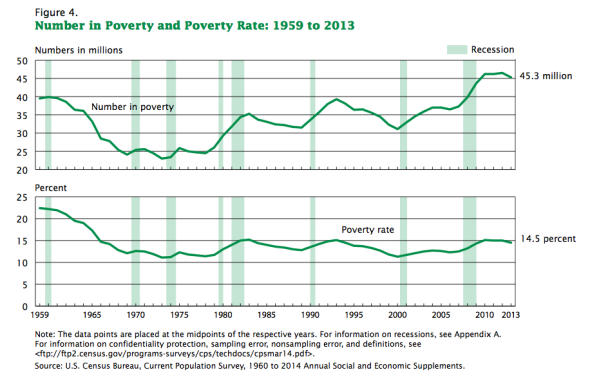
The official poverty rate declined from 15 percent in 2012 to 14.5 percent in 2013, although the number of Americans living in poverty remained statistically unchanged for the third year in a row. That’s largely because of population growth. Poverty is now starting to tick down as unemployment declines, and as more workers, who held at best part-time jobs in 2012, find full-time employment. Between 2012 and 2013, Census counted 2.8 million net new full-time workers in the United States, with many of those jobs marginally improving the prospects of families that had been living below the poverty line.

Jared Bernstein pours more cold water on the figures:

Yes, various indicators improved in 2013. Real G.D.P. was up, but no faster than the year before (a bit above 2 percent); same with payrolls. And while the unemployment rate fell seven-tenths of a percentage point in 2013, from 8.1 percent to 7.4 percent, more than half of that was from people dropping out of the labor force. That’s not exactly a sign of strength. In fact, the share of the working-age population with a job barely budged last year.

The real wages of low-wage workers were generally as torpid in 2013. For example, if we look at the hourly wage of those in the bottom third of the pay scale, it averaged a bit above $10 per hour over both 2012 and 2013. However, a stagnant low wage is actually an improvement, because real low wages fell sharply earlier in the recovery. And the real median hourly wage went up 1 percent last year, providing a slight bump to the middle class.

How Neil Irwin presents the figures:

This simple fact may be the most important thing to understand about today’s economy: Around 1999, growth in the United States economy stopped translating to growth in middle-class incomes. In the last 15 years, median income has been more or less flat while there was far sharper growth in, for example, per capita gross domestic product. …

But there really is no mystery as to why public opinion has been persistently down on the quality of the economy for years. You can’t eat G.D.P. You can’t live in a rising stock market. You can’t give your kids a better life because your company’s C.E.O. was able to give himself a big raise.

Jordan Weissmann considers the usefulness of the Census’ measure:

The official poverty rate is sometimes criticized as unreliable because of its odd origins and narrow definition of income. The statistic was basically MacGyvered into existence in the 1960s by a lone Social Security Administration economist who based it on cost of food for a family of three, since that was just about the only data on living standards she had to work with. Since then, the stat has only really been updated for inflation. While it counts cash payments such as Social Security towards a family’s finances, it doesn’t account for benefits such as food stamps. As a result, it vastly understates the decline of material need in America over the decades.

That said, it does provide a decent snapshot of poverty as it exists today. For several years, Census researchers have been honing an alternative statistic known as the Supplemental Poverty Measure, which takes into account more government benefits along with geographical variations in the cost of living for a much more sophisticated approach to quantifying need. But in 2011, the SPM was only 1 percentage point higher than the cruder, official measure we’ve been using since the Johnson days.

Ben Casselman points to a few pieces of good news:

The weak recovery has hit young people especially hard; the unemployment rate for Americans younger than 25 is still 13 percent, more than double the 6.1 percent for the population as a whole. But the “lost generation” may at last be seeing some gains. Americans ages 15 to 24 saw their household income rise 10.5 percent in 2013, the biggest increase for any group, though they are still earning 4 percent less than before the recession. Those 65 and older, meanwhile, saw their incomes rise 3.7 percent. No other age group saw statistically significant income gains.

Cassidy’s bottom line:

To oversimplify a bit, income stagnation paired with rising inequality is a recipe for political polarization and, under the American system of divided powers, political gridlock, which is what we have. Based on the latest Census Bureau figures, there’s no sign of that changing anytime soon.


Free Music Rage

Last week, Apple pissed off quite a few music fans by automatically adding the new U2 album Songs Of Innocence to the libraries of 500 million iTunes users. In the face of a mounting backlash, the tech giant launched a help page Monday with instructions on how to remove the album. Writing this weekend, Peter Cohen spoke for those who didn’t get the outrage:

[T]he inordinate amount of actual anger directed at Apple and U2 over this is so disproportional to the actual event, I’ve started to wonder about the mental state of some of those complaining. It’s really been off the charts. If you fall into that camp, let me speak very plainly: I have no sympathy for you. I have trouble thinking of a more self-indulgent, “first world problem” than saying “I hate this free new album I’ve been given.” For the past few days I’ve seen screeds posted on blogs and remarks on social media attacking Apple and U2 for invading privacy, for their NSA-like invasion of the sanctity of people’s music collections, claims of fascism, and a host of other utterly imagined insults. The resulting outrage has been disproportionate and more than a little sad.

Dan Wineman couldn’t disagree more:

Music collections are deeply personal, and to young people, they can be surprisingly wrapped up in identity. Back when CDs and cassettes were the thing, my friends and I would collect and proudly house them in elaborate alphabetized racks. Every cramped freshman dorm room had several cubic feet devoted to this purpose. You wouldn’t visit a friend for the first time without spending at least a few minutes arms folded, waist bent, scanning tiny lettering on 25 or 50 or a couple hundred plastic spines. It was smalltalk; it was a courtship display. Wait a sec, you’re into Genesis?! Oh, just the early stuff. Cool, cool.

We’ve surrendered the physical trappings, but the connotations remain. And I think Apple didn’t see this because — no matter how deeply they insist music runs in their DNA — from the perspective of the iTunes Store, “library” means licensed content the user is currently authorized to stream or download. But due to various design decisions Apple’s made over the years, that’s not what it means to anyone else. I’d wager that to a majority of iTunes users, “library” means my personally curated collection of stuff that I enjoy and feel comfortable associating with my identity. Messing with that is, to be frank, nothing short of a violation.

Meanwhile, Vijith Assar is struck by the sheer novelty of Apple’s move:

[H]ere’s a very simple reason why this is unprecedented, and that is because it doesn’t make any sense. Never before has such a major technology company also operated as publicist for a creative artist. The whole endeavor yearns desperately to be a landmark new innovation for the music industry, perhaps something along the lines of Radiohead’s legitimately earth-moving In Rainbows, which was self-released with variable pricing in 2007 and remains the gold standard against which music industry innovation is measured.

But this is not In Rainbows, and as such should instead be remembered primarily as a monumental blunder by the tech industry. The delivery mechanism amounts to nothing more than spam with forced downloads, and nothing less than a completely indefensible expansion by Apple beyond its operational purview. This company makes hardware and operating systems – even if it’s one to which I’ve more or less entrusted the management logistics of my personal music collection. It has, demonstrably, no competence in the sort of social and cultural thought that should have gone into a well-orchestrated version of this same gimmick, like, say, a free album as a birthday gift. It also certainly has no business forcing files of any sort onto my computer without my permission.

Marco Arment adds, “The right way for Apple to do a big U2 promotional deal like this would have been to simply make the album free on the iTunes Store for a while and promote the hell out of that”:

Instead, Apple set everyone’s account to have “purchased” this album, which auto-downloaded it to all of their devices, possibly filling up the stingy base-level storage that Apple still hasn’t raised and exacerbates by iOS’ poor and confusing storage-management facilities. And when people see a random album they didn’t buy suddenly showing up in their “purchases” and library, it makes them wonder where it came from, why it’s there, whether they were charged for it, and whether they were hacked or had their credit card stolen.

Chart Of The Day

Soldier Deaths

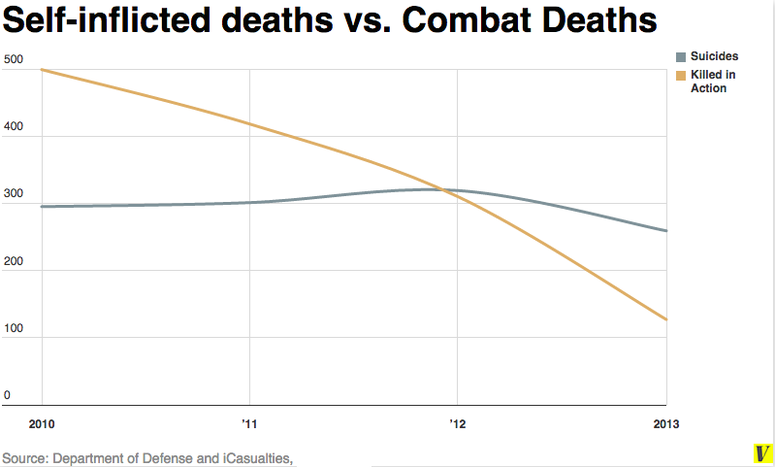
We are losing more soldiers to suicide than to combat:

Last year alone, 475 active service members took their own lives according to a report published last week by the Department of Defense. In the same year, 127 soldiers lost their lives in the line of duty reported icasualties.org — a website that has been documenting war deaths since the Iraq War in 2003. That’s the lowest level since 2008.

The same Department of Defense report said that 120 personnel took their own lives in the first quarter of 2014, a rate of nearly one soldier every day. That compares with 43 soldiers who lost their lives on the front line between January 1 and September 11, 2014.

Good News For The ACA?

The law seems to have effectively boosted insurance rates insurance coverage. Arit John explains:

The number of uninsured Americans fell 8 percent during the first three months of 2014, thanks to 3.8 million uninsured individuals gaining insurance, according to the Center for Disease Control. Put another way, the uninsured rate dropped from 20.4 percent to 18.4 percent among adults ages 18-64. This marks the first government study on health insurance after insurance through the health care law kicked in on January 1 and, as The New York Times notes, the numbers match up with previous independent surveys.

The important thing to note is that this survey is only through the end of March, meaning it doesn’t account for the surge of procrastinators who took advantage of the two week special enrollment period in early April.

Jonathan Cohn is pleased:

Critics will say that the number, though significant, falls short of expectations. And it’s true: The Congressional Budget Office and other experts had predicted the Affordable Care Act would reduce the number of uninsured in 2014 by several million more, in addition to the young people who already got insurance. But, as Sabrina Tavernise explains at the New York Times, the timing means this set of NHIS data didn’t capture most of the late enrollment surge that basically doubled enrollment in the Obamacare exchanges. As Harvard economist Katherine Baicker told Tavernise, the NHIS results sound “reasonably consistent with what had been expected,” given what private surveys like those from Gallup and the Urban Institute have already shown.

Meanwhile, Sarah Kliff argues the CDC data “reflects the importance of a totally different health insurance expansion”:

The Children’s Health Insurance Program was created in 1997 to offer insurance coverage to low income children. By early 1999, nearly all states had opted into the program (and all 50 participate today). That program has, over the past 17 years, cut the uninsured rate of children in half. The uninsured rate for kids has fallen from 13.9 percent in 1997 to 6.6 percent today, a huge decline that pretty much all traces back to the CHIP program expanding coverage.

But as Jason Millman notes, the CDC’s figures are far from the final word:

The new surveys Tuesday also come out a day after the Obama administration announced that 115,000 immigrants who purchased insurance through federal exchanges will lose their coverage by the end of this month for failing to provide documentation of their citizenship or immigration status. Another 360,000 customers risk losing part or all of their premium subsidies after September if they don’t provide updated income information to the federal government. Monday’s news is reminder that the coverage landscape in 2014 is still changing.

Suderman has more along those lines:

It’s possible that many have already lost their subsidies. The CMS memo notes how many cases have been closed, and how many are being resolved. But it doesn’t provide any information at all about how those cases were resolved. That’s a departure from when the discrepancies were first revealed in June. At the time, as CBS News reported, federal health officials stressed that consumers were coming out ahead in the “vast majority” of resolved cases. It seems probable some portion of the resolutions since, and perhaps even a significant fraction, were resolved with the subsidies being taken away.