Quote For The Day II

“For some time I have been disturbed by the way CIA has been diverted from its original assignment. It has become an operational and at times a policy-making arm of the Government. This has led to trouble and may have compounded our difficulties in several explosive areas. I never had any thought that when I set up the CIA that it would be injected into peacetime cloak and dagger operations. Some of the complications and embarrassment I think we have experienced are in part attributable to the fact that this quiet intelligence arm of the President has been so removed from its intended role that it is being interpreted as a symbol of sinister and mysterious foreign intrigue—and a subject for cold war enemy propaganda.

With all the nonsense put out by Communist propaganda about “Yankee imperialism,” “exploitive capitalism,” “war-mongering,” “monopolists,” in their name-calling assault on the West, the last thing we needed was for the CIA to be seized upon as something akin to a subverting influence in the affairs of other people… I, therefore, would like to see the CIA be restored to its original assignment as the intelligence arm of the President, and that whatever else it can properly perform in that special field—and that its operational duties be terminated or properly used elsewhere,” – Harry Truman, December 22, 1963.

My take on the CIA as an increasing malignant cancer on our democracy is here.

War Will Keep Them Together

https://twitter.com/Khaleed1949/statuses/511845817125044224

Remember that schism between al Qaeda and ISIS? Well, there’s nothing like a new war with the Great Satan to help patch that up. Adam Taylor passes along some salient news and poses a troubling question:

In a two-page message posted to Twitter accounts that represent both groups, al-Qaeda in the Arabian Peninsula (AQAP) and al-Qaeda in the Islamic Maghreb (AQIM) asked their “brothers” in Iraq and Syria to “stop killing each other and unite against the American campaign and its evil coalition that threatens us all.” It’s an unusual move. The two groups are perhaps the most notorious of the al-Qaeda-linked groups: AQAP operates in Yemen and Saudi Arabia, and it has been described as the “most lethal Qaeda franchise” by the Council on Foreign Relations, while AQIM operates in Northern Africa, in particular Algeria, Mali and Libya. Analysts say a joint statement from the two is unprecedented. …

[T]he statement calls on all jihadist groups to unite against a common enemy: “crusader America” and the alliance of states backing the U.S. plan to strike the Islamic State. This language echoes the Islamic State’s own language and presents a bigger concern: Might U.S. strikes against the Islamic State cause it to reunite with al-Qaeda and other extremist groups it opposes?

Aymenn al-Tamimi translates and analyzes the statement. In his view, the answer to that question is “not necessarily”:

This statement does not mean AQAP and AQIM are getting closer to IS or warming to the idea of pledging allegiance to IS. Indeed, they have firmly rejected IS’ Caliphate declaration, and have maintained their loyalty to al-Qa’ida Central (AQC). For comparison, note that members and supporters of Jamaat Ansar al-Islam- an Iraqi jihadi group (with a Syrian branch) which like al-Qa’ida does not accept IS’ claim to be a state or caliphate- have also denounced the U.S. airstrikes etc. targeting IS as constituting war against Islam, and like al-Qa’ida would want an ideal situation where all jihadis having the end-goal of a Caliphate unite against a common enemy, while rejecting IS’ assumption of supreme authority.

Meanwhile, much though Obama takes pains to deny that there is anything religious or civilizational about this war, that’s not how ISIS sees it:

[N]o matter how delicately the White House wants to frame renewed military operations in the region, it’s serving up rich propaganda fodder for the militant group in Washington’s crosshairs. As Morning Mix’s Terrence McCoy notes, the Islamic State is all too happy to paint the coming battle as a civilizational conflict. In its own glossy publication, Dabiq, the terror organization hails its plans to fight the “crusaders in Washington” and sees its rise amid the chaos of the Middle East as an evocation of history. …

In any event, it’s all dubious propaganda for the Islamic State, which as Obama noted, spends most of its time killing fellow Muslims and faces a constellation of largely Muslim factions — Kurdish militias, Syria’s Assad regime, the Iraqi government, Iran, and the Sunni Gulf states — arrayed against it. And, given Obama’s caution, the Islamic State can’t count on the same slip of the tongue of the president’s predecessor. Just days after the attacks of Sept. 11, 2001, President George W. Bush warned that “this crusade, this war on terrorism, is going to take a while.”

Is Britain’s Security Council Seat In Jeopardy?

Elaine Teng takes the question seriously:

Strictly speaking, the Scottish referendum should not affect Britain’s Security Council seat, but reform of the U.N. is increasingly in the air. Currently, there are five permanent Security Council members who hold veto power (the U.S., France, the U.K., Russia, and China), and ten rotating members elected by the General Assembly to serve two-year terms. There’s a general consensus that the Council should be expanded to 20-25 permanent members, but that’s when things start to get tricky. Which countries should join? India, a nuclear power home to a fifth of the world’s population? Germany and Japan, two of the world’s largest economic powers who contribute more to the U.N. budget than any country other than the U.S.? Nigeria, to give Africa a seat and correct the skew of power towards Western countries? Should France and Britain’s seats be combined into a single European seat to better accommodate the changing political realities?

Independence could accelerate these conversations, especially since the Scottish referendum comes just two days after the opening of the U.N.’s General Assembly on Tuesday. Should Scotland become independent, the position of the new, much smaller Britain on the Security Council might be called in to question. (An independent Scotland would apply for U.N. membership, a process that should be relatively smooth and straightforward.)

Stewart M. Patrick dismisses such speculation:

This is not going to happen. The near-certain outcome, if the Scots unwisely choose to go it alone, is that the authorities in Edinburgh will immediately recognize the UK government’s UNSC claim. A newly independent but closely integrated Scotland has everything to lose and nothing to gain by disputing the UK’s permanent seat. (Nationalism may be “political romanticism,” in Isaiah Berlin’s words, but even the most starry-eyed Scots understand that a country of fewer than six million has no permanent slot on the UNSC). Perhaps more surprisingly, the attitude of the remaining permanent four UNSC members will be identical: they will quickly recognize the rump United Kingdom as the state entitled to permanent membership.

Scotland Is Not So Easily Broken

The Final Day Of Campaigning For The Scottish Referendum Ahead Of Tomorrow's Historic Vote

Whatever tomorrow’s result, Alex Massie anticipates that the Scots will make peace with the result:

There will be a deep sadness in many places if Scotland votes Yes and, in other parts, some raging disbelief if she votes No. How could it be otherwise? This may be a wee country but the matter of Scotland is nothing small. Some folk will leave if we vote Yes and that, I think, will be a great pity. Others will react poorly to a No vote but at least cling to the consolation that losing a battle is not the same as losing a war. The nationalists have known defeat before and coped; they can do so again. Their faith will remain. It will be harder, I think, for Unionists to accept the song is over.

But hatred? Real hatred? How can we really hate our opponents? We may think them sorely mistaken but we can also agree – if we try to remember to do so – that they are not motivated by baser motives than we are ourselves. They are our brothers and sisters, fathers and mothers, husbands and wives, sons and daughters. Our neighbours too. To hate them is in some sense to deny a part of ourselves.

In that respect we really are all in it together. Today, tomorrow and Friday too. Come what may. Be not afraid. It is, probably, going to be fine. The little white rose of Scotland, so small and sharp and sweet, will still bloom.

Peyton Craighill interprets the polls:

The most recent poll using the most robust methodology will generally offer the best picture of where things will end up. In this case, that would be the phone poll from Survation completed Sept. 12 that showed 42 percent in favor of independence and 49 percent opposing, with 9 percent unsure. The survey reached respondents on both land lines and cellphones.

The 9 percent who are unsure in the Survation poll are a critical group. If they do turn out to vote on Thursday, their choices have the potential to sway the vote one way or another.

Tim Stanley would be unsurprised by a Yes victory. One reason why:

Historically, turnout in Scottish elections is low – in about the mid-sixties. But this time around some 97 per cent of Scots have registered. Now, why would someone go to the effort to register for the first time? To vote negatively (NO) or to vote positively (YES)? A local journalist put it to me that many of those new voters will be working-class Scots motivated by national passion. It’s unlikely that they’re fired up by David Cameron, Ed Miliband or the prospect of Devo-Max (which sounds like a reunited Eighties pop group).

Isabel Hardman visited both campaigns:

Which was the better operation, Labour No or the Yes camp? The two sessions I’ve attended in the past two days will not be entirely representative of their respective national campaigns, which unlike a stick of rock will vary depending where you cut. But the Labour lot seemed more organised, presumably because Labour is an experienced ground war party, while the Yes troops today were more enthusiastic and passionate. Even ‘No’ voters congratulated the two men on their impressive campaign.

Yes don’t have the media on their side – only one paper has come out in favour of independence – so their focus is so much more on grassroots support. Perhaps this makes them appear more sincere and energetic.

Peter Geoghegan is befuddled by Westminster’s mistakes:

The choice tomorrow didn’t have to be binary, but the third option – more powers for Holyrood without full independence – was left off the ballot paper. Then on Tuesday, just two days before the vote, Scotland woke to news that ‘devo max’ was back on if they voted No. The specifics of the additional powers seem both vague and unworkable, but the medium was more important than the message. The pledge, which could effectively usher in federalism across the UK, was delivered not after months of discussion, or even in person by the prime minister. Instead, ‘the vow’ was splashed across the Daily Record. If Westminster thinks that the front page of a tabloid is the best way to talk to Scotland in 2014 then it really has learned nothing from the referendum.

Ewan Morrison takes the Yes campaign down a notch:

In truth, the Yes camp is a ragged collection of factions all seeking power for themselves – a bigger slice of the political pie in a much smaller country. The unity and positivity behind the singular Yes has masked the divisions on the Yes side, between Greens who want no more drilling and the “it’s-our-oil” men; between steady state anti-capitalists and “business for Scotland”. There are even within the Yes camp factions of the old left that have long been pushed out of modern politics. The chanted “Yes”, it turns out, is as much about silencing the dissent among the ranks of Yes followers as it is about silencing opponents.

How will so many disparate and vying factions manage to create a better, more “positive” Scotland? We could have had an answer to this if months back the Yes factions had actually made concrete plans for the future and recognised their divisions, but instead they chanted the mantra of fantasised unity: Yes Yes Yes. This is why the word plastered all over our country has come to mean absolutely nothing. It’s an illusion of positivity. A hope about hope. A pure advert, selling us something we don’t need, something that does not even exist – a post-political dream of a new nation untroubled by the conflicts of the past or grim realities of the world beyond. Say it enough times and you start to believe it. Yes Yes Yes. Say it and see it too many times, and it vanishes into meaninglessness.

Clive Crook, who thinks Scotland could come to regret independence, nevertheless favors it:

It comes down to this: Scots are bound more tightly to each other — by history, culture and ethnicity – than they are to the rest of the U.K. In this sense, Scotland is, and for centuries has been, another country. Its desire for full nationhood has waxed and waned, but it certainly isn’t new. The union is hundreds of years old, but the things that make Scotland different haven’t been smoothed away, which tells you something.

What has changed in recent decades is that the U.K. has become both less hospitable to the Scots and less necessary.

And Paul Wells’ hunch is that “an independent Scotland would, in 30 years, be doing fine and maybe better than fine”:

And that the United Kingdom, whose history is rich in upheaval, could handle this one with little difficulty. There would be transition costs, and they would be borne disproportionately by people whose means are so modest they have a hard time handling any new cost, but a lot of them will vote Yes tomorrow anyway. That’s only irrational if you assume voters are, or should be, profit maximizers before all else.

All of the Dish’s Scotland coverage here.

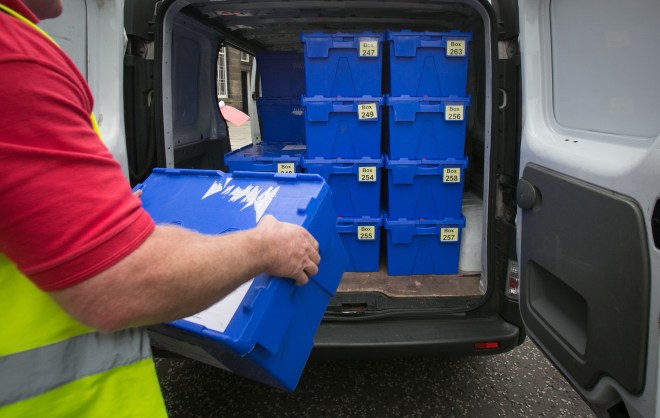
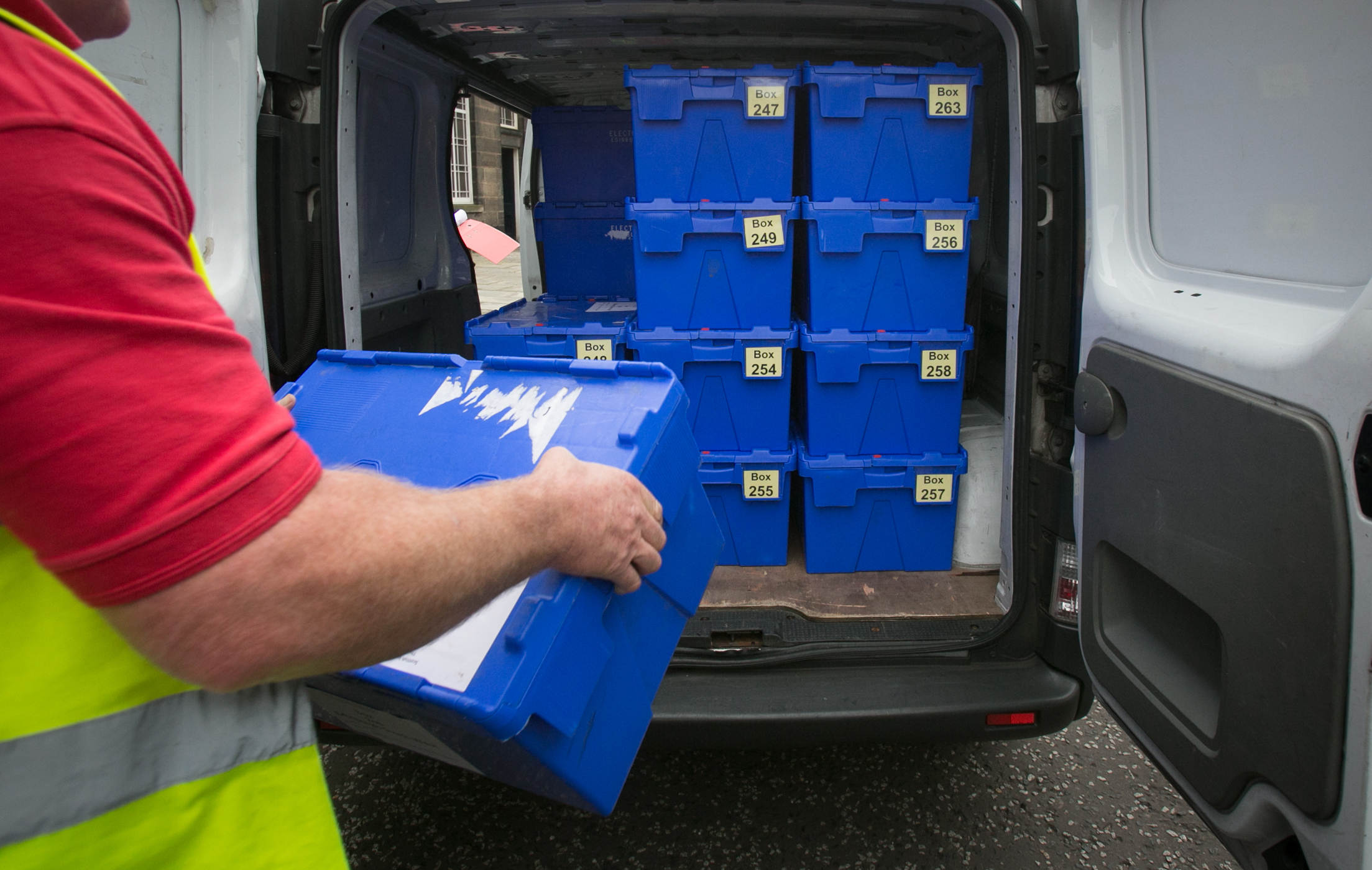
(Photo: Ballot boxes are carried to a waiting van as ballot boxes that will be used in the Scottish independence referendum are collected from New Parliament House for delivery to Edinburgh’s 145 polling stations on September 17, 2014 in Edinburgh, Scotland. By Matt Cardy/Getty Images)
Counterterrorism, Containment, Or Conquest?

Juan Cole argues that containment is the superior strategy for answering the challenge posed by ISIS, noting that “the most effective campaigns in which the US air force has been involved have been more or less defensive”:

A minimalist, defensible position for the US could have been to say that the US will intervene aerially to ensure that Erbil and Baghdad don’t fall, but that recovering the Sunni Arab areas that Nouri al-Maliki had alienated was up to Iraqi politicans and forces. And a minimalist strategy could have simply ignored the Syrian side of the border. It is true that ISIL has a big base in Raqqah and uses its Syrian assets to support its operations in Iraq. But ISIL successes in Iraq were in any case not mainly military but rather political. Since this is so, the military position of ISIL in Syria isn’t really so central to its taking of Mosul, Tikrit, etc. Nor would holding Raqqah help it to hold Mosul if Mosul turned against it.

The US was very good in the Cold War at containing Stalinism but very bad at defeating a guerrilla group like the Vietcong. It was the former that mattered in the end.

He’s right. And I say that not from any ideological position, but simply by observing US policy failure this past decade. To try and do the same thing again when it didn’t work before is the mark of insanity.

Meanwhile, former congresswoman Jane Harman wants to go to war with the ideology of extremism rather than the terror groups themselves:

What’s much more challenging is to confront—and defuse—the ideologies that underpin these groups. The jargon for this is “countering violent extremism” (CVE), a crucial part of the strategy that’s underfunded and hard as all get-out to accomplish. If we lump both al Qaeda and ISIL into one bucket labeled “terror,” we’ll never pull it off.

An example: The State Department recently put out an exceptionally violent video that used some of ISIL’s own promotional materials. The point was to highlight that Abu Bakr al-Baghdadi’s thugs kill Muslims—which is an important point to make. Osama Bin Laden cautioned ISIL’s ancestor, al Qaeda in Iraq, that its slaughter of fellow Muslims made for bad optics. But what might have worked against al Qaeda won’t necessarily work against this new enemy. ISIL glamourizes violence, the notion that its caliphate is worth dying and killing for. The group celebrates death. We need to undermine that pitch with a positive narrative, not amplify its negatives.

Paul Pillar cautions against returning to “war on terror” rhetoric:

Names matter, even if it is not so much the term itself but associated concepts that dominate public discourse and thinking. To the extent that efforts to curb the expansion of ISIS are thought of as War on Terror II, this has unfortunate effects, including the mistaken belief that seizure of territory in the Middle East constitutes a terrorist threat to the United States, and insensitivity to counterproductive effects of the use of military force.

The Obama administration isn’t calling its effort War on Terror II, because it does not want to be seen as copying the approach and the mistakes of its predecessor. Whatever the administration’s motives, eschewing the war metaphor is good for public understanding. What the United States is doing against ISIL is a continuation—albeit more intensively for right now, because of the public alarm—of counterterrorism that has been going on for a long time and, unlike wars, will not end.

And J.M. Berger and Jessica Stern find it “hard to escape the feeling that our policies still come from the gut, rather than the head”:

Bin Laden once said, “All that we have to do is to send two mujahideen to the furthest point east to raise a piece of cloth on which is written al Qaeda, in order to make the generals race there.” Abu Bakr al-Baghdadi, the emir of ISIL, may be counting on just that response, and for the same reason—to draw the United States into a war of supreme costs, political, economic and human.

A limited counterterrorism campaign may insulate us from those costs, but it is not likely to be sufficient to accomplish the goals laid out by the president. ISIL is a different enemy from al Qaeda. It has not earned statehood, but it is an army and a culture, and more than a traditional terrorist organization. Limited measures are unlikely to destroy it and might not be enough to end its genocidal ambitions. Our stated goals do not match our intended methods. Something has to give—and it’s probably the goals.

When Facebook, Twitter And CCTV Solve Crimes

Last Thursday, a brutal gay bashing took place in the City of Brotherly Love:

Sources tell NBC10 the 27-year-old and 28-year-old victims were walking from a restaurant in the area of 16th and Chancellor around 10:45 p.m. Thursday. Suddenly they were approached by a visibly intoxicated group of two men and six women. Witnesses say someone in the group asked, “Is this your fucking boyfriend?” When one of the victims told them yes, the group allegedly attacked them, punching and kicking them in the face, head and chest.

Both men suffered shattered cheekbones and one had to have his jaw wired shut. But a combination of CCTV and social media – especially by a lone and heroic tweeter – caught the fuckers who did it:

The Philadelphia police department on Tuesday released surveillance video of the large group of suspected attackers as they walked along the Philadelphia street where the attack occurred. Within hours, the above photograph [shown in the lower-right corner of that tweet by Greg Bennett] surfaced on Twitter that purports to show many of the suspects at a dinner party taken that evening at a nearby restaurant. …

According to reports, a Twitter user named @FanSince09 turned to Facebook Graph Search to see who had checked into La Viola after it was determined that the photo first surfaced on Facebook. After matching the photo from people who called into the restaurant, he notified police.  It wasn’t long after that Philadelphia police detective Joe Murray credited @FanSince09 with helping to crack the case with this tweet: “S/O to @FanSince09 This is what makes my job easy. Sure, it’s up to me to make the arrest but we are all in this together.”

Late Tuesday evening, WPVI-TV reported that attorneys representing the suspects have contacted police and are marking arrangements to turn themselves in for questioning on Wednesday.

It reminds me a bit of our Window View contest. It’s amazing what you can do with Google earth, let alone with CCTV and Facebook clues. It’s also a sign of the power of social media to replace conventional sources. In the old days, a newspaper would have had to do all the legwork – probably not as swiftly – and have far fewer resources to do it. Now, independent, social media sleuthing can make all the difference. In a pretty demoralizing and depressing time, this cheered me up no end.

A New Euphemism: “Story Advertising”

They keep coming up with ways to camouflage the out-sourcing of journalism to advertising, don’t they? Check out this screen shot of the NRO home-page this morning:

Screen Shot 2014-09-17 at 9.51.26 AM

The reader has to glean what is an ad and what is an article by those two tiny little icons at the top right. Buried in a Washington Post story on DC’s ABC affiliate, WJLA, is this little nugget:

Newsroom employees say they were alarmed last month by comments made by David Smith in an introductory staff meeting. According to several employees, Smith repeatedly said the station’s newsroom would “work for” its advertising-sales department … The apparent blending of news and advertising has been evident in some parts of the station’s newscasts. WJLA’s morning news has aired footage from Myrtle Beach, S.C., and its anchors have mentioned a tourism promotion in conjunction with the Myrtle Beach Area Convention and Visitors Bureau. The tourism organization has been running a similar promotion with other Sinclair-owned stations.

Then a new Sunday magazine in California is experimenting with this:

For Nest, the maker of connected home devices that was acquired by Google, California Sunday enlisted artists and illustrators to come up with artwork centered on the idea of home, according to Edwards. Nest picked the ones they liked, which will run in the magazine labeled “Commissioned by Nest,” followed by a page with standard Nest creative on the same theme.

For another, Lexus’ hybrid line, the magazine commissioned travel articles on California day trips, accompanied by original photography. Lexus was allowed to pick the destinations and be included in the photo but otherwise remained uninvolved in the content creation, Edwards said. The articles are running on one right-hand page, followed by a traditional brand ad on the next right-hand page.

What’s notable is that this kind of thing – once utterly unthinkable in ethical journalism – is now completely routine. Swisher notes:

As to the “story advertising,” Edwards correctly noted that this is just par for the course going forward in publishing, although that does not mean the ads need to be boring.

I’m not sure that’s exactly the problem.

Yes They Can?

Scotland Ballot

Dave Brockington suspects “the current polling is overstating the estimate of the yes support.” Tomorrow he expects “at least a four point (i.e. 52% No, 48% Yes) victory for the unionists”:

We do have empirical evidence to make some reasoned, if imprecise, estimates regarding the don’t knows. As the ICM poll released yesterday still reports 14% Don’t Knows, this remains a significant chunk of the potential electorate. The literature on direct democracy, specifically referenda and initiatives in the United States (the literature about which I’m most familiar), suggests that in a yes / no dichotomous decision, the No option has some of the advantages of incumbency. I strongly suspect that of the DKs that do turn out to vote, they will break significantly to No. This makes sense. Given this is the most important and far reaching election in Scotland in a lifetime, if a voter has yet to make up their mind 48 to 96 hours before the election, the odds of them sticking with the safety of the status quo rather than the riskier unknown of independence is compelling.

But, if tweets are any indication of votes, Yes still has momentum. Mark Gilbert explains:

Karo Moilanen, a visiting academic at the university, has dissected more than 1 million tweets in the past month. The “yes” campaign has generated more than 782,000 missives, compared with 341,000 for those backing the “no” movement. Both camps saw a dive in activity yesterday, though those backing the Scottish nationalists were still twice as active as the unionists

Dan Hodges thinks the referendum has already exposed the fact that the union is essentially a mirage:

In Scotland we see that just under half the people are toying with turning their back on the United Kingdom for good, and the other half are demanding almost total autonomy as the price for remaining within it. In England there are growing calls for similar autonomy via an English parliament, regional parliaments or even individual city parliaments. In Wales support for independence is now nudging twenty per cent, and there are similar calls for the devolution of more powers and a reassessment of the funding settlement. In Northern Ireland people are currently refraining from murdering each other, which apparently represents a great success. If this is union, what exactly would fragmentation look like?

Jack Shenker frames the independence campaign as part of a tectonic shift in British politics:

What the Scottish independence referendum has exposed, unexpectedly but enthrallingly, is not so much a vein of support for nationalism, or even for independence in its own right, but rather a vein of political imagination that upends everything we’re usually told about politics today. It’s exposed a rejection of gradualism in favor of more ambitious, and even radical visions of change. As young musician Becci Wallace puts it, “it’s opened up so many people’s minds and given them a voice they didn’t even know they had.”

The hope for many is that regardless of the referendum outcome, this mental gear shift could seep across the border; as indicated by the rise in England of the self-styled “anti-establishment” U.K. Independence Party, which tacks firmly to the right, a hunger for alternatives to the political status quo can be discerned right across the British Isles.

Ishaan Tharoor highlights Thatcher’s role in all this:

Critics point to the dark corners of her foreign policy and say Thatcher’s epochal transformation of Britain — her systematic privatization of the country’s industries and wars with labor unions — hollowed out Britain’s industrial base and deepened inequities.

It’s a legacy that many in Scotland have invoked as grounds for wanting to leave, including Alex Salmond, leader of the “Yes” campaign. “That overwhelming desire among the people of Scotland to escape the economic and social bedlam of the 1980s was actually the result of the approach of Margaret,” Salmond told the BBC in 2013. “She set the ball rolling to make Scottish self-government a huge priority, and that ball is still rolling fast now. So in that respect, people should reflect that in some ways, she was the handmaiden for a return to Scottish democracy. Not what she intended, but nonetheless what happened.”

Alex Massie wants No voters like himself shown some respect:

Chafe against the United Kingdom of Great Britain and Northern Ireland by all means, imagine a different, more glorious future all you want but at the very least – and it should not be a large thing to ask – recall, just for a second, that your opponents are not motivated by a willingness to sacrifice Scotland or do her down or oppress her or lead her to some kind of dystopian future.

Deep down most Yes voters know this. Deep down they know that if Scotland is a half-decent place to live today it will remain a half-decent country on Friday even if Scots vote No. If it is large and smart and rich enough to be independent it is also – must, in fact – be large and smart and rich enough to remain a part of Britain.

Confidence, in other words, is a two-way street and while there are a hundred, even a thousand, reasons to vote Yes or No it remains the case that many Scots are confident enough in our collective future to vote No.

Part of the deal for the Scots in 1707, after the failure of their own colonial venture in Darien, was to join in England’s imperial and commercial expansion, for glory and profit. They were not cheated on this. Scots played a quite disproportionate part in the British Empire, from its trading-houses to its battlefields. Glasgow became the shipbuilder to Empire. Hong Kong was created by Scots. But that’s gone now. Cameron can still offer occasional battles to the shrunken Scottish regiments; his oath of vengeance on ISIS was not just theatre. But generally, Britain is now just another peaceful European welfare state, cultivating its gardens like Candide. There is no wider vision or ambition to stir Unionist blood, not even building Europe, an unpopular project. So why can’t Scotland be its own cosy welfare state like Denmark or Slovenia? Catalans and Basques are asking the same question, with potentially graver consequences for Spain.

Previous Dish on Scotland here.

(Image: A sample ballot from the U.K. Electoral Commission via The Atlantic.)

Cool Ad Watch

She even looks a little like Maureen Dowd:

Screen Shot 2014-09-17 at 11.03.28 AM

The billboard version is even more obviously Modo:

MPP_-_CR_Dowd_Billboard_-_FINAL_-_SMALL.0

This is from a new ad campaign from the people who won the ballot initiative in Colorado. Among the advice given:

Don’t be a pothole.

Do not pressure others to join you in consuming marijuana, and never give anyone a marijuana-infused product without their Screen Shot 2014-09-17 at 11.06.17 AMknowledge. It is not funny, and it could result in serious problems for that person and others. For example, they might end up driving or engaging in another activity that should not be done while under the influence. It could also cost someone their job if they get drug-tested by their employer. If someone would like to join you in consuming a marijuana-infused product, be sure to inform them of the amount of THC in the product, and let them know the appropriate serving size if they are unsure.

Be respectful of the people around you and do not smoke marijuana in public or in the presence of someone who would prefer not to be exposed to it. This applies especially to situations in which kids are present.

For legalization to be a success, it has to be accompanied with an embrace of real responsibility, a commitment to do all we can to prevent kids getting high, and an ethic that is better than our current campaigns to drink responsibly. Colorado is once again leading the way.

Obama vs The Obama Administration On War

Could the messaging get any worse? Eli Lake and Josh Rogin wonder how the president will maintain his light-touch approach to fighting ISIS when his people, specifically his top military brass, keep hinting that they favor a more direct intervention:

The internal dissent is likely to intensify with Obama’s choice of John Allen to lead the international campaign to persuade U.S. allies to pony up troops, money, and arms for his new war. Allen, a retired general beloved by Washington’s neoconservatives, has called for a robust U.S. war against ISIS since June. Obama and Allen sat down together Tuesday at the White House. Soon after he retired in 2013, Allen took a veiled shot at his old and now new boss, observing that in the wake of Obama’s withdrawal from Iraq, “the body count is going up, the bloodletting is going up.”

As the details of the president’s new war plan leak out this week, many of Allen’s former colleagues and lawmakers wonder whether the president’s new special envoy will be able to convince Arab and European states to get behind a strategy they see as amounting to a half-measure.

Friedersdorf points out that if Obama didn’t want his administration going off-message and calling for more war, he shouldn’t have staffed it with hawks:

That momentum would build behind war is no fluke. What else did Obama expect when he staffed his entire administration with hawkish Iraq War proponents? Any attempt to measure the momentum for war must include Defense Secretary Chuck Hagel calling ISIS “beyond anything we’ve ever seen,” heated rhetoric from Secretary of State John Kerry, and Vice President Joe Biden vowing that the United States will follow ISIS “to the gates of hell.” Former Secretary of State Hillary Clinton has also been a prominent hawk. This is not a surprise. Obama elevated a faction of hawkish Democrats, despite purporting to believe that they all favored a “stupid” war. Little wonder that elites seem so overwhelmingly in favor of intervention.

Mark Thompson thinks Dempsey’s statement yesterday was telling:

[W]hile he caveated what he told the panel about the escalating fight with the Islamic State in Iraq and Greater Syria, his message was clear: if the U.S.-led effort to defeat ISIS and oust it from its self-proclaimed Islamic State straddling the Syrian-Iraq border falls short, Dempsey will go back to the Oval Office and ask Obama for a green light to send at least a limited number of American ground-combat forces to help get the job done.

What was striking was how he delivered the message. Pentagon officials are forever saying they won’t speak in “hypotheticals”—things that might happen in the future—yet Dempsey dropped an atomic what-if into his opening statement. “If we reach the point where I believe our advisers should accompany Iraq troops on attacks against specific ISIL targets,” he said, “I’ll recommend that to the President.”

And to Zack Beauchamp, it indicates that our commitment in Iraq and Syria could easily snowball:

Obama has final say on America’s Iraq policy and is free to reject Dempsey’s “recommendation” to send troops into combat. Given the president’s wariness about ground wars after George W. Bush’s Iraq War and Afghanistan, and his own consistent promise to the American public, he might reject any plan to send US troops into a direct combat mission. But here’s the third thing: this war is escalating quickly. We went from a targeted mission to protect American citizens in Kurdistan and save Iraqi Yazidis from genocide to a full-scale mission to destroy ISIS in both Iraq and Syria in the span of, roughly, a month. Despite his promises, Obama did indeed consider sending ground troops into combat to rescue Yazidis trapped on a mountain.

Internal pressure from leading advisers like Dempsey could very well push the president towards even larger escalations. So, too, could the internal logic of war.

And Obama appears as if he is a spectator to this dangerous escalation – not someone strongly tamping it down. I fear he has lost control of events – by attempting to appease them.