The End Of Britain? Ctd

Scotland’s independence movement has the wind at its back. But the increasing likelihood of a Yes victory sent the Pound tumbling yesterday. And the economic consequences of independence don’t end there:

Douglas Flint, the Scottish-born chairman of HSBC (HSBC), predicted that uncertainty over Scotland’s currency arrangements could “prompt capital flight from the country, leaving its financial system in a parlous state.” Independence advocates haven’t said whether Scotland would establish its own currency or maintain an informal link to the British pound. Whatever approach is taken, Flint wrote in a recent column for the Telegraph, “Scotland’s borrowing costs and those of its businesses and consumers would rise, at least in the near term.”

Should Scotland secede, Drum suspects the country will get its own currency soon enough:

The pro-independence forces probably feel like they need to support continued use of the pound for now, just to take it off the table as a campaign issue. But if independence succeeds, there’s a good chance that Scotland will adopt its own currency within a few years for all the reasons Krugman brings up. Being stuck in a currency union is so obviously dangerous that it will probably be abandoned once things shake down in an independent Scotland and the new government has time to focus on it.

Yglesias agrees that “the most sensible option might well be for independent Scotland to have its own central bank and its own currency that would trade freely on global markets”:

Other small developed countries (Norway, Iceland, New Zealand, Sweden) do this successfully, and it appeared to work well enough for Denmark and Finland in the past. Small countries are inevitably very exposed to developments in the global economy that are outside their control, and currency flexibility can help cope with that. … The downside of creating a new currency is that it would have no track record, and might be catastrophically mismanaged and destroy the value of everyone’s savings. Independence campaigners appear to feel that these fears are widespread, and have not made the creation of a new currency part of their proposal for Scottish independence.

But this all assumes the Scots vote for independence in the first place. Justin Wolfers has doubts:

In contrast with the polls, traders at the British betting exchange Betfair.com currently assess the “No” vote as the likely favorite, assigning it a 72 percent chance of winning. To be sure, that still suggests a sizable 28 percent chance that a majority of Scots will vote for independence, but the odds that it will happen seem a lot weaker than polls would suggest.

And, even if the polling is taken at face value, the goodies Westminster is promising Scotland might boost the No vote. But Fraiser Nelson wouldn’t bet on it:

So Gordon Brown has spoken, and the unionist parties are in agreement: if there’s a ‘no’ vote then more powers will be given – we’re told – ‘to Scotland’. And why? Because there’ll be another commission and another Scotland act and the Great Broon announces that the results will come out on Burns Night! Neeps and haggis all round! To me, this is only a little better than the Treasury telling Scots that they should vote ‘no’ because they’ll be able to afford more bags of chips. It’s patronizing, not credible and I doubt will make very much difference. This so-called Devo Max should have been offered six months ago; to offer it in the last few days of the campaign smacks of desperation.

Indeed it does. Peter Geoghegan remarks that the “No side might still be the favorite to stumble across the finish line first in the coming referendum, but it has singularly failed to make an emotional case for the United Kingdom”:

A Better Together activist told me recently, “It is like a business transaction. I look at the sums, they don’t add up, so you don’t do it.” This might be a good reason to reject independence, but such instrumentality hardly bodes well for the union’s future health — and such sentiments leave plenty of room for uncertainty about what will happen on September 18. Nationalists have won the argument that Scotland could be a separate state. The question now is whether they can persuade their fellow Scots that it should be. If they can, what seemed unimaginable just a few months ago could become a reality.

Should that happen, Robert Kuttner imagines that other independence movements around Europe will take notice:

If the Scots actually become independent, it’s not Britain alone that is affected. Also threatened are such venerable unitary nations as Spain, France and Italy. That’s why the leaders of the E.U. have signaled that an independent Scotland would not be welcome as a member. If Scotland secedes, Catalonia will be next. And if Catalonia, why not Brittany and Northern Italy? Why not Wales? Not to mention Quebec.

Most major nations were created by acts of conquest and often brutal suppression of ethnic and linguistic minorities. Irish schoolchildren got their knuckles rapped for speaking Irish in school. In Catalonia, kids caught speaking Catalan were warned, “Habla Cristiano!“—as if Castilian Spanish were the language of Christ and Catalan the idiom of Satan. But it is absolutely startling to see hundreds of years of political history unwinding.
Terrorism Is Hard To Pull Off

David Sterman points out another reason why the threat of homegrown jihadis fails to live up to our outsized fears of it:

Once in an American city, an extremist must still acquire weapons. And if he plans to conduct a large-scale strategic attack (rather than a lone wolf-type shooting), he must also connect with others, engage in planning and surveillance activity, and finally prepare and carry out the attack. All of these steps are constrained by the willingness and ability of local Muslim and non-Muslim communities to report extremist and suspicious activity, as well as by the domestic efforts of law enforcement. …

None of this is to say that Jihadist groups in Syria should be allowed to fester and develop the capability to conduct attacks in the United States, or that it is impossible that a returning Syrian foreign fighter will evade the layered defenses that protect the American homeland. That Abu Salha was able to return undetected to the United States after participating in Jihadist training should concern law enforcement. The layered defense system may need reinforcement to deal with new challenges, but the constraints it imposes upon jihadist activity ought not be obscured, particularly when making the case that the threat posed by foreign fighters calls for military action. Doing so does a great disservice to the admirable efforts of Muslim communities, local and federal law enforcement, and American citizens in confronting Jihadist extremism at home.


Recidivism By Design?

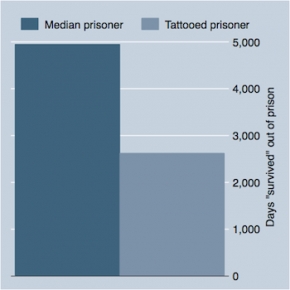
Research finds that “someone lasts 5,000 days (about 14 years) before finding themselves back in the cooler,” but “a tattooed ex-con lasts half that”:

[Researcher Kaitlyn] Harger compares people with different types of tattoos: dish_tattooedprisoners those that can easily be seen, and those that cannot. People with tattoos on the face, head, neck or hands go back to prison 714 days earlier than other tattooed ex-offenders. Having a visible tattoo is the real problem for employers.

What’s the cost of all this to the hard-pressed American taxpayer? Uncle Sam pays roughly $30,000 a year to house one prisoner (though this figure varies wildly from state to state). About 600,000 prisoners are released each year, 70% of whom have tattoos. Tattooed types return to prison earlier: that translates into an extra cost of $5.5 billion per year (a little less than the budget of the Federal Prison System, which houses 200,000 prisoners). Tattoo removal can cost thousands of dollars. Even so, free removal for every prisoner would be sensible economics.

Update from a reader:

As you have often pointed out, correlation does not equal causation. The data in Kaitlyn Harger’s research might lead one to assume that face tattoos are causing a higher rate of recidivism. I suspect that the reverse is true. Face tattoos are very common in gangs. The recidivism rate for gang members is high because they go back to that life when the get our of prison. Tattoo removal will not wipe away all of their connections and affiliations. They are not career criminal acts because they have face tattoos; they have face tattoos because they are career criminals.

Paternity Pays

Claire Cain Miller discusses new findings showing that having kids furthers men’s but not women’s careers:

This bias is most extreme for the parents who can least afford it, according to new data from Michelle Budig, a sociology professor at the University of Massachusetts, Amherst, who has studied the parenthood pay gap for 15 years. High-income men get the biggest pay bump for having children, and low-income women pay the biggest price, she said in a paper published this month by Third Way, a research group that aims to advance moderate policy ideas. … [M]uch of the pay gap seems to arise from old-fashioned notions about parenthood. “Employers read fathers as more stable and committed to their work; they have a family to provide for, so they’re less likely to be flaky,” Ms. Budig said. “That is the opposite of how parenthood by women is interpreted by employers. The conventional story is they work less and they’re more distractible when on the job.”

Update from a reader:

Hi Andrew, welcome back! I have no doubt that paternity pays, at least in the corporate world, and need look no further than the phrase I most despise when used in a business setting: Family Man. I can’t tell you how many times I’ve heard, following a hire or a promotion, “Bill’s a great guy, a family man”. It doesn’t matter if Bill is a good father/husband, just that he is one. You will never hear, “Jill is a great gal, a family woman”. Family Man = Stable, solid, dependable. Family Woman = More devoted to family than career. This is why it pays to be a dad.

“One In Five”

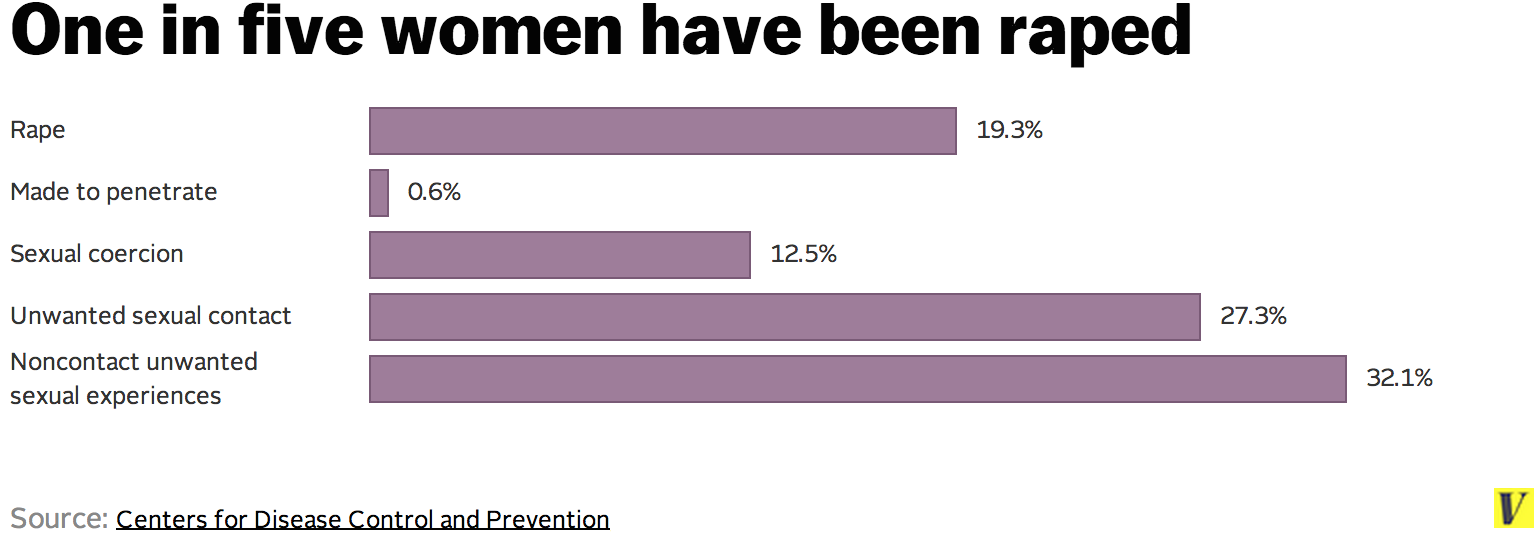
Sarah Kliff provides a graph with a stark visual representation of new CDC figures on rape:

rape.0

Jessica Roy expresses alarm:

After polling over 12,000 participants in a randomized, nationally representative telephone survey, the CDC found that an estimated 19.3 percent of women and 1.7 percent of men have been raped during their lifetimes. 19.3 percent — nearly 1 in 5 American women — have been raped. Just let that sink in. The study also yielded some shocking statistics about other forms of sexual violence, defined as “being made to penetrate, sexual coercion, unwanted sexual contact, and noncontact unwanted sexual experiences.”

Other surveys have found significantly fewer rape victims. Claire Groden explains the discrepancies:

The CDC … did not mention any legal terms in the survey queries, instead asking questions like, “How many people have ever used physical force or threats to physically harm you to make you have vaginal sex?” Because of this, the CDC included cases in which the victim might not have been aware or willing to identify her experiences as rape.

This difference made the CDC’s survey broader, especially in the case of victims who were under the influence during the attack. The CDC counted alcohol- and drug-facilitated rape, asking if the respondents had ever experienced various sex acts while “drunk, high, drugged, or passed out and unable to consent.” But, as Scott Berkowitz at RAINN, the Rape and Incest Abuse National Network, pointed out, not all of those 1.2 million cases in 2011 would be considered rape by the Department of Justice. A person who was drunk might have still been lucid enough to give consent, but the CDC would have counted that experience as “alcohol-facilitated rape.”

Still, the CDC numbers are a reminder of how many sexual assaults and rapes go unreported. The total number of rapes reported to police in 2011 was 83,425far lower than either the NCVS or CDC numbers.


When Your Textbook Is Your Teacher

Gabriel Kahn takes note of textbook publishers muscling into the online education market:

Creating online courses from scratch is expensive and time-consuming. When universities try to do it themselves, the results can be erratic. Some online classes wind up being not much more than grainy videos of lectures and a collection of PowerPoint slides.Publishers have rushed in to fill the gap. They’ve been at the game longer, possess vast libraries of content from their textbook divisions, and have invested heavily in creating state-of-the-art course technology….These courses feature content vetted by experts, slickly produced videos, and a load of interactive tests and quizzes. Some are so advanced that they can simulate a physics experiment, engage a student in a developmental psychology exercise, or even run software that grades an 800-word essay. They provide pretty much the entire course experience, without much interaction with a professor and without the hassle of showing up to class on time – or, for some instructors, the hassle of teaching.

The growing uniformity, though it has its advantages, puts schools in an awkward position. The transaction can reduce colleges’ academic mission to that of middleman, reselling course materials produced elsewhere. If schools are offering the same basic courses with minimal variations, it makes it all the more difficult to sell themselves to prospective students or justify their tuition levels.

The Best Of The Dish Today

Jim Murphy In Dundee As Part Of His '100 Towns in 100 Days' Tour

As I was catching up today on the details of various stories I’d left hanging in the air, I came upon today’s news analysis by the NYT. In particular, this paragraph, which we excerpted here, about the various phases of Obama’s extension of the Iraq war:

The next phase, which would begin sometime after Iraq forms a more inclusive government, scheduled this week, is expected to involve an intensified effort to train, advise or equip the Iraqi military, Kurdish fighters and possibly members of Sunni tribes.

What I found delightful in that paragraph was that little sub-clause – “scheduled this week!” Yes, this week, after a few centuries of rancorous vengeful sectarian divides, and brutal sectarian cleansing in the very recent past, the Iraqis were going to produce a coalition government of Sunnis, Shia and Kurds in order to face down ISIS. At least, it’s: “scheduled.” It’s that kind of fantasy – the same kind of fantasy we heard so often from 2002 to 2009 – that really reveals to me how amnesiac we really are.

And on cue, of course, today the new government did not quite arrive on schedule:

Iraqi lawmakers approved a new power-sharing government led by the Shiite prime minister, Haider al-Abadi, late Monday. But they left the two most divisive security posts unfilled, potentially extending a contentious debate even as American officials prepared a new campaign of military support for the Baghdad administration … Mr. Abadi said he would nominally run the Defense and Interior Ministries himself, and gave lawmakers a week to agree on new ministers before filling the posts with his own choices.

Even now, the key decisions have not, it seems, been made by the Iraqis. There is no real unity government yet for the United States to support. The one we have exists tenuously with multi-sectarian trust not close to being built – even as the state itself is besieged. Which means we could be already Americanizing this civil war, making it less resolvable by the actors themselves, and making it ever more likely that the US will once again become the focus of Islamist hatred and terror.

My sense is that Obama knows this – hence his incredibly careful statements over the last few weeks. So it seems to me he should postpone any commitment to a campaign against ISIS until the Iraqis unite against it. This is not our war; it’s theirs. And we should only intervene behind a multi-sectarian government that represents all of Iraq. Which means, in my opinion, never. We can win no friends in Arabia; we can merely increase the number and ferocity of our enemies.

Today, I worried that ISIS was baiting the West into another religious war, and tried to make sense of the calm and sanity I felt while off-off-grid. We pondered the end of Britain, the deaths of Russians and some new grisly details from the torture files of the Bush administration.

The most popular post of the day was Back From The Desert, my reminiscence (such as it is) of Burning Man, followed by Are We Being Baited? Many of today’s posts were updated with your emails – read them all here.  You can always leave your unfiltered comments at our Facebook page and @sullydish. 21 more readers became subscribers today. You can join them here – and get access to all the readons and Deep Dish – for a little as $1.99 month. Dish t-shirts and polos are for sale here. A reader writes:

I’ve never emailed before, but felt that two items were worth passing your way. One, I’m a human geography professor at a small liberal arts college and I’ve assigned weekly engagement with the VFYW Contest as part of their grades for the semester. I’ve done so for a number of reasons, but one of them is so that these students will at least gain a passing interest in some of the many other topics that circulate on the Dish. So primarily, THANK YOU for offering such an interesting and engaging contest each week, and secondarily, please keep it running, at least for this semester. My students and their grades are counting on you.

Secondly, and I’m sure some other readers have discussed this at length, but I just saw my credit card was charged $19.99 for my Dish renewal. Here’s the thing: I was going to let this subscription expire or whatever so that I could then offer you folks a little more substantial contribution this year. But the auto-renew process preempted my plan. Just please know that you’ve got lots of readers out there who want to support your work. (I don’t, however, want to support you by buying a shirt. Sorry, it’s just not my thing.) Thanks for everything, and please keep up the good work.

One way to support the Dish beyond your subscription is to get a gift subscription for a friend, family member, or geography student.

See you in the morning. And, yes, it’s great to be back.

(Photo:  Yes and Better Together supporters exchange views with one another as Jim Murphy Shadow Secretary of State for International Development (not seen), speaks on his soapbox during his “100 Towns in 100 Days” tour in Dundee, Scotland on August 27, 2014. By Jeff J Mitchell/Getty Images.)

Seeing Stars

Colin Schulz flags the above video explaining why we see stars as having pointed ends:

Stars twinkle for a fairly intuitive reason: The movement of the air in Earth’s atmosphere can momentarily dim a star’s light. This is why, says NASA, stars on the horizon seem most twinkly—“because there is a lot more atmosphere between you and a star near the horizon than between you and a star higher in the sky.”

But what about stars’ characteristic pointy star shape? The science behind that is surprising and has less to do with the stars or the Earth or with space than it does with us. Stars are shaped like stars, says Henry Seeing StarsReich in the Minute Physics video above, because of imperfections in the back of our eyeballs. Most intriguingly, says Reich, this biological explanation means that every one of us sees stars slightly differently.

Abuse In The Public Eye

Today new video surfaced of NFL player Ray Rice hitting his now-wife. Dara Lind provides the backstory:

In February, TMZ posted a video of Baltimore Ravens running back Ray Rice dragging his apparently unconscious then-fiancée (now his wife Janay Rice) from an elevator at the Revel casino in Atlantic City. The incident led to Ray Rice’s arrest for domestic violence, though he was assigned to a pre-trial diversion program rather than being charged with a crime. It also led him to receive a two-game suspension from the NFL. League commissioner Roger Goodell, after facing harsh criticism for the relatively light punishment (first-time marijuana offenders generally get suspended for more games), he announced a new, much stricter league domestic-violence policy in August.

But the original video didn’t show exactly what had happened inside the elevator, leaving an opening for Rice supporters to assume that he was acting in self-defense. Janay Rice apologized for her role in the incident, which seemed to confirm this suspicion. Now, TMZ has released a second video (warning: it’s very graphic) from inside the casino elevator. It shows Rice punching Palmer — and makes it clear that what happened wasn’t a “fight,” but an attack.

After the release of this new video, Rice’s contract was terminated. Jonathan Cohn hopes some good comes from this episode:

The footage is not easy to watch, but it shouldn’t be. Domestic violence is violent. Maybe if more people realize that, more people will take it seriously.

Dave Zirin disagrees with that line of reasoning:

[I]f no one is going to talk about the welfare of the person who is actually subjected to the violence on that tape, let’s talk about it here. I spent the morning communicating with people who work on issues involving domestic violence and violence against women nearly every day of their lives. They all said the same thing, without dissent: releasing this tape to the world is incredibly damaging to Janay Rice. Just as we would protect the name of an alleged rape victim, just as we would not show a video of Ray Rice committing a sexual assault, we should not be showing this video like it’s another episode of Rich People Behaving Badly. If Janay Rice wanted to show this tape to the world, in other words if she had offered her consent, that is a different matter. But showing and reshowing it just because we can is an act of harm.

Josh Marshall is not settled on the ethics of showing images of domestic violence. But he does “have a general stance against those who think news reporters should be in the business of not reporting certain things to advance various purportedly good ends”:

Two examples. Recently we have used still photos from the videos of the beheadings of the two American reporters by ISIS. Not stills of the actual killings but from the parts before that happens. Like many other press organizations, we’ve never published the videos themselves. In recent days I’ve heard from a number of readers who’ve said we should not be publishing any of these photos, even in stories which directly relate to the videos themselves because this is somehow too upsetting or doing ISIS’s work for it.

Similarly, I know there’s a move afoot to refrain from publishing the names of mass shooters on the theory that this just gives them the notoriety they crave and which led to their atrocities. I disagree. These killings are facts. The ISIS beheadings are facts. There’s no reason to publish imagery of mutilated bodies. But within certain bounds, these things happened. And withholding critical information about what happened just doesn’t make sense. I’d go further and say that it’s actually wrong. Ugly things happen. We shouldn’t play games about reporting them. We shouldn’t get into mind-games about what a mass murderer might or might not have wanted. Journalists should just focus on doing their jobs.

Meanwhile, Coates thinks the “idea that it took today’s release to understand the gravity of things is insupportable.” He feels the NFL is simply in damage control mode:

The league suspended Rice for a meager two games for knocking his wife unconscious. The league now propose to suspend him indefinitely for….the same thing. This suspension only indirectly relates to the protecting women. It mostly relates to protecting the shield.

Lots Of Americans Are Earning Less

Income

Neil Irwin delivers a reality check:

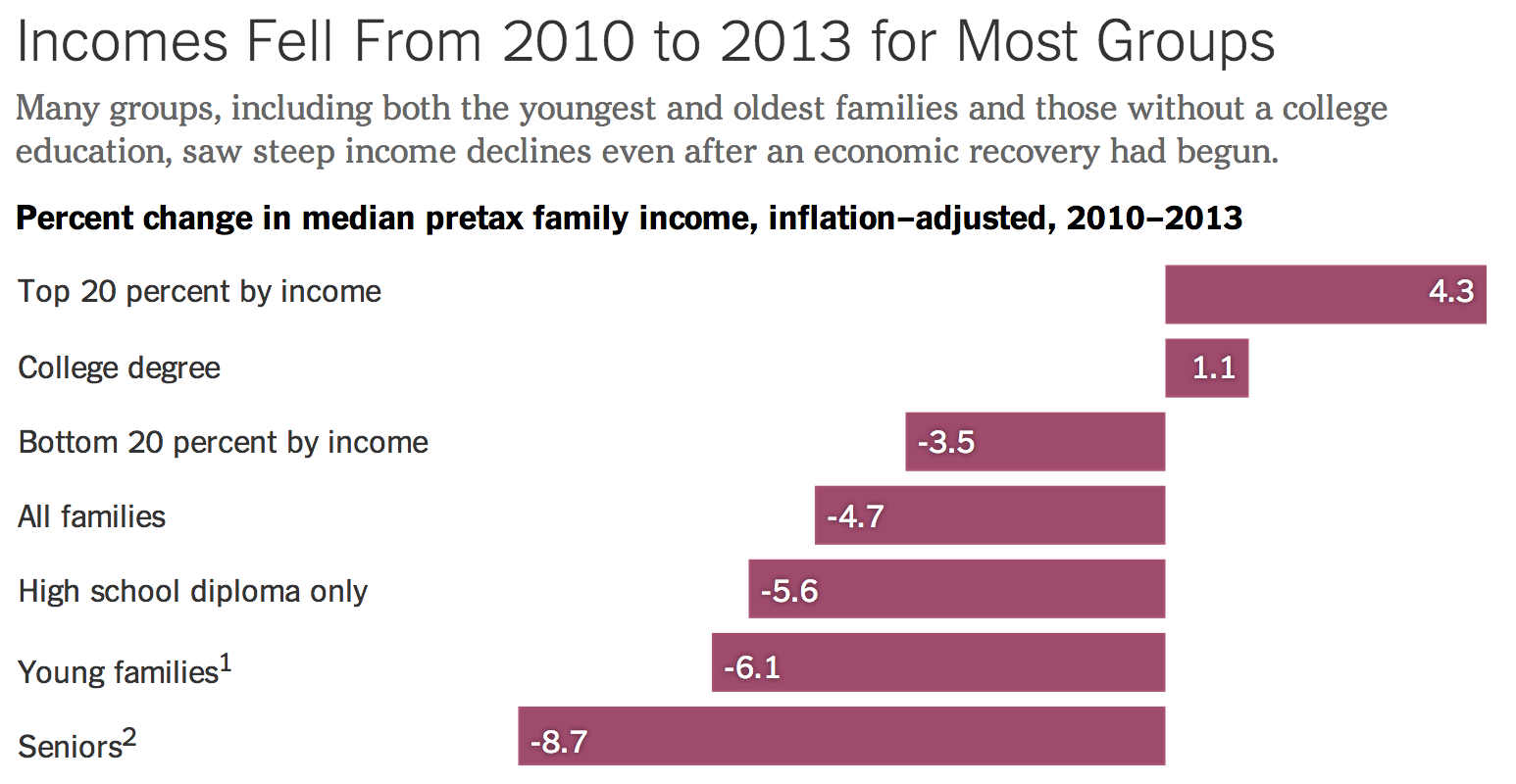
Many groups, including both the youngest and oldest families and those without a college education, saw steep income declines even after an economic recovery had begun. Separate people by age or education, and the same basic pattern applies. Those with a college degree have done fine, but anything less than that and incomes have fallen. Both young adult households (those headed by someone under 35) and those households headed by someone over 75 have seen steep income declines in that same period.

This is the simplest yet most important fact to understand about the current economic recovery: It has not resulted in higher incomes for anyone other than those who were already doing well. And very large groups of Americans have experienced falling incomes.

Late last week, Ben Casselman and Andrew Flowers also covered the continued fallout from the Great Recession. They warned that the young may be in even worse shape than the numbers suggest:

Many young people are living with their parents because they can’t afford to strike out on their own; they aren’t included in the Fed’s figures because they don’t count as their own households. Young people have also become less likely to own their own homes (35.6 percent listed their primary residence as an asset in 2013, down from 40.6 percent in 2007) and much more likely to have student debt (41.7 percent in 2013, up from 33.8 percent in 2007). Whether by choice or by necessity, young people are also taking fewer financial risks, holding more of their assets in cash and less in stocks.