You Go To War With The Warmongers You Have

by Freddie deBoer

Kristol

Though the left is often seen as home to only pacifists and those who see the hand of imperialism in all proposed military action, there is also a healthy strain of messianic militarism on our side. I regularly engage with lefties who believe we should be “doing something” for the people of Syria, although what that something entails is not consistent or clear. In this telling, the Syrian uprising is a legitimate revolutionary force, the Islamists among them a small corruption that doesn’t jeopardize a post-Assad future, and the situation such that the United States could deploy military power in a way that increases stability and humanitarian outcomes rather than degrades them. These lefties believe in revolution, and they want the United States to be a revolutionary power.

Well, I would simply start by asking: is the United States military in the habit of supporting revolutionaries? What about the history of this country compels you to think that it has the capacity to support revolution, or any interest in doing so? If the United States goes to war, it doesn’t go with some hypothetical benevolent military machine. It goes to war with its actual existing military machine, under the auspices of the same-old warmongering politicians and officials, and with the same old military leadership. We don’t have some spare revolutionary force lying around. So: do you want to break bread with those people? Do you want to give your support to them? Do you want them to do what they do? Because that is a necessary precondition of getting involved. The neocons who want us to get into every war are not suddenly going to throw up their hands and say “we’re sitting this one out, the lefties have got it.” You are free to say that you don’t want to get involved with Bill Kristol and his cronies. But they will most certainly get involved in your war.

There are more arguments against intervening in Syria than I can count. The first and most salient is the only argument we need against calls for more righteous bloodletting: should implies can. The United States went to war under ostensibly humanitarian pretenses in Iraq. We had over 100,000 troops stationed there, and the result was a humanitarian calamity, limitless slaughter. We sent cruise missiles to liberate the people of Libya, and the country has descended into civil war and chaos. Saying that we should free the Syrian people implies that we can. But for now, I want left-wing advocates of military intervention in Syria to recognize: anything that the United States does, will be done in the way that the United States always does it. This will not suddenly become the country you want it to be. And no matter how much you wish it were different, you will be lying down with the Tony Blairs and the Dick Cheneys and the Weekly Standards and the Commentarys. They will be getting involved, and they will exercise more control than you ever can. That’s reality.

Back in a rare moment of clarity, before quickly rediscovering his cruise missile liberalism, Peter Beinart wrote an apology for his previous support for the war. He explained that he had come to learn “a painful realization about the United States: We can’t be the country those Iraqis wanted us to be. We lack the wisdom and the virtue to remake the world through preventive war.” That was true then, and it’s true now. Because the United States is not that country. Because everything about our history, recent and distant, teaches you that this country does not rescue. It doesn’t liberate. It supports dictatorships, destroys enemies, secures resources, destabilizes countries, drops ordnance, and generally imposes its will. But it does not liberate, and no amount of wishing will make it the kind of power you want it to be.

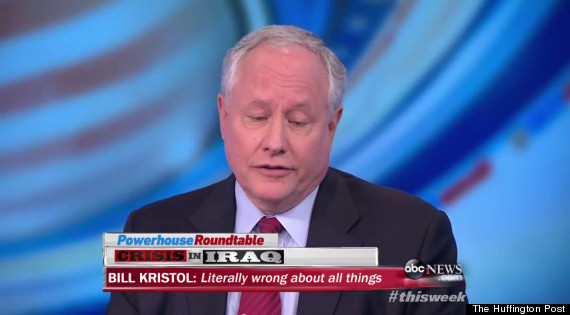
(Image from HuffPo’s “True Chyrons For Bush-Era Iraq War ‘Experts’“)

“No. No. No.” Ctd

by Dish Staff

A reader writes:

That email is such a compelling, extraordinarily well-written, and utterly heartbreaking account of a truly sadistic and unspeakably selfish rape. I find myself completely ashamed that I share similar chromosomal make-up with someone capable of such an act. This account should be required reading for all men, and not merely because it’s always good to remember that sexual assault creates far more damage – lasting damage – than just the violent act itself, but also as a broader reminder that empathy is one of the most important values that anyone can have and demonstrate in all aspects of our lives.

The disgusting selfishness displayed by this woman’s rapist, and the total lack of empathy for the feelings and well-being of another human being is truly chilling. And the planning that took place to execute this violent assault. So many opportunities to take a step back from the precipice. So many opportunities to listen to the inner voice that says “No. This will hurt someone.” And yet.

We must do better. We fathers of sons must do better.

Another gut-wrenching story:

I wanted to write to tell you that rarely have I been moved – rocked may be a better word – by something on your blog more than that story of a woman’s rape and its aftermath. Considering all of the subjects you deal with on a daily basis and how long I’ve been reading the Dish, that’s saying something. It’s also saying something because I’m a man, and yet much of what she wrote rings very true for me. Let me explain.

When I was in my late 20s, I learned that the woman I planned to marry had also been raped while in college, also while studying abroad.

She also had said nothing about it to anyone. A few weeks before I was planning on asking her to marry me, she felt that she needed to share with me what had happened to her. Needless to say, I was shocked and stunned and angry in a way I’d never been before. I desperately wanted vengeance, and yet I wanted to concentrate on not making it about me. I wanted to support her in any way I could. 

In the days and weeks after that, she revealed that there was more she had to tell me, and it wasn’t just about that horrible night. Much like the woman in the email, she was struggling and ashamed because of some things she’d done after that night – some things she’d done while trying to regain the identity and self-control which had been taken from her. She was with people she normally wouldn’t surround herself with, abusing alcohol and drugs. There were sexual encounters she was ashamed of. She was “typically responding.” They were things that didn’t seem like the type of things the woman I know would do, and they were fairly recent.

As the man who loved her, these were very difficult things to hear. They were even more difficult things to understand. I felt like I didn’t know who she was before she met me, or at least that there was a part of her I wasn’t privy to.

It unsettled me, and I’m embarrassed to say that these revelations eventually unravelled our relationship and our plans to marry. I tried hard to come to grips with all of this new information, but I simply couldn’t return to the level of trust and confidence I had in her before.

It’s painful to write that, because I understand now what I didn’t then: that none of this was her fault. These weren’t character flaws. Those incidents weren’t who she was. They were an attempt to recover from what had been done to her. I knew this, but after reading the email you posted, it suddenly made sense in a way it hadn’t before. I’m sitting here today, at my desk, ashamed of not being more understanding, ashamed of quietly blaming her for how she conducted herself in the months after she was raped. Ashamed of judging, of holding those things against her instead of understanding that she needed someone to do the exact opposite.

She has since moved on with another man and married him, and I am happy for her. Like the woman in the email you posted, she was not defeated by her rapist. She’s successful. She has a young family. No one around her knows the things she’s been through. Her parents don’t even know, which makes me wonder how many women (and men) are quietly suffering in our midst. But I’m sure her husband knows, and that he’s a more loving, more understanding man than I ever was.

Or maybe he doesn’t. Maybe what I taught her is that you have to keep those things to yourself if you want to have a life with someone. My stomach hurts just writing that.

I want to thank this woman for sharing her story, for explaining her struggle so honestly and eloquently. As horrified and saddened as I felt after having read that, I hope she knows she’s helped me understand what my ex had been through in a way I never had before. And that like she said, she is surely not alone, sadly.

What’s God Have To Do With Our “Libertarian Moment”?

by Matthew Sitman

Tea Partyjpg

Last week Sarah Posner expanded on Ed Kilgore’s argument that the efforts of the Christian right are a big reason for the rise of libertarianism in the United States – and why Robert Draper’s NYT Magazine story on libertarian politics was off the mark:

I do think that non-religious libertarians played a role in elevating some of the Tea Party agenda to the fore of the Republican Party. But Kilgore is right that the Christian right — a movement very much at home in the Tea Party movement, and one which would take up a good deal of space in a Venn diagram of the coalition — made that libertarian-ish conservatism an ideology that could find a comfortable and uncontroversial place in a political party whose electoral fortunes hinge on holding together a coalition of religious conservatives and anti-regulation free marketers.

An essential dogma of the religious right is that government should provide minimal services for and impose minimal demands on the citizenry. Sound familiar? But the reason isn’t, as popular libertarian dogma would have it, because the government should keep its nose out of your business. Dating back to conservative Christian red scares, anti-union and anti-New Deal ideology, and to Christian Reconstructionist framing of the proper role of government in relation to the church, the family, and the individual, these principles emerge from the idea that the secular state is the enemy of a proper Christian ordering of markets, social norms, and family and religious life.

The thrust of Posner’s piece is to express doubts about “the so-called ‘libertarian moment’ that we may or may not be witnessing,” viewing it not as the emergence of anything new, but rather a sleight of hand concealing the religious right’s grip on the Republican Party. Move along everybody, the theocrats are still running the show, is what she and Kilgore seem to be saying. The Tea Party, don’t you know, has more conservative Christians than real libertarians among its ranks. That’s true but beside the point – it only shows that the Republican Party might fail to exploit the emerging libertarian sensibility, especially among younger voters, that Draper describes. And it has absolutely nothing to do with where this sensibility comes from and what issues are driving it.

Posner is right that, historically, the Christian affinity for some libertarian ideas has not been about a principled defense of freedom, but rather anxiety over the government supposedly imposing secular values on ordinary, God-fearing Americans. The rhetoric of limited government really has been used to advance the agenda of the religious right. But what does that have to do with millenials who are fine with pot and gay people and tired of the wars that have marked so much of their lives? Here’s an important passage from early in Draper’s story:

[T]he age group most responsible for delivering Obama his two terms may well become a political wild card over time, in large part because of its libertarian leanings. Raised on the ad hoc communalism of the Internet, disenchanted by the Iraq War, reflexively tolerant of other lifestyles, appalled by government intrusion into their private affairs and increasingly convinced that the Obama economy is rigged against them, the millennials can no longer be regarded as faithful Democrats — and a recent poll confirmed that fully half of voters between ages 18 and 29 are unwedded to either party. Obama has profoundly disappointed many of these voters by shying away from marijuana decriminalization, by leading from behind on same-sex marriage, by trumping the Bush administration on illegal-immigrant deportations and by expanding Bush’s N.S.A. surveillance program.

It’s true that Draper speculates about the fortunes of Rand Paul and the Republican Party, but he made clear that Republicans would need to do some real work to take advantage of the younger generation’s political views – as he put it, “Republicans would seem well positioned to cast themselves as the fresh alternative, though perhaps only if the party first reappraises stances that young voters, in particular, regard as outdated.” The premise of Draper’s article, in other words, is exactly the opposite of everything Posner and Kilgore write – that our libertarian moment exists independent of the Republican party and it’s religiously-based social conservatism. Draper’s point is not that the libertarian moment is a Republican moment, but that younger voters increasingly hold libertarian-leaning positions on a constellation of issues increasingly, and that, just maybe, a figure like Rand Paul can be a vehicle for their aspirations. But even if Paul can’t, these libertarian sentiments exist. They are, in a way, the independent variable in Draper’s story.

Posner’s article is titled “The ‘Libertarian Moment’ Wouldn’t Exist Without Religion” and Kilgore’s “The So-Called ‘Libertarian Moment’ Is Engineered By The Christian Right.” Both get it exactly wrong. Consider Draper’s description of younger voters noted above – what does any of that have to do with an amorphous “religion” or the Christian right, apart from their notable absence? I would love for Posner to explain how support for pot legalization “wouldn’t exist without religion” or for Kilgore to demonstrate how the Christian right “engineered” millenials wariness of the surveillance state, because those are the kinds of issues our libertarian moment is about. If the most interesting thing you can do with all this is rail against the Republican party, you’re missing the point.

(Photo by Randy Robertson)

Calling Out Catcalls

by Dish Staff

catcalling3

YouGov’s Peter Moore presents a new survey:

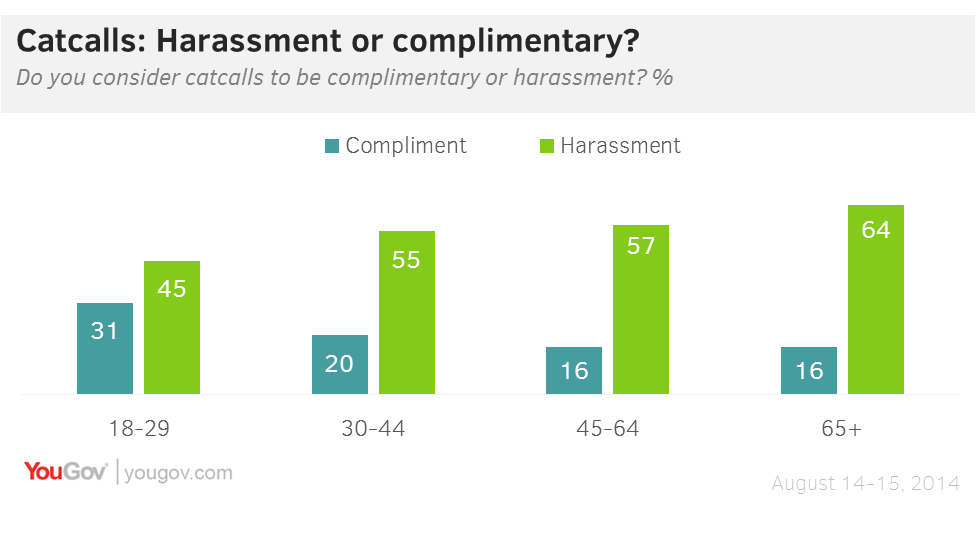
[A]ccording to a large majority of the public, it is never appropriate (72%) to catcall. 18% say that it’s sometimes appropriate, while 2% think that it’s always appropriate. Men (22%) were only marginally more likely than women (18%) to say that it is ‘sometimes’ or ‘always’ appropriate. Asked whether catcalls are compliments or not, most Americans (55%) say that they [constitute] harassment, 24% aren’t sure while only 20% think that they are ‘compliments’.

As seen in the chart above, the relationship between age and catcall-attitudes may come as a surprise:

The question of whether or not catcalls are harassment or complimentary reveals a significant generation divide. Under-30s are the least likely group to say that catcalls constitute harassment (45%), and are the most likely to say that catcalls are complimentary (31%).

In another study released this year, 57% of women indicated they had suffered street harassment and 23% reported they had been “purposely touched or brushed up against in an unwanted, sexual way” while in public. Bryn Donovan recently collected some catcall horror stories:

One woman was harassed right after having her dog put down after his battle with cancer.

I’m at least glad she let the guy have it. Two of the women I talked to had been catcalled while going home from a funeral. One of them had stopped at a convenience store, wearing a black dress, because she had cried so hard at her friend’s service that she needed some Gatorade. A man called after her, making kissing noises and saying, “Damn girl you make that dress look gooood.” A doctor told me possibly the worst story. She had finished a terrible shift in the ER. After declaring a 15-year-old girl brain dead, she had a painful talk with the family about organ donation. Then she admitted a 14-year-old girl who had been raped, beaten, and left for dead, and a long-term patient of hers suddenly coded and died. She came out into the parking lot at 10 a.m. and got catcalled. The family of the 15-year-old was walking out with her, and when the doctor hugged the girl’s mother, the stream of harassment got worse.

Many of us have a long history with harassment, beginning in our early teens. One of my friends thought being pregnant would make her temporarily immune. Nope. I honestly thought that at my age, I would be done with it. Middle-aged women, I am always told, are invisible. I don’t want to be invisible in social situations or at work, but on the street? Yes please.

For more stories, read through our 2012 thread The Terror Of Catcalling.

Is Edward Snowden the World’s Dumbest Spy?

by Freddie deBoer

Michael B. Kelley thinks he might be! Such a fine line between espionage mastermind and espionage incompetent. Kelley does a deep dive into Snowden’s interviews and, with the help of some very, very willful reading and powerful cognitive dissonance, concludes that Snowden has distributed essential intelligence to those commies in Russia and China.

Well, actually, that’s not quite true. Kelley admits that he doesn’t know whether Snowden has done any such thing. He just waits until the long piece’s third-to-last paragraph to make that admission. “Fifteen months after his epic heist, we still don’t know if Snowden was telling the truth when he said he destroyed the tier 3 documents between June 12 (the SCMP leak) and June 23 (the flight to Moscow).” I would call that a fairly important qualifier! I think you’ve buried your lede here, Michael. I mean, if you’re writing a piece about how you think somebody leaked something, but you have a paragraph where you admit that you have no evidence that he in fact leaked that something, you might want to put that up near the top. Just a thought.

Kelley is part of the professional Edward Snowden skepticism circuit, which has kept a lot of “National Security Experts” gainfully employed. (Stimulus!) But Kelley isn’t a part of the knuckle-dragging, “hang his lifeless carcass from the Pentagon flagpole” school of anti-Snowden rhetoric. Instead, he’s part of another class of Snowden critics, the Snowden concern trolls. It’s carrying water for the national security state, just for the sophisticates. In this genre, you cast your aspersions on Snowden, intimate he’s a Russian or Chinese spy, or that he’s been duped by Russian or Chinese spies, or that he’s so deluded he doesn’t know he’s fallen into the trap of the Russians or Chinese. But you do it all while hemming and hawing and giving a little sugar to the people who don’t think we should have a limitless domestic surveillance system. You undermine him and what he’s done, but you do it with a veneer of journalistic objectivity.

But I said that Kelley must think Snowden is the world’s dumbest spy. Here’s Kelley’s thesis: Snowden stole three types of documents, Tier 1, Tier 2, and Tier 3. The first two have a legitimate whistle blowing purpose, and Kelley concedes that someone could steal them out of legitimate civil liberties concerns. But Tier 3, in Kelley’s view, has no legitimate white blowing value, and so the only reason to steal them is to give them to the Russians or the Chinese. Or sell them to the Russians or the Chinese. And Snowden has wound up in… drum roll please… China and Russia.

Now, as Kelley is perfectly aware, it would have been incredibly easy for Snowden to have simply gotten the Tier 3 files and given them to a foreign government. For an encryption and communications expert like Snowden, it would have been no great difficulty to send those files securely online… or, you know, send a flash drive via UPS. That’s part of the great scandal here: that somebody like Snowden had such carte blanche to explore the domestic surveillance files of the NSA, and that he was able to walk out of there with so much information without anyone noticing. Indeed: were I interested in keeping the NSA’s secrets, I’d be a lot more worried about all of the other contractors I don’t know about than I am about the one I do know about. So since he knows Snowden could have easily taken the info and run without ever telling the world, he has to come up with a version where Snowden either legitimately wanted to blow the whistle on the NSA and then also wanted to give intelligence to the Russians and China so he fled there, or where Snowden acted like a whistle blower just to hurt the USA’s legitimacy and fled to Russia and China to share the Tier 3 documents with them.

Both of these are really dumb. If he was both legitimately interested in spreading the word about the NSA’s illegal activities but wanted to also help America’s antagonists, whether for money or any other motive, then he’d have hurt the value of the Tier 3 documents by going public. When you tell the world that you’ve gotten your hands on some explosive documents, and you tell the government agency you took them from what you took, then those files become much less valuable. The espionage value of intelligence that the other side knows you’ve shared is far lower. And if the whistle blowing is all a con as part of an elaborate scheme to hurt the United States, hiding out in China and Russia is the very worst thing he could have done. Does Michael Kelley really think that the Chinese and Russian intelligence services are that bad at their jobs? If this was all some elaborate plan to discredit the United States, would Russia’s spy agencies really say to Snowden, “make sure you hide out in China and Russia– that’ll  add to your credibility with the American people”? How dumb would they and he have to be, if that was the plan? Indeed, the fact that Snowden ended up in those countries makes it much less likely he’s a spy. If he were a spy, he’d have fled someplace way less suspicious.

Given that, by his own admission, Kelley has no evidence that Snowden shared damaging intelligence materials with any other foreign governments, and given that if he were a spy, he’d be doing a terrible job of it, I conclude that in fact Snowden is who he says he is: a whistle blower, one who fled to China and then Russia because he was on the run from an American government that would like very much to throw him in some closet somewhere, preferably in a friendly dictatorship where he could be tortured. Was it a good idea to go to China in the first place? I have no idea. I’ve never been on the run from the world’s most powerful country. And I have no idea what conditions Snowden was under when he grabbed those documents, if he had much choice, or what was on his mind. I do know that he’s in Russia because he’s been trapped there by our government, and that if he’s a spy, he’s gotta be the world’s worst.

No One’s Watching The Skies

by Dish Staff

Mark Jacobson mulls over the decline of UFO culture:

It is true that very little beyond a shadow of a doubt forensic proof of alien presence has come to light over the years, but there are a number of subsidiary reasons for the seeming twilight of the UFO moment. With voracious proliferation of vampires, New World Order conspiracies, and the unprecedented rise of evangelical Christianity, the simple flying disc from far, far away has become a quaint, almost nostalgic specter. The saucer may have been the post-war generation’s signifier of the strange, but even versions of the unknown outlive their usefulness.

The end of the era may have commenced with William Gibson’s Neuromancer, which located the drama of the unknown inside the claustrophobic cyberspace accessible to the common keyboardist. Instead of the far-flung wonder to the universe, much of what falls under the rubric of contemporary ufology has become deeply interiorized, resigned to the viscous psych-sexual abduction phenomena described and popularized by people like Budd Hopkins, Whitley Strieber, and John Mack.

Update from a reader:

While it may seem as if the UFO community is dying, there’s still a lot of interest in UFOs. I write for the weird news section of HuffPost, which does a lot of UFO stories. In fact, HuffPost is the only major news website with its own full-time UFO reporter, Lee Speigel. Those stories attract a lot of attention, and Lee gets a lot of deserved credit for focusing on the science and not the “woo woo” part of the UFO community.

Why Are American Police Trigger-Happy?

by Dish Staff

The Economist blames Americans’ easy access to guns:

Last year, in total, British police officers actually fired their weapons three times. The number of people fatally shot was zero. In 2012 the figure was just one. Even after adjusting for the smaller size of Britain’s population, British citizens are around 100 times less likely to be shot by a police officer than Americans. Between 2010 and 2014 the police force of one small American city, Albuquerque in New Mexico, shot and killed 23 civilians; seven times more than the number of Brits killed by all of England and Wales’s 43 forces during the same period.

The explanation for this gap is simple. In Britain, guns are rare. Only specialist firearms officers carry them; and criminals rarely have access to them. The last time a British police officer was killed by a firearm on duty was in 2012, in a brutal case in Manchester. … In America, by contrast, it is hardly surprising that cops resort to their weapons more frequently. In 2013, 30 cops were shot and killed—just a fraction of the 9,000 or so murders using guns that happen each year. Add to that a hyper-militarised police culture and a deep history of racial strife and you have the reason why so many civilians are shot by police officers.

What A (Hemingway) Man Wants

by Dish Staff

TNR recently pulled this review by Max Eastman of Hemingway’s Death in the Afternoon by from their archives, which purportedly causes Hemingway to track Eastman down in his New York City office and show him just what was under shirt. You can see why:

Why then does our iron advocate of straight talk about what things are, our full-sized man, our ferocious realist, go blind and wrap himself up in clouds of juvenile romanticism the moment he crosses the border on his way to a Spanish bullfight? It is of course a commonplace that Hemingway lacks the serene confidence that he is a full-sized man. Most of us too delicately organized babies who grow up to be artists suffer at times from that small inward doubt. But some circumstance seems to have laid upon Hemingway a continual sense of the obligation to put forth evidences of red-blooded masculinity. It must be made obvious not only in the swing of the big shoulders and the clothes he puts on, but in the stride of his prose style and the emotions he permits to come to the surface there. This trait of his character has been strong enough to form the nucleus of a new flavor in English literature, and it has moreover begotten a veritable school of fiction-writersa literary style, you might say, of wearing false hair on the chestbut, nevertheless, I think it is inadequate to explain the ecstatic adulation with which Hemingway approaches everything connected with the killing of bulls in the bull ring.

Reviewing The Letters of Ernest Hemingway, Volume 2: 1923-25, Edward Mendelson offers related insights into Papa’s psyche:

What makes the book revelatory is not its biographical detail but the spacious view it gives of Hemingway’s mind at work in his long, eager, and unguarded letters to boyhood friends. For the past fifty years, ever since his embittered older sister Marcelline reported that their mother had dressed the young Hemingway as a girl and had tried to raise the two of them as twins, and ever since his posthumous novel The Garden of Eden (1986) revealed his androgynous fantasies, the conventional reading of Hemingway explained him away as the product of sexual confusion and category-crossing. This turns out to be as simplifying and crude as the he-man image it supplanted. These letters make clear that both the he-man and the androgynous fantasist were surface expressions of a deeper wish that shaped Hemingway’s life and work, a driving impulse that ultimately had nothing to do with sex.

The wish, Mendelson argues, has to do with the breakdown of heroic male code the young Hemingway upheld, which included belonging to a band of brothers – but which failed as he became an adult, at which point he fantasized that “he could merge instead with a lover”:

Everyone quotes the most obvious examples. A Farewell to Arms: “There isn’t any me. I’m you.” “We’re the same one.” “I want us to be all mixed up.” For Whom the Bell Tolls: “I am thee also now…. You are me now.” “I am thee and thou art me and all of one is the other…. I would have us exactly the same.” The Garden of Eden: “Now you can’t tell who is who can you?” (this after the woman enters the man with her hand). Everyone interprets these as gender-crossing, but they express the same wish for dissolution that recurs throughout Hemingway’s letters to his band of brothers, where, in one enthusiastic paragraph after another, he refers to each of them with the single phrase “a male.”

What Hemingway wanted—both as he-man and as androgyne—was a lasting intimate connection that did not require him to be a separate individual person—something no one can have. Virginia Woolf, in a review that infuriated him, perceived the price he paid for his wish. Hemingway’s characters, she said, are like people overheard in a restaurant talking in rapid slang, “because slang is the speech of the herd.” Those who speak it are “seemingly much at their ease, and yet if we look at them a little from the shadow not at their ease at all, and, indeed, terribly afraid of being themselves.”

Israel Has Been Singled Out by Israel’s Defenders, Ctd

by Freddie deBoer

A reader shares some very typical sentiments in a criticism of my piece yesterday on the “why do you single Israel out?” narrative:

I’m  a Jewish American who is not at all afraid to criticize Israel, particularly with respect to its settlements in the West Bank.  As I mention to friends whenever Israel is being discussed, there are plenty of Israelis who completely disagree with the Netanyahu administration and many current policies of the Israeli government, so no reason we in the U.S. can’t do the same.

That said, deBoer’s argument is wanting on several fronts, two of which I will address here because they are the most egregious, and interrelated in many ways.  First, deBoer makes no mention whatsoever of anything that Hamas may have done to provoke the recent violence, as if the entire situation is 100% the fault of Israel.  I sometimes disagree with Andrew about Israel, but I respect his opinion and am open to be persuaded by his arguments because he always makes clear that he condemns what Hamas (or others) have done, and explains that he understands the larger historical context that Israel (and Jews) operate under, even if he disagrees with their conclusions.  I see no similar effort by deBoer, and if the effort is to persuade someone with his writing, it causes me to completely tune him out, because he gives the impression that he only sees this conflict from one perspective, i.e., Israel=bad/evil, Hamas=oppressed/innocent.

This is a very common rhetorical ploy: why do you not mention Hamas’s problems when you mention Israel’s? Well, first, that’s the very argument of my post: that we bear responsibility for Israel’s actions because we enable them to a degree that is completely unprecedented in American history, and so we are responsible for them. That simply is not true of Hamas. Not remotely. Second, the idea that we should always take pains to achieve balance in our criticism of Israel– a kind of “one for you, and one for me,” reciprocal approach”– is fundamentally misguided, because it misrepresents the reality of official support for Israel and for Hamas. Support for Israel is as close to unanimous in national American politics as you can get, despite the fact that public polling shows a great deal of criticism from America’s people. Essentially all of our legislature and our executive will support Israel’s actions literally without exception. In this recent conflict, the vast majority of those killed have been civilians, by absolutely anyone’s reckoning, including within the Israel media. Hundreds of children have been killed. That has not changed the elite political consensus one iota. Meanwhile, the number of American politicians who support Hamas is exactly zero. Such a person does not exist in our Congress. So who exactly am I supposed to be scolding for supporting Hamas? Why would I bother to criticize the side that has no establishment political support whatsoever, when the other side has slaughtered hundreds of children and lost no face with America’s political class? This emailer is operating under a broken understanding of political responsibility:

Second, I understand deBoer’s point about people here in the U.S. being able to single out Israel for criticism because of how much moral and financial support the U.S. provides to Israel, but his complete dismissal of any possibility of anti-Semitism is simply naive and, again, makes me question his entire perspective.  Does he not see the news about supposed anti-Israel rallies in Europe turning into pogroms against synagogues and Jews there?  Modern Orthodox friends of mine traveling to Europe this summer, even the UK, wear hats in public so they don’t invoke the ire of residents there.  Is there no anti-Semitism in this lashing out at Jews who have no direct connection to Israel?  deBoer completely dismisses the notion that there could possibly be anti-Semitism behind at least some of the criticism lobbed at Israel.  Again, this is in contrast with Andrew, because he always acknowledges the reality of anti-Semitism, particularly in Europe where it should be particularly concerning for anyone with a modicum of knowledge of history, both recent and ancient, to see graffiti and violence condemning Jews.

The reasoning is again the same: the political establishment of my country, which is my responsibility, is entirely opposed to anti-Semitism. I don’t doubt that there is hatred of Jews lurking around out there, but there is no one– literally no public figure of any importance whatsoever, whether politician or celebrity– who would ever publicly express anti-Semitic remarks, unless they’re interested in committing reputation suicide. If they did, they would be rightfully cast out and reviled. Meanwhile, hatred of Muslims and Arabs generally, and Palestinians specifically, is an absolutely mainstream phenomenon. Republicans in Congress spew hatred and venom for Muslims and Palestinians daily. Can you imagine if a celebrity said “Jews deserve to die,” the way Joan Rivers said Palestinians deserve to die? Can you imagine a celebrity saying that Israelis are like a crazy woman who needs to be slapped, as Bill Maher said about Hamas? No. No, you can’t imagine it, because it would never happen. Because it’s OK in public life to hate Palestinians. It’s not OK in public life to hate Jews. I don’t “balance” condemnation of Palestinian oppression with condemnation of anti-Semitism because the whole world defends the former and only a lunatic fringe defends the latter.

Nobody of importance defends Hamas’s rockets. Almost everyone of national prominence defends Israel’s right to murder children. That is the condition under which I argue, and for that reason, I will not take part in the facile exercise of mentioning Hamas’s bad deeds every time I mention Israel’s. They are not comparable phenomena:

deBoer actually makes me much more sympathetic to Israel, because unmitigated condemnations like these, without any scintilla of sympathy or perspective on what it must be like to be an Israeli, whose homeland (and fellow Jews around the world) has been the consistent target of mass genocide by your neighbors, give Israelis the distinct feeling that they are on their own and must do whatever is necessary to protect their citizens and preserve their state.

If your take on collective punishment and illegal occupation can change because I didn’t do enough to assure you that I don’t condone anti-Semitism, I would suggest you think it over a bit more.

Art-Sigh

by Dish Staff

dish_demoisellesdavignon

Bryan Appleyard isn’t convinced by Arthur I. Miller’s Colliding Worlds: How Cutting-Edge Science Is Redefining Contemporary Art, a book based on dozens of interviews with “science-influenced artists and musicians” that heralds “the onset of a new ‘third culture’ in which art and science will, somehow, embrace.” Why he’s skeptical of what Miller calls “art-sci”:

Perhaps the problem is that the very idea of some kind of art-science union is incoherent. Art and science are not separated by misunderstandings or ignorance, they are separated by definition. Art engages with the complexity of human experience, more precisely with that it feels like to be human; science explores the material world in a manner that necessarily ignores all such considerations. In the book the problem with this discontinuity is repeatedly made apparent by scientists who know perfectly well that art cannot impinge in any way on what they do, however enthusiastic certain artists may be. A deal between the two – Miller’s Third Culture – is, therefore, likely to be more of an annexation than a partnership.

The one exception to this might be said to be neuroscience.

This now claims to have access to the physical substrate of our minds, feelings, impulses and so on. And, indeed, Miller does mention Semir Zeki, the genial and entertaining UCL professor who observes the reaction of our brains to works of art. Thanks to Zeki and others, neuroaesthetics is a distinct discipline. But what does any of that mean – that Titian would have been a better painter if he had been stuck in an MRI machine?  Or, in biology, there are those fatuous evolutionary explanations of art as some kind of adaptive mechanism. Maybe but so what? You’re not going to get very far with Les Demoiselles d’Avignon if you persist in seeing it as nothing more than an attempt to propagate Picasso’s genes. The point about art is that it is precisely about those things that science cannot address, those things that make us more than the sum of our (no doubt) adaptive parts.

(Photo of Picasso’s Les Demoiselles d’Avignon, 1907, via Flickr user gωen)