Map Of The Day

by Dish Staff

UcQkq0b

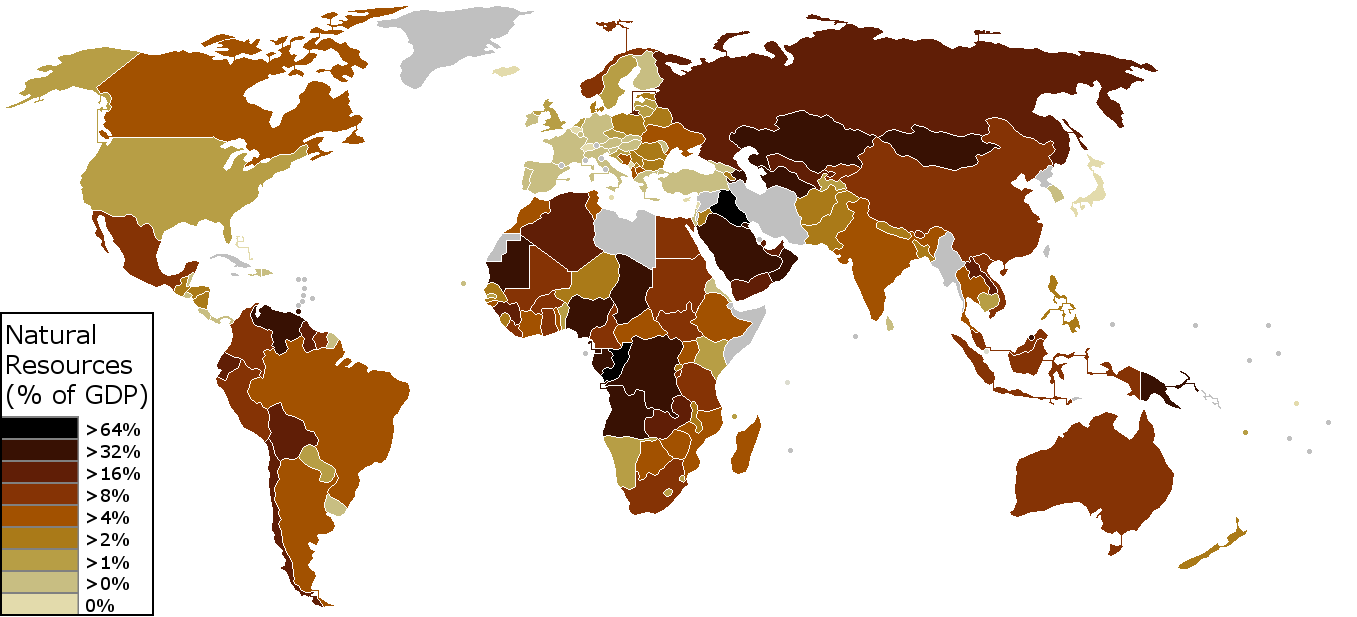
Yglesias digs up a creation by Redditor nonmetuammori that maps out, based on World Bank data, how much the economies of different countries depend on natural resources. Matt comments:

The news that, say, Saudi Arabia depends heavily on its oil wealth probably won’t shock you. What really jumps out here, however, is that most of the people who live in countries that have a low resource contribution to GDP live in rich countries (the USA, Japan, Germany, France) not in countries that lack natural resources. Places like Canada and Australia that have high incomes and resource-dependent economies take up a fair amount of space on the map but they have very little population density. There are more people in Italy than in Australia and Canada combined.

Does “Stupid” Have A Place In Political Discourse?

by Dish Staff

About two weeks ago, Paul Krugman caused a tiff by obliquely calling Paul Ryan “stupid,” leading Laurence Kotlikoff to respond, “No one, and I mean no one, deserves to be called stupid.” (Krugman later clarified that he believes Ryan isn’t stupid, but rather a “con man.”) In a post relevant to all in the blogosphere, Noah Smith mulls over the power of the s-word:

Now, calling people “stupid” is certainly not polite. But I never cease to be amazed at how effective it is in terms of making people choke on their own rage. People really do not like being called stupid. … In the end, I think people overreact to the “stupid” insult because, as a society, we use arguments the wrong way. We tend to treat arguments like debate competitions– two people argue in front of a crowd, and whoever wins gets the love and adoration of the crowd, and whoever loses goes home defeated and shamed. I guess that’s better than seeing arguments as threats of physical violence, but I still prefer the idea of arguing as a way to learn, to bounce ideas off of other people. Proving you’re smart is a pointless endeavor (unless you’re looking for a job), and is an example of what Stanford University psychologist Carol Dweck calls a “fixed mindset.” As the band Sparks once sang, “Everybody’s stupid – that’s for sure.” What matters is going in the right direction – becoming less stupid, little by little.

Megan McArdle similarly sees “stupid” as a rhetorical crutch:

Ultimately, calling people stupid is simply a performance for the fellow travelers in your audience. It’s a way that we can all come together and agree that we don’t have to engage with some argument, because the person making it is a bovine lackwit without the basic intellectual equipment to come in out of the rain. So the first message it sends – “don’t listen to opposing arguments” – is a stupid message that is hardly going to make anyone smarter. The second message it sends is even worse: “If he’s stupid, then we, who disagree with him, are the opposite of stupid, and can rest steady in the assurance of our cognitive superiority.” Feeding your own arrogance is an expansive, satisfying feeling. It is also the feeling of you getting stupider.

Update from a reader:

When Krugman suggested that Paul Ryan was a “stupid person’s idea of what a thoughtful person sounds like,” he was not calling Paul Ryan stupid. He was, quite plainly, suggesting that those who thought that Ryan was thoughtful were the stupid ones.

Another elaborates:

I read both Krugman’s original article and his supposed clarification and I did not at all get the impression that he was calling Paul Ryan stupid. He begins with a quote by Ezra Klein, in which he describes Dick Armey as “A stupid person’s idea of what a thoughtful person sounds like”. Krugman goes on:

It’s a funny line, which applies to quite a few public figures. Representative Paul Ryan, the chairman of the House Budget Committee, is a prime current example. But maybe the joke’s on us. After all, such people often dominate policy discourse. And what policy makers don’t know, or worse, what they think they know that isn’t so, can definitely hurt you.

This is Krugman’s only reference to Ryan in the entire column, so this has got to be where his critics are accusing him of, at the very least, implying that Ryan is stupid. However, the plain reading of the passage does not bear this interpretation out. This is, after all, English grammar. Words have consequences.

Obviously, Paul Ryan is a public figure who, in Krugman’s estimation (and to follow his implied comparison), would be a substitute for Dick Armey in Klein’s quote. Krugman is in no way saying that Ryan is stupid, but rather that he is “A stupid person’s idea of what a _______ person sounds like”. In this blank you could insert the word “smart”, “serious” or any one of a number of descriptions, but I think it is quite clear that Ryan is NOT being singled out as being stupid. At least, not by Krugman is this particular column he isn’t.

With that said, Krugman DOES seem to be obliquely accusing anyone who believes that austerity cures recessions and that stimulus spending makes them worse of being wrong and, perhaps even wrong-headed. In fact, you might even take that a step further and accuse Krugman of calling pretty much anybody who believes these things stupid, but those who interpret him as specifically calling Paul Ryan “stupid” here are, I hate to say it, kind of stupid.

Kimono Cardigans

by Phoebe Maltz Bovy

A Tokyo style blogger recently took issue with a mislabeled kimono:

While it seems like the accompanying photo of a sundress was unintentional and due to the awkwardness of Twitter image selection (the linked Telegraph article includes story-appropriate images), this tweet started a conversation about the various non-kimono items currently going by “kimono”:

Indeed, there’s “kimono” everything, even, from Kate Spade of all places, a kimono-themed iPad cover.

Graham Ruddick explains the pseudo-kimono trend in Britain:

The kimono is a traditional Japanese garment that has been historically known as a thin full-length robe influenced by the east Asian culture However, it has been reimagined for western shoppers in a similar form to a casual cardigan and is flying off the shelves of fashion retailers. New Look is selling a kimono every five seconds, the equivalent of 1,440 a day, and claims to have been the first major fashion chain to sell them in the UK.

Things did not go so well the last time a traditional garment was “reimagined for western shoppers in a similar form to a casual cardigan.” Remember Navajo-chic-gate of 2011-2012?

What often happens, in such conversations, is a descent into utter confusion. It’s not clear where the line falls between the cultures one can and cannot dress as. A generic “British” is presumably fine – by all means, take Hyacinth Bucket as your style inspiration. (Some of those floral dressed weren’t bad, in a kind of Elaine Benes way…) But how about the traditional dress of Estonia? Is the line whiteness-or-not, the wealth of the country, or both? It seems not all that exploitative – if still Orientalist – to go out and buy all Korean skincare products after reading a blog post about how Korean women get “poreless skin.” (Yes, I do believe that positive stereotypes about East Asian women’s skin were Edward Said’s main concern.)

Now for some first-person-as-second-person:

If you happen to be a bit of a Francophile and a Japanophile, is one of these acceptable but not the other? Is a Breton-inspired shirt from Muji or Uniqlo (says someone who owns both) different than a kimono-inspired cardigan from a Western European company? If you yourself are of an ethnicity (Eastern European Jewish) that was, until relatively recently, thought to be in disguise if in Western attire, aren’t you sort of always culturally appropriating (unless in Hasidic garb), or is this just like everything else to do with white privilege – all that matters is the time you live in? My ancestors would have been defined as ‘Oriental,’ but I am not.

Discussions of cultural appropriation, at least in the first person, tend to inspire such sinkholes. Consider the following, from Jarune Uwujaren’s 2013 post:

Is the Asian fusion takeout I order every week culturally appropriative? Even though I’m Black, is wearing dreadlocks appropriating forms of religious expression that really don’t belong to me? Is meditating cultural appropriation? Is Western yoga appropriation? Is eating a burrito, cosplaying, being truly fascinated by another culture, decorating with Shoji screens, or wearing a headscarf cultural appropriation?

Each, then, to her own, culturally-specific sinkhole.

The best I can conclude is as follows: If people of the group in question are offended, then you have to at least consider that you’ve crossed a line. I mean, you don’t have to. I suppose one could take the approach that the offended are in the wrong, but in such cases, why? There are times when violating rules of PC is courageous, but wearing a headdress to a music festival after learning that this offends many American Indians isn’t one of them. As for the kimono cardigans, it seems as if the offensiveness comes not from Westerners wearing traditional Japanese dress because they find it attractive, but rather from things that are not kimonos being labeled as such. And – speaking still more generally – if the culture you’re appropriating from looks down its nose at you, someone from what they view as an inferior culture, trying to imitate theirs (hi, France!), you’re in the clear.
Why Is Latin America Nuke-Free?

by Dish Staff

As Taylor Marvin puts it, “the simplest answer is that nuclear weapons have gone out of style”:

In an era where interstate war is comparatively rare, the value of a nuclear security guarantee has shrunk when nuclear weapons’ diplomatic and image costs have grown. As the threat of major war has receded both around the world and in the region — which is partially due to US hegemony in Latin America, as Joe Young noted — the practical security gains from nuclear weapons have declined. Given the time, effort, and resources required to acquire nuclear weapons, if states cannot expect enough security or prestige gains to justify their costs they will be more hesitant to invest in them. Tellingly, countries that have armed in the last few decades have tended to be isolated or facing extraordinarily dangerous security situations: Israel, North Korea, Pakistan, and South Africa are all a little of column A, and a little of column B. None of the Latin American states with the resources to develop nuclear arms are, or more arguably have been, in this situation.

Beyond security, nuclear weapons are no longer seen as a path to international status. If a Latin American country armed itself today with a nuclear weapon it would be more likely to receive global condemnation than great power prestige. Indeed, in the modern era aircraft carriers are arguably a more important military status symbol than nuclear weapons.

Thinking In Third

by Dish Staff

Research suggests that adding a little distance to how we think about ourselves might improve how we act:

Participants were told, upon entering the lab, that they faced a nerve-wracking task: to impress a member of the opposite sex, in one study, or to give a speech. To up the ante, they also knew their performance would be videotaped and later analyzed. But right before they began, they were told to prepare themselves for the task ahead. Some participants were assigned to do so by speaking to themselves in the first person; the rest were instructed to address themselves using their own first name, as well as non-first-person pronouns like shehe, or you.

Though we don’t tend to look kindly upon those who speak of themselves in the third person, the practice is not without its benefits. According to reviewers, who were blind to participants’ condition, those who’d avoided I and me in their pep talks actually appeared less nervous, and did a better job on the task at hand. Speaking to ourselves as though we are someone else, it seems, lets us distance ourselves from an overwhelmingly stressful experience.

Face Of The Day

Typhoon Survivors Continue To Rebuild Lives 9 Months After Haiyan Devastation

A young girl plays with a toy gun in the coastal area renamed by residents “Yolanda Village” in Tacloban, Leyte, Philippines on August 13, 2014. Tacloban residents continue to focus on rebuilding their lives nine months after Typhoon Haiyan struck the coast on November 8, 2013, leaving more than 6,000 dead and many more homeless. With many businesses and government operations back up and running and with the recent start of the years typhoon season, permanent housing continues to be the main focus with many families still living in temporary accommodation. As well as continuing recovery efforts, Leyte is preparing for the arrival of Pope Francis, who will visit the region from January 15- 19. By Chris McGrath/Getty Images.

The Knots Of Depression

by Dish Staff

Like Elizabeth, Rod Dreher uses the death of Robin Williams to discuss his own experiences with depression:

It seems so elemental — of course your mental state affects your perception of reality, duh! — but unless you’ve lived through it, it’s hard to understand how profound it can be. I walked around the house as if I were wearing a heavy wool blanket soaked in cold water almost all the time. Reason is largely powerless in the face of it. You can’t just snap out of it. You can’t make an argument for why you shouldn’t be depressed, and why things are really not as bad as you think they are. I mean, you can try this, and maybe it will help a bit, but it’s like being tied up and thrown off a pier, and being told by well-meaning people standing on the pier how you can save yourself by swimming to safety.

Some people — like Robin Williams — are not going to be able to save themselves, or be saved, for the same reason that some people who are thrown into the water bound by knots they did not tie will drown. I could be wrong about this, but I trust in the mercy of God in the case of poor souls who suffer so much that they cannot see any other way to relieve their pain.

The death prompted Ty Foster to come out as bipolar:

I can’t speak for anywhere else, and I can’t really speak for any other disabilities, but I know that in my home country [the US], we are still quite a long way from eliminating the stigma that surrounds mental illness. When I’m depressed, it’s hard enough to get myself to the bathroom and back, let alone getting myself to a freaking doctor. Recovery is made all the more difficult by the fact that the world around me, in many insidious ways, causes me to feel even more alone, weird, creepy, scrutinized, awkward, unworthy than I already would. So the hell with that world.

Relatedly, Jason Millman flags research finding that “improvements in understanding mental illness … didn’t help reduce the social stigma”:

People were more likely to say they didn’t want an alcoholic to marry into the family (up from 70 percent to 79 percent) or have someone with schizophrenia as a neighbor (up from 34 percent to 45 percent). Most in 2006 also said they were unwilling to work closely with someone who had schizophrenia (62 percent) or alcohol dependence (74 percent), and most thought people with either illness would likely be violent.

“There was no support that greater scientific understanding translated into reduced prejudice in the United States or elsewhere,” Pescosolido wrote in a more recent March 2013 review of research into the social stigma around mental illness. Reducing the stigma, she points out, will depend on a better understanding of the social and cultural factors shaping it.

Vladimir Putin, Locavore, Ctd

by Dish Staff

annual-change-in-euro-zone-consumer-price-indexes-all-items-fruit-vegetables_chartbuilder

Jason Karaian looks at how Putin’s counter-sanctions on EU produce imports stand to affect European farmers and consumers:

While it’s never a good time for farmers to lose a big market like Russia, now is particularly inopportune. Bumper crops have pushed down prices in recent months, which is bad for producers as well as policymakers—the euro zone has been flirting with deflation this year, and a glut of produce once destined for Russia but dumped closer to home could push prices down even further[.]

“We can only hope that European consumers eat more pears,” a Belgian fruit farmer told the Wall Street Journal (paywall). … To add insult to injury, the upcoming apple harvest in Europe will be one for the record books, according to an industry forecast published yesterday. “The same day it’s announced we have a big crop our largest customer, Russia, stops buying, so it’s like a Black Thursday,” the commercial manager of a French apple concern told FreshPlaza. “The producers will be hit,” an Athens fruit seller told Euronews.

And Alec Luhn measures the impact, as well as the politics, of the ban in Russia:

State-controlled television has been downplaying any effects of the ban. “Consumers will barely be able to notice any price increase…. Even if people have to travel abroad for some dishes, it will lead to greater profits for Russian tourist firms,” reporters on Rossiya 24 exclaimed during a newscast on Friday, Aug. 8. But analysts predict an overall rise in food prices that will further exacerbate inflation, which has already risen beyond the Central Bank’s predictions to 7.5 percent.

The import ban doesn’t only affect luxury goods. Almost one-third of Russian families don’t obtain the minimum amount of calories and nutrients designated by the Health Ministry, according to the Russian Presidential Academy of National Economy and Public Administration, and they will likely have even more difficulty as cheap products from Ukraine are taken off the shelves.

Bershidsky highlights the ban’s potential impact on Putin’s shaky Eurasian Economic Union project, which the Russian president still wants as part of his legacy:

Putin has not given up. Rebuilding at least a smaller, narrower version of the Soviet Union remains at the center of his agenda. He wants it to be part of his legacy. Armenia — dissuaded by Moscow from EU association — and Kyrgyzstan are on track to join the EEU this year. As of 2015, the member states will harmonize their tax systems.

The other members of Putin’s union, however, don’t have the same interest in imposing or enforcing a ban on imported food. Belarus and Kazakhstan have nothing to retaliate against: Only Russia faces Western sanctions. “This is our domestic matter,” Belarussian President Alexander Lukashenko said yesterday. “If we need Polish apples, we buy them, but for our domestic market, not for Russia.” Kazakhstan President Nursultan Nazarbayev’s press service clarified after he talked to Putin on the phone that the food embargo was “Russia’s unilateral measure that doesn’t involve” other EEU members.

In Anne Applebaum’s view, the trade angle of this conflict puts to rest the “McDonald’s theory of international relations”:

This week, as Russia, a country with 433 McDonald’s, ramps up its attack on Ukraine, a country with 77 McDonald’s, I think we can finally now declare the McPeace theory officially null and void. Indeed, the future of McDonald’s in Russia, which once seemed so bright—remember the long lines in Moscow for Big Macs?—has itself grown dim. In July, the Russian consumer protection agency sued McDonald’s for supposedly violating health regulations. This same consumer protection agency also banned Georgian wine and mineral water “for sanitary reasons” at the time of the 2008 Russian-Georgian war, and it periodically lashes out at Lithuanian cheese, Polish meat, and other politically unacceptable products as well. …

This week—as Russia bans most American, European, Canadian, Australian, and Japanese agricultural goods—globalization suddenly began to unravel a lot faster than anybody imagined. Vladimir Putin knew sanctions were coming and openly declared that he didn’t care. He also knows that a trade war will hurt a wide range of his countrymen, but he didn’t mind that either.

So You Think You’re Part Cherokee

by Dish Staff

Iron Eyes, the “Crying Indian” in the famous 1970s anti-pollution PSA above, had no actual Cherokee heritage, though he claimed he was “born and raised on a ranch in Oklahoma to family of Creek and Cherokee farmers.” Miley Cyrus, Johnny Cash, and Elizabeth Warren, too, have made dubious claims to Cherokee heritage, as Russell Cobb notes. But Cobb understands the allure. He describes how a college encounter with British exchange students marked his entry into the “tribe of the Wannabes: non-Native Americans who insist on claiming Indian heritage”:

The British exchange students really seemed interested. They clearly wanted to know an Indian. “I think I’m part Choctaw,” I said. “But only, like, one-sixteenth, so I’m not on any tribal rolls or anything.”

Now that I’d said it, it had to be true. After all, my mother’s family came from rural eastern Oklahoma, right on the dividing line between the Choctaw and Cherokee Nations. The family’s cemetery plot in Checotah was right next to the Indian section. And, like Liz Warren’s Papaw, we had high cheekbones.

So I would belong to the tribe of the Wannabes for a while, especially during my early 20s, when I actually didn’t know what the hell I was.

The tribe gave me a sense of identity and it carried some instant prestige when traveling abroad. Europeans love Indians, I discovered. I never fully bought in, however. I knew plenty of people who tried to cash-in on some supposed Indian great-grandfather to qualify for a tuition break or minority status. That wasn’t me.

There was one small problem: The only Indians I knew in Tulsa were a lot like me. They grew up on the same ‘80s pop music and TV shows, followed the same sports teams (even the Oklahoma Sooners, who got their name illegally stealing Native land in the late 19th century). They didn’t ride horses and they didn’t even have cool names, like Iron Eyes. Most of them weren’t any darker than I was. So I didn’t want to be them. I wanted to be like that Indian in that commercial, stoically paddling his canoe through the American landscape, offering a rebuke to the crass commercialism of mainstream America. Oh, wait…