The Worrying Vacuity Of Hillary Clinton, Ctd

Outside the fever swamps, Ben Smith detects relatively little interest in Clinton’s candidacy:

All this data suggests that Clinton still hasn’t unlocked the only thing that could really turn a campaign into a movement, and make her a figure of the future and not just the past: authentic excitement among American women at her historic candidacy. There have been blips of real, viral enthusiasm — Texts From Hillary is the best I know. And this too could surely come. Indeed, I expect it to come. But for all the ersatz hashtags pushed by would-be grassroots support groups, it sure hasn’t happened yet.

But the data also suggests that perhaps Clinton shouldn’t rely on inspiration for her candidacy. There is, after all, another way to win. Perhaps she can’t run a campaign modeled on the Obama 2008 movement. The alternative is Obama 2012 — a boring, grinding affair that sold a nascent economic recovery, scorched the Republican, and plodded to the White House.

It’s what happens when you’re running on a thin resumé and soundbites designed to offend no one.

All Wars Are Important, But Some Wars …

Goldblog wonders why the press is paying so much attention to Gaza and so little to Syria, when the implications of the latter conflict are, in his view, much broader (and the death toll much higher):

[T]he Arab Spring (or Awakening, or whatever word you choose) has given lie to the idea—shorthanded as “linkage”—that the key to American success in the broader Middle East is dependent on finding a solution to the Israeli-Palestinian conflict. This idea, that all roads run through  Jerusalem, has traditionally motivated a great deal of journalistic and foreign policy expert interest in this conflict. Finding a solution to this conflict is very important to the future of Israelis and Palestinians, of course, but not nearly so much to Americans. A peaceful resolution to this conflict would do little to bring about good governance in Arab states, or an end to Islamist extremism in the greater Middle East. Which brings me back to Syria. The war in Syria (and Iraq, since it is more or less a single war now) is of greater national security importance to the United States than the war in Gaza, and it should be covered in a way that reflects this reality.

It’s a familiar, ancient device for Israel apologists: there are worse massacres elsewhere; solving Israel-Palestine won’t help us much in foreign policy anyway; so let’s move right along, shall we? And don’t mention the settlements, except in asides that are designed to credentialize the writer as someone who naturally opposes them – even as he also opposes any serious pressure on Israel to stop the provocations. He attributes the discrepancy to the Western world’s weird obsession with criticizing Israel, which is subtler version of the accusation of anti-Semitism.

One reason, of course, which Goldblog mentions, is that the US is partly paying for the slaughter in Gaza and for the clean-up afterwards. More to the point, condemnation of Assad is universal in the US (while Netanyahu is lionized and egged on by one political party), and the conflict there is an evenly matched civil war, rather than one more relentless pounding of a weak mini-state under Israeli control with casualties massively lop-sided in one direction. This is not to say that what is going on in Syria isn’t unbelievably awful and worse in many ways than what’s occurring in Gaza. We noted the massacre here that Goldblog says the NYT ignored. It is simply to say that we would be far more involved if we were supplying the weapons that were killing Syrians en masse.

Keating, on the other hand, agrees that the world is paying attention to the wrong events, but thinks the reason has more to do with how we react to short-term vs. long-term conflicts:

One big problem with the now prevalent “arc of global instability” narrative is that it lumps together short-lived flare-ups of long-running local conflicts with much larger and more transformative events. Sooner or later, the violence in Gaza will be resolved by a cease-fire, though the question is how many more people will die before it happens. The violence in eastern Ukraine flares up and dies down, but despite the understandable wariness in Eastern Europe, it seems unlikely to spread beyond its immediate region.

The twin civil wars in Iraq and Syria are another story: a long-running and increasingly chaotic situation without an obvious political solution, even a short term one. The violence challenges long-standing borders in the region and could increase the risk of international terrorism, and the refugee crisis it has created will continue to place strain on surrounding countries. Given the Iraq war and the deepening U.S. involvement in Syria, I would also argue that it’s the crisis the U.S. bears the most direct responsibility for. This week’s most discussed tragedies will eventually come to an end. But the chaos in Iraq and Syria isn’t going anywhere.

Taxing Our Way To Equality

inequality-800x656

Zachary Goldfarb presents the findings of a Tax Policy Center analysis showing that by one measure, income inequality has declined appreciably in the Obama era:

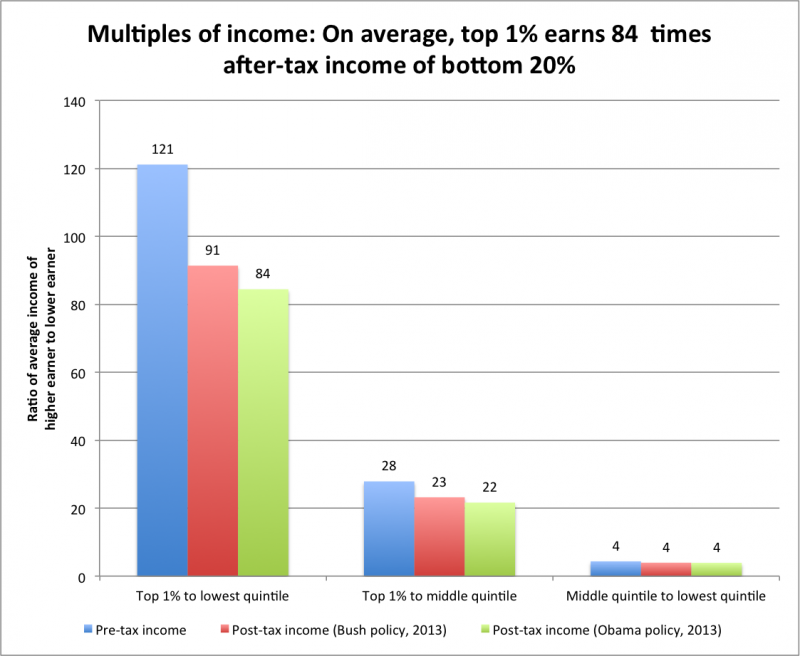
Today, the average after-tax income of a member of the top 1 percent of earners is $1.12 million. The average after-tax income of someone in the bottom 20 percent is $13,300. That means the average person at the top takes home 84 times the income that the average person in the bottom takes home. Now, consider what it would be like if none of President Obama’s tax policy changes had happened: not the upper-income tax hikes negotiated at the beginning of last year, not the upper-income tax increases imposed by the Affordable Care Act, not the low-income tax credits enacted in the 2009 stimulus and later renewed.

In this alternative universe, the average member of the top 1 percent would take home $1.2 million, or 6.5 percent more in income, according to a new analysis. The average member of the bottom 20 percent would bring home $13,100, or 1.2 percent less in income. As a result, the average member of the 1 percent would take home 91 times what the average person in the bottom would bring home. If you’ve wondered whether Obama has made any headway at reducing income inequality, here’s evidence that he has.

For Jordan Weissmann, this finding illustrates the importance of measuring inequality both before and after taxes and transfers:

Between the tax changes and health reform, Council of Economic Advisers Chairman Jason Furman argues that the administration has undone “more than a decade” of growing inequality. And he has a point. Liberals prefer talking about pre-tax inequality in large part because it’s a raw reading of how egalitarian our economy is—it tells us how bad the income gap would be were it not for Washington’s intervention. But looking at post-tax-and-transfer inequality tells us how much more work needs to be done to even outcomes—and whether the government’s interventions are having an effect. Both sets of numbers tell us important stories. One says the rich are still pulling away from the rest of us. The other says that the administration has managed, ever so slightly, to pull them back.

Violence Triumphs Over Pluralism

That’s the essence of Shadi Hamid’s take on the aftermath of the Arab uprisings and the rise of armed Islamist groups throughout the Middle East:

The July 3, 2013 coup in Egypt has had a chilling effect beyond the country’s borders, strengthening one particular narrative among both regimes and their opposition: that the only currency worth caring about is force. With the relative decline (for now) of the Muslim Brotherhood and other mainstream Islamist groups that had made their peace with parliamentary politics, radicals and extremists have quickly moved to fill the vacuum. They do not counsel patience. They tell followers and fence-sitters that there is little need to wait 20, 30, or 80 years for the Islamic State, or something like it. The Islamic State can be realized now through brute, unyielding violence. Within the varied, often fractious world of political Islam, the radicals remain a minority, but their numbers belie an outsized influence.

We might not like to admit it, but violence can, and often does, “work” in today’s Middle East. This is not just a reference to the Islamic State of Iraq and Syria (ISIS), but also to less extreme militant groups that control territory throughout Syria, providing security and social services to local populations. From Libya to Palestine to parts of the Egyptian Sinai, armed—and increasingly hard-line—Islamist groups are making significant inroads.

William Dalrymple argues that the rise of ISIS and its persecution of Christians bode ill for secularism in the Arab world:

Certainly since the 19th century Christian Arabs have played a vital role in defining a secular Arab cultural identity. It is no coincidence that most of the founders of secular Arab nationalism were men like Michel Aflaq – the Greek Orthodox Christian from Damascus who, with other Syrian students freshly returned from the Sorbonne, founded the Ba’ath party in the 1940s – or Faris al-Khoury, Syria’s only Christian prime minister. Then there were intellectuals like the Palestinian George Antonius, who in 1938 wrote in The Arab Awakening of the crucial role Christians played in reviving Arab literature and the arts after their long slumber under Ottoman rule.

If the Islamic state proclaimed by Isis turns into a permanent, Christian-free zone, it could signal the demise not just of an important part of the Arab Christian realm but also of the secular Arab nationalism Christians helped create.

Relatedly, noting the unusually cold shoulder Hamas has gotten from some Arab states during the Gaza war, Juan Cole attributes this to the region’s recent political realignment around the struggle between states and Islamist non-state actors:

[Y]ou have a bloc of nationalist states– Egypt, Jordan, and Syria — facing off against movements of political Islam, and Hamas has to be counted among the latter. (Iraq, ruled by parties of Shiite political Islam, is trying to join the nationalists in the region in alliance against the “Islamic State”). It is therefore difficult for these states to intervene on behalf of Hamas, since they want the organization, and the whole tendency to political Islam, to drop dead. …

Even the so-called “Islamic State” turns out to be useless to Hamas. Its leadership says that it has to tackle the “hypocrites” among the Muslims before turning to “the Jews.” This is a reference to early Islam. When the Prophet Muhammad emigrated from Mecca to Medina, most people in the latter city came to embrace Islam, even if only pro forma. City notables who outwardly had become Muslims but inwardly resented and tried to undermine the Prophet, were termed “hypocrites” or “those in whose hearts there is a sickness”. The so-called Islamic State views all other Muslims this way. So the struggle between nationalism and political Islam has neutralized most of the Middle East if it hasn’t made them de facto allies of Israel.

The Able-Bodied Actor’s Handicap

Christopher Shinn, a playwright who underwent a below-the-knee amputation in his late 30s, discusses the limited depth that able-bodied performers bring to disabled characters and why actors with disabilities don’t get cast in these roles instead:

Able-bodied actors can listen to the disabled, can do research, can use imagination and empathy to create believable characters. But they can’t draw on their direct experience. That means that audiences will be able to “enjoy” them without really confronting disability’s deepest implications for human life. Often, one fears, that’s the point: Pop culture’s more interested in disability as a metaphor than in disability as something that happens to real people.

For example, in his review of Side ShowNew York Times theater critic Charles Isherwood wrote, “Of course, in some sense, we all know what it’s like to feel self-divided, or alienated from the world, which is what makes ‘Side Show’ emotionally stirring.” Disabled characters are often seen as symbolizing the triumph of the human spirit, or the freakishness we all feel inside. That may be another reason disabled actors are overlooked—they don’t allow disability-as-metaphor to flourish as easily.

I may not have been much bothered by any of this until my own disability asserted itself. But now I know that the physical pain and challenges that come in the wake of disability, alongside the insensitivity and lack of understanding one encounters, are profound experiences that cannot be truly known until they are endured. Perhaps the worst feeling is when people avert their eyes. Even someone gawking is better than their looking away.

(Video: Daniel Day-Lewis as Irish poet Christy Brown, who suffered from cerebral palsy, in the 1989 film My Left Foot. He won an Academy Award for his performance.)

The Islamic State In Iraq And Only Iraq

Jacob Siegel casts doubt on ISIS’s ability to extend the reach of its “caliphate” beyond Iraq, given that its Sunni rebel allies there don’t share its objective of world conquest:

There is a paradox to ISIS’s power. The caliphate has grown to rival al Qaeda for prestige in the global jihad movement but it becomes clearer with every day that, within Iraq, the Islamic State doesn’t extend very far outside of Mosul. As an attacking force, ISIS might be the most powerful army in Iraq, able to ambush the army in lightning assaults that have either scattered or slaughtered government and militia soldiers. But the skills and composition that have led to ISIS successes on the battlefield haven’t set them up to rule in any more than a handful of cities. They are too small to impose their authority over extended territory. For that they rely on their allies, using them until the day they are no longer needed, just as they, in turn, are being used.

ISIS’s victories and social media theatrics have won it a flock of Internet supporters and death-seeking recruits, but most of its potential followers in Iraq aren’t looking online to choose a cause, they take orders from tribal leaders or other local authorities.

Likewise, Yezid Sayigh contends that “in fact ISIS is following a well-worn path for taking power and consolidating it in the limited geographical space of a single nation-state where its true social base lies”:

To legitimize itself ideologically and acquire leverage over its partners and competitors, ISIS calls Muslims to jihad, labels western governments “crusaders,” and pledges to free Palestine. This again mimics Saddam, who appealed to pan-Arabism and the Gulf monarchies to support his war against revolutionary Islamist Iran in 1980, and in 1990 linked his invasion of Kuwait to the liberation of Palestine and evoked Islamic solidarity by having “Allahu Akbar” inscribed on the national flag.

But Saddam remained an Iraqi leader in the Iraqi setting, benefitting from the country’s oil wealth to cement his rule internally but remaining bound by its limitations, especially its deep social cleavages and weak national identity. ISIS is even more dependent than he was on its societal balances and alliances within the narrower domestic demographic base of the Arab Sunnis of Iraq, a vulnerability that is not seriously compensated by its partial extension into Syria.

Superhero Social Justice, Ctd

In the wake of the announcement of a female Thor, Noah Berlatsky considers the female comic-book readership:

Lots of women do read comics in general, and superhero comics in particular.  That fact should be self evident enough by now, given the way the Internet has given voice to many female fans of the genre. And yet sexism in the comics world persists. The effort to firmly debunk gendered stereotypes about who enjoys comics and who doesn’t would seem to benefit from hard statistics about just how many women are reading. Those statistics are surprisingly difficult to come by—but the ones that are available suggest that comics, and superhero comics, historically did appeal to both genders and very well could again.

Because of low critical standing or low readership or some combination of both, good data about comics readership over the years is rare. We do know that comics were much, much more popular during the 1940s, when superheroes first burst on the scene, than they are today. Comics then were more like film or television—a mass entertainment option, rather than a niche one. A Market Research Company of America report from 1944 found that 95 percent of all boys and 91 percent of all girls between six and 11 read comics; 87 percent of boys and 81 percent of girls between 12 and 17, and 41 percent of men and 28 percent of women between 18 and 30. Comics scholar Trina Robbins told me that The Newsdealer, a magazine for newsstand owners, actually published figures suggesting that girls at the time read more comics than boys.

Previous Dish on superhero diversity here.

No Country For Young Women

U.S. Agents Take Undocumented Immigrants Into Custody Near Tex-Mex Border

Among the many horrors that the Central American refugee children are fleeing, Mónica Ramírez and Anne Ream focus on the epidemic of sexual violence, which is often ignored, or even committed, by the police:

One key factor driving this crisis is the well-documented and widespread sexual and gender-related violence in Latin America. In a 2014 report conducted by the UN High Commissioner for Refugees, 70 percent of children interviewed cited domestic violence as well as violence at the hands of gangs, cartels, or “state actors” (such as police), as reasons for fleeing homes in Mexico and Central America. Sexual violence has become so widespread in Guatemala in recent years that in 2009 Doctors Without Borders launched its first Latin American mission dedicated to treating rape and abuse victims. And gender-based violence is now the second highest cause of death for women of reproductive age in Honduras. …

Anti-violence advocates on the ground say that two factors drive the high incidence of sexual and gender-related violence in the region: a lack of awareness about the nature of gender-based violence, which has historically been downplayed or normalized, and the absence of official efforts and channels that might encourage reporting of such crimes. The fact that law enforcement and judicial systems are most often dominated by men who are disinclined to pursue sexual violence or trafficking cases, and may in fact be implicated in such violence themselves, further exacerbates the crisis.

Previous Dish on the chaos in Central America here and the child migrant crisis here.

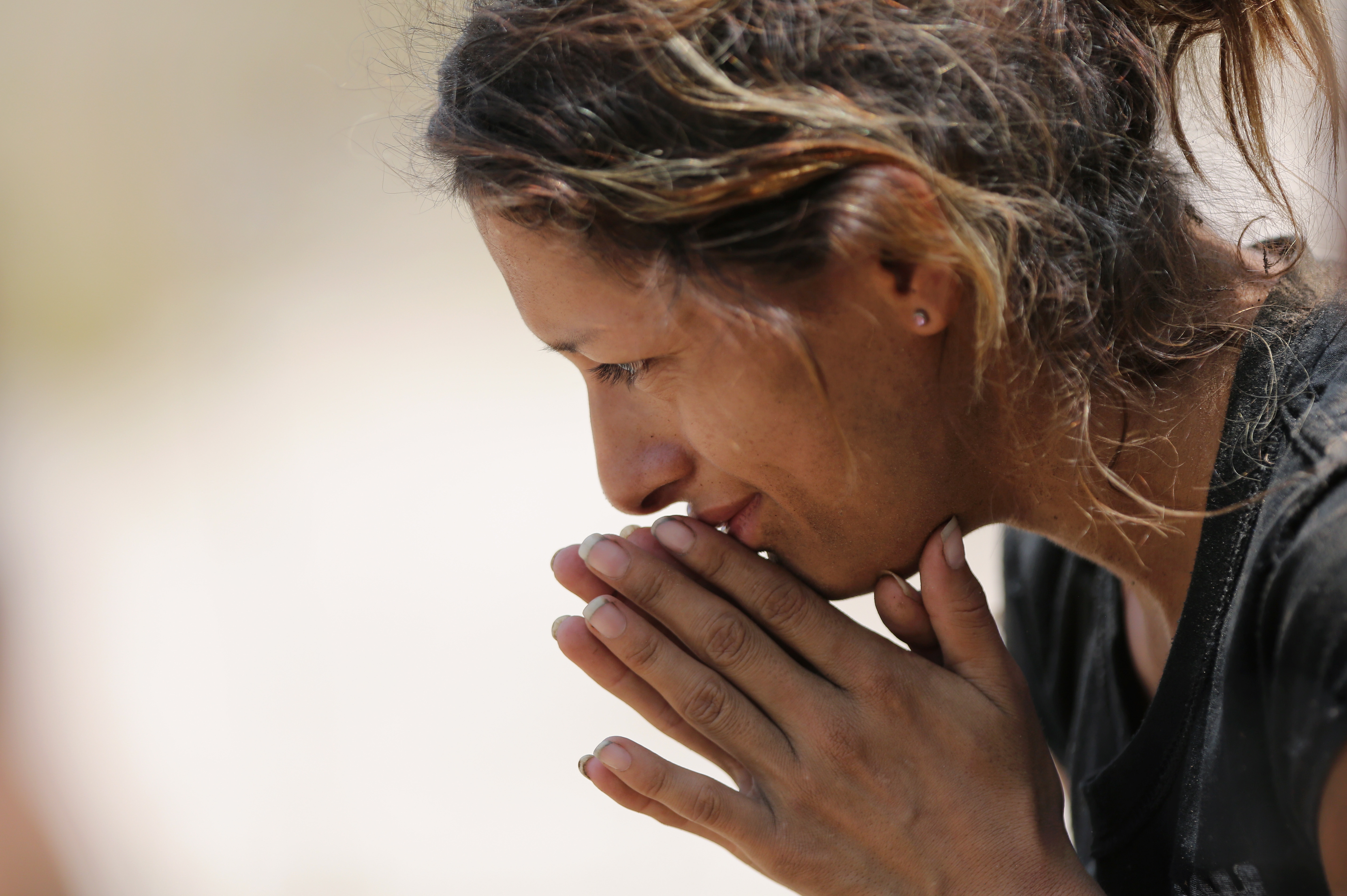
(Photo: An undocumented immigrant sits after being detained by U.S. Border Patrol agents some 60 miles north of the U.S. Mexico border on July 23, 2014 near Falfurrias, Texas. She said she was from Guatemala, one of a group of immigrants Customs and Border Protection agents caught moving north through dense brushland in Brooks County. By John Moore/Getty Images)

Creepy Ad Watch

yiayiaad827

A reader flags it:

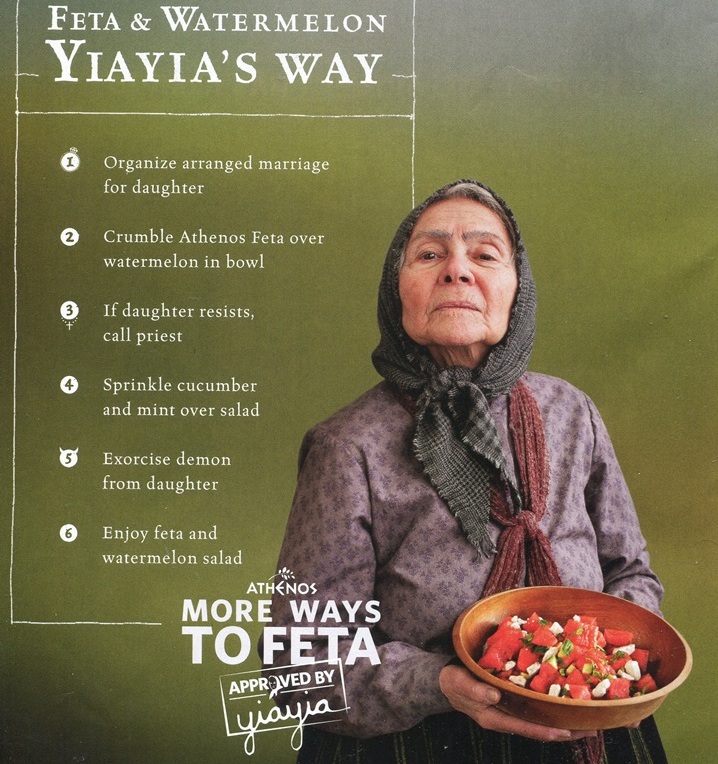
I received my August Bon Appetit magazine and as usual, eagerly sat down to read it as soon as it was delivered. I was dumbfounded when I came across this advertisement. To me, it seems like an overt case of ethnic stereotyping. I can understand the use of a traditional “yiayia” figure to advertise Greek food products, but to also have her include arranged marriage and exorcism on her to-do list seems outrageous. And oh yes, there are others ads in a similar vein – apparently in one, the yiayia calls her granddaughter a “prostitute.”

When I went to Athenos website and Facebook page, I am clearly not the only person who is offended by these ads. Athenos’ explanation (and boilerplate response to Facebook posts) is that they “didn’t intend to offend anyone” and were trying for a lighthearted approach, using a character “set in the old ways.” Apparently that means the traditional yiayia is a disapproving grump, putting her seal of approval only on the Athenos food items. As one of the Facebook commenters (with a Greek surname) said: “The only thing my yiayia would force anyone to do is eat a big plate of food.” I don’t know what is more offensive to me – the ad campaign, or Athenos’ dismissive “we didn’t mean to be offensive” responses.

Update from a reader:

I’m half-Greek (on my mother’s side) and HAD a Yiayia. Although my Yiayia was born in Greece, she emigrated when she was still a teenager and was Americanized enough in her thinking that she didn’t try to arrange marriages for her daughters, although HER marriage was, in fact, arranged by her family. Also, I have been to Greece and visited the very small village where my maternal grandfather grew up, and I can certainly envision contemporary Greek Yiayias who spent most of their lives living in that environment coming across pretty much like the Yiayia in the ad.

However, even if that were not true, I think the point of the ad is that “Feta and Watermelon Salad” would be something that a traditional Yiayia would approve of. Frankly, I think the ad is amusing, and as someone who loved his own Yiayia I can’t for the life of me understand what is so offensive about it.

One more thing, I am not at all sure that MY Yiayia would approve of Watermelon and Feta salad. It’s certainly not something that she ever served as far as I can remember. In fact, my sense is that she might actually be MORE LIKELY to disapprove of the Feta and Watermelon Salad than she would be to disapprove of arranged marriages.