Wisecracker Of Woe

This embed is invalid

Sara Corbett spotlights comic and Dish fave Maria Bamford (NYT):

Much of Bamford’s work examines the relationship between “people” – generally well-intentioned friends and family – and those who grapple with depression or anxiety or any other challenge to the psyche. Her act is a series of monologues and mini-skits performed rapid fire and often without regard for transition. Deploying a range of deadpan voices, she mimics the faux-enlightened who hover around the afflicted, offering toothless platitudes (“You just need to get out in nature”), bootstrapping pep talks (“It’s all about attitude. You gotta want it!”) or concern warped by self-interest (“You’d think you’d just stop vomiting for me and the kids”).

The humor of any given moment relies not so much on punch lines as it does on the impeccably timed swerves of her tone, the interplay between Bamford’s persona and those of all the people who don’t get her. Often, she is demonstrating helplessness on both sides. “We love you, Maria,” Bamford says, imitating her 69-year-old Midwestern mother, Marilyn, in one of her recorded performances, heaving a fed-up sigh. “We love you, we love you, but it’s hard to be around you.”

Previous Dish on Bamford here and here.

(Video: Part one of wonderfully well-done The Program, a new series by Bamford and Melinda Hill)
Face Of The Day

carla_richmond_09

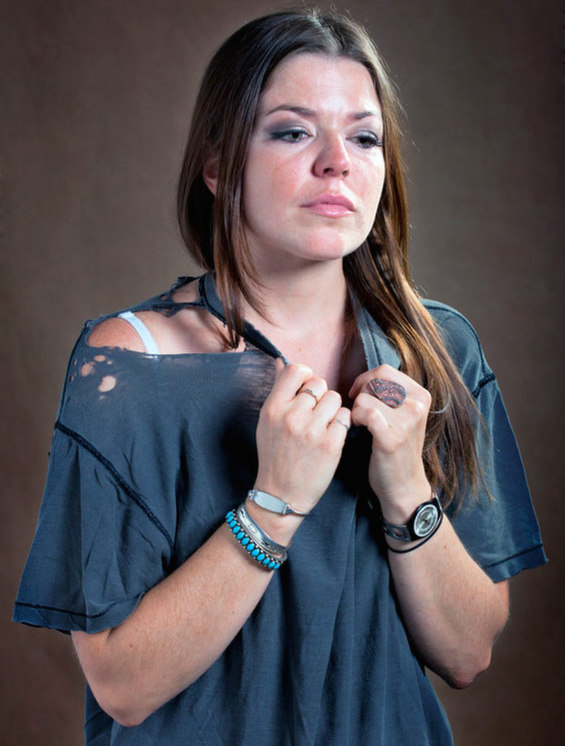
From a photo series of people wearing the shirts of former lovers:

When all else is gone, it is often the things we most take for granted that endure, like an old, torn t-shirt. For her collaboration with writer and actress Hanne Steen, photographer Carla Richmond collects intimate portraits of the brokenhearted, women wearing shirts left behind by ex-lovers. Hanging loosely about the contours of bodies they do not quite fit, the shirts and their wearers remain anonymous, their words recorded only in unending, stream-of-consciousness style poetry.

From that stream:

It feels like a flag I can’t stop flying. It comforts me in the meantime between the spaces. It’s just a rag I turned into a promise that he would never leave. Some sort of common thread between us. Part of me wants to rip it off. So many what-ifs and could’ve-beens and should’ve-beens and never- weres. It’s just a shirt. It’s been there for me when people haven’t. It makes me feel childish and taken care of. It makes me look a little stronger than I am. As long as I hold onto the shirt she is never completely out of my life. I’d wear it every day if I could. As much as you build a house around it or put a ring on it it’s all still temporary and dissolving so all you can do is love it. Even if it’s painful we need to hold onto something. Proof that we did it. That we went through it. That we learned something. That our hearts were broken. That we were loved. That we weren’t loved enough. For someone I won’t be something that will be so easily shed.

Many more portraits from “Lovers Shirts” here.

The Big Six Oh! Ctd

Schermata-10-2456204-alle-10.45.49

A reader writes:

I can hardly believe there’s been no reader response to the excerpt quoted in your post about sex after 60. I’m bisexual, polyamorous, almost 60, and recently back on the market after mourning the loss of a partner. Took my saggy old body and face out on the market, fearing the worst. Was welcomed with open arms by wonderful sexy imperfect humans of my own age, people who are out to maximize their pleasure and as much as possible the pleasure of others, and are not possessive. Given the explicitly sexual nature of the market I’m using (Adult Friend Finder, NSFW) and a general acceptance of Fucking on the First Date, one might expect a rough or skanky culture.

Quite the opposite. A generally courteous bunch, appreciative and even affectionate, but in a very non-controlling way. Generous and considerate in bed, and for the most part quite skilled (you pick up a few tricks every decade). Smart, honourable people; good communicators. In their fifties and sixties. Who like to fuck. Who like to try new games, new partners. Who know what they want. Who are really, really good at it.

So my conclusion is all the people who could refute A.A. Gill are all too busy having wonderful sex to bother. And I’m so glad my comments, if published, will be anonymous. Nobody in the town where I live knows what I do on my holidays.

Thanks for all the Dish.

(Photo © Rankin. See more of his work here. Hat tip: Ariane Fairlie)

“The Oldest Depiction Of Sex On Record”

turin-erotic-papyrus-full

Josh Jones takes a gander:

Painted sometime in the Ramesside Period (1292-1075 B.C.E.), the fragments above—called the “Turin Erotic Papyrus” because of their “discovery” in the Egyptian Museum of Turin, Italy—only hint at the frank versions of ancient sex they depict …. The number of sexual positions the papyrus illustrates—twelve in all—“fall somewhere between impressively acrobatic and unnervingly ambitious,” one even involving a chariot. Apart from its obvious fertility symbols, writes archaeology blog Ancient Peoples, the papyrus also has a “humorous and/or satirical” purpose, and probably a male audience—evidenced, perhaps, by its resemblance to 70’s porn: “the men are mostly unkept, unshaven, and balding […], whereas the women are the ideal of beauty in Egypt.” …

Sacred temple prostitutes held a privileged position and mythological narratives incorporated unbiased descriptions of homosexuality and transgenderism. Ancient Egyptians even expected to have sex after death, attaching fabricated organs to their mummies.

Check out a video about the papyrus here.

Binge-Drinking Your Way To Success

A new study indicates that heavy drinking can boost your social status:

Titled Drinking to Reach the Top, the analysis shows that men and women who engage in more frequent heavy drinking occupy higher statuses within their friend groups. Set to be to be published in the October issue of Addictive Behaviors, it provides hard data to support what shows like Mad Men preach: Alcohol is a high achiever’s secret weapon.

However:

[T]he phenomenon did have a threshold. Participants who said they’d consumed more than 12 drinks in one sitting generally showed no more social clout—and, in some cases, less—than those who drank less.

Not to mention:

Of course, binge drinking is associated with high risk factors, including increased risk of homicide and unintentional injury, in addition to liver damage, stroke, and heart disease.

Feeling The Burn

A drone’s-eye view of Burning Man 2013:

When she visited Burning Man for the first time last year, Emily Witt enjoyed the opportunity to experiment with sex and drugs. But she understands where detractors are coming from:

No wonder people hate Burning Man, I thought, when I pictured it as a cynic might: rich people on vacation breaking rules that everyone else would be made to suffer for not obeying. Many of these people would go back to their lives and back to work on the great farces of our age. They wouldn’t argue for the decriminalisation of the drugs they had used; they wouldn’t want anyone to know about their time in the orgy dome. That they had cheered at the funeral pyre of a Facebook ‘like’ wouldn’t play well on Tuesday in the cafeteria at Facebook. …

The $400 ticket price was as much about the right to leave what happened at the festival behind as it was to enter in the first place. Still, I’d been able to do things here that I’d wanted to do for a long time, that I never could have done at home. And if this place felt right, if it had expanded so much over the years because to so many people it felt like ‘home’, it had something to do with the inadequacy of the old ways that governed our lives in our real homes, where we felt lonely, isolated and unable to form the connections we wanted.

Previous Dish on Burning Man here and here.

Who Killed The RomCom? Ctd

A recent addition to the genre, Le Week-end:

The reader who pointed to Finding Mr. Right as evidence of a Chinese appreciation for romantic comedies responds to the critic who argued that culturally specific jokes don’t translate well:

It’s not true. In Finding Mr. Right, the heroine is a fanatical fan of Sleepless in Seattle, a comedy by the notoriously verbal Nora Ephron. Shakespeare in Love by the even more linguistically-oriented Tom Stoppard was a huge underground hit in China on DVD. And North American audiences have embraced British romantic comedies such as Bend It Like Beckham without even knowing exactly what the title referred to.

This reader is exactly wrong; what we often enjoy in our filmgoing experience are familiar tropes cycled through a foreign sensibility. In fact, you could argue that’s exactly what continues to make Shakespeare so popular (in all his myriad forms) with North American audiences.

Meanwhile, Megan Gibson suggests that the romcom genre peaked 25 years ago, with the release of When Harry Met Sally:

Part of what makes the movie so great is its simplicity.

First of all, the two leads aren’t thrown together due to some ridiculous bet (How to Lose a Guy in 10 Days, She’s All That), nor are they dealing with any kind of magic or spell (Groundhog Day, 13 Going on 30). Harry and Sally aren’t even grappling with any class or status differences (Pretty Woman, Notting Hill). Both are white and privileged, living in New York with huge apartments and loads of disposable income and time.

Instead, the Harry and Sally are simply dealing with the age-old question of the differences between men and women. The issues that the pair – along with their two best friends, Jess and Marie, excellently played by Bruno Kirby and Carrie Fisher, respectively – face are pretty universal in the relationships of 20 and 30-somethings everywhere: fights over possessions when moving in with someone; needing a “transitional person,” aka a rebound, after a break-up; dealing with a partner who’s “high maintenance” – a term that the movie just happened to have coined. And, of course, the tension and awkwardness that follows having sex with a good friend. What’s even more remarkable is how relevant the movie still feels today.

Watch it again. Aside from some hairstyles and sartorial choices, the film has aged remarkably well, largely thanks to its script.

Recent Dish on the state of the romantic comedy herehere and here.

Interracial Couples Are Hotter

At least among college kids in California:

A new study of university undergraduates in California found students engaged in interracial dating gave their partners higher ratings for attractiveness and intelligence than did their peers who were seeing someone of their own race. A research team led by psychologist Karen Wu of the University of California-Irvine, reports these positive evaluations were persuasively communicated to their partners, and – at least on a level of physical attractiveness – were not illusory.

“We hypothesized that because interracial daters face social biases, their partners would have to possess higher levels of (certain) positive attributes to offset the costs of these biases,” the researchers write in the Journal of Social and Personal Relationships. Their results indicate that may indeed be the case. … For the final study, independent raters assessed the attractiveness of the individual members of 101 couples. “Interracial daters were rated as more physically attractive,” the researchers write.

Isn’t the exotic often erotic? It seems to me that one of the biggest advantages of living in a racially diverse society is that sexual life can be more adventurous and, with differing cultures, also mind-expanding. I think of the 21st Century as the era of the miscegenation nation – with Obama its early symbolic product.

Why Write A Novel?

The Spanish novelist Javier Marías sees seven reasons not to bother and only one to give it a shot:

Writing novels allows the novelist to spend much of his time in a fictional world, which is really the only or at least the most bearable place to be. This means that he can live in the realm of what might have been and never was, and therefore in the land of what is still possible, of what will always be about to happen, what has not yet been dismissed as having happened already or because everyone knows it will never happen. The so-called realistic novelist, who, when he writes, remains firmly installed in the real world, has confused his role with that of the historian or journalist or documentary-maker. The real novelist does not reflect reality, but unreality, if we take that to mean not the unlikely or the fantastical, but simply what could have happened and did not, the very contrary of actual facts and events and incidents, the very contrary of “what is happening now.” What is “merely” possible continues to be possible, eternally possible in any age and any place, which is why we still read Don Quixote and Madame Bovary, whom one can live with for a while and believe in absolutely, rather than discounting them as impossible or passé or old hat. …

Earlier, I said that fiction is the most bearable of worlds, because it offers diversion and consolation to those who frequent it, as well as something else: in addition to providing us with a fictional present, it also offers us a possible future reality. And although this has nothing to do with personal immortality, it means that for every novelist there is the possibility— infinitesimal, but still a possibility— that what he is writing is both shaping and might even become the future he will never see.