The Workaround That’s Not Working Yet

Well this complicates things:

The Supreme Court ruled against imposing the contraceptive mandate on for profit religious companies in part because there’s a less religiously “burdensome” alternative in place for non-profits: the insurer foot the bill and the government reimburses them. The justices suggested that President Obama should just make that accommodation available to the Hobby Lobbys of the world. Unfortunately, that accommodation only works smoothly on paper.

According to Bloomberg‘s Alex Wayne, under the current system the administrator of a religious non-profit’s health plan pays for objectionable forms of birth controls, and the government reimburses them. The third-party administrators say the government doesn’t have a way to pay them back yet.

The Worst Polling Question Since WWII

Jesse Singal doesn’t take seriously the new Quinnipiac poll that’s burning up the blogosphere:

Not surprisingly, a new poll suggesting that Americans think Obama is the worst president since World War II is getting a fair amount of attention, particularly among gleeful conservatives. Thirty-three percent of the respondents, who were offered a list of the 12 U.S. presidents since the war, picked Obama. George W. Bush wasn’t far behind, at 28 percent.

Jonathan Bernstein is blunt:

[T]he questions about who are the best and worst post-WWII presidents are useless. What they mainly show is that Republicans are far more unified around a single story than are Democrats.

Aaron Blake sees a pattern:

As our own Philip Bump noted, the last time Quinnipiac asked the same question, in 2006, the American people also chose the current president, then George W. Bush. Going back even further, this question has proven similarly unkind to those who have made the poor decision to be president too close to when the poll was conducted.

[Here] are similar polls from Gallup in 1999 and 2000. Guess who just happened to place second? The guy who was in the White House! Bill Clinton even got more votes than Jimmy Carter, who to this day is basically the guy Republicans point to when they want to reference a bad Democratic president.

Weigel weighs in:

Once you process the old results, this poll looks like most polls in 2014—the president has lost independents, and voters have stopped hating George W. Bush so much. (He paints so well!) If you look at the crosstabs, the percentage of people calling Obama “honest and trustworthy” has actually stabalized and risen since 2013; the percentage calling him a strong leader, also stable.

If you ask me, the truly humiliating number for Democrats comes later, when by a 45–38 margin voters say “the nation would be better off” had Mitt Romney won the presidency. Someone at the White House is reading that, then stewing about how it was just a month ago that the job market returned to its 2008 peak, then bouncing a tennis ball against the way with with increasing force and fury.

Arit John, for his part, points to “the actual worst thing in the poll for Obama”:

“American voters say 54 – 44 percent that the Obama Administration is not competent running the government.” Politico’s Mike Allen agreed, flagging that number as of most concern to the White House this morning. This is the second recent poll to give the president or his administration a bad rating on a “competency” question: an earlier NBC/WSJ poll found that just half of Americans believe Obama is a competent leader of the federal government.

Vinik looks to the future:

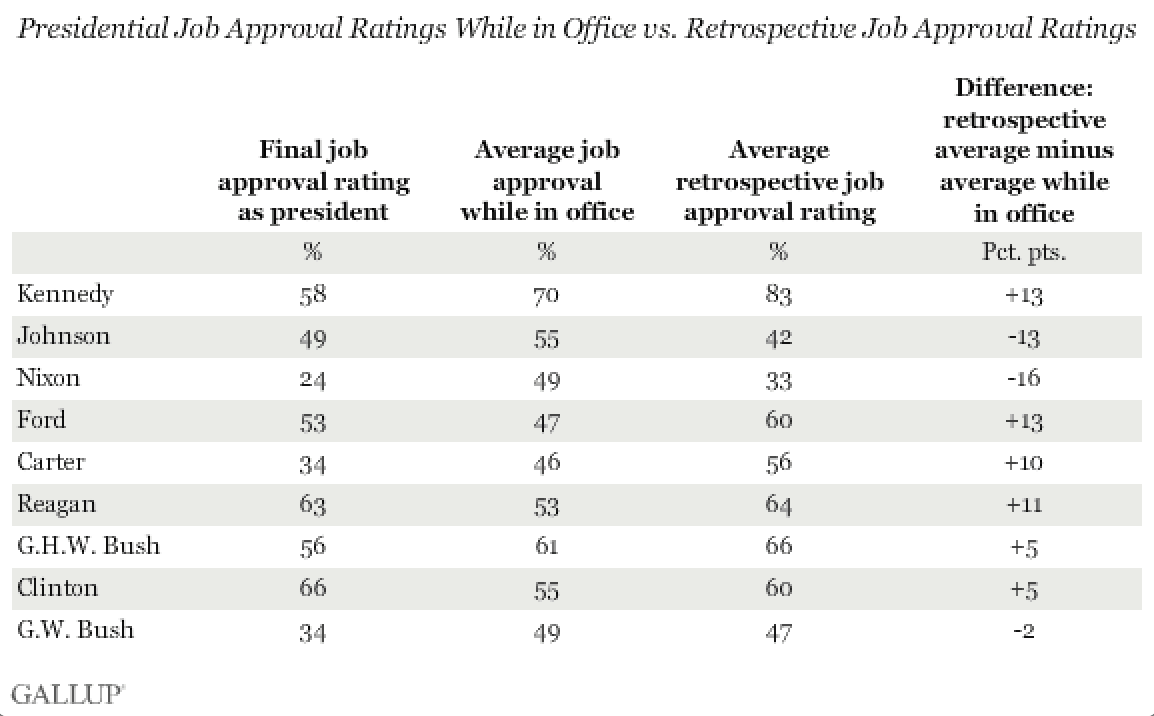
The first thing to remember is that presidential approval ratings almost always rise once they leave office. In 2013, Gallup released polling data on John F. Kennedy, Gerald Ford, Jimmy Carter, Ronald Reagan, George H.W. Bush and Bill Clinton. All saw their approval ratings increase after their presidencies. Despite the fact that millions of Americans still blame George W. Bush for the weak recovery, even he has seen his approval rating tick up in recent years.
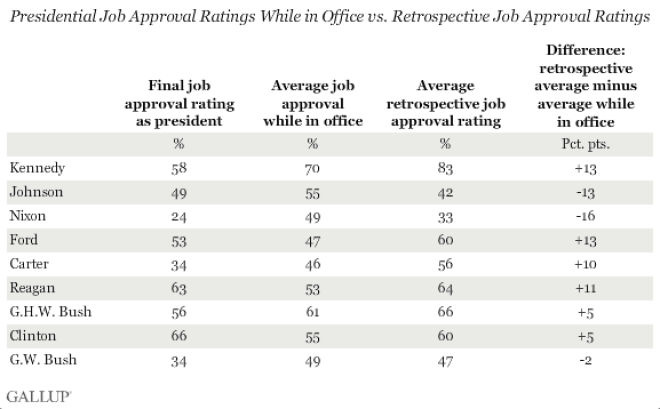
Screen Shot 2014-07-03 at 11.41.03 AM

As the current president, Obama has not yet had the opportunity to capture this post-presidency favorability boost. Five years from now, Americans will almost certainly look back with fonder memories of his time in office.

This might help:

[A] report from the Commonwealth Fund, published Wednesday in the New England Journal of Medicine, credits President Barack Obama’s health reform law with an estimated 20 million enrollments as of May 1.

Rick Warren Wants You To Pay Him To Discriminate Against Gay People

How’s that for chutzpah? I put it that way because it reveals quite a lot about Rick Warren, and his desire to fire gay people from working for him in any capacity – and because it reveals the big difference between what he is demanding – and the usual exemptions allowed for religious groups. It’s not related to the Hobby Lobby ruling as such – but it represents a pretty shameless attempt to exploit the similarities.

Here’s why Rick Warren is, as so often, full of it. In a proposed law like the Employment Non-Discrimination Act, the government forces every employer to abide by the principles of equal opportunity. That’s why it can be appropriate for, say, a church or synagogue, to ask for an exemption from coercion. They’re asking to opt out of a system they are included in as Americans. But in federal contracts, an organization is first choosing to opt in for federal money, and then demanding special privileges of discrimination against another minority.

It is, in effect, asking two things: that it get a bunch of tax-payers’ money (thank you very much) and that it gets to discriminate against a minority in employment (fuck you very much). I see absolutely no reason to allow it. The federal government should represent all its citizens, gays, evangelicals, Mormons, and atheists. When it gives religious organizations money, it has every right to demand it not be used to persecute or stigmatize a minority. If those religious groups really feel it’s an integral part of Christianity to find out who’s gay and fire them (yes, that’s what sadly passes for Christianity these days), they can give up the money.

And there’s a simple matter of basic fairness here. Look at the current conditions set on federal contracts:

The existing federal contractor executive order bars federal contractors who do more than $10,000 worth of federal work in a year from discriminating on the basis of race, color, religion, sex, or national origin.

If the federal government prevents any group – say a secular charitable organization – from discriminating against evangelical Christians, why should it allow discrimination against gay people? Why should one group be protected and another left to the tender mercies of discriminating employers? It seems to me that if the Christian right wants to re-position itself as a minority that deserves federal protection, it should also agree that other minorities qualify. And that includes gay people.

The Arab Spring Is Still A Thing?

A woman with her child participates in a demonstration

Summing up the argument of his latest book, The New Arabs, Juan Cole hums a hopeful tune about the long-term fate of the youth-driven uprisings in the Middle East:

The generation of young Arabs who made the revolutions that led to the unrest and civil wars of the present is in fact distinctive — substantially more urban, literate, media-savvy, and wired than its parents and grandparents.  It’s also somewhat less religiously observant, though still deeply polarized between nationalists and devotees of political Islam. And keep in mind that the median age of the 370 million Arabs on this planet is only 24, about half that of graying Japan or Germany.  While India and Indonesia also have big youth bulges, Arab youth suffer disproportionately from the low rates of investment in their countries and staggeringly high unemployment rates.  They are, that is, primed for action. …

[M]any of the millennial activists who briefly turned the Arab world upside down and provoked so many changes are putting their energies into non-governmental organizations, thousands of which have flowered, barely noticed, in countries that once suffered from one-party rule.  In this way, they are learning valuable organizational skills that — count on it — will one day be applied to politics.  Others continue to coordinate with labor unions to promote the welfare of the working classes.  Their dislike of nepotism, narrow cliques, and ethnic or sectarian rule has already had a lasting impact on the politics of the Arab world.  So don’t for a second think that the Arab Spring is over, no matter the news from Libya, Egypt, Iraq, or elsewhere.

Meanwhile, in an interview, Cole notes that the Bush-era neocons may indeed have helped spread democracy in the Middle East – just in the totally opposite way they intended:

To the casual observer, the Arab Spring seemed to come from nowhere. It was an extemporaneous uprising triggered by a Tunisian street vendor who set himself on fire—the proverbial straw that broke the camel’s back. In talking to many of the activists, Cole came to see that organized protests over the invasion of Iraq and the 2008 Israel-Gaza conflict also played a major role. Just as indispensable were a decade’s worth of labor organizing over economic issues.

“In some ways, it was the invasion of Iraq that often produced the first big street demonstrations that these young people were involved in,” explains Cole. “But then the Gaza War in 2008-9—that surprised me in the sense that it seems to have been a really big rallying point for the Tunisian youth.”

(Photo: Bahrainis protest against the government and call for the release of political prisoners on June 20, 2014. By Hussain Albahrani/Pacific Press/LightRocket via Getty Images)

Why Not Just Provide The Pill Over The Counter? Ctd

A reader writes:

I have no problem with forms of the birth control pill being made an over-the-counter drug. Women are intelligent beings who can figure out how to use these drugs correctly, and the side effects from using birth control pills are less severe than those of other drugs currently sold over-the-counter.

That said, just selling a birth control pill over the counter wouldn’t make up for losing contraceptive coverage from health insurance. An IUD can cost upwards of $1,000 upfront for the exam and insertion. That’s a big chunk of change that many women can’t save up for. It also happens to be one of the most reliable forms of birth control because women don’t have to take a pill at the exact same time every day; once it’s in, you can largely forget about it until you want to take it out.

So pushing birth control as an OTC drug does not eliminate the need for women to have contraceptive methods covered on their health insurance.

Another speaks from personal experience to make the case “why birth control pills should not be sold overthe-counter”:

I took the pill on and off for about ten years when I was in my late teens and 20s. At first, it was prescribed by a general practitioner, and then by an elderly OB/GYN. After I married, I moved to Connecticut and needed to find a new OB. I went with the closest provider listed in my insurance booklet, which turned out to be a Planned Parenthood.

I have a history of migraine with aura.

I don’t get severe migraines as these things go, and I don’t get them frequently. Like 1/3 of migraine sufferers, however, I get weird symptoms that precede the headache – mine are visual and include flashes and zigzags of light, which is typical. According to a quick google search, 5-10% of women of childbearing age have migraine with aura, so this is hardly an exotic diagnosis.

The doctor at Planned Parenthood took the time to review my medical history. She started asking probing questions about having checked the box for “migraines” on my medical history form, which seemed bizarre to me. And then she told me she would not be renewing my prescription for the pill. While the absolute risk is still comparatively low, women who have a history of migraine with aura have a greatly increased risk of stroke if they take the combined pill (meaning the pill with both estrogen and progesterone; the vast majority of women on the pill take the combined pill).

I thought she was crazy until I went home and googled it, and she was absolutely correct. The WHO unequivocally states that women with a history of migraine with aura shouldn’t take the combined pill. Women with a history of migraine with aura can safely take progesterone-only versions of the pill, but those are less effective.

The pill is a drug. Drugs have side effects and risks. These risks are greater for some of us than others. When a drug is sold over the counter, people tend to assume the risks are minimal, and with the pill, this isn’t the case.

Update from a reader, who responds to that last paragraph:

So let’s put it behind the counter and have pharmacists dispense it. Thanks to credential creep, American pharmacists get almost as much training as doctors. Every drugstore has a licensed pharmacist but they have little practical authority to use that training. Their two main jobs are to catch doctor screw-ups and to waste your time waiting for them to check with you that yes, you have been on this medication for ten years.

Why not use the pill as a wedge to introduce the intermediate class of drugs between prescribed and OTC that most Western countries have? It’d eliminate a lot of unnecessary med-maintenance appointments with physicians, increasing capacity and lowering costs.

The Jews Of Shanghai

The Sephardi Chief Rabbi of Israel, Rabb

Julian Gewirtz and James McAuley explore the history of the city’s Jewish community:

As early as 1845, when Shanghai was forcibly opened to foreign trade under the unequal treaties that concluded the Opium Wars, a network of prominent Sephardic Jewish merchant familiesthe Kadoories, the Hardoons, the Ezras, the Nissims, the Abrahams, the Gubbays, and, most prominently, the Sassoonstook root in the city and eventually joined the ranks of its Western occupying elite.

Small but powerful, this Sephardic merchant class financed many of the Beaux Arts mansions along the stately Bund, Shanghai’s version of Vienna’s Ringstrasse. Completed in 1929, Victor Sassoon’s Cathay Hoteltoday the Peace Hotelwas the Bund’s crown jewel, the center of their cosmopolitan social world. In that sense, much of what survives today from prewar, European Shanghai is an artifact of Jewish Shanghai. When Nazi refugees arrived in the mid-’30s, Shanghai’s existing Jewish community became even more visible, swelling in size to nearly 30,000.

It was in this period of traumatic conflictin Europe and in Asiathat Chinese leaders across the ideological spectrum, relying on stereotype but not necessarily on a Western anti-Semitic vocabulary, began to discuss the Jews as a people worthy of special attention.

The association between Jews and prosperity survives in China today:

Whether this association is philo-Semitic in its enthusiasm or anti-Semitic in its reliance on caricature is difficult to say, perhaps because the Chinese popular imagination seems to have imbued a historically negative Western stereotype with a decidedly positive meaning. At the Shanghai Jewish Refugees Museum, which commemorates the city’s hospitality during World War II, an elderly Shanghai native working as a security guard recalled to us that he had known what Jews were as he was growing up because “Jews lived in Shanghai” and “Jews built the Peace Hotel.” He grinned broadly. “We say that a person who is very shrewd is ‘like a Jew.’” A compliment? At least in Shanghai.

(Photo: The Sephardi Chief Rabbi of Israel, Rabbi Shlomo Amar (C) prays with a group of Orthodox Jews on June 12, 2006 during a tour of the historic Ohel Rachel synagogue which was built in 1920 during the period of the first wave of Jewish migration to Shanghai. The Chief Rabbi is in China to meet government leaders in Shanghai and Beijing and toured the synagogue which is only open to the Jewish community during special religious occassions and used to house up to 700 devotee’s in the period 1920 – 1949 when many Jews sought refuge in Shanghai. By Mark Ralston/AFP/Getty Images)

Cooling Off With Compost, Ctd

A reader says the case for no-till farming is more complicated than it seems:

While the evaporation argument made by the Ars Technica article is valid, I don’t see the benefit from the change in albedo – the amount of sunlight reflected from the Earth’s image001surface. During most of the hot and sunny portion of the summer, for example, the crops we grow on our family farm in Missouri will have grown tall (corn) or canopied (soybeans) so that the residue is in shadow. Other crops like winter wheat are planted and harvested on a different cycle, so there might be more benefits from the effect on albedo.

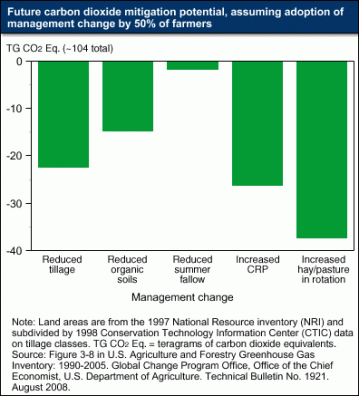
Regarding carbon affects, there are drawbacks to no-till systems. Typically, more herbicide is required to kill weeds, and more nitrogen (which is produced with fossil energy) is required for fertilizer. Farmers argue about the comparative yields, but generally, flat land farmers still use conventional tillage. A recent USDA analysis shows that 35.5 percent of US cropland was planted with no tillage in 2009. No-till use has increased a great deal since it began to be adopted in the 1980s, but even in the US it’s still used on a minority of farms. There’s research under way at the Economic Research Service of the USDA on the potential of various methods to mitigate carbon dioxide additions to the atmosphere. Here‘s an example of their analysis [partly illustrated in the above graph].

Overall, higher temperatures and the greater risks and uncertainty of more extreme weather conditions are driving forecasts for 15- to 20-percent reductions in crop yields over the next 25 to 50 years. The implications of those forecasts are sobering.

The Past Is A Place You Can Visit

Susan Cheever, author of the recently-released e.e.cummings: A Life, reveals a mystery that haunted her while working on the poet’s biography: his father was killed and his mother injured in a 1926 car accident caused by driving over railroad tracks into the path of an oncoming train. How could the pair have missed it hurtling toward them? The incident, never fully explained in previous books about Cummings, made her think about the research methods available to biographers (NYT):

EECummings_pd4Three official types of research are the foundation of writing biography: Primary-source research uses original papers found in libraries, archives or occasionally an attic; secondary-source research uses the work of other writers and researchers; interviews can be with experts, people whose memories are useful or other writers and researchers. There is a fourth kind of research. It doesn’t have a fancy name; it is just going to the places where the story happened. Landscapes often speak, and houses hold ancient scenes and memories and secrets.

She reveals how this fourth research method helped her solve what happened that night in New Hampshire almost nine decades ago:

Once I saw the crossroads, the accident made perfect sense. The tracks were perfectly flush with the road and came toward it at a 45-degree angle from the right — Rebecca Cummings’s blind side in the driver’s seat, especially in the snow. I walked around a bit, noticing which of the trees were second growth and which might have been there in 1926. I could almost hear the screech of brakes from the locomotive and the dreadful sound of metal crushing the wooden frame of the Franklin and shattering the windshield. I could see the brakemen running through the snow and imagine Rebecca’s insistence that her husband’s body be covered. The Chevy engine ticked quietly. An occasional car passed going north. Then the dachshund began to whine. I was back in 2012. I said a small prayer for the soul of Edward Cummings and got in the car for the short drive up to Silver Lake.

(Image: self-portrait of e.e. cummings)

The Best Of The Dish Today

The emails on religious freedom keep pouring in, and I’d like to sleep on them before responding at length again. The arguments are dense and complex and I want some time to think them through some more and not get too defensive in response. So bear with me.

Today, I noted the astonishingly categorical dismissal of a ban on marriage equality by a Bush appointee judge in Kentucky, of all places. We mulled one response to the ACA fights: why not make all contraceptives over-the-counter medications? I argued that, in the context of the culture war, the religious right is actually losing – and not winning – most of its battles. We celebrated rap as poetry. And we said goodbye to pi.

The time-lapse above is of the recent massive pro-democracy protest in Hong Kong. I guess I needed cheering up a bit.

The most popular post of the day was KY Lubricates The Case (apologies for the headline); followed by Perspective, Please.

Many of today’s posts were updated with your emails – read them all here.  You can always leave your unfiltered comments at our Facebook page and @sullydish. 17 more readers became subscribers today. You can join them here – and get access to all the readons and Deep Dish – for a little as $1.99 month. One writes:

So, after 13 months of being unemployed (largely of my own doing … following my heart and all that), I have finally found meaningful employment in the foothills of the Rocky Mountains, working on an environmental-public policy issue that I’d bet most of your readers care about.  After a few years in DC and NYC, I’m now living in the middle of the country, but still feel happily (albeit much more tangentially) connected to the freneticism of our nation’s public life – thanks largely to this blog, you and your readership.

Your daily posts on politics and culture and reading your readers’ sane and informed commentary during this rather destabilizing period in our country has helped me keep my political-moral compass. And your “View From Your Window” has kept me feeling happily in love with the beauty of this country – urban, rustic, autumn, summer, whatever.  VFYW was a small and symbolic, but integral part of what led me to Colorado.

So, one of the first decisions I made after getting the call that I’d been hired (after roughly 120 job applications) was doing my fair share to keep this blog going.  I feel bad that I skimped for as long as I have.  But now that I have a steady income, I’m trying to align my paycheck with my values.  So, you get $20.

See you in the morning.