Do Animals Get Depressed?

3859862007_a130c1f64b_o

In a moving essay about her dog Oliver, who suffered from extreme anxiety and exhibited a number of strange, almost neurotic behaviors, Laurel Braitman considers the question of whether animals, like humans, can suffer from mental illness. One adherent to that view was William Lauder Lindsay, a 19th century Scottish physician and natural historian:

Lindsay is intriguing because, despite working as the medical officer at another British insane asylum, he didn’t limit his studies to crazy humans acting like animals. He also refused to see animals themselves as dumb beasts. Instead Lindsay believed that animals themselves could go insane. He was even convinced that some human lunatics were more mentally degenerate than sane dogs or horses.

In Mind in Disease, a sort of Victorian mental illness field guide, Lindsay posited many forms of animal insanity, from dementia and nymphomania to delusions and melancholia. Lindsay was also convinced that animals exhibited what he called “wounded feelings” of many kinds, and he tells story after story on the subject. There was a mother stork who “let herself” be burned alive rather than desert her young and a Newfoundland dog who was so sad after being scolded, then ceremoniously beaten with a handkerchief, and finally having a door shut in his face when about to leave the room with the nurse and the family children (his usual companions) that he “tried twice to drown himself in a ditch but survived … only to stop eating.” He died soon thereafter.

(Photo by Ink Hong)

Three Ways The GOP Is Like Iraq

Screen Shot 2014-06-25 at 11.18.39 AM

It appears that the sectarianism is deepening:

In essence, tea party activists are the RINOs. A Republican Party campaigning on making the Senate “conservative,” used liberal Democrats to preserve an incumbent Republican and defeat a conservative. The actual conservatives are the outsiders with the GOP establishment doing all it could to preserve its power at the expense of its principles.

The problem for those who call themselves Republicans is that it is harder and harder to say exactly what a Republican is these days. The great lesson from Mississippi is that Republican means, more or less, that if elected the party will reward its major donors, who are just different than the Democrats’ major donors. Policy differences are about different donors, not an actual agenda to shift the country in a different direction. The Republicans have become the party of lobbyists, most of whom were on twitter celebrating their purchase.

And we have arguably the most incendiary sectarian tactic yet – deploying African-American Democratic voters to beat back the Tea Party, with an extra-nuts-making flier making a difference:

pic_cornerIn Jackson’s Hinds County, where two-thirds of the population is black, Cochran won 73 percent of the vote, 7 points higher than his performance in the primary. Turnout was up significantly in heavily African-American counties in the Mississippi Delta, like Quitman, Sharkey, Humphrey, and Coahoma, where Cochran increased his primary-election margins over McDaniel. Over 347,000 voters cast ballots in the runoff, a higher total than in the primary—marking the first time in 30 years that has happened in any Senate race.

“Looking at county data, Cochran’s #MSSEN win is almost entirely attributable to a large turnout increase among black voters b/t 6/3 and 6/24,” tweeted Cook Political Report analyst David Wasserman.

Here’s a little nugget from the NYT that will send every Drudge reader up the wall:

Kino Sintee, 17, and three black friends waved “Thad” signs on a street corner in a black Hattiesburg neighborhood. They said the preacher from Mount Olive Baptist Church asked them to help out. “They’re talking about taking everything away from us,” he said. “People still need stuff.”

And the entire legitimacy of the process is being challenged by an infuriated base:

“As you know today, folks, there were literally dozens of irregularities reported all across this state,” McDaniel said. “You know why. You read the stories. You’re familiar with the problems that we have. Now it’s our job to make sure that the sanctity of the vote is upheld. Before this race ends, we have to be absolutely certain that the Republican primary was won by Republican voters. We will stand with courage, we will stand with judgment, we will stand with integrity. This is our fight conservatives. This is necessary. We are not prone to surrender, we Mississippians. A strong and sturdy people we are, a brave people we are, a people that can still lead the conservative revival in this country. We will lead the resurgence. That begins right here in Mississippi.”

This party is deeply fractured; and this run-off election has taken every factor deepening those fractures and intensified them. And the insurgency rages on …

(Graphic from Nate Cohn)

Jihad 2.0, Ctd

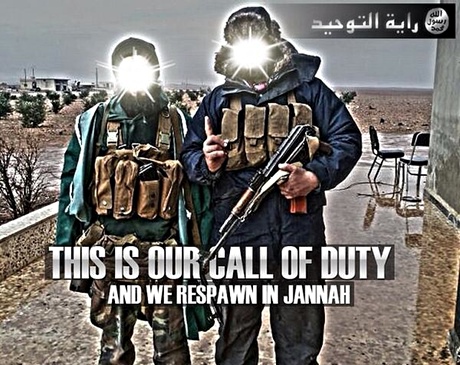
An Isis propaganda photograph.

Patrick Kingsley looks into the success of ISIS’s online propaganda:

Thousands of their Twitter followers installed an app – called the Dawn of Glad Tidings – that allows Isis to use their accounts to send out centrally written updates. Released simultaneously, the messages swamp social media, giving Isis a far larger online reach than their own accounts would otherwise allow. The Dawn app pumps out news of Isis advances, gory images, or frightening videos like Swords IV – creating the impression of a rampant and unstoppable force.

And it works, Iraqis say.

When Isis stormed Mosul, Iraqi soldiers fled their posts, apparently aware that they would face a gruesome fate if they were captured while on duty. “The video was a message to Isis’s enemies,” says Abu Bakr al-Janabi, an Isis supporter in Iraq who claims to have knowledge of the group’s media operations. “It’s Isis saying to them: look what will happen to you if you cross our path. And it actually worked: a lot of soldiers deserted once they saw the black banners of Isis.”

Canadian-born ISIS fighter “Abu Usamah” describes how the group puts skilled recruits from the West to work, including in its media department:

[W]hen prospective members do arrive on the Syrian front, he says ISIS places them into skill-specific trades supporting their overall war machine. In other words, there are fighters, there are thinkers, and there are even propagandists for the outfit now carving out a new state in northern Iraq and Syria.

For example, I asked him about the super-stylized ISIS videos of battle highlights, which are both horrifying in content and impressive in production value. It’s a far cry from the grainy videos Osama Bin Laden issued during the invasion of Afghanistan in 2001. “We have a large media department and Doula [ISIS] doesn’t allow people with skills to enter the front lines,” Abu Usamah said. “If you’re an engineer, doctor, or in the case of a graphic designer, etc you are placed in a position suited to your skill set. Many underestimate the strength and organization of this state, many just think of us as bloodthirsty barbarians which is FAR from the truth.”

Meanwhile, enterprising retailers in Indonesia and Turkey are rolling out ISIS swag:

(Top image: ISIS propaganda)

Putin’s Kangaroo Council

The latest machination:

[Yesterday] the Russian president made a request to the Federation Council, the upper United Russia Party Congress Conveneshouse of parliament, that they revoke his right to stage a military intervention in Ukraine. [Today] they will undoubtedly approve his request, just as they approved his request for that questionable authority several months ago. Although Ukraine’s president welcomes Putin’s move as a “first practical step,” skepticism remains with good reason. After all, Russia last week began to regroup thousands of troops near the Ukrainian border, less than a month after promising to remove troops. And, the separatists, some of whom claim to be Chechen mercenaries on official orders, have an uncanny ability to get their hands on tanks, rocket launchers, and other military equipment, and earlier [yesterday] they broke a ceasefire they agreed to several days ago.

Anna Nemtsova tries to get in Putin’s head:

Why would Putin want his hands tied (however loosely)? One likely reason: He made the request a few days before European leaders are to discuss new sanctions against Russia, this time covering the banking sector. Another possibility: He can get the reversal reversed any time he wants, and may be trying, once again, to wrong-foot the West by talking conciliation while stepping up covert action to support the rebels in eastern Ukraine.

Bershidsky also makes clear why Putin’s gesture is bullshit:

Given his rubber-stamp parliament, Putin can gain permission to send troops back to Ukraine at any time. Besides, if Putin’s goal is to keep Poroshenko off balance, an invasion isn’t necessary. Russia has already succeeded in drawing out the conflict, arming rebels and making it possible for Russian citizens to fight on the separatists’ side. So much for “deceit.”

As for “bargaining,” it has now started in Donetsk, with Ukrainians from both camps searching for compromise. [Viktor] Medvedchuk’s ties to both Putin and Poroshenko — along with the possible backing of one of Ukraine’s richest men, Rinat Akhmetov — suggests a resolution with the armed rebels is in sight. The rebels have been useful to Putin, but they are unreliable over the long term. The Kremlin prefers to work with familiar pro-Russian politicians and businessmen in Ukraine’s east to make sure Ukraine doesn’t end up in the Western bloc.

In effect, Putin is now ready to enter the quiet phase of his Ukraine operation. The West will acquiesce to his game — but only after claiming that sanctions have been a success.

Keating’s take:

With more international sanctions potentially on the way, Putin lately seems to be playing the unlikely role of good cop in this conflict, voicing support for reconciliation and peace while the pro-Russian rebels keep fighting with what certainly seems like tacit support from Moscow, and his foreign minister and the national gas monopoly keep up the pressure on Kiev. Some of the rebel groups may also have gone rogue – some members of the recently formed militia group Russian Orthodox Army recently expressing irritation with Putin’s on-again-off-again support.

In any event, the good news is that the worst-case scenario – full Russian invasion – now looks extremely unlikely. But the volatile mess in Eastern Ukraine still looks a long way from resolution.

(Photo from Getty)

Reality Check, Ctd

Screen Shot 2014-06-24 at 2.56.59 PM

Yesterday I posited that Obama’s sudden downward turbulence in the polls was almost certainly about Iraq. Sure was:

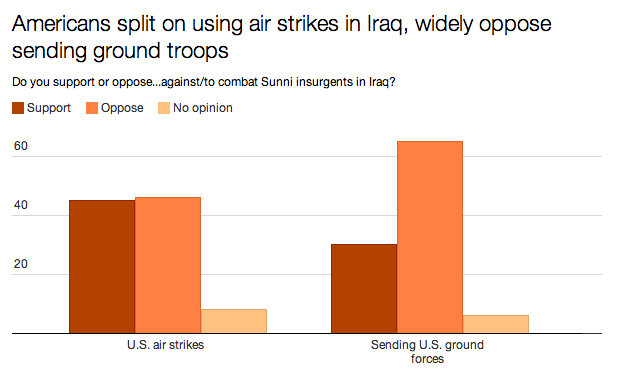
President Obama receives his worst marks yet for handling the situation in Iraq, with 52 percent disapproving and strong negative sentiment now outpacing strong approval by 2 to 1 (34 to 17 percent) in a new Washington Post-ABC News poll. Asked whether the U.S. should launch air strikes against Sunni insurgents, 45 percent support and 46 percent oppose that idea. Fifty-eight percent of Republicans support air strikes, compared with 44 percent among Democrats and 41 percent of independents. The gap between men and women is just as large and extends across party lines. Men support air strikes by a 54 to 40 percent margin, while women oppose them by 52 to 38 percent.

Nearly two-thirds of the public, however, opposes sending U.S. ground forces to combat insurgents, including at least six in 10 Democrats, Republicans and independents. No demographic or political group in the poll expresses majority support for deploying ground troops, while opposition surges to above 70 percent among those over age 50 and post-graduates.

Flagging yet another new poll, Aaron Blake remarks on the partisan gap:

A new CBS News/New York Times poll on Iraq suggests that the American people are quite uncertain about what should be done amid the rise of the al-Qaeda-inspired group ISIS. Perhaps most notably, though, there is little urgency among Democrats or independents to get involved, suggesting that any push for further involvement will be spurred in large part — yet again — by the political right.

The poll shows majorities of Democrats (51 percent) and independents (55 percent) believe that the United States does not have the responsibility to do something in Iraq, while 52 percent of Republicans say it does. Similarly, majorities of both Democrats (60 percent) and independents (56 percent) say the violence in Iraq doesn’t raise the threat of terrorism against the United States. Six in 10 Republicans say it does increase the threat.

Waldman ponders why Obama’s approval numbers keep sinking when he and the public agree on pretty much everything:

While you can quibble about the wording of a question here or there, the overall picture is one of a public that would like to help, so long as it doesn’t involve much direct risk to our personnel, but still doesn’t think what we do is going to make much of a difference. That certainly sounds like a description of where the President himself is at the moment.

So why doesn’t he get more credit for being on their side? We can stipulate that there is literally nothing Obama could do that would satisfy most Republicans; when he says he intends to do exactly what they want, they simply change what they want, since agreeing with him on anything is psychologically intolerable for so many of them. But what upsets most Americans, I suspect, is that we’re being forced to think about Iraq at all. To the American public, the place is a black hole, sucking all our good intentions and sacrifice and money and attention into its miasma of chaos. They hear that there’s an army of Sunni extremists rampaging through the country, then see that Muqtada al-Sadr’s Shiite followers are mobilizing in response (remember when they were the bad guys?), and they can’t figure out how anything we could do would possibly stop this nightmare.

Which is where I am – except I’ve come to a more non-interventionist position overall since 2003. Drum’s take:

In other words, Iraq is like the economy: it doesn’t really matter what the president is doing. If the economy is good, the public approves of his performance. It it’s bad, they disapprove.

But Larison isn’t letting Obama off the hook:

As I’ve said before, Obama sets himself up to fail by trying to take the “lead” in crises and conflicts that the U.S. doesn’t know the first thing about resolving. The mismatch between rhetoric and action has been a persistent problem for this administration. For instance, Obama has made unnecessary declarations about the legitimacy of other leaders and governments (e.g., “Assad must go”) that would seem to require much more aggressive policies than he or the public would be prepared to support. As a result, his policy is judged against the much higher standard that he unwisely set for the administration. Pursuing more ambitious hawkish goals with limited means puts Obama in a bad position at home as well, since it invites attacks from hawks that always want the U.S. to “do more” without giving anyone else something that they can fully support.

I agree. But in his actions, Obama has been more eloquent. Maybe it’s impossible for a US president to resist giving the impression that he is somehow able to do anything about vast, complicated upheavals thousands of miles away, but at some point we need one who will say so more definitively.

Not A Single, Solitary Good Reason

Last summer, we highlighted the hunger strike of 30,000 prisoners against California’s draconian solitary confinement system. Now, Jessica Pishko suggests the practice may be on its way out:

Earlier this month, a federal judge in Oakland held that five inmates currently locked up in California’s Pelican Bay State Prison are permitted to move forward with their class action, Ashker v. Brown, on behalf of over 500 other inmates, all of whom have been held in Segregated Housing Units (SHU), the administrative term for solitary confinement, for over a decade. Some of those inmates have been in solitary for over 20 years now, and many are there on the basis of alleged gang affiliation only. …

This lawsuit may definitively determine the future of solitary confinement and force the CDCR to phase it out completely. This is no small task. California holds more people in solitary than any other state. Famously foreboding because of its remoteness, Pelican Bay has over 1,000 inmates in SHU alone, and two other prisons – Corcoran State Prison and CCI Calipatria – hold over 2,000 more inmates in SHU confinement.

For more on the subject, check out our Ask Anything series with Shane Bauer, who responded to several of your questions about solitary confinement based on his research and first-hand suffering.

Rehabilitated To Death

Lily Kuo takes note of the death of a teenage girl at a Chinese “Internet addiction” rehab facility:

Her death is the latest example of military-style boot camps – intended to cure China’s supposed millions of internet addicts – gone horribly wrong. Ever since China classified internet addiction as a mental disorder in 2008, parents have been sending their children to camps that promise to cure them through military-style training and discipline. Estimates for the number of these internet-addiction camps, some of which employ former Chinese military personnel, range from 65 to 300. …

A report in the Chinese newspaper Legal Evening News says there have been at least 12 cases of physical abuse at such centers over the last few years, with seven of them ending in deaths. That includes a teenage boy that was beaten to death at an internet addiction camp in 2009. That same year, China’s Ministry of Health had to order a hospital in Shandong province to stop using electric shock on internet-addicted youths, after it used the so-called treatment on some 3,000 patients.

Previous Dish on Internet addiction in China here and here.

When Dylan Found His Way Home

It turns out there’s more to Bob Dylan than protest songs and plugging-in. Robert Dean Lurie tells the story of how, “after leading the revolution for a time, [he] recused himself from the movement and became something of a traditionalist—albeit an idiosyncratic one”:

On a personal level this involved getting married, moving to the country, and having a lot of kids. For a time he gave up smoking, drinking, and the various other substances that had fueled his manic outpourings over the previous years and had almost led to his demise. Journalists and commentators at the time attributed this transformation to his convalescence following an alleged motorcycle accident in July 1966. Whether or not the accident actually happened (and there are no hospital records to corroborate it), the young songwriter used the story as a pretext to pull himself off the fast track.

Inevitably, with the downtime came introspection. “When I [moved to] Woodstock,” Dylan wrote years later in his memoir, Chronicles, Volume One, “it became very clear to me that the whole counterculture was one big scarecrow wearing dead leaves. It had no purpose in my life.” This revelation brought with it some pretty serious implications for Dylan’s songwriting. If the “spokesman of his generation” repudiated said generation, would he have anything left to write about?

The answer turned out to be a decisive “yes”: He wrote enough to fill the albums “John Wesley Harding,” “Nashville Skyline,” “New Morning,” and “Planet Waves”—what would be a career’s worth for anyone else. Writing from a position of stability for the first time in his life, Dylan imbued his new material with warmth and melody.

(Video: Bob Dylan sings “I Threw It All Away,” from the album Nashville Skyline, on the Johnny Cash show in 1969)

The Rarest Of Them All, Ctd

2394372803_60555088f2_z

A reader objects to Rex Sorgatz’s argument that the Digital Age has made rarity obsolete:

I understand Sorgatz’s point that rarity can be defined as “scarcity,” and that with millions of people being able to experience something that is described as rare, that scarcity is eliminated. But this is a very narrow view of rarity. “Rare” can also refer to something that is unique. Sure, the Biggest Ball of Twine in Minnesota (hat tip to Weird Al!) has had thousands upon thousands of visitors, which to Sorgatz would mean that it isn’t rare. But that’s one unique ball of twine!

Another reader:

It is an oversimplification to imply, as I think Sorgatz does, that digital content by its very nature cannot be scarce. Nothing on YouTube could be considered rare once it’s on YouTube by the very fact that it is now something that is widely accessible. A video that only a handful of people have on their local hard drive is still rare while being digital.

As a fan (and recovering completist) of alternate takes and unreleased songs and live performances, I wish it were the case that anything that’s been made digital is no longer rare.

Another agrees:

It appears Sorgatz is conflating “rarity” with “popularity.” If there is only one video in existence of Slash playing “Sweet Child” acoustically, then it’s rare even if every person on the planet has seen it.

(Photo of the biggest ball of twine in Minnesota by Mykl Roventine)