The Ever-Expanding ISIS

Adam Chandler tracks their gains this weekend:

As the Associated Press reports, by wresting control of Rutba, ISIS now runs a strip of a major highway, “a key artery for passengers and goods” heading to and from neighboring Jordan. The capture of al-Qaim, as we noted earlier, has already given ISIS control of a vital border crossing post between Iraq and Syria. ISIS also took the towns of Rawah and Anah, which some fear will lead to the capture of Haditha, home to an important dam that, if destroyed, could cause massive flooding and damage the country’s electrical grid.

Juan Cole sees the fall of Qaim as a potentially explosive development:

The first thing that occurred to me on the fall of Qa’im is that Iran no longer has its land bridge to Lebanon. I suppose it could get much of the way there through Kurdish territory, but ISIS could ambush the convoys when they came into Arab Syria. Since Iran has expended a good deal of treasure and blood to keep Bashar al-Assad in power so as to maintain that land bridge, it surely will not easily accept being blocked by ISIS. Without Iranian shipments of rockets and other munitions, Lebanon’s Hizbullah would rapidly decline in importance, and south Lebanon would be open again to potential Israeli occupation. I’d say, we can expect a Shiite counter-strike to maintain the truck routes to Damascus.

Mona Mahmood relays an account of life in Mosul under ISIS rule:

People are scared an air strike might be launched by Maliki’s forces against Mosul at any moment.

Most of the people who have enough money are heading towards Kurdistan. The situation is secure and calm inside Mosul. The rebels – some of them are masked, others are not – are guarding all the official buildings, including hospitals and banks. You can see the flag of the Islamic State in Iraq and the Levant (Isis) flying on most of the buildings in Mosul. There is no Iraqi flag at all.

Ba’athists are in charge now of running the city facilities and official institutions like hospitals, directorates and banks. The new mayor, Hafidh al-Jamas, a former military commander in the time of Saddam Hussein, was installed by the Ba’athists and he is doing his best to make life easy for the people in Mosul by providing fuel, food and by keeping prices low as much as possible. A commander was also installed for Mosul who was a former navy commander in the time of Saddam. His name is Khalid al-Jabin. He was in Syria for many years.

People in the city are circulating rumours that we should be careful of smoking in public, wearing jeans or letting women get out without a veil. But the reality is totally different. You can do and wear whatever you want, the rebels are busy now with their liberation of Iraq, and they do not care what people are doing or wearing.

Another dispatch from the occupied city finds the people happy to have Baghdad off their backs, but leery of what their Jihadist rulers have in store for them:

Mosul’s people still seem reluctant to live as they normally do. Everyone is cautious. A group of people I know arranged to meet in the same café they normally do; it was the first time they had all met up since the city was taken over by the extremists. Although everyone likes football, nobody was talking about the World Cup in Brazil. It was clear that everyone had the same thing on their minds: The city, its unpredictable future and how they would find safe places for their families. They all know things cannot remain the same in Mosul after what has happened here and their conversation was carried on in whispers.

“Let’s smoke a shisha [water pipe] because this may be the last time we can,” one of the friends said. He had heard that ISIS would ban shisha smoking and cigarettes as well as many other things.

Reading similar reports, Max Fisher sees a popular support base forming around ISIS:

Mosul residents told the Financial Times that ISIS sacked alcohol shops and tore down a church that was under construction, but that otherwise personal freedoms have been unchanged. Their one complaint was the lack of electricity, which they blamed on the central Iraqi government, and said they were cheering on ISIS to seize a nearby refinery to fix the issue.

The trick that ISIS has pulled off here is seizing Mosul but not ruling it directly. The group appears to have handed authority for the large city over to local, tribal, Sunni armed groups. Those groups share ISIS’s hatred of the Iraqi national government, so they’re happy to help oust the Iraqi army, but unlike ISIS they are not as fixated on imposing extremist Islamism. “There is no ISIS in Mosul,” a 58-year-old Mosul resident told the Financial Times. “The ones controlling city are now the clans. The power is with the tribes.”

Meanwhile, in Baghdad, support for Maliki weakens:

Mr Maliki seems to want to fight Isis without help from the Sunnis, tarring all of them with the same brush of complicity. That there has been some complicity is clear. Some rump Ba’athists and some tribal leaders joined Isis, or at least stepped aside. Sunnis have been provoked but they also have a lot of explaining to do. But this is still a deeply counter-productive approach. The Iraqi prime minister should be seeking to get more Sunni Arabs and Kurds on the government side on the battlefield.

Yet the frigid line up earlier this week when Shia and Sunni political leaders gathered to make a joint call for Iraqi unity told another story. After the photocall, the prime minister and the Sunnis drifted off without a word to each other.

To make matters worse for Maliki, Ayatollah Ali al-Sistani, the country’s leading Shia authority, is calling for a new government:

Although he avoided directly criticising the Iraqi prime minister, Sistani’s call is far short of the resounding support Maliki needs to overcome rising unease at home over his leadership as well as rapidly shrinking international support.

Sistani also renewed a demand he made last week for his followers, who comprise the majority of Iraq’s dominant Shia sect, to fight the jihadist group Isis and its insurgency that continues to ravage north and central Iraq. “They must be fought and expelled from Iraq, [or] everyone will regret it tomorrow, when regret has no meaning,” Sistani’s spokesman announced during Friday prayers in Najaf.

With ISIS bearing down on Baghdad, Martin Chulov observes the rearming of the city and the re-emergence of the notorious Mahdi army:

Up to 20,000 men, many of whom quit jobs last week to join the militia, responded to the call to arms from al-Sadr and [Sistani]. … On Baghdad’s streets, battered pickups shuttled weapons from depots to mosques where the rapid rearming has transformed the already militarised capital into a war zone in waiting. With the mobilisation complete, the now battle-ready militia presented itself to Iraqis once more on Saturday, staging a series of parades in Baghdad and the south that made an emphatic statement of its readiness and intentions.

One of the most feared names in Iraq was back in business, even if it was fighting under a different banner. This time around, the Mahdi army will be called the Peace Brigades, after its leader, Moqtada al-Sadr, decided that a rebranding might shake it free from its infamous past.

But military marches are hardly peace offerings. And the rally through the Sadrist heartland of Sadr City was no different. Columns of fighters carrying rifles, trucks laden with rockets and men in white wearing mock suicide vests were on the move through the former slum-turned-battlefield soon after sunrise in a futile attempt to beat the blazing midsummer heat.

How To Read A Death Sentence

D.G. Myers, who has entered the last stages of prostate cancer, reflects:

Cancer may be a death sentence, but there are many ways to read the sen­tence. Resignation is only one of them, and a particularly arrogant one at that, because it pre­sumes to know, as it cannot, the outcome in every detail. But if you are ignorant of the suffering that awaits you when you are first diag­nosed, you are equally ignorant of the changes that cancer will work in your thinking and emotional life, some of which may even be improve­ments in old habits of thought and feeling.

You may, for instance, become more conscious of time. What once might have seemed like wastes of time—a solitaire game, a television show you would never have admitted to watching, the idle poking around for useless information—may become unex­pected sources of joy, the low-key celebrations of being alive. The difference is that when you are conscious of choosing how to spend your time, and when you discover that you enjoy your choices, they take on a meaning they could never have had before. You no longer waste or mark time. You fill it, because now you can see the brim from where you are lying.

“In a sense,” Flannery O’Connor wrote to a friend about the lupus that would kill her at thirty-nine,

sickness is a place, more instructive than a long trip to Europe, and it’s always a place where there’s no company, where nobody can follow. Sickness before death is a very appropriate thing and I think those who don’t have it miss one of God’s mercies.

Previous Dish on Myers’ thoughts on death here.

Shakespeare, Philosopher?

dish_shakespeare

Nonsense, argues Simon Critchley in an interview about his recent book, The Hamlet Doctrine:

Q: To what extent was Shakespeare a philosopher?

Critchley: He wasn’t, I think in just about every important sense. If a philosopher is someone who is trying, through the use of reason, to find a kind of intelligibility which grounds our experience of that which there is, that very general sense of philosophy as a project that is trying to uncover the true nature of reality, a metaphysical project, then Shakespeare isn’t a philosopher. Shakespeare is someone who leaves us in the dark as to what that reality might be. What we get instead is an experience of ambiguity and opacity. We look at these plays and we are left – not confused – but having been presented with a conflict between different positions where we are not told what to think.

Whereas with philosophy, we’re generally told what to think. Any commentators too, they tell you what to think, the dead philosophers as well. Drama or theatre – in many ways this is the virtue of theatre – doesn’t do that. It presents us with a situation, which is complex. Reason is on display, arguments are happening back and forth, but it’s not clear what you should think at the end of the play – I think at the end of any of Shakespeare’s plays. And that’s what audiences find intolerable about Shakespeare, about theatre in general, that’s why they won’t comment on it. They want to be told what it means.

(Hat tip: Robin Varghese. Photo of statue of Shakespeare at the center of Leicester Square Gardens, London, by Elliott Brown)

Working On Salvation

Jimmy Carter Helps Habitat For Humanity Build 1000th Home In New Orleans

Reviewing Randall Balmer’s new faith-focused biography of our 39th president, Redeemer: The Life of Jimmy Carter, John G. Turner places Carter’s work ethic at the center of his distinctive approach to life and politics:

Balmer ends his book with the “impression that Carter was driven—almost obsessed—by a kind of works righteousness.” He observes quite rightly that too many Christians seek “to prove by their good works that they are among the elect.” From his days on his family farm to his years in the Navy to his many years on the campaign trail, Carter was an incessant worker.

Most of the time, his hard work paid off, but Carter’s work ethic could not solve the Iranian hostage crisis, his nation’s economic malaise, or the electoral threat of Ronald Reagan. Balmer observes, however, that after his defeat to Reagan “Carter reaffirmed his commitment to works righteousness as a way to redeem his loss,” and his ceaseless activism and philanthropy bolstered his reputation in the United States and abroad. … He went door to door trying to “share Christ” with strangers. He devoted one week each year to Habitat for Humanity projects. Through the Carter Center, he attempted to eradicate disease, poverty, and dictatorship around the world.

Although he could not redeem his nation from the sins he believed had imprisoned it, Carter was always an ambassador for his Savior in a way that made nearly everyone around him uncomfortable, whether his unmarried staff members when he encouraged them to stop “living in sin” and get married, feminists who bristled at his staunch personal opposition to abortion, or politically conservative evangelicals who just could not believe that a follower of Jesus Christ would affiliate with donkeys instead of elephants. As Balmer laments, by the time of his presidency, Carter was already a rare breed.

Jonathan Yardley, also reviewing Balmer’s book, finds Carter’s approach to religion and politics a cautionary tale:

Religion is a tricky business, never more so than when it gets mixed up with government. Although Balmer pays due respect to the argument that “religion functions best from the margins of society and not in the councils of power,” that “once a religious group panders after political influence, it loses its prophetic voice,” he does not convince me that Carter, either as governor of Georgia in the early 1970s or as president in the second half of that decade, really “understood that the Christian faith had flourished in the United States precisely because the government had stayed out of the religion business.”

To the contrary, Carter brought religion (religiosity, too) into the national government more directly and intensely than any president before him in the 20th century. He campaigned as a religious man, speaking repeatedly, openly and almost boastfully about his religious convictions, about the centrality of prayer to his daily life, about the joy he took in being “born again.” Balmer sees this as a redemptive response to the cynicism and venality of the Nixon years, and unquestionably there is some truth to that. But Carter made religion a campaign weapon as well as a private belief, which was not appreciably less calculating than Nixon’s disregard for the Constitution and the common decencies.

(Photo: Former U.S. President Jimmy Carter works on the 1,000th home to be built by Habitat for Humanity on the Gulf Coast May 21, 2007 in Violet, Louisiana. Photo by Chris Graythen/Getty Images)

A Poem For Sunday

14095556628_3b311a150e_b

Dish poetry editor Alice Quinn writes:

Today we post a poem chosen in light of the chapter “Capturing Animals” from Poetry in the Making: An Anthology of Poems and Programmes from ‘Listening and Writing,’ a series we introduced yesterday that was designed by the poet Ted Hughes for the BBC in the 1960s and addressed primarily to children and teachers.

Early on in the book, he struck the note of his approach, “Imagine what you are writing about. See it and live it . . . . Just look at it, touch it, smell it, listen to it, turn yourself into it. When you do this, the words look after themselves, like magic. . . . The minute you flinch, and take your mind off this thing, and begin to look at the words and worry about them . . . then your worry goes into them and they set about killing each other. So you keep going as long as you can, then look back and see what you have written.”

The nineteenth-century English poet John Clare, whose poem appears below, wrote with exceptional ease, naturalness, and intimacy about the creatures of our world.

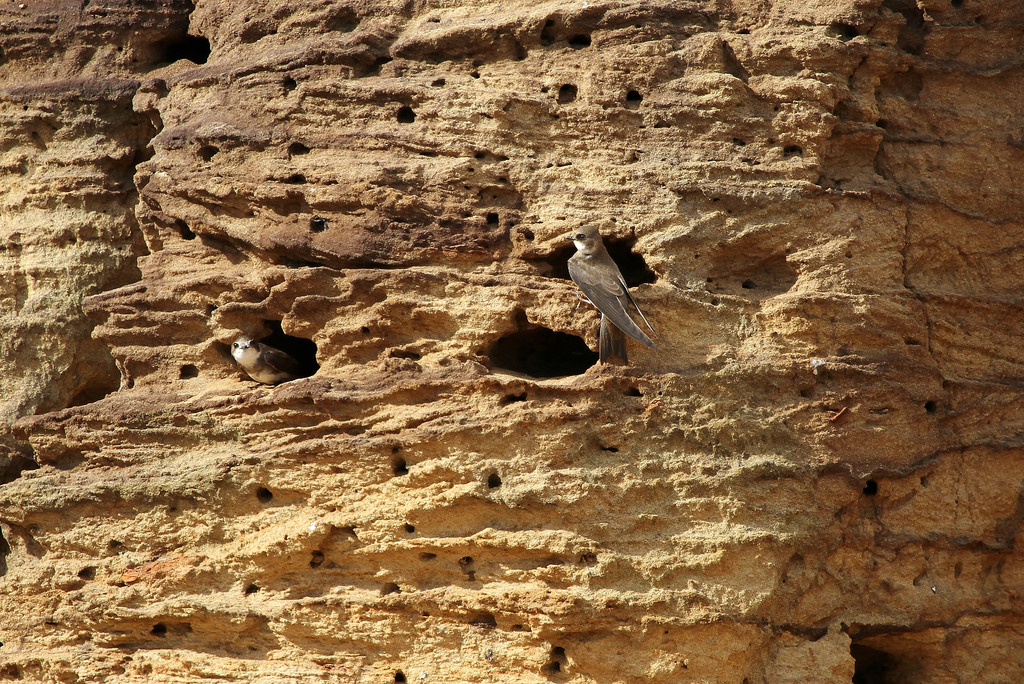
The Sand Martin by John Clare (1795-1864):

Thou hermit haunter of the lonely glen
And common wild and heath—the desolate face
Of rude waste landscapes far away from men
Where frequent quarries give thee dwelling place,
With strangest taste and labour undeterred
Drilling small holes along the quarry’s side,
More like the haunts of vermin than a bird
And seldom by the nesting boy descried—
I’ve seen thee far away from all thy tribe
Flirting about the unfrequented sky
And felt a feeling that I can’t describe
Of lone seclusion and a hermit joy
To see thee circle round nor go beyond
That lone heath and its melancholy pond.

(Photo of two sand martins by Jo Garbutt)

Hitler Before Hitler

Who embodied evil before the Nazi dictator? Tyler Cowen highlights an answer from Tim O’Neill:

People were generally very familiar with the Bible pre-1900, so the figures usually cited as the Head_of_Rameses_II.,_the_Pharaoh_who_persecuted_the_Israelites._(1884)_-_TIMEAepitome of evil tended to be Judas Iscariot, Herod the Great or, most commonly, the Pharaoh of the story of Moses in Exodus. In Common Sense, Thomas Paine wrote: “No man was a warmer wisher for reconciliation than myself, before the fatal nineteenth of April, 1775 [the date of the Lexington massacre], but the moment the event of that day was made known, I rejected the hardened, sullen Pharaoh of England forever.”  The Confederates referred to Abraham Lincoln as “the northern Pharaoh” and abolitionists in turn called slaveowners “modern Pharaohs”.  Americans also referred to all tyrants by comparing them to King George III and Napoleon was often cited as the ultimate bogeyman in Britain.  But generally it was Pharaoh who was used the way we use Hitler.

Quote For The Day II

“There is no man … however wise, who has not at some period of his youth said things, or lived in a way the consciousness of which is so unpleasant to him in later life that he would gladly, if he could, expunge it from his memory. And yet he ought not entirely to regret it, because he cannot be certain that he has indeed become a wise man—so far as it is possible for any of us to be wise—unless he has passed through all the fatuous or unwholesome incarnations by which that ultimate stage must be preceded. I know that there are young fellows, the sons and grandsons of famous men, whose masters have instilled into them nobility of mind and moral refinement in their schooldays. They have, perhaps, when they look back upon their past lives, nothing to retract; they can, if they choose, publish a signed account of everything they have ever said or done; but they are poor creatures, feeble descendants of doctrinaires, and their wisdom is negative and sterile.

We are not provided with wisdom, we must discover it for ourselves, after a journey through the wilderness which no one else can take for us, an effort which no one can spare us, for our wisdom is the point of view from which we come at last to regard the world. The lives that you admire, the attitudes that seem noble to you are not the result of training at home, by a father, or by masters at school, they have sprung from beginnings of a very different order, by reaction from the influence of everything evil or commonplace that prevailed round about them. They represent a struggle and a victory,” – Marcel Proust, Within a Budding Grove.

(Hat tip: John Benjamin)

No God, No Problem?

Peter Watson rejects the view that “there is something missing in our lives” when we try to live without religion. He turns to his own recent book, The Age of Atheists, for examples of those who didn’t get down about the death of God:

I surveyed a raft of playwrights, poets, philosophers, psychologists and novelists who have been active since Nietzsche made his fateful pronouncement, many of whom did and do not share this view that there is something missing in modern life. Some did – Ibsen, Strindberg, Henry James and Carl Gustav Jung would all be cases in point. But far more did not see any reason to mourn the passing of God – George Santayana, Stéphane Mallarmé, Wallace Stevens, Stefan George, Sigmund Freud of course, and, not least, the Impressionist and Post-Impressionist painters. Alfred Sisley and Gustave Caillebotte, Degas, Pissarro and Renoir were each very different in artistic style but they did have something in common. As the art critic Robert Hughes writes in The Shock of the New, “It was a feeling that the life of the city and the village, the cafés and the bois, the salons and the bedrooms, the boulevards, the seaside and the banks of the Seine, could become a vision of Eden – a world or ripeness and bloom, projecting an untroubled sense of wholeness.”

Rabbi Jonathan Sacks, reviewing Terry Eagleton’s Culture and the Death of God, tells a less happy story:

We are meaning-seeking animals. And if we can no longer believe in God we will find other things to worship.

Eagleton’s book is a brisk, intelligent, and provocative tour of Western intellectual history since the Enlightenment, understood as a series of chapters in the search for a God-substitute. The Enlightenment found it in reason, the Idealists in the human spirit, the Romantics in nature and culture, the Marxists in revolution, and Nietzsche in the Übermensch. Others chose the nation, the state, art, the sublime, humanity, society, science, the life force, and personal relationships. None of these had entirely happy outcomes, and none was self-sustaining. …

The result is that we are witnesses to the advent of the first genuinely atheist culture in history. The apparent secularism of the 18th to 20th centuries was nothing of the kind. God—absent, hiding, yet underwriting the search for meaning—was in the background all along. In postmodernism, that sense of an absence, or what Eagleton calls “nostalgia for the numinous,” is no longer there. Not only is there no redemption, there is nothing to be redeemed. We are left, Eagleton writes, with “Man the Eternal Consumer.”

Recent Dish on these questions here and here.

A Slip-N-Slide With Siddhartha

dish_suoitiencrocs

It’s not all fun and games at Suoi Tien Cultural Theme Park in Ho Chi Minh City, “the world’s first Buddhist waterslide park”:

You would think that a theme park attraction called the Palace of Unicorns would be a charming fantasy world. You’d be wrong. Located within Suoi Tien Cultural Theme Park in Ho Chi Minh City, the Palace of Unicorns is a graphic depiction of Buddhist hell. But the sight of torture and violence being inflicted on drug addicts, gamblers, and adulterers is just one small part of Suoi Tien’s diverse and colorful offerings.

Located next to a garbage dump, the amusement park, which opened in 1995, is full of huge sculpted dragons, tortoises, phoenixes, and Buddhas. Employees dressed as golden monkeys scamper around the grounds, tasked with creating mischief.

Suoi Tien is specifically devoted to the Southeast Asian animistic form of Buddhism, so “instead of Mickey and Daffy, Suoi Tien has chosen the Dragon, Unicorn, Tortoise, and Phoenix as its sacred animals.” As for what you’re seeing above?

Perhaps the strangest and most unnerving feature of the enormous park is the crocodile kingdom. A pond with over 1,500 live crocodiles, visitors are invited to feed them with raw meat attached to fishing poles.

The whole thing is quite impressive and constructed on a huge scale. Although, the lax safety controls -acres of wet, slippery concrete, low hanging stalactites in the cavern water slides, and the bay of crocodiles- remind you that you are not in Disneyland anymore.

(Photo by Mike Fernwood)