Suddenly Jewish

In an essay exploring notions of belonging, James Meek recalls how, shortly before her death, his grandmother revealed to the family the long-held “confession, or acknowledgment, that besides being Hungarian, she was Jewish.” Meek reflects on discovering an overlooked heritage later in life:

What I knew of Jews was gleaned – not that I was trying to glean – from news about Israel, from books and films about the Holocaust, from a TV play by Jack Rosenthal set in London called Bar Mitzvah Boy, and from Woody Allen films. I’m not sure I was even conscious in the 1970s that Woody Allen was Jewish. He was a funny American comedian who looked a bit like me. I had no Jewish experience. And then came Granny’s near-death announcement and it turned out me and my sibs had been having one. Not knowing we were having a Jewish experience was our Jewish experience.

Quarter Jewishness might seem a small and meaningless thing, and perhaps should be. It was Jewish enough for the Nazis to designate it as a particular category, ‘crossbreed of the second degree’. Under the terms set by the Wannsee Conference they were to be left more or less alone unless they had a particularly ‘Jewish appearance’ or ‘a political record that shows they feel and behave like a Jew’, in which case they would be exterminated along with the others. Israel, accordingly, under its Law of Return, offers citizenship to those with at least one Jewish grandparent. One day just after the turn of the millennium I was sitting in the canteen of the Knesset interviewing an MP for a newspaper article about proposed modifications to the Law of Return. At some point I mentioned my own grandparentage, which, having conferred Jewishness down the maternal line, made me of the tribe, halachically speaking. Before then the encounter had been rather stiff and remote; afterwards my interlocutor relaxed, smiled, chuckled, and made me understand that as long as his political rivals didn’t meddle with the law, I’d be welcome. It seemed an arbitrary offer to make an atheist who couldn’t say what and when the Jewish feast days were, or speak one word of Hebrew or Yiddish, and who had no intention of becoming Israeli. It was friendly, and gave me a warm buzz, yet it was odd. Like a credit card offer, I’d been pre-approved for membership, using the same criteria with which my forebears had been singled out for execution.


Face Of The Day

Screen Shot 2014-05-30 at 12.32.54 PM

Rankin’s photographs are inspired by All Souls Day and the Day of the Dead:

Like the sugar skulls, or calavera, used to celebrate the holiday, these elegant masks put a vital and lively spin on death. Decked out in intricate beading and filigree, their models look luxurious and festive.

Calavera, normally colored in vibrant greens, reds, yellows, and blues are often eaten after the holiday; adorned in glittering stars and blooming daisies, these living skulls look like sweet confections. The female faces, painted in black, become a youthful template for imaginative explorations of an afterlife that awaits us after old age. As if from another world, their gray-green eyes stand starkly against coal-toned flesh. Rankin and Gallimore infuse the editorial with a hefty dose of high-fashion edge, introducing elements like metal spikes and and chains. These harder elements blend seamlessly with the iconography of the Day of the Dead; in one mask, a red clown nose made of punk-rock studs puts a contemporary spin on the timeless tradition.

See more of his work here and here.

(Photo © Rankin)

Is The Era Of Evangelicals Over?

Surveying the political landscape, Steven P. Miller finds it “tempting to say yes” to that question. He interprets the Christian Right’s emphasis on religious liberty in the face of defeats on issues like same-sex marriage as evidence they’ve “abandoned the pretense of being a moral majority”:

Social conservatives (evangelical or otherwise) are no longer only battling liberal elites. They are contending with a growing real majority of Americans who either vigorously disagree with them or do not see what the fuss is all about. These Americans have long separated their workplaces from their places of worship. They likewise assume the separation of church and health care (notwithstanding the names of their neighborhood hospitals). Some of them support increased access to contraception precisely because they are uncomfortable with abortion.

Many evangelicals affirm these common-sense approaches, of course. The Christian Right does not represent them; in most cases, it never did. Now, though, evangelical conservatives are having a harder time getting away with claiming to speak for all evangelicals, never mind for Christians as a whole.

We are witnessing the public de-coupling of “evangelical” from “Christian” when it comes to politics. Born-again Christianity is no longer the standard against which religion’s role in public life is measured. This is a pivot from forty years of Carter, Falwell, Robertson, and Dobson, and it seems unlikely to be reversed anytime soon.

This assessment might explain Albert Mohler’s recent statement at the Southern Baptist Convention’s annual meeting that America “is embracing a horrifying moral rebellion that is transforming our culture before our very eyes.” Ruth Graham’s unpacks his comment:

To be fair, that’s a line that could have been used at just about time in the SBC’s 169-year history. And “embattled minority” is a treasured pose for many participants in the culture wars, no matter how powerful or popular they happen to be. But the United States really is undergoing a moral revolution on certain sexuality issues the SBC considers crucial: support for gay marriage has grown by almost 20 percentage points since the turn of the millennium, for example. The “transgender tipping point” just made the cover of Time. Conservative Christians will likely discussing these issues for years to come, but it may be only a matter of time before they’re simply talking to themselves.

This is a challenging time for the Southern Baptist Convention. A few weeks ago, the denomination released its annual “church profile” that revealed membership numbers declined for the seventh year in a row. Baptisms, a key measure of health for a denomination whose very name reflects the importance of the practice, declined for the second year in a row, with a quarter of all SBC churches reporting no baptisms at all. Attendance at Sunday services was down, too. The only silver lining was a slight uptick in the number of churches.

Related Dish on conservative churches and secularization here.

The Secret Lives Of Paintings

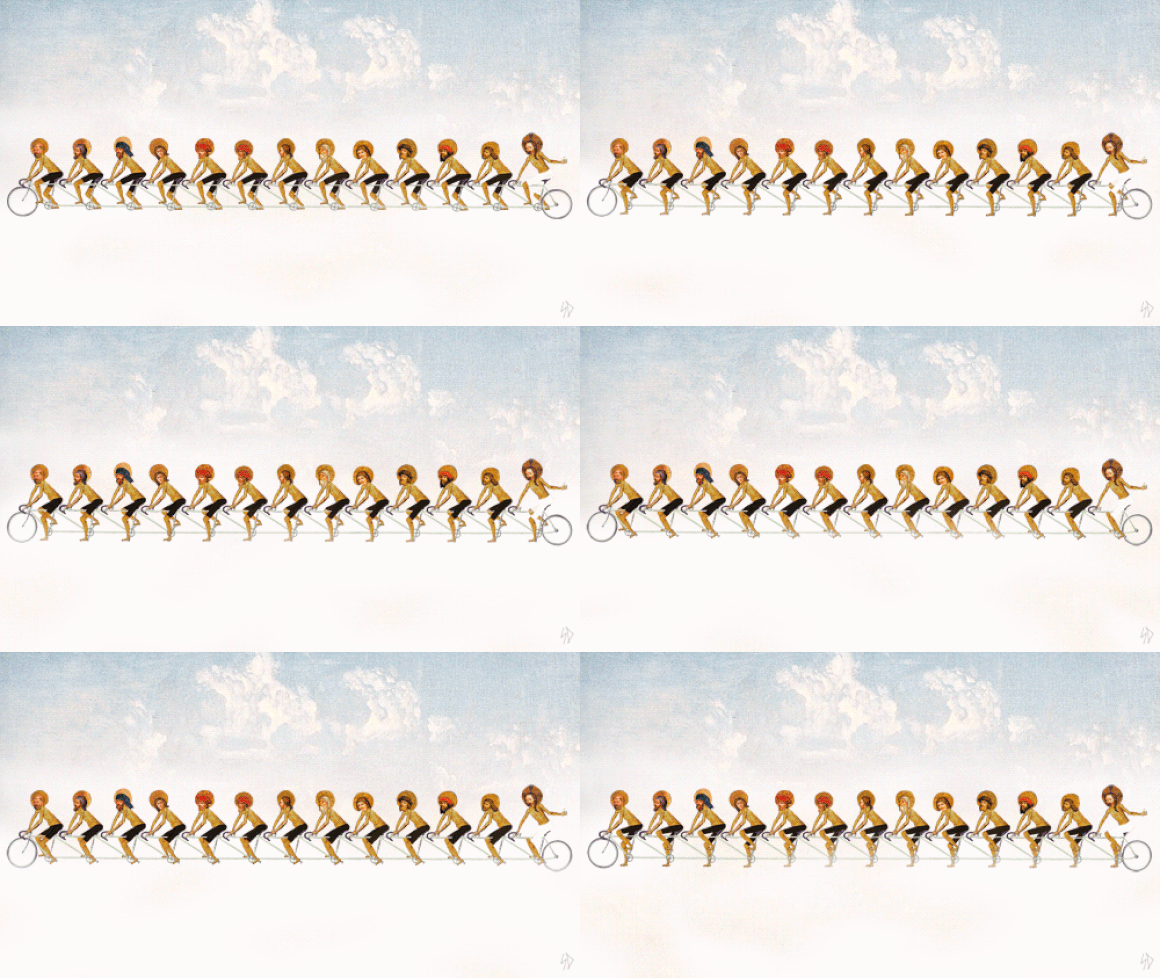
ezgif.com-save
dish_sdagger2resized

James Kerr, aka Scorpion Dagger, makes irreverent GIFs out of Renaissance art. He described his project in an interview this February:

Q: How does your practice relate to collage, or your other pre-GIF art practices?

A: Essentially, I’m using these Renaissance paintings as a palette to draw upon or cut open. So I’ll take a head from a Lucas Cranach the Elder painting, and hand from a Hans Memling painting and put those things together.

Mostly, I’m inspired by the idea of what happens to these types of paintings after a museum closes. I like the idea that the people in the paintings then get on the bus, go home, do the dishes, go to a restaurant. I like to think I’m creating a world for them outside of the museums where you would normally view these pieces of art. I like to think about what the life of these subjects might be away from the painting they are in.

Q: What is your process like? Many analog artists have a sketchbook. How do you collect and develop ideas?

A: Most of my ideas come from things that I see getting played out day to day in my life. The other day I was looking at the water cooler at the office where I work part-time, and I thought, What would it be like to have a water cooler in in the Vatican? Or in the paintings at the Vatican? So I made a GIF about that.

See more of his work here.

Quote For The Day

“When I look at [the Biblical book] Revelation now, it still seems frightening and impenetrable, and it still suggests a fearful, inexorable order that is unknowable by us, in which our earthly concerns matter very little. However, it no longer reads to me like a chronicle of arbitrarily inflicted cruelty. It reads like a terrible abstract of how we violate ourselves and others and thus bring down endless suffering on earth. When I read “And they blasphemed God of heaven because of their pain and their sores, and did not repent of their deeds,” I think of myself and dozens of other people I’ve known or know who blaspheme life itself by failing to have the courage to be honest and kind. And how we then rage around and lash out because we hurt. When I read “fornication,” I no longer read it as a description of sex outside marriage: I read it as sex done in a state of psychic disintegration, with no awareness of one’s self or one’s partner, let along any sense of honor or even real playfulness. I still don’t know what to make of the doctrine of the Nicolaitanes, among other things, but I’m now inclined to read it as a writer’s primitive attempt to give form to his moral urgency, to create a structure that could contain and give ballast to the most desperate human confusion. …

In the past, my compassion felt inadequate in the face of Revelation because my compassion was small–perhaps immature is a better word–and conditional. I could not accept what I read there because it did not fit my idea of how life should be, even though I could feel the truth of it in my psyche. Now I recognize, with pain, a genuine description of how hellish life can be, and how even God can’t help us because we won’t allow it. Paradoxically, I find that the more you accept the pain and fear inherent in human experience, the greater your compassion can become, until finally it is no longer merely your compassion but a small part of the greater love epitomized in the Bible as Jesus,” – Mary Gaitskill, from her essay “Revelation.”

(Hat tip: David Zahl)

The Creation Museum Of Movies

It’s easy to dismiss God’s Not Dead, the cringe-inducing film about an evangelical undergraduate who takes on his atheist professor, but Robert Geroux sees it as an emblem of what’s wrong with too much of conservatism, and conservative Christianity, in America these days:

I have a theory about contemporary conservatism generally, and the religious right more specifically. They’ve studied the post-68 playbook of the center-left. They’ve appropriated the language of civil rights, the student movement and identity politics and turned it in a new direction: targeting “religious discrimination,” cultural indifference and even aggression (the “War on Christmas”), and so on. Both then and now, many of these battles took place on college campuses. Kevin Sorbo’s arrogant professor is surely a distortion, but the persona is meant to resonate with conservative viewers, especially young people who have been told repeatedly that the secular classroom is the place where faith commitments are deconstructed and stripped-away, often painfully. In God’s Not Dead this myth becomes hyperbole: no philosophy professor requires – on the first day no less! – the disavowal of God. What the distortion discloses however is the cynical belief that the role of authority in the pursuit of knowledge and even wisdom is nothing more than a sham, a mere power trip, intellectual combat for its own sake. According to these terms, the young man in question doesn’t really belong in a Philosophy class, since he already has all the wisdom he needs.

We have to strip away the image here to get at the reality.

What parades as a liberating experience of “speaking truth to power” is in fact profoundly disingenuous. The position and situation of the young man in the film is merely one of nothing more than a mobilized series of stale tropes, tableaux that support a worldview in which evangelical Christians are an oppressed minority. That we know this isn’t true is beside the point. Films like God’s Not Dead are the ideological expression of this stance, of a piece with the Creation Museum and Fox News histrionics around the holiday season. What we see in films like this is the elaboration of a closed circuit, a symbolic gated community in which to live. No thanks. And it has to be said as well: the ideological edifice just isn’t a very good one. So far, every overtly evangelical work of pop culture I’ve experienced is a transparent piece of unconscious self-parody and abysmal kitsch.

Are You A Heretic?

In an interview about his recent book, Know the Heretics, professor and priest Justin Holcomb lays out a definition for the term:

A heretic is someone who has compromised an essential doctrine and lost sight of who God really is, usually by oversimplification. Literally, heresy means “choice”—that is, a choice to deviate from traditional teaching in favor of one’s own insights.

For Christianity, the Nicene Creed is a historic, globally accepted creed that encapsulates the Christian faith in a short and rich summary. If someone holds to the Nicene Creed, we should not call them a heretic. Not even if we believe they are in error on the details or on other doctrines. I think a good shorthand for heresy, is to ask, “Can they say the Nicene Creed and mean it without their fingers crossed?”

His take on the heresies most prevalent today:

I think many of the old heresies are repackaged today. For example, there is plenty Sabellian Modalism—the belief that God is one actor wearing three hats—floating around today. Also, I think a repackaged version of Pelagianism is most “live” today. (My summary of Pelagius’ heresy is “God has already given us the tools we need.”)

Pelagius correctly saw human nature as something good created by God, and there is no such thing as original sin. Adam’s sin in no way makes humans guilty or corrupt. Humans by nature have a clean slate — a state of neutrality — according to Pelagius. Potentially, then, one could live a sinless life and merit heaven, for there is nothing intrinsically sinful about humans. To me, this sounds like lots of the gobbledygook that is passed around today in popular Christian TV, radio, and publishing.

Praise Be To Presbyterians

A reader points to some fantastic news (NYT):

Just wanted you to know that the General Assembly of the Presbyterian Church voted on Thursday to allow same sex marriages in states where they are already legal. My Dad, a Presbyterian minister, is thrilled to finally be able to marry same sex couples within his church. This is probably under the radar, but I think it is huge for common society to have a large national mainstream church recognize this right for all loving couples. Progress!

Another Presby writes:

I know we’re a bit late to the marriage equality game, but we’ve been at this conversation for a long time and this is a day to rejoice for so many of us in our little corner of the church. By a strong majority (61%-39%), the Presbyterian Church (U.S.A.) at its biennial assembly in Detroit voted to allow ministers to officiate at weddings of same-sex couples in states where it is legal. (The technical language is that this is an “authoritative interpretation” of our constitution by our most inclusive governing body.) It takes effect immediately. Presbyterians who love their church may be married by their own pastors as early as this Sunday if they wish. As a young adult minister who serves this denomination, I could not be more grateful.

Later that afternoon we also voted to change our constitutional definition of marriage from “a man and a woman” to “two people, traditionally a man and a woman.” This passed by an even wider margin (approximately 71%-29%). This change must be ratified by a majority of our presbyteries (regional governing bodies – we have 172 of them) in the next year, but the hope is that it will pass with flying colors.

We have so much to be grateful for. As you would say, “know hope.” As it turns out, our theme for this year’s general assembly is “Abound in Hope,” drawn from language from chapter 15 of the apostle Paul’s letter to the Romans.

Behind The Screens

When the new Transformers movie, Age of Extinction, began filming in Chicago last year, Kevin B. Lee decided to make a behind-the-scenes documentary about how the filming affected the city. But he wasn’t the only one; he noticed “dozens of people standing across the street, most of them holding phones and cameras, doing the same thing I was doing.” So his project, Transformers: The Premake, took a twist:

The original idea for the Transformers documentary grew out of my dissatisfactions as a freelance film critic who spent most of his waking hours in front of screens. … Part of the reason I backed away from work as a critic and went to graduate school was so that I could spend more of my time interacting with people face to face. Similarly, I chose a film project that would allow me to connect with the physical realities behind the media that gets served up on our various screens.

But my encounters with so many other people filming their own videos made me rethink my whole approach. Frankly, it humbled me as a filmmaker, because it drove home the realization that everyone is a filmmaker now. I also realized that everyone in their own way was making their own version of Transformers, based on the small privileged glimpses they had of this massive production. I started to notice these videos popping up on YouTube, and not just from Chicago, but from Utah, Texas, Detroit, Hong Kong. After a weekend of keyword-spelunking through the caves of YouTube, I emerged with 355 videos that documented the production. In a sense, the documentary of the making of Transformers had already been made, in 355 pieces. Now it was a matter of figuring out how the pieces fit together.

Noel Murray appreciates the end result:

[W]hile Transformers: The Premake’s insights into modern life and modern moviemaking are depressing, the movie itself is anything but. Lee’s not really scolding the fans here; The Premake seems to acknowledge that big blockbuster explosions are fun to watch, and that it’s genuinely thrilling to catch a glimpse of Mark Wahlberg on the other side of a barricade. …

Transformers: The Premake is about the increasingly long cycle of build-up to the release of a major motion picture, and how studios defray the staggering costs by getting communities to provide tax breaks, and convincing local governments and businesses to work for them for nothing. Lee explores the myriad aspects of the complex ecosystem that’s developed, up to and including the way that studios allow some fans to hype their films for them, but shut others down. Lee puts it all together cleverly, contrasting the state censorship of China with the relatively benign (but still irritating) copyright claims of Paramount, and conveying the surreal experience of sitting inside of a Starbucks and watching a city pretend-crumble outside. In the end, Lee takes his cues from a piece of Age Of Extinction set dressing: a giant poster from the Chicago location that reads, “Report Alien Activity.” Transformers: The Premake does just that, thoroughly and entertainingly.

The full 25-minute documentary can be seen above. The Dish previously featured a browser-based short film here.