Well This Dude Isn’t Ready To Be The Non-Clinton

Brian Schweitzer is on a roll lately. On Dianne Feinstein’s criticism of the CIA:

She was the woman who was standing under the streetlight with her dress pulled all the way up over her knees, and now she says, ‘I’m a nun,’ when it comes to this spying! … I mean, maybe that’s the wrong metaphor—but she was all in!

And he has a genuinely new theory to explain the implosion of Eric Cantor:

Don’t hold this against me, but I’m going to blurt it out. How do I say this … men in the South, they are a little effeminate … They just have effeminate mannerisms. If you were just a regular person, you turned on the TV, and you saw Eric Cantor talking, I would say—and I’m fine with gay people, that’s all right—but my gaydar is 60-70 percent. But he’s not, I think, so I don’t know. Again, I couldn’t care less. I’m accepting.

Next!

(But let’s keep him in the primaries. I miss Gravel.)

Baghdad Begs For Bombs

iraq1

The Iraqi government has formally requested US air strikes on ISIS, but our top brass is hesitant to give Maliki what he wants. Karl Mueller asks whether attacking ISIS from the air would be effective:

The military success of any air power intervention in Iraq depends very much on the ground forces fighting against ISIS. Bombing could do a great deal to give Iraqi security forces the upper hand, and it might also provide an important psychological boost to their willingness to stand and fight, which has often been less than impressive. But if they were ultimately unable or unwilling to make effective use of that advantage, such an intervention would be a wasted effort. (Conversely, if the Iraqis can defeat ISIS without such help, there would be little reason to consider intervening.)

And of course, even if ISIS were defeated with the help of Western air power, whether the outcome would ultimately be a strategic success for the United States hinges on what comes next in Iraq. Air power is a potent instrument for changing the course of wars, but as experience in Libya shows, shaping what happens in the wake of the conflict means building influence on the ground and devoting sustained effort to the often difficult problems of postwar stabilization.

Carpenter doesn’t see the point of airstrikes to prop up a loser like Maliki:

U.S. airstrikes could deepen Iraq’s Sunni-Shia divide, they could alienate the Saudis and align us with Iran, they could convert thousands of non-combatant Iraqi Sunnis to violent jihadism against the United States, and perhaps worst of all, they not only could, but would tie us militarily to the region’s most incompetent leader–Nuri al-Maliki. All of which tends to swamp the “good.”

Nonetheless, airstrikes to bolster the Iraqi Army’s morale might indeed be a good thing–other considerations aside–but not as long as Maliki rules. That would be bad. In fact that would be dumb. And President Obama isn’t a dumb president.

But Morrissey is more sanguine:

This is probably an easy call for Obama to make. Air strikes are a lot more antiseptic than putting ground troops in harm’s way, and a lot more practical in terms of politics, logistics, and timing. It gives Obama a chance to take some action that will at least address the deep concerns from allies in the region about the lack of action and direction from Washington these days, too. Air strikes will also provide a positive impact on the situation and give Baghdad some room to maneuver politically and militarily. Plus, Congress is likely to rally around this limited intervention, which would provide Obama with political cover — if he’s smart enough to seek it. He didn’t in Libya and is still paying the political price for high-handing Congress and going it alone.

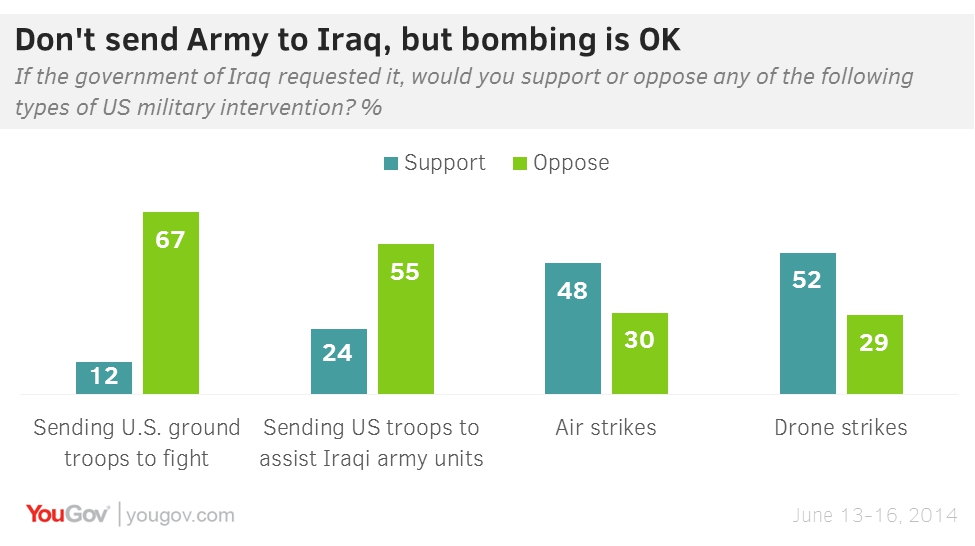
A new poll reveals that Americans don’t much care for bombing Iraq, but as the above chart shows, it’s a good deal more popular than boots on the ground. The public, however, doubts intervention will do any good:

Opposition to sending troops to Iraq may not be entirely due to weariness after nearly thirteen years of war, but also because of doubts over the ability of the US to actually have a positive impact. Only 19% say that US intervention would defeat the insurgents and restore the power of the Iraqi government, while 25% say that the insurgents would be defeated but the Iraqi government would still be ineffectual. 34% think that US intervention would do little to change anything.

Previous Dish on the possibility of US airstrikes on ISIS here and here.

Have The Cheneys Finally Jumped The Shark?

In a video introducing their new 501(c)4, Dick and Liz provide what will surely be SNL’s opening skit this Saturday:

Update from a reader:

I took a look at the Cheney video on YouTube to read some of the comments. And what did I see? Comments have been disabled. Some things never change.

Their astonishing op-ed – a classic in the annals of non-self-awareness – has even prompted Fox’s Megyn Kelly to balk and Byron York’s jaw to drop. Waldman identifies one of many huge holes in the warmongering op-ed from the father-daughter team:

[T]he Cheneys’ op ed is silent on what they would do differently in Iraq today. The op-ed contains nothing even approaching a specific suggestion for what, other than to say that defeating terrorists “will require a strategy — not a fantasy. It will require sustained difficult military, intelligence and diplomatic efforts — not empty misleading rhetoric. It will require rebuilding America’s military capacity — reversing the Obama policies that have weakened our armed forces and reduced our ability to influence events around the world.”

So to recap: we need a strategy, and though they won’t tell us what that strategy might be, it should involve military, intelligence, and diplomatic efforts, and rebuilding the military. Apart from the absurd claim that the armed forces have been “weakened” (we’re still spending over $600 billion a year on the military even with the war in Iraq behind us and Afghanistan winding down), the Cheneys are about as clear on what we should do now as they were on how invading Iraq was supposed to spread peace and democracy across the Middle East.

They know nothing but the fumes of their own ideology and self-regard. Ed Morrissey comments that the Cheneys “are likely whistling into the wind here”:

There hasn’t been much polling on Iraq, but the PPP poll taken over the weekend shows that the neocon policy is even less popular than Obama’s leadership at the moment. Even with the looming disaster facing Baghdad and by extension American policy, and even with the threat that ISIS represents to the region and eventually to the US directly, only 20% want American troops back in Iraq. The majority want a diplomatic “mobilization” to deal with ISIS, which as I wrote yesterday would look pretty strange, since ISIS is an unapologetic terrorist organization.

Jason Zengerle calls the op-ed an opening for Liz Cheney’s next political campaign:

While Obama is the ostensible target of the Cheneys’ op-ed and new group, their real opponent isn’t Obama but Rand Paul and the school of foreign-policy thinking that Paul represents inside the GOP. Liz finally has the proxy war she’s been waiting for.

Even before Liz abandoned her Senate race, people in Wyoming were speculating that she wouldn’t stay in the statethat, win or lose, her family would move back to the home in the Virginia suburbs that they never bothered to sell. But six months later Liz is still in Wyoming (just witness that gorgeous mountain backdrop on the video she recorded for the Alliance for a Strong America) and it seems likely she’ll make another run for office there at some point. If she does, today will have marked the start of that long campaign.

Maybe she could just get a job at NBC for $600,000 a year. I hear the children of shameless nepotists are doing quite well in this economy. Allahpundit also detects a preemptive strike against the young senator from Kentucky:

Really, why would you even need to attack O on foreign policy at this point? His numbers are already in the toilet; Chuck Todd read his political obituary on the air just this morning. He’s the lamest of lame ducks.

The guy whom hawks are worried about is Paul, who could do a lot of damage to the interventionist cause by succeeding with a more dovish foreign policy agenda in the GOP primary. Remember, too, that the Cheneys have a history with Paul: He eagerly endorsed Enzi after Liz announced her primary challenge and offered to campaign personally for him in Wyoming in the name of squashing a famous hawk with the Cheney name. The Cheneys are going to repay the kindness next year by attacking him as a dangerously irresponsible appeaser who’ll build on Obama’s legacy of failure. That’s where the new group comes in, I think. By rolling it out now against Obama, they’re going to build goodwill among righties. Then they’ll put that goodwill to use next year in hammering Paul.

But Tim Mak points out that Paul has been pretty cagey about where he actually stands on Iraq:

Paul has dropped hints here and there about his Iraq stance. He told the Des Moines Register this month that he didn’t oppose helping arm the Iraqi military and said he “would not rule out air strikes.” In a Senate Foreign Relations Committee hearing last week, he said he was “not very excited about” the prospect of sending military service members back into Iraq. But he stopped short of endorsing military intervention in Iraq or ruling it out, and his on-the-fence position hasn’t been clarified.

Boarding a senators-only elevator Tuesday morning with fellow Republican Sen. John McCain, a hawk well known for his foreign policy views, Paul joked that he should just tell reporters he believes “whatever McCain says.”

Paul is not turning out to be a profile in courage, is he?

Why Aren’t Gay Men On The Pill? Ctd

The New York Times has produced a “Room for Debate” colloquium on Truvada, the daily pill to prevent HIV infection. They lead with the Michael Weinstein, who writes this sentence:

PrEP has failed to protect the majority of men in every clinical trial (study).

He links to an Indian summary of drug trials from 2011. That ignores the data since then:

A key Truvada study found more than 90 percent effectiveness in preventing HIV infection even among those not fully compliant with the one-pill-a-day regimen. Another study showed that “parti­ci­pants could re­duce their risk of HIV by 76 pe­r­cent tak­ing two doses per week, 96 pe­r­cent by tak­ing four doses per week, and 99 pe­r­cent by tak­ing se­ven doses per week.”

That’s a huge majority in all the most recent studies. Then we have Larry Kramer writing the following:

Truvada is a form of chemotherapy, and we have not faced up to the possible side effects that might come.

truvadaChemotherapy? He sounds like someone’s hysterical grandma from a Roz Chast cartoon. It’s one pill a day whose side effects have been documented as minimal for the vast majority and easily monitored for anyone else. You get your bloodwork every three months. The drug has been used in combination for several years and has no resemblance even slightly to chemotherapy in any form. Of course, with any drug, including aspirin, there are side effects. But they pale in comparison to the side-effects of the full anti-HIV cocktail – which is the real life alternative to this simple pill a day.

So where are these people coming from?

If they were deadly serious about reducing HIV infections, why wouldn’t they want every possible means of prevention? Why, in fact, continue to favor an approach that has already demonstrably failed, rather than try a new one that might work? One clue comes from a sentence like this from Weinstein:

What we do know is that this generation didn’t live through the holocaust of the ’80s and ’90s.

As if that’s a bad thing! It doesn’t seem to occur to him that sex without terror is a good thing, in fact, an extraordinarily good thing for a fully realized life. Or that adjusting your behavior when the cost-benefit analysis decisively shifts is a perfectly rational thing to do. The same blindspot is in Larry’s sentence:

There is already a lot of complacency among gay men that makes the lucky uninfected neglect or reject condom use.

Complacency? It doesn’t seem to occur to Larry that it’s not complacency, but rationality at work here. Adjusting your behavior when the cost-benefit analysis decisively shifts is a perfectly rational thing to do. The only people being complacent with HIV are those “mainly” using condoms, hoping for the best when they lapse from time to time, and not taking Truvada. Why would Kramer not support someone attempting to make his own body as immune to HIV as possible – with a safety net as well as protective gear?

What we’re seeing perhaps is the understandable trauma of an older generation cramping the options of a younger one, in a different time, with different – and much less terrible – problems. The obvious drawback is the possibility that fewer condoms means more other STDs. But the check-ups required for continued use of Truvada can be a warning sign for that; and one study has found no probability of such unintended consequences. Maybe they’ll occur and we can adjust. But right now, we have a lethal weapon in the fight to the most lethal STD there is, and we’re unconscionably failing to use it.

The long-running Dish thread on the male pill is here. Update from a reader:

Thanks for continuing to cover Truvada. I’m a 54-year-old gay man, HIV-negative, lived in San Francisco in the early ’80s (and have lived to tell about it). I don’t have unprotected sex (truth be told, I don’t have much sex, period, but that’s another story). But at my last doctor’s visit, I went on Truvada. My doctor was unfamiliar with it (my gay doctor!), but he was happy to prescribe it. He said it seemed “a bit like overkill, but when the alternative is a life-and-death condition, is there such a thing as overkill?” My health insurance covers it, and so far no side effects that I can tell.

My reasons for going on Truvada are mostly emotional (what a spectre of fear relieved!) and political. As part of the political aspect, I’ve begun telling people that I am taking Truvada. The stigma attached to it needs to be removed, and having more people on the drug will enlarge the medical track record as well as, eventually, bringing the price down.

When I told two women friends about it, and the very high prevention rate some tests show, she said, “Why aren’t they putting it in the drinking water?” The other, in response to the idea that if gay men won’t even always wear a condom, how can they be expected to take a pill daily, pointed out that women on birth control seem to handle taking a pill every day.
ISIS Or ISIL?

As regular readers have surely noticed by now, the English-speaking world can’t settle on an acronym for the Islamic State of Iraq and Syria/al-Sham/the Levant. Ishaan Tharoor comments on the distinction:

[I]f we are to interpret “greater Syria” as the equivalent of “the Levant” — which it essentially is — then both designations are basically correct. Neither are as accurate as “DAIISH,” the Arabic shorthand for the group that no one in the English-language press seems to use. ISIS has become part of the English-language media’s common parlance and has something of a ring to it — it’s like the ancient Near Eastern goddess. So switching to ISIL is, if nothing else, a bit jarring.

Most of the time, we deploy acronyms that preserve the wording of non-English languages. Many English-language readers following South Asian politics will know the upstart Pakistan Tehreek-e-Insaf party as the PTI, not the Movement for Justice (which is what Washington Post style dictates). The main ruling party in Algeria is almost always referred to as the FLN — for Front de Libération Nationale – and not by what would be its English equivalent, the NLF. And there are myriad more examples.

The Dish has settled on ISIS primarily because of how it rolls off the tongue, but also, as Hassan Hassan points out, “Bilad al-Sham” is the proper term for the Levant as a whole, whereas “al-Sham” is commonly used to mean Syria alone. In any case, a look at the region’s history leads Nick Danforth to conclude that the group’s dream of uniting “Iraq and al-Sham”, by any definition, is a little quixotic:

Both Iraq and al-Sham are place names with their own historical and political cachet, but it’s telling that ISIS’s leadership couldn’t come up with a single geographical term to describe its current area of operations. Al-Sham — which has sometimes been translated as Syria, though perhaps “Greater Syria” or “the Levant” gives a clearer sense of the geography — was most recently the name of an Ottoman province based in Damascus. Iraq, by contrast, was a geographical term that came into its own with the arrival of the British in the 1920s.

Operating on the sound logic of opportunism, ISIS is claiming to unite two regions that even the first opponents of the European mandate system were content to treat as separate. In the immediate aftermath of World War I, some of the earliest Arab nationalists came together in defense of a state covering the entire Levant. When Faisal, champion of the Arab revolt and later king of Iraq, proclaimed in 1920 a short-lived Arab Kingdom based in Damascus, he imagined its territory stretching from the Taurus Mountains in southern Turkey to the Sinai Peninsula, but not east into Iraq.

Book Club: Sensing Too Much, Ctd

A reader responds to the email from the parent of two sons with sensory processing disorder:

horowitz-onlookingAs a well-functioning but diagnosed older person on the autism spectrum, taking a walk is an annoying and frustrating event. I friggin’ notice everything. I have to force myself not to read every word in every ad, identify the make and model of every car I pass by, peek around to see what that sound was – even though I know it was just a car door closing or a skateboarder in the distance. It doesn’t ever, ever stop.

That said, taking these walks with Alexandra Horowitz and her guests in On Looking got me out of my head. Getting out of my own head doesn’t happen enough, even when reading insightful books. Now, when I walk, I remember some of the wisdom of her experts’ knowledge and I look for those things. I think, What am I smelling? I look at the annoying signs and instead of repeating the words over and over until I see another annoying sign, I look at the typeface. I force myself to focus. On building materials, on rocks, on asphalt even.

In some small sense, I’ve become a better autistic. Or at least a calmer walker.

Maria Popova, who is hosting the Book Club, responds to the reader:

I love this. It reminds me of a favorite passage from the book:

Right now, you are missing the vast majority of what is happening around you. You are missing the events unfolding in your body, in the distance, and right in front of you. By marshaling your attention to these words, helpfully framed in a distinct border of white, you are ignoring an unthinkably large amount of orwell-2information that continues to bombard all of your senses: the hum of the fluorescent lights, the ambient noise in a large room, the places your chair presses against your legs or back, your tongue touching the roof of your mouth, the tension you are holding in your shoulders or jaw, the map of the cool and warm places on your body, the constant hum of traffic or a distant lawn-mower, the blurred view of your own shoulders and torso in your peripheral vision, a chirp of a bug or whine of a kitchen appliance.

The challenge this reader articulates, and a challenge for many on the autism spectrum, is that of being unable to turn off precisely those myriad external stimuli that the average person automatically misses. But what’s interesting is that over the past decade, growing bodies of research have shed light on the autistic mind as not lesser but different.

Perhaps one of its great advantages, and a key point of difference, is exactly this wide lens of attention coupled with narrow focus on each of the many things attended to – a fusion of what’s an either-or proposition for the nonautistic person. At its most acute, this advantage can manifest as anything from intricately detailed visual lists of everyday objects to mathematical genius. Autism advocate and pioneering animal behaviorist Temple Grandin has spoken about this beautifully in her TED talk and her introduction to the book Drawing Autism.

For the rest of us, though, missing “the vast majority of what is happening” is undoubtedly a survival strategy. I tried to imagine, biking through the city today, what it would be like if I paid attention to everything simultaneously – listened to every bird and every siren and every rushing executive yelling on her cell phone, looked at every storefront and every redhead and every fleeting reflection in a car window. I’d crash instantly – both literally and figuratively.

Follow the whole Book Club discussion here. Maria and Alexandra just recorded a short conversation over various aspects of On Looking, so stay tuned.

It Pays To Keep Out Of Trouble

In the face of an intractable violent crime epidemic, Richmond, California, decided in 2007 to try out a new approach to the problem: paying people not to kill each other. Tim Murphy reports on the “Office of Neighborhood Safety”:

Here’s how it works:

A team of seven “neighborhood change agents” patrol the streets like beat cops, keeping tabs on the 50 high-risk members of what [DeVone] Boggan [who designed the initiative] calls the “focus group.” The coordinators, most of them former convicts, check in with their sources at corner stores, barbershops, and churches and report back daily on what they’ve heard. “I want us to hunt ‘em like they hunt, and I want us to hunt for information,” Boggan says. “We have better information than the police.” Once a certain level of trust has been established between the coordinators and their targets, a meeting is arranged, and the pitch is made.

In exchange for shunning dangerous behavior, ONS fellows receive anywhere from $300 to $1,000 per month, depending on their progress following a “life map” of personal and professional goals.

If they team up with someone from a rival community to renounce violence altogether, they can get even more money—though that’s yet to happen. Fellows can receive stipends for 9 of their 18 months in the program. The city gave ONS $1.2 million for its operating budget last year, but the money for the stipends came from a handful of private donors, including the health care giant Kaiser Permanente. (A Kaiser spokeswoman says the program is good for “diffusing community tensions and reducing violence,” thereby limiting stress-related health risks like heart disease, strokes, and diabetes.)

ONS staffers help fellows take concrete steps toward stability, from providing assistance in getting a driver’s license or a GED to helping raise $5,000 for a merchant-marine training class. Though the program officially cuts off when fellows turn 25, Boggan says ONS tries to stay in touch with them as long as possible.

What Do You Do With A BA In English?

You will actually get hired more than most:

Defying all conventional wisdom and their parents’ warnings, most English majors also secure jobs, and not just at Starbucks. Last week, at the gathering of the Associated Departments of English, it was reported that English majors had 2 percent lower unemployment than the national rate, with an average starting salary of $40,800 and average mid-career salaries of $71,400. According to a 2013–14 study by PayScale.com, English ranks just above business administration as a “major that pays you back.”

But using numbers to dispute the fatalism over humanities is a bit like reading novels to cure consumption – at best it is a distraction before the next coughing fit. Besides, engineers and dentists still earn more than English majors. Rather than citing more statistics, we might ask why humanists keep simultaneously pursuing this field and lamenting its perpetual crisis. The answer is that crisis, which comes from the Greek word for “choice,” is what humanities do best.

Meanwhile, Pascal-Emmanuel Gobry wishes certain political reporters had studied the liberal arts rather than communications:

The expression “liberal education” is quite important. Today, when we think “liberal education”, we think “Would you like fries with that?” But as the common root with the word liberty suggests, liberal education is an education that helps make us free. Only by first understanding not only the empirical scaffolding of our Universe–a.k.a. science–but also its conceptual scaffolding, a.k.a. the ideas, concepts and history which shape the world we live in, can we ever hope to be free, that is to say to be able to make informed, conscious decisions. …

Nobody stops to ask what education is for, because the answer is implicitly accepted by all: an education is for getting a job. It is, in other words, for being a cog in the giant machine of post-industrial capitalism. It is, in other words, for the opposite thing that our forefathers wanted for us.

Update from a reader:

Good grief, can Gobry be any more melodramatic about the need for a liberal education? I don’t dispute the importance of the humanities, but explaining condescendingly why we’re all “less free” for not reading Aristotle is asinine.

I majored in Russian in college, because that massive, eternally tsarist country has, in spite of the odds, turned out some of the greatest literature we have. And besides that, the language and culture are fascinating. Even though I only had the opportunity to spend three months there, my studies and time abroad were formative experiences. They have certainly shaped how I approach the rest of my life, and I continue to foster a love for all things Russian.

Unfortunately, the world can support only so many American Slavophiles, so I also majored in Chemistry. Why? Because I needed to get a job. Yeah, I guess it’s a bummer that I can’t “freely” pursue whatever I want, but we can’t all get paid to mock people for not reading Plato or Max Weber. When I’m not at work, I can spend my time doing whatever I want; but when it comes to making a buck, whether we like it or not, concrete skills that produce tangible goods make money.

Trying To Stand It

After becoming convinced that his sedentary lifestyle posed a major health threat, Dan Kois decided to spend a month on his feet. (He made exceptions for driving, using the bathroom, and, once, attending a play). His thoughts toward the end of the experiment:

Hit wall. Completely fucking dead. Wife rubbed my feet tonight. If Sitting Dan got a foot massage from his wife, he’d thank her. Standing Dan is a whiny asshole. Email to friend: “If a nun gave me a $100 bill I would be like, screw you, my legs hurt.”

What he learned:

[T]his enforced standing has made me realize how much of my time bonding with my family is spent seated. Now we play Crazy Eights with me hulking over the table like a grudgingly accepted giant. I’ve begged off story time because my kids don’t like craning their necks to see the pages, and I find it maddening not to be able to snuggle with them in bed. At the beach house we shared with my in-laws for Easter weekend, I was completely unable to relax or join anyone else in relaxing. … It all came to a head at Easter dinner, during which I stood straight up as if in a Last Supper parody, loved ones assembled to each side, my roast lamb perched on that stupid aluminum work tray. All I wanted to do was just be for a little while! Instead, I could never stop thinking about my dumb, clumsy, painful body, not for a second. …

My month has been an ordeal, but it’s clearly succeeded. I’ve lost almost five pounds and gained muscle in my legs, especially my calves. I’ve cut my time-wasting drastically, editing and writing more than in any month I can remember. I’ve walked 92.5 miles, basically without trying.