Clinton’s Latest Drivel

Hillary Clinton Addresses National Automobile Dealers Association Convention

Behold her explanation for why she refused for such an endless time to concede she had been wrong on Iraq:

I knew some of the young people who were there and I was very close to one Marine lieutenant who lead a mixed platoon of Americans and Iraqis in the first battle for Fallujah. So I felt like I couldn’t break faith with them. Maybe that doesn’t make sense to anybody else but me, but that’s how I felt about it. So I kept temporizing and I kept avoiding saying it because I didn’t want there to be any feeling that I was backing off or undercutting my support for this very difficult mission in Iraq.

She was supporting the troops by backing an impossible mission – and then refusing to reconsider! If that sounds like a neocon, you’re not wrong. She’s also going out on a limb naming her favorite book: the Bible. If that sounds like George W Bush, you’re not wrong. I’m with Damon:

Despite sharing her husband’s poll-driven risk aversion, Hillary Clinton has never played the game on his level, and her vulnerability to backlash against gratuitous displays of patent insincerity is already becoming glaringly apparent. Twice within the last week, she’s made a fool of herself by presenting a carefully crafted, overly fastidious, and utterly unconvincing version of her opinions. This kind of thing is going to get old very fast if it continues over the (God help us) nearly 29 months between now and November 2016.

Her political skills are legendarily poor. And yet our only hope for keeping the lunatic party out of the White House is a charm-challenged political amateur.

(Photo: Sean Gardner/Getty.)

No, ISIS Is Not Al-Qaeda

Evan Perkoski and Alec Worsnop clear up an important misconception:

[C]ontrary to many media reports, ISIS is not a splinter group of AQ. ISIS wasn’t founded by or ever directly a part of AQ; rather, they were affiliates, two groups with close bonds, with one pledging loyalty to the other though at all times maintaining autonomy. This is an important distinction since labeling ISIS a splinter implies AQ factionalism that in reality never existed. Instead, ISIS’s links with AQ, rather than signaling weakness or factionalism, have played a major role in their development by providing access to resources, strategic and tactical guidance, recruits, and an ideology that helped socialize and bind together individuals from disparate backgrounds.

Benjamin H. Friedman also rejects the comparison in terms of the threat ISIS poses (or rather doesn’t pose) to the US:

The idea that we need to fight ISIS because of its potential to use terrorism against the United States suffers similar flaws [to the logic of the Iraq War]. During the Iraq War, hawks constantly warned that leaving Iraq would allow terrorist havens to form there. Their mental model was 1990s Afghanistan. They ignored the fact that al Qaeda (the original group that attacked Americans) came from particular conflicts, rather than being some kind of plant that grew in failed states. And even in Afghanistan, the problem was more that the government — the Taliban — allied with al Qaeda, rather than the absence of government. And hawks forgot that U.S. gains in drones and surveillance technology since the 1990s had destroyed havens—now those were easy targets.

Today, we are repeatedly told that ISIS is more brutal than al Qaeda and thus a bigger danger to Americans. But that logic confuses an insurgency with a group focused on attacking Americans. ISIS is a nasty organization fond of terrorist violence, radical Islam, and Islamic caliphates, but not an obvious threat to Americans. Conflating morally noxious Islamists with those bent on killing Americans is one of the errors keeping us at endless war.

In fact, Barak Mendelsohn considers ISIS’s ascendency evidence of al-Qaeda’s decline:

[B]eyond raising ISIS’ profile, the terrorist group’s march through Iraq also diminishes al Qaeda’s. Al Qaeda’s greatest achievement was the 9/11 attacks, but that was 13 years ago. Many of today’s jihadis were young children at that time. Moreover, the attack on the United States was only supposed to be a means to an end: the establishment of an Islamic caliphate in the heart of the Middle East. Al Qaeda franchises did manage to gain (and then lose) some territory in Yemen, Somalia, and northern Mali. But these territories are smaller in size and significance than what al Qaeda wanted — and what ISIS controls today. Although al Qaeda may have started the march toward the reestablishment of the Caliphate, it is ISIS that seems to be realizing it. …

Al Qaeda’s appeal relative to ISIS’ is greater when questions of how to run a territory populated by Sunni Muslims who do not subscribe to the Salafi-jihadi radical interpretation of Islam take center stage. When the front stabilizes and the intensity of the fight subsides, such questions will return and the inherent weakness of ISIS will resurface. ISIS is an extremely capable force, but its battle achievements do not make it any more appealing as a government.

The question is whether we can muster the patience and restraint to see it blow itself out.

Their Poor, Huddled, Underage Masses, Ctd

Bishops Hold Mass And Procession On US Border In Support Of Immigration Reform

Many outlets have identified gang activity in Latin America as the main cause of the increasing number of child migrants crossing the border. But Byron York thinks the Fox News right, which instead blames Obama’s immigration policies, has a solid case:

Border Patrol agents in the most heavily-trafficked area of the surge, the Rio Grande Valley sector of Texas, recently questioned 230 illegal immigrants about why they came. The results showed overwhelmingly that the immigrants, including those classified as UACs, or unaccompanied children, were motivated by the belief that they would be allowed to stay in the United States — and not by conditions in their homelands. From a report written by the agents, quoting from the interviews:

The main reason the subjects chose this particular time to migrate to the United States was to take advantage of the “new” U.S. “law” that grants a “free pass” or permit (referred to as “permisos”) being issued by the U.S. government to female adult OTMs traveling with minors and to UACs. (Comments: The “permisos” are the Notice to Appear documents issued to undocumented aliens, when they are released on their own recognizance pending a hearing before an immigration judge.) The information is apparently common knowledge in Central America and is spread by word of mouth, and international and local media. A high percentage of the subjects interviewed stated their family members in the U.S. urged them to travel immediately, because the United States government was only issuing immigration “permisos” until the end of June 2014…The issue of “permisos” was the main reason provided by 95% of the interviewed subjects.

But Dara Lind lists “13 things you need to know to get a handle on what is actually going on along the border right now.” Among them:

[Homeland Security Secretary Jeh] Johnson has said that immigrant children coming in now aren’t eligible for “an earned path to citizenship” — which could be interpreted to mean that they aren’t eligible for any legal status whatsoever. But under existing immigration law, if they meet standards for humanitarian status because they were persecuted in their home countries, they are eligible to receive it. And experts say that immigration judges aren’t supposed to take comments like Sec. Johnson’s into consideration when considering a child’s case.

A recent report from the Office of the UN High Commissioner for Refugees says that about 60 percent of children coming over from Central America might be eligible for some kind of humanitarian protection. And a Vera Institute of Justice report from 2012 identified 40 percent of immigrant children as eligible for some sort of legal protection under US immigration law.

I’d say it’s obviously a combination of the two: brutal insecurity in their lands of origin, plus the knowledge that overwhelmed humanitarian resources on the border have no choice but to let immigrant children find temporary (but practically permanent) refuge in the U.S.

(Photo: A child on the Mexican side of the U.S.-Mexico border fence looks into Arizona during a special ‘Mass on the Border’ on April 1, 2014 in Nogales, Arizona. By John Moore/Getty Images.)

Mosul Under The Fanatics

Andrew Slater tries to get a sense of what daily life is like there now:

Residents in Mosul seemed very worried about the city being bombed by the Iraqi Air Force and the return of the Iraqi Army from the south, but most did not see this prospect as imminent. But many sounded untroubled by the fearsome reputation of life under ISIS after observing them for a few days as even the foreign fighters appeared to be leaving the people of Mosul alone. New announcements are being broadcast throughout the city from the speakers of mosques, but these primarily concerned people returning to work.

Most said they had not observed or heard of the new ISIS authorities enforcing their announced bans on smoking cigarettes or water pipes, immoderate dress, and public gatherings, but most residents said they have been very careful to comply with the new rules.  A few women had returned to work wearing the hijab, but most are staying home, uncertain of how they would be treated by the ISIS fighters in public. Even low-level government employees who were forced to swear oaths against the government in Baghdad were reportedly allowed to return to work unmolested.

Just wait a while … and the beheadings will surely begin. Meanwhile, Fehim Taştekin talks to Mosul’s governor Atheel Nujaifi, now taking refuge in Kurdistan, about his plans to try and retake the city:

It appears almost impossible for Iraqi actors to develop a joint plan for action against the chaos generated by ISIS. The governor said he is now relying on his own resources and the KRG administration. He is coordinating with Erbil and believes some groups controlling parts of Mosul are ready to fight ISIS. Even if ISIS is ousted from Mosul, however, it will not bring about resolutions to the grievances of the Sunni majority there. It is not enough to treat the matter solely as an issue of terror. Nujaifi had earlier proposed a federalism model for the region, but it was not accepted.

So what is the the real solution to ISIS? Nujaifi offered, “Another course of action is needed to combat ISIS. This issue has to be resolved not by Maliki, but as a Sunni project. We have to struggle against ISIS with our Sunni way. It is not a fight for Shiites or Maliki’s supporters. Maliki cannot fight ISIS. Sunnis can do it because that will prevent ISIS from exploiting sectarian arguments.”

Who Are These ISIS Chappies, Anyway? Ctd

Keating pens a thorough explainer on ISIS leader Abu Bakr al-Baghdadi, tracking his rise from low-level militant to head of his own rogue proto-state:

Baghdadi fought in some capacity with Sunni militant groups after the U.S. invasion of Iraq but was arrested in 2005 and interred by U.S. forces at Camp Bucca, the main U.S. detention facility after the closing of Abu Ghraib. He wasn’t considered much of a threat and was released in 2009. The former commanding officer of Camp Bucca recently told the Daily Beast that when Baghdadi was released, he told his captors, “I’ll see you guys in New York.” (The guards at the prison were from a Long Island-based military police unit.) The commander, Col. Kenneth King, says Baghdadi “was a bad dude, but he wasn’t the worst of the worst” and is surprised he rose to such prominence.

It seems as if Baghdadi became far more hqdefaultinvolved with al-Qaida in Iraq while imprisoned than he had been before, to the point that he took over the group after the deaths of [Abu Ayyub] Masri and the other [Abu Omar] Baghdadi a year later. In 2011 he was designated as a global terrorist by the U.S. State Department with a $10 million bounty. Things really picked up in 2012, when, sensing an opportunity, Baghdadi dispatched some foot soldiers to join the fighting against Bashar al-Assad’s government in Syria. In 2013 he announced that the group was merging with Jabhat al-Nusra, the other al-Qaida affiliate in Syria, to form a new group called the Islamic State in Iraq and al-Sham.

That new group has turned out to be more formidable than anyone expected, in no small part due to its impeccable organization. Martin Chulov passes along what CIA and Iraqi analysts have learned from a massive trove of ISIS intelligence acquired on the eve of the group’s blitzkrieg on Mosul:

Laid bare were a series of staggering numbers that would be the pride of any major enterprise, let alone an organisation that was a startup three years ago.

The group’s leaders had been meticulously chosen. Many of those who reported to the top tier – all battle-hardened veterans of the insurgency against US forces nearly a decade ago – did not know the names of their colleagues. The strategic acumen of ISIS was impressive – so too its attention to detail. “They had itemised everything,” the source said. “Down to the smallest detail.”

Over the past year, foreign intelligence officials had learned that ISIS secured massive cashflows from the oilfields of eastern Syria, which it had commandeered in late 2012, and some of which it had sold back to the Syrian regime. It was also known to have reaped windfalls from smuggling all manner of raw materials pillaged from the crumbling state, as well as priceless antiquities from archaeological digs. But here before them in extraordinary detail were accounts that would have breezed past forensic accountants, giving a full reckoning of a war effort. It soon became clear that in less than three years, Isis had grown from a ragtag band of extremists to perhaps the most cash-rich and capable terror group in the world.

Yochi Dreazen outlines the “mafia tactics” ISIS is using to become financially independent of its benefactors in the Gulf:

The exact amount of money in ISIS’s possession is the subject of intense debate among Western intelligence officials. At the high end, some analysts estimate that the group may have access to at least $500 million in cash drawn from bank robberies, oil smuggling, and old-fashioned extortion and protection rackets. Other analysts believe the number is far lower, with one official putting it at between $100 million and $200 million. Those numbers are moving higher as the group conquers more cities on its seemingly inexorable drive toward Baghdad and is able to loot the local private and government banks. On Monday, ISIS fighters took the strategically important town of Tal Afar, adding to the territory under its direct control. …

ISIS’s success at funding its own operations is indicative of a broader trend. Extremist groups throughout much of the world, particularly Africa, are beginning to reduce their dependence on outside donors.

More background on ISIS here and here.

Why Is Paul Wolfowitz On Television?

A reminder (from David Corn) of the man’s fathomless ignorance about Iraq (as well as the blood of well over 100,000 on his hands). Here’s the intellectual’s assessment of the possibility of sectarian warfare once Iraq had been invaded:

There’s been none of the record in Iraq of ethnic militias fighting one another that produced so much bloodshed and permanent scars in Bosnia along with the requirement for large policing forces to separate those militias. And the horrors of Iraq are very different from the horrific ethnic cleansing of Kosovars by Serbs that took place in Kosovo and left scars that continue to require peacekeeping forces today in Kosovo. The slaughter in Iraq—and it’s been substantial—has unfortunately been the slaughter of people of all ethnic and religious groups by the regime. It is equal opportunity terror.

The tape is here. It’s reminiscent of Bill Kristol’s conviction that sectarianism was a fantasy:

We talk here about Shiites and Sunnis as if they’ve never lived together. Most Arab countries have Shiites and Sunnis, and a lot of them live perfectly well together.

I wish I could feel calm contempt for these people. But it is interwoven with rage.

Soccer: An Immigrant’s Game

Charles Kenny adds soccer to the list of reasons to support a more open immigration policy, pointing to the aftereffects of a 1995 European Court of Justice ruling that made it easier for players from outside the EU to play for European clubs:

Unsurprisingly, leagues that saw a higher influx of talented players improved: Clubs in the South Africa Child Football Teamsleague won more Europewide competitions. Meanwhile, talented players migrated to teams in strong leagues based in countries that were richer, closer to their home country, and shared colonial ties. That meant the better leagues, like the English Premier League or Spain’s Primera Division, extended their lead over other European leagues in countries such as Denmark and Romania. In this case, talented migration into Europe created greater productivity but also increased inequality. Everyone was better off, but it is true the best leagues benefited the most.

There was unvarnished good news for the countries that the talented migrants left behind. First, national teams in origin countries did better in international matchups the more their emigrants played in the top leagues in Europe. [Researcher Chrysovalantis] Vasiliakis estimates that the impact of greater global mobility of players lifted Uruguay, Paraguay, and Chile 25 places or more in the 2010 FIFA rankings of national teams.

But those effects only seem to extend so far. Mallé Fofana asks why West African countries don’t field World Cup-winning teams even though they produce lots of great players for European clubs:

Talent alone cannot win games. Talent must be molded and refined in a system that can nurture and sustain it.  European and South American football teams have perfected this system — a well-oiled and well-financed system of coaches, trainers, nutritionists, and sports psychologists that not only have helped to develop the system but also sustain it today.  This system offers part of the access that a country like Cameroon lacks, in soccer as in the rest of its economy.

The other part comes from the lucrative financial incentives for performance. When the potential for income is taken away, so is the incentive to perform.  This in turn impacts morale, motivation, and results, and once again the matter circles back to the issue of access.

Brandon Valeriano notices that the US national team is short on Latino players:

Club soccer dominates in the U.S., and this is an expensive and almost impossible barrier for Latinos due to the costs and suburban nature of the programs.  Moving up a level, participation in high school or college teams assumes the participant has the freedom to actually play sports after school, an option not many of us had as working became a priority once we were of legal age.  College soccer is an even tougher prospect, since the costs or barrier of an inadequate school system make this path a huge obstacle for the Latino population.  The pipeline of talent to the World Cup team is broken for Latinos, but it’s also broken in the higher education system and in the political system.  The lack of development of Latino players is a symptom of the deeper problems in American society.

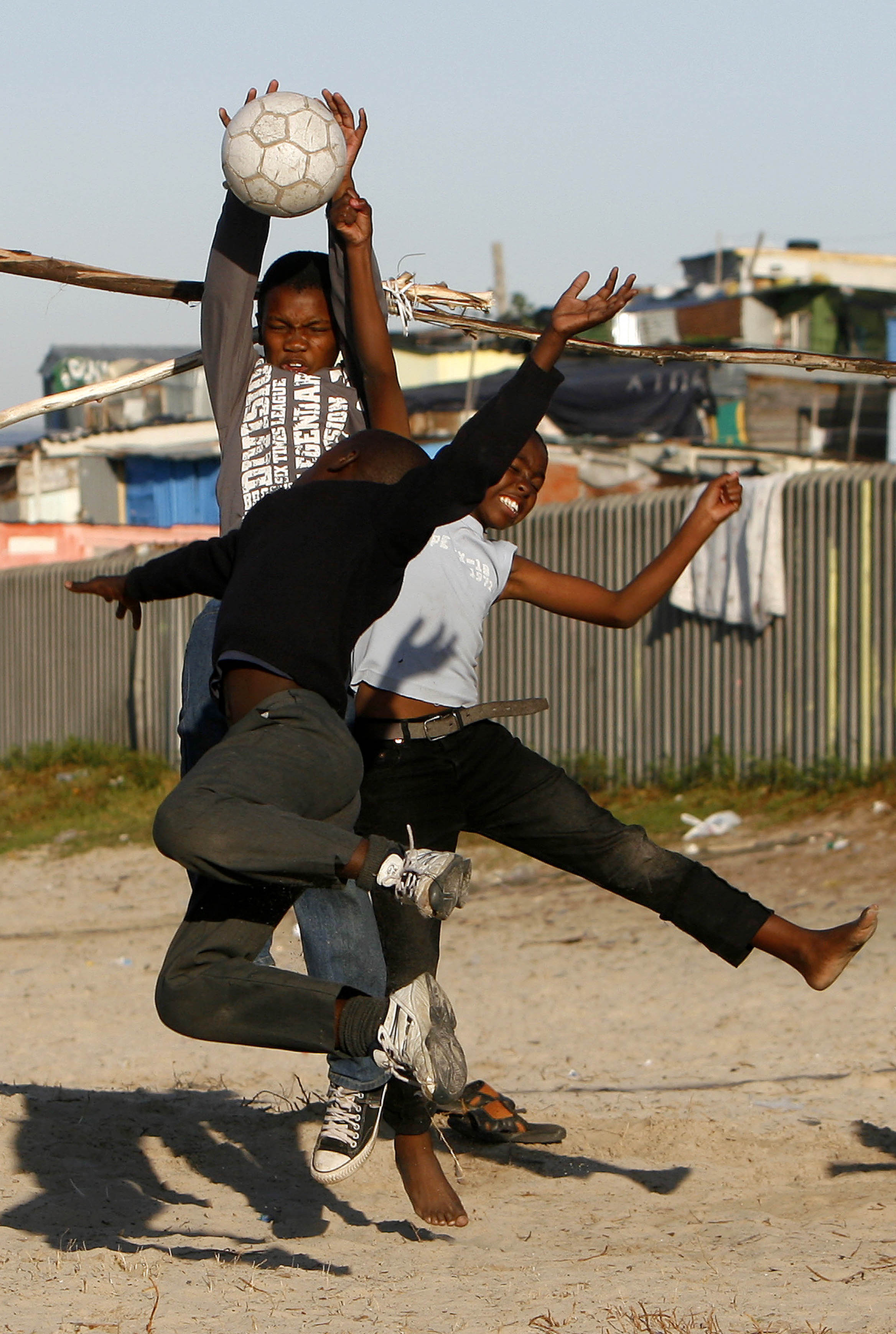
(Photo: Local children from the ‘Seven Stars’ Football Team practice and play football on their field next to the N2 Highway that runs past Gugulethu Township near Cape Town, Western Cape, South Africa on May 20, 2010. By Mark Wessels / Barcroft Media / Getty Images)

Don’t Get Too Excited, Neocons …

Obama is deploying troops to Iraq, but only 275 of them, to reinforce security at the embassy. Beauchamp breaks down the move:

[T]his doesn’t mean the US is going to war in Iraq again, or even helping the Iraqis fight theirs. It does, however, say that the US wants some of its embassy personnel out of Baghdad. The reasons why could be safety, or they could be something more subtle (say, to liaise more effectively with the Kurdish authorities). According to the Press Secretary statement, “the US embassy in Baghdad remains open, and a substantial majority of the US Embassy presence in Iraq will remain in place if the embassy will be fully equipped to carry out its national security mission.”

Per this useful Q&A from the AP, the 100 troops currently guarding the embassy are the only US service members in the country. We might also send in Special Forces to help train Iraqi soldiers to fight ISIS. Allahpundit doesn’t see how we’d advance our objectives any other way:

If you want trustworthy intelligence inside Iraq, your only option is American troops. The Special Forces team is probably there mainly for surveillance, to pick up tips on ISIS movements and relay them to American air assets. And of course there’s a third possibility in honor of the McCain/Graham spat, that U.S. troops are on the ground to coordinate with Iranian military elements that are already inside the country and, maybe, to provide a U.S. counterweight to Iran in influencing Maliki’s maneuvering. And if worse comes to worst and ISIS ends up overrunning Baghdad anyway, hey — you’ll have 100 of the best troops in the world right there to help get everyone out of the embassy before the barbarians run wild and start chopping off heads.

A Healthy Sign For Obamacare

Insurers

Last week, Dan Diamond spotlighted one:

Insurers sat out of the exchanges for different reasons in year one. Some were wary of the start-up risks. Others were openly taking a wait-and-see approach. Still more, it seems, didn’t want any part in the first year’s batch of customers, who were expected to be older and sicker.

And while the technical problems associated with the exchanges have been legion, plans that participated have reported predictably higher revenue, if unclear profits. One million more consumers signed up than expected…and while they weren’t as young and healthy as the insurance companies had hoped for, they were more customers.

Now, more plans want their chance to chase those dollars.

Kliff comments:

It’s not just new entrants into the exchanges that’s increasing competition.

In Washington, for example, there are two plans that only sold in small parts of the state that now want to sell everywhere. Both United Health Care and Moda, a local plan, are increasing the geographic area of where they plan to sell coverage.

The only state that hasn’t reported an increase in carriers for 2015 is Oregon. There, all 12 carriers who sold in 2014 plan to sell again in 2015, but no new insurers have proposed rates. It’s possible that this has to do with Oregon’s incredibly challenged Obamacare rollout — or it could reflect the fact that Oregon had one of the most competitive Obamacare markets to begin with.

More nationally though, the trend seems to be clear: More insurers are getting into the Obamacare game in year two.

Jason Millman adds:

The development is important for a few reasons. For one, recent research suggests that more competition in the exchanges could help temper premium increases. Other new analysis shows that exchange plans, on average, are cheaper than individual plans offered outside the insurance marketplaces. And given the narrow networks in exchange plans, more insurers could mean better access to providers.

In New Hampshire, the exchange’s only insurer last year had excluded 10 of 26 hospitals in the state from its network, meaning the exchange’s customers were limited in their choice of care providers. In 2015, though, New Hampshire will have five insurers selling individual and family health plans on the exchange, state officials announced [last] week. That also includes the expansion of two non-profit, co-op plans that received start-up funding from the Affordable Care Act.

India’s Rape Infrastructure?

crime-and-sanitation-of-homes-with-toilets-rate-of-rape-per-100-000-_chartbuilder

Neil Padukone connects the high incidence of rape in India to its urban design choices:

Most of New Delhi is built according to what urban planners sometimes call “single-use” design: sections of the city are devoted almost exclusively to one use (industrial, institutional, retail, or residential) and separated from each other by open space, roads or other barriers. … This is in contrast to “mixed-use” planning, which carefully integrates residential, retail, institutional, and cultural spaces into the same area—areas that are easily accessible by walking, bicycle, or mass transit.

There are many reasons planners favor mixed-use design, including smaller carbon footprints and increased access to economic opportunity. Easy and efficient access to work, leisure, home, and childcare makes juggling responsibilities much easier, particularly for women. But one of the most important benefits of mixed-use planning is what the urbanist Jane Jacobs famously called “eyes on the street.” If an area is used for multiple purposes, there will always be somebody—a homemaker, shopkeeper, pedestrian, peddler, or office worker—keeping a passive watch, inadvertently but effectively policing it 24 hours a day. Street vendors, for example, may be the most perennial pairs of eyes that monitor any streets, and even police have tapped this human resource.

Two girls who were gang-raped and murdered in Uttar Pradesh last week were attacked while going to relieve themselves in a field at night. Hayes Brown discusses how the absence of private toilets poses a serious safety problem for women in the poorest parts of the world:

Some critics have said that the focus on sanitation as an issue ignores the larger issue of rape and deterring men from assaulting women in the first place. As an article from First Point India explains, however, nobody is arguing that “the sole reason for sexual violence is the lack of a loo. It is an undeniable fact, however, that the absence of a safe toilet adds to the vulnerability of women. And there are numbers to show it.” The First Point article cites a BBC report in which “a senior police official in Bihar said some 400 women would have ‘escaped’ rape last year if they had toilets in their homes.”

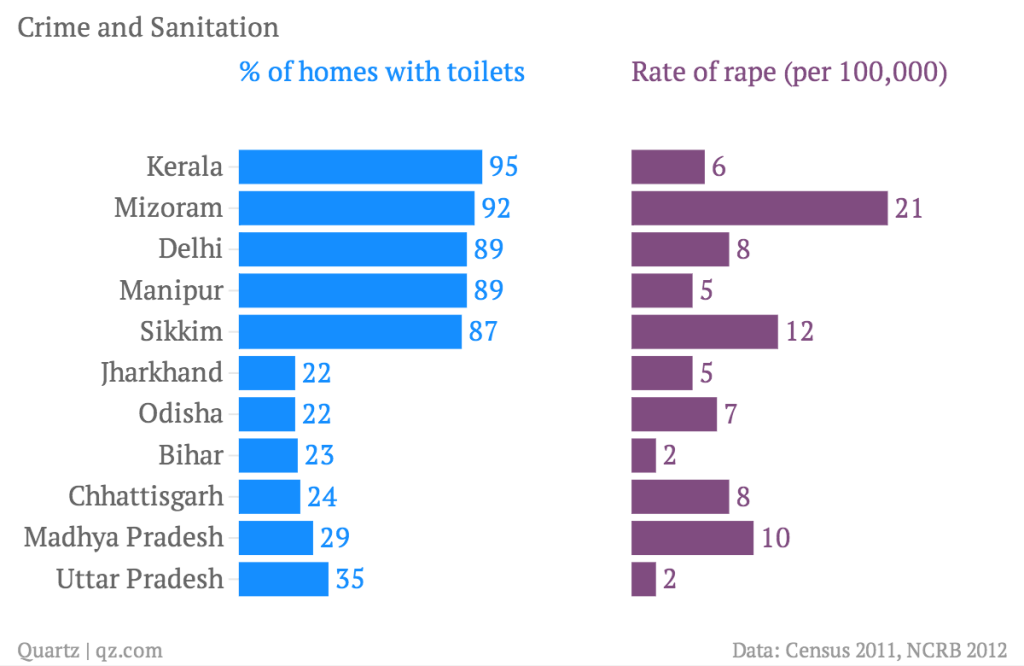
Diksha Madhok pushes back on that alleged link with the above chart:

[I]f a toilet shortage is fueling rape in India, then their presence should lead to lesser crimes against women. But data analyzed from the National Crime Records Bureau (NCRB) show that there is no inverse relation between rape and toilets. Quartz India compared the states with the highest and lowest toilet density against their rates of rape, defined as those reported per 100,000 women.

The state of Mizoram has one of the lowest number of households without toilets. Yet, the rape rate against women remains a stubborn 21, much higher than the national average of 4.26. Meanwhile, only 20% of households in Jharkhand have a toilet, but its rape rate is one-fourth of Mizoram’s.

Update from a reader:

As an Indian living in India, I strongly favour mixed-use urban spaces. That said, if this was the reason for rape, it would be a reason for all sorts of other crimes. But violent crime against men is relatively rare in India. As a man, I feel perfectly safe walking in quite seedy-looking neighbourhoods – far more than I would in New York or Paris. With women, two sorts of crime occur: (1) molestation (rape is merely the extreme end of a spectrum) and (2) “chain-snatching”, ie grabbing their gold chains and running. The solution to (2) is presumably not to wear gold chains, but social customs die hard. As for (1), I remain convinced that this is a societal problem exacerbated by inadequate policing by poorly-trained and often prejudiced personnel.

Back to mixed-use spaces: in 2006, the Chief Justice of the Indian Supreme Court, Y K Sabharwal, ordered the sealing of commercial establishments in many residential areas. Thousands of such establishments were sealed, many of which had been functioning for decades. It turned out that Sabharwal’s sons, both of whom were in the real estate business, stood to benefit immensely from this order. Journalists from the Mid-Day newspaper who reported this were held in contempt of court and jailed. A good overview of all this is here.

The bottom line is, India’s separate-use urban practices encourage not only criminal activity, but corruption. And when it’s the Supreme Court, there is little recourse for citizens.