Chart Of The Day

Reddit Fuck

Someone data-mapped every use of the word “fuck” on Reddit over an eight-hour period:

Appropriately titled The F Word, the visualization was created by user “codevinsky,” who mined all the fucking data on Monday and wrote the visualization [Tuesday], June 10. He broke it out into multiple categories, allowing you to toggle between instances when “fuck” was coupled to another word (All of the Fucks), and when “fuck” stood alone (Single Fucks). … All told, users said “fuck” or some variation thereof 25,203 times. Which doesn’t strike me as all that staggering. If anything, I’m surprised that figure isn’t actually much higher.

Interactive version of the above graphic here.

A World Cup Of Waste

It’s likely to follow in the soccer tournament’s wake:

The host country has been producing 30% more TV sets than last year, according to the Asociação Nacional de Fabricantes de Produtos Eletrônicos (National Association of Electronics Producers)—which means that, by the end of this year, Brazil will have between 18-20 million more TVs than when it started. By May, over half of them had been sold to giddy Brazilians in anticipation of seeing their team, the big favorites, win the sixth World Cup of its history in high definition.

The paixão pelo futebol, as they say in Brazil of their passion for soccer, might have unexpected effects. For every new TV set that comes into a Brazilian home, an old one usually goes out. A study by the World Bank pointed out that Brazil currently produces 14 lbs. of electronic waste per person every year, which makes it the leader in this type of garbage in Latin America. And it is rising: the government expects the amount will go up to 17.5 lbs per person by 2015. Television sets account for the largest type of e-waste in Brazil.

Meanwhile, the strain on Brazil’s power grid is requiring it to burn more fossil fuels:

According to Ildo Luís Sauer, director of the Institute for Energy and the Environment at the University of São Paulo, there’s “a chance” a blackout could occur in the country during the World Cup due to a “critical situation of excess demand” on the national electricity grid. “Usually, in Brazil, during World Cup hours — especially during evening games — you have a composition of huge demand because everyone is at home watching them,” he said.

But it is a risk that the sprawling country seems unwilling to take. Javier Diaz, a senior energy analyst at Bentek, said Brazil is attempting to preserve hydro inventory levels by importing and burning more liquefied natural gas, “especially with the [arrival of the] World Cup.” “Brazil’s monthly LNG imports broke new records in February and March, importing 95 percent and 76 percent more than in 2013,” he said in an email. In fact, the country is currently firing all of its thermal power plants — LNG, coal, diesel and fuel oil — said Sauer, who added that it’s “quite unusual.”

Finally, Thomas Brewster reports that Anonymous hackers are launching an all-out assault on FIFA, World Cup sponsors, and the Brazilian government:

Anonymous is irate at the Brazilian government for spending hundreds of millions on stadiums and infrastructure for the World Cup, rather than funnelling funds into the poorest parts of the country. It’s launching digital attacks to coincide with the street protests that erupted across the South American country this week, which have highlighted the abject poverty and governmental abuse of citizens in Brazilian cities and favelas.

A representative of the collective told Reuters they planned to launch attacks on other big-name sponsors, including Adidas, Budweiser, Coca-Cola and Sony, yet they seem to have had limited success with those large organisations so far. That’s likely because they’re used to DDoS attacks and have the resources to fend them off. DDoS threats can be dealt with by various techniques. One method is to use “scrubbing,” where massive influxes of data are split between data centres to ease the pain. Another is to use DDoS detection technology, which picks up on huge surges of traffic and allows the user to quickly block connections from offending IP addresses.

Previous Dish on Brazil’s World Cup woes here.

Female Execs Are Kicking Ass In Emerging Markets

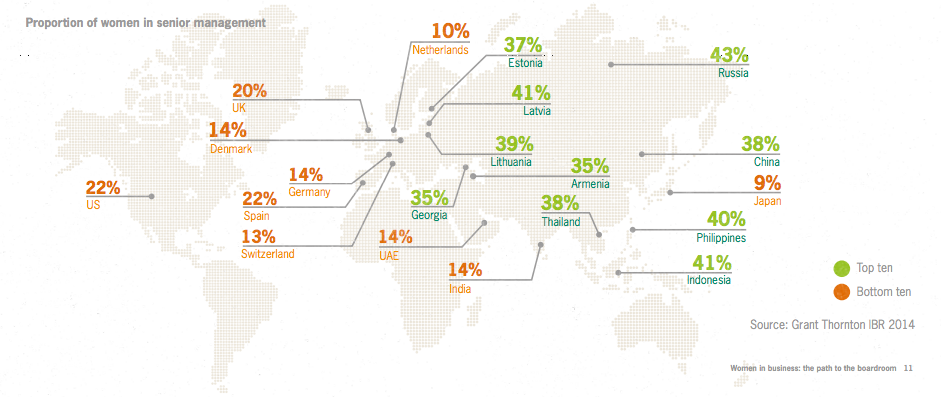
Screen Shot 2014-06-13 at 12.28.20 PM

Maria Saab shares the perhaps-surprising news:

[W]here are women climbing the corporate ladder? In countries you would probably least expect. The highest proportions of women with senior roles are in the BRICS nations – Brazil, Russia, India, China, and South Africa. There, women comprise 30 percent of senior management positions, which is higher than the global average (24 percent).

What is more surprising is that none of these countries have enacted compulsory quotas or legislation addressing this issue. Russia has the highest proportion of women in senior management globally (43 percent) without this type of gender programming. The same applies for the neighboring Baltic States – Estonia, Latvia, Lithuania, Georgia, Poland, and Armenia – which boast 30 percent or more. Between 2012 and 2013, China doubled the number of senior management roles held by women from 25 per cent to 51 per cent.

(Map from Grant Thornton’s “Women in Business: From Classroom to Boardroom”)

Justice In A Bind

Dahlia Lithwick worries that retention elections for state supreme court justices are becoming more and more politicized, particularly with the help of outside money:

Knocking off a state supreme court justice is one of the cheapest political endeavors going. It costs a few measly million bucks to buy a judge’s robe, which is vastly cheaper than a Senate campaign. But when politicians target elected judges and justices with political claims using political tactics (big money and inaccurate accusations), judges are forced to either respond like politicians or judges. Opting to do the former destroys the notion of impartial justice. Opting for the latter ends judicial careers.

And now here we go again.

Three justices on the Tennessee Supreme Court are facing an election-year attack, not for any particular decision they have authored or even for any unpopular opinion they have espoused. No, in an ugly campaign in Tennessee that appears to be getting ever uglier, Senate Speaker Ron Ramsey, who is also the state’s lieutenant governor, is attempting to oust three state Supreme Court justices in their Aug. 7 retention elections, chiefly for the judicial outrage of having been appointed to the high court by a Democrat. Under Tennessee law, the governor appoints Supreme Court justices, and then they come up for retention elections every eight years thereafter. This is a pretty common set-up in states that elect their justices.

The Best Of The Dish Today

The United States Celebrates The World Cup in Brazil

It’s been a sobering day, with one paragraph I read – by Razib Khan – sticking in my mind:

“No matter what establishment voices assert, intervention in foreign lands in a ham-handed fashion to prop up our American values is bound to lead us down a path of tears. As Shadi Hamid states, the future of democracy in the Middle East is going to be illiberal. This may be inevitable. We don’t need to avert our eyes from it, and we need to acknowledge that so we were, so they will be. It took the Thirty Years war to finally purge the enthusiasm of sectarianism from the cultural DNA of Europeans (and even then, religious minorities were second class citizens for centuries). There will be no calm reasoning with Iraqis of any stripe because the march of history continues, and only sadness can convince all parties that moderation is necessary for the existence of modern nation-states. Intervention in some fashion may be inevitable in the world, but our goal should be to prevent hell, not to create heaven on earth. The former is possible, the latter is not.”

“Only sadness can convince.” An awful truth – but a deeply human one.

Today, we tried to cover every aspect of the confusing and dynamic civil war in Iraq. An alliance with Iran? The Battle for Baghdad – and how ISIS could regret it.  The welcome calm at the White House. Iran’s quagmire now? The Sunni quandary. The Kurdish exception. The impact on Syria. And, of course, the shamelessness of Bill Kristol.

Relief? A South Park superfan Book of Mormon supercut. And I answer readers on whether I can endorse (or even vote for this time) Hillary Clinton.

The most popular posts of the day was No Drama Obama On Iraq; followed by Responding To Student Groans, Ctd,

Many of today’s posts were updated with your emails – read them all here.  You can always leave your unfiltered comments at our Facebook page and @sullydish. 14 more readers became subscribers today. You can join them here – and get access to all the readons and Deep Dish – for a little as $1.99 month.

See you in the morning.

(Photo: Soccer fans cheer for team U.S.A. as they face Ghana during the World Cup in Brazil at Jack Demsey’s bar on June 16, 2014 in New York City. By Michael Loccisano/Getty Images.)

Kristol Meth

 
What do you do with near-clinical fanatics who, in their own minds, never make mistakes and whose worldview remains intact even after it has been empirically dismantled in front of their eyes? In real life, you try and get them to get professional help.

In the case of those who only recently sent thousands of American servicemembers to their deaths in a utopian scheme to foment a democracy in a sectarian dictatorship, we have to merely endure their gall in even appearing in front of the cameras. But the extent of their pathology is deeper than one might expect. And so there is actually a seminar this fall, sponsored by the Hertog Foundation, which explores the origins of the terrible decision-making that led us into the worst foreign policy mistake since Vietnam. And the fair and balanced teaching team?

It will be led by Paul D. Wolfowitz, who served during the Persian Gulf War as the Under Secretary of Defense for Policy and as Deputy Secretary of Defense during the first years of the Iraq War, and by Lewis Libby, who served during the first war as Deputy Under Secretary of Defense for Policy and during the Iraq War as Chief of Staff and National Security Adviser to Vice President Dick Cheney.

Next spring: how the Iraq War spread human rights … by Donald Rumsfeld.

Most people are aware that relatively few of the architects of a war have fully acknowledged the extent of their error – let alone express remorse or even shame at the more than a hundred thousands civilian deaths their adventure incurred for a phony reason. No, all this time, they have been giving each other awards, lecturing congressmen and Senators, writing pieces in the Weekly Standard and the New Republic, being fellated by David Gregory, and sucking at the teet of the neocon welfare state, as if they had nothing to answer for, and nothing to explain.

Which, I suppose makes the following paragraph in Bill Kristol’s latest case for war less shocking than it should be:

Now is not the time to re-litigate either the decision to invade Iraq in 2003 or the decision to withdraw from it in 2011. The crisis is urgent, and it would be useful to focus on a path ahead rather than indulge in recriminations. All paths are now fraught with difficulties, including the path we recommend. But the alternatives of permitting a victory for al Qaeda and/or strengthening Iran would be disastrous.

But it is shocking; it is, in fact, an outrage, a shameless, disgusting abdication of all responsibility for the past combined with a sickening argument to do exactly the same fricking thing all over again. And yes, I’m not imagining. This is what these true know-nothing/learn-nothing fanatics want the US to do:

It would mean not merely conducting U.S. air strikes, but also accompanying those strikes with special operators, and perhaps regular U.S. military units, on the ground. This is the only chance we have to persuade Iraq’s Sunni Arabs that they have an alternative to joining up with al Qaeda or being at the mercy of government-backed and Iranian-backed death squads, and that we have not thrown in with the Iranians. It is also the only way to regain influence with the Iraqi government and to stabilize the Iraqi Security Forces on terms that would allow us to demand the demobilization of Shi’a militias and to move to limit Iranian influence and to create bargaining chips with Iran to insist on the withdrawal of their forces if and when the situation stabilizes.

What’s staggering is the maximalism of their goals and the lies they are insinuating into the discourse now, just as they did before.

Last time, you could ascribe it to fathomless ignorance. This time, they have no excuse. ISIS is not al Qaeda; it’s far worse in ways that even al Qaeda has noted undermine its cause rather than strengthen it. It may be strategically way over its head already. And the idea that the US has to fight both ISIS and Iran simultaneously is so unhinged and so self-evidently impossible to contain or control that only these feckless fools would even begin to suggest it. Having empowered Iran by dismantling Iraq, Kristol actually wants the US now to enter a live war against ISIS and the Quds forces. You begin to see how every military catastrophe can be used to justify the next catastrophe. It’s a perfect circle for the neocons’ goal of the unending war.

I don’t know what to say about it really. It shocks in its solipsism; stuns in its surrealism; chills in its callousness and recklessness. So perhaps the only response is to republish what this charlatan was saying in 2003 in a tone utterly unchanged from his tone today, with a certainty which was just as faked then as it is now. Read carefully and remember he has recanted not a word of it:

February 2003 (from his book, “The War Over Iraq“):  According to one estimate, initially as many as 75,000 troops may be required to police the war’s aftermath, at a cost of $16 billion a year. As other countries’ forces arrive, and as Iraq rebuilds its economy and political system, that force could probably be drawn down to several thousand soldiers after a year or two.

February 24, 2003:  “Having defeated and then occupied Iraq, democratizing the country should not be too tall an order for the world’s sole superpower.”

March 5, 2003: “We’ll be vindicated when we discover the weapons of mass destruction.”

April 1 2003: “On this issue of the Shia in Iraq, I think there’s been a certain amount of, frankly, Terry, a kind of pop sociology in America that, you know, somehow the Shia can’t get along with the Sunni and the Shia in Iraq just want to establish some kind of Islamic fundamentalist regime. There’s almost no evidence of that at all. Iraq’s always been very secular.”

Yes, “always been very secular”. Always. Would you buy a used pamphlet from this man – let alone another full scale war in Iraq?

(Thumbnail Photo: Gage Skidmore)

Face Of The Day

SYRIA-CONFLICT

An injured Syrian boy waits for medical attention at a makeshift hospital following a reported barrel-bomb attack by government forces in the city of Douma, northeast of the capital Damascus, on June 15, 2014. Syria’s army said it had recaptured the strategic town of Kasab and the only border crossing with Turkey in Latakia province, after it fell to rebels almost three months ago. By Abd Doumany/AFP/Getty Images.

Drug War And Peace In Colombia

A new approach to combating the cocaine trade, embedded in peace talks between the Colombian government and FARC rebels, raises the hopes of Oliver Kaplan that “the drug war may soon be coming to an end”:

In early May, negotiators from the Colombian government and the rebel group Fuerzas Armadas Revolucionarias de Colombia (FARC) reached an agreement on drug trafficking as part of their effort to end the country’s 50-year old conflict. Shifting away from old, controversial methods like crop fumigation, the new deal focuses on substituting crops, taking on organized crime and cartels, and treating drugs as a public health issue to treat addicts and reduce demand. It’s a historic move — and good news for President Juan Manuel Santos, who faces an increasingly popular opposition candidate in second-round elections on June 15.

Santos’ re-election yesterday bodes well for the peace process, which his opponent had threatened to halt:

Santos got 53 percent of the votes for candidates, against 47 percent for right-wing challenger Oscar Ivan Zuluaga, the hand-picked candidate of former two-term President Alvaro Uribe, who many considered the true challenger. More than 600,000 voters cast “blank” ballots, a protest vote for neither candidate. Zuluaga and Uribe accused Santos of selling Colombia out in slow-slogging Cuba-based negotiations, and said Zuluaga would halt the talks unless [FARC] ceased all hostilities and some of its leaders accepted jail time. Santos said the win affirmed his claim to be ably steering Colombia through a historic moment — out of a crippling conflict that has claimed more than 200,000 lives, mostly civilians.

But if coca cultivation in Colombia declines, Reid Standish suspects that Peruvians will increase theirs:

Drug researchers call this the “balloon effect” — where pressure from the authorities in one country or region pushes drug production elsewhere. Squeezing the balloon at one end causes drug producers to compensate and expand into another. Since the U.S.-led war on drugs began in the 1980s, the balloon effect has shaped the cocaine trade.

In 2013, fumigation and forced eradication of coca crops in Colombia finally hit a turning point and the South American nation bequeathed its crown as the world’s top coca producer to its neighbor, Peru. Both the United States and the U.N. declared it a milestone. Unsaid was that the Colombian government’s efforts to crack down on production — in part under the banner of Plan Colombia, the U.S.-backed effort to combat left-wing guerrillas and drug traffickers — simply shifted production to Peru.

Colombia and Peru have swapped the coca-producer champion crown for decades. In the mid-90s Peru launched an intense eradication campaign and Colombia was back on top. In 1990, Colombia was only responsible for 19 percent of the global coca market, behind top producers Bolivia and Peru. By 1997, it was the world’s top producer. See the pattern here?

Happy Bloomsday!

Every June 16, fans of James Joyce celebrate his famously demanding Ulysses, which takes place on this day in 1904. Jonathan Goldman assures revelers that the point of celebrating Bloomsday “is to recognize the stature of a book without necessarily comprehending it. All you need to understand is its un-understandability.” Dan Chiasson explains why the date particulary appealed to Joyce:

By setting the novel on the day his first inklings of it formed, Joyce ensured that the book would always be, whatever else it would be, a book about its own conception and growth. He had dreamed of writing “Ulysses” since at least 1904, the year two things happened:

a Dublin Jew named Alfred Hunter dusted him off after a brawl and walked him all the way home; and a beautiful barmaid, Nora Barnacle, on their first date—the first Bloomsday—slid her hand “down down inside my trousers,” as Joyce reminded her, later, in a letter, “and pulled my shirt softly aside … and touched my prick with your long tickling fingers and frigged me slowly till I came off through your fingers.”

Each of these courtesies was performed by a stranger for a stranger, though Nora would become Joyce’s lifelong companion and eventual wife. Neither one was an act of specific personal connection or love. Kindness, sexual willingness, patience, forbearance, and especially “equanimity”—that beautiful word that so comforts [character Leopold] Bloom in the end, and perhaps the most important word in the novel—all exist quite independent of personal bonds and the private economies of friendship, family, and marriage. That these lovely traits exist outside of the exchange market of human frailties—that they exist at all, in fact—would have been news to Henry James or, for that matter, to Jane Austen; it is almost hard to conceive of the novel as a genre without the idea that human virtues are always tactical, and spent with the expectation of handsome returns. It may sound sappy, but for me “Ulysses” is chiefly valuable as the most moving tribute in literature to kindness.

Jason Diamond offers tips on how to celebrate the occasion “without totally embarrassing yourself”:

The first, and most important thing, of course, is drinking. If you’re an American, then congratulations — this is one of those rare instances when you can accept a pint of beer in an Irish pub with a hearty “Cheers,” and not have it sound touristy and amateurish.

What do you order? Obviously, there’s always Guinness, but consider this delicious act of sacrilege: change things up this year and drink something like Left Hand’s wonderful Milk Stout. Your beer, of course, should also be accompanied by a whiskey, and this is where you can’t accept any substitutes. No Kentucky bourbon, no scotch from Scotland: Irish whiskey only. So if somebody says they’re getting a Jameson on the rocks, you had better order the same damn thing. To be honest, you could, in theory, get away with drinking anything today — but we’d suggest is you stay away from cider, since that stuff made Bloom gassy. The most important thing is to get at least a solid two drinks in your belly before you’ll be ready for a reading from the book itself.

But James S. Murphy considers such celebrations a “travesty”:

It would be nice to think that swelling readership of Ulysses drives the Bloomsday boom, but it’s more likely that Bloomsday provides an opportunity for cultural validation that’s about as substantial as sharing an author quote on Instagram. Reading Ulysses is a slow, immersive, and ultimately private experience; Bloomsday is a social-media-ready event, where like-minded people convene to celebrate their own taste.

And yet, the silliness might not have bothered Joyce so much. If anything, the aspect of Bloomsday that would have bothered him is its holiness.  Bloomsday celebrations treat Joyce too much like a saint and his book too much like a gospel to be revered first and read later, if at all. By placing Ulysses on a pedestal, we lose sight of both its vulgar origins and its power to tell us deep truths about our world and ourselves precisely by keeping the earthy and obscene aspects of ourselves in view.

Listen to Joyce fans around the world read from the book here. Recent Dish on the author here, here, and here.

The War Beyond Iraq

Mohammad Ballout examines the effect that ISIS’s blitzkrieg in Iraq is having on the war in Syria:

The results of the “Mosul invasion” will soon change the nature of the battle in the battlefields between the “jihadist” brothers in the Syrian east.

If Mosul is not recovered, ISIS may find more than it needs of land, financial resources and human resources to revive the “rule of the caliphate in Badiyat al-Sham.” Controlling Mosul has doubled ISIS’ ability to recruit thousands of fighters from the new Iraqi human reservoir, after annexing the large Ninevah province. All that depends on tribal alliances stretching from Anbar to Deir ez-Zour. And there are inexhaustible oil resources. The Turkish market will buy looted Syrian oil at the cheapest price across the Tell Abyad crossing, taking advantage of the European Union’s decision to facilitate the sale of Syrian oil to finance the opposition.

On the other hand, Fabrice Balanche considers the rise of ISIS a boon for the Assad regime:

Bashar al-Assad is clearly on the path to victory by way of continuing gains since Qusayr in June 2013. From the spring of 2013, the Syrian army, helped by Hezbollah, has been retaking territories: the southern suburbs of Damascus, the Qalamoun, and most recently, the center of Homs. The Syrian regime is not only massively supported by Iran and Russia (something the insurgency lacks), but Assad also applies a highly effective strategy of counterinsurgency. The rise of Islamists against him provided the ideology that Bashar al-Assad needed, i.e. the fight against Islamist terrorists supported from abroad. By demonstrating his resoluteness, Bashar al-Assad wants to reassure his supporters and win over the silent majority. The latter no longer seek the return of peace, but are falling into line behind the force that can ensure their security and is most likely to win.

But that second “S” in ISIS doesn’t really stand for “Syria” the country, but rather for “al-Sham”, i.e., “greater Syria” or the Levant (hence the alternate acronym ISIL). Dexter Filkins illustrates the conflict’s regional dimension:

The extremist groups dominating the fighting are beginning to take their war beyond the two countries that they now freely traverse. In January, isis carried out a car-bomb attack in Beirut near the offices of Hezbollah, the Lebanese militant group that has been fighting on behalf of Assad. The Nusra front has also carried out attacks in Lebanon. Meanwhile, the number of Syrian refugees who have fled to that nation exceeds twenty per cent of its population, which is not something that a state as weak and as fractious as Lebanon can be expected to sustain. In Jordan, the presence of half a million Syrian refugees is putting an enormous strain on the fragile monarchy.

Taylor Luck reports on ISIS’s plans for Jordan:

Islamist sources claim that the Islamic State is preparing for “expansion into Jordan” as it continues to push westward through Iraq. According to jihadist sources close to ISIL, the former Al Qaeda affiliate opened on Friday an “unofficial” office and branch in Jordan to usher what sources claim as expansion of the Islamic “caliphate”.

Despite having a low-profile presence in Jordan over the past six months, with over 800 Jordanian nationals reportedly serving under the ranks of ISIL, the movement has allegedly been reluctant to open an official branch in Jordan due to its ongoing rivalry with Al Qaeda, which retains larger popularity and support among hard-line Islamists in the country. Senior members of Jordan’s hard-line Salafist movement, which keep strong ties with both Al Qaeda and the Baghdad-based ISIL, had previously mediated “understandings” with the Islamic State to forego expansion into the country in a bid to prevent ongoing jihadist civil war in Syria to spill over into the country.