The Enemy Of My Enemy Is My Frenemy?

As more evidence surfaces of Iranian forces joining the conflict in Iraq, the WSJ reports that the US and Iran will now engage in direct talks toward resolving the crisis:

The U.S.-Iran dialogue, which is expected to begin this week, will mark the latest in a rapid move toward rapprochement between Washington and Tehran over the past year. It also comes as the U.S. and other world powers try to reach an agreement with Iran by late July to curb its nuclear program. …

The U.S. officials said it wasn’t certain yet which diplomatic channel the Obama administration would use to discuss the Iraq situation. One avenue could be through Vienna, where senior American and Iranian diplomats will convene starting Monday as part of international negotiations aimed at reaching a comprehensive agreement to curb Tehran’s nuclear capabilities.

Over the weekend, Rouhani himself expressed an openness to working with the US to confront ISIS:

“If we see that the United States takes action against terrorist groups in Iraq, then one can think about it,” he said, despite the lack of diplomatic relations between Tehran and Washington for more than three decades. “We have said that all countries must unite in combating terrorism. But right now regarding Iraq… we have not seen the Americans taking a decision,” Rouhani added.

But a Foreign Ministry spokesman also mixed that signal by suggesting Western intervention would only complicate a situation Iran believes it can handle all by itself. Ian Black surveys the debate:

Commentators in Tehran and Washington have argued that these old enemies share significant interests in defending the status quo in Baghdad: for example, both had urged Maliki to act more inclusively to stop alienating Sunnis for fear of empowering Isis. “Iraq is one of those places that contradicts the popular notion that Iranian and American interests constitute a zero-sum game,” the analyst Kenneth Pollack, a CIA veteran, commented on the eve of the April elections. “There, what is bad for Iran is often just as bad for the United States and what they want to see is often what we want to see as well.”

Whether those common interests will extend to actual, as opposed to de facto, military coordination – US air strikes or drone intelligence in support of Iranian revolutionary guards, or Iranian-advised Iraqi units – remains to be seen. It is fascinating too to speculate whether any cooperation could impact on the ongoing talks on Iran’s nuclear programme, a month before the deadline for a deal.

Meir Javedanfar thinks through the ramifications for Rouhani:

In the short run, President Rouhani also has much to gain. The ISIS victories will make Iran look like an attractive partner to the United States in the fight against ISIS. Should the West decide to cooperate with Iran, this would boost Rouhani’s position domestically, as he could say his moderate approach toward the United States made the country dependent on Iran for help. Rouhani could then use such help as a bargaining chip in the P5+1 talks to extract further concessions.

However:

There could also be domestic repercussions against Rouhani’s interests.

The head of the Basij organization, Gen. Mohammad Reza Naghdi, has already accused the United States of being behind the ISIS attacks. The spokesman for parliament’s National Security Commission, Mohammad Hossein Naghavi Hosseini, has publicly accused the Saudis (as well as Israel and the United States) of being behind the ISIS attacks.

The longer the ISIS crisis continues, the more difficult it will be for Rouhani to create a diplomatic rapprochement with the United States, as this crisis could strengthen the hand of Iran’s conservatives, who are against such a scenario. The same applies to Rouhani’s aspirations to improve relations with the Saudis.

Stepping back, Keating tries to sum up the bizarre intersection:

Relations between Iran and the U.S. have improved since Hassan Rouhani became president last year, but this hasn’t been a great couple of weeks. Nuclear talks have hit an impasse over the number of centrifuges Iran will be allowed to maintain for nuclear enrichment. It now seems unlikely that a deal by the July 20 deadline set by negotiators. It seems like it should be possible to compartmentalize the nuclear issue while the two sides work together on another pressing priority.

But the bigger obstacle may be Syria, where Iran has been one of the primary international backers of Bashar al-Assad’s government. Iran views ISIS as the inevitable consequence of American, Arab, and Turkish support for anti-Assad rebel groups. The U.S. view is that Assad’s brutal response to the moderate Syrian opposition led to the growth of radical opposition groups. It’s hard to wrap one’s head around a situation where the U.S. and Iran are fighting as allies on one side of the porous Syrian-Iraq border and essentially fighting a proxy war on the other side, but all bets are off when it comes to Middle Eastern geopolitics at the moment.

Robin Wright has some important reminders:

In 2010, James Jeffrey, the U.S. Ambassador [in Iraq], estimated that Iran was linked, through its surrogates, to the deaths of more than a thousand American troops. “My own estimate, based just upon a gut feeling, is that up to a quarter of the American casualties and some of the more horrific incidents in which Americans were kidnapped … can be traced without doubt to these Iranian groups,” he said.

Even after Washington announced its intent to leave Iraq, Defense Secretary Robert Gates charged that Iran’s support for Shiite militias was intent on “killing as many as possible in order to demonstrate to the Iraqi people that, in effect, they drove us out of Iraq at the end of the year.” When the United States ended its combat mission, in 2011, it did not leave even a residual force behind, because Iraq—under Iran’s strong influence—refused to sign a Status of Forces Agreement granting immunity to U.S. troops for acts deemed criminal under Iraqi law.

Marc Pyruz adds that Iran’s current strategy against ISIS will need to change from how it tried to fight the US:

[Quds Force] direction of battle in Iraq is set to differ in key respects from the period of American military occupation. During that period, the American military relied on combat aviation, overwhelming firepower and a heavy logistical presence. The current situation in Iraq is very similar to what is taking place in neighboring Syria, where IRGC-QF tactics have been developed against determined, hardy Jihadist fighters dug often in built-up or urban environments, with IRGC-organized militias often times proving more motivated and reliable in combat.

One of the weak links for Iraq is the lack of a capable air force. The Iranian air forces’ fixed wing combat aircraft– IRIAF and IRGC-AF –are not in a state of fit and lack the numbers of operable aircraft for sustained operations, and any potential losses can not be replaced with additional acquisitions. To some extent, this might explain certain Iranian officials’ public statements of floating the idea of a shared role [with the US] in stabilizing the military situation in Iraq.

That idea seems to have piqued the interest of even Butters, who yesterday, while calling Iran the Stalin to ISIS’s Hitler, nevertheless endorsed some kind of collaboration:

“The Iranians can provide some assets to make sure that Baghdad doesn’t fall. We need to co-ordinate with the Iranians and the Turks need to get into the game.”

“We should have discussions with Iran to make sure they don’t use this as an opportunity to seize control of parts of Iraq. They’re in this, we need to put a red line with Iran.” Graham said the US should “sit down and talk” with Iran. “To ignore Iran and not tell them ‘Don’t take advantaged of this situation’ would be a mistake,” he said.

Jessica Schulberg sees no other choice:

While there are political barriers to an outward alliance with Iran, the U.S. needs to recognize the influence that Iran has in the Middle East, and harness the cooperative gains made in the nuclear negotiations to wider cooperation in dealing with Syria and Iraq. … While it is not clear what form their intervention will take, collaborative effort with the Iranians, whether overt or covert, is necessary in stabilizing Iraq.

Responding To Student Groans, Ctd

A reader writes:

This writer’s complaint shows no connection to the contemporary job market or college reality.  Anyone who writes about “Why don’t kids nowadays do what we did back in our day!” is probably full of shit.  Not to put too fine a point on it.

I too worked my way through college: security guard, office clerk, janitor, movie theatre tickets/concessions, laborer on construction sites – then, once 21, waiter/bartender.  I worked summers to save cash for the school year and during the school year as well.  No frats, no 5d4parties – just full-time work and classes (and years or semesters off when broke).  I ended up with a PhD and in academe, where I now work advising and teaching and deal every day with the economic reality contemporary college students face.

So, kids nowadays, why don’t they just work instead of taking out student loans?  The sort of jobs I got when I was their age are no longer available to your average college student in a four-year university.  They have to spend their summers doing unpaid or lowly-paid or pay-tuition-to-get-course-credit-and-work-for-free internships to prep for their long-term career goals.  What paying jobs are available for the kids who choose the JuCo/State School route are minimum-wage fast food/retail jobs that actually will not help you pay your tuition now, much less save money for tuition later.

“Summer jobs” don’t exist anymore.  The average age of the minimum wage worker is now 35, not 18. This reality is just one more symptom of the end of the striving lower-middle class.  Kids whose parents can pay the rent while their children work unpaid summer internship help their kids get – or stay-ahead.  Kids who don’t have such resources are screwed, though some universities (including, thank God, the one I work at) do their best to help these kids with stipends or grants.

The good old days are done. Anyone who thinks otherwise isn’t paying attention.

Several more readers support that view with data:

In my work as a graduate teaching assistant and adjunct instructor over the past seven years, I can also attest to the fact that many undergraduate students are working while going to school – it just isn’t enough. The reader blithely concedes that “tuition has increased,” but that’s such an understatement. It’s a fitting coincidence that he said he started college in 1985 because this Labor Department study shows that college costs have not just “increased” but have skyrocketed over 500% since 1985. And this is while the cost of living has also increased but wages have stagnated.

Another adds, “Even the state institutions have more than doubled in cost since the ’80s.” Another continues along those lines:

Even state schools have gotten expensive. Emma Green at The Atlantic did a great piece back in April on Randal Olson’s graduate work at Missouri State University, where he determined that it now takes a little under 1000 hours of work at minimum wage just to cover the average cost of tuition only, and he was using in-state tuition data from state schools.  With additional fees (including room and board and meal plans), the idea of working your way through college is just unrealistic now.

Another crunches some numbers:

$8000 a year for tuition, in the scenario your reader presented, means that working at just above minimum wage ($8), you’d have to work 1000 hours, or 20 hours/week to make that money. This is ignoring whatever deductions occur for federal/state/local income taxes and FICA taxes.

But wait! This is for a non-residential program, which means that you also have to cover housing and food. Let’s assume $300 a month in rent and $200 in food a month (~$2 a meal). That’s another $6000, or another 15 hours/week. And this doesn’t begin to include other costs such as transportation, books and supplies, clothing, etc.

So basically, even in the scenario your reader describes, you’re essentially working at least a full-time job on top of a full slate of classes and homework to make this work. Of course these costs are mitigated if you’re able to live at home, or your parents can help defray some costs, but students take out loans specifically because parents are not able/willing to defray these costs, and many students live in areas that aren’t close enough to any kind of college to commute.

Furthermore, this all supposes that these students are even able to get jobs. Given that the unemployment rate for 16-24 year olds is much higher than other age groups (13-15% vs. <7%), the unemployment rate for high school graduates is also way higher (7% vs. <5%), AND that these numbers are all down from their peaks in 2009-2010, I’m not certain how reasonable that is.

And even if they could make this situation work, it’s not apparent that it would be worth it. Employment rates for young college graduates aren’t very good, and if you drill down in the numbers deeper, those who come from less prestigious schools are more likely to be unemployed or underemployed. Should you scrimp and sacrifice to go to a local school, get a degree, and possibly be not much better off coming out of that, or should you take on debt to go to a better school without distractions? I’m not certain which of these is the better choice, but i don’t think it’s as clear cut as your reader does, especially when the benefits are four years off from when these students make their decision.

Finally, your reader was able to do what he did because a) he spread out his degree over 10 years, and b) his tuition costs were MUCH lower, even after you control for inflation. It’s a stark fact that tuition has outpaced both inflation and real wage growth over the last 30 years.

As a Millennial (and one of the lucky ones with no debt and a good job), it kills me when I hear people talking about how they managed to do this or that 20+ years ago. Things just aren’t that simple any more.

(Image of “Old Economy Steven” from Know Your Meme)

Why Fish Never Run Late For School

In Ferris Jabr’s telling, sea creatures evolved to perceive time very differently than we do:

Five hundred million years ago, every animal in existence made its permanent home in the ocean. We can safely assume that many such animals experienced time as one moment following the next and, if they were like many modern finned and tentacled denizens of the deep, formed memories. Indeed, the octopus, one of the ocean’s greatest geniuses, seems to have evolved the means to use tools, solve problems, and possess foresight completely independently of land animals. But mental time travel—the ability to consciously relive past experiences and imagine the future—may have really taken off at the water’s edge.

This notion forms part of the buena vista hypothesis, which Malcolm MacIver, of Northwestern University, conceived to explain the origins of consciousness:

In deep or murky water, animals can see only a few meters ahead of themselves at any moment. There is not much opportunity to make long-term plans if you cannot even glimpse where you will be in a few minutes. Around three hundred and fifty million years ago, however, when pseudo-limbed fish first crawled ashore and brought their eyes into the open air, they could suddenly see much farther into the distance than ever before. With such grand views, they could learn much more about the world from a single glance and construct more intricate mental maps of the surrounding landscape, which in turn permitted more sophisticated thought and behavior. …

In other words, our evolutionary ancestors may have been limited in their ability to mentally travel through time until they got to the right place.

Previous Dish on the experiences of animals here and here. Update from a reader, who ties in yesterday’s post on Dawkins’ dismissive attitude toward fairy tells:

Yesterday, my teenage daughter (a self-defining atheist) described a book she liked: “It’s historically accurate, except for the magic.” Then she laughed, and joked that she would use that as a title for her autobiography. Your post discusses the development of time-consciousness and “the ability to consciously relive past experiences and imagine the future.” One should not assume that Dawkins speaks for all atheists, or for anyone other than himself. Memory and imagination – including the ability to imagine those things not empirically provable, and to invent memory – has nothing whatsoever to do with supernaturalism, and neither do memory and imagination inherently enact enchantment and mystery, visions and miracles, as Olmstead suggests. My ability to imagine frogs and princes (or sub-atomic particles and global commodity flows), and to use such narrative constructs to make sense of experience, has nothing to do with the discourse of belief.

The Impact Of The Nuclear Option

Judges

Relaxing the Senate’s confirmation rules has paid off for Democrats:

Contrary to some predictions, the GOP hasn’t reacted to the rules change by slowing the confirmation process to a crawl. The above chart seems to indicate that fewer nominees have been confirmed overall — but the Senate was in session for fewer days in the latter 6 months. When one accounts for that, the confirmation pace seems unchanged — the Senate has confirmed about 2 nominees for each session day.

The big change, though, is how many of those confirmed nominees are now federal judges with lifetime appointments. Compared to most executive branch nominees, who will serve only two and a half more years, judges seem more consequential to Obama’s legacy. And in a post-nuclear Senate, far more are getting through. Here are the numbers broken down by district courts and appellate courts

David Fontana remarks that more “than 99 percent of federal cases are never decided by the Supreme Court and are resolved at the final stage by these other federal courts”:

Over the course of his entire presidency, Obama has succeeded in having more federal judges confirmed than did President George W. Bush, who put a lot of work into transforming the federal courts. When President Bush left office, ten of the 13 federal appellate courts had a majority of judges nominated by Republican presidents, two had an equal ratio of Republican and Democratic nominees, and one had a majority of judges nominated by Democratic presidents. Now, nine have a majority of judges nominated by Democratic presidents, while four have a majority of judges nominated by Republican presidents.

Be Cool

It helps to know how to break the rules:

The crucial factor [in being cool], says a forthcoming study in the Journal of Consumer Research, is the demonstration of autonomy. Refusal to comply with established norms signals that you have confidence and independence, that you’re not concerned with the expectations of others. But this only works if autonomy is considered appropriate—if the norm being defied seems unnecessary, illegitimate, or repressive. Being cool isn’t just about breaking rules. It’s about breaking the right rules in the right context.

In one experiment, participants were asked to evaluate an advertisement for a brand that advocated either breaking or following a dress code. When the participants were told that the dress code existed for an “illegitimate” reason—to honor a corrupt dictator—breaking it was perceived as cool. Conversely, when it existed for a “legitimate” reason—to honor war veterans—breaking the code wasn’t cool anymore. Rule-breaking is cool, researchers hypothesized, when it hits a sweet spot of moderate, but not extreme, unconventionality.

America’s Saddest Workers

dish_depressingjobs

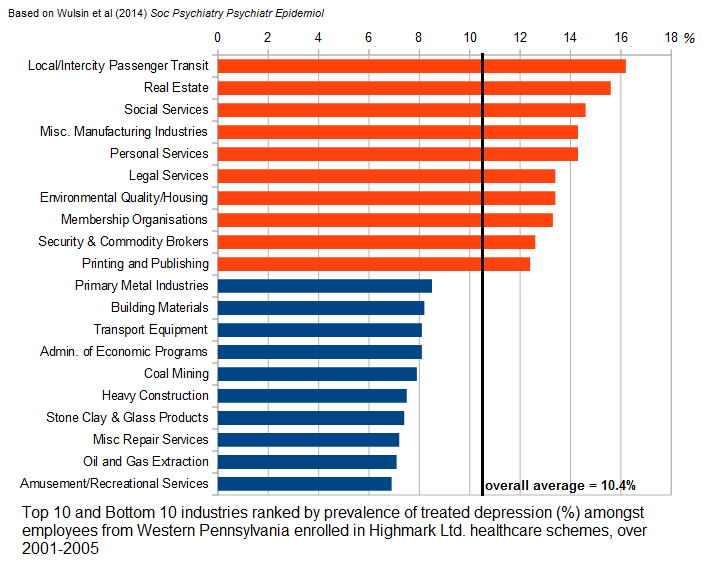
A recent study measured mental health on the job, drawing from insurance care records in Western Pennsylvania:

Looking at the chart above, the items in blue represent those industries in which depression is reported the least, while the ones in red report the most. So, people working in passenger transit, real estate, and social services are among the most affected by clinical depression, while those working in amusement/recreational services, oil and gas extraction (who knew?), and miscellaneous repair services are among the least affected.

According to the researchers, “Rates for clinical depression in 55 industries ranged from 6.9 to 16.2%, (population rate = 10.45%). Industries with the highest rates tended to be those which, on the national level, require frequent or difficult interactions with the public or clients, and have high levels of stress and low levels of physical activity.”

Neuroskeptic nods:

Which makes intuitive sense if you go with the idea that those are actually more depressing jobs, i.e. that they cause depression, rather than (a weaker claim) just being correlated with it or (weaker still) being correlated with people reporting it to their doctors.

However, is that true the world over or is it just a Westsylvania thing? It’s interesting to contrast this paper to one I blogged about in 2012. That study showed that, in the UK, blue collar occupations were amongst those with the highest rates of suicide, over the period of 2001-2005. Coal mining occupied the #1 spot in the British suicide rankings but in Western Pennsylvania, remember, coal miners had amongst the lowest rates of treated depression.

A Big Wynne For Equality

A reader relays the great news from up north:

As you may now be aware, Kathleen Wynne was just elected premier of Ontario, Canada’s largest province (representing over 40% of the national population). That makes her the first woman to lead Ontario, and the first openly gay politician to lead a provincial government in Canada.  This is despite winning the leadership of a tired and scandal-ridden Liberal Party only 18 months ago (the Liberals had been in power since 2003), AND where the previous premier, Dalton McGuinty, had resigned in disgrace.

Premier Wynne’s sexual orientation NEVER came up during the campaign, and her wife Jane was with her every step of the campaign trail (including on the victory stage last night).  No one predicted the size of her victory, and the pundits were falling all over themselves last night describing her “authenticity” and “immense charm,” and referring to her as “everyone’s favourite aunt.”  Yesterday I voted for our openly gay transportation minister (Glen Murray, the former Mayor of Winnipeg) who represents the riding of Toronto Centre, and our first directly elected lesbian premier.  I am old enough (47) to remember when marching in the Toronto Pride parade was a little bit dangerous.

I believe Ontario (pop. 14 million) is now the largest jurisdiction in the Western world to have an openly gay leader, after Belgium (pop 11 million) and Iceland (pop 350,000).  Know hope!

Update from a reader:

Regarding this: “I believe Ontario (pop. 14 million) is now the largest jurisdiction in the Western world to have an openly gay leader, after Belgium (pop 11 million) and Iceland (pop 350,000).” Annise Parker, mayor of Houston (pop 2.161 million) is way ahead of the leader of Iceland.

Previous Dish on Parker here.

The Best Of The Dish This Weekend

ISIS-Salahaddin-Division-WC-12-thumb-560x317-3199

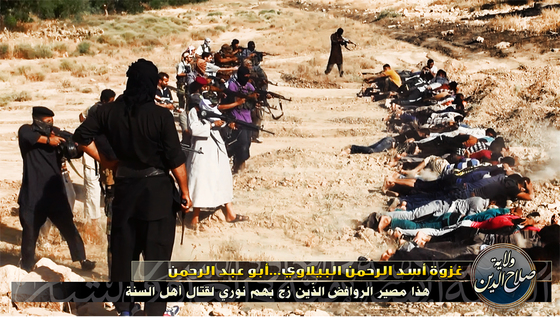
We can only hope and pray that the summary executions of members of the Iraqi army shown above and here are not what they appear to be. Because what they appear to be is an incendiary attempt to reignite the most brutal and vicious of sectarian wars. On that front, the sudden attempt by Ayatollah Sistani to rein back in his call to arms last week in order to avoid the worst type of sectarian conflict does not bode well either. Our coverage on Saturday is here and here.

My only and continuing concern is that we do not continue to believe, as Tony Blair apparently does, that further Western intervention on any side – Iran’s? Assad’s? Saudi Arabia’s? it gets surreal when you play it all out – can do anything but hurt us. The lesson to be drawn from the last decade is not that we somehow managed to pull off the impossible in Iraq and then, for some unfathomable reason, it fell apart, but that Iraq itself is a deeply divided country, has long been riven by sectarian hatred, was constructed precisely to exploit those divisions, and, without thorough secularization, is impossible to govern in one piece without despotism.

This is what we discovered while occupying it, and lifting up the rock on ancient, deep and resurgent cycles of sectarian fear and revenge. And if we could not truly change that deep dynamic with over 100,000 troops in the country over a decade at the cost of trillions – and it was an impossible task – there’s no way it can be changed with some weapons or humvees. Just look at who has our weapons and humvees now anyway: ISIS.

You have two choices there: a dictator or a constantly simmering civil war. And they tend to go together over time.

On saner, calmer notes, we introduced the poetry of Kevin Simmonds this weekend (here and here); the great Alan Watts explained what God is; Los Angeles never looked so serene; and someone actually had the bright idea of getting the government to create a safe and cool designer drug.

The most popular post of the day was Iraq: You Broke It, You Bought It? followed by Our Cold Civil War intensifies.

See you in the morning.

1,700 Slaughtered?

ISIS-Salahaddin-Division-WC-10

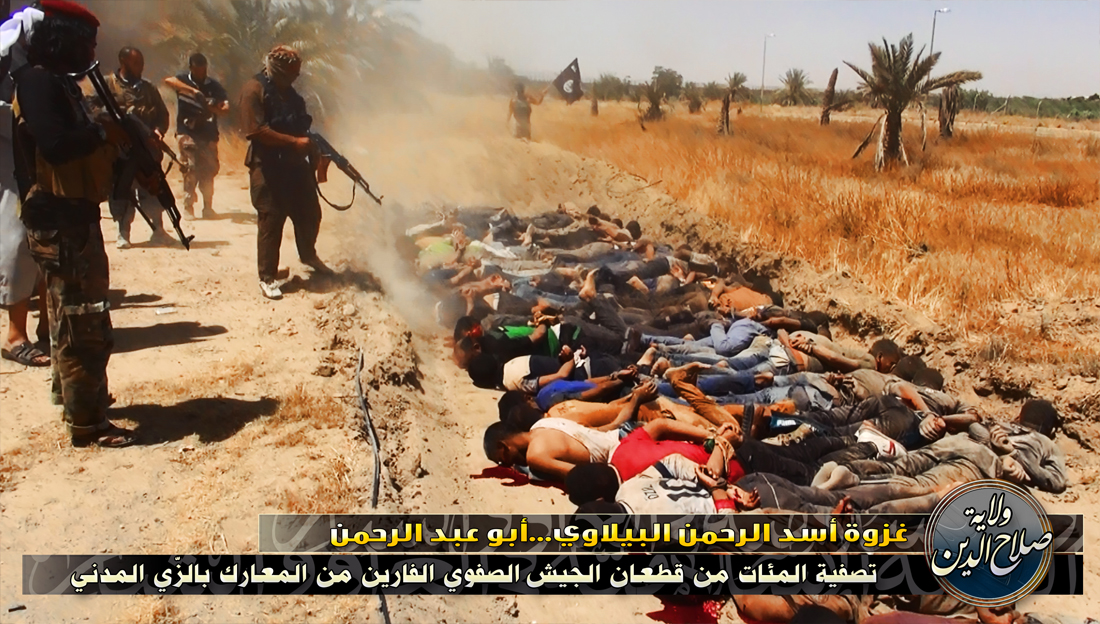
That’s the number ISIS claims to have killed in its ongoing rampage through Iraq. Yesterday the group released a disturbing series of images they claim shows the capture and execution of numerous Iraqi troops last week. Bill Roggio has full details. A glimpse from the NYT:

The photographs showed at least five massacre sites, with the victims lying in shallow mass graves with their hands tied behind their backs. The number of victims that could be seen in any of the pictures numbered between 20 and 60 in each of the sites, although it was not clear whether the photographs showed the entire graves. Some appeared to be long ditches. The photographs showed the executioners flying the ISIS black flag, with captions such as “the filthy Shiites are killed in the hundreds,” “The liquidation of the Shiites who ran away from their military bases,” and “This is the destiny of Maliki’s Shiites,” referring to Prime Minister Nuri Kamal al-Maliki.

If the alleged executions prove accurate, the atrocity would surpass Assad’s chemical weapon attack in Syria last year, which killed 1,400:

The latest attack … would also raise the specter of the war in Iraq turning genocidal, particularly because the insurgents boasted that their victims were all Shiites. There were also fears that it could usher in a series of reprisal killings of Shiites and Sunnis, like those seen in the Iraq war in 2005-7.

A reputable theory explaining the publicity ISIS seeks with these photos: