Face Of The Day

slide_350349_3760098_face

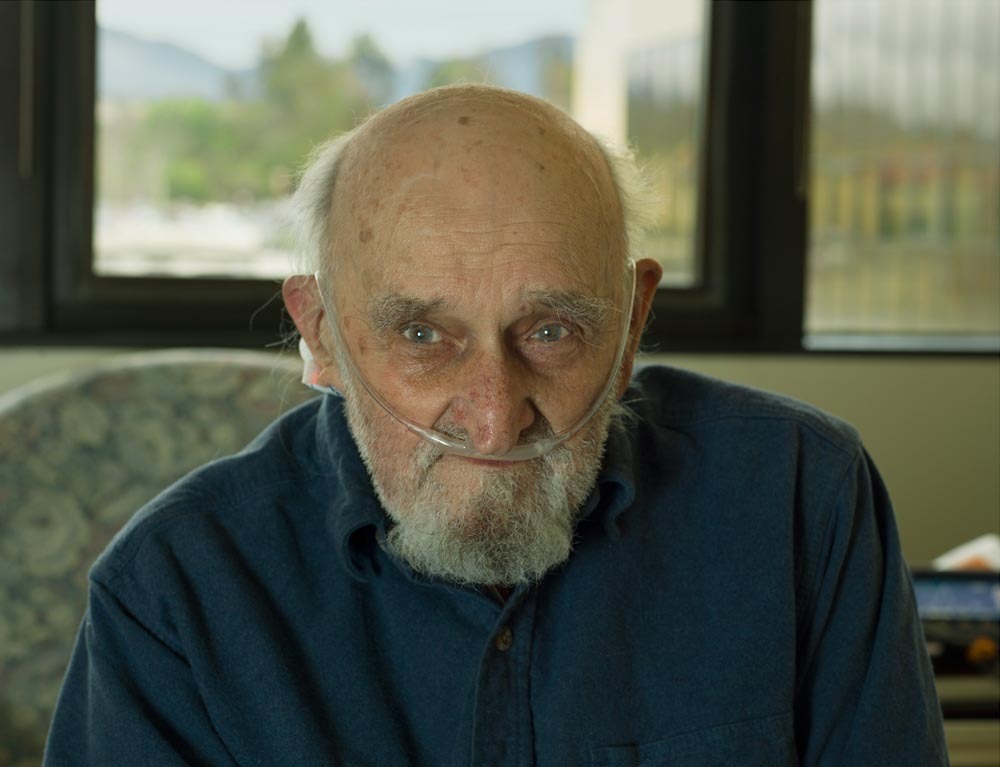
Andrew George photographs people at peace with their impending deaths:

“When the idea for this project came to me, the mother of a friend had recently passed away and at her memorial, I marveled at how there was so much genuine love for her,” George explained to The Huffington Post. “I began to wonder what it was about this woman that brought that out. She had this magic in the clear and wise way she spoke and never took herself too seriously. She laughed more than anyone I knew, reacted with sincerity and interest to her friends, and had so much passion in her fearless curiosity to travel and explore different cultures of the world. She was, quite simply, one of the best people I’ve known, yet, regrettably, was no one you’d ever learn about if you didn’t know her because her material accomplishments did not include fame.”

See more of the project here and more of George’s work here.

Happy Father’s Day! Now Get Back To Work.

James Poniewozik stresses the need for paid paternity leave:

A new study from the Boston College Center for Work and Family has found that new dads take paternity leave only to the extent that they’re paid to – i.e., not a lot. As the Washington Post reports, the majority of men who get two weeks’ paid leave take two weeks, those with three weeks take three, and so on. And per the Families and Work Institute, those lucky guys are few; only 14 percent of employers offer any pay for “spouse or partner” leave, compared with 58 percent for maternity leave (mostly through temporary disability insurance and very rarely at full salary).

Bryce Covert digs into the new research:

The report notes that in a study of 34 developed countries, the United States is one of just two that doesn’t ensure all fathers can access paid family leave. Here, both parents are only guaranteed 12 weeks of unpaid leave for the arrival of a new child, but even that only covers about half of all workers thanks to restrictions. Only 12 percent of workers get paid leave through their employers, although three states — California, New Jersey, and Rhode Island –  have instituted paid family leave programs for everyone. This past December, Sen. Kirsten Gillibrand (D-NY) and Rep. Rosa DeLauro (D-CT) introduced a bill that would give all workers access to paid family leave.

A past study from the Center for Work & Family found that 85 percent of fathers still take time off when their child arrives, but three-quarters take a week or less. California’s experience, meanwhile, backs up the most recent survey’s finding that paid leave increases leave taking. Just 35 percent of fathers took leave before the program began, but now three-quarters do, taking an average of three weeks.

Jena McGregor adds:

The vast majority of respondents – 86 percent – said they wouldn’t use paternity leave or parental leave unless they were paid at least 70 percent of their normal salaries. Roughly 45 percent said they wouldn’t use it unless they received all of their regular pay. Much of the explanation for those numbers is likely an economic one, as many of these fathers may be the primary breadwinner in their families.

Meanwhile, Aaron Gouveia praises his employers for letting him take paid leave as a new father:

By the time my second child was born last year, I had switched companies and had access to two weeks of fully paid paternity leave in addition to vacation time — all of which I was encouraged to take if I needed it. That extra time (and positive company attitude) was invaluable to me; it gave me peace of mind.

I was able to take care of my wife. I was able to supervise my oldest’s transition from only child to big brother. But most importantly, I was free to bond with my baby. I held him, changed him, got up at night to support my wife during feedings, learned his sounds, and developed a routine. Whether it’s moms striving for perfection or dads being hesitant (or already back at work) during those first few weeks, uninvolved dads lose out on so much of that initial experience that serves as a foundation for fatherhood. But paternity leave allowed me to be an active participant in parenting, as opposed to a bystander.
A Ledger For The Soul

death-and-the-miser

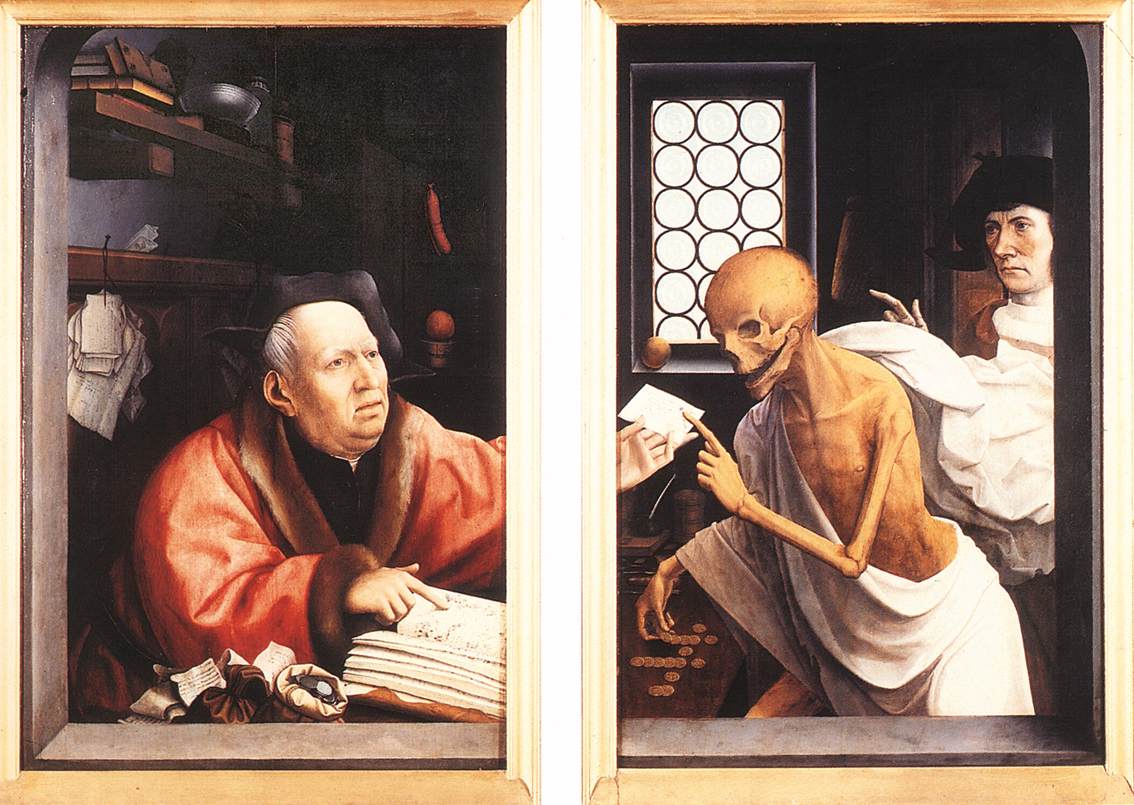
Jacob Soll explores the penchant 16th and 17th century Dutch artists had for portraying accounting in their paintings, claiming that “the tradition of accounting in art shows just how much is at stake in ‘good accounting,’ and how much society can gain from seeing it, like the Dutch, not just as a tool but as a cultural principle and a moral position”:

Double-entry accounting made it possible to calculate profit and capital and for managers, investors, and authorities to verify books. But at the time, it also had a moral implication. Keeping one’s books balanced wasn’t simply a matter of law, but an imitation of God, who kept moral accounts of humanity and tallied them in the Books of Life and Death. It was a financial technique whose power lay beyond the accountants, and beyond even the wealthy people who employed them.

Accounting was closely tied to the notion of human audits and spiritual reckonings. Dutch artists began to paint what could be called a warning genre of accounting paintings. In Jan Provost’s “Death and Merchant,” a businessman sits behind his sacks of gold doing his books, but he cannot balance them, for there is a missing entry. He reaches out for payment, not from the man who owes him the money, but from the grim reaper, death himself, the only one who can pay the final debts and balance the books. The message is clear: Humans cannot truly balance their books in the end, for they are accountable to the final auditor.

(Image: Death and Merchant by Jan Provost, via WikiArt)

The Sons And Daughters Of Abraham

Pulitzer Prize-winning playwright Ayad Akhtar, whose The Who And The What recently opened in New York, considers the similarities between Jewish and Muslim identity, particularly in America:

My relationship to Jewish artists and writers began when I was very young. It started with Chaim Potok, and in college I discovered Saul Bellow, Philip Roth, Woody Allen, Seinfeld. All of that stuff was hugely influential in helping me think about my experience. There seemed to be so many commonalities; I found myself and my community in those works, oddly.

I think there is a lot of continuity between the Jewish and the Islamic traditions. We know this historically, though people don’t want to talk about that – especially Muslims. There is a common source for both Judaism and Islam, or let’s say that Islam finds its source in Judaism. The commonalities of practice and sensibility, ethos and mythos, create a lot of overlap.

Post-9/11, the notion of “Muslims” taking on a potential truculence [corresponds to] – although it’s different – ways in which Jews were seen pejoratively within dominant Western cultures. Something about the orientation of faith being your identity marker as opposed to nationality or ethnicity. Post-9/11, that is an issue: folks get labeled “Muslim” no matter where they’re from. If you are Muslim, then that is part of it, but here’s the complicating factor for me: growing up, the only part of my identity that mattered was being Muslim, and I knew that. Being Pakistani was not as important as being Muslim. So the black guy whom I met who’s a Muslim, I’m much closer to him than the Christian Pakistani guy who is my dad’s friend. We have a closer bond. This was innate to me as a kid.

I don’t know what it’s like to be Jewish, but I suspect there is some aspect of that: being Jewish is the thing that bonds you as opposed to being Jewish from Poland, or Jewish from Hungary.

Pop Rocks

Jillian Mapes reflects on the musical taste she inherited from her father:

These days, there’s a phrase for the classic rock my Baby Boomer father raised me on: Dad Rock. Some say Dad Rockers are forever stuck in 1976 or 1985 or even 1994, when the music was real, man. Prominent in Urban Dictionary’s most up-voted definition of Dad Rock is this phrase: “Dad Rockers have no desire to listen to recent music and are stuck in the past.” But I can assure you it is possible to teach an old dad new tricks when it comes to matters of rock ‘n’ roll.

I prefer this definition from Wilco’s Jeff Tweedy, the leader of a band often dubbed New Dad Rock: “When people say Dad Rock, they actually just mean rock. There are a lot of things today that don’t have anything to do with rock music, so when people hear something that makes them think, ‘This is derived from some sort of continuation of the rock ethos,’ it gets labeled Dad Rock. And, to me, those people are misguided. I don’t find anything undignified about being a dad or being rocking, you know?”

Mapes’ advice for teaching an old dad new tunes:

The key is to mix familiar sounds and structures (perhaps a current band who makes room for guitar solos) with something new or slightly experimental (could be as simple as electro-pop synths). Still, if your Dad Rock dad was as obsessive over music as my pops was in his day, trust that his tastes are not as narrow as they may seem now that he’s past his prime music discovery years. (My dad said that for the typical music fan, keeping up with new music slides off the priority list when you have kids and you settle in hard with your all-time favorites.) Present a wide array of new music and see what sticks. It may be a chart-topping rap song about money-grubbing groupies, or it may be the new War on Drugs album (which I will be sending dad).

More suggestions here.

(Video: Bruce Springsteen, Dad Rocker extraordinaire, performs “The River” in 1980)

Fairy Tales Can’t Come True

So Richard Dawkins would rather do without them:

Speaking at the Cheltenham Science Festival, Dawkins, a prominent atheist, said that it was ‘pernicious’ to teach children about facts that were ‘statistically improbable’ such as a frog turning into a prince. … Speaking about his early childhood he said: “Is it a good thing to go along with the fantasies of childhood, magical as they are? Or should we be fostering a spirit of skepticism?” “I think it’s rather pernicious to inculcate into a child a view of the world which includes supernaturalism – we get enough of that anyway,” the 73-year-old said. “Even fairy tales, the ones we all love, with wizards or princesses turning into frogs or whatever it was. There’s a very interesting reason why a prince could not turn into a frog – it’s statistically too improbable.”

Nothing but Zola for the kiddies, then? Gracy Olmstead ripostes:

[T]his is the argument for fairy tales that I don’t think you’ll like – because the more you appreciate the pattern and beauty, the magic and charm of the empirical world, the less likely you are to chalk such things up to statistical probabilities. When you see the wonder of nature and people, the potency of words, the luminosity of our world, it’s very hard to return to a merely statistical, empirical vision. Things do become enchanted and mysterious. We begin to consider visions and miracles. These things are very dangerous, so I can understand why you’re alarmed by them.

Perhaps you’re right – perhaps it’s better for us to just abandon the tales and fantasies. After all, the more we dabble in “creating worlds,” the more likely we are to consider whether our own world had a Creator. The more we construct and tell stories, the more likely we are to ponder the possibility of our own Storyteller.

Update from a reader:

On one hand, I’m amenable to what Dawkins is saying. But the death of the fairy tale is the death of science. The actual practice of being a scientist who advances knowledge demands a kind of imagination, creativity, and questing that can’t be contained in a regression equation. The tools we use to prove hypotheses are profound in their own right, but inculcating a sense of magical possibility and hidden reality in children is the first necessary condition in preparing them to make the next generation of rigorously tested leaps forward.

The Good Book, Without God

Valerie Tarico asked a number of prominent atheists and secularists what their favorite verses in the Bible were, reasoning that “if clear-eyed Christians can take the risk of exposing the Bible’s nasty bits, the converse should also be true—atheists should be able to acknowledge the parts that are timeless and wise.” Greta Christina, author of Coming Out Atheist, was one of a number of respondents who pointed to Ecclesiastes:

I actually have an entire favorite book: Ecclesiastes. There’s lots of beautiful stuff in it about nature, human nature, and good ways to live life. It has plenty of stuff I have serious problems with, too — the God stuff, obviously, and some other stuff as well — but much of the philosophy and poetry is quite lovely and moving. And much of it is oddly humanist, with an awareness of how small humans really are in the scheme of things, and how fragile our lives are, and the absurdity of how important we think we are (“all is vanity”), and how much our lives are shaped by chance, and the repeated reminders of our mortality.

I deeply love 4:9-12: “Two are better than one; because they have a good reward for their labour. For if they fall, the one will lift up his fellow: but woe to him that is alone when he falleth; for he hath not another to help him up. Again, if two lie together, then they have heat: but how can one be warm alone? And if one prevail against him, two shall withstand him; and a threefold cord is not quickly broken.”

Passages about social justice also appeared with some frequency. Here’s Kim Veal’s selection:

I sometimes read Gospel passages in the tradition of Zen koans. I like John 14:2, where Jesus says, “In my Father’s house there are many mansions.” Holding the paradox of many mansions inside a house gives me a sense of spaciousness, of welcome, of saying, “Everyone can find a home in my heart.” I have no idea if that’s what Jesus meant—it doesn’t seem to be what Christians mean sometimes—but it reminds me that we’re all one grand, human family and that we need to care for each other.

A Poem For Sunday

2410771182_33507e1383_b

“Soon I will be done” by Kevin Simmonds:

Negro Spiritual

I go down where it’s still sung
by the mother of the block
lifting her tremulous contralto
from the screened porch that leans
such that the latch won’t lock

I’ve grown mean without its milk
that saved masters from their slaves
salve rubbed into the pink tears
where rot should’ve set in
the revolt

Ask some black kid if they know it
& they might say the title
rings a bell but that doesn’t matter
it runs mad in the ruby fractals
of their capillaries & in their spit

Never mind the tempo, child
the stride began with Soon
from your upbeat
of breath & the ancestors
already galloping

(From Bend to It © Kevin Simmonds, 2014. Reprinted with permission by Salmon Poetry. Photo by Jennie Zell)

Reading The Bible With Fresh Eyes

The Anglican theologian and priest N.T. Wright explains why he understands scripture’s place in the Christian life in dynamic, rather than static, terms:

One of the wonderful things about the Bible is the way no generation can complete the task of studying and understanding it. We never get to a point where we can say, “Well, the theologians have sorted it all out, so we just put the results in our pockets or on the shelves, and the next generation won’t have to worry — they can just pull it out and look it up.” No, the Bible seems designed to challenge and provoke each generation to do its own fresh business, to struggle and wrestle with the text. I think that is the true meaning of the literal sense, in Augustine’s sense of “what the writers really meant”: we have to acquire those old eyes, the historian’s quest to understand Genesis and Matthew and Romans in their historical context. I know that is strongly resisted today by many conservatives, but this is ridiculous: without historical inquiry, parallels, lexicography, and so on, we wouldn’t even be able to translate the text.

And, yes, I know that there are many secularizing biblical scholars, and indeed many left-brain dominated conservative ones, who produce a kind of biblical scholarship that the church either shouldn’t use or couldn’t use. But just because the garden grows weeds, that doesn’t mean we shouldn’t plant fresh flowers, instead paving the whole thing over with concrete. No, each generation must do its own fresh historically grounded reading, because each generation needs to grow up, not simply to look up the right answers and remain in an infantile condition.

Recent Dish on Wright’s work here and here.