The Known Unknowns About Bowe Bergdahl, Ctd

Was he actually a bit of a gung-ho warrior? As I noted last night, further reporting keeps complicating the Palinite meme:

To many of those soldiers, Sergeant Bergdahl was viewed as standoffish or eccentric, smoking a pipe instead of spitting tobacco, as so many soldiers do, and reading voraciously when others napped or watched videos. But he was not isolated from his platoon Screen Shot 2014-06-09 at 10.18.38 AMmates, some said. And while he was, like other soldiers in the platoon, often disappointed or confused by their mission in Paktika, some of his peers also said that Sergeant Bergdahl seemed enthusiastic about fighting, particularly after the platoon was ambushed several weeks before his disappearance.

“He’d complain about not being able to go on the offensive, and being attacked and not being able to return fire,” said Gerald Sutton, who knew Sergeant Bergdahl from spending time together on their tiny outpost, Observation Post Mest Malak, near the village of Yahya Khel, about 50 miles west of the Pakistani border. Mr. Sutton said he had struggled to square the popular portrayal of Sergeant Bergdahl as brooding and disenchanted with the soldier he knew. “He wanted to take the fight to the enemy and do the mission of the infantry,” he said, adding, “He was a good soldier, and whenever he was told to do something, he would do it.”

But Carpenter expects the right to stick to its story without regard for the evidence:

The Times adds that “Just how and why Sergeant Bergdahl disappeared remains a mystery to his fellow soldiers.” But it’s no mystery to the right. They have their story and they’ll stick to it–no matter how thumpingly it unravels–because not only does it mesh with their history of Obamian horrors, it must mesh.

Meanwhile, Tomasky knocks down the meaningless notion that “we don’t negotiate with terrorists”:

Every president since has said we don’t negotiate with terrorists. And every president has. And I would say prudently and reasonably so. When terrorists can give you information, for a certain price or because you have a shared enemy, take it. George W. Bush paid a ransom of $300,000  to a radical Islamist group in the Philippines that was holding two American missionaries, a married couple, captive. To get them to safety? I say, fine. Alas, however, the man was killed, even after we paid the money. So an American president ended up financing terrorist operations and overseeing a failed military mission. Imagine what Lindsey Graham would be saying today if Barack Obama had done that over the weekend.

It’s a mindless, right-wing electoral politics that make our politicians say “I won’t negotiate with terrorists.” It’s just like “I won’t let the Willie Hortons out of prison,” or, from an earlier time, “We won’t let the ChiComs take over Korea.”

David Rohde, who was kidnapped by the Taliban around the same time as Bergdahl and subsequently escaped, weighs in on our misguided approach to the issue:

Both sides in the furor over the Bergdahl case offer simplistic answers to the growing problem of abductions. Those who say the release of the five prisoners sets no precedent are downplaying the scope of this propaganda coup for the Taliban. Other militants around the globe will likely emulate them. At the same time, the argument that refusing to pay ransom or release prisoners will end all kidnappings is wishful thinking. Given the delusions of my captors, jihadists will remain convinced for years, if not decades, that secret ransoms are being paid.

The real solution would require a massive and difficult long-term effort to reduce the world’s pockets of ungoverned spaces. The Taliban who held Bergdahl and me felt no pressure to reduce their demands because they had a safe haven in the mountains of Pakistan.

And Dexter Filkins wonders about the extent of Pakistan’s involvement in the Bergdahl case:

So far, Pakistani officials have been silent about any role they played in either Bergdahl’s captivity or his release. But there are many questions that need to be answered. The Haqqani network, the group that was holding Bergdahl, maintains especially close ties to Pakistan’s Inter-Service Intelligence, or I.S.I. (The Taliban official who told me about Bergdahl was a leader of the Haqqani group.) That a Taliban-aligned guerrilla unit would be so closely tied to the government of our ostensible ally—to which we give more than a billion dollars each year—has long raised troubling questions about American policy in the region. …

Given the close connections that the I.S.I. maintains with the network, it seems inconceivable that the organization wasn’t well aware of Bergdahl’s condition, status, and whereabouts. Did the I.S.I. try, over the years, to free him? We don’t know. Could Pakistani intelligence officials have done more to help him? Did they do nothing? Likewise, we don’t know. Were they involved, and perhaps even instrumental in, gaining his final release? We don’t know. But, given the amount of American money that flows into Pakistan, we’re entitled to ask.

Recent Dish on the evolving Bergdahl story here. My take on the right’s hysterical reaction here, here, here, and here.

(Photo: a reaction to the military’s difficulties in interviewing someone immediately after five years of sometimes brutal captivity and stress.)
Curbing Memorial Sprawl

Screen Shot 2014-06-05 at 10.33.07 AM

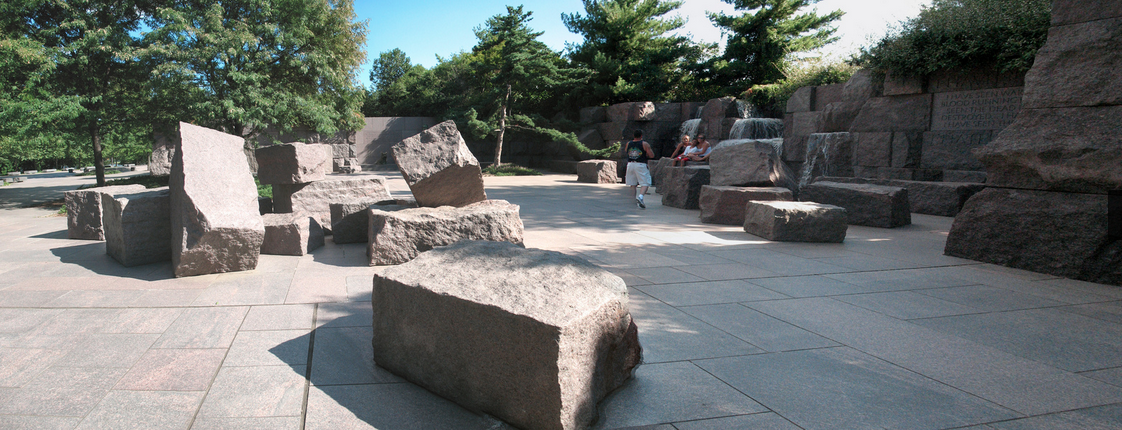
Catesby Leigh raises an eyebrow over proliferating monuments:

In prehistoric times, when people wanted to commemorate something or someone, they erected a monument—even if it was nothing more than an upright slab or heap of stones. Elaborating on those origins, traditional architecture would come to embrace an array of monumental forms readily recognizable for their symbolic import. As a result, the Washington Monument is an obelisk, the nearby Lincoln and Jefferson Memorials are temples, Eero Saarinen’s Gateway Arch in St. Louis is a modernist rendition of a triumphal arch and Felix de Weldon’s Marine Corps War Memorial in Arlington, Va., a realist sculptural composition. All mine the monumental vein in one way or another.

But more recently we have seen a remarkable shift from the vertical to the horizontal, with a significant number of major memorials designed as places rather than objects. They are symptomatic of a civic-art disease: memorial sprawl. Memorials are now sprawling both physically and conceptually—and becoming unnecessarily expensive in the bargain.

Previous Dish on memorials here.

(Photo of the FDR Memorial in Washington, DC, via Mike Boucher)

How Unhealthy Is Your Sweet Tooth?

honey-booboo

James Hamblin takes a close look at the literature on sugar, high-fructose corn syrup, and agave:

Barry Popkin, who was investigating fructose long before [Dr. Robert] Lustig, recommends caution. Popkin, a distinguished professor of nutrition at the University of North Carolina, co-authored a widely-read academic article in 2004 titled “Consumption of High-Fructose Corn Syrup in Beverages May Play a Role in the Epidemic of Obesity.” That paper was followed by many popular articles that cited it, and a lot of research down this road. But he didn’t mean for it to lead to all-out fructose terror.

All that Popkin really wrote in the original article was that metabolism of fructose, unlike glucose, favors production of fat in our livers. That leads to a fatty liver, a condition that affected at least 70 million Americans at the time, and affects many more now. Fatty liver is linked to insulin resistance and cardiovascular disease.

But the science is far from settled:

The amount of sugar Americans consumed before the late twentieth century was trivial compared to what we eat today, Popkin noted. “We’re in a whole new world of sugar consumption. It’s not just beverages; it’s in all the foods. And we don’t really know what that means to our health. We know that we face an epidemic of things like fatty liver disease. Not just obesity, not just diabetes, but many other problems that could potentially be related to all the sugar. We think from some studies that fructose could be responsible, but we don’t have slam-dunk evidence on any of it.”

Relatedly, German Lopez flags a report on the effectiveness of a soda tax:

A new study published in the American Journal of Agricultural Economics found that adding a tax of 0.04 cents per calorie of sugar on drinks — the equivalent of nearly 6 cents for a 12 ounce can soda — would drive Americans to drink 5,800 calories less in sweet drinks each year. That reduction is roughly two days worth of the recommended number of calories.

A Bot That Blushes

Katerine Kravtsova reports from Moscow’s “Robot Ball”:

Of all those at the ball, one of the most human-like is RoboThespian, a life-size humanoid robot created by British engineers to perform on stage and to provide guided tours in museums. Unlike robots like Cubic, designed for domestic servitude, RoboThespian is intended to entertain and educate. It can be controlled via an online interface from anywhere in the world, interact with humans independently by scouring the internet for answers to questions, recognise faces, sing and dance. The gracefully moving machine can be bashful, friendly or bored depending on the situation. It can even blush when an attractive woman walks past. “Android robots such as Thespian demonstrate well the full range of technologies available,” says [exhibition organizer Igor] Nikitin.

Although the technology is developing at a rapid pace, it’s still a long way off before robots will be able to develop and display emotions in the same way as humans. Last year, British scientists developed the Experimental Functional Android Assistant, or efAA, a socially intelligent humanoid that has been designed not only to recognise and respond to human emotion but also to develop empathy. “It’s quite possible to have robots that exhibit strong emotions,” says Ray Taylor, one of the exhibition’s organisers. “And it will be possible to teach robots to be able to identify human emotions in the future.”

Please Keep Your Seatbelt Fastened

But don’t freak out over turbulence:

For all intents and purposes, a plane cannot be flipped upside-down, thrown into a tailspin, or otherwise flung from the sky by even the mightiest gust or air pocket. Conditions might be annoying and uncomfortable, but the plane is not going to crash. Turbulence is an aggravating nuisance for everybody, including the crew, but it’s also, for lack of a better term, normal. From a pilot’s perspective it is ordinarily seen as a convenience issue, not a safety issue. When a flight changes altitude in search of smoother conditions, this is by and large in the interest of comfort. The pilots aren’t worried about the wings falling off; they’re trying to keep their customers relaxed and everybody’s coffee where it belongs. Planes themselves are engineered to take a remarkable amount of punishment, and they have to meet stress limits for both positive and negative G-loads. The level of turbulence required to dislodge an engine or bend a wing spar is something even the most frequent flyer—or pilot for that matter—won’t experience in a lifetime of traveling.

Update from a reader:

Check out China Airlines Flight 006. Air Crash Investigation (best. show. ever.) did a whole show on this a while ago. Just watch the first minute of that. Blows my mind that that’s survivable. I used to be really afraid of flying. Somehow this show has made me way less stressed about it.

Map Of The Day

Screen Shot 2014-06-05 at 10.41.44 AM

Cartographer Kenneth Field was inspired by a U2 song:

The map shows, according to Field, all 3.5 million streets with no name (which are highlighted in gold, à la the album art). … According to the map, Bono should stick to rural areas, while avoiding Vermont and Maine. The Joshua Tree album art was photographed in the Mojave Desert, but if Bono really wanted to show you “a place high on the desert plain …” with lots of unnamed roads, the map suggests that perhaps he should have stuck to the High Plains and Great American Desert of Texas.

See Field’s website here and blog here.

MoDo-Proofing Edibles, Ctd

First, a few of the many tweets that followed “Thomas Friedman eating brownies with his daughter’s roommate at Yale”:


The whole brilliant parody is here. Meanwhile, a reader gets serious:

Dowd’s edible OD sounds a bit like my experience this year in Seattle. While the legal pot retail outlets have not yet opened, some entrepreneurs just dived into the murky legal gray area and started selling pot direct to consumers. I tried out Winterlife Co-op a couple months ago after reading about it in The Stranger and experienced both the improvements and pitfalls of legalization.

The good part: I got to look up the varieties on their online menu to see reviews and descriptions on leafly.com and settled on Sour Grapes, which has lived up to its great reviews. The delivery guy drove out to my apartment and we made the trade in his truck, where he had a whole cabinet of inventory neatly wrapped and labeled. I bought a quarter ounce of pot for what seemed a fair price, and threw in one chocolate edible for laughs. It was all thrilling but felt very safe and legit. The pot quality was miles above the crud I’d had on the east coast.

The not-so-great part:

During intermission at the Pacific Northwest Ballet, the missus and I split the little chocolate edible (no bigger than a miniature York patty). It had no dosage instructions, and it was so small I figured after splitting it we might just enjoy the scenery of a Midsummer Night’s Dream a little more intensely.

Wrong. I just started feeling odd toward the end of the show, an hour later. Soon after getting home, I was reeling with dizziness, and my mind couldn’t maintain a train of thought for more than a few seconds. Kneeling down to leash the dog for a short walk, I almost just toppled over. By that time the missus was in bed, and I flopped down as soon as the dog was walked, figuring I’d fall and hit my head if I kept walking around. I watched the walls spin up into the ceiling, then reset and spin again, over and over. It reminded me of my drunkest nights in freshman year of college, but a little less nauseous. Eventually the spinning slowed down enough for us to drift off.

My takeaway? As a consumer: eat edibles in the smallest possible increments, ramping up till you get the feeling you want. Don’t think just cause you’re a big guy you’ll need a lot (or even half a York patty’s worth). As for policy: yeah, some sort of labeling, with contents and dosage recommendations, would be a great place to start with edibles. I’ve smoked pot maybe 15 times before in my life and this felt like an entirely different, more potent drug.

I do think that buying it in such a normalized manner, like a pizza delivery, made me more trusting and naive. I probably wouldn’t have tried it alone the first time otherwise; like most of my early pot experiences I would have done it with a trusted friend who could guide me through what to expect. I’m usually not an idiot but some idiot-proof labeling would have helped me out on that chocolate.

Previous commentary on the regulation of edibles here.

The Best Of The Dish This Weekend

garden6

Some small part of me wants to see the instant-demonizers of Bowe Bergdahl proven horribly wrong. The likelihood, of course, is that the story of the still-mysterious soldier will produce only more ambiguities. But these little nuggets complicate the culture war paradigm in which a POW has been framed:

“He’s said that they kept him in a shark cage in total darkness for weeks, possibly months,” said one American official. CNN reported Friday that Sergeant Bergdahl said he was held in a metal box or cage, but the officials on Saturday offered new details. He was kept there apparently as punishment for one or possibly two attempted escapes, as first reported by the Daily Beast website last week and confirmed by an American official.

That kind of total sensory deprivation, and isolation is a form of torture … practiced by the Taliban and the US, a merging of values only made possible by the dark soul of Dick Cheney. Then there’s Bergdahl’s own resistance to the promotion awarded him in captivity – and used by the Palinites to attack one of those they usually defer to as generic heroes:

“He says, ‘Don’t call me that,’ ” said one American official. “ ‘I didn’t go before the boards. I didn’t earn it.’ ”

A tortured POW who tried several escapes who rejected any honors … well that isn’t quite the treasonous hippie the hard right wants to attack. And yes, attack:

Late Saturday, the F.B.I. said the Bergdahl family in Idaho had received threats. Federal agents, working with state and local law enforcement authorities, were “taking each threat seriously,” an F.B.I. statement said. Officials declined to give other details.

This weekend, we featured the poetry of Patrizia Cavalli – check out this terse account of loving someone you cannot really love. It’s a pretty good description of the relationship between Christopher Isherwood and Don Bachardy, thirty years his junior, but still somehow his full equal.

We grappled with the chimera of “happiness” – with a lovely, and very grown-up video from Adam Phillips and a haunting revisit of Philip Seymour Hoffman’s confusion on the subject.

We asked the following questions: should God be a stop-gap for when our understanding of the world fails? (No, according to Bonhoeffer.) Is it possible to feel empathy for non-practicing pedophiles? (It should be.) Are conservative churches finally going the way of liberal ones … and for the same, secularizing reasons? (Of course they are.) What do Augustine and O.J. Simpson have in common? (Confession.)

Plus: Tolstoy on life and faith; and the sacredness of salmon-fishing.

The most popular posts of the weekend were The Palinite Tendency and Bowe Bergdahl, followed by Compassion for Pedophiles.

It was a gorgeous June weekend on the Cape, where I am now ensconced for my annual – and 21st! – full summer in Provincetown. When I first get here each year, it’s always the same … just fighting every day to stay awake. Something about the place taps something deep inside and says: you’re home now; you can let your guard down; and rest. But not until Bowie has explored every cranny of the beach.

See you (and her) in the morning.

After The World Leaves

dish_Doskow

Jade Doskow photographs the remains of World’s Fair sites. In an interview, she explains the project:

For each site, research and development before the shoot plays a major role. Who were the key players — architects, designers, political figures — coordinating the fair? What important architecture was conceived and constructed specifically for it? Did this exposition permanently affect the reputation of that city (like the Eiffel Tower of the 1889 Exposition)? Is the remaining fair architecture still a monument, is it abandoned, is it repurposed, or was it demolished? These are all concepts that I consider very carefully before actually traveling to a shoot.

When I get to a site, I spend about 3-5 days shooting, scouting the area with an original fair map and retracing where the original structures would have once stood. The resulting images have come to show a wonderful variety and indicate the ultimate arbitrariness of urban preservation and collective cultural memory; in Paris, I photographed the Eiffel Tower; in Philadelphia, some lovely Victorian toilet buildings from 1876; and in Chicago, the empty place on the shore of Lake Michigan where the enormous 1893 Manufacture Liberal Arts building once stood.

See more of her work here.

“A Priest Of Eternal Imagination”

James Joyce elevated the role of writers by describing them in such terms. But he was less reverent toward actual priests:

James Joyce didn’t have much use for priests; he thought that priests like [“The Sisters” character] Father Flynn had lost their sight, their ability to focus their spiritual eye. Joyce’s characters often say things like, “We are an unfortunate priest-ridden race and always were and always will be till the end of the chapter. … A priest-ridden Godforsaken race” (A Portrait of the Artist as a Young Man). Like the rest of the Dubliners [in Dubliners], Father Flynn experiences his epiphanies, but is unable to reflect upon them, to know them. This is a task for artists.

In My Brother’s Keeper Stanislaus Joyce wrote of James:

“He believed that poets in the measure of their gifts and personality were the repositories of the genuine spiritual life of their race and the priests were usurpers.” If the priests ever knew eternal truths, the artist know[s] them now. The artist not only sees epiphanies, but makes them manifest by turning them into art. The artist, for Joyce, stands in the shadows with eyes and ears wide open, “like the God of the creation,” remaining “within or behind or beyond or above his handiwork, invisible, refined out of existence, indifferent, paring his fingernails.” Because artists have the gift of seeing they are especially called to notice epiphanies and, moreover, “to record these epiphanies with extreme care” as [Joyce’s character] Stephen Hero says. A writer, thought Joyce, is a kind of priest, “a priest of eternal imagination.” By collecting epiphanies the writer is “transmuting the daily bread of experience into the radiant body of everliving life.”