The Price We Paid For Bergdahl

Zack Beauchamp profiles the five Taliban commanders we freed in exchange for our POW:

Internal Pentagon reports label all of them “high risks” to the United States. These Screen Shot 2014-06-05 at 12.25.56 PMGuanatanamo dossiers, helpfully reviewed by Daily Beast reporters Eli Lake and Josh Rogin, suggest that some of them have links to al-Qaeda and Iranian plots against American troops in Afghanistan.

Independent experts are somewhat skeptical of these claims. [Afghan Analysts Network’s Kate] Clark, for one, calls the documents on the five inmates “peculiar, opaquely sourced and peppered with factual errors.” The “claims made in the Guantanamo Bay tribunals and in press reports sourced to un-named US officials,” she says, “frequently do not stand up to close inspection.” But even if we throw the US intelligence reports completely out the window, this prisoner swap should still be troubling. Even Clark concedes there’s good reason to believe [Mullah Mohammad] Fazl committed war crimes.

Eli Lake relays concerns from the intelligence community that Qatar, where the five detainees are being transferred, will accidentally-on-purpose lose track of them:

[T]here are other reasons U.S. intelligence officials are worried about Qatar. The emirate is a good place to raise money for terrorist organizations. Late last year, the Treasury Department placed sanctions on Abdul Rahman Omeir al-Naimi, a Qatari history professor and human rights activist, for raising hundreds of thousands of dollars for al Qaeda’s affiliates in Iraq, Somalia, and Yemen.

In March, David Cohen, the undersecretary of the treasury for terrorism and financial intelligence, said in a speech to the Center for a New American Security that while Qatar is a longtime U.S. ally, it also has “for many years openly financed Hamas, a group that continues to undermine regional stability.” Cohen also referenced press reports that indicated Qatar’s support for extremists in Syria. The State Department’s latest report on counterterrorism says that while Qatar has cooperated with the United States in some important areas of counterterrorism, its efforts to stop fundraising for terrorist groups have been inconsistent.

Like Greenwald, Sean Davis suspects that Bergdahl was just the administration’s cover for closing Gitmo:

It was never about Bowe Bergdahl. Make no mistake: judging by the behavior of the White House as this story has unfolded, the Obama administration’s primary goal was not the return of likely deserter (and rumored defector) Bowe Bergdahl. The primary goal was making it easier to finally shut down Guantanamo Bay, a 2008-era campaign promise that President Barack Obama was regularly mocked for failing to keep. Bowe Bergdahl was just the perfect political cover, or at least he was supposed to be.

Allahpundit is on the same page:

The “euphoria” Obama expected after Bergdahl’s release was supposed to be the perfume masking the stench from sending five lethal degenerates back into the jihadi ranks as a prelude to closing Gitmo entirely. Remember, he said in his State of the Union address in January that this was the year he wanted the prison shut down; that was one month after the ransom idea for Bergdahl had been dropped. Having resolved to exploit his lame-duck status to the fullest in 2014 and proceed with shuttering Gitmo, he recognized that Bergdahl would be better used as a consolation prize in handing over Taliban leaders than as part of some dubious ransom deal.

Bazelon criticizes Obama for his willingness to let these high-risk Gitmo prisoners go while dozens of others remain locked up indefinitely despite having been ruled innocent and harmless:

[W]hat about the suffering of Jihad Ahmed Mujstafa Diyab, the Syrian held in Guantánamo for 12 years without a trial, a man on the 2010 list of recommended transfers, who is being strapped against his will into a chair so a feeding tube can be forced into his nose and down his throat? The government doesn’t want to send Diyab back to Syria in the middle of the war there. Uruguay has offered to take him and five other detainees. Yet they’re still in Gitmo. As Andy Worthington writes at PolicyMic, for the 78 men cleared for transfer who remain imprisoned, “the release of the five Taliban prisoners is unlikely to cause anything but despair.”

P.M. Carpenter focuses on the nomenclature pundits are using to describe the “worst of the worst”:

Are the freed Taliban “warriors” terrorists? Were they prisoners of war? Are they jihadists? [the WaPo’s Kathleen] Parker conflates the three as though there are no distinctions to be bothered with, or troubled by. Yet the distinctions are critical ones; there’s a vast gulf in meaning between “prisoner of war” and “terrorist,” and even between terrorist and “jihadist.” … President Obama released prisoners of war, precisely as George Washington did. Such clarity might not kill the right’s outrage–would anything?–but it would contribute to more calm in the mainstream debate, which, at the moment, is hopelessly muddled and all over the road.

Will Saletan defends making the deal on the same basis:

Sgt. Bergdahl was not a noncombatant. He was a prisoner of war, captured on the field of battle. Therefore, by definition, his capture wasn’t terrorism. Negotiating for his release, trading enemy combatants for our own combatant, isn’t a concession to terrorism. It’s conformity with the long-standing tradition of exchanging POWs.

According to Sen. Ted Cruz, “The reason why the U.S. has had the policy for decades of not negotiating with terrorists is because once you start doing it, every other terrorist has an incentive to capture more soldiers.” That’s ridiculous. Terrorists didn’t invent the capture of soldiers. It’s a basic military objective, with a standard option to trade the enemy’s soldiers for yours. The reason not to negotiate with terrorists is to discourage the seizure of civilians, not the seizure of soldiers. So Obama’s critics are wrong to believe that negotiating for Bergdahl sends a dangerous message to terrorists. But they’re also ignoring the message his abandonment would have sent to our troops, their families, and prospective military recruits. It would have betrayed our pledge that if you’re captured in service to our country, we’ll free you.

But a Taliban commander close to the negotiations confirms that the Bergdahl trade makes his compatriots more eager to capture American soldiers:

“It’s better to kidnap one person like Bergdahl than kidnapping hundreds of useless people,” the commander said, speaking by telephone on condition of anonymity because he is not authorized to speak to the media. “It has encouraged our people. Now everybody will work hard to capture such an important bird.”

The commander has been known to TIME for several years and has consistently supplied reliable information about Bergdahl’s captivity.

Previous Dish on Bergdahl herehere, here, and here.

MoDo-Proofing Edibles

Gillespie offers a qualified defense of MoDo’s pot column:

Dowd’s column—and her admirable willingness to talk frankly about her experience in all its inglory—raises real issues about the process by which pot legalization will be vetted. The fact is, there’s a societal learning curve that’s every bit as real as individual learning curves. It takes a while, and oftentimes a lot of trials and errors, for a society to figure out how to deal with major changes (divorce, gender and racial equality, etc.).

The sooner we acknowledge that the end of pot prohibition will require a lot of conversation about what works well and what doesn’t, the faster than the new normal of “marijuana on Main Street” will be accepted for the huge leap forward in freedom and peace that it really represents.

Jon Walker suggests that “the ‘Maureen Dowd test’ be the new, unofficial metric by which [edibles] regulations are judged”:

If legalization advocates want to avoid a potential political backlash the regulations don’t just need to be sensible and easy for a regular person to understand, they need to be idiot-proof. They need to be so clear that even someone who goes to buy edibles with a Maureen Dowd level of ignorance can’t say they misinterpreted the instructions.

The Colorado legislature has already approved new laws intended to do just that. While some people might find it annoying that future labels may have extra large instructions, edibles won’t come in certain shapes, and that packaging will need to clearly separate individual doses; that is what is necessary to make something idiot-proof.

Alyssa is more sympathetic:

She got much higher than she wanted to because she made the not-unreasonable assumption that a candy bar was a single serving, eating the whole thing in one go. “A medical consultant at an edibles plant where I was conducting an interview mentioned that candy bars like that are supposed to be cut into 16 pieces for novices,” Dowd explains that she finds out later. “That recommendation hadn’t been on the label.”

It is one thing for experienced consumers to scoff at Dowd’s lack of knowledge. But she is not going to be alone, and asking for labeling or instructions is not unreasonable. Similarly, new marijuana consumers may look to analogous delivery mechanisms and social rituals when they are smoking joints for the first time, and expect that they ought to treat joints exactly like cigarettes.

Charles Pierce recalls “two less-than-pleasant experiences with marijuana and both of them involved eating the stuff rather than smoking it”:

These two episodes taught me two things — a) that, in terms of how quickly it hits you and how hard it hits you, eating dope is radically different than smoking it and, b) the only way to cope with the difference is to get the hell out of where you are and get out into the world in one way or another until your head settles down. The worst thing you could possibly do is determine that you will have your first serious marijuana experience by gobbling down an electric candy bar and then sitting there alone in your hotel room while waiting for the newspaper taxis to appear at your door, waiting to take you away.

Weissmann uses the the column to argue that “the cannabis business is probably the sort of industry that would be better off dominated by big, name-brand manufacturers”:

It’s perfectly fine to have government-mandated product testing. But it’s even better to have companies that mass produce a highly standardized product and are willing to invest in the technology to get it right every single time. From a safety perspective, you want a Hershey’s or Entenmann’s of edibles, rather than a hodge-podge of pot boutiques and small companies distributing locally. At the very least, we’d be better off with companies the size of large craft brewers, which tend to be more attentive to quality control than their tinier cousins, in part because they have the money to spend on it.

The Palinite Tendency And Bowe Bergdahl, Ctd

Senators Attend Briefing On Release Of Sgt. Bowe Bergdahl

This is now becoming quite a spectacle, and it’s hard not to see Tomasky as prescient when he immediately grasped how the Bergdahl rescue would galvanize so many. There is the legitimate concern that this was a bad deal, of course. But the following factors bear remembering: the war in Afghanistan is drawing to a close; since we went to war against the Taliban regime, their POWs require repatriation and release; finding a way to do that while also getting our one POW back to safety is a perfectly legitimate option for a commander-in-chief to weigh in negotiations for ending the war; and the military ethic of doing everything possible to retrieve POWs is extremely deep (reiterated by Dempsey and McChrystal in the last week).

There’s still room for a debate, of course, but that’s not what we are witnessing. We’re witnessing something much more primal – and it reaches deep into the id of the American right. Michelle Malkin, as is her wont, put it all together yesterday:

The Bowe Bergdahl mess isn’t just a story about one deserter, but two.

Those two would be the president and the POW. In other words, this is classic Dolchstoss stuff. And what’s remarkable, in fact, given its emotional traction among the GOP base, is that it hasn’t all but defined this presidency.

Obama, after all, inherited two failed and catastrophic wars of occupation. He was elected in large part to end them. Since the wars had been failures, no “victory” was possible, despite the astonishing human and economic cost. My own fear back in 2007 and 2008 was that any attempted withdrawal from Iraq could lead to a humiliation that the right would then deploy brutally against the traitor Muslim in the White House. I feared we would become stuck in quicksand because the Palinite right could not accept failure and tar Obama as a surrender-monkey. I worried about the same dynamic in Afghanistan. A Vietnam-style departure, handing the country back to the forces of Islamist extremism, would also be catnip for the Palinites. Even though they knew the war could not be “won”, they could pivot to blame Obama for “surrender without honor.”

That the president has somehow managed to extricate the US from those two catastrophes without such a rightist revolt is, to my mind, the real story here. You can put that down to various factors:

the public’s own utter exhaustion with the war; the freshness of the disasters in people’s minds; and the canniness of Obama’s long game in Afghanistan – giving the military much of what it wanted in the “surge”, showing the impossibility of a permanent solution, and slowly, painstakingly, withdrawing over the longest time-table available to him – eight long years. This has been one of Obama’s least noticed achievements, and shrewdest political moves: ending two wars without being blamed for surrender.

What the Bergdahl deal does is give the right a mini-gasm in which to vent all their emotions about the wars they once backed and to channel them into their pre-existing template of the traitor/deserter/Muslim/impostor presidency of Barack Hussein Obama. This venting has been a long time coming, it springs from all the frustrations of losing wars, and it can have pure expression against a soldier with a hippie dad and a president they despise. It’s a bonanza of McCarthyite “stab-in-the-back” paranoia and culture war aggression. They don’t have to vent against Cheney, the true architect of the defeats, because now they have a cause celebre to pursue Obama over.

They also get to avoid the messy awful reality that Cheney bequeathed us: an illegal internment/torture camp with 149 prisoners with no possibility of justice or release. Permanent detention and brutal torture of prisoners are not issues to the right. They invariably refuse to acknowledge the extraordinary cost of Gitmo to the moral standing of the US or its increasingly tenuous claim to be a vanguard of Western values. Instead, they wallow in terror of the inmates – being so scared of them that they cannot even tolerate them on American soil – and impugn the very integrity and patriotism of a twice-elected president when he tries to untie the knot Bush left him.

They have no constructive solution to this problem, of course. They have no constructive solution to anything else either – whether it be climate change, healthcare or immigration. But they know one thing: how to foment and channel free-floating rage at an impostor/deserter president for inheriting the national security disaster they created. This they know how to do. This is increasingly all they know how to do.

And the beat goes on.

(Photo: Butters talks to reporters as he arrives at a closed door briefing on Capitol Hill on June 4, 2014. By Alex Wong/Getty Images.)

Sex-Selective Abortion In America? Not So Much.

Molly Redden calls attention to new research that debunks the rationale behind bans like the one South Dakota enacted in April:

Notably, [the authors] examine two papers that comprise the only empirical support that proponents of the ban can point to for their arguments. These two 2008 papers, by economists Lena Edlund and Douglas Almond, show that when foreign-born Chinese, Korean, and Indian women have two daughters, their third child will tend to be a son—a trend that suggests sex-selective abortions are being performed, ban proponents say. Both papers rely on census data that is nearly 15 years old. The University of Chicago study, using newer data from the 2007 and 2011 American Community Survey, found that when all their children are taken into account, foreign-born Chinese, Korean, and Indian parents actually have more daughters than white Americans do.

The study also notes that India and China are not, as proponents of these bans claim, the only countries with male-biased sex ratios. In fact, the countries with the highest ratios are Liechtenstein and Armenia.

“This really should come as no surprise,” Emily Bazelon writes:

If you want to control the sex of your child, the easiest way to go is a method called sperm sorting. If legislators really cared about preventing this, that’s what they’d try to ban. And yet, as Hanna Rosin pointed out a few years ago, American parents who turn to sperm sorting increasingly are trying to have …

girls. “A newer method for sperm selection, called MicroSort, is currently completing Food and Drug Administration clinical trials,” she wrote in the Atlantic. “The girl requests for that method run at about 75 percent.”

In Liechtenstein, Armenia, Hong Kong, Azerbaijan, China and India, the problem of parental preference for boys is a real one. But in the United States, it’s a canard. And there is nothing feminist about invoking it to make abortions harder to get.

And Callie Beusman underscores that making abortions harder to get was the point of these bans all along, adding that their proponents have even said so explicitly:

[I]n a 2008 article quoted by the study, an influential conservative thinker wrote that “key to eroding Roe v. Wade. . . is to pass a number of state or federal laws that restrict abortion rights in ways approved of by at least fifty percent of the public,” such as “a ban on abortion for sex selection.” Many anti-choice groups have taken up this call and created model legislation to ban sex-selective abortion. Meanwhile, after Illinois and Pennsylvania enacted bans in 1984 and 1989, the ratio of boy to girl babies being born in those states remained totally unchanged. So these laws literally accomplish nothing, save for subjecting women seeking abortions to undue scrutiny.

Keeping women from having autonomy over their own bodies is ghastly and retrograde. Cloaking these intentions in rhetoric that feigns to protect women while spreading harmful untruths about Asian American communities is simply unconscionable.

Previous Dish on South Dakota’s sex-selective abortion ban here and here. Further Dish on the issue more generally here.

Chart Of The Day

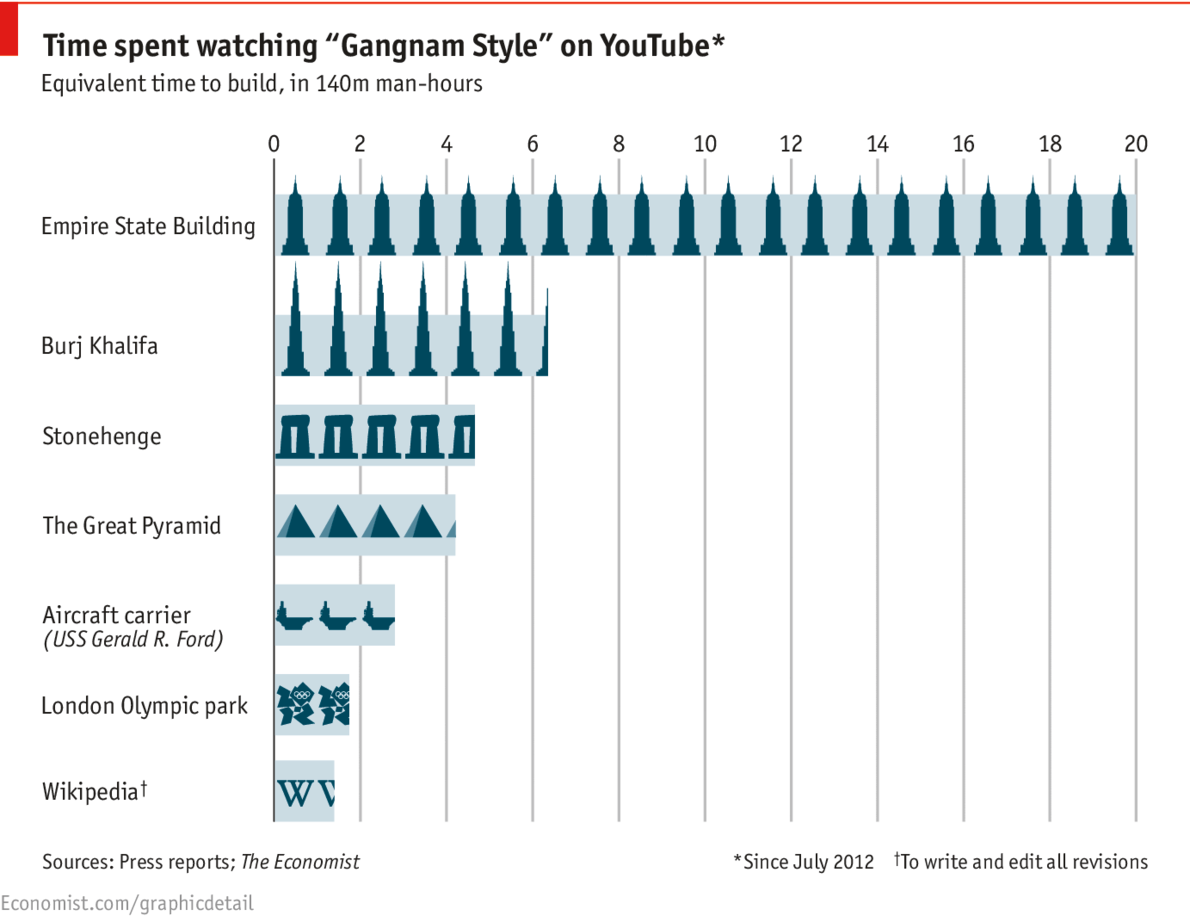
Gangnam Style

“Gangnam Style” passed two billion views this week. The Economist puts in perspective the time spent watching the music video:

At 4:12 minutes, that equates to more than 140m hours, or more than 16,000 years. What other achievements were forgone in the time spent watching a sideways shuffle and air lasso?

An Uptick In Islamophobia

Beinart detects one:

Even as public tolerance for most other forms of bigotry declines, hostility to Muslims has actually grown, despite the winding down of America’s wars in Iraq and Afghanistan. In fact, the rise may be partially due to the end of those wars. After 9/11, George W. Bush told Americans that although we were fighting “bad Muslims” (al-Qaeda) “good Muslims”—who constituted the large majority—would embrace our invasions.

It hasn’t worked out that way. My hunch is that faced with the realization that many Iraqis and Afghans hated America’s occupation of their countries, Democrats have been more likely to blame the U.S. for starting those wars in the first place. According to polls, large majorities of Democrats now see both Iraq and Afghanistan as mistakes. Republicans don’t. For Republicans, I suspect, America’s problems in Iraq and Afghanistan say less about us than about them. They prove that Bush was wrong: Most Muslims really are our enemy. Otherwise, why would they oppose our efforts to make them free.

Yeah, Secret Service, Like That’s Gonna Happen

The agency is looking for an intrepid software developer to create a sarcasm detector for social media. Mary Beth Quirk sums it up thus:

Basically, the Secret Service would love it if someone would explain the Internet so it doesn’t go around arresting sarcastic people with itchy social media trigger fingers.

Another thing that sounds a bit weird?

The software will have the “functionality to send notifications to users.” Because that wouldn’t freak someone out to get a popup window from the Secret Service just being like, “Hey, did you mean that like, for real? Or are you being sarcastic? Thanks, juuust checking in!”

But Jesse Singal doubts they’ll come up with anything:

One study from 2011 (PDF) used tweets that had been specifically hashtagged #sarcasm or #sarcastic, stripped those hashtags, and then dumped them into a virtual pile with a bunch of other straightforwardly positive and negative tweets. At their best performance, the computer programs the researchers used could only correctly separate sarcastic from non-sarcastic tweets about 65 percent of the time — and this was in a rather controlled setting.

Bing Liu, a University of Illinois at Chicago computer scientist who authored a book about sentiment analysis (that is, extracting emotional context from text), expressed skepticism that anyone yet has a good handle on this problem. “I am not aware that anyone has a satisfactory algorithm or system that can detect sarcastic sentences,” he said in an email. And the stuff the Secret Service would be looking at would be a particularly uphill battle: “In discussions about politics [sarcasm] is fairly common and very hard to deal with because it often requires some background knowledge which computers are not good at.”

Bringing Some Diversity To A Galaxy Far, Far Away

Lupita Nyong’o (12 Years a Slave Oscar winner) and Gwendoline Christie (Brienne of Tarth in Game of Thrones) have been cast in the next Star Wars movie:

That’s hardly gender parity — with Carrie Fisher and newcomer Daisy Ridley the only other females currently announced — but it’s certainly a substantial and necessary improvement for a traditionally boys-heavy franchise entering the post Hunger Games universe. Thus far, the only significant female Star Wars characters in six episodes have been a princess and a queen — but Abrams has a solid reputation for strong, well-drawn female characters, from Felicity to Alias to Fringe. 

Alyssa is thrilled:

Beyond the simple joy of getting to see Nyong’o and Christie together on the big screen, there is also something exciting about the fact that these particular actresses are taking their first steps into this particular world.

Because Nyong’o made her international reputation in a socially significant historical drama, she easily could have been stuck there, relegated to playing characters whose experience of abuse is their most salient characteristic. That she is joining “Star Wars” instead, and has optioned Chimamanda Ngozi Adichie’s novel “Americanah,” a contemporary story about Nigerian immigrants who return home, suggests that Nyong’o will not let herself be limited to stories about the American past. Instead, she will stake out territory for herself that stretches from a galaxy far, far away to a part of the present with which many American audiences are unfamiliar.

This makes Nyong’o the first black woman to appear in a Star Wars film, while the entire franchise has only featured two black characters (Lando Calrissian and Mace Windu). Alex Abad-Santos notes why there’s no excuse for this:

There aren’t any rules or constrictions about race or gender in galaxies far, far away. And at the heart of it, Star Wars revolves around an allegory about an outsider.

Other sci-fi/fantasy/superhero franchises have traditionally challenged the way we’ve thought about and perceived race. Perhaps there’s no better example than Star Wars’s rival franchise: Star Trek. Characters like Uhura (Nichelle Nichols) and Sulu (George Takei) contributed to a vision of the future in which positions of power aren’t solely held by whites. Star Wars, on the other hand, has more ewoks with speaking roles in Return of the Jedi than it does black characters with speaking roles in the entire franchise.

Update from a reader:

You’ll probably get a deluge of emails from Star Wars geeks, but I hope I’m not halfway down the pile.  There is at least one other black character in Star Wars: Quarsh Panaka, from Episode 1. He was Padme Amidala’s head of security. He’s a minor, supporting character, but he does have a speaking role.

Another:

Lupita Nyong’o won’t be “the first black woman to appear in a Star Wars film.” That honor goes to Femi Taylor, who portrayed the green-skinned Oola in Return of the Jedi. An understandable mistake!

Clinton’s Ties To Wall Street

Corn examines them:

Hillary Clinton’s shift from declaimer of Big Finance shenanigans to collaborator with Goldman—the firm has donated between $250,000 and $500,000 to the Clinton Foundation—prompts an obvious question: Can the former secretary of state cultivate populist cred while hobnobbing with Goldman and pocketing money from it and other Wall Street firms? Last year, she gave two paid speeches to Goldman Sachs audiences. (Her customary fee is $200,000 a speech.) …

If Hillary does decide to seek a return to the White House, can she straddle the line? Assail the excesses of Wall Street piracy and tout the necessity of economic fair play yet still accept the embrace, generosity, and meeting rooms of Goldman Sachs and other Wall Street players? During her speech, she offered a good summation of populism, remarking “working with my husband and daughter at our foundation, our motto is ‘We’re all in this together,’ which we totally believe.” Yet her association with Goldman might cause some to wonder how firmly she holds this belief—and how serious she is about reining in those robber barons.

Judis, for one, doesn’t foresee a populist uprising anytime soon:

Why did movements against economic inequality flourish in the past, but not now? Some people on the left blame the President. If only Obama had taken a stronger stand against what Theodore Roosevelt called “the malefactors of great wealth,” the logic goes, he could have roused the country to action and prevented the rise of the Tea Party. That argument seemed persuasive to me four years ago, but no longer. If you compare the circumstances in which the older challenges to inequality took place with those now, you discover that something important has been missing and would have been missing regardless of whether Obama had sounded the tocsin. For all the talk today about stagnant wages and the long-term unemployed, today’s foot soldiers of a movement remain significantly more invested in the status quo than those who embraced populist agitators Sockless Jerry Simpson or Huey Long.

Shoring Up The Shores In NYC

[vimeo https://vimeo.com/90759287 w=580]

As part of a $60 billion federal aid package for states hit by 2012’s Hurricane Sandy, New York and New Jersey are getting nearly $1 billion to protect their coastlines, particularly in and around Manhattan. Katie Valentine looks at where that money is going:

The $920 million is being distributed to resilience projects that were decided upon through a federal competition called Rebuild by Design. The competition awarded money to six projects, with the largest chunk going to a project called “the Big U,” which aims to build a 10-mile protective barrier around lower Manhattan. The point of the barrier, which will be composed of levees and berms, will be to protect the region from storm surge and flooding, but the project’s creators — architecture firm Bjarke Ingels Group — are also focusing on the utility and aesthetics of the wall, factoring in greenspace and protective walls that would be “decorated by neighborhood artists” into their proposal. …

Another of the winning Rebuild by Design projects will install breakwaters, or partially submerged barriers, off the south shore of Staten Island.

The “Living Breakwaters” will dull the severity of storm surge and create new habitat for fish, oysters and lobsters. The proposal also plans on building a network of “water hubs” on the shore near the breakwaters. These would act as recreational parks, providing opportunities for kayaking and other activities in the calm water created by the breakwaters, along with providing space for birdwatching and outdoor classrooms and labs.

Justin Davidson breaks down how much of that cash is going to each project:

The keeper of the purse strings was Shaun Donovan, the Obama administration’s housing secretary and Sandy reconstruction czar, who recently became budget chief — and it was Donovan who popped up yesterday to announce the awards: $355 million for those lower Manhattan berms, designed by the Danish architecture firm BIG and its partners; $230 million for a full package of strategies to protect Hoboken, from a team led by the Dutch firm OMA; $60 million for those Staten Island reefs; $20 million for a plan to safeguard the Hunts Point Market — and so on.

Even with all that promised money, pushing some of these projects closer to reality won’t be easy. In Hoboken, public funds will need to leverage a much larger pile of private investment, which makes the plan vulnerable to economic fluctuations. The Manhattan project, a multi-stage piece of green riverside infrastructure, will mean whipping together a fractious choir of bureaucrats, community boards, the Army Corps of Engineers, activists, obstructionists, NIMBYites, and environmentalists. Still, Henk Ovink, the tireless Dutch water management expert who runs the program, claims to relish the obstacles.

(Video of the “Big U” via Rebuild by Design)