Treating PTSD With Brain Implants?

DARPA is working on it:

The hope is to implant electrodes in different regions of the brain along with a tiny chip placed between the brain and the skull. The chip would monitor electrical signals in the brain and send data wirelessly back to scientists in order to gain a better understanding of psychological diseases like Post-Traumatic Stress Disorder (PTSD). The implant would also be used to trigger electrical impulses in order to relieve symptoms.

It’s just one facet of an emerging therapeutic field:

The program is inspired by deep brain stimulation, a surgery that implants a brain pacemaker to treat movement disorders like Parkinson’s and essential tremor as well as paralysis and or patients who are missing limbs.

Similar implants have been used in small trials to treat disorders like major depression but have yet to be widely approved for wider use. SUBNETS plans on demonstrating the technology it develops and then submitting those devices for approval by the U.S. Food and Drug Administration. Deep brain stimulation spans approximately 100,000 worldwide patients. But it still has its glitches. The treatment recently sparked headlines when a Dutch man being treated for severe obsessive compulsive disorder developed a strong urge to listen to American country singer Johnny Cash.

Patrick Tucker explains what the program hopes to accomplish:

If the DARPA program is successful, it will yield new brain-monitoring capabilities that are exponentially cheaper smaller, more useful and that collect data when the patient is most likely to actually encounter traumatic stimuli, not just when he or she is in a lab-making data collection much easier and the data more useful. “With existing technology, we can’t really record anxiety level inside the brain. We can potentially record adrenaline and cortisol levels in the bloodstream to measure anxiety. However, if a deep brain implant is to be used (as proposed in this project), it might be possible to monitor activity in the amygdala, and this would be a direct way of monitoring anxiety,” said [University of Arizona neuroscientist Charles] Higgins.

Using that data, the researchers hope to create models and maps to allow for a more precise understanding of the electrical patterns in the brain that signal anxiety, memory loss and depression. The data from devices, when they come online, will be made available to the public but will be rendered anonymous, so records of an individual test subject’s brain activity could not be traced back to a specific person.

A World Class Police State

Vac Verikaitis condemns the militarization of the World Cup:

There are 170,000 or more security troops assigned to the World Cup – not to protect the thousands of tourists who will be coming to Brazil to watch the matches, but to quell dissent. Among them are a group of 40 FBI agents, part of an “anti-terror” unit. In January, French riot police were brought in to train their Brazilian counterparts. There are several Israeli drones, the ones used to chase down suspects in the West Bank, as well as 50 robotic bomb-disposal units most recently used by US forces in Afghanistan. There are also facial-recognition goggles that police can use to spot 400 faces a second and match them against a database of 13 million.

But there won’t be that many tourists, so exactly whom, people want to know, are the police checking? At a cost of nearly $1 billion, the international composition of the security measures is not only a contentious issue among Brazilians, but a cruel irony given FIFA’s mandate of bringing the world together through football.

Meanwhile, Steven Kurczy checks in on a stadium in the Amazon rainforest:

In a competition for most improbable place to host the World Cup, the city of Manaus would surely make the finals. Its Arena da Amazônia sits in the middle of the Amazon rainforest, 900 miles up the Amazon River in Brazil’s isolated Amazonas state bordering Venezuela, Colombia, and Peru. “The Amazon Arena” will host four matches [this] month—including one featuring the English team, whose coach got into a spat with the mayor of Manaus after complaining about the prospect of having to play “in the middle of the Amazonian jungle.”

So perhaps more than any other of Brazil’s 12 World Cup host cities, Manaus faces a Sisyphean task during [this] month’s influx of futebol superstars and their rabid fans: prove that it was worthwhile to build a $300 million, 42,000-seat stadium in an isolated port city lacking a serious futebol culture, or experience hosting major events.

What’s A Press Secretary Good For?

Following Jay Carney’s resignation, Weigel isn’t sure we need a White House press secretary:

Carney’s many ways of dodging questions became so infamous that former Slate-ster Chris Wilson compiled them into a usable chart format. In that exercise, he highlighted one of Carney’s most meta dodges.

We have a team here that works really hard trying to anticipate the questions you’re going to ask. The problem is, there’s a lot of you and you’re good at your jobs and you’re smart.

This basically gave the game away. The tragedy of the White House beat, as hacks like me keep pointing out, is that the White House is forever innovating ways to make it useless.

Kenneth T. Walsh observes that “the White House press secretary has increasingly become a flak catcher, policy and political debater, and public relations strategist for the president rather than the conveyor of straightforward information to the media and the public”:

During Carney’s tenure, journalists raised frequent objections to what they considered reduced access to Obama and his senior advisers. They complained that Carney sometimes didn’t seem to know the president’s thinking or what was happening in the administration on key issues. There was distress within the media over the administration’s attempt to crack down on unauthorized leaks. And there was concern among White House correspondents that White House officials were shunting them aside and dealing instead with new media or communicating directly with key constituencies via the White House website and the Internet.

Reid Cherlin contrasts Carney’s tenure with Gibbs.’ His bottom line:

The good news for Carney is twofold. As soon as his successor, Josh Earnest, assumes the job, Carney’s reputation will undergo a rehabilitation, just as Gibbs is now remembered with nostalgia by White House reporters. More important, Carney will get to step out of one of Washington’s most fruitless positions and go make more money doing something rewarding.

Tumblr Of The Day

tumblr_n501dbcdCH1rrqskho1_500

Prepare to lose half your afternoon, poring through Terrible Real Estate Photographs. The captions push this one over the edge into edgy. So for the one above:

If you’re the sort of person who doesn’t mind defecating in a kitchen, then you probably won’t mind doing it next to a large window either.

Another fave:

tumblr_n5f7cfUZuJ1rrqskho1_500

Of the two options, “bless this house” is the more popular.

The World Community Doesn’t Miss Bush

Beinart gives the Bushies a reality check:

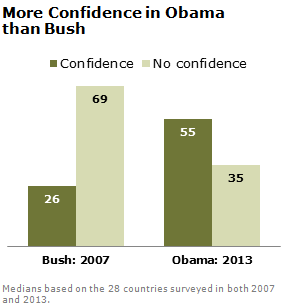
[W]hen Cheney says world opinion is “increasingly negative” and Rove detects “declining confidence” in the United States, it’s hard not to ask the obvious question: compared to when? In fact, while faith in the United States, and in Obama personally, has declined Obama Bushmodestly since 2009, it is still dramatically higher than when Cheney and Rove roamed the West Wing.

For more than a decade, the Pew Research Center has been asking people around the world about their opinion of the United States. The upshot: In every region of the globe except the Middle East (where the United States was wildly unpopular under George W. Bush and remains so), America’s favorability is way up since Obama took office. In Spain, approval of the United States is 29 percentage points higher than when Bush left office. In Italy, it’s up 23 points. In Germany and France, it’s 22. With the exception of China, where the numbers have remained flat, the trend is the same in Asia. The U.S. is 19 points more popular in Japan, 24 points more popular in Indonesia, and 28 points more popular in Malaysia. Likewise among the biggest powers in Latin America and Africa: Approval of the United States has risen 19 points in Argentina and 12 points in South Africa. (For some reason, there’s no Bush-era data on this question for Brazil or Nigeria).

Reports Of His Meditation Have Been Greatly Exaggerated

Followers of the Hindu spiritual leader Ashutosh Maharaj, who died of a heart attack several months ago, insist that he is not in fact deceased, but rather “in a state of transcendent bliss called samadhi, a central tenet of traditional yoga in which a yogi becomes one with the universe”:

This would seem to be at odds with the assessment of a team of local physicians who examined Maharaj in February. After performing an ECG that showed no heartbeats, noting that he had no respiratory movements, and seeing that his pupils were fixed and dilated, the physicians declared him “clinically dead.”

The sect’s website states, “His Holiness Shri Ashutosh Maharaj Ji has been in a deep meditative state (samadhi) since January 29, 2014.” Though, a representative from the sect did say on February 3, “About 4:00 PM yesterday, some changes were noticed in his skin (it became greenish). The body was then shifted to a freezer,” which may or may not be part of the traditional protocol for transcendent bliss.

The guru’s son and wife corroborate that he died of a heart attack in January, and that his followers are keeping his body in order to retain control of his financial empire, including the ten billion rupee ($170 million) estate where the corpse resides.

He is, of course, just pining for the fjords.

The Post-Shinseki VA

Shortly after a damning Inspector General’s report revealed widespread fraud and unacceptable wait times in Phoenix’s VA clinics, Eric Shinseki resigned on Friday. Jacob Siegel is saddened at his ouster:

The VA’s problems didn’t start with Shinseki and they won’t be solved by his resignation—in fact, they may get worse. The secret waiting lists discovered in VA hospitals exploited a lack of oversight that made cheating easy and profitable. But beneath them there are underlying structural issues that will be even harder to fix.

As I wrote last week, it didn’t have to be this way. The VA didn’t learn about treatment delays and falsified schedules when the national press picked up the story last month. This is a problem the VA has known about for years. The same “scheduling schemes” that placed 1,700 veterans on secret waiting lists in Phoenix have been extensively documented since 2005 and no one, including Shinseki, yet explained why it took so long to act.

Cassidy even thinks Obama should have kept him on:

As he demonstrated during the Iraq war, when he warned the Bush Administration that it would need a lot more troops to occupy the country than the Pentagon was deploying, Shinseki is a man of honor. Despite this scandal, he has done a number of positive things in his time at the V.A., such as expanding the treatments offered to victims of past wars, including the war in Vietnam, and helping to reduce the number of homeless veterans by a third. His remarks on Friday were made before the National Coalition for Homeless Veterans, which gave him a standing ovation.

The underlying problems facing the V.A. are well known in Washington, and they go back at least a decade. As the number of wounded veterans has increased sharply, the agency’s budget hasn’t been raised in line with the increased demand for medical services. That’s why there are such long waiting lines: there are too few doctors and beds available for all the patients that need them.

Gordon Lubold and John Hudson ponder potential replacements:

Members of Congress, individuals associated with veterans groups and others were disinclined to name publicly individuals who should replace Shinseki, but a handful of names have emerged, including a slew of retired general or flag officers, from Mike Mullen to Stanley McChrystal or Peter Chiarelli. John McHugh, a former Congressman and now the sitting Army secretary, and Navy Secretary Ray Mabus were also on the lips in Washington on Friday. And Gen. Raymond Odierno, the Army’s chief of staff, and James Webb, the former senator, Marine, and Navy secretary have all been mentioned as a possible successors. Someone with corporate leadership experience, coupled with a military background, could also be seen as a good fit. That very short list would include someone like Fred Smith, the chairman and CEO of global mailing giant FedEx, who served as an officer in the U.S. Marine Corps from 1966 to 1970.

Kleiman argues that Shinseki was felled by his preoccupation with metrics:

Apparently the systematic fudging of the waiting-list numbers was known to the Bush the Lesser administration and had started even earlier, but Shinseki was a strong advocate of numerical goal-setting, and in particular the strategy of setting “stretch” (i.e., impossible-to-satisfy) goals as a way of motivating extra effort. (One VA health-service provider, a sound progressive, told me back in 2010 that she was so frustrated at having to deal with idiotic goals imposed from DVA headquarters that planned to vote for any Republican against Obama in 2012.)

In fact, what “stretch” goals motivate is mostly deception.  If there’s no honest way to “make your numbers,” cheating seems like the only sensible strategy.

An audit released on Friday backs up this notion that the VA’s goals were simply unattainable:

Thirteen percent of staff were instructed to schedule appointments without regard to a patient’s desired date, which could indicate an attempt to falsify records. At least one instance of the practice was detected in 64 percent of the surveyed VA facilities. The survey, however, did not determine whether these activities were intentionally fraudulent behavior. The audit also acknowledged that the VA’s goal of seeing patients within two weeks of a desired appointment date “was simply not attainable given the ongoing challenge of finding sufficient provider slots to accommodate a growing demand for services.” The report also criticized other complications and technicalities in the VA scheduling system, many of which have been known for years.

Phillip Carter thinks the department’s problems won’t be easy to fix:

The VA is the second-largest cabinet agency, and the nation’s largest health care and benefits provider, with an overall fiscal 2015 budget of $165 billion (greater than the State Department, USAID, and entire intelligence community combined), including $60 billion for health care. The VA employs more than 320,000 personnel to run 151 major medical centers, 820 outpatient clinics, 300 storefront “Vet Centers,” more than 50 regional benefits offices, and scores of other facilities. This massive system provides health care to roughly 9 million enrolled veterans, including 6 million who seek care on a regular basis.

It’s hard to overstate the challenges of leading this massive agency: The ideal candidate would probably fuse the best traits of a general like Shinseki, a politician like Bill Clinton, and a businessman like Lee Iacocca or Mitt Romney. The systemic integrity problems in the VA’s health care system, coupled with the broader resource allocation problems they were masking, will remain for the next secretary, whoever he or she is.

Yuval Levin blames the disjunction between the administration’s ability to identify the problem and its willingness to fix it:

Centrally run, highly bureaucratic, public health-care systems that do not permit meaningful pricing and do not allow for competition among providers of care can really only respond to supply and demand pressures through waiting lines. It happens everywhere, but when it has happened at the VA the response has been to criticize waiting times rather than to reconsider how the system is organized.

There is no question that the quality of the VA system has improved significantly over the last three decades, thanks to a series of modernization efforts launched (and very well executed, I should note) by the Clinton administration and continued by both the Bush and Obama administrations. But these efforts began from an extremely low baseline and they have achieved improvements by essentially modernizing the infrastructure that supports a very inefficient bureaucracy. The potential of these kinds of changes to dramatically reduce waiting times was always going to be limited, and the increasingly unrealistic targets set for waiting times put pressure on the system without giving administrators any way to release it.

Byron York pans Bernie Sanders’ bill that would give the VA an additional $20 billion to expand its services:

The bill would essentially offer VA health care services to all veterans, including those who do not have service-related problems and have incomes above current cutoff levels. It would also greatly expand a program that pays caregivers of disabled veterans a monthly stipend. Congress originally passed the measure for veterans of post-Sept. 11 wars; Sanders would expand it to all veterans.

The caregivers provision is one of the single most expensive features of the bill, and it was put into the legislation over the objections of the Department of Veterans Affairs itself, which believes it would cost even more than Sanders estimated. “VA believes the expansion of benefits to caregivers of eligible veterans of all eras would make the program more equitable,” the agency noted in a statement on cost. “Unfortunately, core health-care services to veterans would be negatively impacted without the additional resources necessary to fund the expansion.”

But Beutler warns Republicans against trying to score points on the VA scandal without offering a meaningful alternative:

This isn’t a familiar Congressional impasse where Democrats want to spend a certain amount of money on something while Republicans want to spend less money. Those sorts of fights are destructive, too. In a way they’ve defined the Obama presidency. But they’re also resolvable. Veterans health care is differentthe story here is 100 percent ideological, and zero percent fiscal.

It’s not that big government foes are after spending less money on the VA, per se, or want to isolate efficiencies within its existing structure and ply the savings into building out capacity within the department. They instead want to spend more money on veterans by transitioning them into an entirely different, private-sector oriented system of care. This includes House Speaker John Boehner.

Previous Dish on the VA scandal herehere, here, and here.

Face Of The Day

Elphie

Gannon Burgett captions:

While Scott Brierley was on a tour at West Midlands Safari Park, located in Worcestershire, England, he managed to drop his phone next to the African elephant enclosure. After Brierley was told to not exit his car, Latabe grabbed his phone, presumably thinking it was food, and in doing so managed to capture quite a selfie. After his phone was returned to him by keepers at the park, Brierley shared that he might be in possession of the world’s first “elfie” — an elephant selfie.

Quote For The Day

“I’m only getting paid two and a half cents per click on this story. That’s more than what 99.9% of contributors on Medium get paid. I have a $60,000 graduate journalism degree from Medill, nearly a decade of writing experience, and, let’s be honest, I’m super smart and seriously good at what I do. I can write and report a kickass story with my eyes closed and one hand tied behind my back. But the algorithm that decides how much I get paid for all that badass-ness doesn’t put any value on how good I am. It cares not at all how well written this story is or how much experience I have. All that’s important is how many times you guys click,” – Erin Biba, Medium.

And there you have it: an economic ecology online that militates against good writing, thoughtful prose, serious engagement. And, look, we can all intend to produce content that lives up to that standard, but, in the end, the structural incentives for ADD-fueled crap will overwhelm us. That’s why shifting toward a subscription model has been such a revelation to me. Sure, I thought I was above pageview whoring, but I see now I wasn’t entirely. When you’re writing every day to gain pageviews – period – you’ll find yourselves looking for crowd-pleasers for complete strangers rather than interesting shit for a committed readership. To blog now with only a minor concern for traffic really is a different way to write online. It’s been a revelation to discover how subtly I’d been corrupted by the pageview metric, as I explained last night.

That’s why it’s such good news that Slate, for example, and TPM are moving in our direction. Josh is re-launching TPM Prime today for exactly those reasons:

In the history of publishing – publishing the printed word – there are very few examples of publications that are 100% dependent on advertising. Not only is it difficult to get enough revenue from advertising, as a revenue source it’s inherently unstable. Both are distinct and important. Advertisers are fickle; they change their schedules and goals, the amounts they’re ready to spend. It’s your core fans that are really invested in you being there every day and next month and next year. So it’s really important to build a reliance on people like you who want to be sure TPM is alive and well.

I think it also matters in wresting new media from the growing sense that it’s increasingly a corporate marketing scheme, rather than another independent part of the fourth estate. If you edit a site that has 100 percent of its revenue from advertisers and 0 percent from readers, who do you think will ultimately control the end-product? Even the best editor cannot get traction against that kind of advertiser power. What we may be seeing now is an evolution past this trashy, desperate period in online media.

Well, I can hope, can’t I? And if you want to help, subscribe!

The Scandal Of The GOP And Climate Change

Screen Shot 2014-06-02 at 12.03.24 PM

Chait has a great little jab at the Republican “I’m not a scientist” schtick when trying to square objective reality with the denialism or fantasy of their own coalition. I’m not a scientist either. I have no expertise in measuring carbon levels back thousands of years; I have no clue how to balance measurable heat in the oceans as opposed to the deserts; I cannot say what would likely shift in weather patterns if we keep boiling our planet like the proverbial frog; and on and on. But I can read temperature charts and I can read the IPCC report and I can glean something relevant from the crushingly overwhelming majority view of the relevant climate scientists.

And that simple act of amateur reasoning is all we ask of ourselves as citizens, and it is all we can ever ask of our elected representatives. We elect them to make decisions about the future of Afghanistan, the sectarian conflict in Syria, the intricacies of Internet regulation, and any number of complex questions usually grasped only by experts. Sometimes, they can become kinda experts themselves. But what’s vital is that they simply use reason – a core democratic practice – to figure stuff out.

On this important issue, one entire party in our system has simply decided to opt out of these basic demands of democratic life. And this is not restricted to Christianist congressmen who believe the earth was created 6,000 years ago. It’s deep in the bones of what’s left of the intelligentsia as well:

In a recent hearing before Congress, the U.S. Chamber of Commerce refused to take a position on whether anthropogenic global warming is real. “Room to Grow,” the new policy manifesto by a coalition of non-crazy Republicans, has one chapter on energy, which omits any reference at all to climate change. It doesn’t deny climate change, nor does it concede it — it merely treats the energy debate as if the question of whether to price carbon emissions does not exist at all.

A figure as respected on the right as Charles Krauthammer has been reduced to claiming that no reigning scientific theory should be taken seriously because it might one day be adjusted in light of new data or new experiments.

This is what happens when reason becomes anathema in one hermetically sealed party:

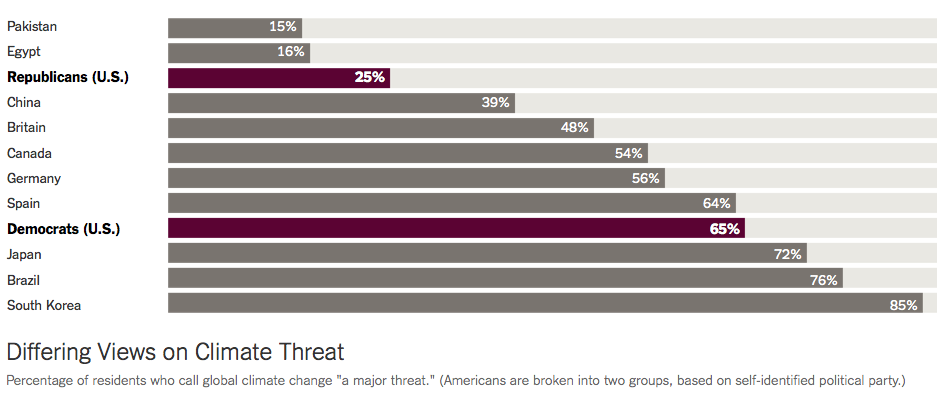
According to Pew Research Center surveys conducted last year, 25 percent of self-identified Republicans said they considered global climate change to be “a major threat.” The only countries with such low levels of climate concern are Egypt, where 16 percent of respondents called climate change a major threat, and Pakistan, where 15 percent did. By comparison, 65 percent of Democrats in the United States gave that answer, putting them in the same range as Brazilians (76 percent), Japanese (72 percent), Chileans (68 percent) or Italians and Spaniards (64 percent).

It matters when one major party refuses to accept reality – when it refuses to grasp the fact that you cannot raise revenue by cutting taxes, that the United States practiced torture, or that human-made climate change is real. When one side engages in this surreal debate, the country becomes incapable of engaging in any real debate. I know we’ve become used to this – and the press has found a way to write about the GOP as if they are not a reckless, know-nothing, post-modern fantasy machine. But it doesn’t mean we shouldn’t remain capable of shock and anger at this pathetic excuse for a political party, at the unique idiocy of this party of the right in the Western world.