A Problematic POW

The last American prisoner of war in Afghanistan, Army Sgt. Bowe Bergdahl, was freed on Saturday after five years in Taliban captivity:

Bergdahl, 28, is believed to have slipped away from his platoon’s small outpost in Af­ghanistan’s Paktika province on June 30, 2009, after growing disillusioned with the U.S. military’s war effort. He was captured shortly afterward by enemy ­forces and held captive in Pakistan by insurgents affiliated with the Taliban. At the time, an entire U.S. military division and thousands of Afghan soldiers and police officers devoted weeks to searching for him, and some soldiers resented risking their lives for someone they considered a deserter.

Bergdahl was recovered Saturday by a U.S. Special Operations team in Afghanistan after weeks of intense negotiations in which U.S. officials, working through the government of Qatar, negotiated a prisoner swap with the Taliban. In exchange for his release, the United States agreed to free five Taliban commanders from the military detention center at Guantanamo Bay, Cuba.

Eli Lake and Josh Rogin name the bad guys we traded for Bergdahl:

A senior U.S. defense official confirmed Saturday that the prisoners to be released include Mullah Mohammad Fazl, Mullah Norullah Noori, Abdul Haq Wasiq, Khairullah Khairkhwa and Mohammed Nabi Omari. While not as well known as Guantanamo inmates like 9-11 mastermind Khalid Sheikh Mohammed, the Taliban 5 were some of the worst outlaws in the U.S. war on terror. And their release will end up replenishing the diminished leadership ranks of the Afghan Taliban at a moment when the United States is winding down the war there. “They are undoubtedly among the most dangerous Taliban commanders held at Guantanamo,” said Thomas Joscelyn, a senior editor at the Long War Journal who keeps a close watch on developments concerning the detainees left at the Guantanamo Bay prison.

I’ll be honest here and simply report that I am deeply conflicted about this event. I totally see the importance of maintaining the ethic of never leaving a soldier behind on the battlefield. Equally, it’s depressing that we had to release serious Taliban prisoners of war to get him back. This is an excruciating choice – but if Bergdahl’s health was in jeopardy, the administration made what strikes me as the right move. Even the Israelis do this kind of thing quite regularly.

Then there’s the question of the actual soldier in question and the circumstances of his capture. Was Bergdahl really a deserter? Nathan Bradley Bethea, who served in his battalion, says yes:

He is safe, and now it is time to speak the truth.

And that the truth is: Bergdahl was a deserter, and soldiers from his own unit died trying to track him down. On the night prior to his capture, Bergdahl pulled guard duty at OP Mest, a small outpost about two hours south of the provincial capitol. The base resembled a wagon circle of armored vehicles with some razor wire strung around them. A guard tower sat high up on a nearby hill, but the outpost itself was no fortress. Besides the tower, the only hard structure that I saw in July 2009 was a plywood shed filled with bottled water. Soldiers either slept in poncho tents or inside their vehicles.

The next morning, Bergdahl failed to show for the morning roll call. The soldiers in 2nd Platoon, Blackfoot Company discovered his rifle, helmet, body armor and web gear in a neat stack. He had, however, taken his compass. His fellow soldiers later mentioned his stated desire to walk from Afghanistan to India.

The Daily Beast’s Christopher Dickey later wrote that “[w]hether Bergdahl…just walked away from his base or was lagging behind on a patrol at the time of his capture remains an open and fiercely debated question.” Not to me and the members of my unit. Make no mistake: Bergdahl did not “lag behind on a patrol,” as was cited in news reports at the time. There was no patrol that night. Bergdahl was relieved from guard duty, and instead of going to sleep, he fled the outpost on foot. He deserted. I’ve talked to members of Bergdahl’s platoon—including the last Americans to see him before his capture. I’ve reviewed the relevant documents. That’s what happened.

Morrissey believes the White House erred in bringing Bergdahl home with fanfare:

[T]here is a big difference between swapping for a man who’s accused of desertion (and whose disappearance cost at least six soldiers’ lives, and possibly more), and cheering his release in a presidential Rose Garden speech along with his family. That is a return for a hero, not a potential deserter (who, we should stress, has not yet been charged with that crime, let alone convicted). Did no one at the White House bother to check into the details of Bergdahl’s disappearance, or calculate what that might mean politically in this trade? Everyone from Obama on down seems to have been caught flat-footed in a controversy of their own making … again.

House Republicans are promising hearings, of course, but not because Bergdahl might have deserted:

On a series of Sunday talk shows, Republican lawmakers slammed the decision to carry out the prisoner swap as a dangerous concession to the militant group and a violation of long-standing U.S. policy not to negotiate with terrorist groups. They also said the White House had violated a law requiring the administration to give Congress 30 days notice before such a swap. “The question going forward is have we just put a price on other U.S. soldiers?” Sen. Ted Cruz, the Texan Republican, said on ABC’s “This Week.” “I do not think the way to deal with terrorists is through releasing other violent terrorists.”

With Republicans blasting the Obama administration for, in their view, surrendering to terrorist hostage taking, the White House is defending the move as an effort to bring back a prisoner of war and show other troops the lengths to which Washington will go to ensure that none are left on the battlefield. On Sunday, administration officials said the swap was in line with the military’s commitment to see all its soldiers return from war, as a reflection of its “leave no man behind” ethos.

But Lt. Col. Robert Bateman reminds critics that exchanging prisoners with the enemy, no matter how unsavory the enemy, isn’t a novel concept:

As George Washington did, as James Madison did, as Abraham Lincoln did, our current president decided to make a trade. Sergeant Bowe Beghdahl, promoted in absentia twice since his capture in Afghanistan, is now free. We let loose five of theirs to regain the only American held by the enemy. This is not something new, it is a return to the old. Those who oppose the idea are taking offense with George Washington, James Madison, and Abraham Lincoln.

Martin Lederman addresses the complaint that the administration broke the law in carrying out the swap without notifying Congress beforehand:

Secretary Hagel’s statement suggests that he did comply with the substantive requirements of Section 1035, but that he notified Congress today, not 30 days ago.  It’s difficult to imagine that Congress would have intended to insist upon such a 30-day delay if the legislators had actually contemplated a time-sensitive prisoner-exchange negotiation of this sort; but the statute does not on its face address such a rare (and likely unanticipated) case.  Note that the President wrote this in his signing statement:  “Section 1035 does not . . . eliminate all of the unwarranted limitations on foreign transfers and, in certain circumstances, would violate constitutional separation of powers principles. The executive branch must have the flexibility, among other things, to act swiftly in conducting negotiations with foreign countries regarding the circumstances of detainee transfers.”  Perhaps he had the prospect of a Bergdahl negotiation in mind . . . .

Josh Rogin sees the deal as a possible first step by Obama toward clearing out Gitmo by executive fiat:

In his 2014 State of the Union address, Obama promised to shutter the prison built on Cuban soil by the end of the year. Obama now has seven months to fulfill his latest promise to shut down Guantanamo—or come as close to it as he can. During that time, Congress will be unable to prevent the release of the 149 prisoners still there.

“This whole deal may have been a test to see how far the administration can actually push it, and if Congress doesn’t fight back they will feel more empowered to move forward with additional transfers,” said one senior GOP senate aide close to the issue. “They’ve lined up all the dominoes to be able to move a lot more detainees out of Guantanamo and this could be just the beginning.”

That’s what I take away from this. We’ve just released five actual enemy combatants by executive order. Why not release the innocent ones by the same rubric? When you contemplate this move – and the EPA’s tough stance on coal along with the zero option in Afghanistan – you begin to see Obama re-take the initiative in his last two and a half years. Imagine the legacy: no troops in Iraq or Afghanistan; Gitmo closed; universal healthcare entrenched; Iran’s nuclear threat defused; marriage equality in all fifty states; the end of marijuana Prohibition; and carbon energy cut down to size.

Repeat after me: meep meep, motherfuckers.
Obama Gets Serious About Climate Change

EPA Admin Gina McCarthy Announces New Regulations Under Obama's Climate Action Plan

Yglesias calls today “the most important day of Obama’s second term”:

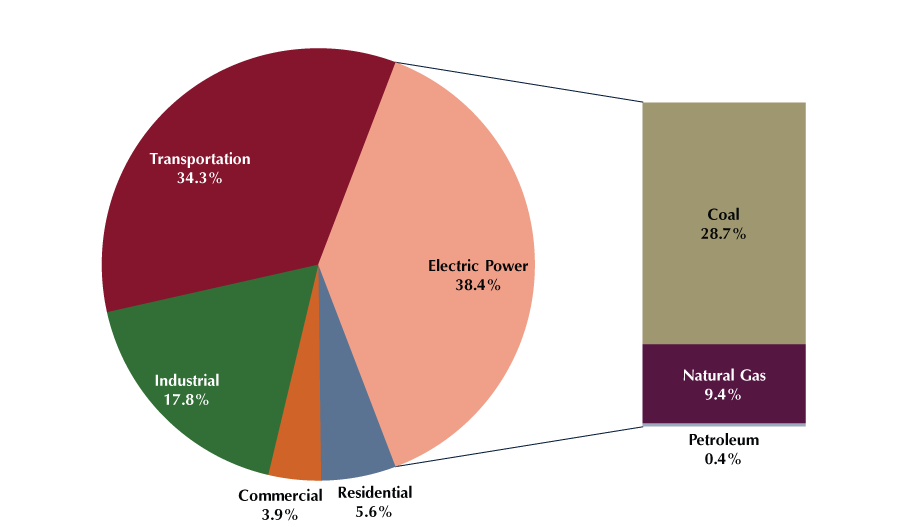
It’s important not only because climate change is an issue of enormous significance, but because the text of the Clean Air Act really does give the executive branch power that matters. The White House can’t unilaterally change the wage structure of the United States or create a path to citizenship for unauthorized immigrants, but it really can revolutionize the environmental practices of the electricity sector — a sector that, as seen [here], is responsible for about 38.4 percent of America’s total carbon dioxide emissions.

Ryan Koronowski declares that this is “the most significant move any U.S. president has made to curtail carbon pollution in history”:

There are many opinions of what method is best to lower emissions: carbon tax, cap-and-trade, clean energy incentives, direct regulation. All that matters for those concerned about climate change, in the end, is whether emissions drop, and how quickly. The Council of Foreign Relations’ Michael Levi points to EIA analysis of the likely impact of a carbon tax and other climate bills on power plant emissions. A $25-per-ton carbon tax would be far more effective, dropping emissions 47 percent by 2020 and 66 percent by 2030 — and the cap-and-trade bill passed by the House would have lowered emissions 56 percent by 2030 according to the EIA. The EPA’s proposed target, however, achieves reductions comparable to a far lower carbon tax, the Senate’s 2010 American Power Act, and 2012′s Clean Energy Standard Act. Levi suggests that the 2030 could be seen as a moving target — it could be ratcheted down through additional legislation or new regulation.

Indeed, the EPA could finalize this rule next year with a stronger target, especially if it receives a great deal of feedback from the public. Many environmental groups will be pushing for more ambitious targets later in the decade, even as they nearly unanimously applauded the regulations.

Ben Adler is hearing complaints from environmentalists. He also wonders about the international reaction:

The big question on the minds of many environmentalists is whether this will be enough to encourage other major polluting countries to make significant climate commitments. While the CO2 reduction will be significant by historical U.S. standards, it won’t get emissions down anywhere close to what’s needed to avert catastrophic global warming, nor even get the U.S. to the goal it agreed to at U.N. climate talks in Copenhagen in 2009: a 17 percent reduction in greenhouse gas emissions from 2005 levels by 2020. The hope is that it will signal enough progress to get the rest of the world to agree to binding emissions reductions in the next round of U.N. climate talks, which is supposed to culminate in a new climate treaty signed in Paris in December 2015. Will these proposed rules be good enough?

Plumer has a full explainer on the new EPA regulations. On whether the rules will survive legal scrutiny:

[T]he regulations could get knocked down in court. Industry groups and conservative states are sure to challenge the power-plant rule as soon as humanly possible. Environmentalists, for their part, have argue that the EPA’s flexible approach to regulation is defensible. Other legal experts think it’s a closer call. But it would all come down to whatever the DC Circuit Court or the Supreme Court decided.

If the EPA’s power-plant rule did get struck down in court, the agency might have to start all over again — raising the possibility that it wouldn’t be able to craft a new rule until Obama left office in 2017.

Jason Mark labels the EPA move “Obamacare for the air”:

If the “job-killing EPA regs” and “Obama overreach” soundbites seems to echo the political script from the Obamacare battle, there are some key differences. For starters, Republican-controlled states won’t have the ability to opt out of the system, as many have with the Affordable Care Act’s extension of Medicaid. If a state fails to submit a plan for lowering emissions from its power plants, the EPA has the authority to impose one—a scenario most states will choose to avoid.

More importantly, corporate opposition to the new rules isn’t as unanimous as it may appear. Several major electric utilities —including Dynergy, American Electric Power, and First Energy — have expressed cautious optimism about being able to thrive within the new regulations. Electricity generation is a capital-intensive industry that works on planning horizons of 30 to 50 years, and the utilities would prefer certainty and clarity as opposed to the policy purgatory they’ve been in the for the last decade.

Michael Grunwald sees the regulations as part of Obama’s war on coal:

It’s filthy stuff. When Obama said Saturday that his carbon rules will prevent 100,000 asthma attacks in Year One, he wasn’t describing the health benefits of emitting less carbon dioxide; he was describing the health benefits of burning less coal.

So let’s face it: When Obama talks up his “all-of-the-above” energy strategy, he really means all-of-the-above-except-the-black-rocks-below. In the 21st century, any national leader that takes environmental protection and the fate of the planet seriously will need to launch a war on coal, and Obama takes it very seriously. He hasn’t advertised his war on coal—it would be questionable politics in swing states like Ohio or Virginia, and even his home state of Illinois—but he’s fought it with vigor.

Tom Zeller Jr. thinks the plan may boost the economy:

While some jobs will almost certainly be lost if companies decide that it’s not worth it to outfit their aging coal plants with new pollution-control technologies, those losses will almost certainly be offset by the creation of new jobs elsewhere, as the new regulations drive investment in cleaner technologies, efficiency upgrades and other areas. A recent analysis from the Natural Resources Defense Council estimated that new greenhouse gas limits on power plants could reduce electric bills for U.S. households and businesses by as much as $37.4 billion by 2020, and create more than 274,000 jobs.

Sure, the NRDC isn’t exactly an impartial observer, but then neither is the API or the U.S. Chamber. The larger point is that most regulations have upsides and downsides, and short-term pain is often offset to some degree by long-term benefits that industry likes to ignore.

McArdle has low expectations:

As with any new Environmental Protection Agency rule, a lengthy comment period will ensue. After the comment period, the EPA presumably has discretion about the deadlines they set. With a big election coming in 2016, and some nice, big, coal-consuming swing states on the line, I would wager cash money that those deadlines are set no earlier than Dec. 31, 2016.

Whenever the deadlines do kick in, the new president will be besieged with desperate legislators and governors pleading to keep electricity prices from rising in these hard economic times. I can imagine a steadfast Democratic president standing up for the environment against utility lobbyists, coal-mining districts and electricity users, telling them that we need to do what’s best for the planet, not some narrow economic interest. But I can also imagine a beautiful world where everyone rides around in carriages driven by unicorns, angels sing in the trees, and purple raspberry pie grows on bushes outside your backdoor.

Ann Carlson reminds everyone that Obama is following the law:

Obama’s proposed rules are not a power grab. Nor are they an end run around Congress. Rather, the rules are reactive, a legally-required response to a petition filed when Bill Clinton was still president. I hope this part of the story — that Obama is following, not skirting or flouting, the law — gets highlighted in what is already a big press story.

Here’s the backdrop for those who don’t know it. In 1999, the International Center for Technology Assessment and a number of other non-profit organizations filed a petition with the Clinton EPA arguing that EPA should regulate greenhouse gases from automobiles under Section 202 of the Clean Air Act. In 2003, after George W. Bush became President, EPA denied the petition. A coalition of states and environmental groups then challenged the denial of the petition in the case that resulted in the landmark decision Massachusetts v. EPA. The Court held in Mass v. EPA that the agency erroneously denied the petition. The Court also ruled — and this is key — that greenhouse gases are an “air pollutant” as defined in the Clean Air Act and that EPA must decide whether, under Section 202 of the Act, greenhouse gases endanger public health and welfare. The Court’s ruling triggered a cascade of regulatory actions by EPA, all required by the Court’s substantive holdings.

And Ezra Klein points out that the new regulations “are far less ambitious than the proposal McCain offered in Oregon in 2008”:

They’re less ambitious than the proposals Newt Gingrich championed through the Aughts. They’re far less than what’s required to keep the rise in temperatures to two degrees Celsius.

But they’re probably at the outer limit of what can be done so long as the Republican Party refuses to even believe in climate change, much less work with the Obama administration on a bill. The good news, if there is any, is that the Republican Party hasn’t always refused to believe in climate change. There was even a time when its key national leaders were committed to doing something about it. Those leaders are still around today. They could still do something about it today.

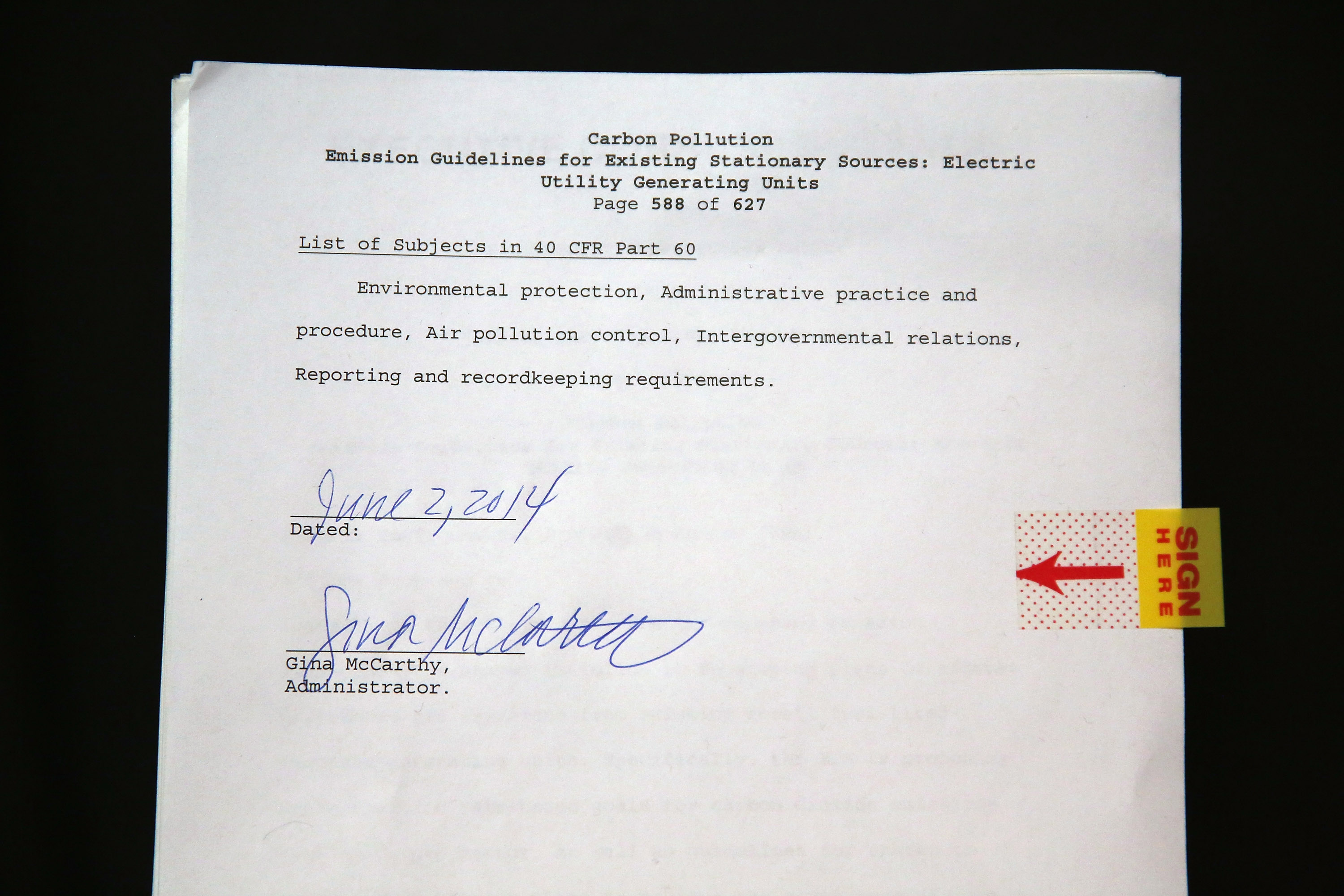
(Photo: U.S. Environmental Protection Agency Administrator Gina McCarthy’s signature is shown on new regulations for power plants June 2, 2014 in Washington, DC. By Chip Somodevilla/Getty Images)

Can Republicans Win Black Voters?

Bouie thinks it’s possible, if not likely:

[W]hen it comes to analyzing black voters, conservatives need to stop treating them as irrational or stuck on some kind of “Democratic plantation.” Like any coherent group of citizens, black Americans have a strong sense of their individual and collective interests. And in their correct view, they do better under Democratic presidents, which contributes to their overwhelming support for Democratic politicians. Put another way, if conservatives want to make inroads with black Americans and other minorities, they have to show them they’ll succeed under Republican governance and have to deliver when the opportunity comes.

Unfortunately for the GOP, research suggests that African Americans have good reason to vote Democratic:

According to a recent paper from Zoltan L. Hajnal and Jeremy D. Horowitz – both political scientists at the University of California–San Diego – there’s clear evidence that when the nation is governed by Democrats, black well-being “improves dramatically” across multiple dimensions. Specifically, looking at data from 1948 to 2010, Hajnal and Horowitz found that “African Americans tend to experience substantial gains under Democratic presidents whereas they tend to incur significant losses or remain stagnant under Republicans.” On average, under Democratic presidents, blacks gained $895 in annual income, saw a 2.41 point drop in their poverty rate, and a 0.36 point drop in their unemployment rate. By contrast, under Republicans, blacks gained $142 a year, along with a 0.15-point increase in poverty and a 0.39-point increase in unemployment.

The Scourge Of Women Laughing Alone With Salads

170088502

Clive Thompson wants an end to stock photography:

Let me be blunt: Stock photography needs to die. In his 1946 essay “Politics and the English Language,” George Orwell argued that clichéd language produces clichéd thinking. Using a stale image, as he’d put it, “makes it easier for us to have foolish thoughts.” Stock photography imprisons us in the same cognitive jail. Its intentionally bland images are designed to be usable in many vaguely defined situations. This produces wretched photography for the same reason Hallmark cards produce wretched poetry. We live in a visual world, communicating and thinking in pictures. When we use stock photos, we think in clichés.

His solution:

You take pictures every day, many of which I’ll bet are superb. Several photo-sharing sites let you slap on a Creative Commons license, allowing others to use your pics. (A bunch of my own pictures are on Flickr.) If everyone reading this article posted their best snapshots online, we could seed hundreds of thousands of free pictures of real things and real people in the real world. The true cure for stock photography is inside your camera phone.

(Photo: “Smiling young girl eating salad for breakfast.” By Kristian Sekulic/Vetta. More such images can be seen on this classic tumblr. Update from a reader: “How can you mention ‘Women Laughing Alone With Salad’ without also mentioning ‘Women Struggling to Drink Water‘?…”)

Giving A Whole New Meaning To “Computer Worm”

OpenWorm, an informal collaborative group of biologists and computer scientists from several countries, aims to create a complete digital model of a simple organism:

On May 19th this group managed to raise $121,076 on Kickstarter, a crowd-funding website. The money will be put towards the creation of the world’s most detailed virtual life form—an accurate, open-source, digital clone of a critter called Caenorhabditis elegans, a 1mm-long nematode that lives in the soils of the world’s temperate regions. … The idea, says Stephen Larson, a neuro- and computer scientist, who is the project’s co-ordinator, is to model the biochemical behaviour of every one of the worm’s cells, and how they interact with each other. If that can be done, then movement—and all the beast’s other behaviour patterns—should emerge by themselves from that mass of interactions.

George Dvorsky reviews the brief history of virtual organisms and why scientists are eager to create more of them:

To be fair, scientists have already created a computational model of an actual organism, namely the exceptionally small free-living bacteria known as Mycoplasma genitalia. It’s an amazing accomplishment, but the pathogen — with its 525 genes — is one of the world’s simplest organisms. Contrast that with E. coli, which has 4,288 genes, and humans, who have anywhere from 35,000 to 57,000 genes. Scientists have also created synthetic DNA that can self-replicate and an artificial chromosome from scratch. Breakthroughs like these suggest it won’t be much longer before we start creating synthetic animals for the real world. Such endeavors could result in designer organisms to help in the manufacturing of vaccines, medicines, sustainable fuels, and with toxic clean-ups.

There’s a very good chance that many of these organisms, including drugs, will be designed and tested in computers first. Eventually, our machines will be powerful enough and our understanding of biology deep enough to allow us to start simulating some of the most complex biological functions — from entire microbes right through to the human mind itself (what will be known as whole brain emulations).

Saving The Whales For Ourselves

dish_whale

Simon Lewsen traces “our whale fixation [to] the fraught, shifting relationship between humans and the non-human world”:

Anthropologist Arne Kalland explains that, with the rise of the green movement, cetaceans became icons of environmental utopianism. They epitomized the complexity of the natural world: a realm that could teach us a thing or two, if we didn’t destroy it first. Whales were imagined as highly sensitive creatures swimming peacefully through rarified water. Many whale behaviours jibe with human notions of compassion: they sing to each other, nurture their infants into maturity, and care for their wounded and elderly. Given their longevity (they predate humanity by at least 25 million years) and brain size (larger than that of any other creature), it is possible to envision them as sage-like and profound—a species that has outgrown our territorial and violent impulses. Their ability to communicate across hundred-mile expanses seemed to indicate an otherworldly, near-telepathic sensitivity.

As Kalland makes clear, this eco-utopian “super whale” is actually a mash-up of different species-specific traits:

the grey whale’s friendliness, the sperm whale’s braininess, and the humpback’s phenomenal ability to project sound across large ocean basins. In ecological terms, this hybrid creature is every bit as mythical as the unicorn.

Lewsen adds that a global whaling moratorium in 1982 shifted the real threat from human hunters to more complex problems, such as industrial pollution:

Some whales, like the humpback and blues, really do need our protections; other species, like the minke, could probably sustain a limited harvest. Of course, the thought of an intelligent mammal being brutalized with harpoons is obscene, but from a conservation perspective, there’s little to be gained from scapegoating small-time hunters for global problems. The super whale became the sacred cow of the green movement, and after the 1980s moratorium, many pods regenerated briskly; meanwhile, carbon emissions continued to rise.

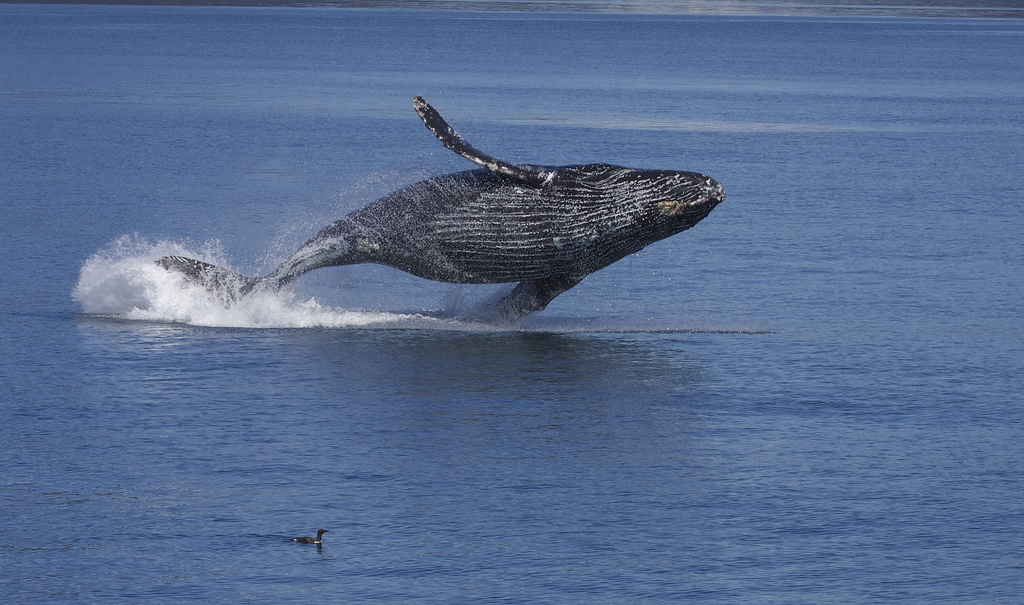
(Photo of breaching humpback whale by Gregory “Greg” Smith)

Swimming Stereotypes

Segregation deserves a lot of the blame for them:

[D]uring those decades when African Americans were kept out of New Orleans pools and beaches, black kids found other places to dive, like the other dredged-out canals around the city and dangerous parts of the Mississippi River. These unauthorized swimming areas would end up stewing a steady news feed of drownings. By the 1940s, the NAACP estimated that 15 black children had been drowning each summer in the city.

This chapter of New Orleans history helps explain some of the truths underlying the stereotype that black people don’t swim — but also illustrates why that reputation is ill-deserved, just like the notion that people of color don’t like the outdoors. The truth in it comes courtesy of the oft-cited statistics that close to 70 percent of black children can’t swim (compared to 42 percent of white kids) and black children are three times more likely to drown than white kids. But clearly, those stats don’t tell the whole story.

Battle Scars

Screen Shot 2014-05-30 at 12.51.19 PM

Mike St Maur Sheil photographs World War I battlefields:

This is the site of the most intense and protracted engagement of the Great War. For nearly 11 months, German and French troops waged an unrelenting battle. Despite the horrific losses on both sides, the iconic Battle of Verdun failed to be decisive for any of the combatants, though it effectively marked the end of Erich von Falkenhayn’s military leadership. Today, the farmers’ fields still bears its tortured marks.

Recent Dish on Verdun here. See more of Sheil’s work here and here.

(Photo © 2014 Mike St Maur Sheil / Mary Evans Collection)

The Rigorous Humanities

Guy Raffa argues, contrary to popular opinion, that a liberal arts education can impart logical, analytical thinking skills just as well as a course of study in STEM can:

In “Dante’s Hell and Its Afterlife,” an undergraduate course I teach at my university, students have to work hard to achieve good results (not to mention an A-level grade) on a research essay. The “excellent” paper will contain a substantive thesis that is appropriately focused, coherent, and interpretive, not merely descriptive; a detailed analysis of well-chosen examples to support the argument; a logical ordering of parts, each contributing to the whole, with transitions and topic sentences that advance and crystallize the main points; an effective use of information from credible sources, correctly cited and documented; and all expressed in clear, concise, grammatically correct prose.

My course – a large-format class in which students read Dante’s Inferno in English translation and examine its resonance in other creative works – is one of many “signature courses” offered across disciplines at my university. To fulfill core requirements, students must take at least one of these courses, whose objectives include developing the writing and critical-thinking skills evaluated in the research essay. Performing at the highest level on this kind of assignment is a challenge for everyone. But the degree of difficulty increases for STEM majors who have been fed red-meat lines mistakenly suggesting that they will learn to think with rigor, structure, and logic in computer science but not in English.