Where It’s Really Hard To Come Out As An Atheist

In Saudi Arabia, the government deems “calling for atheist thought in any form” a terrorist act. Nesrine Malik comments:

In my experience, when it comes to atheism in the Muslim world, there is a conspiracy of sorts, akin to the [former] “don’t ask, don’t tell” principle on homosexuality in the US military – if a Muslim has lapsed, and no longer believes in God, there is no censure of that as long as one does not proselytize. Indeed, a 2012 poll by WIN-Gallup International found that up to 5 percent of Saudis polled identified as atheist, according to Sultan al-Qassemi, a number “comparable to the US and parts of Europe.” However, these atheists are almost anonymous in the public sphere, only “out,” at most, to their families and friends.

Some atheists have taken to describing themselves as “ex-Muslims,” adopting a stance similar to that of the New Atheists:

Few people define themselves as “ex-Christian” or “ex-Jewish.” The “ex-Muslim” tag is an identity, a refuge, a political statement that is not to be confused with simple lack of belief in God. It is also one that finds common cause with a new tradition of western atheism, one that couches its position more in the public rejection of religion than simple non-belief. The difference is that the former can thrive in a secular society, where communities have become weaker and individuals revel in self-expression. Muslim societies are quietly tolerant of rebellious acts of all kinds, from the sexual to the religious. But because religion, family, society, and politics are built around community, to be a declared atheist in the public space is to make a stand against the fabric of society.

Previous Dish on the atheist closet in the West here.

No Gold Stars For America’s 12th Graders

Screen_Shot_2014-05-07_at_9.02.45_AM

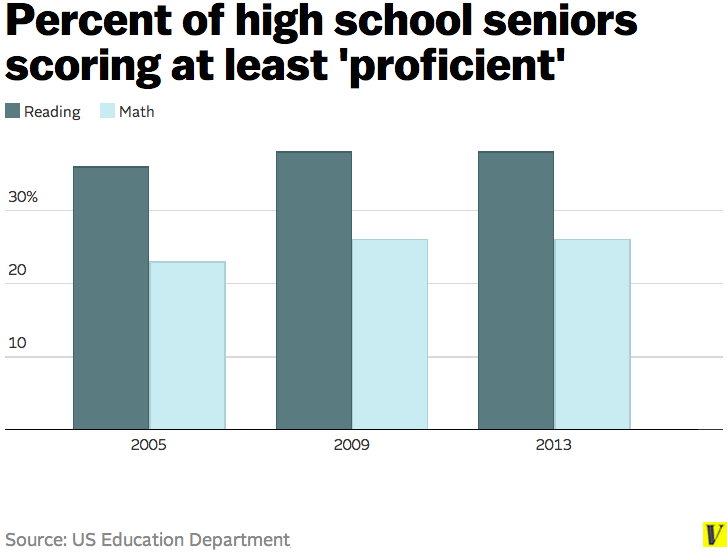
Libby Nelson finds “little good news” in the latest National Assessment of Educational Progress (“the nation’s report card”), which the DOE released yesterday:

Just 26 percent of 12th-grade students scored as proficient or better in mathematics in 2013. In reading, 38 percent were proficient or better. And there has been no improvement in 12th-graders’ scores since 2009, the last time students took the tests. … Scores released in December showed that fourth-grade and eighth-grade students have slowly improved their performance in reading and math, even though less than half of them score as proficient in those subjects. But Wednesday’s data show high school seniors haven’t even made incremental progress.

Why are seniors doing so poorly, when younger students are improving? Demographics might be a factor:

One change that probably has influenced the 12th-grade scores somewhat is the demographic changes of America’s seniors since testing began in 1992, as well as an upward trend in graduation numbers. The percentage of students who are Hispanic has risen from 7 to 20 percent in that time, and the percentage of students with a disability has doubled, from 5 to 11 percent, while the portion of students who are white has dropped from 74 percent to 58 percent. At the same time, the average freshman graduation rate has risen from 74 percent to 81 percent, meaning more students who might have dropped out in the past are now included in the sample that are tested.

But Jill Barshay is unsatisfied with that explanation:

[H]ere’s the thing. When you look at top achieving students in the top 75th and 90th percentiles. Their scores are FLAT. … High achieving students aren’t improving at all. So you can’t blame the infusion of more low performing students in the testing pool for the disappointing test scores. Even if we hadn’t introduced a greater number of weaker students into the mix, the scores of our high school students would still be stagnant.

Indeed, when you drill down by percentile, it’s the weakest students who are showing modest improvements. If not for their improvements, the national average would have declined!

Also, Maya Rhodan notes that, in the longer term, minority students’ scores are improving faster than those of white students:

Between 2005 and 2013, African-American students’ math scores jumped by five points and white students saw their scores go up by four points. Asian/Pacific Islander students and Hispanic students experienced the highest gains, with math scores increasing by 10 and seven points, respectively. Yet achievement gaps persist between racial groups and genders. Boys scored an average of three points higher than girls in math, and girls scored about 10 points higher in reading than boys. Whites scored 30 points higher than blacks in math and 21 points than Hispanic students. In reading, whites scored 30 points higher than blacks and 22 points higher than Hispanics.

Face Of The Day

Tensions Continue To Grow In Eastern Ukraine As Clashes Continue

Ieromonah Opanasiy, an Orthodox priest, sits in a tent providing humanitarian services to pro-Russian activists outside the occupied regional administration building, which serves as their local headquarters, in Donetsk, Ukraine on May 8, 2014. Tensions in Eastern Ukraine are high after pro-Russian activists seized control of at least ten cities ahead of the Victory Day holiday and a planned referendum on greater autonomy for the region. By Brendan Hoffman/Getty Images.

Do I Sound Gay? Ctd

Readers keep the popular thread going:

I’m deaf and I read lips. I’ve definitely noticed that someone’s speech can “look gay.” Sometimes this seems to trump how the person actually sounds. Occasionally I’ve mentioned something to a hearing person who says, “What? That person doesn’t sound gay at all.” Then, a little down the line, the person in question comes out of the closet. (This has only happened with gay men, not with lesbians.)

Another offers a “gay4pay perspective”:

I’m a straight male sex worker who has mostly serviced male clients. Most of my experience was in Canada but I have since moved to the US. My educational background is in the social sciences and law. At the end of nearly every session I conduct an informal, oral survey to find out some basic information about the client’s sexuality and his/her marital status and, where relevant, their “out” status (i.e. Are you “publicly” gay?)

One of the things that struck me quite early on in my experience as a sex worker was how many of my self-identified gay male clients had NO hint of a “gay voice”. At one point it was definitely a majority of them, but since moving to the US it has evened out a bit. I can tell you with absolute confidence that I did not notice any relationship between the client’s “out” status and their voice type.

Where I did detect a relationship was with age; the younger gay clients were much more likely to possess a voice that would at least hint at their sexuality. Most of the older ones (I stress these were mostly “out” clients) sounded much straighter than me, which brings me to my next point.

At least since high school, people have seriously questioned my straightness. It died down considerably during undergraduate school, but when I began law school it resumed. I have fun with the ambiguity much of the time, but there comes a point where I start wondering if it is actually affecting my prospects with women. When I ask people why I come off as gay, they point out a number of things that include my voice. Now, I personally don’t think I have a gay voice, but I do think it sounds “anti-macho” – sort of like a lot of European voices sound to Americans. I was born and raised in a part of the Arab world where anyone with some measure of civility would differentiate themselves from others with more “tribal” leanings. I speak with tremendous care, as though I love every word I say. I think it’s a terrible shame that doing so associates me with a specific sexual orientation.

My personal experience and what I’ve witnessed in my sex work, anecdotal as it is, really reinforces my view that a person’s voice and speech are things they are socialized into having.

Your Thursday Cry

Lori Dorn has details:

Max the cattle dog and Ralphee the kitten are the best of friends, so much so that it doesn’t seem to bother either one of them that little Ralphee suffers from a neurological disorder that causes him to walk like a drunken sailor. In fact, Ralphee’s disorder just makes the two of them closer as they grow up together in the same home, as shown in this video posted by Wakaleo Animal Channel.

Ralphee’s condition is a neurological disorder known as feline cerebellar hypoplasia. A kitten is born with “CH” when their cerebellum, the part of the brain that controls fine motor skills and coordination, is underdeveloped at birth. These cats are known for their “drunken sailor” walk, which is why they’re known endearingly as “wobbly cats.”..Ever since Ralphee was brought home, Max is never far away. He appears to be forever curious and watches over Ralphee wherever she goes. Ralphee is growing more mischievous by the day and loves to see what Max is doing as well. She will often get excited when he is nearby and leap in the air before playfully charging in his direction.

Simply lovely.

You Can’t Feed Your Family With A New TV, Ctd

A reader explains why it’s so much cheaper to buy goods than services:

Three words: Baumol’s. Cost. Disease. The basic idea is that as productivity increases over time (i.e., more widgets built, more burgers flipped), it can’t increase over time for work that is denominated in … time. Hours of child care. Hours of surgery. Hours of psychotherapy. Credit hours in education. You can’t cram more hours into an hour. So as wages rise, the per-hour cost of an hour has to just plain rise, in order to keep up.

His own example:

My wife and I have two small daughters. At present, full-time care for both costs about $1,600 a month. For comparison, our modest apartment costs us $1,800 a month. And the child care is modest, too! It was modest in a preschool until recently, and currently in a home daycare. The preschool was one of the cheaper day-care centers. The home day care is a little on the high side at the same price.

And here’s the rub: daycare workers are badly undervalued, undertrained, and underpaid. And even at that price they’re this expensive! I know a preschool that really pays and trains its teachers well. It costs about twice as much as ours did.

So my position is that good child care is fundamentally unaffordable. In the past, it was subsidized at the cost of women’s futures. Now, it is less and less subsidized – and less and less affordable.

Another reader takes issue with Derek Thompson:

Now consider education, health, and childcare, the blue sectors above where prices are rising considerably faster than average. These are service industries that employ local workers. They are not, to use the economic term, “tradable.”

Wrong! Education does not always employ local workers. I can send you evidence to show that STEM teachers are being imported by the dozen from India. I know them personally, I know the agency, and how it was investigated by DOL. Many years ago, tutoring, or doing your homework for a fee, was off-shored to India.

Healthcare was off-shored even before that: medical transcription, reading radiological reports. That trend reversed a bit because of the quality, but even then that has depleted the economy, rather than create value. I think the right explanation is that electronic consumable and durables become cheaper over time, like generic drugs, because the initial investment has been recouped. It is just economies of scale.

A “Judicial Coup” In Thailand

Thailand’s Constitutional Court has ordered Prime Minister Yingluck Shinawatra and nine members of her cabinet to step down:

Lennox Samuels situates the order within what critics call a “rolling silent judicial coup” against the Shinawatras’ political movement:

The ruling comes weeks after the same court nullified the February 2 national election, which Yingluck’s Pheu Thai party was expected to win. The party won the last election, in 2011, routing the opposition Democrat Party. Ever since that 2011 victory, anti-government elements have been agitating to topple Pheu Thai. … “This is a full-blown version of a judicial coup, with long-lasting impact on the balance of powers,” legal expert Verapat Pariyawong tells The Baily Beast. Previous rulings were among the principal reasons that led to the rise of an anti-Thaksin government and the 2010 massacre of the Red Shirts. “One can only hope that the political outcome will be different this time,” said Pariyawong. “But to be realistic, once the rule of law in the chamber is gone, all that is left is probably violence on the street.”

Keating remarks that, for all they are reviled by their opponents, “no party with one of the Shinawatra siblings at the top of the ballot has lost a Thai election” since 2001:

None of this is necessarily to defend the Shinawatras. Thaksin was a populist tycoon with an authoritarian streak who was accused of human rights abuses including extrajudicial killings and detentions during the country’s war on drugs. Yingluck was fairly transparently acting has his proxy by pushing an amnesty bill that would have allowed him to return to the country. A scheme to hoard rice to drive up global prices has been an economic disaster.

But it’s fairly apparent that any time Thai voters are asked, they vote Shinawtra—particularly in the country’s less developed north. But any time one of them or their allies gets into power, the judiciary and the military figure out a way to remove them. The opposition, whose supporters are drawn primarily from the urban middle class, are now advocating that the country’s electoral democracy be replaced with a vaguely defined “People’s Council.” If the Shinawatras are removed from power again, we could also see the return of massive and occasionally deadly street protests of years past.

Adam Pasick looks ahead:

Niwattumrong Boonsongpaisan, a cabinet minister, was named as acting prime minister, and much of Yingluck’s cabinet will remain in office, preventing the political vacuum that some had feared. But that’s only a stopgap, since the entire government has been in caretaker mode since Yingluck dissolved parliament and called for elections last year. The vote in February was boycotted by the anti-Thaksin (and misleadingly named) Democrat Party and the results voided by—you guessed it—the constitutional court. …

Previous setbacks have resulted in violent street clashes between security forces and Thaksin supporters known as “red shirts,” who have scheduled a protest for May 10 in response to Yingluck’s ouster. The outcome of that rally may determine whether Thai politics are yet again about to swing from absurdity to violence. In any case, chaos seems certain.

The Bloomberg editors slam the Thai opposition, which is still refusing to participate in the upcoming elections:

The courts have now satisfied one of the opposition’s central demands by getting rid of Yingluck. For weeks this spring, the army allowed protesters great leeway as they tried to blockade Bangkok’s streets. Yet neither the judges, the generals nor the king — the third leg of the traditionalist establishment — has stepped in to replace Yingluck’s government, for at least one obvious reason: No undemocratically chosen administration would command legitimacy among a majority of Thais or the international community.

The opposition’s continued refusal to stand in the elections — even with more than two months to prepare — simply cannot be justified. There’s little reason to suspect that the July vote won’t be largely free and fair. If the Democrats and their allies lose again, as they have repeatedly over the past two decades, it will be because they have still not crafted a message that appeals to most of their countrymen, nor built a strong political organization that extends to all parts of the country.

Previous Dish on Thailand here and here.

What Is The Ulysses Of Romance Novels? Ctd

The debate continues:

Your reader claiming that explicit writing about sex in romances makes those romances porn and then saying the writing about sex is “orthogonal to true art – it suppresses rather than invites reflection” irritates me. Look, for me, violence in television shows, movies, video games, and some books is also “orthogonal to true art.” Nevertheless, reviewers review and discuss violence (such as Jaime Lannister raping his sister Cersei in Game of Thrones) and do so in thoughtful ways, exploring the nuances of the violence, the sex, and their effects. There is no similar, serious, thoughtful writing in quantity about romance novels in the mainstream press. In fact, it’s my belief that the reason a lot of romance has unnecessary or uninspired writing about sex is that there are no sympathetic yet analytical reviews that could have helped shape the skills of writers and the tastes of the audience from the beginning.

Another reader:

Speaking as an erotic romance writer, and an acquisition editor for a romance publisher, I can assure you that erotic romance novels are not at all ONLY pornography. In fact, if you throw the word “porn” into a gathering of romance authors, you’d better get the hell out of there quickly before they eat you for breakfast! Only someone who has not read a well-written romance novel would say something so obviously dismissive and condescending.

I could list the many romance novels I’ve consumed that have influenced my ethics and morality (for the better), but the number is too unwieldy for this email. I’ve learned about racism, miscegenation, rape, slavery, consent, dub-con, homosexuality, ageism, history, polyamory, and most importantly, hope and acceptance, from romance novels. The kind of subject matter some authors routinely tackle is stunning. I’ve also learned how not to write from the badly written romances (just as I have learned that same lesson from crappy literary novels, of which there are many).

Romance is easily one of the most widely-read category of books. As an industry, it is booming. Yet I am continually amazed at the lack of respect these novels receive. Thank you for once again highlighting how little progress we have made in our world when it comes to what we allow women to be – because it’s just not cool to read something romantic, is it? In order to be a real woman, a smart woman, a perfect woman, you can only read The Odyssey.

Oh wait, what was Ulysses trying to do? Get back home to the woman he loved? Hmmm …

Meanwhile, another reader – who is writing a book about the cultural response to romance – puts forth a canon that stretches back hundreds of years:

The word “romance” originally referred to a relatively lengthy, fictional narrative, in poetry or in prose, written in “romanz” – that is, the romance language, which, in this case, was Old French. Romances could treat topics out of classical or French history, but they are most famous nowadays for treating matters of British history, especially the stories of King Arthur and the knights of the Round Table. So, the first “romance novels,” in a sense, are the accounts of the loves Lancelot and Guinevere and Tristan and Iseut in the twelfth century, which are the ancestor of the love stories we know today.

While classical culture knew erotic love, such as the passion of Dido for Aeneas, it is often argued that “romantic” love as we know it – with its emphasis upon the lovers’ suffering and their exaltation through suffering – originated in these “romanz.” The “canonical” works of this genre would include Chrétien de Troyes’ Lancelot; Béroul’s, Thomas’, and Gottfried von Strassburg’s romances of Tristan; Marie de France’s Lais; and the lengthy Vulgate and Post-Vulgate Cycles, with their compendia of Arthurian lore.

Medieval romance is followed by Renaissance romance epic. I would recommend Ludovico Ariosto’s Orlando Furioso, which contains enough bodice-ripping to satisfy any Harlequin reader, and Torquato Tasso’s Jerusalem Delivered.

While the English made a distinction between medieval “romance” and the modern “novel” (which they claim to have invented in the eighteenth century), most other Europeans use the same term (“roman,” “romanzo,” “Roman,” etc.) for the two genres. Even in England, Gothic novels were often subtitled “A Romance,” in order to link them with the earlier, medieval tradition. I can’t speak to modern romances, but I suspect one can’t do much better than Emily Bronte’s Wuthering Heights.

While there is very much a “romance canon,” it is also true that, from the 12th century to the present day, the genre has been criticized for suggesting that amorous relationships should be passionate and, typically, outside the boundaries of marriage. Emma Bovary reads too many romances, and we see what happens to her …