There Are Less Painful Ways To Die

Stephanie Mencimer calls lethal injection a “terrible way to kill people.” She claims that the “veins of death row inmates can’t handle the needles”:

Many death row inmates were once IV drug users, and by the time they reach the death chamber, their veins are a mess. Others are obese from years of confinement, which also makes their veins hard to find. Compounding that problem is the fact that the people inserting the needles usually aren’t medical professionals. They’re prison guards (in Oklahoma they’re paid $300 for the job), and they’re usually in a big hurry to get it done quickly—an factor that doesn’t mesh well with the slower-acting drugs states are now resorting to.

Sonny Bunch recommends the guillotine as an alternative:

There are other, less dramatic, ways, of course. Hanging and firing squads would probably be quicker and more painless than lethal injection or the electric chair. But the guillotine really seems to solve everyone’s problems: It was designed to deliver an efficient, quick, and painless death. It performs that task admirably. I understand the irony of a reactionary such as myself embracing the Terror’s preferred method of execution, but one must give credit where it’s due.

If we’re going to do something—and a large number of Americans and American states are pretty committed to performing executions—we ought to do it right. And “right” in this case means a quick and painless death. I can’t really imagine any reasonable objections to a widespread adoption of the guillotine.

Dish readers raised several objections to bringing back the guillotine when John Kruzel suggested it last year.

Has China Pulled Ahead?

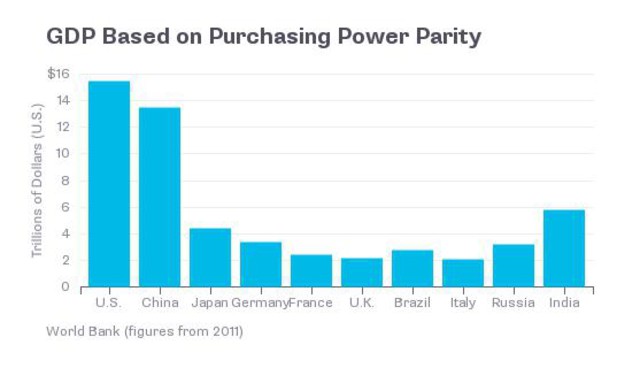
These are just the numbers from three years ago:

ioOW2PtgCvMw

So it’s only a matter of time before China overtakes the US as the world’s largest economy – and by one measure, it may be there already:

The World Bank’s International Comparison Program takes account of international prices to give a more accurate measure of real output. The statisticians have just completed the exercise for 2011, and they found that China’s economy back then was 87 percent as big as the U.S.’s — not 47 percent, as output converted at market exchange rates would have you believe. Since 2011, China has grown much faster than the U.S. According to the new numbers, its economy will be the world’s biggest before 2014 is out, if it isn’t already.

But Christopher Ingraham deflates the excitement, noting that Purchasing Power Parity isn’t a useful way to compare economies:

On that measure, China is looking pretty good. … But there’s a reason that standard measures of GDP don’t use the PPP conversion. As the Wall Street Journal’s Tom Wright explains:

China can’t buy missiles and ships and iPhones and German cars in PPP currency. They have to pay at prevailing exchange rates. That’s why exchange rate valuations are seen as more important when comparing the power of nations.

Standard GDP measures take these exchange factors into account. And here, China is doing about as well as one would expect. They’re still the world’s second-largest economy, but their GDP is less than half the size of the U.S. GDP.

Drum also downplays the new numbers:

I don’t want to pretend to some kind of faux naivete here, but can someone tell my why there’s suddenly a big frenzy about whether China is now the biggest economy in the world? China has 1.3 billion people. Of course they’re eventually going to eventually be bigger than the US. If not this year, then next year or the year after. Everyone knows this. Everyone has always known this. It’s no surprise, and it’s no big deal. They’ve still got about the per capita GDP of Albania, and it will be decades before they become even a middle-income country.

Yglesias Award Nominee

“Whether one is a left-wing looney who becomes unhinged upon simply seeing this woman who loves her family and her country or is a right-wing yahoo who looks on her as some sort of high priestess of traditional values, Sarah Palin’s statement that, if she were in charge, “waterboarding is how we’d baptize terrorists” should shock the conscience … C. S. Lewis warns (I forget where exactly) about one’s glibly getting off, at God’s expense, one-liners that please the crowd but provoke unseen angels to weep. I think Palin’s guardian angel (and yes, she has one, CCC 336) wept at her comparing baptism to waterboarding,” – Edward Peters, of the Sacred Heart Major Seminary in Detroit.

There is also a request for an apology from Palin and the NRA from the National Religious Campaign Against Torture. See their letter to Palin here (pdf).

The Occasional Upper-Class

In a summary (NYT) of the findings from his new book, Chasing the American Dream, Mark Robert Rank explains that “the 1 percent” doesn’t include the same people from one year to the next:

It turns out that 12 percent of the population will find themselves in the top 1 percent of the income distribution for at least one year. What’s more, 39 percent of Americans will spend a year in the top 5 percent of the income distribution, 56 percent will find themselves in the top 10 percent, and a whopping 73 percent will spend a year in the top 20 percent of the income distribution.

Yet while many Americans will experience some level of affluence during their lives, a much smaller percentage of them will do so for an extended period of time. Although 12 percent of the population will experience a year in which they find themselves in the top 1 percent of the income distribution, a mere 0.6 percent will do so in 10 consecutive years.

It is clear that the image of a static 1 and 99 percent is largely incorrect.

After a few celebratory digs at the left, Kevin Williamson uses these findings to urge conservatives to re-focus on poverty:

Professor Rank’s work and the reality of what an optimist might call lifetime income dynamism and a pessimist might call lifetime income instability should have conservatives rethinking their approach to the issue. It is not enough to explain that income inequality does not mean what Paul Krugman wants his readers to think it means, or to keep hammering away at the necessary but not sufficient project of reorienting our welfare programs toward work and the Sisyphean labor of trying to make those programs at least operationally efficient. A deeper appreciation for the lumpy and unpredictable nature of personal income over the course of a working life might help conservatives to deal with the issue of risk aversion, which is a critical factor behind our generally poor record of connecting with women and non-white voters, who lack the economic confidence of traditional conservative constituencies, and not without some reason. Selling an ownership society to people who are terrified of and baffled by the stock market is not a model for success.

But, as Danielle Kurtzleben points out, Rank’s book also addresses the barriers to achieving success in America, of which there are several:

Being smart, white, and coming from a wealthy family may not guarantee a person will achieve the American Dream, but all of those things can help by putting a person at the center of the funnels, the authors write. Falling right through all of those funnels — good primary schooling, getting a higher education, and finding a good job — makes it all the easier to get to the end goal.

Being lower-skilled or growing up poorer, meanwhile, starts a person out at a disadvantage. It means more distance to travel to get to the center of the funnel, meaning more obstacles to be overcome. So having to work harder to even graduate can keep a person out of the middle. And Americans who grow up poor, for example, have a tough time of climbing the ladder — much harder than their peers in other countries. Likewise, SAT scores tend to be higher for kids from higher-income families.

Ask Elyn Saks Anything: Living With Schizophrenia

In our first video from the author of The Center Cannot Hold: My Journey Through Madness, Saks explains what it’s like to have a major mental illness:

Her symptoms began as a teenager:

More about Saks:

Elyn Saks is an expert in mental health law and a winner of the Mac­Arthur Foundation Fellowship, which she used to create the Saks Institute for Mental Health Law, Policy, and Ethics. She is also Associate Dean and Orrin B. Evans Professor of Law, Psychology, and Psychiatry and the Behavioral Sciences at the University of Southern California Gould Law School. Saks lives with schizophrenia and has chronicled her experience with the illness in her award-winning, best-selling autobiography, The Center Cannot Hold: My Journey Through Madness.

(Archive)

Should Doctors Play Executioner?

After the botched execution in Oklahoma, Room For Debate wrestles with question. Neil J. Farber examines opinion within the medical community:

In the survey in 2000, 1,000 physicians in the United States were asked whether they condoned colleagues’ involvement in capital punishment. Of the 482 physicians who returned questionnaires, 80 percent said they believed at least one of the proscribed actions by the American Medical Association and the American College of Physicans (starting IV lines, monitoring vital signs, selecting injection sites, administering the lethal drugs, determining death, maintaining lethal injection devices, supervising personnel who give the lethal injections, and ordering the lethal drugs) was actually permitted, and 53 percent said 5 or more of the actions were acceptable. Those who approved of the death penalty were more likely to approve doctors’ involvement with several actions.

Sidney Wolfe makes the standard case against doctors administering lethal injection drugs:

[G]roups like the American Medical Association oppose participation and anesthesiologists can lose board certification for taking part in executions. Involvement perverts the duties and responsibilities that physicians have to heal, not to hurt. Administering a lethal dose of drugs is the most serious violation of ethics, but merely being present to pronounce a patient dead still makes that physician complicit in someone’s killing, as a necessary part of the death squad.

Ken Baum and Julie Cantor share a different perspective:

Physician involvement in lethal injection can make capital punishment less grotesque, more palatable, and even routine. But so long as the state uses the tools of the physician to kill its citizens, those who wish to step in to ensure that executions are, at the very least, competently handled should have the option to do so. Anything else is death penalty politics at the expense of the condemned. And no matter where you come out on capital punishment, no one should be sentenced to a botched execution.

And Sometimes I Just Get Things Wrong

I guess it’s a function of not following the Benghazi story as diligently as some others. But that’s no excuse. Weigel and Dickerson are must-read correctives to my take on the Ben Rhodes email, and show how this new email – though indeed foolishly withheld (the real story) – isn’t anywhere near as damning as it may sound at first blush. For two reasons: the information Rhodes was working off – via the CIA and State – was indeed that the attack was related to the inflammatory video. Dickerson:

Rhodes sent his email at 8 p.m. on Friday, Sept. 14. Nine hours earlier, the CIA had sent its first set of talking points. The very first line of the first CIA talking point read: “The currently available information suggests that the demonstrations in Benghazi were spontaneously inspired by the protests at the US Embassy in Cairo and evolved into a direct assault against the US Consulate and subsequently its annex.” (The original copies are here, released by the White House last May.) What was causing the protests in Cairo that the CIA mentions? The video.

Weigel offers this timeline, via Zeke Miller:

2:23 p.m.: The CIA’s office of general counsel adds a line about the “inspired by the protests” theory being inconclusive.

3:04 p.m.: The talking points are sent to relevant White House aides, including Ben Rhodes.

4:42 p.m.: The CIA circulates new talking points but removes a mention of al Qaida.

6:21 p.m.: The White House (Tommy Vietor, not Ben Rhodes) adds a line about the administration warning, on September 10, of social media reports calling for demonstrations.

7:39 p.m.: State Department spokeswoman Victoria Nuland objects to some of the language because “the penultimate point could be abused by members to beat the State Department for not paying attention to Agency warnings.”

8:09 p.m.: Ben Rhodes sends the “smoking gun” email, nine hours after the first draft of talking points from the CIA said that the attacks grew out of a demonstration.

Weigel’s conclusion:

The White House’s shifty-sounding excuse, that the “demonstration” story line came not from its spin factory but from the CIA, remains surprisingly accurate.

It was spin, not deception. There’s a big difference. And for full disclosure: I’m friends with Ben and should have known he is not the type to lie about anything. But sometimes, a relationship like that makes me be extra skeptical about stories involving friends or acquaintances. I learned that in the Bush administration. But in this case, I was over-correcting and under-informed. Apologies.

Iraq Votes. But Will It Matter?

Joel Wing outlines the likely results of yesterday’s general election in Iraq:

Most Iraq watchers now seem to believe that the prime minister [Nouri al-Maliki] will get the most seats in parliament, and then go through a very long process of negotiations that could drag out for up to a year, and ensure himself another four years in office. The premier is hoping that his Shiite base will come out for him out of fear of the growing insurgency, and give him a plurality of votes. He will then be able to play upon the splits within the Sunni parties to ally with Deputy Premier Salah al-Mutlaq. If that gives him momentum the history of Iraqi politics is for the other parties to jump on board to assure themselves positions within the new government.

An alternative scenario could play out however. Last year ISCI was able to cut into Maliki’s base, and are hoping to repeat that again. It has portrayed itself as a nationalist party that has the support of the religious establishment in Najaf. The Sadrists’ Ahrar bloc believes that it can maintain its alliance with the Supreme Council that it forged in the 2013 elections. If they get anything near the number of seats of Maliki it will be a free for all for to create the majority necessary for a new government.

Bob Dreyfuss recounts how Maliki has cemented himself in power since the last election:

Back in 2010, when an opposition party led by Ayad Allawi—a wily, nonsectarian, secular Shiite politician with a largely Sunni base—won the biggest share of the vote, both the United States and Iran weighed in to prop up Maliki and ensure that he was able to form a government that eventually excluded Allawi. A year later, in 2011, the remaining American troops departed, and within days Maliki went to war against Sunni politicians, the Sunni establishment and others who opposed his authoritarian style.

Maliki used spurious charges of terrorism against top politicos, including the Sunni vice president of Iraq, who was forced to flee for his life. Following that, Maliki cracked down viciously on peaceful, Arab Spring–style protests in Anbar, killing hundreds and detaining thousands. …

So, it’s no wonder that the Iraqi insurgency that erupted after 2003 is back. This time, it’s enhanced by the chaos in Syria, where a largely Sunni army of Islamist fanatics and rag-tag rebels tied to Al Qaeda and ISIS are battling the government of President Bashar al-Assad. Cities such as Ramadi and Fallujah have turned into strongholds of the insurgency, and the anti-Maliki radicals have deployed waves of suicide bombers and car bomb experts to slaughter thousands of Shiite civilians in markets, public squares and other soft targets. They’ve also carried out a lethal pattern of assassinations of moderate and establishment Sunnis outside Baghdad.

Jay Ulfelder doubts the polls will stem the rising tide of violence:

Iraq is already suffering mass atrocities of its own at the hands of insurgent groups who routinely kill large numbers of civilians in indiscriminate attacks, every one of which would stun American or European publics if it happened there. According to the widely respected Iraq Body Count project, the pace of civilian killings in Iraq accelerated sharply in July 2013 after a several-year lull of sorts in which “only” a few hundred civilians were dying from violence each month. Since the middle of last year, the civilian toll has averaged more than 1,000 fatalities per month. That’s well off the pace of 2006-2007, the peak period of civilian casualties under Coalition occupation, but it’s still an astonishing level of violence. …

In theory, elections are supposed to be a brake on this process, giving rival factions opportunities to compete for power and influence state policy in nonviolent ways. In practice, this often isn’t the case. Instead, Iraq appears to be following the more conventional path in which election winners focus on consolidating their own power instead of governing well, and excluded factions seek other means to advance their interests.

Zalmay Khalilzad, who also expects Maliki to remain in power, addresses how the US should respond:

A new leader, untainted by a record of distrust and broken deals, could offer Iraq a promising way forward. A U.S. push to oust Maliki, however, would be risky. Relations between Washington and Kabul deteriorated sharply after Afghan president Hamid Karzai won re-election over the Obama Administration’s opposition. The experience with Maliki, moreover, shows that U.S. support for the winning candidate does not necessarily translate into reliable governance. …

Instead of relying on preferred Iraqi leaders, the Obama Administration should clearly articulate the program of reform it wants implemented during the process of government formation. Iraq’s constitution, which emphasizes federalism and decentralization of power, provides a roadmap for reform. Continued effort at monopolization of power by a majoritarian central government could incite a Kurdish push for sovereignty, as well as increased violence among Iraq’s Sunni population. Some Sunni leaders, after opposing federalism in the years after Saddam’s overthrow, now seek recognition of its provinces as federal regions.