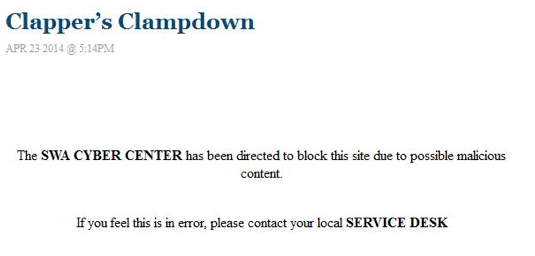
I’m a US Army soldier on deployment to Kuwait and read your blog daily. Like other government computer networks, the one here blocks certain content. This screen capture, from the article about the gag order imposed by James Clapper on the intel community, is too ironic not to share.
Category: The Dish
Eastern Ukraine Descends Into… What, Exactly?
This doesn’t look good:
Ukraine has sent in troops to clear out occupied government buildings in the city of Sloviansk, sparking a new round of violent clashes in the eastern part of the country. The fighting comes one day after President Oleksandr Turchynov announced that Kiev would move forward with “counter-terrorism” efforts in the east. Some outlets are reporting that a number of Russia separatists have been killed in clashes with Ukrainian soldiers. …
Russian President Vladimir Putin, not surprisingly, appears to be seizing on the event as justification both for the previous annexation of Crimea, and a pretext for further incursions into Ukraine. He said using the army against the Ukrainian people is “a very serious crime” that would have “consequences.” The Russian army claims they’ve been “forced” to launch news military drills along their border with Ukraine as a response.
Civil war expert James Fearon of Stanford tells Zack Beauchamp why he wouldn’t call this a “civil war”:
What we’re seeing is not so much civil war as an intervention by a very powerful neighbor who’s interested in annexation, but now there’s an interesting question as to what’s sort of path there will be towards actual annexation or will they be content with something formally short of that. The Russian Army is so strong that, relative to anything Ukraine could put up against them, I don’t see them starting a war against the Russian forces. And since that appears to be who’s there in the east, I don’t see what the fight would be.
If [Putin] extends this program further west, you could imagine the development of a terrorist or violent guerrilla movement that could someday get to civil war levels. There just isn’t much evidence right now that, at the core, this is a conflict between Ukrainians.
Quote For The Day
“I would absolutely concede that, while I find [Cliven] Bundy’s case completely unsympathetic, it is 100 percent possible to agree with his views on grazing rights without being racist. Where we differ is that, I’d argue, it’s not exactly a coincidence that Bundy also turns out to be a gigantic racist. Just like Ron Paul’s longtime ghostwriter turned out to be a neoconfederate white supremacist. And like the way Rand Paul’s ghostwriter also turned out to be a neoconfederate white supremacist. Presumably all these revelations have struck Tuccille as a series of shocking coincidences. Why do all these people with strong antipathy toward the federal government turn out to be racists? Why do all these homosexuals keep sucking my cock?” – Jon Chait.
The View From Your Window
The Dismemberment Of Sean Hannity
Better not to take the Stewart bait sometimes (after the jump because of auto-play complaints):
The War Over The Core, Ctd
Jennifer Rubin sighs over growing right-wing distrust of the Common Core:
The rationale for Common Core is that state standards, even the best of them, are far too low, leaving our kids in the dust behind international competition. (“A 2009 study by the National Assessment of Educational Progress (NAEP) found no state had reading proficiency standards as rigorous as those on the highly respected and internationally benchmarked NAEP 4th grade exam. Only one state, Massachusetts, had an 8th grade test as rigorous as the NAEP exam. Worse still, a large number of states had reading proficiency standards that would qualify their students as functionally illiterate on NAEP.”)
At a dinner with a group of journalists a year or so ago, [Jeb] Bush explained to us that while middle-class families in good school districts may think they are getting a good education, a significant percentage of their kids are not college ready and, in any case, match up poorly against foreign competition.
Jamelle Bouie, who doesn’t agree with Rubin very often, describes the opposition from conservatives as “near-senseless”:
Common Core was a bipartisan initiative, with support from the vast majority of governors, including Louisiana’s Bobby Jindal, who has since reversed course as he preps for a potential 2016 presidential run. What happened to make Common Core an object of hate for conservative activists? The answer is easy: “The Republican revolt against the Common Core,” noted the New York Times on Saturday, “can be traced to President Obama’s embrace of it.” This near-senseless Republican reaction is just one part of a growing tribalism that’s consumed the whole of conservative politics.
Steve Benen points out:
It’s become so bad that in January, Common Core supporters practically begged the White House not to mention the standards in the State of the Union address, fearing it would necessarily push Republicans further away.
“It’s imperative that the president not say anything about the Common Core State Standards,” Michael Petrilli, executive vice president of the Thomas B. Fordham Institute, said at the time, adding, “If he cares more about the success of this initiative than credit-taking, he will skip over it.”
Obama obliged, but it didn’t help.
But as Catherine Gewertz observes, the Common Core is a fait accompli in most states, “all but a handful” of which are set to administer exams based on those standards for the first time next year:
The two state consortia designing new tests for the standards – with the help of $360 million in federal aid – have sought to fundamentally reshape the way learning is assessed. And yet, over time they have scaled back some of their original testing plans in the face of political, economic, and technical constraints. Those realities have led consortium officials – who once made lofty promises about the revolutionary nature of their forthcoming tests—to represent them more humbly as “version 1.0” of assessments that are a vast improvement over what most states currently use, and will keep getting better in the coming years.
Meanwhile, Stephen Sawchuck reports that college education programs are not all on the same page when it comes to integrating the Core standards into their teacher training:
Teacher education has been under many pressures of late, including calls to improve student-teaching, classroom-management coursework, instruction, and program outcomes. The addition of the Common Core into that mix promises to be especially volatile, because it stands to reshape teacher education curricula to a greater degree than the other efforts. And that fuels concerns about academic freedom, as well as long-standing debates about whether programs’ main duty is to prepare teachers capable of carrying out specific, state-approved courses of study – or, as others argue, to prepare teachers to be knowledgeable about competing theories and to be critical actors in education policy.
Update from a reader:
Not only right-wing people are opposing Common Core. I am a former public school teacher and as liberal as they come. I put my kids into school this year, after home schooling them for many years. I have to say that the Common Core math instruction is truly insane. Parents can’t even help their child with homework half the time because getting the right answer is not enough. You have to do it the “right way”. And the right way is often crazy and filled with multiple steps well beyond anything needed to get to the answer. I have friends who are teachers or just parents and vote Democrat or even Green that feel the same way. I am waiting to see if it gets better or improvements are made, but we might be going back to home schooling in the future.
Don’t Judge A Fruit By Its Covering
Bonnie Tsui chides our aversion to ugly produce, which results in massive waste:
A recent report commissioned by the U.K. global food security program shows that of a given crop of fruit or vegetables grown in the country, up to 40 percent is rejected because it doesn’t meet retailer standards on size or shape. That’s a sizable chunk of the $31.3 billion of food that gets jettisoned in Britain every year. American supermarkets lose $15 billion each year in unsold fruits and vegetables. American consumers like their apples red and their bananas unspotted, so grocery stores comply—sometimes even dyeing and cutting to fit.
Changing mainstream culture to accept a crooked cucumber has bigger implications than just cost. Given that 20 to 30 percent of greenhouse gas emissions come from agriculture, food waste is a huge piece of the global climate problem. Last month, a new study by the Intergovernmental Panel on Climate Change revealed scientists’ deep concerns about dropping agricultural production—as much as 2 percent per decade for the rest of the century. The panel’s researchers have also found that though minor improvements can be made to improve efficiency in agriculture, the real game changers will lie on the consumption side.
(Image via Flickr user comedynose)
Surviving As A Stowaway
Kent Sepkowitz explains how the 16-year-old boy who stowed away in the wheel well of a Hawaiian Airlines flight from San Jose to Maui on Sunday survived the ordeal:
[A] confluence of dangers sometimes works to some small advantage.
The extreme cold of the upper atmosphere—wheel well riders have had body temperatures recorded at around 80 degrees Fahrenheit—slows the body’s cellular activities, sharply reducing the demand by cells for oxygen. A normal person becomes unconscious—comatose really—in this extreme cold. Just as once in a while, a drowning victim will survive because the extreme cold water acted in a similar fashion to suspend normal function, so too does some lucky wheel well stowaway occasionally make it back to the ground alive. According to the FAA data, younger men, like this week’s 16-year-old, are the survivors.
That is, unless they fall out as the plane lands:
The bodies of stowaways falling from airplanes on final approach has happened a few times in recent history, including on flights from Angola to London and from Charlotte, N.C. to Boston. The FAA lists several instances where a stowaway managed to survive the extreme temperatures with little oxygen, only to fall to his or her death when the airplane started to land.
Chad Griffin Responds
The head of the Human Rights Campaign doesn’t take on the distortions and exaggerations in the Becker book, but he does necessary damage control by saluting just a few of the countless individuals who, far from allowing marriage equality to “languish in obscurity” for years, actually made everything we are tackling now possible. The statement is made under obvious duress, but it’s also graceful. And true.
With any luck, we can get past this ugly, unnecessary spat and get on with the business of making marriage equality a reality in every state. Internal debates about strategy are inevitable and usually good things. But the point must never be about who’s getting credit. It must always be about getting the job done. We owe it to this vital moral cause not to lose sight of that.
Update – a reader writes:
This reader comment on his parva mea culpa made me spit coffee on the monitor:
Truly, he stands on the necks of giants.
He made a nice first start, but it’s not nearly enough, IMO.
Fathering In The Mother Tongue
After speaking only Hebrew to his daughter for three years, Noam Scheiber explains why he decided to stop trying “to mold her in the Israeliness that shaped me as a kid”:
[T]he older my daughter got, the less plausible the whole routine felt. Last fall, she started going to pre-school five days a week. Like any parent, I was keen to know what she’d been up to all day. We’d turn out the lights at bedtime and lie on her bed, and I’d pump her for information. In English, my natural sensibility is patient and understated. My style in Hebrew was hectoring and prosecutorial. At some point it occurred to me that I was mimicking an Israeli. It also occurred to me that I was getting nowhere—my daughter was clamming up.
One night a few months ago, I finally switched languages. The effect was magical. I hear my daughter speak English all the time and still I was shocked by her verbiage. She would riff about what she’d done at the playground and what she’d concocted in art class. As is her wont, she would also tell me who’d bitten whom that day, and who’d broken down in tears. Part of it, surely, was that she is much more fluent in English.
But that couldn’t have been the whole story. After all, she would answer me in English even when I spoke to her in Hebrew. It was hard to avoid the conclusion that, just as I felt more myself in English, I felt to my daughter more like her father.