Category: The Dish
Quote For The Day II
“For a journalist to write a book that says, in essence, that the struggle for marital equality “had largely languished in obscurity” until 2008 and the battle over Proposition 8 in California is tantamount to saying that the black-civil-rights struggle didn’t get going until President Obama was elected president that same year,” – Frank Rich on the Becker book.
Rauch On Eich
The obvious weakness in my own and others’ case for not wanting to punish someone who donated to the pro- Prop 8 campaign six years ago is the racial analogy. After all, isn’t opposition to marriage equality morally identical to opposition to inter-racial marriage? If so, why not punish and ostracize and get someone fired for opposing marriage equality as you would in a miscegenation case? I grappled with this at the time but Jon Rauch has a helpful piece explaining our position a little better.
Basically: gendered marriage had long been a settled assumption about the nature of what marriage is when we came along with the argument for same-sex marriage. Inter-racial marriage had existed as gendered marriage for a long time in some parts of the country, alongside anti-miscegenation laws in others. We were therefore asking for a bigger change than in the past – and one that had far less traction and history behind it. When you’re asking for more, a little more patience is necessary – and a little more lee-way for opponents is appropriate. We’re talking prudence here.
Yes, the opposition to inter-racial marriage had religious roots and rationalizations.
But the theological underpinnings of marriage as a gendered institution – between one man and one woman – were far deeper and wider than any theological roots for opposing miscegenation. And since the religious conscience carries weight in America, a full-scale assault on that ancient tradition as nothing but bigotry would have repelled far more people than it would have attracted. And that’s still the case. Calling every religious opponent of civil marriage equality a bigot would hurt our cause not help it. It alienates the very people we need to persuade.
Lastly, if reason and debate and testimony and civility had met total failure and unyielding majority opposition, I can see the case for more radicalism. But these tactics actually led to as swift a shift in public opinion on a major social issue as we’ve seen in American history. It’s therefore prudent, it seems to me, to sustain the same civility to get us to the ultimate prize of equality across the nation and world. And the posture of shutting people up, of declaring their consciences objectively null and void, and punishing dissent – even as it is fast disappearing – is an unnecessary and self-defeating posture.
(Photo from Getty)
Starry-Eyed Youth
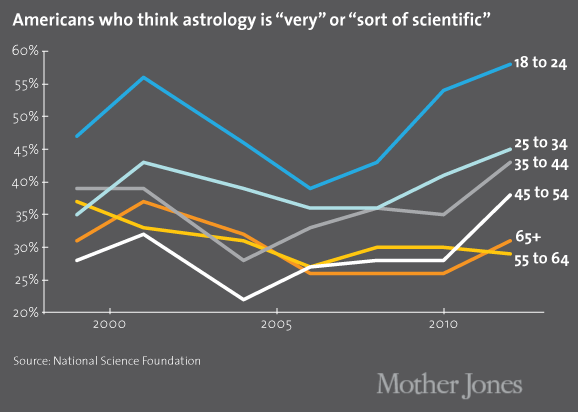
Amanda Petrusich theorizes about why young people are more attracted to astrology than their elders:
While [Millennials are] hardly the first group to feel the draw of the unknown, it also makes sense that a generation that came of age with the whole of human knowledge in its pockets might find the ambiguity of astrology a little welcome sometimes. For people born with the web, information has always been instantly accessible, so astrology’s abstruseness – and, ironically, its promises of clarity regarding the only real unknowable: the future – becomes appealing. This generation’s predicament, as I understand it, has always felt Dickensian: “We have everything before us, we have nothing before us.”
But then I’m reminded, again, that inaccuracy, or, at least, a belief in the fluidity of truth, is at the heart of the present-day zeitgeist: Our news is often hasty and unverified, our photos are filtered and retouched, our songs are pitch-corrected, our unscripted television programs are storyboarded into oblivion, and most everyone shrugs it all off. Astrology might not offer the most accurate or verifiable information, but at least it offers information – arguably the only currency that makes sense in 2014.
Palestinians Come Together, Peace Talks Come Apart
Zack Beauchamp explains the Palestinian reconciliation agreement signed in Gaza yesterday:
According to the new deal, the two Palestinian factions would form a shared interim government within five weeks, and hold elections for Palestinian Authority President, PA legislative council, and Palestinian Liberation Organization council within six months. If implemented, the Palestinians would have a unified government for the first time since 2007. The Palestinian split had made peace negotiations extremely difficult, as Israel couldn’t make two separate deals with two separate Palestinian groups.
There’s some reason to believe the deal won’t hold. Hamas and Fatah came to similar agreements in both 2011 and 2012, but both of those fell apart. This deal doesn’t resolve underlying issues between the two groups, such as whether Palestinians should agree to a permanent peace deal with Israel or whether Palestine should be governed according to Islamic law. Those are pretty significant disputes.
Israel immediately cut off talks and announced reprisals:
The top-level inner cabinet of Prime Minister Benjamin Netanyahu’s government “decided unanimously that it will not negotiate with a Palestinian government that incorporates Hamas, a terrorist organization that seeks the destruction of Israel,” a statement said after an emergency meeting that lasted throughout Thursday afternoon. Israel also said it plans to introduce economic sanctions against the PA — which will reportedly include withholding tax revenues collected by Israel on behalf of the PA.
Noting that past attempts at reconciliation have failed, Karl Vick thinks this announcement could be a tactical play:
The timing of the announcement, six days before the April 29 deadline for U.S.-sponsored peace talks, suggests Palestinian Authority President Mahmoud Abbas, who heads Fatah, may have chosen to push back against pressure from Israel and the U.S., which Palestinians see as insisting on new concessions. Israeli Prime Minister Benjamin Netanyahu was angered by the latest announcement, declaring, as he did after the previous pacts, that Abbas “must choose. Does he want reconciliation with Hamas, or peace with Israel?”
By appearing to choose Hamas, Abbas wins points with the Palestinian public (which strongly opposes the factional rift), while perhaps also driving a wedge between the Americans and Netanyahu. “Is he hoping this will raise alarm bells in Washington, and they’ll go back to the Israelis and say, ‘We’ve got to offer him something’?” asks Mouin Rabbani, a senior fellow at the Institute for Palestine Studies. “Yes, the timing is suspicious.”
Jacob Eriksson exposes the cynicism of Netanyahu’s position:
Israeli prime minister, Benjamin Netanyahu, has said the Palestinian Authority president, Mahmoud Abbas (Abu Mazen), can have peace with Israel or peace with Hamas – but not both. But this logic is inherently problematic; an oft-heard criticism during the seven-year rift between Fatah and Hamas has been that the Palestinian Authority does not represent all Palestinians and so any agreement reached would not be able to be implemented.
But when the Palestinians do move to create a unified, democratically elected leadership that represents all their people and can negotiate meaningfully if it chooses to do so, Israel considers this a non-starter.
This is a convenient excuse for Netanyahu to disengage from negotiations that he was never seriously committed to in the first place.
Juan Cole piles on:
[T]he hostility of Israel and the US to a Palestinian internal reconciliation also derives from their desire to divide and rule. A united Palestinian front would make that strategy much less salient. If the 4.4 million Palestinians in the Occupied territories could speak with a single voice, they would nearly have the weight of the 5.5 million Israeli Jews.
The US spokesperson said that Israel cannot be expected to negotiate with a party that does not believe it has a right to exist. The hypocrisy and irony is thick. Israel doesn’t recognize the right of Palestine to exist. As for the demand that Hamas renounce violence, likewise, Israel has not renounced violent aggression toward the Palestinians, something it and its settler surrogates engage in daily. The fact is that parties to negotiations are often engaged in violence against one another (hence the negotiations) and often don’t recognize each other’s legitimacy at the start.
Why Hasn’t Marriage Equality Come To Germany?
The same Pew survey that showed the French to be so accepting of extramarital affairs also offered a fascinating overview of global attitudes toward homosexuality. One reader’s take-away is that public support for gay people doesn’t always translate into gay rights:
Only 8 percent of respondents in Germany, my home country, find homosexuality “morally unacceptable,” while 37 percent of Americans hold that view. I would have guessed that there was a significant difference between Western European countries and the US, but I would not have expected the difference to be so stark.
So considering those numbers, you’d think we’d have marriage equality in Germany. We don’t. We have registered partnerships, a form of civil unions, and most rights coming with them had to be fought for in the courts in recent years. The political left is for marriage equality. Standing in the way of enacting it in parliament are Angela Merkel’s Christian Democrats. Before last year’s elections, Merkel was put on the spot by a gay voter in a televised town hall forum asking for adoption rights for gay couples. Merkel had to explain her opposition and she was clearly uncomfortable having to do so . One wonders if her opposition is heartfelt or merely a nod to her party’s religiously conservative wing.
The fact that whether homosexuality is viewed as morally acceptable or not does not necessarily go hand in hand with marriage equality is quite evident when looking at other countries.
Spain has marriage equality (6 percent believe homosexuality to be morally unacceptable); Italy does not (19 percent). Parts of Britain have marriage equality (17 percent); Australia does not (18 percent). Indeed, South Africa has had marriage equality (mandated by the country’s supreme court), and still 62 percent find homosexuality morally unacceptable.
Apart from marriage equality, these numbers could be an explanation for why it’s so easy to stir up anti-gay feelings in some countries such as Uganda. In Uganda, homosexuality (93 percent) trumps abortion (88 percent), extramarital affairs and gambling (80 percent each), premarital sex (77 percent), and divorce (76 percent) as the most morally unacceptable. Looking at some other African countries such as Kenya (88 percent) and Nigeria (85 percent), where this is also the case, it’s not at all surprising that politicians in some of these countries are using anti-gay laws in an apparent effort to redirect any animus away from them to a vulnerable minority.
That negative feelings about homosexuality don’t automatically have to lead to an anti-gay witch hunt is apparent when you look at the country where homosexuality is almost universally seen as morally unacceptable (98 percent): Ghana. Of the four countries (Uganda, Kenya, Nigeria and Ghana), Ghana is far and away the most democratic. While homosexual acts are still illegal there and it’s unlikely to change in the coming years, there don’t seem to be any measures on the horizon like those enacted in Uganda and Nigeria. Quite to the contrary, according to this report.
Where The Males Have (Little) Vaginas And The Females Have (Big) Penises, Ctd
We learn something new from readers every day:
I enjoyed that link on the gynosome, but I think that your coverage of sexual orientation and biology focusing on things like
bug penises miss issues about sexual orientation that genuinely fascinate biologists. The concept of “natural law” doesn’t really carry much weight with actual biologists, and it’s not all that surprising that there is an insect in which the female has a penis.
There are hundreds of species with these sorts of reproductive role reversals, including males who incubate eggs internally or even in their mouths, and in which female parental investment is limited. At this point, it’s almost trivial to point out that same-sex behavior and even same-sex parenting is common in nature, or that every possible variation on genitalia occurs somewhere in nature. Even in mammals, there are females with “penises.” Female hyenas have pseudo-penises bigger than those owned by males, and they swing their dicks with more élan and pride than the males do!
This is all entertaining, but it misses the deeper and more interesting question evolutionary biologists ask about homosexuality:

“Why does a trait that appears to reduce reproductive fitness persist?” There’s no moralizing about right or wrong in this question, just curiosity about how same-sex sexual attraction makes sense from the standpoint of natural selection, when it appears to lead to reduced reproduction on the part of those who have this trait. All of the unusual traits discussed above really do result in increased reproductive fitness. But same-sex sexual attraction itself? Now that’s a different and more interesting issue than the gender role differences and odd anatomy described above.
Biological speculation on this issue is based on a few assumptions. First, there is a strong indication that being gay is an inherent biological trait mediated by genes rather than a cultural variable or something that is socially constructed, given its apparent occurrence in roughly the same percentage across human populations at all times.
Second, it must not be maladaptive or it would not persist. I’d like to refer you to an older Scientific American blog post by a gay evolutionary biologist that outlines some of the thinking on this issue. I do hope you get a chance to read it, because one of my very few complaints about the Dish is that I wish you discussed science with more of the subtlety and depth of understanding with which you discuss faith.
(Image of a not-male hyena by Christine Drea)
The View From Your Obamacare
Not all of the experiences from our readers are positive:
I was going to get a new car, but the increase in my premiums sapped up the income I’d set aside for the additional expense. So I guess I’m stuck with my 12 year old truck. Oh, should also mention that my deductibles nearly tripled and my coverage sucks in comparison.
Another reader:
While I recognize the large-scale benefits of the ACA, we found its implementation absolutely devastating to our small business. Our company is a medical device developer/manufacturer with about 12 employees. Because we employ mostly high-pay, high-skill engineers and scientists, almost none of our employees qualified for any sort of subsidy. Most of our employees are married and have kids, so they needed the most expensive policy, the dreaded “Self + Family” option.
Because we are a small-business, we did not have the H.R. resources to shop for private insurance and had to contract a third party to do so for us. And because we are a small company, we had virtually zero bargaining leverage with insurers. Larger companies in our area ended up with much better group policy offers from the same insurer as us. In general, our policies went up about $300/month per employee, and our deductible increased from $2,500 to $3,850.
But what is the absolute worst is that insane 2.3% medical device tax enacted to “pay for” the ACA.
It taxes gross revenue, not net profit, so even if our company were to have a down year where we actually lost money, we STILL have to pay that tax on our total proceeds from sales (no matter what NYT columnists claim, most medical device companies aren’t enjoying massive profits via monopolistic evil).
This is completely absurd. I am a wildly left-leaning proud socialist, and I recognize the utility of taxes to pay for things, but the idea that gross income is taxed instead of net profit is a giant FUCK YOU to medical device companies. And worse yet: the pharmaceutical industry doesn’t have the same tax! If net profit were taxed, let’s say, then medical device companies could pour their profits into R&D prior to being taxed, which would foster innovation, bolster high-pay scientist/engineering jobs, and generally help the sick in this and other countries.
Long story short, someone obviously had to get the short end of the stick in ACA, and it is patently clear that it is the small, high-tech businesses who had no lobby.
Another:
I have been a supporter of the President and the ACA since the beginning. I certainly understand the political compromises that had to go into the development of the law and it’s far from perfect, but I was certain it would help a lot of people and help bend the cost curve of medical expenses.
However, my personal experience was somewhat shocking. I pay the full price for my family health insurance plan and my premium costs went up by 21% over the previous year to just under $1,650/month. I still have a $1,500/ $3,000 deductible and my co-pays on both doctor’s visits and medication went up by a few dollars as well.
Being in Massachusetts, my plan didn’t have to change very much to comply with the ACA. Guaranteed insurability was already state law, and a few small additions were added to the plan; doubling of rehab visit days in a calendar year, mental health visit co-pays equalized with other doctor co-pays etc. They also added pediatric dental as a requirement, but looking at plans that didn’t have that provision (if you had external dental coverage you could drop it) only lowered the premiums by about $30 a month.
I’m willing to put my money where my mouth is and pay extra if it’s helping implement a law that I believe in, and I make enough money that I can begrudgingly afford it. But this experience tells me that the upset self-employed and small business owners on Fox News talking about the unaffordable costs of this law are not completely full of it.
I was really taken aback by how much my premiums increased – much more in both percentage and dollar terms than in any other year, yet health care cost inflation was supposed to have leveled off? Trust me, I shopped around so it wasn’t just my provider; all plans similar to mine cost within $100 a month of this one – and it’s still considered a bronze plan (HMO not PPO). I have yet to see any justification for this increase and I hold out hope that our Mass. Based insurers are just overestimating costs and I’ll get a nice fat check next February when Harvard Pilgrim pays less than 85% of their income in benefits.
Like I said, I’m willing to pay the extra money – but single payer still sounds pretty good to me.
The Segregation Of Southern Politics

Nate Cohn highlights the increasing political uniformity of Southern whites:
While white Southerners have been voting Republican for decades, the hugeness of the gap was new. Mr. Obama often lost more than 40 percent of Al Gore’s support among white voters south of the historically significant line of the Missouri Compromise. Two centuries later, Southern politics are deeply polarized along racial lines. It is no exaggeration to suggest that in these states the Democrats have become the party of African Americans and that the Republicans are the party of whites.
The collapse in Democratic support among white Southerners has been obscured by the rise of the Obama coalition. Higher black turnout allowed the Democrats to win nearly 44 percent of the vote in states like Mississippi, where 37 percent of voters were black. But the white shift is nearly as important to contemporary electoral politics as the Obama coalition. It represents an end, at least temporarily, to the South’s assimilation into the American political and cultural mainstream.
This all intensified under Obama. And none of this is really disputed. Those who see no racial aspect to this have to explain a huge fucking coincidence, do they not? Aaron Blake thinks black voters could decide who gets the Senate:
Six of the 16 states with the highest black populations are holding key Senate contests in 2014. A seventh — the most African American state in the country, Mississippi — is holding a contest that could get interesting if there’s a tea party upset in the GOP primary.
This is a highly unusual set of circumstances, especially when you consider that most states with large numbers of African American voters generally don’t hold competitive Senate races because they are safely red (in the South, generally) or blue (in the Northeast).
What’s more, black voters don’t just matter to a lot of races; they also matter to the most important races.
Has The FCC Given Up On Net Neutrality?
Derek Mead outlines the FCC’s new proposed Internet regulations:
While the exact framework has yet to be announced, it’s expected that ISPs will be able to charge content providers extra for higher speeds. It would likely be voluntary, which is a key legal distinction; if Netflix doesn’t want to pay Comcast for bandwidth, it won’t have to. And if Time Warner Cable wants to negotiate different rates for special treatment with Google, NBC, and Netflix, it’ll be open to do so. But regardless, it will mean that those that have money can cruise in the internet fast lane, and those that can’t will be stuck with what’s left.
It represents a fundamental shift away from net neutrality, which assures that end users can pay for faster speeds but all content is treated the same. Net neutrality proponents argue that such equality is crucial for the vibrancy of the web. If Netflix has to pay more for faster streaming speeds, it will probably just pass those costs on to users; if a startup can’t afford to leverage a better delivery deal, it’s going to find it even harder to compete with the web giants.
Tim Wu is dismayed:
The new rule gives broadband providers what they’ve wanted for about a decade now: the right to speed up some traffic and degrade others. (With broadband, there is no such thing as accelerating some traffic without degrading other traffic.)
We take it for granted that bloggers, start-ups, or nonprofits on an open Internet reach their audiences roughly the same way as everyone else. Now they won’t. They’ll be behind in the queue, watching as companies that can pay tolls to the cable companies speed ahead. The motivation is not complicated. The broadband carriers want to make more money for doing what they already do. Never mind that American carriers already charge some of the world’s highest prices, around sixty dollars or more per month for broadband, a service that costs less than five dollars to provide. To put it mildly, the cable and telephone companies don’t need more money.
T.C. Sottek accuses the commission of cowardice and complicity with the ISP industry:
The government is too afraid to say it, but the internet is a utility. The data that flows to your home is just like water and electricity: it’s not a luxury or an option in 2014. The FCC’s original Open Internet rules failed precisely because it was too timid to say that out loud, and instead erected rules on a sketchy legal sinkhole that was destined to fail. As the WSJ reports, the FCC has once again decided against reclassifying broadband as a public utility. To declare the internet a public utility would go against the wishes of companies like Comcast and AT&T, which don’t want to be “dumb pipes.” There’s too much money to be made by charging everyone who uses the internet far more than what it actually costs to provide service.
Peter Weber offers more nuanced criticisms:
There are legitimate concerns that this rule, if enacted as envisioned, will turn the internet into a reflection of how the world works, with the rich and powerful using their clout and dollars to maintain their advantages and keep the smaller, newer players in the second tier or lower. But as long as no ISP can throttle or discriminate against traffic of any legal content, as promised, the biggest short-term impact to consumers will probably be higher fees for services that pay for the fast lane.
Net neutrality proponents are understandably skeptical of [FCC Chairman Tom] Wheeler, a former top lobbyist for the cable and telecom industries. But this weak-tea neutrality is neither fully his fault — the U.S. Court of Appeals, D.C. circuit, bears most of the blame — nor is it necessarily the death knell for an open internet. It’s just the beginning of a slightly stratified one.
 The Dish