The Best Time To Fly

silver-flights-2

“Between 6 and 7 in the morning,” says Silver:

Flights scheduled to depart in that window arrived just 8.6 minutes late on average. Flights leaving before 6, or between 7 and 8, are nearly as good. But delay times build from there. Through the rest of the morning and the afternoon, for every hour later you depart you can expect an extra minute of delays. Delay times peak at 20.7 minutes — more than twice as long as for early-morning flights — in the block between 6 and 7 p.m. They remain at 20-plus minutes through the 9 p.m. hour. …

Late-arriving aircraft account for the bulk of the difference in the timing of delays. Ever have one of those days when you’re 10 minutes late to your first appointment and never make up the time? Airplanes are the same way. Early in the morning, almost all of them are in position from the previous evening. But there isn’t much slack. Once they’re late, their schedule may be off for the rest of the day.

The Best Of The Dish Today

2014 B.A.A. Boston Marathon

Now there’s a Boston physique for you!

Meanwhile, the slams on the dreadful Becker book continue to pile up. When Michelangelo Signorile is compelled to agree with me, you have some idea of how bad it is. He notes how the book grotesquely distorts the legal work of Robbie Kaplan, who argued the much-more-significant Windsor case, only to have Becker relegate it to a footnote of her exclusive-access p.r. clients, Olson and Boies:

In Becker’s zeal to make her book and its insiders seem more important, she shockingly steals the win on DOMA by Kaplan and gives it to Prop 8 attorneys Ted Olson and David Boies. She wrongly portrays Kaplan as having argued a very narrow case, one not based on the dignity and civil rights of gay people, when in fact that is how Kaplan has always portrayed the case against DOMA, in the media and before the courts, right up to the high court. …

But Becker’s breathtakingly shameless conclusion, for which she quotes no legal scholar and clearly got directly from Olson and Boies, is that Olson’s arguments on Prop 8 won the DOMA case for Kaplan. She even quotes Kaplan seeming to back this up, a quotation that I find very strange, having read everything Kaplan has said about the case since DOMA was struck down. (Kaplan has not publicly commented on this book.) The omissions in the book are certainly egregious. But throwing Roberta Kaplan and Edie Windsor under the bus while comparing Chad Griffin to a woman who refused to sit at the back of the bus is truly horrendous.

My sources tell me that Kaplan rebutted this argument to Becker directly, only to have Becker ignore her points – which tells you something about the ethics and fairness of this shoddy p.r. exercise. Signorile, however, has to insist that my notion of the gay left’s resistance to marriage equality in the 1990s is unfounded. Well, since Evan Wolfson is an upstanding member of the gay left, and always has been, he is partly right. But the idea that the gay left was supportive of marriage equality as a priority or even at all in the early days is not true. Don’t ask me (although I can recite you chapter and verse), see this new piece by Richard Kim of The Nation on the epic struggle within the movement that preceded and accompanied the struggle for marriage rights. Money quote:

In the early 1990s, the writers Andrew Sullivan and Tony Kushner, in the pages of The New Republic and The Nation respectively, laid out two catalytic visions of gay politics. In his essay “The Politics of Homosexuality,” Sullivan made the conservative case for a gay agenda that focused solely on eliminating state discrimination against lesbians and gay men, chiefly the bans on same-sex marriage and military service … Kushner’s rejoinder, “A Socialism of the Skin,” published in these pages in 1994, was a galvanizing interpretation of gay liberation’s utopian and solidaristic spirit … I am, of course, Team Tony. But twenty years later, it is undeniable that Sullivan’s brand of politics defines the gay movement and that the achievement of its limited goals is on the near horizon.

Does Signorile think Richard Kim just made all that up?

On Becker, two questions: why, after all this fuss, does she refuse to engage her critics? And where is the NYT’s Public Editor on this mess?

The most popular post today was “Was Jesus God?” followed by my response to Ann Wroe’s thoughts on sin. I also went another round responding to critics of Ayaan Hirsi Ali. From the in-tray, small business owners shared their Obamacare stories (follow the whole thread here).

See you in the morning.

(Photo: A man with ‘We’re Back!’ written on his chest limps by after finishing the Boston Marathon on April 21, 2014 in Boston, Massachusetts. By Andrew Burton/Getty Images.)


Biting The Stardust

dish_hubble

In a loving tribute to her father, Sasha Sagan remembers how she came to learn about death. She describes an exchange in which she asked Carl if he would ever see his deceased parents again. He responded that “there was nothing he would like more in the world than to see his mother and father again, but that he had no reason — and no evidence — to support the idea of an afterlife, so he couldn’t give in to the temptation”:

Then he told me, very tenderly, that it can be dangerous to believe things just because you want them to be true. You can get tricked if you don’t question yourself and others, especially people in a position of authority. He told me that anything that’s truly real can stand up to scrutiny. As far as I can remember, this is the first time I began to understand the permanence of death. As I veered into a kind of mini existential crisis, my parents comforted me without deviating from their scientific worldview.

“You are alive right this second. That is an amazing thing,” they told me. When you consider the nearly infinite number of forks in the road that lead to any single person being born, they said, you must be grateful that you’re you at this very second.

Think of the enormous number of potential alternate universes where, for example, your great-great-grandparents never meet and you never come to be. Moreover, you have the pleasure of living on a planet where you have evolved to breathe the air, drink the water, and love the warmth of the closest star. You’re connected to the generations through DNA — and, even farther back, to the universe, because every cell in your body was cooked in the hearts of stars. We are star stuff, my dad famously said, and he made me feel that way.

Meanwhile, Jason Koebler explains the latest Hubble photo, pictured above:

What you’re seeing is a cross-section of the universe, showcasing objects that are one billion times fainter than those that you can see with your naked eye. Most of the things that look close are actually billions of light years apart, and most of them are billions of light years away from us. Check out the ultra high-res version here.

(Image by the NASA/ESA Hubble Space Telescope)

In Search Of A Well-Credentialed Egg, Ctd

A reader shares her experience:

Your reader noted that models and actresses get a premium on their donated eggs, and that reminded me that there’s also a Jewish premium.

I seriously considered donating my eggs as a way to pay off some grad school debt. I knew from the frequent ads in my undergrad newspaper (a prominent liberal arts school) that there is a high premium not just for the characteristics of being tall, slim, and with high SAT scores, but also for being Jewish – especially on the mother’s side since the ethnicity is traditionally matrilineal. Based on what I saw at the time, I could get about 40% above average (an extra $3K+) just for being ethnically Jewish.

It was interesting to think about my genes as high-priced commodities in this way – both flattering and uncomfortable. But it certainly makes sense in economic terms that low supply leads to high demand. And in this case, it’s not just a matter of wanting a baby that looks like you (as with the ad you posted specifying a Caucasian donor), but of wanting a baby that is part of your culture in a very deep and irreplaceable way.

Ultimately I decided against donating because the process sounds so unpleasant. I also have reservations about going to such lengths to bring new children into the world when there are so many already born who need a loving home.

Update from a reader:

“I seriously considered donating my eggs ….I could get about 40% above average (an extra $3K+) just for being ethnically Jewish.”

That’s not donating; that’s selling.

The reader responds:

It absolutely is selling. So is most sperm donation. Though actually one could look at the money for egg donation as being compensation for the months of physical discomfort, as opposed to the egg itself.

Dogs Have People Smarts

Cognitive researcher Brian Hare suggests that the secret to canine intelligence “may be nothing more than a good attitude”:

Hare had his epiphany while studying silver foxes in Siberia – animals researchers have bred for decades, selecting for tamer and tamer animals every generation until today they are docile as golden retrievers. When Hare first noticed that dogs could follow human pointing and chimps couldn’t, he initially thought that they must have simply picked the ability up from hanging around people. The idea made sense. Wolves don’t pass the pointing test, and because they’re nearly identical to dogs, the difference must lie in cohabitation. But when Hare visited the Russian fox farm in 2002, he found that the domesticated foxes were just as good as dogs at understanding human pointing, even though they’d spent almost no time with people.

“The control foxes,” says Hare – the ones not bred to be docile – “were too freaked out to participate in the study. When you’d walk by a row of cages, they’d all run to the back. It was like parting the sea. And when they did calm down, they weren’t interested in interacting with you.” The domesticated foxes were a different story. “Their stress response to people was completely gone. And because of that, they could solve all sorts of problems the other foxes couldn’t.”

The Case For Soaking The Rich

Yglesias makes it:

Very high taxation of labor income would mean fewer huge compensation packages, not more revenue. Precisely as Laffer pointed out decades ago, imposing a 90 percent tax rate on something is not really a way to tax it at all — it’s a way to make sure it doesn’t happen. If you believe systematically lower CEO compensation packages would mean a mass withdrawal of talent from the business world and a collapse of American industry, then those smaller pay packages could be an economic disaster. But the more plausible theory is that systematically lower CEO compensation packages would mean systematically higher compensation spending elsewhere in the corporate structure. Either more frontline workers or better-paid ones. The new tax code would redistribute value inside the corporate structure without anyone actually paying the new sky-high taxes.

But Zachary Karabell doubts that taxing the bejesus out of CEOs will solve our problems:

The top 100 CEOs in the [NYT’s] survey took home a total of $1.5 billion. That’s rather nice for them, but redistributing, say, $1 billion of that would do almost nothing to help the 100 million people at the bottom of the economic pyramid in the U.S.

Even if you included upper management and got to, let’s say, $100 billion, the extra income distributed across American society would barely improve living standards. Boards could mandate that, say, Larry Ellison of Oracle should be less wealthy so that Oracle employees could be more wealthy, but Oracle employees are already on the winning side of the global economic equation. They are not the ones who need help. …

No matter what redistributive measures we took, we’d still be faced with an economic system in dramatic flux based on the erosion of traditional wage industries in the developed world over the past decades. It is not inequality that has caused the middle class to lag and suffer. Inequality rather is a symptom of a system that reached the limit of what it could provide wage earners performing jobs tied to 20th-century manufacturing.

Danny Vinik counters Karabell:

[I]f he thinks $100 billion in additional redistribution “would barely improve living standards,” he does not understand the federal budget. President Obama’s plan to expand the Earned Income Tax Credit (EITC) would cost $60 billion over 10 years and lift half a million people out of poverty while helping another 10.1 million Americans in deep poverty. You could fund that and still have $940 billion to spend on antipoverty programs over the next decade. The federal government spent $61 billion in total on the EITC last year. On the Child Tax Credit, it was $57 billion. In January, Republicans and Democrats bitterly fought over food stamp cuts that ended up totaling $9 billion over a decade. An additional $100 billion in annual federal spending would have an immense effect on the living standards of low-income Americans.

In another post, Yglesias flags a study suggesting that higher taxes on the rich could boost the economy by redirecting talent out of the financial sector:

The career choices talented people make matter not just for themselves, but for the rest of society. Jobs differ in the extent to which success helps others. Major scientific breakthroughs help a scientist advance her career but are also broadly beneficial to society. A great teacher may impact a smaller circle of people, but is still helping many people beside herself.

By contrast, lawyers and traders seem to largely compete with each other in zero-sum games. If high taxes push talented people into careers where their work helps others that could raise the growth rate and increase human welfare completely apart from revenues. The authors show that under a variety of plausible assumptions the socially optimal top marginal income tax rate is very high — in the 70 to 90 percent range — largely because high tax rates would deter talent entry into finance and encourage talent entry into research/academia and teaching.

Party On, Tehran

3035293917_1d691ee4b7_o

Tehran Bureau takes a peek at the party culture lurking just below the surface in the Iranian capital’s more affluent districts:

For the wealthy and the well-connected, the boundaries of hedonism are limited only by the spatial confines of their villas or luxury apartments. Some outfit their homes with back-lit bars and DJ tables, transforming their homes into nightclubs at the flick of a light switch. There are strobe-lit discos where girls in bikinis spray guests with water guns, and embassy-district shindigs in which all counter space is taken up by imported alcohol. Then, there are parties based around film screenings, dance performances and concerts by underground bands, where members of the cultural scene gather to critique each other’s projects, sway to 1970s-style rock music or enjoy some Persian-tinged flamenco.

Most of the time, however, they are simple gatherings where friends and acquaintances gather in search of release from daily pressures. Nastaran, a 33-year-old translator, says throwing regular parties in her two-bedroom central Tehran apartment gives her something to look forward to as she goes through the weekday grind. “I get up after 6, splash some water on my face and head out into the traffic. In the evenings, if I’m lucky, I make it home by 8, eat dinner and go to bed. If I didn’t have this” – she says, raising up her glass of bootleg liquor – “what kind of life would I have?”

(Photo: Tehran skyline by Shahrokh Dabiri)

GROWing Pains, Ctd

Jay Newton-Small wonders why New Hampshire state representative Marilinda Garcia, a Latina who could be the GOP’s dream diversity candidate, isn’t getting much financial support for a Congressional run:

One of the challenges for female candidates on either side of the aisle is training them in raising money, generally a harder task for women than men at first. Emily’s List on the left holds regular training seminars around the country that are free to all perspective candidates. But the Susan B. Anthony List, which raises less than one-fifth of the money Emily’s List does, has not yet been able to launch such a program. “Do we wish that [Garcia] had more support? Do we wish that we had more money to give her to cross the finish line? Of course I do,” says Marjorie Dannenfelser, president of the Susan B. Anthony List. “I do wish the [National Republican Congressional Committee] would do more.”

Ostensibly, the NRCC is doing more. Last year, they launched a program called Project GROW to help female candidates. But Garcia, though she is a female Republican running for the House, has yet to get anything from the group.

Previous Dish on Project GROW here.

For The Love Of God

Ryan Jacobs flags a study that suggests people grow closer to God amidst relationship troubles:

In a new study published in Social Psychological and Personality Science, researchers recently tested how threats to romantic relationships affected people’s intimacy with God. The results suggest that the divine can act as a sort of rebound during moments of romantic desperation or trouble. The researchers exposed mostly religious subjects to psychological exercises that “threatened their romantic relationship” and then asked them about their connection to God. A control group just answered the God questions. Across three experiments, those in the experimental group reported stronger connections or a greater interest in God. The experiments also showed that those under the threatened relationship condition were “more willing to accommodate God’s transgression,” like not answering prayers. The researchers write that the results indicate that there is “considerable overlap between people’s divine and interpersonal relationships.”

But the study indicates a flip side:

[Researcher Kristin] Laurin’s team found that participants sought to enhance their relationship with God when under threat of romantic rejection – but only if they had high self-esteem. This fits with past work showing that people high in self-esteem seek social connection when their relationships are threatened. It’s a sobering finding, Laurin says: “We find that high self-esteem people, who already are the ones who take constructive steps to repair their relationships when they are under threat, have yet another resource they can turn to: their relationship with God,” she explains. “Low self-esteem people, who are the ones who retreat and protect themselves at the expense of the relationship when the relationship is under threat, don’t seem to be able to use this new resource either.”

Our Tentativeness Toward Future Tech

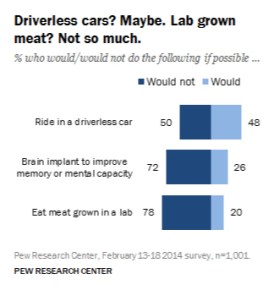
Last week, Pew released a study measuring American attitudes toward future technologies. While the majority of respondents expressed significant reservations about most of the tech, Emily Badger is glad that the driverless car was among the most accepted:

Transportation geeks generally love the idea of autonomous cars because they’ll make ownership unnecessary. When cars no longer need people to drive them, they can drive around all day, transporting one passenger after another after another — in a network PI_2014.04.16_TechFuture_driverless_cars-dish-cropthat might look a lot like personalized public transit. The resulting transportation system would be tremendously efficient. Cars wouldn’t spend the vast majority of their lives parked. We wouldn’t need to devote so much of our land to parking spots. We could get rid of the urban congestion that’s caused purely by people driving around looking for parking. …

Maybe you own a car because you need it, for mobility. But you own that car because you want it for some more intangible reason. In the future, however, the arrival of mass-market autonomous cars will force us to confront the difference between these two ideas. When you no longer need to own a car for mobility, will you still want one anyway for the love of cars, or for what they say about you, or for some other deeply personal reason?

Elsewhere in the study, 65% of respondents felt “it would be a change for the worse if lifelike robots become the primary caregivers for the elderly and people in poor health.” Waldman, on the other hand, welcomes the age of the robo-sponge-bathing:

Part of the reluctance people have may come from the associations we have with the word “robot,” and not just that they might rise up and exterminate us. When you hear the word, what do you think of? Something made of metal and plastic, probably. Not something with gentle hands that could, say, turn you over carefully and apply a soothing salve to your bedsores. But when they actually start designing caregiving robots, you can bet they’ll make sure to make them soft.

That industrial design will be one important part of gaining acceptance for helper robots. But more important will be the fact the need is so great, and they’ll be really, really handy. We already have a glaring need for caregivers for the sick and elderly, and as the Baby Boomers age, it will only increase. There are never going to be enough people to meet the need, unless half the American population is made up of nurses, orderlies, and home health aides taking care of the other half. And that of course would be prohibitively expensive. Robots will be pricey at first, but the price will drop over time, and Medicare will gladly pay a few grand for a bot that can do work that would end up costing tens of thousands of dollars a month if it were done by humans.

Adi Robertson parses more of the study:

Despite our categorical optimism about “technology,” it turns out that we’re sometimes more conservative about things that are actually on the horizon. 63 percent of Americans, for example, think that it would be a change for the worse if US airspace was opened to “personal and commercial drones.” 22 percent thought it would be a change for the better. … 66 percent think that it would be a bad thing if parents could alter a child’s DNA “to produce smarter, healthier, or more athletic offspring,” compared to 26 percent in support.

The most popular advance was a world where “most people wear implants or other devices that constantly show them information about the world around them,” which 53 percent thought would be a change for the worse and 37 percent thought would be an improvement.

Jason Koebler asked bioethicist Jonathan Moreno to explain all the anti-tech anxiety:

“I’m not impressed that this tells us very much how people will respond in a real case,” Moreno said. “If you go back and look at historical change, people were terrified of horse and carriages, they were shocked you could go 10 miles per hour on a train. But then, once you get them on it, we got very comfortable going from 10-40 miles an hour.” The point, Moreno said, is that people adjust to new tech very quickly. …

It’s not hard to think of more recent examples. At first, people were horrified that someone could reach them at any time on a cell phone—now, we can’t live without them. By generally trusting that “technology” as a whole is a force that’ll make people’s lives easier, the public doesn’t have to pick and choose which ones to throw their proverbial support behind. And, maybe it doesn’t even matter what people want—innovation is going to happen regardless.