So Much For Iraqi Democracy

Dexter Filkins details Maliki’s growing authoritarianism:

Maliki has grown steadily more imperious, reacting violently to the slightest criticism. He often claims to have files on his rivals, filled with evidence of corruption and killings. “I swear to God, if the parliament wants to summon me, I will go, but I will turn the world upside down,” he said on Iraqi television last year. “I will take a list of names with me and call them out one by one, and tell everyone what they have been doing.” Maliki has even resurrected a Saddam-era law that makes it a criminal offense to criticize the head of the government. He has filed defamation suits against scores of journalists, judges, and members of parliament, demanding that they spend time in prison and pay damages. “For any political difference, any rivalry, he makes a case,” a senior Iraqi politician told me.

A depressing, concluding thought:

Emma Sky, the civilian adviser during the occupation, saw Maliki’s parlous situation as the result of the White House’s own policies: Bush and Obama had invested so heavily in Maliki, and made him so powerful, that his authoritarian behavior became inevitable. “Did we just get it wrong with Maliki and Karzai—were we that unlucky?” Sky asked. “No. Maliki wasn’t like that in the beginning. The whole point of these places—of Iraq especially—is that the leaders need to do political deals. We make them so strong that they no longer need to do political deals. So we undermine any chance at stability. It’s destroying Iraq. We’re strengthening the guy who is creating the problem.”

Recent Dish on Iraq’s upcoming elections here.

A Global Tax On The Super Rich?

French economist Thomas Piketty, author of Capital in the Twenty-First Century, just released the English edition of the book, previously covered on the Dish here and here. In a companion post, Piketty puts forth his panacea to “the world’s spiralling levels of inequality”:

The ideal solution would be a global progressive tax on individual net worth. Those who are just getting started would pay little, while those who have billions would pay a lot. This would keep inequality under control and make it easier to climb the ladder. And it would put global wealth dynamics under public scrutiny. The lack of financial transparency and reliable wealth statistics is one of the main challenges for modern democracies.

Clive Crook surveys reaction to the book:

Martin Wolf of the Financial Times calls it “extraordinarily important.” Paul Krugman, writing in the New York Review of Books, says it’s “truly superb” and “awesome.” Branko Milanovic, a noted authority on global income disparities, calls it “one of the watershed books in economic thinking.” Even John Cassidy, in a relatively balanced appraisal for the New Yorker, says “Piketty has written a book that nobody interested in a defining issue of our era can afford to ignore.”

But Crook isn’t onboard:

This book wants you to worry about low growth in the coming decades not because that would mean a slower rise in living standards, but because it might cause the ratio of capital to output to rise, which would worsen inequality. In the frame of this book, the two world wars struck blows for social justice because they interrupted the aggrandizement of capital. We can’t expect to be so lucky again. The capitalist who squanders his fortune is a better friend to labor than the one who lives modestly and reinvests his surplus. In Piketty’s view of the world, where inequality is all that counts, capital accumulation is almost a sin in its own right.

Douthat is also critical of the book:

[A]s the Manhattan Institute’s Scott Winship has pointed out, Piketty’s data seems to understate the income gains enjoyed by most Americans over the last two generations.

These gains have not been as impressive as during the post-World War II years, but they do exist: For now, even as the rich have gotten much, much richer, the 99 percent have shared in growing prosperity in real, measurable ways. Winship’s point raises the possibility that even if Piketty’s broad projections are correct, the future he envisions might be much more stable and sustainable than many on the left tend to assume. Even if the income and wealth distributions look more Victorian, that is, the 99 percent may still be doing well enough to be wary of any political movement that seems too radical, too utopian, too inclined to rock the boat.

Robert J. Samuelson adds to the objections:

[Piketty’s] economic analysis sometimes seems skewed to fit his political agenda. Take his tax increases [roughly 80 percent on incomes above $500,000 or $1 million]. He doubts that they would hurt economic growth. This seems questionable. Incentives must matter, at least slightly. Or consider his predicted slowdown in the world economy. This seems possible, but if it happens, capital owners would likely suffer lower returns. As for the power of the super-rich, they hardly control most democracies. In the United States, where about 70 percent of federal spending goes to the poor and middle class, the richest 1 percent pay nearly a quarter of federal taxes.

Cowen piles on:

Overall, the main argument [of the book] is based on two (false) claims. First, that capital returns will be high and non-diminishing, relative to other factors, and sufficiently certain to support the r > g story [where wealth (r) is greater than the rate of growth (g)] as a dominant account of economic history looking forward.  Second, that this can happen without significant increases in real wages.

Still, it is a very important book and you should read and study it!  But I’m not convinced by the main arguments, and the positive reviews I have read worsen rather than alleviate my anxieties.

Cowen elaborates on those anxieties in Foreign Affairs. Related Dish on confiscatory taxes here.
The Healthcare Spending Rebound

Philip Klein notes it:

According to government data analyzed by the Altarum Institute, national health spending spiked 6.7 percent in February 2014 compared with the same month a year earlier, representing “the highest rate since March 2007, just prior to the recession, which officially began in December 2007.” There are a number of caveats to apply to this data. To start, it’s still subject to revision, as with all government economic data. It also is still too limited to represent enough of a trend. But if the data is confirmed by subsequent reports and does turn into a trend, it would have major implications for Obamacare.

Cohn talked to various experts about what to expect in the future:

[P]retty much all of these authorities agree on the general shape of things to come. Health care spending will acclerate for a little while, partly because of Obamacare’s coverage expansion but mostly because of the economic recovery. Then it will subside. It will, in other words, be like a wave: Spending will go up, crest, and then return to a lower level.

The good news is that, once the wave is done, year-to-year increases in health care spending should be significantly lower than the historical average. Economists like to talk about “excess growth”—that’s the difference between how quickly health care costs are rising and how fast the economy, measured as Gross Domestic Product, is growing. Over the last 50 years, excess growth has been about 2.6 percent. But the average in the last 20 years has been down to 1.6 percent, thanks to structural changes, some of which date back to the 1990s when insurers first started using managed care. There’s every reason to think that, once the economy fully recovers and Obamacare’s expansion is in place, health care spending will be back to rising at something like the level it was before.

Last week, Kliff explained why these numbers matter so much:

Even if a small portion of the health cost slowdown was structural – and latest decades to come – that could make a huge difference for overall health care spending. The Kaiser Family Foundation, for example, estimates that less than a quarter of the spending slowdown is attributable to permanent changes in the health care system. But even that small fraction that is permanent would cut about a half-trillion in health care spending over the next decade.

When Oil Isn’t Worth Extracting

oil-graphic

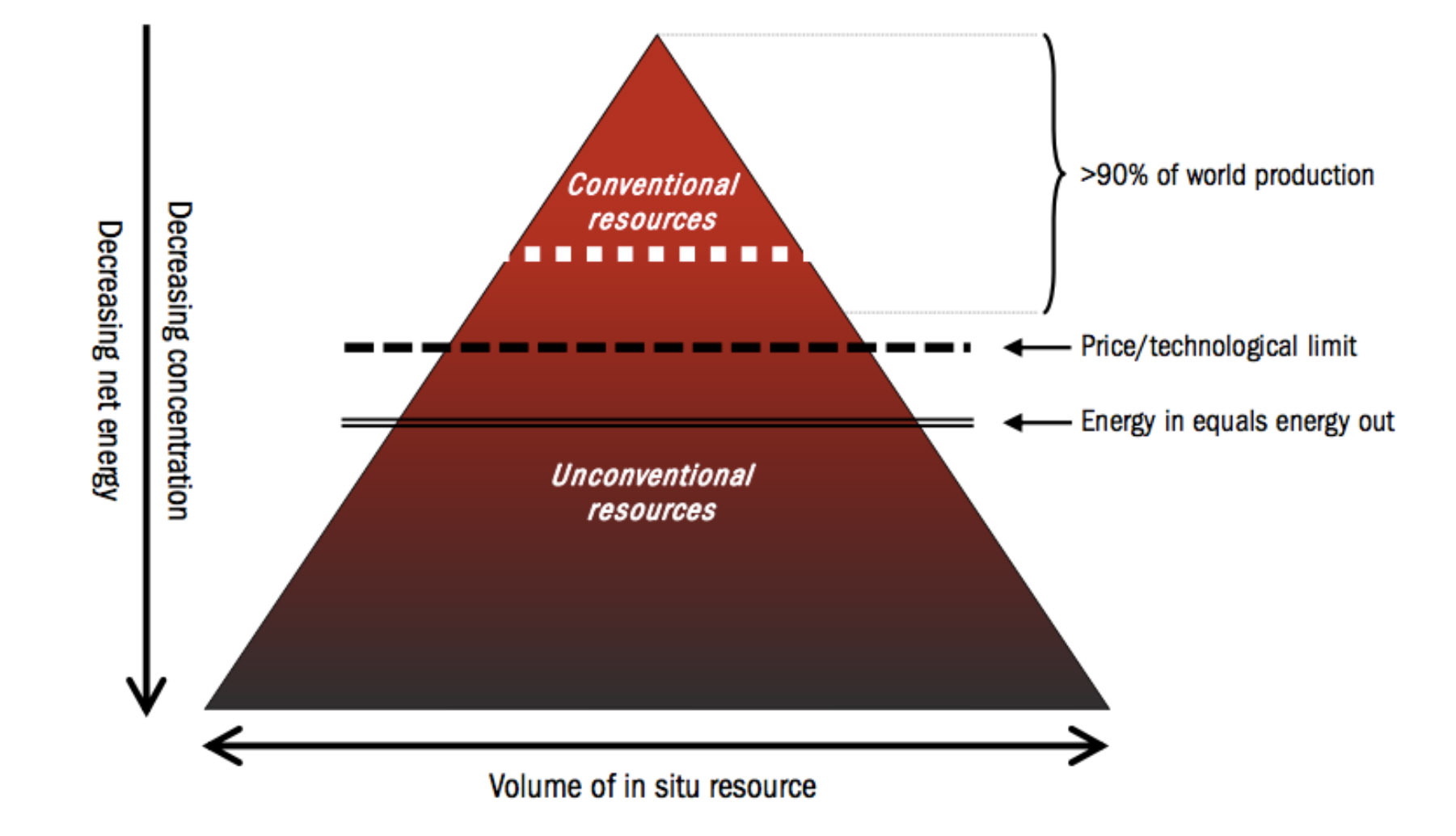
Despite the boom in US oil production, Richard Heinberg warns that we are approaching the point at which energy resources become too costly to take out of the earth:

We’ll never run out of any fossil fuel, in the sense of extracting every last molecule of coal, oil, or gas. Long before we get to that point, we will confront the dreaded double line in the diagram, labeled “energy in equals energy out.” At that stage, it will cost as much energy to find, pump, transport, and process a barrel of oil as the oil’s refined products will yield when burned in even the most perfectly efficient engine.

As we approach the energy break-even point, we can expect the requirement for ever-higher levels of investment in exploration and production on the part of the petroleum industry; We can therefore anticipate higher prices for finished fuels. Incidentally, we can also expect more environmental risk and damage from the process of fuel “production” (i.e., extraction and processing), because we will be drilling deeper and going to the ends of the Earth to find the last remaining deposits, and we will be burning ever-dirtier fuels. That’s exactly what is happening right now.

Discriminating By Being Neutral

Roger Clegg, Hans A. von Spakovsky and Elizabeth H. Slattery proclaim that “discrimination on the basis of race and ethnicity is unconstitutional, unlawful, and morally repugnant, yet the practice is rife throughout federal law and government programs”:

[M]ost civil-rights laws have no such “disparate impact” provisions; rather, they prohibit actual discrimination (“disparate treatment”). The laws have been expanded, however, through agency interpretation and activist court rulings to include “disparate impact.” As Justice Antonin Scalia has explained, disparate impact “place[s] a racial thumb on the scales, often requiring employers to evaluate the racial outcomes of their policies, and to make decisions based on (because of) those racial outcomes.” Thus, Congress should make clear that laws prohibiting disparate treatment do not extend to mere disparate impact.

Jamelle Bouie calls that argument “ahistorical nonsense”:

“Disparate impact” exists because discrimination was often achieved by neutral means.

During Jim Crow, for instance, explicitly discriminatory voting was illegal. White Southerners could block blacks from using public facilities or mandate segregated businesses, but they couldn’t bar blacks from voting. Hence the poll tax and the literacy test. In theory, they were universal requirements—everyone was vulnerable to failing the test or lacking the funds to pay a tax.

In practice, of course, extreme poverty and deprivation meant that ex-slaves and their descendants were most likely to fail the test or lack the funds. The same went for felon disenfranchisement; in theory, everyone who committed the felony of vagrancy or theft could lose his or her voting rights. In practice, however, these crimes were selectively applied to blacks.

Ask Dave Cullen Anything: What Shocked You Most About Columbine?

In the latest video from the author of the best-selling book Columbine, Cullen discusses a major aspect of the story he didn’t anticipate:

Cullen elaborated here about the many contrasts between Eric, the psychopathic mastermind, and Dylan, the depressive follower:

Outwardly, they looked like normal young boys about to graduate. They were testing authority, testing their sexual prowess – a little frustrated with the dumb-asses they had to deal with, a little full of themselves. Nothing unusual for high school.

But Eric had no intention of graduating. He had no plans, which seemed odd for a kid with so much potential. Dylan had a bright future. He was heading to college. He was going to be a computer engineer. Several schools had accepted him, and he and his dad had just driven down to Tucson on a four-day trip. He’d picked out a dorm room. His mother was going to mail his deposit to the University of Arizona on Monday.

On the day of the prom, Robyn Anderson drove out to pick Dylan up on Saturday afternoon. They shot pictures with his parents before meeting up with five other couples to head into the city. Dylan was giddy and beaming, all cleaned up for once. He’d gone with a traditional black tuxedo, bow tie slightly askew. His dad followed him around with a camcorder, capturing every move.

The prom was the standard affair. They crowned a queen, they crowned a king. Dylan and Robyn had fun. Dylan kept talking about college, about his future. He kept saying he could hardly wait.

Watch Cullen’s other videos on Columbine here.

(Archive)

Payback For Skimming A Paycheck

Catherine Rampell wants to criminalize wage theft:

“Wage theft” is an old problem. It can take many forms, including paying less than the minimum hourly wage, working employees off the clock, not paying required overtime rates and shifting hours into the next pay period so that overtime isn’t incurred. Unfortunately, reliable data on the magnitude of the problem are scarce. Workers can be afraid to report the theft for fear of losing their jobs altogether, especially in today’s terrible economy, and many don’t know their rights. Often workers don’t even realize their pay is being skimmed. …

The consequences for wage theft are rare, small and not particularly deterring. Even when government investigators pursue these complaints, for example, criminal charges are rarely filed. Harsher penalties, including prison time, should be on the table more often when willful wrongdoing is proved. Thieves caught stealing thousands of dollars from someone’s home can go to jail; the same should be true for thieves caught stealing thousands of dollars from someone’s paycheck.

Kathleen Geier approves:

Though some people might argue that hard time for the wage thieves is a harsh penalty, I’m not one of them. We call this practice “theft” because that is what it is. Just as anti-choicers who refer to abortion as “murder” should either embrace the logic of their own argument and support prison time for women who undergo abortions, or abandon the use of the “murder” label altogether when applied to abortion, the opponents of wage theft should stand firmly in favor of prison sentences for those convicted of this sleazy, bottom-feeding crime.

The Soaring Suicide In South Korea

Following the suicide of Kang Min-gyu, the vice-principal of the South Korean school whose students died on a ferry last week, Adam Taylor explored the country’s epidemic:

South Korea has one of the highest suicide rates in the world, more than double that of the United States. According to one recent OECD report, Korea had bucked a trend of falling suicide rates among developed nations, with suicide rising to become the fourth most common cause of death. Unlike most other countries, South Koreans actually become more likely to commit suicide as they age.

High-profile suicides have become a regular feature in the media. Former South Korean president Roh Moo-Hyun jumped off a hill to his death in 2009. Park Yong-oh, a well-known businessman who once led the Doosan Group, the country’s oldest conglomerate, also committed suicide that year. In 2010, singer and actor Park Yong-ha committed suicide at the height of his career, just one of a string of suicides in the entertainment industry, and earlier this year, a well-known reality TV show was taken off the air after a contestant killed herself.

A reader fills us in on the ferry incident, which he calls “Korea’s 9/11”:

I’m not sure whether the lack of Dish coverage is reflective of your editorial filtering process or of the level of general media coverage, but this is the ONLY story in Korea right now and one the world needs to know.

Last week a Korean ferry sank while carrying a high school class full of kids en route to Jeju, a popular resort island. Some 250 are missing and by now most likely dead – but what makes the tragedy really horrific is that it was easily preventable. The captain instructed the kids to stay in their cabins instead of preparing to evacuate, which he then promptly did himself. When the ship started to list and sink, they were too crushed in the hallway to get out.

Unsurprisingly, families are howling at the captain’s irresponsibility and cowardice. But the problem runs deeper than the individual level. Officers were woefully undertrained – they hadn’t ever drilled in emergency preparations or even read the manual – so they were clueless about what to do except save their own skins.

This is unfortunately representative of Korean business culture at large, which is notoriously unprofessional and short-sighted. Projects are planned based on overly optimistic assumptions and executed as a series of frantic lurches from one deadline to the next. Deals are cemented informally over “hwae-sik” after-work dinners (usually with drinks) rather than in writing at the office. Employees are measured by face-time, not output. The litany goes on, and anyone – Korean or Westerner – who’s done business both in and out of Korea can expound at length.

This strategy of cutting corners and playing fast-and-loose with the rules pays dividends when everything goes well: back in the ’70s, Hyundai initially became a world-class competitor by undercutting foreign competition to win fat contracts in the Middle East. But when the strategy breaks down, it does so catastrophically: recall the Asiana SFO crash last December was attributable to human error.

In terms of scope of tragedy, this ferry incident is Korea’s 9/11. It has already triggered immense teeth-gnashing and soul-searching, but it remains to be seen whether those emotions translate into meaningful change. Please help bring much-needed awareness to this tragedy, both so that the world may share in these families’ grief and so that they can bring pressure to bear on Korean business practices so that these avoidable tragedies – Asiana, the ferry – do not recur.

The Pleasures And Sorrows Of Solo Reading

12466489955_010c33581c_b

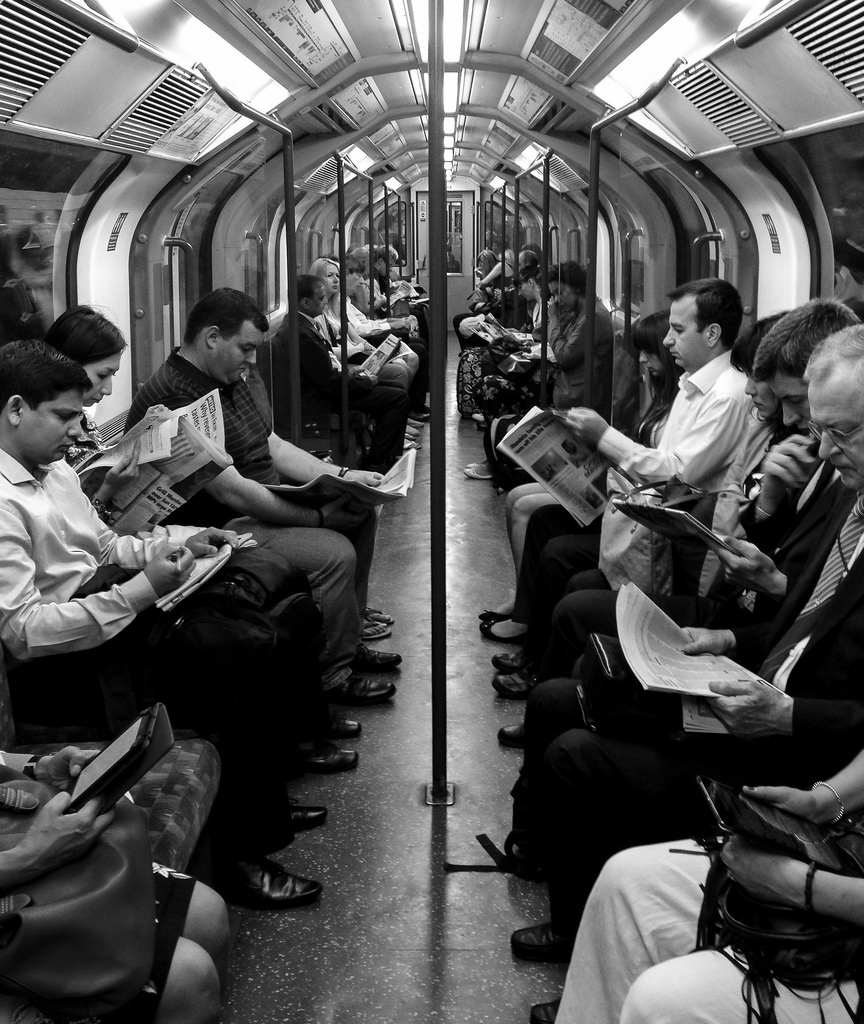
Laura Miller mulls them over:

Reading is a private activity, even as it allows us to commune with the mind and imagination of an author we will probably never meet. Yet because reading a great book can be so overwhelmingly gratifying and transformative, many of us yearn to share the experience with the people we care about. That’s why we join book groups and pester our friends to read our favorites. I once heard of two men, both obsessed with a popular novel series, who check into a hotel whenever a new title in the series is released so that together they can read the whole thing in one fell swoop and talk about it afterward – all without aggravating their wives. …

I suspect that, despite our pervasively socially networked culture, willful idiosyncrasy remains the very essence of reading. A book, and especially a novel, is a world you can enter at a time of your own choosing, and the world itself can be chosen from a seemingly infinite array of alternatives to suit whichever mood has taken you. That’s one of the things we love about reading. A reader’s imaginative freedom is absolute. My mother was not wrong in recognizing my childhood book binges as a retreat into a mental sanctuary whose doors were closed in her face. It turns out that even when we want to let other people in, there may not be enough room.

Perhaps the Dish Book Club can help reconcile those contradictions. Update from a reader:

Oh, so you fell for the old “Jim and I are checking into the Holiday Inn for a couple of days so we can read…” trick, did you?

Heh.

(Photo: “The Reading Club” by Nate Edwards)

Why Vonnegut Endures

Dan Wakefield, a friend to the late writer, contemplates why his work continues to attract young readers:

Few writers are able — or willing — to take on the most serious issues (e.g. the end of the world) andasshole write about them with humor as well as insight. Puzzling over the “big issues” is part of a young person’s coming of age, and young people not only find in Vonnegut a humorous and satirical approach that they find congenial, they also discover a refusal to shirk from the dark side of human nature. Memorializing the death of children killed in war in Cat’s Cradle, Vonnegut’s orator says “… we might best spend the day despising what killed them; which is to say, the stupidity and viciousness of all mankind.”

As young people come of age they are discovering that, as Vonnegut says, the truth is often shocking “because we hear it so seldom.” Vonnegut is a truth-teller, the one who points out the elephant in the room, the one who speaks the unspeakable, expressing the thought that we may be too timid to say ourselves. When Kurt and I and our publisher, Sam Lawrence, were invited to visit one of the first communes, back in the late sixties, the young man who founded it explained that he and his friends were learning to “live off the land” because “we want to be the last people on earth.” Vonnegut asked him, “Isn’t that kind of a stuck-up kind of thing to want to be?”