New York Is Down With NPV

It just become the 11th state to join the National Popular Vote Compact, whose members agree to award their electoral votes in presidential elections to the winner of the popular vote, effective as soon as 270 electors’ worth of states sign the compact. Rick Hertzberg cheers:

A lot of people labor under the misapprehension that the Electoral College status quo is good for small states, or rural states, or states that don’t have big cities in them. Actually, the only states it’s good for, qua states, are swing states. The jurisdictions that have approved N.P.V. so far come in all sizes. Four are small (Rhode Island, Vermont, and Hawaii, plus the District of Columbia), three are medium-sized (Maryland, Washington, and Massachusetts), and four are large (New Jersey, Illinois, California, and now New York).

The discerning reader will have noticed that all eleven, besides being spectator states, are also blue states. The absence of red states from the roster is due largely to to a suspicion among Republican politicians and operatives that N.P.V. is somehow an attempt to get revenge for 2000. In opinion polls, Republican rank-and-filers, as distinct from Party professionals, strongly favor the idea of popular election. And a nontrivial number of Republican pros favor the plan itself.

Ryan Cooper looks at which states get screwed over the most by the Electoral College:
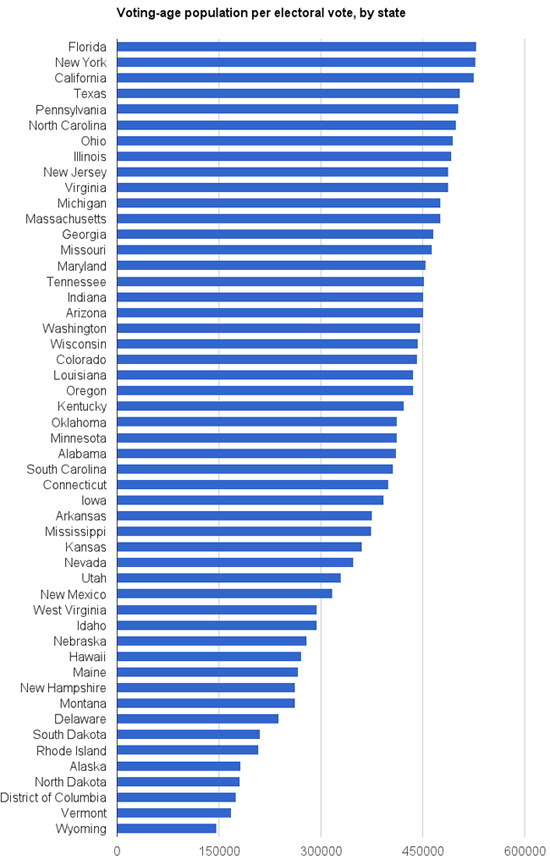
ec_chart3_550

It turns out that many states have huge populations of people who are ineligible to vote. California and Texas, for example, have 5.1 million and 2.6 million non-citizens, respectively, which cuts down their voting-eligible populations significantly. Florida, meanwhile, has slashed its voting population by over 10 percent through the disenfranchisement of felons. (Ironically, this makes its position in the Electoral College look “fairer,” since by raw population the Sunshine State comes out the worst.)

Dick Morris is sure this is all a Democratic conspiracy:

Democrats usually see a smaller percentage of their people go to the polls than Republicans do. Under the electoral vote system, they figure why beat the drums to get a high turnout in New York City when the state will go Democratic anyway? But if it’s the popular vote that matters, the big-city machines can do their thing — with devastating impact.

And think of the chances for voter fraud! Right now, the biggest cities, the ones most firmly in Democratic control — Washington, D.C., New York City, Detroit, Chicago, San Francisco — are all solidly in blue states. Not only does this make it unnecessary to maximize turnouts there, but it also makes it unnecessary to promote double voting, fraudulent voting, and all the other tricks of the trade at which Democrats excel.

Kilgore mocks:

Morris seems to think Republicans absolutely have to have a thumb on the scales via the distorting effect of the Electoral College. That’s perfectly in line with the sense you get from many Republicans that it’s only fair they get other thumbs on the scales through restrictions on voting or the Senate filibuster or limitless corporate campaign contributions—or ideally, from courts that rule progressive legislation as unconstitutional. As is often the case, Morris provides a caricature—but still a reflection—of arguments other conservatives are embarrassed to make.

Nate Silver, however, doubts the NPV movement has a chance as long as red-state politicians appear to share Morris’ fears:

Republican voters are nearly as likely to support ending the Electoral College (61 percent of them would vote to do away with it as compared to 66 percent of Democrats, according to a Gallup poll last year). But Republican legislators in those states evidently feel differently, or perhaps have calculated that the Democrats’ Electoral College advantage in 2008 and 2012 was an anomaly that will soon fade.

If Utah, Texas and similar states do begin signing onto the compact, what signal might that send to the blue states? Might legislators in Vermont and Maryland suddenly decide they agree with Alexander Hamilton’s position on the Electoral College after all?

My personal view is that the Electoral College should be abolished (even if that means we’d have to change the name of this website). But based on the signatories to the compact, blue and red states seem to think of it as a zero-sum game.
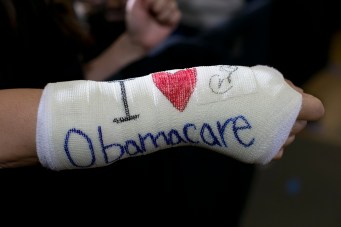
The View From Your Obamacare

A reader writes:

Thank you so much for giving me a platform to share my Obamacare success story! Well, actually, it’s my brother’s story and it starts about a year ago. He was 25 and working for a small radio group in President Obama Visits Boston To Talk About Health CareIthaca, NY. He got into a PhD program at IUP, and since he was barely making any money, he decided to quit his job and spend the summer relaxing and traveling and visiting friends before starting school.

Those plans got thwarted when he was diagnosed with thyroid cancer in June. Three surgeries later, I am happy to say that he is in recovery and doing great, but damn, my family would’ve been fucked without Obamacare. It let my brother stay on my parents’ insurance, so he was covered when he got his diagnosis. I’m not sure what the costs of his treatment have been exactly, but the bill for just administering the radioactive iodine pill he had to take was almost $200,000.  When you add to that all the tests and the three surgeries, the costs have got to be close to a million, if not more. My family would likely be considered well-off, but those costs would’ve bankrupted us.

It’s possible that he would’ve been on Cobra without Obamacare, but I think it’s at least equally likely that he would’ve decided to just wait until he could join the school plan because Cobra is so expensive. At the very least, Obamacare has saved my family from significants costs. And, because he now has a pre-existing condition, it’s the only reason he can buy health insurance and will be able to for the rest of his life.

A reader in Georgia:

My ex and I are splitting soon. I’m leaving my job in a few weeks and moving to another state across the country and will be unemployed for a few months as I switch careers. He’s staying here and working his way through his last couple of semesters of college. He has a pre-existing condition that requires medical oversight and expensive prescriptions. Until I leave my employer in a few weeks, I pay for his insurance through my employer-provided domestic partner coverage. Now that I’m leaving my job and moving to another state, he will have to purchase insurance on his own, something that was impossible before Obamacare due to pre-existing exclusions from the individual health insurance market.

Because we live in a GOP state, thanks to Obamacare, he can buy insurance (yay!) but doesn’t make enough to qualify for subsidies (boo!).

Instead of something affordable, he has the option to pay full-cost for ACA medical coverage ($200 to $250/month) in addition to the deductibles for medical visits and prescriptions needed for his medical condition. He doesn’t make enough annually to qualify for subsidies because he is a full-time student and part-time employee. If Georgia had opted into the ACA Medicaid expansion, he would have qualified for that, saving the monthly premium altogether.

There couldn’t be a starker contrast between the two parties on healthcare. The Democrats want to make it available to millions of Americans like him and the Republicans are doing everything in their power to prevent that from happening. As a bonus, they are also fighting against raising the minimum wage, which would be a huge boost for all the students out there who have to support themselves and go to school. More and more, the GOP seems to be working against hard-working Americans and not for them. I don’t understand why more people don’t see this.

Another reader in a red state:

I am a physician working in Indianapolis. Much of my work is at a county hospital system that supports the poor of the city by providing healthcare to any citizen in the county regardless of their income. Obamacare has allowed many of these patients to come off the county system’s rolls.

Indiana sadly has not fully expanded Medicaid because our governor, uber Republican Mike Pence, refuses to do so. Even without expanded Medicaid, many of my patients have been able to sign up and all are incredibly appreciative. One interesting effect is that many of them now have the ability to get a second opinion and different care options because they are no longer tied to the county system. I started to get worried about our system (and myself) when after the first of the year, I had about five patients leave for second opinions but was rewarded by all of them returning to our practice. Obamacare has allowed these patients to both not be tied down to a system strapped for funding and also gain confidence in the care they receive when they note that we are caring for them just as well as they can get elsewhere.

Our system has its limits and we can’t provide some very expensive care, like radiation, but Obamacare allows these patients to find providers that can give this care. This effect will reduce suffering and prolong lives. I have always been a big supporter of this legislation but the benefits I am seeing are remarkable and under reported.

Another in the medical field:

I have a lifelong chronic disease, Crohn’s, for which I take a biologic that costs about $130,000 per year. These meds keep me and many other people healthy, and out of the surgical OR and off emergency room beds. It also saves me from debilitating pain and allows me to be a productive member of society. Before the ACA, I was stuck paying incredibly high premiums (>$1300/mo) through COBRA and then a HIPPA conversion plan.

Unfortunately for me, I live in a state that did not (yet) expand Medicaid, and since I am a no-income student, I do not qualify for subsidies on the exchanges. So instead, I use my school’s health insurance plan, which is better than nothing, but not excellent. With no out-of-pocket-maximum, I end up with about $10,000 of out of pocket costs every year.

While the ACA hasn’t given me cheaper insurance, it has given me immense security knowing that if my circumstances change, my medical care won’t suffer. As you wrote of your own experience, “It gave me a baseline of security that simply didn’t exist before.”

Finally, and perhaps most interestingly, as a medical student, the ACA has changed the landscape for medical providers. I anticipate that it will pump money into the medical establishment’s pockets much like Medicare made physicians rich several generations ago (and continues to do so today). Whether that is a good, bad, or neutral thing, I can’t say. But for those people who now newly have access to a lifesaving service, it is of incalculable value.

(Photo by Yoon S. Byun/The Boston Globe via Getty Images)

Malkin Award Nominee

“In the last few days in terms of the people who have been yelling the loudest about [Truvada], they’ve all been associated with bareback porn. They’re all associated with bareback porn, which kind of makes my point that it’s a party drug,” – Michael Weinstein, president of the Los Angeles-based AIDS Healthcare Foundation, the largest HIV/AIDS medical care provider in the U.S.

Nobody Is Rounding Up Jews In Ukraine

Yesterday, a troubling report that Jews in Donetsk were being ordered to report to the local authorities and register their property made the rounds in the press and on the Internet. Ioffe explains that the story is overblown:

Today, the Western press caught up with the Ukrainian rumor mill: apparently, the People’s Republic of Donetsk had ordered all Jews over the age of 16 to pay a fee of $50 U.S. and register with the new “authorities,” or face loss of citizenship or expulsion. This was laid out in officious-looking fliers pasted on the local synagogue. One local snapped a photo of the fliers and sent it to a friend in Israel, who then took it to the Israeli press and, voila, an international scandal: American Twitter is abuzz with it, Drudge is hawking it, and, today in Geneva, U.S. Secretary of State John Kerry slammed the fliers as “grotesque.”

The Donetsk Jewish community dismissed this as “a provocation,” which it clearly is. “It’s an obvious provocation designed to get this exact response, going all the way up to Kerry,” says Fyodr Lukyanov, editor of Russia in Global Affairs. ”I have no doubt that there is a sizeable community of anti-Semites on both sides of the barricades, but for one of them to do something this stupid—this is done to compromise the pro-Russian groups in the east.”

But Anna Nemtsova talks to a local Jewish leader who points out that there are prominent anti-Semites within the pro-Russian camp and worries that nobody is looking out for his community:

According to Rabbi [Pinhas] Vyshedski, the press secretary of the self-proclaimed republic, Aleksander Kriakov, is “the most famous anti-Semite in the region.” Vyshedski wondered how separatists who are trying to position themselves as “anti-fascist” and claiming it’s Kiev that’s run by neo-Nazis could pick Kriakov as their spokesman. The sense of insecurity is heightened by the uncertainty and a feeling of abandonment. “I want to know why in two days of these threats, the Jewish community has not heard a single comment from either Donetsk—or from the Kiev authorities,” said the rabbi. … But the problem is, precisely, that there are no authorities who really control the situation in Donetsk Oblast just now.

Zack Beauchamp explains why this leaflet popped up:

Part of the reason this flier is such a big deal is that Russia and Ukraine are both using accusations of anti-Semitism as part of their attempt to portray the other side as in the wrong. The memory of World War Two, and of the devastation Nazi Germany caused their countries, is still fresh in both. Russia alleges that fascist supporters of the new Ukrainian government are threatening Jews, while the Ukrainians say the same about pro-Russian separatists.

So far, there’s very little evidence that the Ukrainian side is persecuting Jews. As Igor Volsky and Hayes Brown at ThinkProgress note, a recent UN report found could not find much evidence substantiating the Russian charges.

“Nobody is afraid of fascists,” east Ukrainian rabbi Shmuel Kaminezki told the New York Times. “But everyone is afraid of war with Russia.”

Freddie chides the US media for their credulity:

American media will believe literally anything you tell them about governments our own government doesn’t like, and the supposedly liberal, supposedly savvy, supposedly hip set are worse than anyone. Maybe every word of this story is true, and all the fevered panic about it is justified. But the broader point would remain the same: when it comes to “the bad guys,” American journalists will print anything, so long as it makes us look better and them worse.

American journos, pundits, writers, and internet obsessives: you are very, very bad at assessing evidence about regimes that your government does not like. You should not trust your own instincts when assessing the likelihood and legitimacy of stories about governments that are antagonistic to your own. Continuing to do the same thing over and over again, and then realizing the bad results after, is not an effective way to go about doing your job. Maybe try, you know, learning.

And Rosie Gray and Max Seddon frame the incident as a propaganda battle:

Ukraine’s Jewish community has become a flashpoint of the media war between Russia and Ukraine. Moscow and the Russian state-controlled media have revived old claims that Ukrainian nationalism is tantamount to Nazism and have amplified the voices of the existing Ukrainian far right, which is intensely anti-Russian. Russian President Vladimir Putin in March described the new Kiev government as “neo-Nazis, nationalists, and anti-Semites on the rampage.”

Pushilin, the pro-Russian local figure, has denied that his group put out the leaflets. And Kirill Rudenko, a spokesperson for the Donetsk Republic, also denied the group had anything to do with the flier. “This is a total lie. We haven’t handed out any fliers. Our only tasks are defending the occupier buildings and preparing for the referendum,” he told BuzzFeed. “This is an American Secret Services provocation to discredit us.”

But even as the source of the fliers remains unclear, the U.S. government Thursday mounted a coordinated campaign to tie the flier to the separatists.

A Quote For Good Friday

“Just as we were all, potentially, in Adam when he fell, so we were all, potentially, in Jerusalem on that first Good Friday before there was an Easter, a Pentecost, a Christian, or a Church. It seems to me worth while asking ourselves who we should have been and what we should have been doing. None of us, I’m certain, will imagine himself as one of the Disciples, cowering in an agony of spiritual despair and physical terror. Very few of us are big wheels enough to see ourselves as Pilate, or good churchmen enough to see ourselves as a member of the Sanhedrin. In my most optimistic mood I see myself as a Hellenized Jew from Alexandria visiting an intellectual friend. We are walking along, engaged in philosophical argument. Our path takes us past the base of Golgotha. Looking up, we see an all-too-familiar sight — three crosses surrounded by a jeering crowd. Frowning with prim distaste, I say, ‘It’s disgusting the way the mob enjoy such things. Why can’t the authorities execute criminals humanely and in private by giving them hemlock to drink, as they did with Socrates?’ Then, averting my eyes from the disagreeable spectacle, I resume our fascinating discussion about the nature of the True, the Good, and the Beautiful,” – W.H. Auden, A Certain World: A Commonplace Book.

(Hat tip: Alan Jacobs)

Dissent Of The Day

A reader writes:

Your criticism of Jo Becker is hopelessly histrionic. I watched election returns at my then-boyfriend’s apartment in West Hollywood on November 4, 2008. I still recall the bewildering disorientation associated with feeling such enormous pride that our country had elected our first black president – while, at the same time, feeling such hopeless despair that my state didn’t care about making me a second-class citizen by approving Prop 8.

It was clear to me on that night that something in the marriage equality movement needed to change. The “No on Prop 8” advertisements that I had been watching and writing a series of small checks to fund were offensive in their banality. Rather than frame the issue in the manner that a majority have subsequently come to understand it – as a matter of fundamental human dignity, love, family, and fairness – the “No on 8” campaign relied on soundbites from Dianne Feinstein, overly defensive rebuttals of ads claiming that Proposition 8 would lead to the kids being converted to homosexuality, and a steadfast resistance to showing gay couples who were actually affected by the issue. The folks who Jo Becker write about are the folks who saw what a hopeless loser the No on Prop 8 was – and how laughably awful other similar campaigns opposing gay-marriage bans were.

Was Chad Griffin the first mover of the gay marriage revolution? No. Did Chad Griffin benefit from the intellectual foundations laid by you, Evan Wolfson, and others crying out in the wilderness in the 1990s? You bet your life they did. Does that mean that he and the others who Jo Becker discusses are not responsible for an important re-boot, re-messaging, and re-investment in the cause in the face of historic defeats in multiple states for the gay-marriage cause just as recently as 6 years ago? Certainly not.

Civil rights movements take stages, iterations, and generations. Griffin, or Dustin Lance Black, could not have done it on their own – but neither could Wolfson, Socarides, and Co. who signed on to a messaging and media strategy in the mid- to late 2000s that ran away from talking about and showing that gay couples wanted marriage because they simply wanted to declare commitment and enduring love in the same way that everyone does.

Jo Becker overstates her thesis. Of course, that’s what some authors, trying to sell books, ultimately do from time to time. (Malcom Gladwell seems to have made a comfortable living doing that for years.) This makes her book less accurate and certainly a heck of a lot less nuanced than it should be. However, it does not make her book, or her, “truly toxic and morally repellent.” Telling the story of how a new generation of gay leaders changed the message and changed the emphasis to change history is neither toxic nor repellent.

The fact that my reader puts Richard Socarides and Evan Wolfson in the same camp reveals the limits of his understanding. Socarides spent the 1990s defending the Clinton administration’s doubling the rate of gay dishonorable discharges from the military and signing of the Defense of Marriage Act. Wolfson spent the 1990s fighting the Clintons and Socarides on marriage day after day. Evan and I were just as critical of the milque-toast crap the Prop 8 campaign put out as Griffin or anyone else. Both of us had spent years arguing against any defensiveness, making exactly the case that my reader does.

It is also emphatically not true that the message or the emphasis changed after 2008. The messages that we gay conservatives honed in the 1990s and 2000s were repeated almost verbatim in the Prop 8 trial; the liberal legal arguments had been aired and analyzed exhaustively by liberals in the movement. There is nothing in the message since 2008 that wasn’t there from the early 1990s onward. The Prop 8 campaign was indeed a fiasco – but that tells us close to nothing about the marriage strategy charted in the 1990s and sustained with real, consistent message discipline even today.

As for more defeats occurring in the past than now: well duh! Our popular support was far lower in the past than now. Of course we would lose cases, just as all civil rights movements have, at the start and even in the middle. But the cases, as in all civil rights movements, could be leveraged into a broader and broader public discussion, which could move the polls, which would increase the chances of winning future cases. And that’s the pattern we saw. We had won legal cases for marriage equality in Hawaii and Vermont in the 1990s – neutralized by state legislatures – but helping us get the issue on the radar screen. Holland enacted marriage equality as early as 2001, Belgium in 2003. We won the breakthrough legal and then political struggle in Massachusetts in 2004. Canada and Spain joined the throng in 2005. We won in the courts in California in 2008 – after Gavin Newsom’s act of civil disobedience electrified the movement. We went on to win the nation’s capital and Iowa in 2009. How could any of that happened if it all depended on Griffin’s non-existent re-branding of the movement?

And by the way, I have had no beef with Griffin at any point in these past few years. Below is the entirely of our posts on him, including:

I have to say that the appointment of Chad Griffin to run the biggest gay lobby this coming June is a great sign of how far we’ve come. There was a time when HRC wanted nothing to do with marriage rights. Now it has selected a grass-roots, if highly networked, champion of them for its new head. Promising … and encouraging.

The other post:

fascinating story that bodes very well for Griffin’s assumption of leadership of the Human Rights Campaign. Griffin fought the usual caution to get the Boies-Olson lawsuit on the road.

And the only two mentions of Dustin Lance Black from the Dish archives praised his Oscar speech and featured his play based on the Prop 8 trial. I have no problem acknowledging their contributions. I only object to their campaign to make it seem as if they did this in spite of all we had done before, rather than because of it.

Update from a reader:

I just want to echo everything you’ve said in response to dissenters and about the Jo Becker book. I was a paid staffer of MassEquality (the coalition group founded to win the political fight for marriage in 2004) during the marriage fight and the tactics that Jo Becker lauds as inventions were ALL in play during that fight. As an anecdote you haven’t mentioned in detail: Pat Guerriero was called in to lobby Republican state legislators, other prominent R’s and donors were identified as possible switches. Massachusetts was where the tactical playbook was written, or at least fine-tuned – and that playbook was and still is being followed around the country to wide and now visible success.

And the leaders from that movement? Well, they’re the intellectual underpinning of today’s HRC and Freedom to Marry. Marty Rouse (who works for Chad Griffin, and has been at HRC as the Field Director for years) and Marc Solomon (who managed the failed Prop 8 campaign and is now doing amazing trail blazing work at Freedom to Marry) are examples of the many people who have guided the tactics of the movement … and they still guide it! But like most political campaigns, they’ve had wins and losses.

Even though I’m occasionally off-put by how strident you are on some issues, I’m glad to see that you’re sticking to your guns on this one. The facts are so solidly in your corner and Jo’s claims are so outrageous … I would just hate to have this movement’s history rewritten when I’ve spent so much of my life involved in it. I’m still just so shocked that she didn’t do real homework on this one. No digging. No depth. The movement she writes about just didn’t happen!

The Putin Way Of War, Ctd

Vice captures a Ukrainian police station being overrun:

Mark Thompson explores the Russian military tradition of maskirovka in more depth:

Maskirovka (which is rooted in the English word, mask) is designed to sow confusion and frustration among opponents by denying them basic information.

The anonymous troops in eastern Ukraine say only that they’re “Cossacks,” but Ukrainian and Western officials believe many of them are led by Russian special forces. Yet the murkiness of their origin and sponsors inflates their menace, and makes it more difficult to figure out how to deal with them. Snipping puppet strings between Ukraine and Moscow may be easier than controlling indigenous separatists operating independently. A combination of both complicates matters still further.

Patrick Tucker reports that Ukrainians are taking the matter of separating real protesters from Russian infiltrators into their own hands:

Anti-Russian grassroots organizations such as the website Ukraine Investigation have employed a crowd-sourcing technique similar to the Reddit thread “findbostonbombers” that sprouted up after the 2013 Boston Marathon bombings.

Ukraine Investigation founder Andriy Nurzhynskyy said that in many of the reports and user-uploaded photos that cross his desk, the “protesters” are armed with rifles like the Kalashnikov 103, a firearm that is unavailable in Ukraine. Conversely, authentic separatist protesters usually carry sticks. While Nurzhynskyy maintains that his site and others have been able to positively identify a small number of Russian military leaders in Ukraine, he said, “We understand that there are many unidentified persons and our work is not [finished].”

If the maskirovka tactics are meant to sow doubt about the identity of the “protesters,” they are not fooling Gen. Philip Breedlove, NATO’s Supreme Allied Commander in Europe:

  • The pro-Russian “activists” in eastern Ukraine exhibit tell-tale military training and equipment and work together in a way that is consistent with troops who are part of a long-standing unit, not spontaneously stood up from a local militia.
  • The weapon handling discipline and professional behavior of these forces is consistent with a trained military force. Rifle muzzles are pointed down, fingers not on triggers, but rather laid across trigger mechanisms.
  • Coordinated use of tear gas and stun grenades against targeted buildings indicates a level of training that exceeds a recently formed militia.
  • Video of these forces at checkpoints shows they are attentive, on their feet, focused on their security tasks, and under control of an apparent leader. This contrasts with typical militia or mob checkpoints, where it’s common to see people sitting, smoking, and so forth.
  • The way these forces target government buildings, hit them in coordinated strikes and quickly secure the surrounding area with roadblocks and barricades is similar to what we’ve seen in Crimea. Again, indicative of a professional military force, acting under direction and leadership, not a spontaneous militia.
  • Finally, the weapons and equipment they carry are primarily Russian army issue. This is not the kind of equipment that civilians would be likely to be able to get their hands on in large numbers.

Any one of the points above taken alone would not be enough to come to a conclusion on this issue, but taken in the aggregate, the story is clear.

The Math On The Midterms

John Sides calculates that the GOP’s House majority could grow significantly larger:

[B]ased on the current model and current conditions, there is a real chance that the 2014 election could give the GOP as many or more seats as it had after the wave election of 2010.  There is less of a chance, though still a chance, that the GOP could command a majority as large as its post-WWII high-water mark.  But, as of now, 2014 appears unlikely to give the GOP the unprecedented majorities it had after 1928 (or after 1920 for that matter, when it controlled 302 seats).

Sean Trende, meanwhile, wonders about the Democrats picking up Senate seats:

Don’t get me wrong: For Democrats to gain seats this cycle would be the equivalent of drawing a straight flush. With that said, straight flushes do occur, so it’s worth examining how it might occur here.

The first thing that would have to happen is that the playing field would have to improve for Democrats. Of the 11 Democratic seats that RCP currently rates as leans Democratic or worse, Democrats are probably at least slightly favored in Michigan, Iowa, New Hampshire, and perhaps Colorado. If the political dynamic were to shift toward the party, these seats would probably be out of the GOP’s reach on Election Day.

The way this could occur is fairly straightforward: The Affordable Care Act improves; there’s no massive rate shock for premiums in September or October; and the economy slowly gains ground.  This should propel President Obama’s job approval upward, lifting the collective Democratic boat.

Now we don’t see this occurring just yet.

Edward Snowden, Russian Propagandist?

Joe Coscarelli introduces the above video:

With NSA leaker Edward Snowden’s asylum in Russia still technically temporary, he’s doing his best to fit in. [Yesterday], that included a special appearance — or bizarre PR stunt — during a televised Q&A with Vladimir Putin, in which Snowden served up a chance for Putin to tell the world that Russia doesn’t spy on its citizens like the big bad U.S. does. “I’ve seen little public discussion of Russia’s policy of mass surveillance,” said Snowden. “So I’d like to ask you: Does Russia intercept, store, or analyze the communication of millions?”

Putin, it’s safe to say, was not caught off guard by the line of inquiry.

For Allahpundit, this proves that Snowden is a tool of the Kremlin:

Only two possibilities here. One: There’s an FSB agent out of frame with a gun pointed at Snowden’s head, just to make sure that he reads the cue card as written. In that case, decide for yourself how likely it is that Snowden’s refused to share any U.S. state secrets with Russian intel. Two: He’s doing this cheerfully, either at Putin’s request as a condition of his asylum or at his own request, to exploit a Putin press conference as a way to further needle the NSA.

Whatever the answer, the stark fact is that he’s asking a question here which he knows — absolutely knows — will generate a self-serving lie told by a guy who embodies the type of fascism that Snowden claims to abhor. For your information, the name of Russia’s mass surveillance program, a.k.a. “PRISM on steroids,” is the System of Operative-Investigative Measures, or SORM. Via Joshua Foust, they’ve been using it for years but lately, as in so many other ways, they’ve gotten more aggressive with it.

But Elias Groll points out that nobody was talking about SORM yesterday:

Putin’s answer was comical on its face — and that should give us doubts about the extent to which Snowden is a really a “pawn” in some grand propaganda scheme. Does anyone actually think that Putin doesn’t aggressively use surveillance to go after his opponents and that Russian surveillance is strictly governed by the law? After all, the Russian intelligence services have spent the last few weeks leaking intercepted phone calls between Western officials.

So thanks to Snowden, here we are talking about how Putin is a liar and a skilled user of aggressive surveillance tactics. That probably isn’t the response the Russian strongman was hoping for.

Adam Taylor fact-checks Putin:

[Agentara.ru editor Andrei] Soldatov argues that there were three key points made by Putin, each of which was a half-truth or a lie. First, Soldatov says, Putin argued that the FSB, the successor agency to the Soviet era’s KGB, needs to get a warrant from a court before surveillance can begin. This is true in theory, Soldatov admits, but in practice the warrants are not required to be shown: Telecoms agencies and Internet providers do not have the necessary security clearance to view the warrants, in any case.

Secondly, Putin seemed to suggest that the Russian legislature, the Duma, has oversight over the FSB. This is not true, Soldatov says, arguing that while the State Duma does have a Special Committee for Security, it has no actual oversight for secret services.

Finally, Putin argued that Russia doesn’t have the “hardware and money the United States has.” Soldatov says this is “not entirely correct.”

Snowden quickly came out with an op-ed claiming he was actually trying to catch Putin in a lie and start a debate over surveillance in Russia:

I expected that some would object to my participation in an annual forum that is largely comprised of softball questions to a leader unaccustomed to being challenged. But to me, the rare opportunity to lift a taboo on discussion of state surveillance before an audience that primarily views state media outweighed that risk. Moreover, I hoped that Putin’s answer – whatever it was – would provide opportunities for serious journalists and civil society to push the discussion further.

When this event comes around next year, I hope we’ll see more questions on surveillance programs and other controversial policies. But we don’t have to wait until then. For example, journalists might ask for clarification as to how millions of individuals’ communications are not being intercepted, analysed or stored, when, at least on a technical level, the systems that are in place must do precisely that in order to function. They might ask whether the social media companies reporting that they have received bulk collection requests from the Russian government are telling the truth.

Mike Masnick buys that explanation:

[T]his latest response suggests that Snowden is (once again) playing a game where he’s several moves ahead of many folks. The question may have set up a propaganda answer, but it appears there was a bigger strategy behind it — and one that remains entirely consistent with what Snowden has claimed his position has been since the beginning. Frankly, while this possibility was raised about his original question to Putin, many people (myself included) thought it was unlikely that Snowden would so directly go after his current hosts (who only became his hosts thanks to the US pulling his passport). Putin is not known for gracefully handling those who directly challenge him, and I don’t think it would be surprise anyone if Snowden had continued to stay out of the question of Russian surveillance, simply out of basic necessity.

But Benjamin Wittes doesn’t buy it:

I’m not sure why this grotesque display does not move Snowden’s many admirers. Perhaps people may rationalize what he did and say that he’s posing the same question to the Russian leader about which he forced a debate in this country—and that he is thus being consistent. But they can’t actually believe that. These are sophisticated people, after all, many of whom are journalists. They must know the difference between a scripted set-piece appearance with an authoritarian strong man on state controlled television and asking the tough questions in the context of democratic dialog. They must know that Snowden either played that role willingly or was, in one way or another, encouraged to do by authorities who have enormous leverage and control over him. They must know, in other words, that at this point at least, Snowden—by his own volition or against his will—is very clearly working for the Russians.