PTSD Is Not A Crime

PTSD

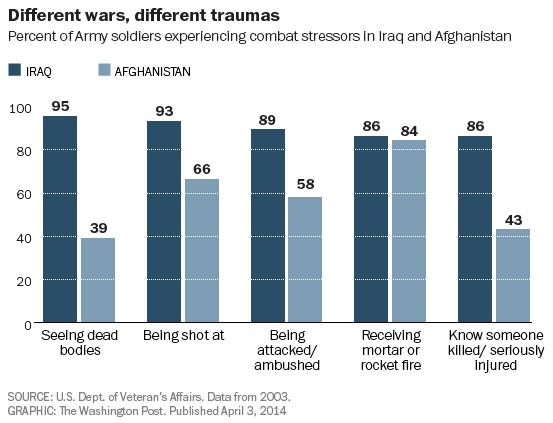
Emily Badger, who passes along the above chart, uses the latest shooting at Fort Hood to discuss PTSD rates:

Combat in Iraq … is not entirely like combat in Afghanistan. And research consistently concludes that veterans are returning from Iraq, where the troubled shooter in Wednesday’s Fort Hood tragedy served, with what appears to be greater exposure to stressors and higher levels of PTSD. The Fort Hood shooter, an Army truck driver named Ivan Lopez, was reportedly undergoing evaluation for PTSD. Some numbers from the Department of Veterans Affairs estimate that PTSD affects about 11 percent of veterans of the war in Afghanistan, but 20 percent of veterans who served in Iraq.

But Richard Allen Smith doesn’t want PTSD blamed for the tragedy:

I am a veteran, having served in Afghanistan with the 82nd Airborne from February 2007 to April 2008. I’ve also been diagnosed with PTSD related to my time in service. (Many vets, myself included, favor the removal of “disorder” from PTSD, our symptoms being a natural human response to what we have experienced.) When mass shootings occur, much too commonly lately, my veteran friends and I always have the same initial reactions.

First, a sincere hope that everyone is okay. But immediately after that we think, “Please don’t let it be a veteran.” When Kate Hoit, a 29 year-old Iraq war veteran and graduate student living in Washington, D.C., first heard of the shooting, she thought, “Here we go again with another round of onslaughts on veterans and those with PTSD.” But a strong link between violent crime and PTSD has not been firmly established.

2012 study found that 9% of Iraq and Afghanistan war veterans surveyed reported arrests since returning from service. But even with this incidence of arrest, most offenses were associated with nonviolent behavior. It’s also notable that the veterans studied, as well as post-9/11 veterans in general, come from demographics associated with higher rates of criminal behavior (young, male, history of family violence, etc.) that are not related to service. That study concluded that veterans suffering from PTSD are at increased risk for criminal arrests, but those arrests are more strongly linked to substance abuse than a predilection towards violence.

Phillip Carter covers the stigma surrounding PTSD:

It would be enough for these stories to leap to conclusions about one particular shooting. Unfortunately, such reporting (in this case and that of the Navy Yard shooting last September) contributes to a deeply ingrained (and factually false) narrative about veterans that has become a part of the American psyche. This “Rambo narrative” — the idea that veterans are deranged killers suffering from post-traumatic stress, ready to explode in the workplace or at home – did lasting harm to the Vietnam generation of veterans. It persists today, and is only inflamed by reporting like that on the Fort Hood shooting.

In a 2012 report on veterans employment, my colleagues surveyed nearly 70 companies from all sectors on questions of barriers to veterans in the workforce. A majority of companies surveyed said that “negative stereotypes,” including but not limited to perceptions of pervasive post-traumatic stress, were a major factor in decisions not to hire veterans. One respondent said that “I’ve heard about some veterans coming back and going on rampages. I’ve never had this happen to me personally, but I always wonder if it is a possibility.” Others spoke about how media reporting suggested that “all vets have PTSD,” even though the data suggest that only a small minority do, and that these concerns may be unfounded or overblown.


Reihan Salam Wants To Pay Higher Taxes

… along with all other childless adults, in order to subsidize parents:

I often reflect on the sacrifices working parents make to better the lives of their children. And I have come to the reluctant conclusion that I ought to pay much higher taxes so that working parents can pay much lower taxes. I believe this even though I also believe a not inconsiderable share of my tax dollars are essentially being set on fire by our frighteningly incompetent government. Leviathan is here to stay, whether I like it or not, and someone has to pay for it. That someone should be me, and people like me.

Who should pay more? Nonparents who earn more than the median household income, just a shade above $51,000. By shifting the tax burden from parents to nonparents, we will help give America’s children a better start in life, and we will help correct a simple injustice. We all benefit from the work of parents. Each new generation reinvigorates our society with its youthful vim and vigor. As my childless friends and I grow crankier and more decrepit, a steady stream of barely postpubescent brainiacs writes catchy tunes and invents breakthrough technologies that keep us entertained and make us more productive.

Matthew Klein mulls Reihan’s proposal:

The advantage of a tax credit is that it could be claimed by the poor. Children who grow up in poverty tend to suffer from malnutrition and elevated stress hormones that permanently impair brain development, so money that makes it easier for low-income parents to provide a decent life for their children would make a lot of sense. The danger, however, is that some people would have more children than they could support just to claim the government benefits. Their children would be the real victims and may end up permanently dependent on support from the state for the rest of their lives. That wouldn’t exactly solve the problem of freeloaders.

laine Maag argues that the childless also deserve a break:

The Tax Policy Center estimates that in 2013, the tax system delivered $171 billion in child-related benefits through five provisions: the earned income tax credit (E.I.T.C.), the child tax credit (C.T.C.), dependent exemptions, head of household filing status, and the child and dependent care tax credit. The E.I.T.C. and C.T.C. tilt these benefits toward low-income families. Together, they lifted 10.1 million people out of poverty in 2012. But because they focus on families with children, the two credits do almost nothing for childless households. That group gets none of the benefit from the C.T.C. andjust 3 percent of the E.I.T.C.

So it is not at all clear that more spending for children (particularly higher-income children) would be the best use of our limited tax dollars. It makes more sense to give all workers a substantial work incentive.

John Seager chips in 2¢:

We should refrain from punishing or rewarding personal decisions about the size and shape of our families. Perhaps the vital individual right is the right to be let alone. If the decision to have or not have children isn’t private, then nothing is private.

Update from a reader:

Huh? Isn’t Salam’s proposal in effect what the EITC already does, with some means testing thrown in ? And it has means testing on both sides – for the EITC itself on the payout side, and from the progressive tax code on the payer side. Why should I (a childless adult) pay at a higher tax rate than someone with much more money who happens to have children? Who would be in charge of figuring what was equitable between this couple and that one?

Then, will we have to examine the reasons and motives of anyone who is childless and make exceptions accordingly? I can just imagine that little bureaucracy. I would be expecting the lawsuits saying, “I shouldn’t be in the childless category because I wasn’t biologically able to have children, or because I am unsuited to be a parent for these reasons, or because we are gay and don’t want to adopt”. It would go on forever.

Quote For The Day

“Call it left-wing anti-liberalism: the idea, captured by Herbert Marcuse in his 1965 essay “Repressive Tolerance,” that social justice demands curbs on freedom of expression. “[I]t is possible to define the direction in which prevailing institutions, policies, opinions would have to be changed in order to improve the chance of a peace which is not identical with cold war and a little hot war, and a satisfaction of needs which does not feed on poverty, oppression, and exploitation,” he wrote. “Consequently, it is also possible to identify policies, opinions, movements which would promote this chance, and those which would do the opposite. Suppression of the regressive ones is a prerequisite for the strengthening of the progressive ones.”

Note here both the belief that correct opinions can be dispassionately identified, and the blithe confidence in the wisdom of those empowered to do the suppressing. This kind of thinking is only possible at certain moments: when liberalism seems to have failed but the right is not yet in charge. At such times, old-fashioned liberal values like free speech and robust, open debate seem like tainted adjuncts of an oppressive system, and it’s still possible for radicals to believe that the ideas suppressed as hateful won’t be their own,” – Michelle Goldberg, The Nation.

Drawing Improves Writing For Kids

Screen Shot 2014-04-02 at 1.58.31 PM

If Maddox knew that finding, maybe he would be a bit more charitable in his art reviews:

Children who draw before they tackle writing tasks produce better writing – it’s longer, more syntactically sophisticated and has a greater variety of vocabulary. It is likely this is because the act of drawing concentrates the mind on the topic at hand, and provides an avenue for rehearsal before writing – rather like a first draft where they can sort things out before having to commit words to a page. … As a first draft, drawings are much easier to erase, to add to, and to rearrange. They provide a common reference point for the teacher and the child to discuss the story before it is written, and this is an important additional oral rehearsal that strengthens the quality of the writing. Ideas are clarified and vocabulary strengthened. The message to teachers is a simple one – instead of telling children they can draw a picture if they finish their writing, have them draw before writing.

Law Enforcement’s Addiction To Drug Money

Nick Sibilla explains how cops are cracking down on marijuana even in states where it’s legal, because forfeiture means revenue:

Legalization now threatens that forfeiture revenue for the police departments that have relied on it. Legal cannabis and the subsequent drop in forfeiture have already caused one drug task force in Washington to cut its budget by 15 percent. That’s great news for due process and property rights.

But marijuana is still illegal under federal law, so local legalization has created ambiguity in civil forfeiture proceedings. Even in states where recreational or medical marijuana is legal, property owned by innocent people is still at risk thanks to “equitable sharing.” This federal program lets local and state law enforcement do an end run around state law and profit from civil forfeiture, simply by collaborating with a federal agency.

Equitable sharing is a two-way street: For the federal government to “adopt” a forfeiture case, cops can approach the feds and vice versa. The U.S. Department of Justice has applications online for agencies to apply for adoption and to transfer federally forfeited property. Crucially, criminal charges do not have to accompany a civil forfeiture case.

Grading Bikeshares, Ctd

48 hours of Citi Bike rides visualized:

Jason Koebler compares NYC’s bikeshare to DC’s:

[P]opularity-wise, Citi Bike has been anything but a failure. In its first year, DC signed up 18,000 annual members, or about 3 percent of its population, and DC is a city with an oft-broken Metro system that leaves huge swaths of the city unserviced. Capital Bikeshare is thriving and Citi Bike is, by the sound of some news articles, on the brink of collapse, despite the fact that it’s been about doubly as popular as Capital Bikeshare was in its first year. What gives?

Government money, that’s what. Capital Bikeshare has received at least $16 million in government subsidies, Citi Bike has got nothin’.

City governments all around the country are pumping money into bikesharing, mainly because people seem to love them, and it’s way cheaper than building a subway. In Minneapolis, for instance, they don’t ever plan on breaking even. That, apparently, is not an option in New York. Former mayor Mike Bloomberg promised no public funds would be spent on Citi Bike, a promise that DeBlasio so far is sticking to. That’s a promise the city isn’t going to be able to keep.

Emily Badger points out that expansion will only make the financials worse:

In Washington, Capital Bikeshare is eyeing expansion into new neighborhoods in the region that are less densely populated and farther removed from commercial hubs. New York theoretically intends to do the same, expanding into boroughs well beyond Manhattan. But as Arlington has expanded, already its cost-recovery ratio has gotten worse, not better.

“We knew that this would happen,” says Paul DeMaio, Capital Bikeshare’s program manager in Arlington. Bikeshare systems typically launch in the most profitable parts of town, where would-be riders are common and tightly clustered together. By definition, expansion means serving the people who are harder to get, who live beyond the tourist centers. “But, again, we’re transit,” DeMaio says, “so you can’t serve only part of the population. With transit, you need to serve everyone.”

Previous Dish on the topic here.

Hyperactive Prescribing? Ctd

A reader writes:

Every time I read an article about over-diagnosis of ADHD, I do a quick scan to see if it mentions girls or women. The Esquire piece mentions the word “girls” exactly twice, but only in the context of little boys, and it has a quote, from a man, about how the “girlification” of the classroom has pathologized boyhood.

I think girls and women, whose symptoms are generally less obvious and less disruptive, are under-diagnosed. I was in gifted-and-talented programs, so no one thought to screen me. I didn’t know until I was 25 that there was actually a reason for my chronic disorganization and not just needing to “try harder.” My sixth grade teacher wrote in my yearbook, “I’ve never met anyone who was so disorganized yet so together.”

Sure, I could go into a three-hour standardized test and score in the 99th percentile. The bigger challenge was not losing my registration forms or photo ID. Once I graduated from college and had full-time jobs, the administrative tasks overwhelmed me to the point that I feared for my employment – until, hallelujah, I was diagnosed and treated for ADHD. On a related subject, I also learned that women are expected to be able to perform administrative tasks even if it’s not their role, while no one expects it to come naturally for men.

Adderall, and much more importantly, the diagnosis of ADHD, changed my life. The excessive focus on the over-diagnosis of ADHD in boys trivializes a problem that can really stunt the life prospects of both girls and adults, and it deepens a harmful stigma that we’ve done nothing to earn.

Indeed, the CDC has found that boys are nearly three times as likely to be diagnosed with ADHD. Psychiatrist David Muzina calls this a classic pattern:

It’s been known for a long, long time that if girls have ADHD they are more likely to have the inattention form, not the hyperactive, aggressive, disruptive form. Perhaps that difference in how ADHD can look is why the diagnosis is missed in girls. They may be quietly suffering and having trouble in school, but they’re not disruptive. They move on into life, where those inattentive symptoms may reveal themselves as academic and social pressures compound. Now it’s becoming more of an issue.

And lastly, we know that women in the United States are increasingly juggling more and more and more. Women still tend to have the majority of the responsibilities at home, particularly when families start up. That elevation of pressure and stress can either produce symptoms like ADHD, or that additional stress can express the underlying ADHD that previously had not been diagnosed.

One female reader’s experience:

I have found ADHD is a misnomer. When I decide to focus, I focus like a laser, be it whatever work I am doing, or subject that intrigues me. But then I cannot focus on much of anything else, just the one thing at hand. For years prior to my diagnosis, my work involved doing a lot of things, all at the same time, with a deadline – media work. I excelled, but burned out more often than my co workers. I was quite good at multitasking, but always felt fractured.

Political Theater You Can Believe In

As the newly revealed LARPER Jake Rush pushes ahead with his primary challenge, Joseph Laycock points out that fantasy role-playing isn’t the political liability it used to be:

Fears of Satanic role-playing games were once so politically expedient that in 1985 Winston Matthews ran for attorney general of Virginia and made a proposed law banning Dungeons and Dragons from public schools the core of his platform. But today appeals to panic over games are less effective – mostly because gamers are no longer defenseless teenagers who are too young to vote. …

In 2012, Republicans attempted to smear Colleen Lachowicz, a social worker from Maine running for state senate as a Democrat, by informing voters that she played the online computer game “World of Warcraft.” The website colleensworld.com declared, “Maine needs a state senator that lives in the real world, not in Colleen’s fantasy world.” As in this latest instance, statements made “in character” were presented out of context. In any case, the strategy backfired. Not only did Lachowicz win the election, but outraged gamers around the country donated $6,300 to political action committees that supported her campaign.

Previous Dish on Lachowicz here. Rush has responded to the mockery with a three-page press release and this bitchin’ photo:

Screen Shot 2014-04-04 at 12.41.36 AM

Alyssa sides with the conservative Republican “in the interest of geeky solidarity”:

As my colleague Alexandra Petri has pointed out, political consultant Peter Schorsch, who went digging for details on the Mind’s Eye Society, is stretching as far as he possibly can to suggest that Rush is palling around with dog-menacers and book burners. Never mind that no evidence exists that Rush’s activities were anything other than fantasy. And as fantasy, there is not actually much contradiction between Rush’s stated policy positions and the games he’s playing. Dave Weigel suggested that there is tension between Rush’s work in drug enforcement during his tenure in the sheriff’s department, which he touts as proof of his law-and-order credentials, and his fantasies of snorting cocaine. But if Rush is role-playing parts that are deliberately transgressive, it makes perfect sense that he would gravitate towards the very things he finds off-limits in his professional capacity. …

I would probably never vote for Jake Rush, but that is because I’m not terribly fond of stand-your-ground laws, and, so far, Obamacare is working out just fine for me. But I absolutely support the idea of more nerds in Congress. Imagination, moral and otherwise, is something we could use more of in Washington.

Yglesias Award Nominee

“[A]s a queer employee of the Mozilla Foundation, this stuff isn’t even an abstraction to me. Perhaps most of all because of my acute awareness that my mother’s marriage to my beloved stepfather would have been illegal under anti-miscegenation laws not repealed in their home state until they were overturned in 1967 by Loving v. Virginia. It is because I have a real stake in the issue, and because my own views on the matter are so clear, that my own ambivalence this week has been strange to me. …

Several of my colleagues have called for Brendan’s resignation. I have not done so, despite my strong feelings on the issue, in large part because of my conviction that the open internet is not and cannot be a progressive movement or a liberal movement or even a libertarian movement. In the climate-change fiasco here in the US, we’ve seen what happens with a globally important issue becomes identified with a single political point of view. We can’t let that happen here: the open internet is not more important than gay rights or any number of other progressive causes, but it should and must be a broader movement. The moment we let “open internet” become synonymous with progressive causes—inside or outside Mozilla—its many conservative supporters will be forced into an impossible position. … I don’t see there’s much to gain by asking Brendan to resign,” – Erin Kissane, prior to the forced resignation yesterday.