Deflating The Rand Paul Hype

by Patrick Appel

Kevin D. Williamson cuts Paul down to size:

Nearly every election cycle, a poll comes out suggesting that many Americans, and a big chunk of swing voters, think of themselves as “fiscally conservative but socially liberal,” and therefore possibly open to libertarian candidates who want to police the deficit but not your sex life. These voters are the political equivalent of people who describe themselves as “spiritual but not religious.” It’s basically an empty formulation to avoid picking a side or a fight; it’s shallow, but it sounds good. The problem, at least for Rand Paul, is that “fiscally conservative but socially liberal” is not a long way of saying “libertarian.” Paul’s libertarianism is intended to offer a little something for everybody, on the left and right—spending cuts for the Republican base, legal relief for potheads, a presidential pat on the head for gay people. But if he gets serious about substantive reform along these lines, his libertarianism is instead going to offer something to outrage everybody.

Jonathan Bernstein predicts that Paul will lose in the primaries:

Think Paul has a chance? Then either convince me that he’s acceptable to the Republicans who support the policies he opposes – or show me that those people have little clout. He can win only if one of the above is true. These days, you can’t be nominated by accident.

Double-Helix Portraiture

by Tracy R. Walsh

unnamed

We’re one step closer to it:

Sometime in the future, technicians will go over the scene of the crime. They’ll uncover some DNA evidence and take it to the lab. And when the cops need to get a picture of the suspect, they won’t have to ask eyewitnesses to give descriptions to a sketch artist – they’ll just ask the technicians to get a mugshot from the DNA.

That, at least, is the potential of new research being published [yesterday] in PLOS Genetics. In that paper, a team of scientists describe how they were able to produce crude 3D models of faces extrapolated from a person’s DNA. “We show that facial variation with regard to sex, ancestry, and genes can be systematically studied with our methods, allowing us to lay the foundation for predictive modeling of faces,” the researchers wrote in their paper. “Such predictive modeling could be forensically useful; for example, DNA left at crime scenes could be tested and faces predicted in order to help to narrow the pool of potential suspects.”

Sara Reardon explains:

[Mark] Shriver and his colleagues took high-resolution images of the faces of 592 people of mixed European and West African ancestry living in the United States, Brazil and Cape Verde. They used these images to create 3D models, laying a grid of more than 7,000 data points on the surface of the digital face and determining by how much particular points on a given face varied from the average: whether the nose was flatter, for instance, or the cheekbones wider. They had volunteers rate the faces on a scale of masculinity and femininity, as well as on perceived ethnicity.

Next, the authors compared the volunteers’ genomes to identify points at which the DNA differed by a single base, called a single nucleotide polymorphism (SNP). … Then, taking into account the person’s sex and ancestry, they calculated the statistical likelihood that a given SNP was involved in determining a particular facial feature. This pinpointed 24 SNPs across 20 genes that were significantly associated with facial shape. A computer program the team developed using the data can turn a DNA sequence from an unknown individual into a predictive 3D facial model.

Peter Aldhous notes the research opens up “the intriguing possibility of producing facial reconstructions of extinct human relatives”:

Even for Neanderthals, where there are numerous fossil skulls, palaeoanthropologists have little idea about the soft tissues of the face. “We don’t know how far out their noses extended,” says Shriver. This means that artists’ impressions of what the species looked like are partly guesswork. Shriver hopes that there will be enough overlap between the Neanderthal and modern human genomes for variants that influence face shape to start filling in such gaps.

(Image via PLOS Genetics)

Obama Lowers The Boom On Russia, Ctd

by Patrick Appel

Ioffe sizes up the sanctions announced yesterday:

These sanctions will not just ban travel to the U.S. or freeze assets (most of which these guys keep in Europe and in various tax shelters around the world), but will effectively bar them from participation in the world financial system. That is going to sting and it’s going to hurt, and it’s going to hurt in the exact right places. Sources inside the administration say that Europe’s list of sanctions, which is forthcoming, overlaps very significantly with the American one. The administration is also discussing whether to distribute the sanctions to family members, given that these men officially may own very little themselves, but have stashed their wealth in shell companies, and wives and children who function as shell companies. But just having a last name that’s on the U.S. Treasury sanctions list may be hurt enough. And, as the White House has emphasized repeatedly, this is only the beginning.

But there are people who are not on the list who are already cringing at the anticipation of the blow: Russian liberals. They were largely horrified by their country’s invasion of Ukraine and are happy to see Putin’s cronies punished by the West, but they know that the Kremlin, unable to lash out at Washington, will take its fury out on them.

Bershidsky doubts Europe’s sanctions will be as harsh as America’s:

Most of the Putin cronies on the list have known assets in Europe and Caribbean offshore areas. They will suffer serious damage only if the European Union puts them on its list of sanctioned individuals — which is doubtful because of the U.K.’s desire to avoid damage to London banks and the city’s reputation as an international financial center. The U.S. sanctions are also designed to cause minimum economic damage: They don’t touch Russia’s major government-owned companies, such as Gazprom or Rosneft, headed by long-time Putin associate Igor Sechin. Keeping them out of the U.S. would be a heavy blow.

The sanctions’ intent is easily readable to Putin. Even if he is not as close to the men on the list as their history and the government contract breakdown suggest, he will know Obama wanted to strike at those who are, to the best of his knowledge, his best friends, possibly even the keepers of his personal fortune.

Charlemagne also looks at Europe’s response:

In the bureaucratic jargon of Brussels, the annexation of Crimea merits only “Stage 2” sanctions: visa bans, asset freezes and political wrist-slapping. The latter includes suspending G8 meetings, halting formal bilateral summits and stopping negotiations on Russia’s membership of the OECD, a rich-world think-tank, and the International Energy Agency. Stage 3 sanctions, comprising unspecified “far-reaching consequences for relations on a broad range of economic areas”, would be triggered by further Russian actions “to destabilise the situation in Ukraine”.

Larison asks about the purpose of America’s sanctions:

One thing that the administration should have also learned by now is that it gets little or no credit from its critics for its hawkish measures, and most of its critics will continue to condemn its response as “weak” no matter what it does. It won’t matter to those critics how much the U.S. tries to punish Russia, because it will never be seen as good enough. Meanwhile, punitive measures can inflict damage on Russia, but there is no good reason to believe that sanctions will ever cause it to change its behavior in the way that Washington wants. Punitive measures have to be aimed at forcing Russia to give up Crimea, and if they’re not then they don’t serve much of a purpose other than riling Moscow and provoking retaliation. Since that goal seems entirely fanciful, what are these punitive measures supposed to be achieving?

Anne Applebaum calls the new sanctions “only a signal”:

Far more important, now, are the deeper strategic changes that should flow from our new understanding of Russia. We need to reimagine NATO, to move its forces from Germany to the alliance’s eastern borders. We need to re-examine the presence of Russian money in international financial markets, given that so much “private” Russian money is in fact controlled by the state. We need to look again at our tax shelters and money-laundering laws, given that Russia uses corruption as a tool of foreign policy. Above all we need to examine the West’s energy strategy, given that Russia’s oil and gas assets are also used to manipulate European politics and politicians, and find ways to reduce our dependence.

The GOP Votes As One

by Patrick Appel
Primary Colors

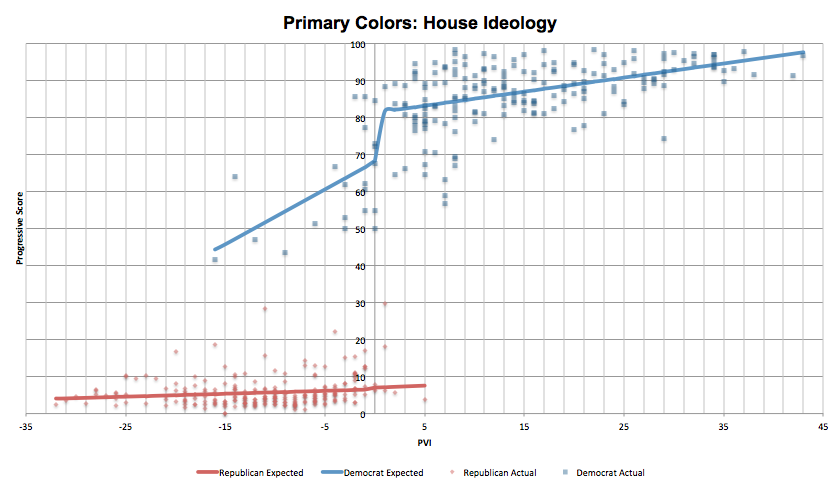
Ryan O’Donnell explains the above chart, which shows the relationship between political districts’ ideology and their representatives’ votes:

Obviously we’d expect Democratic politicians to vote more conservative the more conservative their district gets, and more liberal the more liberal their district gets. And by-and-large, they do. But Republicans don’t really follow that trend, as you can see in red on the graph [above] … If you only take away one thing from this graph, it should be that the expected value for Republicans is nearly a perfect horizontal line. Translated into plain English, that means Republicans vote conservative almost no matter what. It doesn’t matter what type of districts they represent.

The lesson Matt Steinglass draws from this:

This doesn’t predict what might happen if Republicans gained control of the Senate, or of the presidency. It’s possible that with more power Republicans would feel freer to disagree with each other. With their backs to the wall, out-of-power Democrats might feel the need to present a more united front. But basically Democrats have less voting discipline than Republicans. …

In other words, if all else fails, the gridlock of the American government will probably end the next time the country elects a Republican president, since Republican legislators have the discipline to stonewall Democratic presidents while Democrats are more willing to compromise. That asymmetry is probably infuriating to Democrats, but unless their legislators adopt different voting behaviour, it’s not going to change.

Sponsored Content Watch

by Chris Bodenner

A reader sees it moving to TV:

With all the discussion about The Atlantic, Buzzfeed and others blurring the line between journalism and sponsored content, I thought this might add to the discussion. Robert Feder is a longtime Chicago media journalist who has moved from his spot at the major papers in town to the blogosphere. This afternoon, he posted this blog post about the disturbing trend of the local Fox affiliate (and to a lesser extent, WGN TV) is airing segments during their news programming that are paid for by companies looking to promote their products. At the end of segments, a brief “this segment was sponsored by [company name]” is all that tips viewers that what they have already watched is not news and should be viewed with a degree of suspicion.

This, to me, is every bit if not more disgusting than the proliferation of sponsored print content, as it is much less obvious than even the best camouflaged sponsored piece on Buzzfeed. Viewers should not have to watch every segment with suspicion that it is a paid piece in case such a revelation is made at the end of a four minute interview. I assume that if it’s happening here, it’s happening elsewhere, and that both chills and repulses me.

Ask Dave Cullen Anything

by Chris Bodenner

Dave wrote the definitive book on the Columbine shooting, which is about to have its 15th anniversary next month:

Columbine won the Edgar Award, Barnes & Noble’s Discover Award, the Goodreads Choice Award, and several others. It spent thirteen weeks on the New York Times bestseller list, and made two dozen Best of 2009 lists, including the New York Times, LA Times and Publishers Weekly. Columbine was declared Top Education Book of 2009 by the American School Board Journal. Cullen spent ten years writing and researching Columbine. He has written for New York Times, BuzzFeed, Times of London, Newsweek, Guardian, Washington Post, Slate, Salon, and Daily Beast and is a frequent television analyst. He is currently working on a book about two gay colonels, who he has followed for twelve years.

Here’s more about that forthcoming book, Soldiers First:

This book began for me in 2000 with a long piece on gay soldiers for Salon. I spent five months with a group of them in Colorado Springs and was stunned to discover how their world was completely different than what I’d seen, heard and described on the outside. It was easy for them to find quick, meaningless sportsex under the policy, but nearly impossible to find a boyfriend. So we named the first half of that piece: “Don’t Ask, Don’t Tell, Don’t Fall in Love.” It was the best thing I ever wrote prior to my first book and it won the GLAAD Media Award for best on-line story of the year. The article was published in two parts, here and here.

Among the scores of good reviews for Columbine came from The LA Times’ David Ulin:

Forget everything you thought you knew. The girl who professed her faith in God before being gunned down in the library. The Trenchcoat Mafia and the feud between the goths and jocks. The idea that Eric Harris and Dylan Klebold — the two Columbine High School seniors who, on April 20, 1999, killed 12 of their fellow students and one teacher in what was, at the time, the worst school shooting in the history of the United States — were disaffected, unpopular, motivated by resentment or revenge. Even the fact that the killings took place on Adolf Hitler’s birthday was a coincidence: The boys had planned to do it a day earlier but hadn’t been able to get the ammunition in time.

All of this, Dave Cullen notes in “Columbine,” his comprehensive account of the tragedy and its aftermath, is the story we’ve been given, the mythic version, the one that (if anything can) aspires to make a kind of sense. It’s a rendering in which the pieces fit together and the terror of the day is mitigated by small moments of redemption, whispers of epiphany and grace. The problem, however, is that none of it happened — or more accurately, none of it happened exactly like that.

A more succinct review:

What would you like to ask Dave? Submit your questions via the survey below (if you are reading on a mobile device, click here):

[POLL NOW CLOSED]

The Down’s Spectrum

by Chris Bodenner

A reader writes:

The PSA you posted highlights how people with mild cases of Down Syndrome can flourish. The degree of impairment due to Down’s, however, is a spectrum. I have a close relative with Down’s who is severely affected. She learned to speak only for a year or two, then it was all forgotten. She is now in her mid-thirties and has not once slept through the night. In fact, as she has gotten older, she has developed Parkinson’s disease. She requires a cocktail of medications that sometimes leads to complete sleep deprivation.

Her kind and loving parents have rejected suggestions to institutionalize her throughout her life and given her the best life they possible could. But they are now elderly, and are her primary caregivers, taking turns spending all night awake with her. I know they do not have an ounce of regret for the choice they made to keep their child, but I would not judge other families who lack their strength.

Ask Shane Bauer Anything: The Guantanamo Effect

by Chas Danner

In another video from the former hostage, he notes how both he and his Iranian jailers would try to cite Guantanamo to their advantage:

He goes on to try and explain the bizarre and twisted relationship he had with his interrogators, who tried to behave as both enemy and friend:

Shane Bauer is an investigative journalist and photographer who was one of the three American hikers imprisoned in Iran after being captured on the Iraqi border in 2009. He was held for 26 months, four of them in solitary confinement. He subsequently wrote a special report for Mother Jones about solitary confinement in America, and he’s currently running a Kickstarter-like campaign to enable him to spend a full year investigating America’s prison system. Shane and his fellow former hostages, Sarah Shourd (now his wife) and Josh Fattal, have co-written the memoir A Sliver of Light based on their experiences. Except here. Read about what happened one night when Shane’s guards left his cell open here. Shane’s previous videos in the series are here.

(Archive)

A Case Of Technophobia

by Patrick Appel

David Blumenthal explains why the health care industry hasn’t embraced digital medical records:

The reason why the medical profession has been so slow to adopt technology at the point of contact with patients is that there is an asymmetry of benefits. From the patient’s perspective, this is a no-brainer. The benefits are substantial. But from the provider’s perspective, there are substantial costs in setting up and using the systems.

Until now, providers haven’t recovered those costs, either in payment or in increased satisfaction, or in any other way. Ultimately, there are of course benefits to the professional as well. It’s beyond question that you become a better physician, a better nurse, a better manager when you have the digital data at your fingertips. But the costs are considerable, and they have fallen on people who have no economic incentive to make the transition. The benefits of a more efficient practice largely accrue to people paying the bills. The way economists would describe this is that the medical marketplace is broken.

Richard Gunderman provides another perspective:

[Dr. Paul] Weygandt [a VP at a medical communications firm] believes that contemporary medicine has allowed too many intermediaries—financing, technology, and the way practices are structured—to come between patients and doctors. Too much time is focused on generating revenue rather than quality. Too many technological systems are built in ways that make sense to computer engineers but not to doctors. And too much time is spent pointing and clicking rather than capturing the essence of a patient’s story.

What can be done? Weygandt argues that doctors need to play a more active role in all aspects of healthcare’s future, not just implementing but also designing it. Too often, such decisions are currently being made by people who do not take care of patients, and in many cases, have never cared for patients.

A Felon In Florida? No Vote For You

by Tracy R. Walsh

Screen Shot 2014-03-20 at 4.13.06 PM

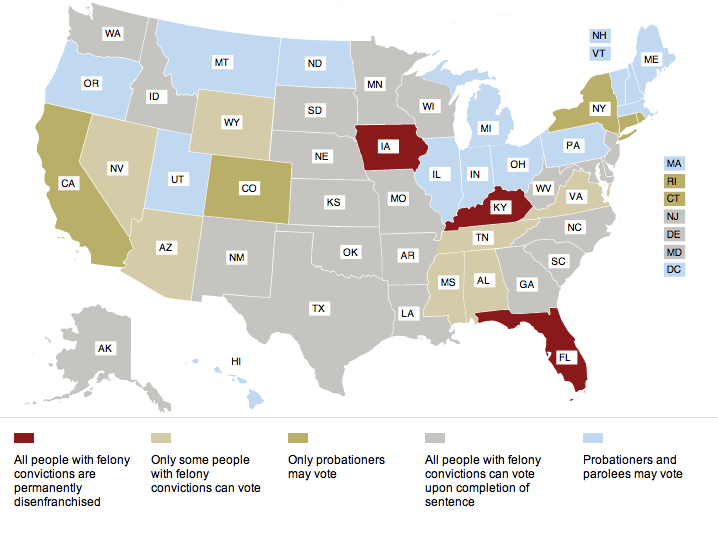
Jessica Chiappone laments losing her rights at the ballot box after pleading guilty to conspiracy to possess cocaine:

I served seven months in a federal prison in Texas, where I was subjected to strip searches every other day after being sent into a forest to chop trees. I spent one year in a halfway house in Brooklyn, and then three years on supervised release – one year earlier than projected. I graduated from college with a degree in criminal justice. I found a job and paid my taxes. I became a mother, graduated from law school and passed the New York State Bar Exam. … Despite my time served and my accomplishments as a legitimate contributing member of society, my fundamental right to vote in Florida was denied – along with several other rights that are supposed to be inalienable in America.

The United States passively accepts the existence of second-class citizenship. Rather than provide an opportunity for automatic restoration of voting rights, Florida imposes a subjective review process that leaves the formerly incarcerated with no clear standard to meet: intrusive and uninformed questions about financial stability, substance abuse and HIV/AIDS – none of which are barriers to voting for those not convicted of crimes, nor should they ever be.

Last month, Eric Holder urged states to “fundamentally reconsider” the practice. Recent Dish on the subject here.

(Map of state felony disenfranchisement laws via ACLU)