Catching Catcalls On Camera, Ctd

A bunch of commentary still remains from last week’s popular thread:

I am a 31 and I’ve been getting these so-called “hellos” on the street for about 20 years (basically since I started to get breasts). Let’s stop pretending that women everywhere cannot distinguish between (1) the casual friendly “hellos” people sometimes give when walking around town and (2) the form of greeting that is really just a form of “I have decided to pass judgment on your appearance and I am very offended when you do not thank me as a wise and respected judge of your sexual appeal.” This is a power dynamic. These cat-callers tend to get upset when you don’t give them the deference they believe they are owed, and sometimes they are so pissed that women fear for their safety. Even when I am not actually fearing for my safety, I do not enjoy being told that I should be slavishly grateful for someone trying to objectify me. Even if I know that there are witnesses and I am unlikely to be physically harmed by someone, I am not an idiot, and I can sense the power dynamic game at play.

Another reader:

All these feminist controversies miss one extremely important point: in the mating game, it is men who are the aggressors. For all the talk of equality among feminists, there is never discussion of equality in the way men and women meet each other. Women, feminists or otherwise, are quite content to let men continue to deal with the issues of approach anxiety or rejection, or the issue of financing the courting process, which is also shouldered almost exclusively by men. Men approach women they do not know and hit on them as a matter of necessity. The men who do not for the most part, are alone.

As for the racial component, in my own experience, men of color are far more easy with approaching women, and they’re often somewhat aggressive in doing so. I’ve also noticed these men of color usually have girlfriends, while the feminism-aware white guy has a lot of female friends … but no girlfriend. He also probably has a great deal of approach anxiety and probably beats himself up a lot for not talking to women when opportunities arise.

Aggressively pursuing women is a winning strategy for men. Of course there will be rejection, but these men power through it, shrug their shoulders and sally forth. The other poor guys, crippled by their fear of offending a woman – and I was once one of them – spend their Friday and Saturday nights alone. Some of these men spend their weekends out and about desperately trying to meet a woman without being an asshole about it, while the assholes sweep up the women.

Update from a reader, who quotes the previous one:

Men approach women they do not know and hit on them as a matter of necessity. The men who do not for the most part, are alone.

That makes my blood boil. He can’t tell the difference between places where it’s acceptable for men to “aggressively pursue women” (and vice versa!) like a bar, a party, and online dating websites and where they probably shouldn’t (the sidewalk) and still fancies himself socially aware enough to comment on “the mating game”? I’m not sure if you posted it yet but this tweet sums up the whole situation very well:

But another responds with an anecdote:

A few years ago, a friend of mine was walking past a construction site in NYC.  A worker squeezes through the orange plastic netting and darts in front of her with his arms stretched wide and says “Hey, beautiful, why in such a hurry?”  She tries to side-step around him but he moves aside, blocking her path again.  “Come on, just say hi.”  She says “Hi” and he doffs his hard hat and bows and she walks past.

She intentionally walks by there a couple of days later at the same time and is “greeted” again.  They strike up a conversation and have been dating for 6 years now.

She is an early 30s lawyer, Ivy educated, and attractive.  (She has since discovered he’s married, by the way.) I think it would be fair to say that his methods verged on assault. But, apparently, sometimes that approach works, it seems. Go figure.

Another offers XKCD’s “great take on this”:
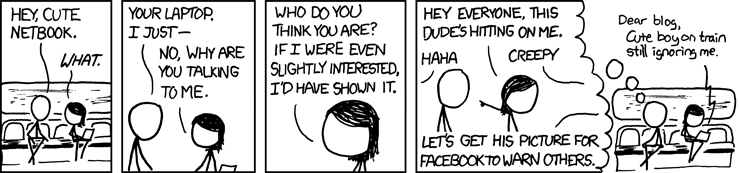
creepy

Another reader on the racial angle:

Instead of injecting my thoughts into this discussions, I thought I would direct your attention to a recent episode of Black-ish.  It’s a very funny show and I highly recommend it.  (In fact, a recent episode chronicled the parents struggle with whether to spank your child, and I think it addresses many of the issues raised by your readers.) In the third episode, available here, the father struggles with his son, who is growing up in an affluent white neighborhood and not understanding black culture, including the face that a black guy makes when he sees a woman with a nice butt.  The episode ends (go to about the 20 minute mark) with father and grandfather high-fiving after the son makes the face and says “damn” after looking at a woman’s behind. I was a little shocked by the scene myself and I don’t know whether it is really reflective of black culture.  However, I was surprised when the episode aired and there was little if any backlash.

Another turns the tables:

As a straight woman, I am constantly objectifying men I see on the street and on the college campus where I work. I am admiring their bodies (sometimes specific parts of their bodies), mentally unclothing them, imagining touching them, imagining having sex with them. I do not stop myself from doing this, and I do not feel shame or guilt about it – because it’s natural.

Yet I also recognize that these are my private thoughts, and that the men I am objectifying may be offended or feel sexually violated by me were I to tell these men that they are beautiful, hot, have a nice ass, etc. I also want to respect their personhood. For that reason, I stay as discrete as possible (though I am sure I’ve been noticed at least a few times). In my opinion, we shouldn’t pathologize the sexualization and objectification of other bodies; we should recognize that to do so is human instinct, for both men and women. We should instead seek to bring more civility into our culture – to recognize that it is the voicing the objectification, not the mental act of objectification itself, that is problematic and dehumanizing.

Another circles back to class:

I just want to respond to your reader on the updated Catcalling post, who wanted to point out this behavior doesn’t happen on their upper-middle-class streets. I’m sure it does happen there, if more rarely than in a heavily populated city; they just aren’t aware. Teenage boys will always find ways to let their female peers know if they like what they see – and I say that as having grown up in areas that sound very similar to this reader’s neighborhood, where once my friends and I were old enough to drive ourselves, rolling down car windows to shout “compliments” at girls and young women became frequent enough. It seemed like harmless fun then, but I’ve known for years that it really wasn’t. I carry no small amount of shame for having participated, even if I can chalk it up to being a hormone-fueled idiot. The phenomenon really shouldn’t astonish me, then, but it still does today when I see or hear of grown men behaving this way.

I work in the very white collar industry of financial products and services, and I hear from my women friends and co-workers that they get sexually harassed on some level on a near-daily basis while at work, in the same office I share with them. I don’t see it because these men have learned that behaving openly like that will get them fired post-haste, but it happens. Married managers, single interns, executives with grandkids. I’ve heard about them all, though never with any names attached to the stories, because these women are afraid of rocking the boat and would rather “deal with it” in relative silence than cost anyone their livelihood (including, especially, themselves).

No, it definitely isn’t all men, or even most men. Not even according to the harassed I’ve spoken to. But when it happens to them, or they witness it, every day, the unwanted attention becomes unbearable. How could it not? Videos like Hollaback are clearly striking that same nerve.

So your aforementioned reader wants to make this a class issue, but he’s using the word incorrectly. It’s not about economic class structure; it’s about a person’s, a heterosexual man’s, level of maturity. It’s about showing decorum, to know that catcalling or trying to get a woman’s attention through disrespectful means is wrong. Always. Period. It doesn’t matter where you grew up or where you live now. Or how you raise your kids. My father certainly didn’t teach me to catcall, but I did it anyway through some combination of peer pressure, cultural osmosis, and those damn hormones.

Catcalling” can happen anywhere, whether it’s yelled on the street or whispered in the halls of corporations. Your net worth has nothing to do with it.

Another would agree:

I’m the cliche long-time reader, first-time writer.  This catcalling business finally struck a deep nerve with me, so after hundreds of started-but-never-completed e-mails, I’m finally mad enough for the “SEND” button.

I’m a 29 year-old woman working in a heavily male dominated industry.  My clients and business partners are primarily white, in their late 40s, and making anywhere from $300-500k annually.  Some, quite a bit more than that.

These upper-middle-class white men are just as bad (I would say, worse) at this catcalling business … they just do it differently.  Your self-proclaimed upper middle class white guy isn’t out on the street all day whistling at girls who walk past. Instead, he’s sitting behind a mahogany desk with all sorts of trumped-up self importance thanks to his six-figure salary dishing out unwanted comments to the occasional woman he comes across under the guise of being complimentary.  Frankly, I prefer comments from strangers to what I deal with on a daily basis at work.

The most insulting “compliment” that I receive on the regular is the classic “you know, there’s more to you than meets the eye” – as if I, walking into his office on my initial visit, received low marks just for the fact that I’m a size-six twenty-something.  I straighten my hair, wear limited amounts of make-up with almost exclusively black suits and almost no jewelry. I’m a straightforward, aggressive, business-focused woman, desperate to hide the three biggest hurdles in gaining their respect: my age, gender, and shape.

A sampling of the repeated “compliments” I get fall along these lines: “It’s so nice that young women today don’t look like the butch girls in the industry when I was young.”  … “I bet if you had a boyfriend or husband he wouldn’t be letting you do this job with so many men.” (I have one, actually) …”You came with such a great recommendation – I was surprised when you walked in the door!” … “A pretty girl like you couldn’t find someone to take care of you so you could stay home and stop traveling so much?” … And, one of my personal favorites: “I bet a ton of the other guys out there hit on you, don’t they?”

These men appear to be committed family men when they’re back in their white, middle-class neighborhoods, but in the office, they feel entitled to comment on (and touch) young professional women’s bodies and general appearances just as much as the men in the video. So please inform your middle-aged white reader that his group is boorish, too.

Another woman complicates matters a little:

I’m 66 years old.  I remember the catcalls of the 1960s – girls walking down the street were often called broads and cunts and asked if we wanted to fuck. (Compare that with the overall good-natured and respectful language on the video!)

However, to muddy the waters; here’s one thing I miss about the catcalls of my youth. I was only average looking, but I had nice long legs.  In the days of short skirts, it was common for guys to whistle when I got out of the car. I loved that!

Another older woman with mixed feelings:

I’ve listened and watched all the comments people have about that woman walking the streets of New York and subjected to catcalls and whatever.  Takes me back to the last century – it really does.  Much has not changed.

The same stuff was going on in the streets my city back in the ’60s and ’70s and all the decades since.  I remember it well.  I hated it when it happened back then; the comments and whistles and gross come-ons made me feel cheap and diminished somehow.  I was a 20-year old from the farm country, new to the city, trying to get on with my career.  I’d steel myself to the shouts and keep on walking.  Some of those comments were the reason I became a “feminist”, way back then – still am, truth to tell.  Fighting for equal wages, equal rights, they called us “bra burners”.  Yeah, sure.

Back then, I got special prices at the butchers, extra bits of meat thrown in at no cost but with a sly comment that sounded much like “wanna meet me out back? I got some short ribs that are really meaty”.  I took the short ribs, but never went “out back”.  I got extra oranges and apples in the bag from the fruit market because I looked good. There were little extras at every turn.  Bartenders would say “we just got this nice white in, thought you might like to try it – this one’s on the house.”

I took it all and said thanks very much!  I knew it was just because of how I looked – young and attractive.

Now, at the age of 70, I can walk the sidewalks and markets downtown with no comments from anyone at all.  I don’t recall when I actually noticed that I’d become one of the “invisible women” on the street, probably around the time I hit between 50 and 55.  That’s about the time I noticed a few other things.

I don’t get deals at the butcher’s anymore – I’m still slender but a bit thicker through the middle, my hair is graying and I have a few wrinkles, I‘m still “good looking” according to my men friends, still dress stylishly, still have good legs but high heels have been traded in for boxy heels for comfort – it’s just that nobody ever whistles anymore or invites me “out back”. Or offers me deals on short ribs. Or offers me a nice white on the house.  I don’t miss it – I just note the absence.

Part of that absence makes me feel a little sad – yes, I’m old now.  The juiciness of life has passed me by.  Still, part of being “older” makes me feel a real sense of freedom; I’m accepted as just another human being, female by birth.  Nobody notices us older gals.  But we pay our way.

I kind of envy that gorgeous woman in her black slacks and black t-shirt. Part of me wants to say you’ll only have to put up with this for so long, and then it’ll be done.  Guys are guys, the cat-callers are mostly just dumb jerks being led by their hormones, and they’ll be old and fat and gone in no time.  And soon you’ll be older and heavier and nobody will notice you ever again.  You just might miss it when that time comes.  Not that I miss it all that much – but I DO have memories.  :-)

Catching Catcalls On Camera, Ctd

32

Many more readers have their say on the controversial video:

You know, I wish this could be supplemented by videos of what it’s like for women to walk down the street who don’t conform to “pretty” norms. Quite frankly, plain women, or ones not compliant with “available chick” visual norms, get just as many cat calls – often more aggressive because “ugly women should be both available and grateful for the attention” and have added in an equal or greater load of criticisms. Dog barks, bitter comments about how ugly they are, suggestions where they should go and what they should do – many obscene, and many suggesting that a man approaching them would be doing them a favor screwing them or letting them go down on the idiots.

If you’re beautiful, it’s bad. If you’re NOT beautiful, it’s hell: all the come-ons, then a layer of vicious critique, all of it from sulky men insisting on their entitlement to women: their bodies, their attention, their sexual favors, even the right to insist on the “right” appearance. Jeez-Louise, it gets old.

Another references the above image:

The reader who wrote “It all smacks of white privilege to me” might be interested in Tatyana Fazlalizadeh’s art project “Stop Telling Women To Smile.” Would that reader tell her portrait subjects (who are largely women of color) that they’re in neighborhoods where they don’t understand the social mores?

Much more commentary below:

I think a very important point has been missed, thus far, in the discussion of the catcall video.

The problem (for many women, at least) is not with the words themselves. The words themselves, as other commenters have pointed out, are First Amendment expression whether we like them or not.  The problem is the context in which they are being spoken.  I’ve never bristled at a “Looking good today, baby” or “Smile, honey!” comment when I’m at the post office or walking through a mall.

However, catcalls are incredibly threatening (or at least feel that way) while walking by myself or in a sketchy area or at nighttime.  In those situations, my goal is to move as quickly and as unnoticed as I can through the environment.  Being noticed brings with it the threat of assault, violence, or something worse. In those situations, therefore, a “Looking good, baby!” is not just a “Looking good, baby!” It’s implicitly saying, “You have been noticed.  I am watching you. I am looking at your body.” The communication has a very predator-prey feeling to it regardless of how it is intended by the speaker.

Another remarks on the complex mix of feelings involved:

When I get catcalls on the street, I’m not reacting to the actual interaction most of the time.  What I am reacting to is the power dynamic that is happening and the possibilities of future violence.  My stress levels rise when I imagine what is going to happen next, whether I ignore the words or whether I engage.  I feel powerless and afraid.  I feel pissed off at them for bothering me and at myself for “letting” them.  I feel a flush of pleasure at being complimented, and then guilty that I should actually like that kind of attention.  I feel afraid of opening myself up to the guy who really does just want to say “Good morning” because then the next guy I smile at will take that as an opening to talk about my big juicy tits.

And this happens to me ALL THE TIME.  It’s a whirlwind of fear, anxiety, relief, pleasure, and mindlessness.

Another turns to the “elephant in the room,” as our reader put it:

In response to those worrying that the catcalling is mostly done by black men: The first catcall I ever received was from a white man in a suit. I was twelve years old, wearing a miniskirt, on my way home from a party in lower Manhattan. I was also lost, and I was grateful to find a subway station. As I walked into the subway, a man in his 20s or 30s coming up the stairs whispered, “Sexy.” I had no idea how to react. I was so alarmed at being sexualized by this adult that I turned around, left the subway, and took a cab home.

I have been catcalled countless times since then. Sometimes it’s truly offensive, and occasionally, rarely, it’s flattering. (A man once yelled at me, “This is why I love New York! The most beautiful women in the world, and you’re one of them!”) Mostly, it’s just tiring. It becomes one more thing to deal with: Should I respond to that guy, or ignore him? Is he honking because there’s an emergency, or is he just trying to get my attention? Is he scary or just a nuisance?

The value of the flawed Hollaback tape is that it shows men how pervasive catcalls are. For a lot of women, they are just a fact of life – and we forget that men don’t see that. I don’t think catcalling should be criminalized (would that even be constitutional?) or that it’s anywhere near the most serious issue facing women. But it’s worth noticing how often catcalls happen.

More on the racial angle:

Your reader who is concerned about the “inconvenient truth” revealed in the video – that the majority of the catcallers were Black and Latino men – needs to confront an inconvenient truth, as well: he or she (despite the caveats that were offered) is overreading it.  First of all, a number of the white guys were edited out of the video.  Second, let me tell you something:  Right now, I live in South Dakota, and the men who have catcalled me, to a person, are white.  If Hollaback had shot a similar video here, and if the overwhelming majority of the woman’s catcallers had been white, I wonder if your reader would have characterized the problem along racial lines.  I suspect that the answer is “No.”

Another reader:

As a mixed-race woman, living in NYC for over 15 years, I can testify from personal experience it is the United Nations of Perverts out there. I have been harassed in similar ways (and worse) as the woman in the video, by men of EVERY race. So have most of my female friends in this city. Where I lived previously (Florida), I was also unfortunately harassed by men of all races (from white rednecks to white men in sportscars to Latin and black men). But in New York, the incidence of harassment is higher because it’s a walking city, and our population is more diverse than most public spaces in America.

This is probably a good moment to post a trailer for the classic documentary of street harassment, “War Zone.” It’s filmed in Chicago. Plenty of white harassers on the video, which makes sense given the population there:

And another:

I worked on a garbage truck for the County Parks Maintenance Department one summer when I was in college.  All the guys in the shop were Archie Bunker types, and I worked with two drivers – one Irish, one Italian (the Italian guy assumed I was also; when I told him I’m Jewish, he thought about it and said “there’s nothing wrong with that”).  The Irish driver would whistle and call women from the truck as I was riding shotgun while I’d squirm, since the last thing I wanted was to call to the attention of pretty women the fact that I was riding shotgun in a garbage truck.

During one whistle/catcall event towards the end of the summer, he turned to me as I was sinking down in my seat and said, “What’s the matter with you, don’t you like girls?”.  It was just kind of taken for granted that this is what you do if you like girls.  Clearly this man in his 60s with a strong brogue, who’d been a laborer all his life and looked it, couldn’t have hoped for any kind of positive reaction from the women, and I don’t think he meant to harass or threaten.  It’s just what you do to express your appreciation for the female form.

He and the other guys had no idea how dumb they made themselves look doing this.  Telling them how threatening they are is probably futile, since they don’t see themselves as threatening and would say that you should just lighten the F up.  A better strategy might be to help them realize how completely ridiculous they look.

One more:

It seems to me that part of what women are saying is the constant everyday-ness of the catcalls.  It’s like African Americans who say it’s not the OPEN discrimination, it’s the thousand tiny cuts, i.e., being followed in stores, being asked for ID along with your credit card when your white friend does not get asked, being stopped by cops for no seeming reason, etc etc.  It just wears you down after a while and I suspect young women feel the same.

Read the whole discussion thread here. Another long thread on catcalling from 2012 is here. More reader feedback on our Facebook page. Update from a reader:

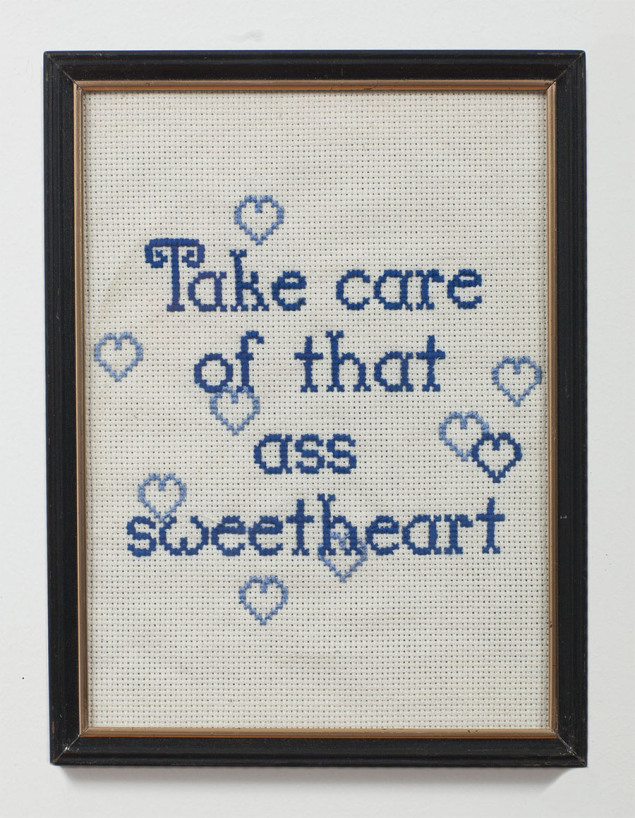
I haven’t read through all the commentary, but as a woman I naturally am very glad to see it being discussed. I’m not sure if this has been sent your way, but rather than catching the catcalls on camera, a Brooklyn artist found another unique way of catching them – she does it in cross stitch:

elanaadler-takecareofthatass

And it’s really discomforting to see the “compliments” or the insults captured in this medium. Sort of perverse folk art.

Another reader:

You know, Andrew, your female readers are reacting to racial aspect of the video (by insisting that white men catcall too, which I’m sure is true) but utterly and completely ignoring the class aspect – or in some cases, as with the story of the Irish guy on the garbage truck, actually making the case that this may indeed be class thing.

I live in a middle class/upper-middle class suburban (and yes, mostly white) neighborhood, and women are not being catcalled here. It’s just not happening. My 13-year-old son has several friends who live in a newer neighborhood with sidewalks and lots of pedestrians about a half-mile away; women are not being catcalled there, either.

The suggestion by your readers seems to be that if a woman were to walk around these neighborhoods she’d get just as many “Hey, baby” catcalls as the woman in the video did. I’ll tell you right now, that suggestion is false.

What we have, then, are women who legitimately feel creeped out or even threatened when something like this happens, but who in turn attempt to suggest that “all men” are either guilty of such behavior, or at least responsible for it in some way. And I reject that; I don’t do collective guilt. I don’t teach my sons to behave this way, the people I hang out with tell their children that this behavior is wrong and offensive. I’m responsible for my behavior, for my kids’ behavior, maybe even to an extent my neighbors’ behavior. But the guys in that video, catcalling the woman? I’m not responsible for their behavior. It’s not my responsibility to change it.

Or should it be my responsibility to tell them they’re wrong – me, the upper middle class white guy, telling impoverished blacks, Latinos and whites that they’re being boorish? That’d be received real well, don’t you think?

The Business Of Coming Out

Apple Unveils iPhone 6

Apple CEO Tim Cook officially exited the closet yesterday:

For years, I’ve been open with many people about my sexual orientation. Plenty of colleagues at Apple know I’m gay, and it doesn’t seem to make a difference in the way they treat me. Of course, I’ve had the good fortune to work at a company that loves creativity and innovation and knows it can only flourish when you embrace people’s differences. Not everyone is so lucky.

While I have never denied my sexuality, I haven’t publicly acknowledged it either, until now. So let me be clear: I’m proud to be gay, and I consider being gay among the greatest gifts God has given me.

Leonid Bershidsky points out that “Cook is the first chief executive of a Fortune 500 company to come out in public”:

Members of this exclusive club are still unsure whether that’s wise, and just a few years ago, it wasn’t. In 2007, John Browne resigned as chief executive of BP after being outed by a British tabloid. He has since written a book about being a closeted gay in big business. “To a headhunter I would have been seen as ‘controversial,’ too hot to handle,” Browne wrote. “Sadly, there were some people, mostly from the business world, who never again displayed any warmth to me.”

Browne regretted choosing to live a double life rather than setting himself up as a role model for other gay executives — something Cook has done now with his candid, touching essay. Still, he had strong motives for staying in the closet — stronger ones than an inclination toward privacy, which Cook, no publicity hound either, has successfully overcome. As head of a large corporation, one has to deal with important people from cultures where homophobia is a way of life. Under Browne, BP had a major joint venture in Russia, where President Vladimir Putin has approved laws against the “propaganda of non-traditional sexual orientation.”

Along those lines, one Russian lawmaker has already proposed banning Cook from the country. And Chinese social media users widely ridiculed the announcement:

Crude puns and derogatory remarks relating Cook’s orientation to Apple products often seemed to drown out praise for his courage and support for his company’s wares. One particular joke, repeated so often in the hours immediately following the release of Cook’s article that the state-run Guangming Daily reported it as a typical netizen reaction, played on the Chinese term “bent man,” slang for gay man. “No wonder the iPhone 6 bends so easily!” wrote user after user. (Tales of the ultra-slim iPhone 6 bending under light pressure have circulated both in the United States and abroad since the iPhone’s release in September.)

Tim Teeman wonders how Cook will deal with such intolerance:

His most radical statement of intent, and one which will be fascinating to see if he holds true to—and if so how practically and volubly, comes at the end: “We’ll continue to fight for our values, and I believe that any CEO of this incredible company, regardless of race, gender, or sexual orientation, would do the same. And I will personally continue to advocate for equality for all people until my toes point up.”

If Cook is serious, then arguably he has just become—indeed made himself—the single most powerful and highest-profile advocate for gay equality globally. How he intends to practically parlay that will be fascinating to watch.

Apple, for example, is in talks to sell the iPhone in Iran, a country where homosexuality is a crime punishable by death. Incidences of gay men being hanged in public have been graphically reported upon. If Cook is to be taken at his word, one would expect him to make some public statement about Iran’s record, as he prepares to do business with the country. His stirring essay makes clear his desire to be an advocate and activist, but it does not specifically lay out how he intends Apple to do business with deeply homophobic countries like Iran.

Issie Lapowsky hopes that Cook’s announcement will help other business managers and employees to come out:

The problem is more acute than you might think. With a recent study, Deloitte University’s Leadership Center for Inclusion examined a phenomenon that sociologists refer to as “covering,” where people will attempt to mask part of their identity in the workplace, and it revealed just how pervasive—and potentially damaging—the practice is among members of the LGB community.

The study surveyed more than 3,000 employees at businesses across the country to determine what percentage of them admit to covering at work, and why they feel the need to do it. The study included people of a variety of races, genders, and sexual orientations, and found that while 61 percent of all respondents said they had covered, a whopping 83 percent of gay respondents said they had. That’s more than black respondents, female respondents, and any other minority group surveyed (the transgender sample size was too small to be included).

Claire Cain Miller makes clear why Cook’s statement matters:

Though there have been chief executives at the upper tiers of corporate America who are gay, they have consistently declined to be identified as such. That sent a similarly strong message to young people, said Sam Altman, president of Y Combinator, a prominent Silicon Valley start-up investment firm and incubator.

“Shame is the wrong word, but there’s some sense of lack of comfort when it goes widely acknowledged and not said,” said Mr. Altman, who is 29 and gay. He said he remembers thinking in high school that as a gay person, he could never become a venture capitalist because the industry was too much of a traditional old boys’ club for him to be included. Mr. Cook has become “an incredibly important role model, and I think people underestimate how important that is in what people think they can do with their lives,” Mr. Altman said.

And Casey Newton savors the moment:

There was a time when I struggled to come to terms with myself; when I felt alone; when I scanned the horizon looking for someone to point the way forward for me. There was a time when the only other gay men I knew were the ones I saw in TV and movies, and they seemed nothing like me. It feels embarrassing to say now that what I wanted back then was a role model — someone confident in himself, powerful, a real leader — to give me permission to be myself. But I very much did.

And many still do, particularly younger people, and particularly younger people growing up in the more rural and religious parts of America. Someday, maybe someday soon, we’ll hear about how Cook’s essay today helped someone there through a difficult time. And then we’ll hear it again, and again, and again.

Update from a reader:

I guess I’m all alone here. To me, Tim Cook is the Jodie Foster of corporate America. Unlike Ricky Martin who said something to the effect of “If I knew back then how good telling the truth feels, I would have done it a long time ago,” Cook and Apple are spinning their message for maximum exposure and publicity. Despite last June’s “outing” on CNBC, Cook and Apple remained coy, and even yesterday’s announcement proclaimed that Cook has never denied who he is. The whole thing seems fishy to me. We have a wealthy and powerful leader of an adored company making a safe announcement once he’s in a comfortable position. Rather than showing that Apple is an open and tolerant organization what this seems to say is that like Jodie’s path to stardom and success, the closet can be a useful career strategy if you play it right.

We should all be glad that Cook is now feeling safe, open, and proud about who he is and let the homophobes know they need to get over themselves, but as a role model, Cook‘s credentials are somewhat weak. He played it safe on the way up, and now he wants to play the hero and get the admiration. Until his role moves beyond symbolism, I am withholding my praise.

(Photo: Apple CEO Tim Cook announces the Apple Watch during an Apple special event at the Flint Center for the Performing Arts in Cupertino, California on September 9, 2014. By Justin Sullivan/Getty Images)

Views Differ On Meaning Of “Sexual Assault” Ctd

A reader comments on this post:

The excerpt from Elizabeth Nolan Brown quotes “increasing progressive activism around the idea that drunk people can’t give consent.” I’m troubled by this.  The fact is, people can (and do) give consent while intoxicated.  Intoxication does not render one a zombie or possessed by a demon.  In fact, many would argue that one’s words and actions while intoxicated reveal more of your true self than when sober (think of the guy who goes off on a racist tirade while drunk, but would never be caught saying those things out loud when sober).

The notion that a woman (or man) should be absolved of all responsibility for their sexual actions while drunk is preposterous.  Yet it seems that this is exactly what high school and college campuses are now telling their students.

But let’s look at it this way: If a female college student were to go to a frat party, get sloshed, and then – instead of climbing into bed with a frat guy – climbed into the driver’s seat of her car, took off and went on to kill someone with it, nobody would be suggesting that she was not responsible for her actions while drunk.  Why should her ability to make a judgment concerning sex while drunk be any different than if she drove a car?

Here’s another example: Let’s say a guy gets drunk and has sex with a woman without a condom and she gets pregnant.  Nine months later should he be absolved of his responsibility to provide for the child just because his judgment in deciding whether to use a condom was impaired at the time of intercourse?  Please.

Update from a reader:

The “increasing progressive activism around the idea that drunk people can’t give consent” runs smack into this reality (emphasis mine):

Typically, if either the victim or the perpetrator is drinking alcohol, then both are. For example, in Abbey et al. (1998), 47% of the sexual assaults reported by college men involved alcohol consumption. In 81% of the alcohol-related sexual assaults, both the victim and the perpetrator had consumed alcohol. Similarly, in Harrington and Leitenberg (1994), 55% of the sexual assaults reported by college women involved alcohol consumption. In 97% of the alcohol-related sexual assaults, both the victim and the perpetrator had consumed alcohol. The fact that college sexual assaults occur in social situations in which men and women are typically drinking together makes it difficult to examine hypotheses about the unique effects of perpetrators’ or victims’ intoxication.

That’s a problem. Unless, of course, the activists want to establish that men are supposed to be the guardians of helpless women’s virtue at all times, which doesn’t sound particularly progressive to me. In fact, it sounds … what’s the word I’m looking for … ah! Patriarchal.

At some point, today’s feminism and yesterday’s Victorianism will reach a perfect convergence. But the new feminists will have to impose their idea of male virtue by force of law.

Getting The Real Ebola Crisis Under Control

ebola_cases_cumulative.0

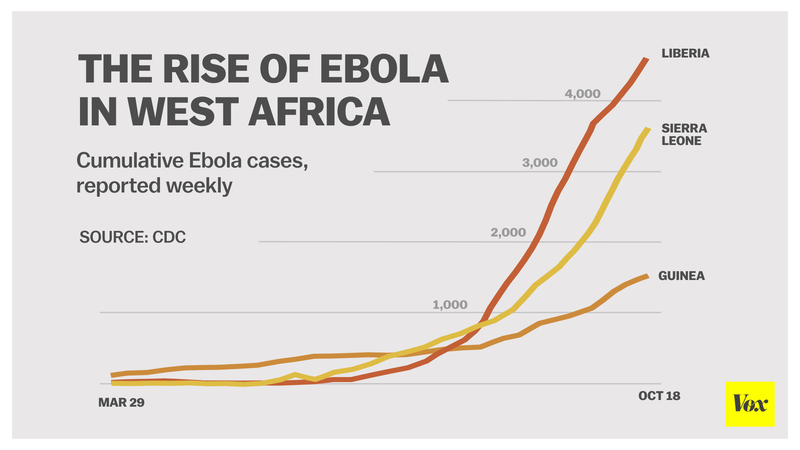
As the above chart illustrates, the epidemic remains a serious public health crisis in parts of West Africa. Nonetheless, Helen Epstein sees signs that the tide may be turning in Liberia, where “the number of new cases each week … is falling, not rising”:

In August, the streets of Monrovia were strewn with bodies and emergency Ebola clinics were turning away patients. Today, nearly half of the beds in those treatment units are empty. I’ve been here a week and have yet to see a single body in the street. Funeral directors say business is off by half. Of course, the situation remains very serious. More than two thousand have succumbed to the disease here since the outbreak began—along with thousands more in neighboring Sierra Leone and Guinea, according to the CDC—and Liberia faces looming economic and political crises. This fragile country urgently needs help—both for the well being of its own people, and for the safety of the rest of this interconnected world. But the epidemic is far from the cataclysmic disaster currently on display on American TV screens.

How did things get so bad in Liberia in the first place? Shikha Dalmia blames “a hopelessly dependent political class that stays in business by ignoring good governance and appealing to its Western benefactors”:

Unlike Nigeria, Liberia’s immediate reaction was not to marshal its domestic resources but to hold press conferences and appeal for international aid, points out Johannesburg-based Yale World Fellow Sisonke Msimang. Liberian President Ellen Johnson Sirleaf, a Nobel peace laureate, even penned an open letter to the “world” this week, plaintively crying that Ebola wasn’t a domestic problem but a global one that “governments to international organizations, financial institutions to NGOs, politicians to ordinary people in the street in every corner of the world” had a “duty” to combat through “emergency funds, medical supplies, or clinical capacity.” But the “world” has been supplying all of this and more to Liberia in spades. Indeed, Liberia is among the largest aid recipients on the continent, with about 75 percent of its budget supplied by aid agencies. It receives $139 per capita in loans and grants, according to World Bank figures, compared with Nigeria’s $11 per capita.

If Liberia has indeed reached a turning point, that’s likely in part because the extremely poor communities where the virus has spread most rapidly, and whose residents often mistrust the government and aid workers (recall August’s attack on an Ebola treatment center in Monrovia), are becoming more knowledgeable about the disease. Abby Haglage profiles a UNICEF initiative called Adolescents Leading an Intense Fight Against Ebola, or A-LIFE, which has put some very dedicated Liberian teenagers on the front line of the information war:

UNICEF’s group was formed in 2012, with the intention of teaching young girls how to protect themselves from sexual violence. The worsening of the Ebola epidemic forced them to teach the girls about a new enemy. They learned what the disease is, how people get it, what happens then. Most important, they learned what they could do to protect themselves. Learning that gave them something the rest of their community, still reeling from the violent government-imposed quarantine, did not have: knowledge. So they walked. From house to house, day by day, teaching the community what they had learned. Ebola is real. It is deadly. Don’t shake hands. Wash them. …

The impact, to [UNICEF’s representative in Liberia Sheldon] Yett, is one only these girls have the authority to make. “They are far more powerful as spokespeople and educators than a public-health official could ever hope to be because they come from that community, they’re known by that community,” he says. “People understand where these girls are coming from, and people believe their messages.”

Yet even if things are looking up for Liberia, Keating cautions, there is still a ton of work to be done to get the regional outbreak under control:

All the same, we’re far from out of the woods in the fight against the disease that has already killed in the neighborhood of 5,000 people around the world. There have been no similar reports of drops in the other countries affected by Ebola. In fact, the number of cases has risen sharply in Western Sierra Leone this month. The disease also may have spread to yet another country—82 people in Mali who came in contact with a toddler who died of Ebola last week are currently being monitored for signs of the disease. The collateral damage from the outbreak—including the impact on the economies and political institutions of some of the world’s most fragile states and the setback in the fight against diseases like malaria—will continue to mount.

Update from a reader:

I work at a large hospital associated with a famous university and medical school. Both hospital and the university are routinely listed toward the top of all rankings of such institutions. My hospital has carefully laid out practice and policy set up for handling Ebola patients. Both my hospital and the university have long traditions of public service, and are not-for-profit. Both entities are renowned for commitments to humanity, education, research, and the elevation of the impoverished. Justice, beneficence, and respect for persons, as it were.

And both have explicitly forbidden any medical staff from traveling to West Africa to participate in Ebola treatment, public health, and eradication efforts. Nevermind quarantines and pay for time off. It is forbidden even if we have the time and don’t want the money (Though, I’m a researcher and not a clinician, so I’d have little to offer on the ground on site in West Africa.).

We talk about the need to prevent this epidemic from growing by addressing the situation at the heart of the outbreak. And it seems that people with the currently active strain of Ebola who are treated from the onset of symptoms with competent and comprehensive medicine are very likely to survive. Yet the death rate in Africa has been as high as 70% in places, because access to even basic medical care, must less excellent care as we have here (access to that care being a conversation for another day), is deplorably lacking. We will not contain this epidemic, and Ebola will become a daily fact of life in many places, unless more resources are brought immediately to bear at the source of the outbreak.

And yet, our esteemed institutions of medicine and science are issuing edicts that thwart any discussion of that possibility, regardless of our federal policies.

Leather Bound

photo-12

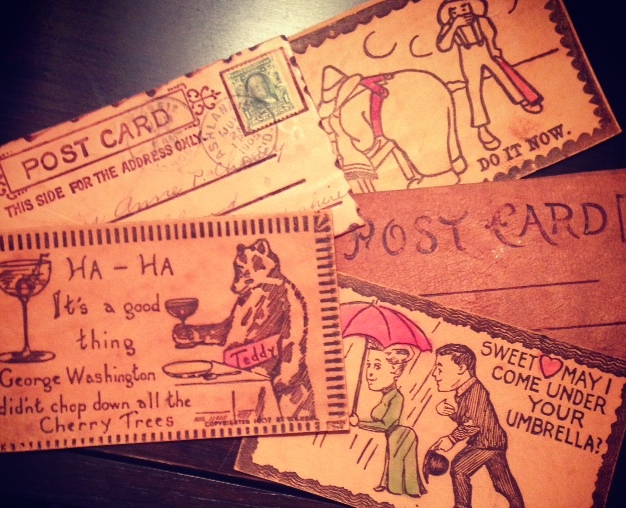
Ever heard of a leather postcard?

Leather postcards were first made in 1903. They were a novelty that appealed to tourists. When stitched together, they could be used as a pillow cover or wall hanging. The holes along the edge could also be used to attach fringe. The cards were made of deer hide and the pictures burned in. The U.S. post office banned leather postcards in 1907 because they jammed postage-canceling machines. Leather cards continued to be made as souvenirs until about 1910.

An avid antiquer on Ebay elaborates:

During the Victorian Era, the term pyrography was coined to describe the artistic use of fire to create graphics on numerous materials such as wood and leather.

It was particularly popular during the latter part of the 19th century for ladies to create hand crafts using this technique.  This process was often also referred to as pokerwork.  It is out of this interesting creative movement that grew a brief and exciting period in postal history.

Beginning in about 1904, leather postcards decorated using pyrography became a popular novelty in the United States.  After a decade, though, the excitement diminished and the fad had nearly disappeared by 1915.  Throughout their short appearance in our postal history, though, the leather postcard had great influence.  Artists such as W. S. Heal created wildly successful cards that were often based on humor derived from period stereotypes.  His cards of this genre, as well as those of other artists, are among the most highly sought after leather post cards available.  Categories that prove very popular among collectors also include souvenir cards, vice or sin cards, puzzles, and cards that express affiliation with organizations.  Other unique qualities, such as color and odd shapes or calendars, add to the desirability of these wonderful historic relics.

The range of subject matter within the field of leather post cards is great as has been noted, but so is the process.  The cards can be as simple as a piece of leather burned by an individual in their own home to production line pieces stamped in a heat press.  Some leather post cards are even inked, and not burned at all.  Purists will seek their own niche within the various forms. As with any collectible, condition is important with regards to the field of leather post cards.  Surprisingly, however, many fine examples were made into quilts and pillows.  Holes are not uncommon in these rare cards.

The leather postcard is an overlooked, but significant, art form remaining from the arts and crafts period in America.

Update from a reader:

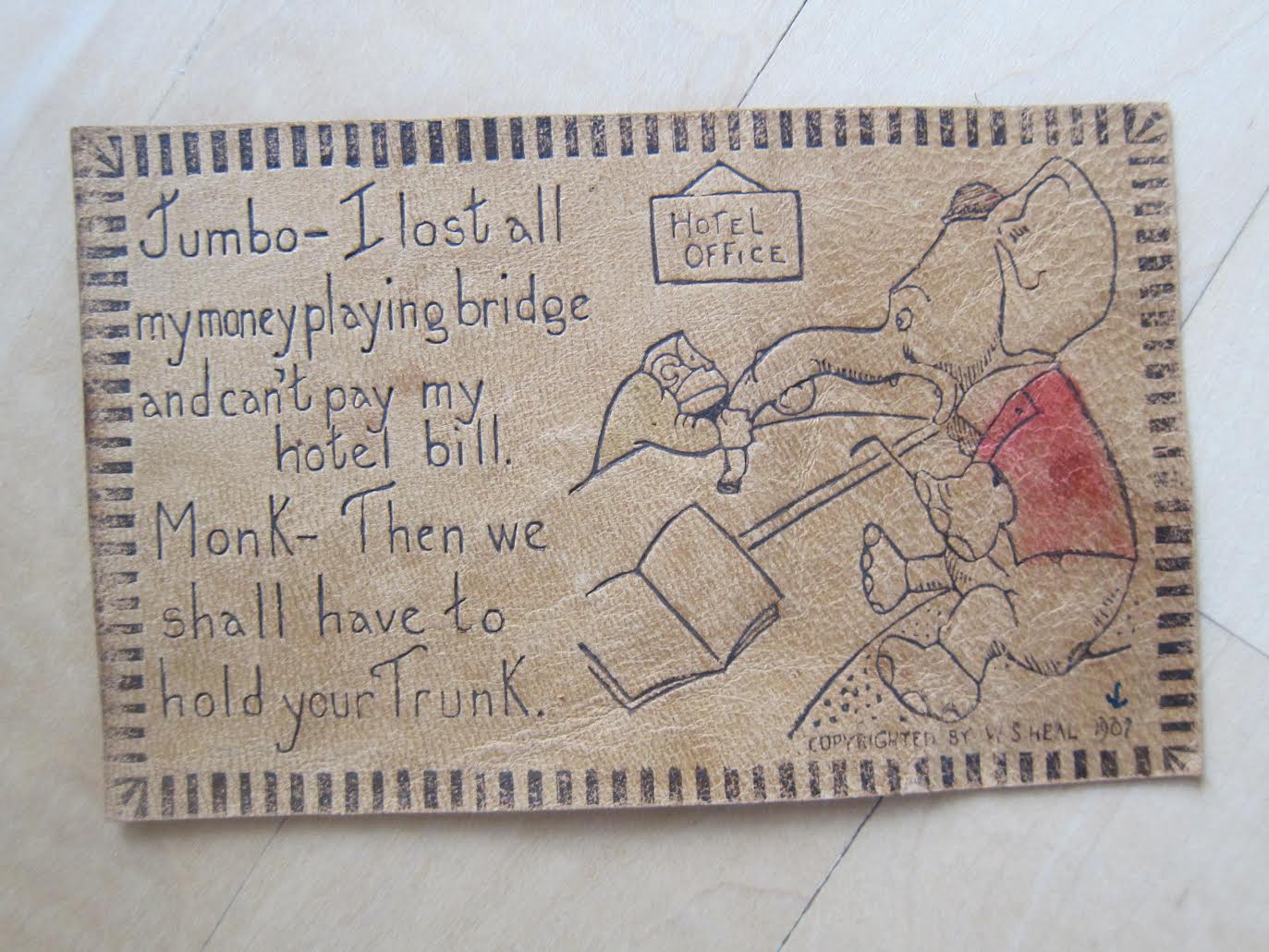
Have I heard of a leather postcard? Why yes … I just mailed one to a friend!

unnamed (13)

I love “real mail” and mail about 5 postcards/letters a day, so this was “bound” to happen.

(Photo of leather postcards from the Albany Rare Book Fair taken by Chris Bodenner)

Did Non-US Citizens Elect Al Franken? Ctd

John Ahlquist and Scott Gehlbach take down the study that claimed they did, pointing out that its limitations “are, in fact, numerous”:

Their estimates rely on a key question from the Cooperative Congressional Election Study: “Are you registered to vote?” Notably, this is not the same question as “Are you registered to vote in the United States?” In principle, non-citizens could be registered to vote only in their home country and respond affirmatively, and truthfully, to the question on the survey.

(Respondents are asked for the Zip code at which they are registered to vote, but this could be interpreted as the Zip code at which non-citizens receive absentee ballots from abroad. Mexico, for example, has allowed absentee voting by mail from abroad since 2005.) If this sounds outlandish, consider that 20 percent (15 out of 75) of those non-citizens claiming to be registered in 2008 were in fact verified as not being registered to vote in the United States. Another 61 percent (46 of 75) could not be matched to either a commercial or voter database. That leaves only 14 out of 75 non-citizen respondents claiming to be registered in 2008 who were in fact confirmed as registered to vote in the United States.

This raises a more general point: The Cooperative Congressional Election Study, which focuses on the behavior of citizens, is ill-suited to examine the behavior of non-citizens, who make up about one percent of the sample. One consequence of this is that the number of respondents who report that they are not citizens yet vote or are registered to vote is quite small in absolute terms: in 2010, for example, only 13 respondents — not 13 percent, but 13 out of 55,400 respondents — reported that they were not citizens, yet had voted. Given the ever-present possibility of respondent or coder error, it takes a bit of hubris to draw strong conclusions about the behavior of non-citizens from such small numbers.

Update from a reader:

In your follow-up to the post about non-U.S. citizens electing Al Franken, it maybe worth noting:

1. The authors of the original study say a follow-up will be posted at the Washington Post any day responding to critics.

2. I investigated the study, specifically looking at the question of whether the public should be worried that Democrats will win tight 2014 elections because of noncitizen voters. On a scale of 0 to 10, with 10 being absolutely true, 0 being wildly false and 5 being half-true, I rated this claim a 4, meaning slightly false. Study author Jesse Richman responded that he agreed.

He said two things your voters may be especially interested in that are a bit of a walk-back from his original post: “Noncitizen voting might tip one or two extremely close races but is unlikely to tip the balance in the Senate, and certainly not in the House.” And: “More work is needed. We view our study as the beginning of the process, not the definitive work on the question.” You can read his full email reply here.

The Complexion Of The Gun Rights Movement

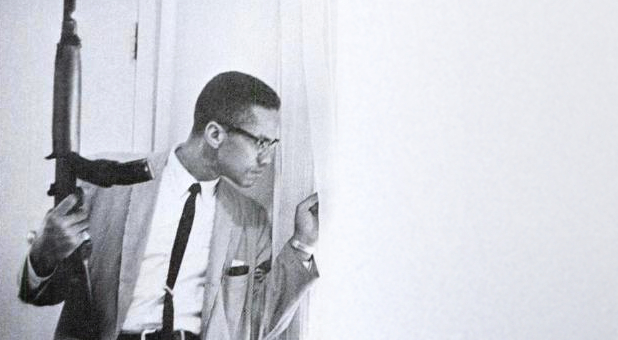
malcolm-x-carbine-ebony

Over the weekend, Charles C.W. Cooke urged Second Amendment activists to “consider talking a little less about Valley Forge and a little more about Jim Crow”:

Malcolm X may have a deservedly mixed reputation, but the famous photograph of him standing at the window, rifle in hand, insisting on black liberation “by any means necessary,” is about as American as it gets. It should be celebrated just like the “Don’t tread on me” Gadsden flag. By not making that connection, the movement is losing touch with one of its greatest triumphs and forsaking a prime illustration of why its cause is so just and so crucial.

Francis Wilkinson finds Cooke’s argument wanting:

If you’re looking for a model of public engagement, it’s hard to do worse than “by any means necessary.” The slogan obliterates compromise — it doesn’t repel violence so much as demand it. And in the late 1960s era of romantic leftist rebellion, Weatherman and others delivered memorably, irrevocably, bloodily, on the promise. …

Ultimately, Cooke’s vision of welcoming blacks into the gun movement ends right where other visions of maximum gun rights end: before the trouble begins. The chief problem with the gun-rights movement is not that it makes distinctions based on race — although it does. The biggest problem is that it doesn’t make distinctions based on more meaningful criteria: mental soundness, personal responsibility, adequate training.

Update from a reader:

I wish that Francis Wilkinson explained further how Malcolm X and his defiance to white supremacy are so negative when it comes to gun rights.  The way Wilkinson writes about Malcolm X makes it sound as if it was within Malcolm’s control not to be oppressed by white America.  The slogan “by any means necessary” didn’t obliterate compromise; white Americans lynching African Americans did that.  White Americans beating, shooting, and drowning a child did that.  A racist judicial system did that.  White America obliterated compromise over and over and over again for generations, yet today it’s unquestioned when people describe Malcolm X as “a man with a deservedly mixed reputation.”

Malcolm X spoke the phrase “by any means necessary” in a speech announcing the creation of a new organization after he left the Nation of Islam.  A larger quote helps fill in the context:

That’s our motto. We want freedom by any means necessary. We want justice by any means necessary. We want equality by any means necessary. We don’t feel that in 1964, living in a country that is supposedly based upon freedom, and supposedly the leader of the free world, we don’t think that we should have to sit around and wait for some segregationist congressmen and senators and a President from Texas in Washington, D. C., to make up their minds that our people are due now some degree of civil rights. No, we want it now or we don’t think anybody should have it.

Note that he was not holding a rifle while giving this speech.  The image and speech are combined by many, including both Cooke and Wilkinson to paint a picture of Malcolm X as irrationally violent rather than someone focused on personal and community self preservation.

I agree with Wilkinson’s overall point about distinctions over meaningful criteria for gun rights, but I wish he would keep in mind why there ever was a radical black nationalist movement.

Previous Dish on gun rights in black America here.

Ebola Federalism, Ctd

A reader pushes back on this post:

Just to be clear here, just because a health-care worker takes time off of work to go volunteer in West Africa in fighting Ebola doesn’t mean that the institution they work for is also volunteering their away time hours. In most cases, the worker must still have accrued enough time off to actually take the vacation in question – and the employer rarely distinguishes between hours off spent sipping martinis in the Maldives and hours off spent replacing IVs in Liberia.

And while the state might reimburse them for the lost wages, that doesn’t mean their medical employer has to welcome them back after three weeks of leaving their workplaces understaffed and their coworkers overworked to fill up the slack. Treating it like the health worker should just be happy they got 21 free days off work is a bit ignorant, and assumes that health care workers are all able to gallivant off from their workplaces. Most workplaces have penalties for taking excessive time off that go well beyond merely suspending pay during the unapproved absence, and those penalties usually include being fired.

But that’s not true here; Cuomo today reassured Ebola volunteers that their jobs will be secure – and then some:

Mr. Cuomo, speaking at an event in Staten Island, noted that the Army was instituting even more restrictive measures on their personnel working in Ebola-infested regions, denying them even contact with their families–and promised New York would duplicate the military’s policy of compensating overseas workers for their time. “If [Mr. Obama]‘s critical of the quarantine, then he has to be highly critical of the Army’s policy,” Mr. Cuomo told reporters today.

“I agree with the president, whose point is, ‘don’t discourage medical workers.’ And that’s why we’ll go the added step of actually putting together a package which I don’t think any other state has done, and which I don’t think the federal government has done.” Mr. Cuomo said he and his aides were meeting with hospitals and other medical organizations to hammer out a package that would guarantee doctors traveling to the nations of Guinea, Liberia, Sierra Leone and the Republic of the Ivory Coast–where Ebola has now killed thousands–a continued income, benefits and job security. “I don’t believe that there is a clash between getting doctors to go to West Africa and an effective quarantine. I don’t believe one is the enemy of the other.

The governor also noted how the NYC area is the most dense in the US, especially compared to a place like Nebraska, “so I don’t know if one-size-fits-all works” regarding the CDC’s nationwide standards. More on the press conference here:

Most of the doctors who go are hospital employees. They tend to be emergency room doctors that go,” the governor said. “I’m asking the hospitals, you tell me: what package I need to put together to encourage medical workers to go and to do it in cooperation with the medical community because the doctors and nurses want to make sure their job are protected when they get back.”

And the fact that Ebola volunteers tend to be ER docs in close contact with trauma patients makes Cuomo’s at-home quarantine even more sensible. Update from a reader:

How does President Obama get to criticize state governors when his Department of Defense has a more stringent policy for service members who have had no contact with ebola patients at all?  My peers and I (just getting back from Afghanistan and about ready to deploy again) were also pretty fucking upset with his poor discussion of what voluntary service to our nation is.

No discussion about this at all?  I’m glad I’m getting out of the service after over a decade. When we fight ebola with the same force we fight ISIS we have completely lost our minds.  When we use different meanings to define voluntary service in the military and in the medical field I feel like we’re leaning towards losing our soul as well.

As I told my friends earlier, I believe we are using the word science when we actually mean policy (or lack there of).

How Do You Say “Chickenshit” In Hebrew?

After a “senior Obama administration official” calls the Israeli prime minister a “chickenshit”, Goldblog wonders whether the strained relationship between the Obama and Netanyahu administrations is finally reaching a breaking point:

What does all this unhappiness mean for the near future? For one thing, it means that Netanyahu—who has preemptively “written off” the Obama administration—will almost certainly have a harder time than usual making his case against a potentially weak Iran nuclear deal, once he realizes that writing off the administration was an unwise thing to do. This also means that the post-November White House will be much less interested in defending Israel from hostile resolutions at the United Nations, where Israel is regularly scapegoated. The Obama administration may be looking to make Israel pay direct costs for its settlement policies. …

Netanyahu, and the even more hawkish ministers around him, seem to have decided that their short-term political futures rest on a platform that can be boiled down to this formula: “The whole world is against us. Only we can protect Israel from what’s coming.” For an Israeli public traumatized by Hamas violence and anti-Semitism, and by fear that the chaos and brutality of the Arab world will one day sweep over them, this formula has its charms. But for Israel’s future as an ally of the United States, this formula is a disaster.

The “chickenshit” comment referred in part to the Obama administration’s realization that, for all his bluster, Bibi will never follow through on his repeated threats to start a war with Iran over its alleged nuclear weapons program. Larison considers that a reasonable assessment, reiterating that a US- or Israel-led war with Iran would likely be a disaster:

Two years ago, Daniel Levy made the case that Netanyahu was too risk-averse as a politician to do anything as hazardous and potentially disastrous as starting a war with Iran. That seemed very plausible at the time, and I still find it persuasive. It has never made much sense that the Israeli government would launch an attack on Iran’s nuclear facilities. Even if Netanyahu were inclined to do this, which he reportedly isn’t, starting a preventive war against Iran wouldn’t prevent Iran from acquiring nuclear weapons. On the contrary, a foreign attack would probably make the acquisition of such weapons a priority for the Iranian government.

Walter Russell Mead mulls what it means if the administration’s “chickenshit” assessment of Netanyahu is correct:

If this is in fact the conclusion U.S. senior officials have reached, their Middle East policy becomes clearer: The Israelis and the Sunnis are whiners who complain about U.S. policy toward Iran but are unable to do anything about it or come up with an alternative. If the threat of Israeli military action is really off the table (and we should remember that this wouldn’t be the first time a U.S. administration misjudged Israeli intentions), then it’s very unlikely that a strong international coalition in favor of tough sanctions against Iran can long survive. Many of the European countries that have supported sanctions on Iran have been trying to deter Israeli military action as much as to influence Iran’s behavior. If Israel has missed its chance for military action, or is perceived to lack the will to take it, then as that perception spreads we will have to expect significant changes in the politics of the region and in the attitudes of the Europeans.

Allahpundit, on the other hand, finds the insult outrageous:

Let me understand this. Netanyahu considered attacking Iran, we pressured him not to do it, and now we’re mocking him as a “chickensh*t” for taking our advice?

John Allen Gay is mystified at what purpose this sniping serves. He believes it could damage the chances of a nuclear deal with Iran:

The Iran negotiations come to a head on November 24. If there’s a deal, the administration will come under immense pressure at home, particularly from Israel’s strongest defenders in Congress. A better relationship with Israel would mitigate that pressure. And if there’s not a deal, the administration may wish to extend the interim deal with Iran—another political friction point in which pro-Israel factions will be at odds with the administration. Yet the White House has opened fire early, and rather than attacking Netanyahu’s Iran approach, it’s engaging in playground name-calling. It’s hard to see what good this will do, and the damage could be serious. There has been a growing feeling in Washington that Israel would not have been willing to push Congress to confront the president on Iran, that it would prefer to live with a tolerable deal than to have an open battle with its closest ally. If Congress is already attacking Obama on Israel and if Israel and America are already fighting each other, these incentives change.

Larison is less concerned about that:

That’s possible, but the administration may assume that it is going to bypass Congress on the nuclear deal anyway so that this doesn’t matter as much. More to the point, Netanyahu already made his opposition to the interim deal very clear, so it’s doubtful that Israeli opposition to a final deal would be kept in check by keeping these criticisms under wraps. The administration may also assume that the Iran hawks in Congress intent on sabotaging the deal will be committed to doing so no matter what the state of the U.S.-Israel relationship is, so there is nothing to be lost by broadcasting that the relationship is in very bad shape. That’s the trouble with being implacable foes of diplomacy–no one has any incentive to treat you as anything more than an obstacle to be overcome. That appears to be how the administration sees Netanyahu as well, and they are treating him and the rest of his government accordingly.

Ilan Ben Zion rounds up the reaction in the Israeli press, which had some difficulty translating the key term:

Israel Hayom writes that the vulgarity expressed by American officials in the Atlantic article brings relations between the two countries to an all-time low. It explains to its readers that chickenshit is “a derogatory slang term whose meaning is ‘coward.’” Haaretz simply translates the insult that put the two allies’ relations on tenterhooks as “pathetic coward.” Yedioth Ahronoth uses the same translation, and also includes the litany of terms American officials used to berate Netanyahu that Goldberg listed.

Update from a reader:

I find it surprising that all of the pundits (and the Hebrew translators) are assuming chickenshit = coward and seem totally unaware of the meaning that the word has long had in the US military. While it is possible that the unnamed “senior Obama administration official” did indeed intend to call Netanyahu a coward, I think it’s just as likely, if not more so, that he meant this:

“Chickenshit refers to behavior that makes military life worse than it need be: petty harassment of the weak by the strong; open scrimmage for power and authority and prestige; sadism thinly disguised as necessary discipline; a constant ‘paying off of old scores’; and insistence on the letter rather than the spirit of ordinances.”

― Paul Fussell, Wartime: Understanding and Behavior in the Second World War