Muddy Medicine

Psychiatrist Simon Wessely suggests that doctors in his field have a deeper appreciation for complexity than other medical professionals do:

Not for us the simplicities of some other parts of medicine. Here is a cancer – take it out. There is a bug – kill it. In psychiatry, the ability to tolerate uncertainty is an essential skill. Because we have to negotiate fuzzy boundaries – between eccentricity and autism, between sadness and clinical depression, between hearing voices and schizophrenia – and there will always be boundary disputes.

Far from backing away from such debates, my experience of psychiatry is that we relish them. We are not the only branch of medicine that argues about classification – so do tumor biologists – but the difference is that the issues that we face in classification are more readily understood by the general public. If there is a little bit of crisis, like argument and discussion it keeps us on our toes, alert to new developments, and is an antidote to complacency.

Update from a reader and neurologist:

I’m a bit behind on my Dish reading, but just saw the post that you referenced from Dr. Wessely, and really have to call complete and utter crap on it.

This is one of the most enduring tropes in medicine, where every specialty sees itself as special and more extraordinary than their peers in lesser specialties. While were all guilty of it from time to time, it’s rare that I’ve seen someone bold enough to put it to print (from the President of the Royal College of Psychiatrists no less!). It would be like me denigrating cardiology by likening the vascular system to something marginally more complex than the pump and plumbing for my pool.

Nothing in medicine is ever as clear cut. Furthermore, we all treat more than a disease; we treat a patient (and often the family issues/fallout arising out of the patient’s disease). And because patients are complex, individual creatures, management has to be tailored not just to the illness, but to them.

Even in cancer, it is not quite as simple as Dr. Wessely suggests. Take prostate cancer for example. Do we have to treat it? The majority are slow growing and aggressive intervention is not always warranted. Psychiatry does itself no favour by promoting exceptionalism.

Egg Freezing On The Company Dime, Ctd

A personal story from the in-tray adds some critical context:

I have read this conversation with some interest, because it is all too close to home. Tomorrow, my wife and I are transferring a frozen embryo after a fresh transfer failed in late August. For these reasons, I have become all too conversant on the subject matter … yet it is a conversation that one rarely has beyond our own home. (I will note that my wife and I are very lucky in that we both have extremely generous coverage and a non-trivial cache of frozen embryos to work from; it is unlikely that we will have to ever do another egg retrieval.)

I think the piece you quoted by Pamela Mahoney Tsingdinos, along with your reader, needs to be placed in a bit more perspective. In Tsigdinos’ case, I suspect the experience she has had (which I can completely empathize with, as fertility treatment is emotionally exhausting) has led to a somewhat jaded perspective. I think a similar critique is in order for your reader.

In any given month, a perfectly fertile couple only has about a 20% chance of conceiving a child if they are trying.

So, a fertile couple doing it the “old fashioned” way, has a roughly 80% fail rate. Suddenly, the 23% success rate of frozen eggs does not seem to shabby, no? In fact, the very study that Tsigdinos cited to support her argument reached a positive conclusion relative to the achieved probabilities. This is why fertility doctors do not take on patients until they have been trying for a year without success; prior to that point, the lack of conception may very well be just due to bad dice rolls.

Here is a PDF on Penn Fertility data on embryo transfers. Of note, they are talking about embryo transfers, which is after the first culling of eggs. They do not appear to post data on frozen eggs but do state the following:

Pregnancy using already retrieved, frozen donor eggs is an incredible step forward and is possible because of the dramatic improvement in egg freezing technology. Methods of rapid freezing called vitrification are now used effectively to freeze eggs. Several large studies have been conducted using frozen donor eggs and indicate that pregnancy rates are no different when fresh or frozen eggs are used.

Under normal circumstances during ovulation, a series of things has to go right in order for a child to arrive. Sex has to happen at the right time, egg and sperm need to meet – the right egg and sperm need to meet – implantation needs to occur, and then the body needs to get on board with the pregnancy. A lot can and does go wrong between a couple having sex and a baby being the result. In fact, one of the most frustrating parts of fertility treatment is the unknown. As of now, in the midst of infertility treatment, our infertility remains “unexplained”.

The problem here is that we are talking about eggs, and our perspective gets skewed when we pull them out of a woman’s body and get to actually trace the failure rates. IVF is instructive in thinking about this. The general rule is that 50% of the retrieved eggs will not fertilize and/or reach a point where transfer is a viable option. Of the resulting 3- and 5-day embryos, a further 50% will not result in a child. What does that mean? We are back in the same ballpark of 25% of retrieved eggs resulting in a child. This is indeed sobering when you break it down, particularly for older women with weaker egg reserves. If you pull less than 8 eggs, the probabilistic expectation is for a single child to result (if that). That, however, needs to be placed alongside the fact that a fertile couple trying for 8 months would be expected to produce <2 children.

With the advent of vitrification as a technique, I suspect we will see freezing become much more common in the years ahead. The practice my wife and I are going to has data that suggests frozen embryo transfers may result in a higher rate of pregnancies than fresh transfers. If true, the reason is most likely a byproduct of the hormonal treatments involved in stimulation and retrieval. An even greater advantage is that freezing effectively stops the clock on egg/embryo aging. So, if you freeze an egg/embryo at age 25, you can transfer it at age 37, and genetically it will be as if you conceived the child at 25 (this has significant benefit given the data we have on egg reserves for 35+ women).

None of this is to suggest that freezing eggs should suddenly become Plan A. There are very real and scary potential side effects of the stimulation and retrieval process, and I worry about the long-term impact on my wife’s health.

That being said, I think expanding coverage for this procedure should be applauded, since it creates an option for women. What the data pretty much universally suggest is that women are much better off making a decision about having a family prior to hitting age 35. After that, the statistics begin to drop rapidly. So if you are an early 30s woman who wishes to have a family but are not ready to do so for whatever reason, freezing and banking eggs is something well worth considering.

Again, yes, the vast majority of the collected eggs will fail to result in a pregnancy – but that’s life, just as is the case in the wild.

Update from a reader:

Your reader is pretty much on the money. I went through two IVFs and have friends who did live and frozen transfers. Those are the stats.

The only kibble I have is about egg freezing versus embryo. Embies do well through the freezing process and the thawing. Eggs? Not so much. They are not like sperm, which also freezes and thaws fine. Eggs are much more fragile.

If companies were offering to help women harvest and fertilize eggs to create embryos for future use, THAT would be truly useful. But they aren’t. It feels more like a con.

That said, why has no one broached the subject of young men storing away their young healthy sperm for future use? The research on older fathers gets grimmer as time goes on, with a laundry lists of mental health, learning disorders and autism now being linked to “old” sperm.

A woman is born with all the eggs she will ever have. They age with her, but they were generated when she was so unlike males whose sperm quality gets spottier all the time because of the DNA damage we all pick up as we age, a woman’s eggs don’t have that particular downside to worry about. Which is why it would be great if they froze well – but they don’t.

The View From Your Window Contest: Winner #228

VFYWC-228

A reader squeals:

FINALLY one I recognize at first glance! I can’t pinpoint the exact location (Google Street View is limited in the marshy/industrial areas by the Bay), but I could drive there on my way home from work. The yellow building is San Quentin Prison.

Another is thinking Reyjavik, while this one looks to mainland Europe:

Reminded me of Sète, on the southern French coast. Took a look at a couple of photos and … it’s not. Probably nearby, though!

Relatively nearby. A principled reader gets us closer:

Penzance, England. Looking eastward. I don’t think it’s fair to research these.

Another gets lost in Cornwall:

Classic VFYW: at first glance, impossible. Then, I find one clue to substantially narrow the range of my search and feel like it is within my grasp. Four hours later, it once again seems impossible.

Another thinks through the evidence:

This week’s photo really fascinates me, though I have no idea where it is, except that it’s someplace in Britain or Ireland. That’s easy enough to tell because of the double, yellow no-parking lines painted on the street, the stonework in the wall, and the fact that this place looks rather chilly. What is that white, round building anyway? A lifeguard station? Really? An old bunker for observing Nazi planes? (That would explain the observation platform on top.) What about that thing in the ocean in the right-hand side of the picture, between the rock and the lamppost – what is that? Is it really attached by a line to the aluminum pole just to the left of the lamppost or am I seeing things? If this really is somewhere in Britain or Ireland, why is the hillside on the left so devoid of vegetation?

I could go on and on. I’m really looking forward to finding out at least some of the answers to these questions.

This reader just misses the mark:

Stalwart folks enjoying the beach in cold weather, the double line, and the kerbstones scream British Isles. The color and shape of the houses is more Ireland than England, I’m thinking. Sandy beach AND rocky shore suggests north.  The shadow of the building suggests east/northeast coast. No scraggly palm trees, so not Man. Googling “cement blue bench” and “UK promenade light post” returns nothing helpful. Might be Cornwall or Wales or Scotland too. But I can’t find it so I’m hoping for proximity here. Bangor, Northern Ireland, UK?

Another hits the target by heading south:

On the “Coffee Difficulty Scale”  (the temperature of the coffee upon getting the answer corresponds to the difficulty of the window), this one scores Lukewarm.

The British influence is strong with the houses here. The double yellow line on the roadside confirms we are somewhere on the British Isles. I was pretty solid on this being either Scottish or Irish, with a possibility of somewhere in Cornwall. I almost looks like St. Ives, but without a seawall, I ruled it out. With some tinkering of search terms, I found Kilkee, Ireland pretty quickly. I could not make out any house numbers, but I think it’s either 26 or 28 Strand Line, Kilkee Ireland. Since I’m putting off raking the leaves outside, I made a picture this week:

Kilkee Ireland Contest 10-25

Now the only question is, do I stick this last half cup of coffee in the microwave, or just down it and get on with my yardwork?

For the record, it’s 26 Strand Line, but that reader nailed the right window. Meanwhile, a father feels some in-home pressure from the next generation of contest savants:

My 9-year-old son is now in the game (and playing Geoguessr on the rare occasions he’s allowed on the computer) and will soon be an force to be reckoned with. He got half way around the coast of Ireland from Dublin before I found a tipoff image under “Irish coastal towns.” Two minutes more and he would have beaten me to it.

But nobody can touch our favorite GIF-contestant, who really gives this week’s view a spin:

kilkee

A former winner really does his research on Kilkee:

Attached is the contest picture with labels for features in the scenery and directions to the statute of the late actor Richard Harris playing squash and one of the murals of Che Guevara around the town.

228 with labels

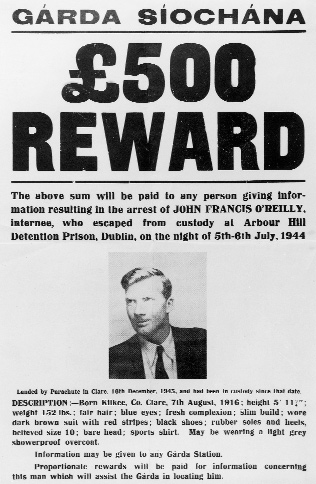
One of the features in the picture is George’s Head, the 100-foot cliff rising up from the bay on the right.  It was off George’s Head that John Francis O’Reilly claimed to have ditched the wireless set provided by his German handlers of the Sicherheitsdienst (a/k/a/ “SD”) before turning himself in to the gardaí on the night of 16 December 1943.  O’Reilly parachuted (out of a Heinkel He 111 or a Junkers JU-88 bomber) into Ireland a short distance from his parent’s home in Kilkee around 2 am and presented himself to the authorities later that evening after he learned the authorities were making inquiries.  His radio transmitter and £143 of the £300 the SD handed him were recovered in the yard of his parent’s house.  (See Terence O’Reilly’s book Hitler’s Irishmen and Anthony Kinsella’s article John Francis O’Reilly: The “Flighty Boy”).

Prior to his insertion as a German spy, O’Reilly read bulletins, poetry and other content on the Nazi’s Irland-Redacktion radio service aimed at spreading pro-German and anti-British propaganda to Irish audiences.  Given his quick arrest and subsequent military prison sentence, O’Reilly did not feed the Germans information on US and British army and navy activity in Northern Ireland as originally instructed. As for the Richard Harris statute, Harris won the Tivoli Cup for Racquets in Kilkee four years in a row (1948-51).

Another has a personal connection to the view:

I’ve tried in vain to find the location, but haven’t been successful.  The frustrating bit is the Royal National Lifeboat Institution (RNLI) lifeguard station in the picture – I thought that would help.

As an aside, I live in NYC and I am married to a Londoner.  A few months before I met my (now) wife, her mother passed away. That I didn’t get the chance to meet my wife’s mother is my great loss – by every account she was an amazing and loving person and inspired all who knew her. She was also a supporter of good works, including the RNLI. And as a tribute to this amazing woman, I make a donation to the RNLI in her memory every year on the anniversary of her death.

This Irish Dishhead is very familiar with the area:

Total time to recognise this location: 0.05 seconds. But that’s hardly surprising as I’m from County Limerick, Ireland and most people from Limerick would be able to recognise Kilkee in less than a second. Kilkee, for most Limerick folk, is like a second home. During the summer months, Kilkee becomes Little Limerick for there is scarcely a family from Limerick that doesn’t have a relative who doesn’t own or rent a mobile home (caravan or trailer) or holiday home in Kilkee where they spend the majority of their summer holidays.

Personally, I’ve been going to Kilkee since before I can remember. When I was a kid, my parents used to rent a holiday home on the West End (the exact area isn’t actually captured n the photo but the white walls on the beech in the photo is an area where people play a hybrid of tennis/squash and our holiday home was just off the Dunlicky Road just behind that. It’s common for most Limerick people to leave work on a Friday evening and wish everyone well and tell them that you’ll see them on Monday, take the 70 minute trip down to Kilkee, get a bite to eat and head of to The Greyhound Bar or Fitzpatricks Pub or Scotts Bar (or any other Kilkee pub) and wind up having a drink with half of the people they’ve just wished a good weekend to at work.

Untitled1The Dunlicky Road is very well known in Kilkee and is one of the famous walking routes in the area. The walk takes you up the Dunlicky Road over towards Intrinsic Bay (not too far away from the Diving Boards) and finally over to the Pollack Holes. It’s considered one of the best natural cures for a hangover. The Pollack Holes are natural holes that have formed in the rocks that are covered by the Atlantic during high and for six months of the year, are a breeding ground for Atlantic Pollack, but during the summer months, when the tide is out, they are one of the most populated swimming spots in Kilkee. But they’re bloody freezing at the best of times! If anyone from the Dish ever decides to visit the area, I have one recommendation: bring a wetsuit! I Googled the Pollack Holes just to see what I’d get back and came across this photo of a brave man who evidently had no fear of the cold … Christ only knows how he survived.

Springsteen played a gig in Limerick last year in Thomond Park (home to the Munster Rugby Team – “G’Wan Munster!”). During his stay in Ireland, The Boss took a trip down to bossKilkee and stopped in Scotts Bar on the Main Street (properly known as O’Curry Street) in Kilkee and the photo went viral on Facebook and twitter for all Limerick people who were raging that they missed the opportunity to get locked (drunk) with The Boss in one of Kilkee’s better watering holes (another tip for anyone planning on visiting Kilkee – avoid Miles Creeks pub – kind of a rough crowd.) [Ed note: see reader update debunking this story at the bottom of the post.]

The window I found is different from the one in Google Maps, but that could be as a result of damage caused by a storm on February 12th of this year (subsequently nicknamed “Wild Wednesday”) that battered Kilkee and other locations on Ireland West Coast including Limerick City. The main bandstand in Kilkee was practically destroyed and quite a bit of damage was done to the promenade on Kilkee beach, but the local town council did a fantastic job of cleaning the area up and repairing the damage in time for the annual summer pilgrimage of Limerick residents to the area. I’m therefore assuming that the new looking wall and window were recently installed.

Another reader has a look at the damage from the storm:

Kilkee - Blue Flag

More on the town from one of several contestants who’s been there::

Kilkee is a Victorian seaside resort in Co.Clare in the west of Ireland that was hugely popular with Irish families in the sixties and seventies before cheap flights to Spain and Portugal took them to more reliable sunshine. The small round white building is the lifeguards’ hut on the Strand Line promenade.  The absence of a small flag from the roof indicates that they’re not in residence today, or not yet anyway. The shadows show the picture was taken in the morning. The hut is one of three round shelters that were originally built to cover fleeing beachgoers from the always imminent rain. The Strand Line seawall dates from Kilkee’s Victorian heyday, when Kilkee was popular with English visitors. Charlotte Bronte visited on her honeymoon in 1854. The seawall wraps around a magnificent horseshoe-shaped beach:

418110

Sponsored Content: The Irish Tourist Board has asked me to point out that the Kilkee/Loop Head area has some truly stunning Atlantic seascapes, less well known than the Cliffs of Moher in the same county, but not as tourist-infested:

doonaha3

Kilkee is also a major centre for safe and spectacular scuba diving. And here’s Kilkee’s beach on a recent summer’s day, just as I remember it in the ’70s.  Note the cloud shadow:

x_large

Speaking of shadows, Chini admits that even he suffers from routine bouts of contest terror:

After this much time and experience, you’d think it would go away; that terrifying feeling every time a new one pops up. That a sort of confidence would have developed. But no, it’s always the same. The mad desire to look around, that growing, gnawing sense of imminent failure, and the voice in the back of the head whispering “…you may never get this one.” Then, from nowhere, a sudden insight and a realization that there was nothing to worry about at all:

VFYW Kilkee Overhead Marked - Copy

This week’s winner is a four-year-veteran who hails from our esteemed list of players who have guessed difficult contests in the past but never won:

This view shows us a day at the beach in Kilkee, a resort town in County Clare, Ireland.  The double yellow lines next to the curb suggested we were somewhere in the British Isles.  My gut told me this was probably a seaside town in Ireland, but I ignored my gut and went on an extended detour through the beaches of the United Kingdom.  Bad call.

When that didn’t work, I went down a list of beaches in Ireland and found the beach in Kilkee.  The view was taken from a one-story home on the Strand Line, a scenic street that runs parallel to the beach.

VFYW Kilkee

Kilkee has a number of claims to fame, one of which is that the actor Richard Harris used to summer there.  The town honored him with a statue of him playing squash, which was unveiled by Harris’ family and Russell Crowe.  Also, the sea wall in the background used to host (improbably) a 20-foot mural with the iconic image of Che Guevara, which would’ve been just out of view to the left had it not been painted over last year.  Guevara spent a night in Kilkee and was recognized there by the artist Jim Fitzpatrick, who went on to create the famous image.  The mural was painted over after it upset some Americans who saw it and apparently left town in protest.  It’s fair to say that either the statue or the now-departed mural would’ve made memorable clues.

Congrats on a long-deserved victory. For everyone else, get ready for the next view Saturday!


Update from an Irish reader:

We have a “Bruce Springsteen in Kilkee” controversy! Your reader was duped by a photo supposedly showing Bruce Springsteenboss-orig outside Scott’s bar in the town. This was Photoshopped. The real picture took place in New Jersey. It’s very obvious when you compare pictures which one is real. Your reader is not alone in these parts to believe Bruce visited Kilkee while he played a concert in Limerick last summer, but unfortunately there is no evidence he was ever in Kilkee.

Update from a Californian reader:

The first guess of San Quentin Prison made me laugh out loud. I had noticed the similarity as well. In case you are not familiar with that view, here’s a photo I took recently from the Corte Madera Ecological Reserve looking toward San Quentin and the Richmond-San Rafael Bridge. It’s almost like a Kilkee parallel universe:

IMG_0163

(Archive: Text|Gallery)

Animal Skyways, Ctd

Andrew D. Blechman notes a collaboration between the Montana Department of Transportation and the Confederated Salish and Kootenai Tribes that “led to the creation of the most progressive and extensive wildlife-oriented road design program in the country”:

The 56-mile segment of Highway 93 now contains 41 fish and wildlife underpasses and overpasses, as well as other protective measures to avoid fatalities. As creatures become accustomed to the crossings, usage is increasing—at last count, the number was in the tens of thousands. Motion cameras have captured does teaching their young to run back and forth through the crossings, much like human mothers teach their children to safely cross a street.

Wildlife crossing structures are such a smart idea that it’s difficult to understand why they’re still a rarity in this country. But by insisting on rebuilding highway infrastructure to address the needs of wildlife, the Salish and Kootenai tribes have led the way toward a greater sensitivity to fragmented habitats. Highway departments around the country are now studying their example.

Update from a reader, who points to a “pretty extraordinary photo sequence”:

Loved that photograph of the animal high-line. I’m sure I am not your only Florida reader who will bring this up, but we’ve been helping our beleaguered Florida panthers cross the road for decades now. Back in the 1980s, the National Wildlife Federation teamed up with panther advocates to file suit against the DOT to do something to stop the carnage on I-75 (the main artery connecting Florida’s coasts that bisects the panther’s habitat).  The DOT eventually added 23 crossings, which by all accounts, has at least slowed this beautiful animal’s extinction. (Numbers are sketchy but there are less than 200 left). Here’s a photo of a panther making a safe crossing that I found in the Naples Daily News:

unnamed (12)

Pretty extraordinary photo sequence because Florida panthers are notoriously shy and rarely photographed in the wild.

Another reader:

The thread just made me think of this West Wing classic for a Wolves Only Roadway!

Previous Dish on a similar highway in Canada here.

Ebola Reaches NYC, Ctd

Noam Scheiber contends that NYC officials clearly lied when insisting “Dr. Spencer acted entirely appropriately and responsibly”:

Despite the fact that Dr. Spencer presented a miniscule risk to anyone around him when he decided to ride the subway, go bowling, and frolic at the High Line Park on Wednesday, he obviously should not have been out and about. His decision to do those things forced the city to shut down and extensively clean the bowling alley in question and dispatch its “medical detectives” all over the city to figure out whom he may have come into contact with. Spencer’s wanderings probably also put a crimp in all the retail establishments along his Wednesday route. And they have generally required the city to manage the suddenly tormented psyches of millions of New Yorkers. It doesn’t seem like asking a guy to hang out in his apartment for a few weeks would have been too much to ask in order to avoid this mess. (On top of which, it’s become our policy in this country to quarantine anyone who had direct contact with an Ebola patient, as Dr. Spencer did repeatedly. Why should someone be exempt from this rule just because the contact happened outside the country?)

So, as I say, we were some lies told last night.

But, he admits, “I kinda think Cuomo et al were right to lie”:

[P]ublicly calling out Dr. Spencer for his failure to self-quarantine could have turned into its own minor disaster. Cuomo, de Blasio, and Bassett were generally pretty effective: They correctly assured people that it’s very difficult to contract Ebola, that all the relevant protocols were followed once Dr. Spencer came forward with his symptoms, that the city had thoroughly war-gamed this scenario. Had they taken the additional step of criticizing Spencer for not isolating himself beforehand, you can imagine that dominating the headlines, drowning out most of what they said, and generally contributing to the very panic they were trying to defuse.

Sarah Kliff, on the other hand, defends Spencer:

Doctors Without Borders has a five-point procedure for doctors returning from West Africa, to monitor for signs of Ebola.

guidelines

There is no evidence that Spencer failed to follow these guidelines. Nor is there evidence that requiring doctors to quarantine for three weeks, if they are non-symptomatic, would do anything to stop the disease’s spread. “It’s completely unnecessary,” says Harvard University’s Ashish Jha, who has been studying the outbreak. “I’m a believer in an abundance of caution but I’m not a believer of an abundance of idiocy.”

Tell that to Jason Koebler, who visited the same bowling ally as Spencer on Wednesday night:

I know how Ebola is spread. I’ve spent lots of time writing about it and researching it and on calls with the Centers for Disease Control and watching press conferences and interviewing doctors. I know I don’t have Ebola. And still, all I could think about was whether or not I had touched or even seen this guy—only part of it being morbid curiosity. Maybe that’s the power of this thing. I’m a (relatively) rational and highly informed person (on this issue), and still I’d be lying if I said I wasn’t at least a little bit worried.

A reader lays into Spencer:

Why is it that some in the media and public health circles are calling Dr. Craig Spencer a “hero” and celebrating his “brave mission”?  MSF [Médecins Sans Frontières] is an amazing organization that does incredible work – but it doesn’t follow that everyone who volunteers for MSF workers is a hero. And we shouldn’t assume that doing good work is always driven by some deep self-less, altruistic, humanitarian motive. Being an MSF volunteer doesn’t make someone Mother Theresa.

Spencer is a physician, who after spending a month volunteering for MSF in Guinea treating Ebola patients then traipsed around New York City. He used public transportation after the outcry and panic at nurse Amber Vinson’s airline flights. (Vinson, by the way, had called the CDC to get permission for her flights.) He went out to a restaurant/bowling alley/dance floor after the very public backlash against ABC Medical Correspondent Nancy Snyderman for leaving the house and sitting in a car while her companion picked up some takeout. (Snyderman never treated any patients for Ebola.)

Maybe he justified this because he had always been careful when treating patients and knew he was not going to get Ebola. Maybe he justified it because he knew that he couldn’t transmit the virus until he was symptomatic. Maybe he thought no one would know. Whatever his justification was really doesn’t matter; at the end of the day, he simply didn’t think the rules applied to him, so he didn’t follow a 21-day quarantine. And he got Ebola.

The result of his hubris is going to be a public health crisis – not rampant Ebola infection, but already overcrowded emergency rooms and doctors offices overrun by nervous A-train commuters who have come down with a fever. A medical professional who incites a public health crisis isn’t a hero; he’s an arrogant narcissist. The kind of narcissist who posts a smug picture on Facebook wearing protective clothing to humble-brag his forthcoming humanitarian trip to West Africa masked as a plea to support MSF.

I hope he gets better, but I’m not going to celebrate his bravery or heroism.

Update from a reader:

The guy risked his life to volunteer for MSF. He willfully chose to expose himself to danger in order to ease the suffering of others. What’s happening now shows how real and serious the danger was. And as a doctor, he knew exactly what was he risking. If that doesn’t make him a hero, what would? We should all pray for him.

One word from a critic jumped out at me: frolic. He was frolicking on the High Line. Like, c’mon dude, try to butch it up a bit.

I ride around on the trains to read. It’s strange, but it’s what I do. I was on the A train on Wednesday night. I rode it to Lefferts Blvd, then back up to 207th st, and then down to 42nd street. So I spent a lot of time on the A train on Wednesday night. It’s a good train for reading, because it runs for a long time and it’s not too crowded.

I don’t think I’m going to get Ebola. Instead, I think: the odds of my getting Ebola are close to zero. But it would be truly awful to die because I wanted to read Robopocalypse. If I do die I hope my family will lie for me. “He just loved Joseph Roth, he talked about him all the time. And now he’s dead because that selfish doctor just had to go out frolicking.”

The End Of Gamer Culture?

timthumb.php

Many readers have warned me not to dip a toe into the gamergate debate, which, so far, we’ve been covering through aggregation and reader-input. And I’m not going to dive headlong into an extremely complex series of events, which have generated huge amounts of intense emotion on all sides, in a gamer culture which Dish readers know far, far better than I. But part of my job is to write and think about burning current web discussions – and add maybe two cents, even as an outsider.

So let me make a few limited points. The tactics of harassment, threats of violence, foul misogyny, and stalking have absolutely no legitimate place in any discourse. Having read about what has happened to several women, who have merely dared to exercise their First Amendment rights, I can only say it’s been one of those rare stories that still has the capacity to shock me. I know it isn’t fair to tarnish an entire tendency with this kind of extremism, but the fact that this tactic seemed to be the first thing that some gamergate advocates deployed should send off some red flashing lights as to the culture it is defending.

Second, there’s a missing piece of logic, so far as I have managed to discern, in the gamergate campaign. The argument seems to be that some feminists are attempting to police or control a hyper-male culture of violence, speed, competition and boobage. And in so far as that might be the case, my sympathies do indeed lie with the gamers. The creeping misandry in a lot of current debates – see “Affirmative Consent” and “Check Your Privilege” – and the easy prejudices that define white and male and young as suspect identities (because sexism!) rightly offend many men (and women).

There’s an atmosphere in which it has somehow become problematic to have a classic white, straight male identity, and a lot that goes with it. I’m not really a part of that general culture – indifferent to boobage, as I am, and bored by violence. But I don’t see why it cannot have a place in the world. I believe in the flourishing of all sorts of cultures and subcultures and have long been repulsed by the nannies and busybodies who want to police them – whether from the social right or the feminist left.

But – and here’s where the logic escapes me – if the core gamers really do dominate the market for these games, why do they think the market will stop catering to them? The great (and not-so-great) thing about markets is that they are indifferent to content as such. If “hardcore gamers” skew 7 -1 male, and if corporations want to make lots of money, then this strain of the culture is hardly under threat. It may be supplemented by lots of other, newer varieties, but it won’t die. Will it be diluted? Almost certainly. Does that feel like an assault for a group of people whose identity is deeply bound up in this culture? Absolutely. Is it something anyone should really do anything about? Nah. Let a thousand variety of nerds and post-nerds bloom. And leave Kenny McCormick alone. This doesn’t have to be zero-sum.

The analogy a reader made this morning between the end of gamer culture and the end of gay culture was really helpful to me. I’ve written and blogged a lot about the end of gay culture; and I’ve always tried to present both sides of the argument. Yes, I wouldn’t trade our freedom for the closeted, marginalized past; at the same time, it’s impossible not to feel some regret at the close-knit, marginalized, very distinctive solidarity gays have lost as a group, and some affection for a world, built defiantly to defend itself against outsiders, that is dissipating before our eyes and on our apps. I’m for integration and against identity politics. But do I miss what, say, leather bars once were – and feel very conflicted now that bachelorette parties come and go as they please in some of them? Do I harbor some traces of resentment at those who treat gay culture as some kind of straight playground, or at the mob of straight folks who will swamp any gay presence at next week’s once-very gay high heel race in Dupont Circle? Guilty as charged.

And look, many gamers were the bullied in high school; this was their safe space; it was a place they could call home. They now feel it slipping away, and it has unhinged some and disconcerted many, as a lot of mainstream culture has heaped scorn and ridicule on them at the same time. And I’m sorry, but I feel some sympathy here. That sympathy has, alas, been swamped by revulsion at the rhetoric and tactics that have come to define this amorphous movement. I haven’t, to continue the analogy, gone stalking bachelorettes or yelling obscenities at them. I just sigh and move on. But these people do have a point; they have long been ostracized and marginalized; their defensiveness exists for a reason; and, in the last couple of months, they have also been the target of truly out-there dismissals and vitriolic abuse – often from other men, and often from those who were not bullied in high school at all.

Am I wrong to detect in this pile-on another round of bullying of these people, of treating them as scum, of dismissing anything they might have to say? Here are Gawker’s Sam Biddle’s tweets last week:

Just to make sure his point wasn’t lost, he then facetiously tweeted:

This was meant ironically, of course – a debating flourish. But the joke only works when you’re re-visiting those high school wars, only to dismiss the losers of them. It was a piece of condescending ridicule, designed to rub the losers’ faces in their own demise, from a prominent perch. Biddle is not alone. Here’s a now-infamous piece by Leigh Alexander:

‘Game culture’ as we know it is kind of embarrassing — it’s not even culture. It’s buying things, spackling over memes and in-jokes repeatedly, and it’s getting mad on the internet.

It’s young men queuing with plush mushroom hats and backpacks and jutting promo poster rolls. Queuing passionately for hours, at events around the world, to see the things that marketers want them to see. To find out whether they should buy things or not. They don’t know how to dress or behave… “Gamer” isn’t just a dated demographic label that most people increasingly prefer not to use. Gamers are over. That’s why they’re so mad.

These obtuse shitslingers, these wailing hyper-consumers, these childish internet-arguers — they are not my audience. They don’t have to be yours. There is no ‘side’ to be on, there is no ‘debate’ to be had.

This last meme – that these people are not even worthy of a hearing – is pretty endemic among the college-educated cool kids running online media operations. Here’s one Kyle Wagner:

What’s made [gamergate] effective, though, is that it’s exploited the same basic loophole in the system that generations of social reactionaries have: the press’s genuine and deep-seated belief that you gotta hear both sides…. Tomorrow’s Lee Atwater will work through sock puppets on IRC. Tomorrow’s Sister Souljah will get shouted down with rape threats. Tomorrow’s Tipper Gore will make an inexplicably popular YouTube video. Tomorrow’s Willie Horton ad will be an image macro, tomorrow’s Borking a doxing, tomorrow’s Moral Majority a loose coalition of DoSers and robo-petitioners and scat-GIF trolls—all of them working feverishly in service of the old idea that nothing should ever really change.

This is Deadspin’s spin on this. It’s pure vitriol, resting on an unspoken, hard left view of culture that is more disturbing because it presents itself as snark and analysis, rather than tired, easy agit-prop. It’s a classic piece that asks all the cool kids today to smear and dismiss all the bullied of yesterday – and give them one last shove into the locker. Gawker’s Joel Johnson actually cites the piece thus:

Gawker Media has been covering the often-confounding phenomenon of Gamergate in detail, and will keep on covering it.

That piece was not so much “covering the phenomenon” as viciously skewing it. And yes, its tone smacked of bullying and dismissal. When you’re telling people they don’t even deserve to be in a debate, and associate them with segregationists and every other entity good liberals have been taught to despise, “dismissive” is the least of it.

Look: whatever case the gamergate peeps have, they have botched it with their tactics. Those tactics have been repellent in every sense of the word. But bullying has occurred on both sides, and only one side was bullied before.

From my update, regarding that last sentence:

The two sides I am describing are the journalists whose work I was just criticizing and the gamergate supporters. Not the whole two sides of gamer culture; not men and women; just the journalists I’ve been citing, and the people they’ve been lambasting.

Vengeance Of The Nerds, Ctd

Readers won’t let go of the debate:

As Arthur Chu artfully pointed out, the basic dynamic of #GamerGate is no different than that of the Tea Party: white dudes angry about Those People encroaching on their turf. What #GGers lambast as the “corruption” of gaming journalism isn’t part of the creeping menace of sponsored content; it’s the default mode of operation. Gaming publications have always been willing and enthusiastic adjuncts of the industry PR machine. The field’s evolution is no different than any other kind of entertainment journalism – critical film, music, and sports coverage didn’t emerge until the 1960s. To this day, no major entertainment media outlet meets the journalistic standard #GamerGate purports to demand (see: ESPN and the NFL). Really, where’s the scandal?

The difference now, of course, is the existence of social media and how it enables new ways of lashing out. No one has more skill with the Internet’s tools of harassment and abuse than the stereotypical gamer. Pretending that violent threats against outspoken women – whose collective influence in gaming, I should point out, is minuscule at best – have nothing to do with #GamerGate is absurd.

Freddie responds to these readers at length:

The video game media, generally speaking, is garbage. … But here’s the thing, you guys: if video game journalism is garbage, then #gamergate is garbage from an Egyptian restaurant that’s been baking in the sun in July in a heatwave on a New York corner, complete with extra dog poop and infested with cockroaches that have names like Misogyny and Threats Against Women. However well-intentioned some members of #gamergate may be, and however much I may agree with some criticisms of the video game media, the grimy sexism and hideous threats that have been made in the name of #gamergate renders the whole “movement” totally unpalatable to me.

Yes, it is unfortunate to define any group by the actions of its worst members, and there are times in life, particularly when it comes to political struggles, that you have to hold your nose and align with people you can’t stand. But this isn’t one of those times, and too many people who complain about how #gamergate is discussed in the media refuse to be frank about how rife with ugliness the phenomenon is.

I mean, there’s even legitimate criticism of Anita Sarkeesian, such as her unpaid appropriation of other women’s artwork, which my friend Alex Layne of the brilliant site Not Your Mama’s Gamer discussed. That behavior bothers me. But in a world where Sarkeesian is subject to such insane, violent threats, my instinct is not to criticize her about intellectual property but build a bunker to defend her from attack.

That’s the thing about surrounding your movement with threats and misogyny: people who might be inclined to listen to you feel compelled to reject you out of hand. Whether through refusal or inability, the principled people who consider themselves part of #gamergate have failed to eject the sexist, threatening core of the movement, and for someone like me, that makes it impossible to take the whole enterprise as anything but ugly.

Laura Hudson adds:

While there are legitimate ethical concerns about games journalism, it’s telling that the movement remains laser-focused not on the ethically shady behavior of the multimillion-dollar gaming studios making the mainstream games they enjoy, but small, often impoverished independent creators and critics—and even within that subset, the targets are nearly exclusively women.

Jesse Singal pens a Reddit letter to all the Gamergate people trying to convince him the press has it all wrong:

So what is Gamergate “really” about? I think this is the sort of question a philosopher of language would tear apart and scatter the remnants of to the wind, because it lacks any real referent. You guys refuse to appoint a leader or write up a platform or really do any of the things real-life, adult “movements” do. I’d argue that there isn’t really any such thing as Gamergate, because any given manifestation of it can be torn down as, again, No True Gamergate by anyone who disagrees with that manifestation or views it as an inconvenient blight from an optics standpoint. And who gets to decide what is and isn’t True Gamergate? You can’t say you want a decentralized, anonymous movement and then disown the ugly parts that inevitably pop up as a result of that structure. Either everything is in, or everything is out.

Faced with this complete lack of clarity, all I or other journalists can do, then, is journalism: We ask the people in the movement what they stand for and then try to tease out what is real and what is PR. And every, every, every substantive conversation/forum/encounter I’ve had with folks from your movement has led me to believe that a large part of the reason for its existence is discomfort with what you see as the burgeoning influence of so-called social-justice warriors in the gaming world.

Update from a reader:

In case you missed it, Clickhole has the ultimate encapsulation of GamerGate ( … unless anyone in GamerGate disagrees with it).

Stalker Stories, Ctd

During this relatively slow news week, a reader draws our attention to “the latest thing blowing up (a small corner of) the Internet”:

Kathleen Hale, YA author and fiancée of Simon Rich (Frank Rich’s son) wrote this article about her experience with a nasty review on Goodreads of her non-yet-published book.  She became obsessed with the reviewer, who was also a book blogger.  Hale eventually discovered that the reviewer was operating under a false identity, stolen photos, made-up job, faked vacation photos, etc.  Against all advice, Hale decided to confront the reviewer, to find out why she had it in for her, going so far as to find her real name and address, pay for a background check on her, and go to her house.

What makes the story so interesting is the reaction to it. I don’t know if Hale thought she would get a sympathetic reaction to her confession, but she has instead set off a firestorm.

Her book now has hundreds of 1-star reviews on Goodreads, calling her a crazy stalker and vowing never to read any of her books.  The book bloggers are out in force, determined to destroy her.  No one cares that the reviewer faked her identity, equating what she did to J.K. Rowling using the Robert Galbraith pseudonym. Hale probably went too far, but I have tremendous sympathy for her frustration with having to sit back and silently take the mean-spirited reviews. (Goodreads strongly discourages authors from responding to reviews.)  But I cringed when I read her article, because I knew she was going to make things much much worse for herself.

Along similar lines to Kathleen Hale’s obsession with her bad reviews is this article by Margo Howard, the daughter of Ann Landers, lamenting the reviews of pre-publication copies of her book by members of the Amazon Vine community. Ms. Howard’s article displays a not-entirely-surprising lack of awareness of the real world.  I think her mother would have advised her to keep her mouth shut.

Writing requires thick skin, something that blogging out loud for years certainly gives you. Erin Gloria Ryan sounds off:

I sympathize with Hale’s feeling of helplessness in the face of what felt to her like people unfairly turning on her. And I’m sure most people who have ever written online understand the feeling of wanting to have a face-to-face conversation with a vitriolic critic. It’s that fantasy confrontation, where all of your stored l’esprit de l’escalier flows freely. I’ve even skimmed the Twitter feeds of professional and romantic rivals after a drink too many, an hour too late. I get that urge.

But you do not go to somebody’s house. You do not call somebody’s place of employment. You do not pose as a fact checker and demand personal information. You definitely don’t call a girl with an eating disorder fat while pouring hydrogen peroxide onto her head, and you do not run away laughing like a maniac after the fact. Hale’s thoughts are defensible; her actions are not.

About that, um, peroxide incident:

This weekend, a tipster sent us this piece Hale wrote for Thought Catalog two years ago, wherein she describes a chance run-in with Lori, a troubled girl with an eating disorder who had, years ago, accused Hale’s mother of sexual abuse. … A sympathetic judge let Hale off without punishment [after pouring the peroxide], but that didn’t stop her from doing what she referred to in her Guardian piece as “light stalking;” she says she followed Lori’s movements online. One day, she contacted her via AOL Instant Messenger, and within an hour, a police officer showed up to give her father a firm talking to about how his daughter shouldn’t stalk a girl she once assaulted.

Zooming out, Michelle Dean places Hale’s “nutso behavior” within a literary tradition of sorts:

Off the top of my head, I can think of the following nutty anecdotes […] of authors concerned that someone has been insufficiently admiring of their work:

1. Richard Ford spitting on Colson Whitehead at a party because Whitehead gave him a bad review;

2. Richard Ford (a theme emerges) sending a copy of Alice Hoffman’s book to Alice Hoffmanwith a bullet in it;

3. Norman Mailer and Gore Vidal literally butting heads before their famous fight on the Dick Cavett Show;

4. Robert Frost setting a fire at Archibald MacLeish’s reading because, I guess, he did not care for MacLeish’s poetry;

5. After Mary McCarthy said of Lillian Hellman, again on the Dick Cavett show, that, “every word she writes is a lie, including ‘and’ and ‘the,'” Hellman proceeded to sue everyone involved for over $2 million; and

6. About eighty different stories about Hemingway fighting with literary rivals.

Previous Dish on stalking here. Update from a reader:

This kind of thing isn’t limited to just authors; this story from a few years back involves a bookstore owner in San Francisco.

Epistemic Closure Watch

Media Polarization

Pew looks at how conservatives and liberals consume their news:

When it comes to getting news about politics and government, liberals and conservatives inhabit different worlds. There is little overlap in the news sources they turn to and trust. And whether discussing politics online or with friends, they are more likely than others to interact with like-minded individuals, according to a new Pew Research Center study.

John Avlon is distressed:

A few decades ago, politicians sent talking points to talk radio hosts. Today, talk radio hosts and online echo-chamber pundits send talking points to politicians. They keep their readers and listeners addicted to anger. The durable wisdom of the late, great Sen. Daniel Patrick Moynihan—“everyone is entitled to their own opinion, but not their own facts”—gets discarded when people come to political debates armed with their own facts.

Justin Elis’ take is more nuanced:

On their face, these findings might seem to lend support to the idea that we’re becoming a country of smaller and smaller filter bubbles, personalized universes of news and people that fit our own interests. But the connection between how Americans get news and their political polarization is not black and white.

Pew found that on Facebook, the majority of people only see political posts they agree with some of the time. That’s also reflected in the real world, as Pew found people on all ends of the political spectrum tend to get a mix of dissent and agreement on politics in their every day life. 58 percent of consistent liberals and 45 percent of consistent conservatives say they often get agreement and disagreement in their conversations on politics. For people with mixed political views — Pew’s middle ideological category — that jumps up to 76 percent.

Christopher Ingraham makes note of the least trusted outlets:

Overall, four of the top five least-trusted news outlets have a strong conservative lean: Limbaugh, Fox News, Glenn Beck and Sean Hannity. MSNBC rounds out the list. The most trusted news outlets, on the other hand, tend to be major TV networks: CNN, NBC News, ABC News, CBS News, with Fox at No. 5.

The Pew Study notes that “liberals, overall, trust a much larger mix of news outlets than others do. Of the 36 different outlets considered, 28 are more trusted than distrusted by consistent liberals.” By contrast, among conservatives “there are 24 sources that draw more distrust than trust.”

On the topic of distrust, Kilgore highlights a telling detail:

BuzzFeed has the dubious distinction of being more distrusted than trusted among every single ideological category. Pretty impressive for a relatively “young” site, eh?

Congrats, sponsored content. Update from a reader:

As a grad student who has studied polarization, the Pew study isn’t all that surprising (although it is very useful in confirming what many have long assumed.)  I think it may be time, however, to challenge a long-standing assertion of polarization studies.  As Bill Bishop has argued in The Big Sort, Americans seem to be increasingly segregating themselves along partisan/ideological lines.  Not only are our neighbors more likely than before to share our political views, but we also are probably consuming the same kinds of political news and cultural products.  This extends to Facebook as well.  Some people argue this creates an “echo chamber” that merely reinforces our political beliefs.  In other words, the more Fox News we listen to, the more conservative we become.

But I wonder if there isn’t an opposite effect going on as well.  The proliferation of media outlets also makes it easier for us to bump into dissenting views.  Unlike the 1950s-1980s, when there was one monopolistic media establishment that kept the heated rhetoric toned down, now there are many outlets, giving us all greater opportunity to encounter viewpoints that we find abhorrent and that we can’t believe others harbor.  Facebook didn’t so much create an echo chamber as expose us to the private opinions of people we previously assumed were “sane” in their opinions.  Consuming partisan news isn’t so much about finding the truth as it is like running for cover in a crazy world.

Another reader:

So according to that graph you posted, Liberals “are more likely to defriend someone on a social networking site because of politics”. Boy has this been true in my own experience (I’m about as far right politically as it’s possible to be). I have had significant disagreements with old and new friends alike on Facebook and Twitter over the past few years, and I have never once defriended anyone, and my conservative friends (at least the ones I’m closest to) have not done so either. But I most certainly have been told off and immediately defriended by some left-leaning friends over one relatively simple disagreement or the other.

Anecdotal yes, but I think it’s probably true in general that there is little room for disagreement allowed, and certainly less tolerance, for differing opinions on the left than on the right. Your graph and the source would seem to validate this as well. I assume that this comes from the self-righteousness and extreme confidence that modern progressives have that they are sole arbiters of truth and justice, with sole claim to the mantle of righteousness, much like they have (many times accurately) portrayed the right to be from days past. To me this point is beyond dispute: there is MUCH less tolerance for differing opinions and beliefs on the left than there is on the right today. The left is simply blind to the deep strains of religious bigotry of many in their ranks, if nothing else.

And another:

I think it’s probably worth noting that liberals are more likely to defriend conservatives over politics, but the chances are good that they weren’t very close friends in the first place (although you can find many laments over the end of long-term friendships on the left, often precipitated by relatively mild pushback and a stream of abuse in response). I’m from the Deep South originally, and of course everyone back there “knows” that Obama is a Muslim socialist, because between Fox and talk radio and right-wing churches and the NRA, that’s what all self-described respectable, well-informed people hear (plus, Democrats are the party of black people, who are widely seen as lazy, violent, and ignorant). I effectively defriended almost everyone there many years ago when I left; social media allowed for at-arms-length reconnections without my having to pretend that I had any interest in the ideology or institutions it was such a relief to leave.

FWIW, I just hide the crazies, and have been defriended a couple of times by conservatives (one a relative to whom I used to be close) even though I’m rarely aggressively political except in political fora or among like-minded acquaintances. The truth is that a) I don’t always want to know what people are thinking about important issues, and b) I do think less of political conservatives, because I consider it a mean, regressive, often self-serving inclination in practice. That’s why I left an area in which it is so unquestioned … and a state that uncoincidentally ranks at or near the bottom of every quality-of-life measure.

Vengeance Of The Nerds, Ctd

A few readers provide key counterpoints to the controversy:

Your latest post presents only one side of a very complex, many-sided argument and unfortunately perpetuates the narrative that #GamerGate is mostly a reactionary, misogynistic movement. Please understand that the vast majority of GamerGate is not misogynist. The vast majority of GamerGate does not think death threats are trivial. GamerGate is a movement that has embraced women, gays, trans-gender people of all political stripes and nationalities, worldwide.

GamerGate is many things, but it is largely a reaction against the huge amount of abuse that gamers have suffered over the years, culminating in a coordinated campaign by a dozen or so articles that appeared on numerous gaming news sites nearly simultaneously on August 28-29, proclaiming that gamers were dead, spear-headed by a piece on Gamasutra by Leigh Alexander, who called gamers:

These obtuse shitslingers, these wailing hyper-consumers, these childish internet-arguers – they are not my audience. They don’t have to be yours. There is no ‘side’ to be on, there is no ‘debate’ to be had.

Now is that any way to speak to a large number of your target audience? Most of the other articles weren’t quite as strident, but the mass coordinated nature of this campaign was not lost on many gamers. Understandably, being called “shitslingers” and “childish internet-arguer” upset many people. Hence GamerGate really took off.

It’s a horrible thing that Zoe Quinn, Anita Sarkeesian and Brianna Wu have received death threats. However, there is very little evidence that at least the threats against Sarkeesian and Wu have had anything to do with GamerGate. And yet, instead fingers were immediately pointed to GamerGate, in an appalling example of guilt-by-association. It is grossly unfair that a movement comprised of thousands of people worldwide is being tarred for the actions of the very few destructive people who just want to watch the world burn. That’s like blaming all Muslims for ISIS!

GamerGaters have been quite vigilant, often being the first and most vocal in calling out harassment as soon as they discover it online. This is a totally open movement. Anyone can do anything and claim that they did it on behalf of GamerGate. Even then, it’s abundantly clear to anyone who has actually talked to GamerGaters, that nearly all of us condemn harassment and welcome women into our movement. In order to counter this misrepresentation, the hashtag #NotYourShield was created in order to demonstrate just how diverse and inclusive the movement is.

Despite all this, GamerGate are being constantly insulted by others as “misogynerds,” “pissbabies,” “worse than ISIS” and god knows what else. Supporters of GamerGate have been given death threats, doxxed, lost their jobs and God knows what else. Yet none of that has gotten any exposure in the mainstream media.

The abuse received by people for the mere mention that they support GamerGate has been so bad that it has caused more than a few people who initially positioned themselves as anti-GG to realize that GamerGaters are on the whole good people who condemn harassment and just want to be able to enjoy video games without being constantly told by self-appointed social activists that their hobby is awful, degenerate, and they should be shamed. It’s part of a larger movement that has been touched upon by you in the past. Just listen to the voices of women here and here who received far more harassment from those opposed to GamerGate than from GamerGate itself.

There’s much much more that I can get into. But I’m just a nobody. GamerGate has been covered more fairly by conscientious, articulate people like these, both supporting and neutral to GG:

https://twitter.com/oliverbcampbell
https://twitter.com/erikkain
https://twitter.com/Totalbiscuit
https://twitter.com/Boogie2988
https://twitter.com/georgieonthego
https://twitter.com/mundanematt

There are many more. Please contact them and listen to their voices. Fairness is important.

Another reader details another major part of the story:

I was surprised to see that your take on #Gamergate ignored its central issue, chiefly because it’s one of your own pet issues – corruption in the media. And by “corruption,” I mean the press acting as a form of PR and not as a source for news. Gamers are upset because it seems, and has seemed for a while now, that the press is no longer interested in talking to them. Leigh Alexander’s piece declaring gamers to be “dead” (alongside a slew of other insults) was just the purest expression of that trend.

But make no mistake: these accusations of misogyny are deflections meant to shift focus (successfully, so far) from their own wrongdoing.

Take, for instance, Jeff Gerstmann, who was fired from GameSpot in 2007 after rating a game as “fair.” The game publisher, Eidos Interactive, pressured the GameSpot to fire Gerstmann, and GameSpot complied. Take also the review of Aliens: Colonial Marines, produced by Gearbox Software, which the press lavished with praise after being shown a “demo” that, in truth, represented nothing contained in the actual game. Or take the latest scandal, wherein WB Games offered review copies of Shadow of Mordor under the condition that the resultant review praise and advertise the product.

The gaming press is too busy begging for the developers’ scraps to care whether or not their readership gets taken for a ride. And in a $93 billion industry, that ride can be quite expensive.

Which leads us to #Gamergate, a scandal that sprang to life after evidence emerged that Zoe Quinn, an indie developer, had leveraged her inappropriate relationship with the press to boost her profile, including shutting down a rival feminist charity (one #Gamergate would later help get back on its feet). Rather than report on these relationships (as they had Brad Wardell and Max Temkin), the press went silent. This, naturally, prompted further digging, which revealed the gaming industry’s very own Journolist, wherein certain members of this press pushed predefined narratives.

Outraged at having been lied to, silenced and manipulated, gamers revolted. #Gamergate. This revolt won’t end by calling gamers misogynists. They’re not. No, this will only end when the press debrides itself of the notion that it reports to anyone other than its consumers. It’s time they stopped lecturing gamers, and started helping them find a fun game on which to spend their hard-earned money.

Another zooms out:

I think the actual point is completely missed by everyone there. It would not have been missed if people didn’t stereotype and objectify nerds as much as they accuse them of stereotyping and objectifying women.

The point is, nerds never wanted to “win”. The ascendancy of their subculture is a horrifying development for most of them. They grew up being marginalized by the in-crowd. They found interests and a common ground with the rest of the persecuted non-alpha class and they were relieved to never again have to be bullied around and to find a social subculture in which they could express themselves freely and, shockingly, even become admired by their peers. Like, really admired. Socially admired, not just admired by their parents and upstanding grown-ups in their community after receiving another scholarship or citizenship award.

And now here come the alphas to take this from them, as well as their eighth grade lunch money. They aren’t undermining themselves; they are sabotaging the movement. I see so many people throwing their hands up and wondering why these guys are behaving so beastly, and if you take five minutes and realize how they got where they are, then you could see where they’re going.

The nerds want the women to go away, because when the women go away, so will the alpha males. High school never ends, not really. Alpha males hate everything new or different, but they learn to feign interest in things that women are drawn to. And so now you have these massive audiences for comic book movies and video games, because women started liking these subjects and the alphas are following along. The producers of this content know that to keep those big audiences spending, they need to lower the sophistication to a level that the casual, obtuse consumer will like. The women will still prefer the alphas to the nerds, no matter what the nerds do, and the nerds know this. They don’t have the tools for the game the way that the alphas do.

Now here is the perfect storm. Everything they like is overrun by women who don’t really want to engage with them and want to see the subculture change to be more appealing to them (and this is where things like feminist critiques of video games drive them even more bonkers). The women are followed by alpha males, who the nerds revile and who will try to seize control everywhere they can, like alphas do. The quiet living room of the nerd has become the scene of a giant house party hosted by the cast of Jersey Shore. Oh, and that’s about to be the level of sophistication coming across in comic books and movies now that there’s billions of dollars to be made by appealing to the lowest common denominator.

Now I don’t sympathize with anyone who engages in death threats or who expresses anti-feminist ideals, or who essentially falls under the sway of their worst fears rather than their highest hopes. But I also gotta say, just because you’re paranoid, doesn’t mean they’re not after you.

So I’m not saying you need to sympathize with these people or ally with them or approve of the obscene ends that some of them go to. But you will never, ever, understand nerd behavior if you think that they are exultant at the new attention on their subculture, and that all this misogyny and anti-social behavior is just exactly what your objectifying, stereotypical model of them says that it is. They are not struggling to express themselves and grappling with zero-IQ social intelligence. They aren’t fumbling their way through their moment in the spotlight because they don’t know how to behave. I know that’s what everyone has been raised to believe about them, and it sure looks like it’s what they’re doing. But the fact is, all this acting out and hostility isn’t awkwardness and it isn’t a dominance play. It’s a simple message to the newcomers: get. the. fuck. out.

Another touches on something we were suggesting with the choice of tweet-image above:

Wow. That third reader doesn’t so much zoom out as much as he spaces out. Apparently there are no female nerds, and the only defining characteristic of nerd-dom is being a social outcast. Really? I thought it was liking scifi and being socially inept was an unfortunate side effect of spending so much time reading as a kid (maybe that was just me?).

And the whole idea that the “sophistication” of some monolithic nerd culture is going to suffer is ridiculous. You know what is happening? They are making more geeky, nerdy things – from movies to comic books to novels. Sure, some will be less sophisticated. Some will be more. Some will not appeal to your tastes and so what, go read or watch something that does, there’s a ton of it. I personally find the idea of Depression Quest ridiculous; it seems more like a psych class than a game to me, but if enough people want to play it to make that kind of genre popular, it’s not like it’s hurting me.

I’m a female gamer, though I admit I haven’t been following the GamerGate nonsense closely. Mostly because yes, there is as much misogyny in gaming as in the rest of life, and yes, video-game review sites have been useless for a long time now. It would be nice if neither of these things were true, but you know what? I play video games to relax, and stressing about that shit isn’t relaxing at all. If sexism in a game bothers me, I stop playing it. If I’m looking for a new game to play, I’ll look at one or two blog reviews and then download it and try it (if the game doesn’t have a trial version, there are plenty of others that do, so, move on to the next one).

The whole death threats thing is ridiculous and people need to realize that’s not ok, but I feel like summing this all up as a message to “get the fuck out” is unhelpful. Not just from a putting the genie back in the bottle perspective, but the vast majority of nerds aren’t issuing death threats. Only a handful of whack-jobs are.

Another gets the last word:

Oh Jesus Christ, can we just let this thing peter out as it should? Honestly, I already have four kids and I have to listen enough of he said/she said young love acquired, denied, lost and how it is the end of and most important thing in the world teen angst babble around the family dinner table. Do I also have to suffer through this at my favorite blog as well?

Sure, there are game developers out there who have an agenda against woman because they weren’t with the cool crowd in high school and carry that resentment into their apparently adult adolescent years. And yes, there are woman out there who detest game developers who seemingly objectify and reduce woman to sexual byproducts. Please, can we just let them go sling it out in their own high-school sophomoric fashion by posting nasty comments to each other on their blogs and the rest of us just move on and focus on more important things? Thank you.