Is Amazon A Monopoly? Ctd

Readers continue the thread on the mega-company:

As a measure of how Amazon is getting its fingers into an ever-widening area of retail, consider this: My Audi TT had a headlight go bad, which required replacing the entire headlight module.  Cost from a dealer? $1200. Cost from Amazon? $600.  (Directly from Amazon, not from a reseller.)

Car parts for a 12-year old, low volume model?  Wow.

A business professor writes:

Two key points about Amazon’s market position are being consistently missed, even in the business press:

1. While Amazon shows accounting net losses, they have generated net positive cash flows for the last three years running from $574 million up to $2.8 billion. Accounting income is largely a fiction these days, aimed as much at minimizing taxes as anything. The ability to generate a positive cash flow through creative means (including “innovative” financing) is what drives most really big businesses. A key part of this strategy is keeping accounting profit so low that competitors cannot fly this close to the ground without crashing.

2. Amazon, like Walmart who mastered the art before them, is a “penny scraper.” Sam Walton realized that if you scraped a few extra pennies per transaction out of suppliers, customers and employee pay, profit becomes irrelevant. Multiplied by millions of transactions daily, these pennies add up to billions of dollars over a single year if you are big enough.

Another focuses on books:

It’s hard to like Amazon.  Their size is genuinely troubling, and they treat many of their employees quite badly.  I’d rather work in a Walmart than an Amazon warehouse.  And it’s easy to love old school publishers, who champion great books, and so much of what’s best in our culture.

But the traditional publishers are doing a terrible job with ebooks.  There are publishers of tech books who do a great job with ebooks, who manage to distribute books without Amazon (even to Kindle owners), and who have found good ways to minimize piracy.  The traditional publishers can’t even copy those existing and proven business models.

The best example of a small publisher that gets ebooks right is probably the Pragmatic Press.  If I buy an ebook book from them, I can download epub, mobi, and pdf versions.  The files I download have my name all over them, which discourages me from pirating them.

They’re good at delivery. I have my Prag press account synced to my Dropbox, so the files appear there automatically.  When corrections are made (which happens often with geek books), updated versions appear automatically.  They also offer automatic delivery to Kindles via email, although I don’t use that.  I just copy the files to my device manually.

It’s really nice to have both PDFs and mobi files of tech books because sometimes the formatting is important it tech books.  This would be a huge advantage for other types of books too – poetry, for example, which has never worked well for me on Kindles.

When the Prag Press sells me a book, they get to keep all of the money.  And they have a relationship with me that they control, which lets them market to me directly.  They send me notifications of new books and discount codes.  This stuff works; I buy books in response to their emails several times a year.

I just bought an ebook as a text for a free online programming class, and I was really unhappy that I had to buy it through the Kindle system (the publisher is more traditional), not because I have a political axe to grind, but because it’s a worse experience.

Everyone who loves books wants literary publishers to succeed.  But they want to respond to ebooks by using some other company (Amazon) as if it were just another bookstore to sell their stuff.  It’s just not a viable approach.  They’ve outsourced their response to massive tech trends to Amazon, and they’re surprised that Amazon has set things up on favorable terms for Amazon.

And another counters many of the previous readers:

I’m glad there’s pushback against the notion that Amazon is a monopoly, but it needs to be mentioned that the fallback view, that Amazon is a monopsony, is also demonstrably false. What is the definition of a monopsony? As your readers say, its “a market form in which there is only one buyer for goods”. A monopsony means that sellers are forced to agree to the terms of the buyer, because there is no one else to sell to.

But the current dispute with Hachette proves that Amazon is not a monopsony, since Hachette is refusing to agree to Amazon‘s terms, and is instead insisting that Amazon agree to its terms. If Hachette had been forced to quickly give in to Amazon, that would serve to prove that Amazon is effectively a monopsony. That they aren’t even entertaining the notion of doing so, but willing to suffer whatever consequences come their way, demonstrates that Amazon can’t force its suppliers to accede to its demands.

And this isn’t the first time. In 2010, Amazon got in similar disputes with the Big 5 publishers, who were demanding agency pricing on ebooks, and guess who was forced to give in to the other sides’ demands? Right again, it was Amazon who folded. Later the Justice Department sued and the courts agreed that those publishers, along with Apple, had engaged in an illegal collusion conspiracy to force Amazon to accept their demands. Again, more evidence that Amazon is not a monopsony, but strong evidence that the major publishers constitute a cartel-monopoly that can force even giant retailers like Amazon to accept their terms.

Following that lawsuit, the major publishers have been required to renegotiate their contracts with Amazon. They are allowed to demand agency pricing, but not to do so as collusion. And that’s exactly what Hachette is doing. They are from all accounts demanding agency pricing on ebooks, and not giving an inch, even when Amazonmakes things more difficult for buyers to order or ship Hachette books. Hachette is the smallest of the major publishers, but it seems reasonable to infer that they would not be taking this hard line unless they felt confident that they would be backed up by the others when it is their turn to negotiate new agreements with Amazon. If that is how it turns out, Amazon will likely be forced to concede to the big publisher’s demands. Which simply isn’t how a monopsony is supposed to work.

If one examines the publishing industry honestly, massive consolidation of publishers into a few major corporations has created an effective monopoly cartel that has successfully forced all the players in the market to accept its demands and pricing. And when it comes to authors, they have also created uniformly non-competitive standard author contracts that only the biggest selling writers are able to get around, which pay the same royalties and have the same highly restrictive provisions. That has made them an author’s monopsony, meaning that most authors have no choice but to sell their works on those same terms.

Only Amazon has created a means to break that cartel-monopsony, by allowing authors to self-publish through their Kindle Direct Publishing program (which has since been copied by Apple, Barnes and Noble, Smashwords, Kobo, and others). And that makes the major publishers and best-selling authors mumble vague threats about the end of literature and the demise of publishing. As if letting authors bypass the monopsony cartel on publishing that has been enjoyed by the major publishers for decades now is somehow a bad thing for writers.

It’s not that Amazon is some angel here, but their disruptive digital technologies have been proven to be a boon to authors and are helping to break up the monopolies and monopsonies of the publishing industry.

Update from another:

I can’t add much to the monopoly thread regarding Amazon, but you have to wonder if the actually sellers being lorded over by Amazon are very happy about not getting a fair shake online when it comes to being found when someone does a search for the products you sell and being absolutely squashed by Amazon’s ability to own the search results.

The Audi TT headlight is a good example. The actual seller/supplier not only sells that headlight for half the price and squat for profit, but then more than likely pays Amazon a percentage for that privilege. Amazon effectively controls their ability to make money. I’m sure there are some who would have no business, but when the profit margins are shit, and Amazon is potentially making more off the sale than they do, where’s the motivation? Where’s the fairness? You’re part of a mega-chain gang, just working to get through the day, but probably not getting ahead.

I used to buy bee pollen from a company in Arizona for $17 a pound. Search results came up with Amazon’s price as $10 per pound. This is a niche market, where that $7 of profit would make a huge difference. I used to buy directly from the supplier to be the nice guy. If you think about the labor and time invested in collecting and packaging bee pollen, not including the efforts of the bees of course, it makes you wonder how this outfit survives.

Amazon is probably great for the consumer, but they’ve effectively killed consumer loyalty when it comes to actually being loyal to a business and their business model. Buying their product from Amazon shows loyalty to the product, maybe. But wholly at the expense of the supplier.

I’m not sure Amazon has a monopoly, but certain they’ve created an unfair advantage. How can you compete with their pricing and stay in business. Amazon is the 1% and their vendors are victims while the business profit margin gap is widening.

One more:

Your reader wrote, “I’d rather work in a Walmart than an Amazon warehouse.” I don’t know if this person has experience working in either, but I tend to think “not,” because there is no comparison.

I just finished 6 weeks of working in an Amazon Warehouse in Tennessee near Nashville. The starting pay is $11.00, plus 50 cents an hour for working the night shift (6:30pm to 5:00am, four ten-hour shifts per week). About four weeks in, there was a big meeting where they announced our pay was going up 25 cents per hour based on a survey of similar businesses in the region.

This would NOT happen at Walmart. Walmart starts at minimum wage (the federal $7.25 here in Tennessee) and good luck actually working full time (they send you home before 40 hours to avoid paying full-time benefits).

I’m not going to lie and say that working in the warehouse was easy, or that the $11.75 per hour I was getting was great and working nights was awful. I quit as soon as I could. And yes, they monitor your production to the minute and require you to hit a certain rate (it depends on your job; mine, in the “Sort” department was one of the “better” jobs in the warehouse). But I met a lot of people who have worked there since it opened and liked it very much.

Most of the horror stories you hear are from seasonal temps who work there during the busiest, craziest time of the year, don’t get proper training and never have a chance to figure out what was going on. It may suck for them, but I was able to earn a basically living wage (supplementing my wife’s income) and sustain us until I found something better. I didn’t have to deal with shitty customers, the managers treated me fairly. I would have stayed there had I not gotten a significantly better-paid job that allows me to sleep normal hours.

(Full disclose: the Dish gets about 3 percent of its annual revenue from Amazon’s affiliate program, detailed here.)

Choosing Death

Meet terminally ill cancer patient Brittany Maynard:

Gene Robinson defends Maynard’s decision to end her life on November 1:

Many people would call this suicide, pure and simple. But life is much more complex, and the human spirit much more creative, than such a judgment would suggest. Perhaps more than anything, what people fear most—aside from the pain of a terminal illness—is the loss of control. Call it pride and the desire for autonomy over one’s life if you will, but to those who advocate for the right to end one’s life, it is the right to “die with dignity.” That’s what Brittany wants. I think she deserves that right. And I think it is a thoroughly moral choice.

Brittany Maynard is not mentally ill. She is not suffering from depression. No amount of therapy—whether psychological or physical—will change the fact that without intervention, she will die a horrible death. She seems to have worked through the “stages of dying” made famous by Dr. Elizabeth Kubler-Ross, and reached the final stage of accepting the fact of her imminent death.

J.D. Tuccille supports the Oregon law that allows Maynard to make this choice:

Well-spoken and obviously thoughtful, Brittany Maynard has literally become the poster child—and video child (see [above])—of the movement dedicated to expanding options available to people otherwise facing an unpleasant end. Specifically, this works out as the ability to seek medical assistance free of legal penalties for those who offer help. In Oregon, the Death with Dignity Act, enacted in 1997, “allows terminally-ill Oregonians to end their lives through the voluntary self-administration of lethal medications, expressly prescribed by a physician for that purpose.” Doctors participate only at their own choosing—they’re not compelled to help patients end their lives.

Which is to say, this is about the final choice that anybody can make, and freeing others to choose to offer assistance in achieving the chosen goal. That’s about as libertarian as it gets.

Ross Douthat reflects on why such laws haven’t become more widespread:

Many liberals seem considerably more uncomfortable with the idea of physician-assisted suicide than with other causes, from abortion to homosexuality, where claims about personal autonomy and liberty are at stake.

Conservatives oppose assisted suicide more fiercely, but it’s a persistent left-of-center discomfort, even among the most secular liberals, that’s really held the idea at bay. Indeed, on this issue you can find many liberal writers who sound like, well, social conservatives — who warn of the danger of a lives-not-worth-living mentality, acknowledge the ease with which ethical and legal slopes can slip, recognize the limits of “consent” alone as a standard for moral judgment.

Jazz Shaw appreciates the complexity, presenting views on both sides:

This is a subject which we’ve had to deal with in our family and one that I’ve personally debated for a long time. It’s not an easy question for many people, though the spiritual and social dilemmas surrounding it can lead to battles which come off as unseemly when dealing with a young person facing their own mortality. …

With or without government permission or medical help, many people are going to make this choice when faced with the ultimate question. They have to struggle with asking whether life is indeed so precious that a few more hours or days of it are worth the cost if that time is spent medicated beyond conscious activity while loved ones weep at their bedside. Those who determine that is is not and who can’t obtain competent medical advice will choose a gun in their mouth, a noose, a car “accident” or some cocktail of pills and alcohol which they cobble together themselves, often with disastrous results in failed attempts. So I’m not going to judge either Maynard or [fellow cancer patient Kara] Tippetts and can only hope that others will spare me such judgement should I wind up facing the same, awful decision point.

Harold Pollack finds that “the mass appeal of assisted suicide reflects an incredible failure of our health care system”:

We do not provide proper palliative care. As Atul Gawande relates in his beautiful new book Being Mortal, we do not reliably address people’s deepest needs when they face life-ending or life-altering illnesses of many kinds. We can do a better job of relieving people’s symptoms and protecting them from pain. We can protect families much more effectively against catastrophic medical expenses and hard caregiving burdens. We can work more effectively to ensure that every patient can make the most of their remaining days. We can more effectively promise that someone will die with dignity without the need to take precipitous measures while they still believe they can.

The Institute of Medicine’s recent report, Dying in America: Improving Quality and Honoring Individual Preferences Near the End of Life, provides many practical suggestions of how these challenges might be more effectively addressed. For example, Aetna expanded its hospice and palliative care benefit by allowing people to still receive curative therapies while enrolled in hospice, and by slightly relaxing its eligibility standards for hospice services.  Such “concurrent care” models allowing people to receive improved attention to quality of life issues and symptom relief, even as they might choose fairly aggressive treatment of a life-threatening or life-ending condition.

Recent Dish on end-of-life concerns here and here. Update from a reader:

My mother died from glioblastoma, the same brain cancer that is killing Maynard. It is as horrific a disease as one can imagine. My mother seemed to lose another piece of herself each day. So I can understand Maynard’s decision to end her life before the worst of the disease affects her.

But, when I brought in home hospice the last week of my mother’s life (and I so regret not doing it sooner), they told me they would treat any symptom that could possibly cause her discomfort. And they did. That week she did not suffer. Witnessing her natural death and caring for her was one of the most profound experiences oft life. It was not a burden; it was a gift and I will always have the comfort of knowing I did this for her.

I respect and understand Maynard’s decision but I urge anyone else considering assisted suicide to speak with hospice first and learn what they can do for you.

How To Explain The World

Funny or Die channels the post-college know-it-alls at Vox:

After spending the past few weeks reading these Wikipedia articles in all of my spare moments I feel dumber and more discouraged than I did before. Human societies are complicated and when assessing history it is all to easy to assign causation after the fact. But when it comes to really be able to draw any meaningful lessons about how to improve in the future, things are less certain. We seem to be doomed to repeat our mistakes for all time.

So, why is shit so fucked in the Middle East? Because humans live there and humans are really good at fucking shit up. Will shit be fucked forever? Probably. But maybe if we collectively take a breath and let the sins of our fathers and mothers be forgiven, we can change the eternal return of the same fucking shit [cue [Aimee Mann’s “Wise Up.”]]

Okay. Now time to go read some Wikipedia pages about something that doesn’t depress the fuck out of me. I think I’ll start with pallas’s cats.

Update from a reader:

I fear that search for a non-depressing subject by turning to Wikipedia’s article on Pallas’s cats will be undercut as soon as he reaches this sentence: “It is negatively affected by habitat degradation, prey base decline, and hunting, and has therefore been classified as Near Threatened by IUCN since 2002.”

Nobel Intentions

Joshua Keating thinks a certain peace prize needs a year off:

This year the [Nobel] prize committee could best serve its mission by giving the prize to the person who most deserves it: nobody. Such a move would highlight that this has been a particularly violent year around the world. More importantly, it would serve as an Dr. Francis Crick's Nobel Prize Medal on Heritage Auctions acknowledgment that the most notable eruptions of violence have been so grimly predictable, the result of years of individual and collective failures by governments and international institutions. … [I]t’s hard to find anyone deserving of a Peace Prize in 2014. The original purpose of the Nobel Peace Prize was to reward the person who “shall have done the most or the best work for fraternity between nations, the abolition or reduction of standing armies and for the holding and promotion of peace congresses.” And on that score, there was not much to report this year. The committee should follow the example of the Mo Ibrahim Prize for Achievement in African Leadership, the world’s most generous prize given to individuals, with an outlay of $5 million over 10 years plus $200,000 per annum after that. The prize has simply not been granted in three of the six years it has existed because no suitable candidates were found.

Noah Smith argues that the entire Nobel system is seriously flawed:

In addition to giving too much credit to too few people, the Nobels have the disadvantage of not being given postmortem. This means that great scientists from ages past, who were probably prevented from receiving the prize only because of sexism or racism, will remain Nobel-less forever. Examples include nuclear physicist Lise Meitner, mathematician Emmy Noether (whose work was hugely important to theoretical physics), and nuclear physicist Chien-Shiung Wu. Speaking of discrimination, another problem with the Nobels is that they are awarded almost exclusively by Swedish and Norwegian people. Just look at the committee that selects the physics prize. In the era when Europe ruled the world, the neutral countries of Scandinavia might have seemed like the ultimate honest brokers, but in today’s globalized world there is no good justification for such provinciality.

But Emily Badger notes one of the awards that went to a project with noble applications:

The Nobel Prize for physiology or medicine was given Monday morning to three scientists who’ve uncovered the “inner GPS” in our brains that helps us find our way through the world around us, identifying where we are, where we’ve been and how to get back there again. … The answers have some direct implications for how we understand diseases like Alzheimer’s that rob people of their spatial memory. But they also have some fascinating implications for perfectly healthy people, too, and for the way we design spaces — from individual buildings to neighborhoods and whole transportation networks — that we move through daily. While the first story is clearly the province of scientists and doctors, the second is very much of interest to urban planners, architects and cartographers.

And as Rachel Feltman points out, the physics Nobel went “to researchers whose findings you probably rely on just about every day (or, if you’re like me, just about every minute). The blue light-emitting diodes they helped create are taking over lightbulbs as we know them, but already see universal use in smartphone flashlights and displays.” Update from a reader:

Perhaps this year would be a good year for the Nobel Committee to not just refuse to award a new prize but to rescind the Nobel Peace Prize awarded to Barak Obama in 2009. I understand that there are several online petitions circulating urging the Nobel Committee to do just that.

Fighting Ebola On Multiple Fronts

hptm6ebnfpwdnxj1o5dy (1)

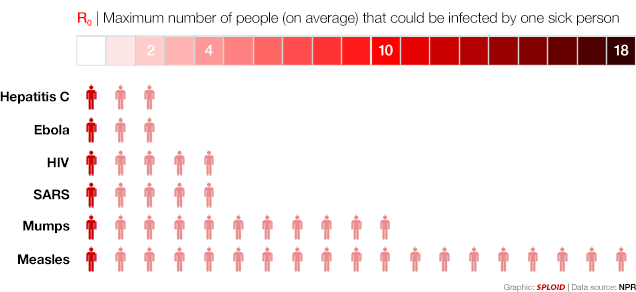
With cases in Texas and Spain raising alarms about potential Ebola outbreaks in the US and Europe, it’s worth remembering, as the above chart illustrates, how slowly the virus spreads relative to other contagious diseases, and therefore how unlikely a major outbreak is in a developed country with proper sanitation and extensive healthcare infrastructure. It’s also worth remembering that the situation in West Africa is, and will remain, far worse. In an interview with Julia Belluz, epidemiologist Lina Moses outlines why the number of Ebola cases there is probably underreported:

The cultural and socioeconomic setting have an impact on case counts. So do basic emotions. The chain of events for reporting cases has been interrupted by the fact that some Ebola victims go underground for fear of being taken away from their families. Imagine being the mother of a son who you think might have Ebola. You know your child might die, and you know that if you call authorities, he will most certainly die alone, far away from you, in an isolation ward where you can’t console him. Do you call that hot-line? “Communities are so afraid, so distrustful about what’s going on,” says Moses. “It’s hell. It’s devastating to the social fabric in communities, in towns and villages.”

This is compounded by denial about the disease. Though denial is less prevalent now, more than six months into the epidemic, for a period at the beginning — when Ebola emerged for the first time ever in West Africa — people just didn’t believe it was real.

Danny Vinik relays the scientific community’s worst fears:

[T]here’s a long-term concern, too, that Ebola will become endemic to West Africameaning it will be there forever with small outbreaks occurring frequently.

In September, the World Health Organization’s Ebola Response Team warned of such an outcome in the New England Journal of Medicine. “[W]e must therefore face the possibility that EVD (Ebola virus disease) will become endemic among the human population of West Africa, a prospect that has never previously been contemplated,” they wrote.

Many other health experts share their concerns. “That’s our biggest fearthat it will be endemic,” said Howard Markel, a medical historian at the University of Michigan. “That’s where you worry there will be little pockets of Ebola, whether in human beings or in bats or other animals, and that we’ll have little outbreaks or big outbreaks for years to come.”

Turning to the US, Laurie Garrett reiterates the need for a quick diagnostic test:

Such an assay would help quell the rising panic in the United States, prevent passage of laws that could be viewed as discriminatory against people of color and/or Africans, and provide nearly instantaneous hospital diagnosis. Rather than rattling the nerves of hundreds of Dallas parents afraid to return their children to classrooms visited by Duncan’s youngest contacts, public health officials could simply test the Duncan clan and assure the public that none are carrying Ebola.

Several tests are now in development, but the wheels of discovery, clinical testing, and federal approval require greasing. A point-of-care assay must be at the absolute top of the Ebola-control innovation agenda. Although compassion might dictate that the search for a treatment is of greater importance, the fact is that no tool — short of a 100 percent effective vaccine — can slow the spread of Ebola quite so dramatically. And though a vaccine may eventually emerge from the R&D process sometime in 2015, a rapid diagnostic could be in commercial production before Thanksgiving (with proper greasing of financial and regulatory wheels). Finger-prick tests for Ebola are in development now at Senova, a company in Weimar, Germany; at a small Colorado company called Corgenix; and at California-based Theranos.

And Jesse Singal touches on the challenges of fighting Ebola panic in the digital age:

Experts have actually known for a while that Ebola was going to show up in the U.S. Ever since the scope of the West African epidemic became clear, said [Columbia University epidemiologist Abdulrahman] El Sayed, American public-health officials have been hammering home the same message: “’There is gonna be an Ebola case here, but there’s probably not going to be a transmission.’” But before experts can effectively explain this, they first have to face down the biggest, scariest images of the disease lodged in the public’s imagination thanks to both fictionalized accounts and sensationalistic news coverage. “You have to address everybody’s worst fears before you can have a logical conversation about it,” said El-Sayed.

Update from a computational biologist:

That chart giving R0 values for various pathogens is kind of misleading, since it leaves off an important virus that most people are familiar with: influenza. R0 for influenza varies from around 1.0 to 2.4, i.e. right around the value for this Ebola outbreak. That doesn’t stop influenza from spreading everywhere pretty much every year and causing pandemics when novel strains appear. Ebola outbreaks can be brought under control because its transmission can be interrupted easily, not because its R0 is low.

Spare The Rod, Ctd

A reader writes:

The line from one of your readers about the need to break a child’s spirit made me weep.  It is the last thing any of us need as children.  Parents need to building up a child’s spirit to withstand the inevitable disappointments of adulthood.

On that note, another reader touches on the religious angle of corporal punishment:

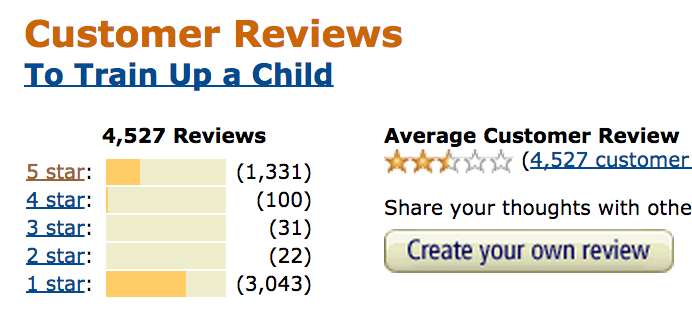
Screen Shot 2014-10-05 at 6.13.53 PMHave you seen this book, To Train A Child?  Apparently is it “christian” to start beating children with a rubber hose before (~12 months) they are capable of understanding of why they are being punished.  A “good christian” parent is supposed to break their children’s will and make them utterly obedient to them as they are obedient to god, all because of a line about “spare the rod, spoil the child.”  It is horrifying how many five-star reviews the book has.  Just reading them makes one wonder how this book can possibly be regarded as “christian” in anything other than a deranged sense of the word.

From a one-star review that cites several horrific passages:

This book has been linked to several cases of child abuse and the deaths of no less than 3 children.

I am the mama of 6 beautiful children – some homegrown, some who came to us from other countries – each of them precious. I firmly believe that each child comes to you a full person. It is my job as a mama to encourage their strong points and give them tools to help them overcome their weaker qualities. It is never, ever my job to decide who they are, to break their spirits or to teach them cruelty in their own homes. My kids range in age from 14-2 and each of them is a blessing. Each of them is different. Each of them needs something different from us regarding discipline. Love your kids. Get to know them. If you are a believer, ask God for guidance. And DON’T BUY THIS BOOK.

downloadSome excerpts: On p.65 co-author Debi Pearl whips the bare leg of a 15 month old she is babysitting, 10 separate times, for not playing with something she tells him to play with. After about ten acts of stubborn defiance, followed by ten switchings, he surrendered his will to one higher than himself. In rolling the wheel, he did what every accountable human being must do-he humbled himself before the “highest” and admitted that his interests are not paramount. After one begrudged roll, my wife turned to other chores

On p.59 they recommend spanking a 3 year old until he is “totally broken.” She then administers about ten slow, patient licks on his bare legs. He cries in pain. If he continues to show defiance by jerking around and defending himself, or by expressing anger, then she will wait a moment and again lecture him and again spank him. When it is obvious he is totally broken, she will hand him the rag and very calmly say, “Johnny, clean up your mess.” He should very contritely wipe up the water.

On p.79 they recommend switching a 7 month old for screaming. A seven-month-old boy had, upon failing to get his way, stiffened clenched his fists, bared his toothless gums and called down damnation on the whole place. At a time like that, the angry expression on a baby’s face can resemble that of one instigating a riot. The young mother, wanting to do the right thing, stood there in helpless consternation, apologetically shrugged her shoulders and said, “What can I do?” My incredulous nine-year-old whipped back, “Switch him.” The mother responded, “I can’t, he’s too little.” With the wisdom of a veteran who had been on the little end of the switch, my daughter answered, “If he is old enough to pitch a fit, he is old enough to be spanked.”

Lord have mercy.

Update from a reader:

I can’t stand to read this thread any longer. It is so painful to realize how I applied some the same practices described because my “church” taught me to. And, even after I left that church, my depression kept me in so much pain that I would lash out against my children’s infractions with those same tactics. I’m so very thankful that I got the treatment I needed for my depression before my children left the home, so I could show them the patient, kind, loving person who was entrapped in that depression.

So painful to read. So desperately necessary to be written.

New York Shitty, Ctd

A reader sends an ominous view from his East Village window yesterday morning:

unnamed (4)

Another New Yorker pounces on my recent snark over the subway:

Really, your pique about New York merely makes you look like an idiot. It’s like a bad breakup that you can’t get over. Well, try.

You would also have a stronger case if you didn’t live in a city where the Metro stations look like the set of a science fiction film about the dystopian future. Every time I’m there, I half expect someone to come running into the Dupont Circle station screaming, “Soylent Green is people!”

Several more dissenters have the floor:

I can’t believe I am writing once again to rail against your railing against NYC, but here I am. Yes, the subway is different from the London Underground. I found the tube-medium-zonedUnderground dizzyingly different when I first encountered it. But yes, it is cheap, and all the millions of people who ride it to school or work really appreciate it! One price takes you to wherever you want to go, no matter how far you have to go, unlike the Underground, which had me standing in front of the map longer than I wished, wondering which zone I will be in if I went here or there. But I just assumed it is just one of many different ways in which seeing the world teaches us to adapt and adjust. If I whined every time a city didn’t live up to my dream image of it, I would never leave my house!

You hate NYC, so you left. Good for you! But can you please remember that it is still home to many, many people and we don’t appreciate someone bashing it again and again, even after he has left, and even if we may actually agree with some of your opinions about it? Please give it a rest!

If I am so inclined, I can find faults with and rail against every city I have lived in or visited, but I accept that every city is what it is! Yes, NYC is a chaotic city; yes, it has all the faults of a giant sprawling city, and yes!, some people have bad experiences there, but tell me in which city all these things are not true!

And no, even in your own dramatic heart of hearts, you know that Lagos is not more civilized than NYC. Sorry for the rant, but your last jab at it actually made me think one more post like it will make me give up my subscription, despite the cool Dish t-shirts I’ve been sporting.

Another isn’t as threatening:

I’ve been a constant reader since, I don’t know, 2001. And I’m a subscriber, too. Maybe due to re-up right about now.  And I will.

I admire and appreciate so much about The Dish – up to and including your self-confessed hysteria sometimes. I mean – go for it. Leave the hand-wringing for the rest of us. Still, you threw me one that rankles tonight.

I’m sorry you hated New York City. That sucks. Lots of people hate it. I lived there from 1997 to 2003, and I was aware every day that there were so, so many people having a hard time of it. People getting just crushed. Or less dramatic than that, people getting worn down by the endless indignities. People in all corners of the economic tangle getting pummeled by this city. My partner at the time was one of them, even though it was she who insisted we move there. I didn’t want to. I didn’t give a shit about New York.

Until I got there. I fucking loved that city. And I had lived in so many places – in the U.S., Europe, Asia, Latin America. But somehow it felt like it was New York that blew my horizons open. Go figure.

I live in San Francisco now, and it’s a lovely town. But the rest of my life I’ll be hoping I get to move back to New York some day.  And every time I visit, I feel it instantly. Put me in the bustle of mid-town, the crush of a  subway, the off-kilter alleys below Houston, the tiny tangle of shelves at your neighborhood bodega – why do I love this shit? I don’t know. I have some ideas. But I don’t think you’d be interested in them.

I can say this. Even most of the people I know who have had a hard time in New York, who even hated New York, at least know what they still love about the place. You, on the other hand, left in a hurry and keep throwing shit over your shoulder at people who are dumb enough to imagine they like living there. A “cult”? Jesus, Andrew. Why the schoolyard insults? For a man of your age, experience, stature and maturity, it’s amazing how sometimes, you still just need to grow the fuck up.

Another circles back to the subway-underground showdown:

As a regular user of the subway in NYC and an occasional user in London, I can’t let yesterday’s shot at NYC signage and route complexity go unchallenged.  There are lots of things to hate about the NYC subway sytem, but I don’t think this is one of them.

In brief, both systems have to come up with a visual means to communicate that many of their lines fan out into branches at their distal ends.  If you board a train in the city center, you can ignore all this if your destination is in the center.  But if you’re headed for the distal fringes, you need to know which branch this train is going to follow.

New York does that by giving each branch a name (a number or letter) and grouping the related branches that share a common trunk by color. Within each color family, the routes may also be distinguished by whether they are all-stops locals or skip-stop expresses.

London names the whole group of lines the same, but you need to know London pretty well to know which train to board, since the only clue you will get is a sign on the train with a destination that the visitor has probably never heard of.  Do I really need to get on a train marked “Barking” to get to a spot only a few stations to the east?  Personally, I find the NYC system easier to remember. This system hardly applies in the rest of the US, since our transit systems are so underdeveloped that most rail lines elsewhere have few branches or none at all.

As for signage in London, could someone please explain to me why the Circle Line isn’t actually a circle, and why the direction of travel isn’t simply indicated as clockwise or counter clockwise?

Update from a reader, who might have our Email of the Day:

I’m so envious over all y’all fighting over subway systems … I wish we (Houston – 4th largest city in the US) had a mass transit system to bitch about.

But another reader demonstrates that I’m not alone:

I lived in NYC for two years before moving to London for the past three, and I have strong views on this subject. First, let me dismiss the comparative advantages of map designs outright. If you are visiting either city, and you don’t understand something, ask for help or spend an extra minute using your brain. Within a handful of journeys on either subway you probably know enough to navigate the system without a major blunder. If you don’t, it’s really your own fault. It’s a fucking subway map, not your tax return.

Second, living in London has opened my eyes to what an impact the subway system can have on your entire day-to-day experience. While some lines are better than others, the veins of the London Underground are an absolute marvel, humming along like a well-oiled machine. The average wait time is a few minutes at most. Even late in the evenings the reduction in service is marginal, adding one or two minutes on average. I am able to pick up the phone, agree to meet someone, and estimate with incredibly accuracy the time I will arrive.

The NYC subway? Not a chance. I had to take the 4/5/6 to and from work each day from lower Manhattan to Midtown, and I can’t even count the number of times I worked myself into an homicidal state pacing on the platform. During rush hour the range of wait times was anywhere from one to twenty minutes, and I am not joking. This incredibly important line under Lex was constantly behind schedule, or more likely, just under serviced. During the endless “waits” between stations, we’d be given cookie cutter updates that you knew were bullshit. I think this patronizing approach towards its ridership is the ultimate difference between the attitudes of the MTA and the Tfl.

New York City is a tough city, without a doubt, but it doesn’t help itself. The subway is a mess, and you don’t ever get the feeling anyone is trying to make it better. Can you imagine a New York City with the Underground beneath it? I’d move back tomorrow. I much prefer London in terms of the level of stress it requires from me. The apologists for the New York subway are either ignorant or not being objective.

Ebola Makes It To America

Ebola Quiz

As we noted yesterday, a man who flew from Liberia to Dallas has been diagnosed with Ebola. Kent Sepkowitz examines the precautions we’d taken:

The Dallas case is breaking some of our ironclad assumptions. The CDC has a well-considered algorithm that places those returning from the three endemic West Africa countries—Sierra Leone, Guinea, and Liberia—into a measure of extra vigilance if and only if the person has had exposure to a known case of Ebola. Per the press conference, the Dallas case had no such exposure. He was not a health-care worker treating patients, nor was he from a family battling active disease. Of course, more facts may emerge that contradict today’s story—but today’s facts, if they hold up, mean that yesterday’s assumptions are no longer correct. Liberia may indeed be enough of a hotbed of Ebola that anyone arriving from the area will need to be considered for extra vigilance.

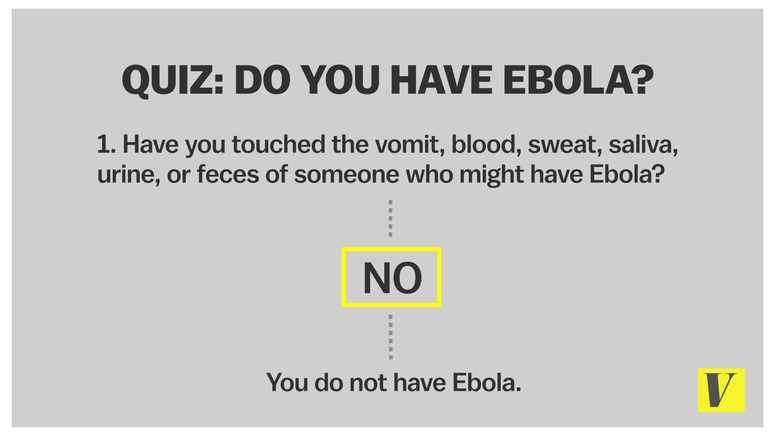
Ezra recommends calming down and taking the quiz seen above:

On average, Guinea spends $32 on health care per-person, per-year. Liberia spends $65. Nigeria spends $94. The United States spends $8,895.

That money buys trained health workers, disease investigators, isolation wards, fever screening, protective gear, and much more. That money buys advanced hospitals all across the country, and labs that can quickly test for the disease, and the ability to do contact tracing and follow-up visits on a tremendous scale. That money also buys public-health officials with long experience combatting infectious diseases — both here and in other countries.

Susannah Locke imagines best and worst case scenarios:

The best-case scenario for the United States is that a patient traveling from West Africa realizes that they might possibly have Ebola as soon as they start feeling sick. Everyone else makes sure not to come in contact with this person’s bodily fluids. And the outbreak ends with just one patient. Hopefully, that’s how this Texas case will end.

The worst-case scenario, meanwhile, is that an Ebola patient comes to America, is ill for days, and comes in contact with a lot of people before anyone realizes that something unusual is going on. That would be much worse. But even in that case, it’s still much less likely that Ebola will get farther one city or town. “I don’t think we’ll have a serious public health threat in any of the developed countries,” Osterholm told mein July. The real problems are for countries like Guinea, Liberia, and Sierra Leone that don’t have the resources to contain the outbreak quickly.

Margaret Hartmann explains the next steps in our response:

The challenge now is to find everyone the Dallas patient came into contact with and begin monitoring them as well. The “contact tracing” process is how Nigeria managed to eliminate its Ebola outbreak. After identifying one Ebola patient who arrived at the Lagos airport in July, Nigerian officials were able to find 72 people he might have infected. By tracing their contact, they found a pool of 894 people potentially infected with Ebola. Eight people died, including the first patient, but the rest have been cleared.

CDC director Thomas Frieden, like the White House, has urged Americans to stay calm. Abby Haglage summarizes his statement. An important part:

Asked how many people the patient came in contact with, Frieden estimated fewer than five. “Handful is the right characterization,” he said. “We know there were family members who came in contact, and there may be other community members, but we will cast the net wide.”

And Olga Khazan cracks open the history books:

At arrival gates, border protection officers keep their eyes peeled for passengers who show signs of fever, sweating, or vomiting. They also try to confiscate any monkey meat or other bushmeat that passengers might have in their luggage.

In some ways, our approach to keeping scary diseases outside of our borders hasn’t changed much since the Middle Ages. As Defense One‘s Patrick Tuckerexplained, when the Black Death was mowing down Europeans, the Doge of Venice instructed so-called “Guardians of Health” to board arriving ships and check the crew for inflamed lymph nodes. Those considered suspect weren’t permitted to dock for 40 days—quaranta giorni. Ever since, “quarantine” has been the way to keep newer plagues from spreading once they reach our shores.

Update from a reader:

You lauded the role HealthMap played in breaking the news of Ebola outbreak before WHO. From Kalev Leetaru’s article you highlighted: “Much of the coverage of HealthMap’s success has emphasized that its early warning came from using massive computing power to sift out early indicators from millions of social media posts and other informal media.” Unfortunately, that is not quite accurate. HealthMap is not quite a “success” here, as you can see from this Foreign Policy story.

The Natural Gas Hype, Ctd

A reader writes:

Good piece overall, but I want to point out this sentence: “Brooks Miner adds that ‘natural gas does have a dark side: It is composed primarily of methane, which has a much stronger climate-warming effect than carbon dioxide.'” That’s misleading without context. Methane is, indeed, a potent GHG. But it only has this impact if it is allowed to escape, unburned, directly to the atmosphere. If it is burned completely, it becomes CO2 and water like any other fuel. So the global warming impact of used methane is equal only to its carbon content (which is lower, per unit of energy, than petroleum). It is only leaked methane that has this “dark side” – and since we should be economically averse to wasting fuel through leakage anyway, it’s only a problem when something goes wrong.

The other thing to note is that leaked methane will only circulate for a few decades because it will naturally combust in the atmosphere and degrade to CO2. So while its immediate impact is high, it won’t have the same centuries-long effects as a commensurate amount of carbon emission.

Another goes into greater detail and more:

It’s worth clarifying that the reason we should be worried about natural gas‘ (methane’s) relative radiative forcing is not because of its use in combustion for power generation, but because of potential leaks. When combusted, it leads to fewer emissions per kilowatt-hour than coal. The study Leber quotes found there was no difference between assuming 0% and 3% leakage, so while this is not something we should totally ignore, it’s not likely to have a huge effect.

The item from The New Republic conflates a few different studies, and in my mind, makes the future for natural gas sound more dire than it really is. They cite this study in Environmental Research Letters to say people will increase their usage, and then the EIA chart which shows no decline in coal use.  But the finding in the study to which Leber points is much more nuanced.

First, they note that “across a range of climate policies, we find that abundant natural gas decreases use of both coal and renewable energy technologies in the future.” Leber focuses on the decreased renewables, but there is a reduction in the amount of coal used. This is worse than a future in which we go heavy on renewables, but better than a future in which we go heavy on coal.

More importantly, though, is the following from their abstract: “Without a climate policy, overall electricity use also increases as the gas supply increases.” The thrust of that article as I read it, rather than being simply pessimistic about natural gas future, is rather the importance of climate policy in achieving real gains.

And this is where it gets trickier. As the authors of the article note, “Some analysts have noted that natural gas may complement and support variable renewable energy technologies such as wind and solar by providing flexible back-up power that can ramp up quickly. The model we use, MARKAL, is not well-suited to evaluating the potential for this relationship because it does not represent the details of dispatch, unit commitment, and other short-term facets of grid operation.”

As the study that you posted about in July notes, one of the biggest problems that we have going forward is that “the technology we need to succeed may exist, but most of it hasn’t been proven to scale sufficiently.” To meet any sort of goals, we need to figure out a low-carbon baseload resource (nuclear, coal with carbon capture, something) and figure out a way to design the power system to cope with the challenges of high renewable penetration. As page XI in the deep decarbonization report reports, these technologies are still developing. A renewables-only future isn’t yet realistic… the question is, in the short- and long-term, how can we maintain the reliability of the electrical grid and promote the deployment of more renewable technologies while balancing with (very real) concerns concerns about the cost of doing so and continuing worldwide development. I think that natural gas, as part of a broader climate policy, has an important role to play in getting to that future.

By the way, discussion about the promise of solar wouldn’t be complete without a mention of this new energy storage project opened by SoCal Edison recently. These kind of projects will be hugely important for our ability to ramp up the amount of solar and / or wind in our electricity mix, whatever kinds of cost advancements are being made.

(Disclaimer: the US team for the Deep Decarbonization report was mostly my colleagues from my old job. So that provides some of the background from which I draw.)

Update from a reader:

Your reader said that methane leakage is only a problem “when something goes wrong” but studies show it is a large and constant problem with natural gas extraction:

Drilling operations at several natural gas wells in southwestern Pennsylvania released methane into the atmosphere at rates that were 100 to 1,000 times greater than federal regulators had estimated, new research shows.

Using a plane that was specially equipped to measure greenhouse gas emissions in the air, scientists found that drilling activities at seven well pads in the booming Marcellus shale formation emitted 34 grams of methane per second, on average. The Environmental Protection Agency has estimated that such drilling releases between 0.04 grams and 0.30 grams of methane per second. . . .

The researchers determined that the wells leaking the most methane were in the drilling phase, a period that has not been known for high emissions. Experts had thought that methane was more likely to be released during subsequent phases of production, including hydraulic fracturing, well completion or transport through pipelines.

Bill McKibben agrees: “Up to 5 percent of the methane probably leaks out before the gas is finally burned.” Importantly, the livestock industry is responsible for 37% of methane pollution. Anyone who cares about the environment should eat plants.

And another:

I’d like to add some observations about methane’s role as a greenhouse gas. Your post correctly notes that methane has a role as a greenhouse gas only if it is leaked prior to combustion. It’s even more restricted than than that. Its role depends heavily on where the leakage takes place. I suspect the amount of gas that actually ends up in the atmosphere as methane is wildly overestimated.

Methane is highly digestible. It is essentially snack food for a wide variety of bacteria, particularly soil bacteria. The vast majority of natural gas pipes are buried several feet underground, in environments where these bacteria are widespread. Gas leakage which occurs at a slow rate from subsurface piping is very likely to be metabolized by those bacteria (and thus converted to carbon dioxide) before it ever makes it to the ground surface.

There’s an analogy for this that’s widely known in the environmental cleanup business that I work in. Gasoline leakage from subsurface pipes and tanks is a widespread problem. Given the ubiquity of the problem, you would expect to find gasoline vapors (especially the more volatile constituents like benzene) infiltrating into buildings all over the place. But in practice, this infiltration is quite rare. Why? Because soil bacteris eat the vapor-phase benzene before it gets a chance to move up toward the ground surface. By comparison, methane is far easier for bacteria to digest than benzene is, so it is very likely that subsurface methane leaks are not a big issue.

App Of The Day

Claire Cain Miller has details:

Enter a San Francisco start-up called Shyp, which [expanded] to New York [yesterday]. For a small fee, it fetches, boxes and mails parcels for you. The other week, I had a get-well package to mail to my cousin. I opened the app, snapped a photo of the items I wanted to send and entered her address. Fifteen minutes later, someone was at my door — and that was it. No boxes, no tape, no weighing, no buying stamps, no standing in line. …

Technology has conditioned us to expect ease, efficiency and speed in almost everything we do. Once it came from sewing machines and dishwashers, later from Google and Kayak, and most recently from start-ups that provide on-demand services like Uber for cars, Instacart for groceries and Munchery for dinner. The post office, with its slow-moving lines and cumbersome packing supplies, offers exactly the opposite.

Update from a reader:

It is amazing to me that people know so little about Post Office services. You can pick up a box (or boxes); keep them at home; put the stuff you are sending in said box; go to USPS.com and click on “ship a package”. Fill out the info; print the label; pay the cost with a credit card or Paypal and either drop in a Post Office or give it to your carrier. You never have to leave home and the cost is the Post Office cost not an inflated app cost. I send all my packages this way. Maybe they should call it a “Post Office app” so people will use it!