Foodies Are Fools

The evidence mounts:

Paying $27 for a burger might seem extortionate. But the chefs behind the most expensive burger in Washington, D.C. – a wagyu skirt steak burger at BLT Steak – can take comfort in new research suggesting that inflated prices can translate into inflated enjoyment:

new paper, forthcoming in the Journal of Sensory Studies, has found that we enjoy food more if we spend extra money on it. A team of researchers at the Cornell Food and Brand Lab, led by David Just, carried out an experiment on 139 unwitting diners at an Italian restaurant in upstate New York. Customers were charged either $4 or $8 for an all-you-can-eat lunch buffet of pizza, salad, breadsticks, pasta, and soup; the researchers stopped them on their way out and asked them to fill out a short questionnaire on the amount they ate, the quality of the pizza, and their enjoyment of the whole experience. Diners who paid the higher price rated the whole lunch more highly, and judged the pizza more favorably on measures of taste, satisfaction and enjoyment. “The way people appreciate taste,” said Just, is tied into “expectations based on the presentation of the food or what other people have said. They interpret taste through that lens.”

Update from a reader:

I may be a foolish foodie, but the phenomenon Alice Robb describes is, I think, that of the Veblen Good, whereby the demand for (the conspicuous consumption of) a thing is driven by its price. That must surely be universal across any luxury category, so at least we foodists (my preferred term) are in good company.

“I’m Here So I Can Sleep At Night”

For those just tuning in, Fisher does a good job summarizing why Hong Kongers have taken to the streets:

Today, the territory’s chief executive Leung Chun-ying asked Occupy Central to disband the demonstrators, casting the disorder as a threat to public safety, but the protest leaders are demanding a face-to-face meeting with Leung and threatening to occupy government buildings if the demand is not met. Christopher Beam takes the pulse of the protest movement going into this week:

The conventional wisdom after the Sunday night clashes was that the movement had lost momentum. But my conversations with protestors on Monday suggested the opposite. Many of the people I spoke with didn’t come out until after the police cracked down. Henry Wong, 19, a student at Chinese University of Hong Kong, decided to join after seeing a live broadcast of students fighting with police. “I’m here so I can sleep at night,” he told me. Michelle Chan, 18, also said she was galvanized by the use of force: “Police don’t have to be that cruel.” Tony Wong, 24, said he was skipping work to come to the protest. I asked if his boss would be upset. “I can get another job,” he said. “I can’t get another Hong Kong.”

Ishaan Tharoor looks ahead:

The protests appear to be growing. Wednesday and Thursday mark a national holiday in China, and many expect what takes place on those days to define the current unrest. If the sit-ins and demonstrations continue with the intensity they’ve already shown, there’s a chance that local security forces could crack down more violently than they have so far, including perhaps using rubber bullets. That sort of violent response could be a disaster for Hong Kong’s government, which would face mounting pressure from the territory’s voluble civil society and media.

Julian Snelder fears the worst:

Twenty five years ago, we saw what happened when a threatened Beijing is backed into an existential confrontation. Today, China is a country with a triumphal sense of infallibility. It is so resolute and confident of its sovereign power that it can deliberately taunt large neighbors like Vietnam and India as a matter of routine. Hong Kong is a mere flyspeck by comparison, and a domestic concern at that. Of course, this is not June 1989, and Hong Kong is not the capital. But the protesters need to realize what they’re dealing with here: a state that will use lethal force if it deems it necessary. Then there’ll be real tears.

Update from a reader on the ground:

Julian Snelder says, “But the protesters need to realize what they’re dealing with here: a state that will use lethal force if it deems it necessary. Then there’ll be real tears.” I’m in Hong Kong. I’ve been at the demos. My students are out there every day. Barring small children, there is not one person who is not vividly aware of this possibility. Julian Snelder, whoever he is, is a patronising git. What gives him the right to assume that courageous people are stupid instead?

Adam Taylor explains why the umbrella has become a symbol of the protests:

Umbrella RevolutionProtesters used whatever they could get their hands on for protection: Some images even show people using plastic wrapping to cover themselves. The use of the umbrellas as protection was striking, however, and media outlets picked up on it, dubbing it the “Umbrella Revolution.”…

Some protesters painted messages on top of their umbrellas, and artists began incorporating umbrellas into logos designed for Occupy Central. “I was inspired by seeing people defend themselves with domestic props,” Hong Kong artist Kacey Wong told the BBC. “The contrast was so marked. On the one side there was police brutality and on the other side there were these poor umbrellas.”  According to the Associated Press, umbrellas are now being donated to replace those destroyed by the police.

Historian Jeffrey Wasserstrom feels that it’s “important to make space in our minds for partial victories”:

It’ll be very hard for the Communist Party to say “Okay, there will be open and free elections.” That’s unlikely to happen.

On the other hand, the protestors are calling, quite specifically, for the current chief executive of the territory to step down. That’s very thinkable: he would become a scapegoat for larger problems, but it would defuse some of the anger over the protests. And if even the person who replaced him had similar policy views, it would be a sign to that official that there would be a value in being more responsive to the people.

(Image from FP’s round up of viral Hong Kong graphics)

Is Baseball A Religion?

As October nears, George Will answers the question this way:

Part of the beauty of baseball, and sport generally, is that it doesn’t mean a damn thing. It’s valued for itself. Now, it can be the pursuit of excellence. dish_baseballprayer It is competition tamed and made civil by rules. It is aggression channeled in a wholesome direction. These are all virtues. They tiptoe up to the point and stop well short of giving baseball meaning. It’s a game. It’s a very pretty, demanding, and dangerous game.

I do think that baseball satisfies a longing in people, particularly urban people. There is a vestigial tribal impulse in all of us. For instance, when you get on the L and the cars begin to fill up with people wearing their Cub blue and you’re all going to the same place for the same reason, for about three hours a little community exists. It disperses after three hours, but it will come back tomorrow.

Daniel Patrick Moynihan talked about what he called the “liberal expectancy.” He said that with the coming of modernity the two drivers of history, religion and ethnicity, would lose their saliency. Sport caters to this and entertains this desire for group identification. But there’s nothing transcendent about baseball.

Update from a reader:

George Freaking Will and baseball? Seriously? Any post about Will and baseball should be accompanied by this SNL skit.

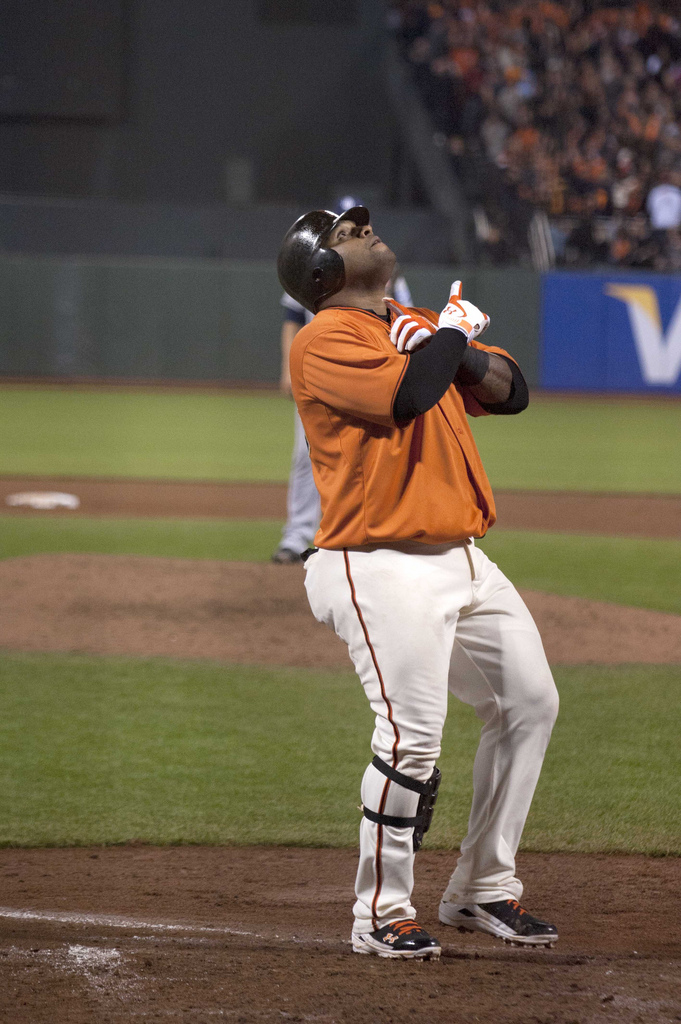
(Photo from 2012 Giants-Padres game by Joel Henner)

If You Think Today’s Concussion Crisis Is Bad

1385662546-1

Take a trip to 1905:

Like the recent Time magazine cover featuring a 16-year-old who died playing the game, Americans are starting to ask, “Is football worth it?” Football has been here before, at a time when it was actually much more vicious. In 1905, 19 college football players died from injuries sustained while playing the sport; with five times as many college players participating today, the modern equivalent would be 95 on-field deaths. The San Francisco Call listed off the year’s fatalities: “Body blows, producing internal injuries, were responsible for four deaths, concussions of the brain claimed six victims, injuries to the spine resulted fatally in three cases, blood poisoning carried off two gridiron warriors, and other injuries caused four deaths.”

That year, amid calls for the abolition of football, Roosevelt hosted “an extraordinary private meeting” at the White House with the coaches of the three largest college teams:

Some say Roosevelt gave the coaches an ultimatum: Change the game or I’ll abolish it by executive order. But [historian John J.] Miller says that Roosevelt, characteristically, spoke softly, merely asking the leaders to save the sport by reducing the violence in whatever manner they could figure out among themselves. Given the fact that Roosevelt elevated the issue to the level of a presidential meeting, however, his implication was clear: It was time to fix football. “He didn’t have to say anything like a read-between-the-lines threat,” Miller says. “He wanted to nudge them in a direction.”

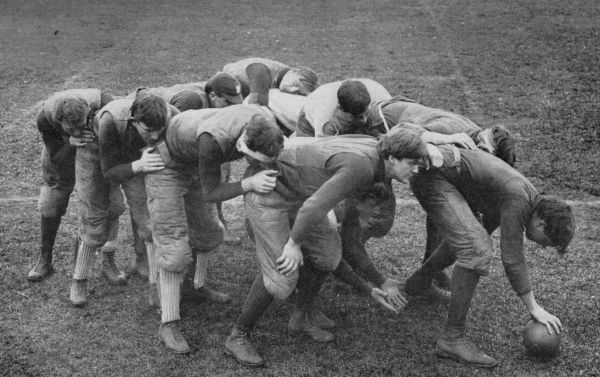
Miss Cellania notes, “Though he never played the game, partially due to his reliance on glasses, Roosevelt was a devoted fan.” She also provides context for the above image:

During the late 1870s, American “foot ball” resembled a combination of soccer and rugby with a riot mob mentality. Almost anything went: Players could carry the ball, kick it, or pass it backward. Starting in 1880, Walter Camp, a Yale player now known as the father of American football, introduced a series of changes to make the game more strategic. Unfortunately, some ended up making the game more dangerous. The most infamous example was Harvard’s “Flying Wedge,” inspired by Napoleonic war tactics: Offensive players assumed a V-shaped formation behind the line of scrimmage, then converged en masse on a single defensive lineman. “Think of it—half a ton of bone and muscle coming into collision with a man weighing 160 or 170 pounds,” wrote The New York Times in 1892.

For lots of Dish on today’s concussion crisis in football, go here. Update from a reader, who reiterates a key point about physics discussed throughout our coverage:

The issue with today’s concussion crisis – and why I personally think the NFL is in very, very bad shape long-term over it – is the intractable problem of F = dp/dt.  Simple physics, really.  Force is the first derivative of momentum with respect to time.  The intractability of the problem is that the object with the momentum in this equation is the player’s brain, and the thing which is rapidly inhibiting the brain’s momentum is the player’s skull.  The inside of their skull.

Football helmets are designed to prevent skull fractures and they do so quite well.  I don’t know that I’ve ever heard of an NFL player getting a skull fracture in my viewing life, from about 1980 to the present.  Maybe there’s been one I can’t remember, and perhaps there have been some in college football, which I have never followed very closely.  But they cannot lessen the kinetic impact of the brain, once it has been given a certain velocity, upon the inside of a rapidly decelerated skull.  Nor can they lessen it when a stationary brain is struck by a rapidly accelerating skull.  I don’t know if there’s any helmet or other device that we could design that ever could.

Lawsuits by former NFL players are such a threat to the league that it has changed its rules and settled for untold billions of dollars.  That an entity with as much power as the NFL flinches at the prospect of these lawsuits gives you an idea of how dangerous they are, but former high school and NCAA players have not sued their leagues and schools for the damage they likely suffered.  Not yet, at least.  I assume that some day they will, and I also assume that it will only take one or two judgments in their favor to create panic among university presidents and school board administrators – and the insurance companies that insure them.  These programs will either be unable to obtain insurance or it will become too expensive for only the richest programs to afford.

Not only that, but a large proportion of parents of high school-age boys will bar them from playing football, seeing the damage the plaintiffs in these cases have suffered.  Schools will no longer field teams and those that do will have a dearth of players to pick from.  The NFL’s talent pipeline will slow to a trickle, the product on the field will degrade, and sponsors and TV networks will balk at the prices the NFL and colleges demand for broadcast rights.

This may take the next 40 years to play out, but unless someone can come up with a solution to the problem of F = dp/dt, I don’t see how the league survives it.  They could of course keep changing the rules, making violent hits ever more rare, but diehard NFL fans are already distressed over the “wussification” of football already.  Much more and they’ll abandon it.  There might be an upstart league that gets started, promising all the hits from the good ol’ days of the NFL, and it will try to indemnify itself from the issue, but the problem is going to be with the high schools and the colleges, not the professional league.

Another physics nerd:

I love your work too much to let you get bamboozled by some bad physics logic. A reader wrote that helmets do not help to prevent concussions because of basic physics. He or she cites the right foundational formula, Newton’s 2nd Law in the calculus-snob form F = dp/dt, then fails to apply it properly.

First, let’s drop the calculus, because we don’t need it to understand this collision problem, and rearrange terms to get delta-p = F delta-t, or change in momentum during a collision equals force (the thing that cracks skulls and concusses) times the time elapsed during the collision. The change in momentum is roughly the same regardless of whether a helmet is worn: brain is moving before collision, brain stops moving after collision. So the left side of the equation is fixed which means the product on the right must also be fixed. The job of a helmet (or airbag, or baseball glove, or iPhone case) is to decrease the average force, F, by increasing the collision time. The right side of the equation must stay fixed, so by whatever factor we increase time we also decrease F.

That explains why a helmet prevents skull fractures: the cushion in the helmet provides a longer collision time which means less average force on the skull at any given instant, and therefore less risk of exceeding the minimum force required to cause a break. Now we just need one more important bit of logic to protect the brain: force transmission, which is really just a combination of Newton’s 2nd and 3rd Laws. The skull, being pretty solid, transmits the force from the helmet directly to the skull. So if the average force on the skull is decreased during the collision, then so is the average force on the brain. QED.

Drop me a line if you ever want some science fact checking. It’s what I do.

To Have And To Put On Hold

The proportion of unmarried Americans has reached an all-time high, according to a new Pew report. Clare Cain Miller looks at a major reason why:

Though marriage was once a steppingstone to economic stability, young adults now see Screen Shot 2014-09-24 at 4.53.25 PMfinancial stability as a prerequisite for marriage. More than a quarter of those who say they want to marry someday say they haven’t yet because they are not financially prepared, according to Pew.

“If you go back a generation or two, couples would literally take the plunge together and build up their finances and nest eggs together,” said Kim Parker, director of social trends research at Pew. “Now it seems to be this attitude among young adults to build up households before they get married.” In other words, marriage has gone from being a way that people pulled their lives together to something they agree to once they have already done that independently.

Kat Stoeffel remarks, “It’s not that we forgot to get married. We’re just being nominally picky”:

According to Pew, 78 percent of unmarried women “place a great deal of importance on finding someone who has a steady job” — a population in decline. The number of employed men ages 25 to 34 per 100 women of the same age “dropped from 139 in 1960 to 91 in 2012,” says Pew, even though there are more 25- to 34-year-old men than women. So, no, you are not imagining it: There is a quantifiable shortage of eligible men. [As Pew puts it,] “If all never-married young women in 2012 wanted to find a young employed man who had also never been married, 9% of them would fail, simply because there are not enough men in the target group.”

Jordan Weissmann adds, “A dearth of eligible bachelors isn’t the only reason marriage has been on the wane”:

Young people are getting married later in part because they spend more time in school. … Oh, and then there’s birth control, changing social mores about sex out of marriage, etc. But economics are an obvious and unavoidable dimension of the issue. That’s why it’s far-fetched to think we can revive the institution of marriage in a meaningful way without addressing the underlying forces that have left young men in such shabby financial shape.

Update from a reader:

The way Pew presents this data only shows half the story. Specifically, it only shows the 2nd half of the 20th century. If you look at a wider range of data, a different story appears. It’s not covering the exact same data, but this table shows the wider story. The year 1960 was a low-point for the percentage of population that’s unmarried. Before and after, the % of the population that was never married was much higher. At the turn of the last century, it was much higher than today. In many ways, the 1950s and ’60s are proving to be the aberration, not the rule. (See also: Political partisanship – can’t find a reference at the moment, sorry- and income inequality.)

Getting Out The Female Vote

One cringe-worthy attempt from the GOP:

Joan Walsh raises an eyebrow:

Yes, admaker Rick Wilson and Americans for Shared Prosperity believe the way to convince women to vote for Republicans is to compare the president to a bad boyfriend. Obviously they think we’re idiots who put romance before reason, even in politics.

Meanwhile, on the Dem side, Greg Sargent explains why 53 percent is their magic number:

[The battle for the female vote] is often discussed in terms of the “gender gap,” i.e., the margin any given Democratic candidate enjoys among women. That’s important, but Dems are also eying another key goal: How to drive up the share of the 2014 electorate that women represent. Democratic strategists familiar with the hardest fought and probably most critical Senate races — in Colorado, Iowa, North Carolina, and Arkansas — all tend to gravitate towards citing 53 percent as an important, if approximate, threshold. That is, they privately say that if the electorates in their states approach 53 percent women, and their candidates enjoy a reasonable advantage among them (as some polls suggest they do already), then their chances of winning improve. This is key to Dem hopes of making the electorate look more like it did in 2012 than in 2010.

Albert Hunt agrees that women voters are key:

This year, it’s Democrats who are on the defensive. In the 10 most competitive Senate races, they are counting on different assets in different states: solid turnout of black voters in the South, Hispanics in Colorado and Alaskan natives. But almost everywhere, Democrats need a big margin — at least in the double digits – with female voters.

But Ramesh Ponnuru downplays the importance of the gender gap. He cites a recent CBS/NYT poll that had the GOP “six points up among likely voters and only one point down among women”:

In 2006, the gender gap was four points: Men gave Republicans 47 percent of their House votes, women 43. In 2010, the gap was six points (55 percent of men and 49 percent of women chose Republican House candidates). In the CBS/New York Times poll, the gap is seven points (49–42).

So the gap isn’t shrinking. It’s just that Republicans are doing alright this year among men and women alike. Shrinking the gender gap turns out to be unnecessary for political success.

Update from a reader:

I don’t get it: Lena Dunham can do a YouTube spot likening voting for the Dems to losing your virginity to the “right one”, but comparing President Obama to a bad boyfriend is something qualitatively different? The problem with this ad isn’t that it’s insulting or not clever, it’s lack of originality:

Why Do Doctors Kill Themselves So Much? Ctd

A reader writes:

While I think this is important question, I also find the suicide rates not at all surprising.  In fact, it is about as surprising to me as the data about soldiers taking their own lives in record numbers (that is to say, not surprising in the least).

During the middle of my residency in surgery, which was before work hour restrictions, I would go months at time without seeing the sun.  I would typically work 80-100 hours a week, take in-house call every second or third night, and deal with all manner of death, dying, stress, and trauma.  I was single and had little time to date, much less start a family.  Showing fatigue, stating you needed a break, or any other sign that you were suffering resulted in you being labeled weak or whiny.

I could look forward to 2-3 more years of the same before my residency was complete.  After that, I could look forward to an average salary which seemed to be shrinking by the year unless I tacked on 1-2 more years of fellowship training.  Furthermore, I could read in the paper everyday that physicians were losing respect and were perceived as a major source of our country’s health care woes.

I went to work everyday and suffered through nurses with clipboards asking why patient X and Y hadn’t been discharged yet, administrators telling us we had to use instrument A instead of instrument B because A was cheaper (even though B was better or safer), operating rooms that were understaffed (“your case will have to wait until 7 pm to get done because it’s after 2 pm and we’ll have to start paying nurses overtime if we start your case now.”), and patient’s family members who weren’t there at all for the first 10 days of a patient’s hospitalization but are now demanding to see the doctor at 8 pm at night.

So after one snowy February day, after treating a mother whose baby had been decapitated in a car accident and all other manner of horrors, as I was driving home I thought, “wouldn’t it be nice to drive up into the Cascades (my residency was in the Pacific Northwest), get out of my car, walk into the woods for about 30 minutes, find a nice tree, and sit down in the snow and drink a bottle of whiskey until I became numb and fell asleep? I would never wake up.”

The good news is, I didn’t.  And I’m one of those older doctors now who has no interest in or thoughts of suicide.  I make a good salary, and while I still work hard and treat all manner of horrible things that happen to people, I usually make them better.  I have a lovely wife and two beautiful children.

But when I read this question, I think that, like our soldiers (I was one of those too, by the way), most people have no earthly idea about what many physicians experience in training and in practice every day, and how much stress, sleep deprivation, administrative nonsense, medico-legal threats, and continual erosion of autonomy we deal with.  It adds up.  Throw in a sudden lawsuit, marriage break-up, or other major stress and you have the potential for a physician imploding.

We have definitely tried to make things better for doctors in training, and that needed to happen.  We haven’t made things better for new physicians out of training; if anything, things have gotten worse with all the upheaval in the health care system.  We are constantly asked to deliver more with less.  Patients are more demanding, not less.  We have a incredibly skewed perspective on end of life care, a topic which has been previously covered at length in this blog.  The future is uncertain for private practitioners.  There are multiple factors in play, and what leads a troubled physician to take his own life is different for each one.

For many more stories on suicide, read our long discussion thread here. Update from a reader:

Your man Aaron Carroll, a doctor himself, has done a lot of pushback on the “it’s horrible being a doctor, we’re all going to quit” meme – here, herehere, and here.

One of Carroll’s readers had a great line:

Most people have to choose between doing God’s work and being in the 1%. Only doctors get to do both.

The Senate Races Chug Along

David Leonhardt figures that, “while the 2014 election is certainly is not the most important of our lifetimes, it is important in some stealth ways”:

Even if no major legislation is likely in the next two years, the people elected this November will be in the Senate for another four. The 2014 elections could well mean the difference between a Democratic Senate and a Republican Senate in 2017. (The map is more favorable to Democrats two years from now than this year.)

Imagine a Washington in 2017 in which President Marco Rubio and a Republican House want to cut top tax rates sharply — but Senator Bruce Braley, an Iowa Democrat who squeaked out a win in 2014, is part of a 51-member Democratic Senate caucus that stands in the way. Or imagine that President Hillary Clinton wants to push an immigration overhaul — but can’t get any momentum behind a bill in either a Republican-led Senate or House.

Nate Cohn maintains that “there’s plenty of time for Republicans to take the lead as undecided voters make up their minds”:

In most states, the Democratic candidates are still stuck in the mid 40s or even low 40s. Most undecided voters probably disapprove of President Obama’s performance. In the red states, a vast majority of the undecided voters probably voted for Mitt Romney. If the national generic ballot numbers are right, those voters probably prefer that Republicans control Congress as well.

This would be the easiest explanation. The Republicans could take a lead in states like Iowa, Colorado or even North Carolina as undecided voters make up their minds. It would give the G.O.P. an advantage commensurate with their edge in the generic ballot, especially in the red states.

Charlie Cook reads tea leaves:

The political environment is so bad, the playing field is so tilted in favor of Republicans, and the midterm election electorate has started to favor Republicans so much so that there are simply many more routes for Republicans to get to 51 seats than there are for Democrats to keep 50. Winning every purple state and picking off a state in enemy red territory obviously can happen, but it usually doesn’t with the other dynamics we see in play.

Cillizza chimes in:

In a series of poll released last week in places like Arkansas, Kentucky and even North Carolina, President Obama’s job approval rating never crested 40 percent. In the first two states, he was in the very low 30s. Ask any Democratic consultant what their side’s biggest problem is heading into November and they will tell you Obama. Ask any Republican consultant what their side’s biggest advantage is heading into November and they will tell you Obama. Bipartisanship! The reality is that for people like Pryor, Landrieu and Alaska’s Mark Begich, overperforming the president of their party by 15 or more points is a very tough thing to do.  That’s true — to a lesser extent, but still true — for people like Jeanne Shaheen in New Hampshire, Bruce Braley in Iowa and Mark Udall in Colorado.  The tough thing for Democrats is that it’s getting dangerously close to being too late for a change in Obama’s approval numbers to have a real impact on the political dynamic in their state.

Update from “one politically independent, liberal-to-libertarian man’s point of view from North Carolina” – a great description of a typical Dish reader:

I haven’t been polled, but if I were, I guess I would be counted as an “undecided” voter. Put bluntly, I find the race between Thom Tillis and (the incumbent) Kay Hagan as repulsive as it is boring. Tillis is running against President Obama, and Hagan is running against the NC legislature (of which Tillis is the outgoing speaker of the House). An outsider could be forgiven for not realizing that they are both running for a seat in the US Senate.

There was a time when I would find the arguments of my (mostly liberal) friends about the implications of who controls the Senate a compelling reason to hold my nose and vote for Hagan (again), but I just can’t bring myself to do it this time around. As much as I abhor nearly everything Tillis stands for, I have yet to hear Ms. Hagan articulate a single positive accomplishment that I should care about in the job she’s had for nearly six years.

There was also a time when I could have happily registered a protest vote for a candidate like Libertarian Sean Haugh, who clearly doesn’t want the job (the persistent problem with Libertarian candidates is that they aren’t actually interested in doing the jobs they seek) because at least his YouTube videos are entertaining. His electoral prospects (or rather, the lack thereof) don’t bother me, but campaigning as performance art (however much I share his sentiments and genuinely enjoy his delivery) is not something that I think merits encouragement.

But … if I vote for anyone at all, it will be for Haugh, if only because he’s the only candidate that voting for won’t leave me wanting to take a shower. More likely, I will write in “none of the above” and devote my attention to more local races, where my vote might matter (marginally) more.

If this is where someone as politically engaged as I am (I’ve voted in just about every election since I turned 18 in 1995, including ones for things like school board and sales tax referendums) finds himself, you know the system is fundamentally broken.

Sarkozy’s Unseemly Return

Emily Tamkin furrows her brow at the former French president’s return to the political scene:

One might think that given [his] particularly expansive marital history, Sarkozy would decline to comment on supposed threats to the institution. But non. In a televised interview over the weekend, Sarkozy—who recently announced his intention to return formally to politics and lead his right-wing UMP party—criticized the policies of French President François Hollande, including the current president’s leadership on LGBTQ issues. The thrice-married politician believes that Hollande’s government, in introducing legislation allowing for same-sex marriage, is “humiliating families and humiliating people who love the family.”

Evan Mulvihill argues argued in 2012 that Sarkozy’s stance makes him a bad conservative:

Sarkozy said he supports inheritance rights for gay couples, but doesn’t want to create “civil unions” because they would “harm the institution of marriage.” France already has a sort of civil union called PACS. How a conservative politician can justify wanting less families on the planet, we do not know. Would that Sarkozy were more like British PM David Cameron, his neighbor to the west, who has said that he does not support gay marriage in spite of being a Conservative, but that he supports it because he is a Conservative.

Update from a reader:

Your post on Sarkozy’s statements includes misleading information:

– The referenced article by Evan Mulvihill is from 2012, when Sarkozy ran for re-election at the end of his term. Since then, gay marriage has been passed in France (the “loi Taubira”). The entire commentary and the specific point about civil unions are obsolete.

– The post implies that Sarkozy is currently against gay marriage. In fact, on Sunday, Sarkozy was not clear one way or another. He did not directly answer the question whether he would move to abolish gay marriage if elected again in the future. He did not say that “gay marriage humiliates families” (that’s what some commentators read into it); he said that, during the earlier debate, the family was humiliated (“on a humilié la famille”) and that he doesn’t want to approach the question in the same way again. He was taken to task by one side for not supporting gay marriage; he got as much flak from the anti-gay marriage side for not supporting its abolition.

Full video here (the part about gay marriage is near the end – around 43:00).

Where Golf Is Driven Out Of Range

In a review of The Forbidden Game: Golf and the Chinese Dream, Maura Elizabeth Cunningham describes the peculiar role of the sport in Chinese society:

[A]s Dan Washburn writes in his compelling new book … golf “offers a unique window into today’s China,” a country of paradoxes perhaps best exemplified by the fact that although construction of dish_kunminggolfnew golf courses has been banned in China since at least 2004, more than 400 were built between 2005 and 2010, making China the only place in the world experiencing a golf boom. Government officials who enjoy hitting the links register at golf courses under false names, afraid of leaving a paper trail connecting them to a game most often associated with capitalism and corruption. And while massive golf course complexes lined with luxury villas populate large tracts of land outside Chinese cities, their owners attempt to hide the courses in plain sight, giving them convoluted names like the “Anji China Ecotourism and Fitness Center.”

Like so much else in contemporary China, golf occupies a gray zone: officially forbidden, yet tolerated — even encouraged — behind the scenes, as local government officials and land developers reap massive profits from the construction of new courses.

Update from a reader:

Perhaps I can contribute a small illustration of the absurdity of golf in China.

My wife and I have lived in China for nearly a year and recently returned from a vacation in Yunnan (very near the course pictured in the thread). One of our stops was Jade Dragon Snow Mountain, which offered wonderful, but in our case, clouded vista at ~4,600m. Coming back down in the cable car and emerging from the fog, we were presented with the last thing we expected at the altitude and surroundings: 18 holes of vibrant green. At 3,100+ meters altitude, Jade Dragon Snow Mountain Golf Club is the longest in the world at 8,500+ yards (par 72). It even boasts villas, but I can’t imagine they would have much conventional luxury at such a remote location.

IMG_20140907_135857_137

(Photo of a golf course in Kunming by Philippe Semanaz)