When A Black Woman Kisses A White Man

Ashley Southall tells the story of a possibly racist misunderstanding:

The actress, Daniele Watts, who appeared in “Django Unchained” and plays Martin Lawrence’s daughter on the FX show “Partners,” revealed the incident last week in a note on Facebook. She said she was “handcuffed and detained” by the officers “after refusing to agree that I had done something wrong by showing affection, fully clothed, in a public place.” … Ms. Watts’s boyfriend, Brian James Lucas, a celebrity raw food chef, said in his account of the incident posted to Facebook on Friday that the officers’ questions indicated that they suspected the couple were a prostitute and her client after observing their different skin colors, his numerous visible tattoos and her shorts. He did not say what questions the police had asked. Mr. Lucas also accused the officers of threatening to call an ambulance and to drug Ms. Watts “for being psychologically unstable.”

Yomi Adegoke contextualizes the incident:

Cases such as Daniele’s illustrate why intersectionality is crucial to any discussion of racism and, more pressingly, any discussion of feminism. We must face the facts — this would not have happened to Daniele had she been a black man, nor would it have happened if she were a white woman. … As it stands, black women are sexualised to such a degree — and black people criminalised to such a degree — that it appears the police are unable to fathom something as common as an interracial relationship in anything other than sexual terms, despite an incumbent biracial president.

And Elizabeth Nolan Brown takes the occasion to describe the extent to which non-black women are not hassled by the police.

The only correlate I have to stories of routine street harassment and cruelty by cops is how often I haven’t been bothered, arrested, or abused. And let’s just say I’m no angel. I have absolutely walked the streets of so many cities drinking alcohol from travel mugs, ducking into dark parks and alleys to sneak a joint or a kiss; purchased drugs and even untaxed cigarettes in the relative open; and generally engaged in the kind of semi-suspicious and minimally-criminal public behavior that I’m certain would get someone with darker skin or more testosterone at least harassed (if not arrested or assaulted) many times over. …

I wish everyone had the privilege I’ve had to not just break dumb laws without really fearing repercussion but even simply to go about regular life without being treated like a criminal. Incidents like this one with Watts, however, show how it’s not merely about the attitudes of cops. Excluding everything the officers did or didn’t do once they showed up, there’s still the fact that someone seems to have called them on an assumption that this young black woman cozying up to a white man must be a prostitute. Absent anything the cops did in Chris Lollie’s case, there’s still the fact that someone called them in to investigate a black man suspiciously sitting idly. There’s the fact that in my decade of living, working, walking, loitering, and sometimes breaking the law in cities, no one has ever called the cops on me.

Update from a reader:

Listening to the police tapes of the encounter clouds the narrative a bit. The police can’t go around randomly asking for ID – but they do have a right to ask for ID when they receive a call about a potential crime in progress, in this case what witnesses thought was public sex in a car. While that initial call to the police might have been racially-motivated (or they might have actually been getting frisky in the front seat), the actions of the officer seem to be pretty standard response: check IDs and move along. She was briefly detained when she refused. But come on: a cop, after getting a call about a possible crime, is obliged to investigate and is not just going to walk after if someone is being uncooperative. Racial bias in policing is deplorably common, but alleging racism over basic policing protocol doesn’t help the cause.

Abuse In The Public Eye, Ctd

A reader broadens the conversation on domestic violence:

I watched with full video of the Ray Rice incident, and one of the first things I noticed is that outside the elevator, when Ray is waiting for his fiancée (now wife) Janay, she walks by and hits him in the face. She definitely did not connect hard, but it is clear she did connect. Then inside the elevator, she attempts to elbow and punch him in the head, and when he retreats, she comes at him with her fists up in a fighting stance. It is only at this point that Ray punches her. You can see the full video here. [Update: Another notes, “It has been reported (ESPN etc.) that Rice spit in Janay’s face twice – before they entered the elevator and right after they entered the elevator, and her physical movements were reactions to both events.”]

I am a man and I was once the victim of domestic violence from a woman. She would hit me and take advantage of the fact that I would never hit back.

It is likely that this was not the first time Janay hit Ray, and based on the fact that she had no hesitation to square off with him, she may have done it many times before and he never hit her back. He may have gotten tired of this and warned her he would start hitting back.

It is certainly wrong of Ray to punch Janay. It is also wrong for Janay to punch Ray. It is certainly wrong to blame the victim, and at the moment Ray hit Janay, she was the victim. But every other time she hit him, including just moments before he hit her, he was the victim, and being the victim of
repeated domestic violence can make someone stop thinking clearly.

It seems we all want to talk about Ray punching Janay, but no one wants to talk about the punches Janay directed at Ray. Until we do that, we aren’t really talking about the truth of what happened there and what happens all the time in our society. We are only talking about a made-up narrative that does not match reality. So let’s start talking about reality. We need to talk about how men can avoid being the victims of violence from women, and what they can do to protect themselves without striking back.

Update from a reader, who elaborates on the first update:

I have no idea what video your reader watched, but it doesn’t appear to be the same one the rest of the world did. While, yes, Janay Rice lightly taps Ray Rice on the chest before they get in the elevator, I don’t think you could even call that a “hit”. It’s somewhere between a light brush and a tap, and it doesn’t look particularly malicious – let alone violent. Also, when the two are in the elevator, Ray Rice is closing in on her, and it looks like he’s trying to intimidate her when she sort of pushes him away. He spits on her, etc. Then, she clearly loses her temper and moves toward him, and he knocks her the hell out.

This statement, from your reader, gives the game away: “We need to talk about how men can avoid being the victims of violence from women, and what they can do to protect themselves without striking back.”

Yes, men certainly can be the victims of domestic violence – I’ve been one myself. But treating the issue as if it’s even remotely an equal problem is the trademark of a men’s rights advocate, who sees the plight of poor, oppressed men as equal to the violence propagated toward women – this would be laughable, if it weren’t so tragic. Men are far, far more likely to injure, abuse and murder their partner than women are; it’s not a remotely equal situation, and treating it as such undermines the very real danger millions of American women are facing every single day.

What Will Happen To The Wilderness?

11003816304_980e987f46_b

Fifty years ago last week, Lyndon Johnson signed into law the Wilderness Act. David Biello assesses what’s happened since:

[M]ost wilderness in the continental U.S. is not untrammeled land. Wilderness areas are often former working landscapes—the Orwellian phrase created by the logging industry to explain away clear cuts—whether they were cleared for logging or farming over the course of the 19th century and early 20th centuries in places like the Adirondacks. The great forest that once covered the eastern U.S. has been re-growing for the last 50 years, even if its primeval quality may be illusory, given the exotic animals and plants that now live there. And, in this era of global warming, even the Artic and other remote spots show signs of human trammeling—whether the leavings are plastic detritus or a changed climate.

How he thinks about the future of the wild:

Wilderness poses this fundamental question at least: what kind of place do we want for our home? Will our terrestrial abode retain an abundance of plants, animals, microbes and fungi like the world Homo sapiens was first born into? Or will the Earth become a vast monoculture, a grim subset of nominally wild species that co-exist in symbiosis with modern human civilization, like rats and seagulls? “Is being an asteroid the great purpose of our species—to steal the lives and homes of millions of species and billions of creatures?” asks political scientist David Johns of Portland State University, in his essay in “Keeping the Wild.”

In the end, wilderness is a state of mind. The natural world can only persist now as a deliberate act of human will. That will require firm human purpose as a gesture of humility, yes, but also a form of self-protection. “This is not really an ‘environmental problem.’ It’s a human problem,” writes environmental historian Roderick Frazier Nash of the University of California, Santa Barbara. “What needs to be conquered now is not the wilderness, but ourselves.”

Update from a reader:

In David Biello’s article, the word “untrammeled” is misused. To be trammeled means to be restricted, such as a trammel used on a horse. To be untrammeled means to be not restricted or hampered. (I learned what “untrammeled” meant in 1972, in my first weeks of Park Ranger training at Grand Canyon National Park.)

The Wilderness Act says that wilderness is an area that is “untrammeled by man, where man himself is a visitor who does not remain.” So wilderness is a place that is unrestricted by mankind, or as noted in Wikipedia, “meaning the forces of nature operate unrestrained and unaltered.”

In this article, “untrammeled” is confused with a word like “untrampled.” (It’s a frequent mistake.) For example, the author writes: “And, in this era of global warming, even the Artic [sic] and other remote spots show signs of human trammeling—whether the leavings are plastic detritus or a changed climate.” This is a clear misuse of the word “trammeling.” Biello should be informed of this mistake and a clarification from you might be in order.

(Photo by Jocelyn Kinghorn)

The Quality Of Britishness, Ctd

A reader quotes a previous one:

“Separation of Scotland has more than political implications. For many of us who do not have any vote in the matter, it carries profound implications about our identity, and what our nationality means.” Yeah, I feel this pain. I’m as Scottish as it gets, and I don’t have a vote in the matter either. I was born in Scotland, hold (only) a UK passport, have lived in England and the US, and now live in Canada. If independence happens, my life is turned upside down. The practical and emotional effects would be unimaginable. Every little page of immigration paperwork, my right to travel freely, my relationship to “home” – whatever that is – all in limbo. If I’m reading the propaganda – sorry, the White Paper – correctly, we will be forcibly repatriated to a new state while living abroad! God help us all.

Expat Scots will suffer as much disruption from this independence experiment as anyone, maybe more. But we do not get a vote. That makes me furious. I mean, 16 and 17 year olds living in Scotland have been franchised especially for this occasion, but I don’t get to play? Am I supposed to hope that they have my best interests at heart?

So I have to sit here, watch, and stew, while the future of my home, my nation and my identity is decided for me. Forgive me, but fuck the whole thing.

Another view:

I’m puzzled by your readers who worry about being unable to feel British if the Scots vote to secede. If, say, France were to leave the EU, does that mean I could no longer feel European?

Of course not. Europe is more than its political institutions. The concept of Britishness is not defined by the scope of the Westminster parliament.

I hope the Scots vote for independence, because I think they will create a kinder, fairer and happier society than the UK has become. Perhaps one day they’ll invite those of us in north-east England to join them: my roots are English not Scottish, but culturally, politically and geographically I feel closer to Scotland than I do to London.

Another draws a distinction:

To get a bit technical about it, Scotland cannot separate from Britain – at least not without employing a tremendous amount of earth-moving equipment. “Britain” is a geographic term, not a political one. It is, of course, short for “Great Britain,” the name of an island called such because it is the largest of the many British Isles.  Scotland can leave the UK, but it is stuck in Britain forever. The Scottish will always be British. If sharing an island with the English and the Welsh is part of the Scottish identity, then separating from the UK will not take that part away.

Another reader:

The letter you posted from the descendant of the Jacobite veteran of Culloden at first surprised me. How can an American, whose family has been in the USA since before the USA existed, be thrilled that “we” might be out from the English thumb?  You and your ancestors have been free of the English thumb for more than 250 years!

This is an example of how ancient political issues in Europe find a long echo in America. My own family is immigrant Irish, and like so many others, my ancestors came to America to escape the civil unrest in Ireland during the late 1800s and early 1900s.  They were devoutly Catholic, adamantly anti-British, and staunchly Republican.

I visited Ireland for the first time in the weeks after the Omagh bombing, and I was surprised to find that the locals I met were quite cool to me, and rather keen to have me on my way.  After awhile I realized that this was because they did not particularly trust Irish-Americans like me.  My – and so many others like me – views on Northern Ireland came to me almost unchanged from Grandpa’s views in 1916.  I think that is why there was such support for Irish republicanism (i.e. terrorism) from the succeeding generations of Irish Americans.  The locals were in no mood for another American’s nostalgia for Grandpa’s stories and how Grandma sang Republican songs as a lullaby.

In short, it caused me to realize that Ireland didn’t stop when Grandpa stepped on the boat at Westport. Obviously this phenomenon is not confined to the Irish-American experience, and can last far longer than the few generations of my family’s experience.

Another shifts focus:

As a Canadian, I’m fascinated by the parallels between England/Scotland and Canada/Quebec. Consider the following rewrite of your original post:

It’s a prickly country, bristling often at [Canada], its exports to [Ottawa] often having more than a bit of a chip on their shoulders. … It’s politically well to the left of [the rest of Canada], and is a big net beneficiary of [Canada’s] Treasury. After a while, if you’re [an anglophone Canadian], and right-of-center, and taxed to the hilt, endlessly subsidizing the [Quebecois] in return for their thinly veiled disdain, you get a bit irritated. Deep, deep down in my [Canadian] soul, there’s a “fuck ‘em” urging to come out.

This, I think, accurately captures some of the feeling in anglophone Canada around the time of the last referendum on sovereignty in 1995. The interesting thing to note is the way Quebecois separatist sentiment has ebbed and flowed over the years. When times are good, the separatists seem to lose sight of the real economic difficulties that an independent Quebec would face: concerns related to a separate currency or monetary union, how to divide up things like the national debt, what’s going to happen to growth and investment after the split, etc. – in short, many of the same issues facing Scotland. When times are not so good, the citizens of Quebec seem to recognize the benefits that they receive from remaining part of Canada and talk of separation largely disappears. This suggests to me that support for Scottish independence may move in the same way – greater support in good times and less when times are tough.

There is an important difference, however, between Canada and Britain: the division of powers between the provinces and the federal government in Canada is much more clearly defined than in Britain. The responsibilities of the federal government and the province of Quebec, while they have been tweaked over the years, are largely fixed by the constitution and other legislation; the situation in Britain seems much less well defined and, as a result, it seems like the politicians and citizens of Britain are more likely to misunderstand or misrepresent the relationship.

What I mean by this is that Scots who feel that Scotland should be independent have more latitude to feel that they’re getting a raw deal, since the deal they have is not really all that well defined. Similarly, the English who want to say “fuck ’em” to the Scots have more latitude to feel that the Scots are getting more than their fair share, again because the terms of the deal are not well defined.

One solution to this would be for Britain to hold a “constitutional conference” with the goal of spelling out, exactly, what exactly is the status of Scotland, England, Wales, and Northern Ireland – are they states in the American sense? Are they provinces in the Canadian sense? Are they something else? Removal of the uncertainty around this relationship might go some way toward resolving Scottish complaints about the union.

Another also looks at the Quebec parallel:

The aftermath of Quebec’s “no” vote was ugly – the reason the referendum lost was because the non-francophone minorities voted nearly unanimously against succession (many Native Americans – or First Nations as is the term up there – swore they would never be part of an independent Quebec given the ugly history with the Catholic church/Provincial government). After the defeat the leader of the successionists basically said they lost because of “money and foreigners” (many read money as “Jews” and foreigners was easy enough to understand). There was also more uncertainty surrounding that vote – nobody knew how Canada would have reacted to a “yes” vote. After the defeat, the Canadian Supreme Court issued a ruling that set out future ground rules for succession, but at the time of the 1994 vote there was no agreement re: potential currencies, etc. so the economic uncertainty was even greater.

And yet, it was 49-51%

My view from afar: If Scotland can’t even stay a part of the U.K., the Middle East is doomed to unravel into goodness knows how many tribal mini-states.

Update from a reader:

I just got a little taste of your life! A reader responded to my comment by saying:

How can an American, whose family has been in the USA since before the USA existed, be thrilled that “we” might be out from the English thumb? You and your ancestors have been free of the English thumb for more than 250 years!

I didn’t mean our family in America is under the English thumb. I meant we would be thrilled the Scots in Scotland were finally free of the English!

How you do this day in and day out, with people parsing every word you write, is beyond me.

The Jubilation Of The Hegemonists

They’re back in charge in Washington, they will always despise Obama, and they will demand, in the end, ground troops. Wieseltier takes a victory lap:

New varieties of half-heartedness would be disastrous. Shall we not do stupid stuff? Fine, then. Not bombing ISIS in Syria would be stupid stuff. (Where is the border between Syria and Iraq?) Not transforming the Free Syrian Army into a powerful fighting force would be stupid stuff. Not armingand in every other way standing behindthe Kurds would be stupid stuff. Andhere comes the apostasy!not considering the sagacious use of American troops would be stupid stuff.

The obsolescence of the American army is not a conclusion warranted by the war in Iraq. In our determination not to fight the last war, we must not pretend that it was the last war. If the president’s ends in his campaign against ISIS are justified, then he must not deny himself the means. The new government in Baghdad may work out or it may not. Our allies may agree to share the toughest burdens of the campaign or they may not. The outcome of this multilateral effort will depend on the United States. It still comes down to us. Why are we so uneasy with our own moral and historical prominence?

No more half-heartedness! Just go to war in the Middle East again – actually attempt to reconstruct two now-imaginary countries, Iraq and Syria – but with one proviso: we’re all in. No ground troops should be ruled out – which means their involvement becomes inevitable. The multi-sectarian, complex forces and counter-forces in the civil wars of what was once Iraq and what was once Syria can all be mastered by American military power – just like the last Iraq war, remember?

Note this line:

In our determination not to fight the last war, we must not pretend that it was the last war.

But we are going to war in the same place we just left! And we are doing so for the very same reason we were the last time around – because a Sunni insurgency does not trust the Shiite-dominated government that we installed and still support. We have no new capabilities that make all our previous mistakes avoidable again. We are once again trying to control the uncontrollable and manage the unknowable in places we know far less about than our enemies, just as we once did – and without any clear, tangible threat to the US. This “last war” began in 1991, it was extended in 2003, it is now being extended again, after the briefest of lulls, for the indefinite future. America is becoming nothing but a war machine, forever fixing the conflicts we create, supported by a Beltway elite with no accountability for anything they have ever said or written in the past.

For some, a forever war against evil everywhere on earth is what gets them up in the morning. I understand how this is genuine, even admirable in its compassion and care. But it is not prudent; it has been proven a failure already; it has cost us a trillion dollars and countless lives and limbs. To believe it will be different this time is the definition of insanity.

Update from a reader:

You wrote:

For some, a forever war against evil everywhere on earth is what gets them up in the morning. I understand how this is genuine, even admirable in its compassion and care. But it is not prudent; it has been proven a failure already; it has cost us a trillion dollars and countless lives and limbs. To believe it will be different this time is the definition of insanity.

I understand trying to ascribe non-malevolent motive here, but I want to make a point that I am somewhat loathe to make, given how the term is often abused: this is chicken-hawking at its most extreme.  The group of neocons and establishment Washington pols (with the media right behind them) that perpetually agitate for war and “boots on the ground” give up NOTHING by their clockwork bellicosity.  They won’t spend years of their lives living in a tent in the desert, their families won’t feel the stress of multiple deployments, their children won’t be blown up by an IED.  Someone else’s will, and they’ll go on agitating for endless military engagement all around the world, forever.

It is inappropriate to cry “chicken-hawk!” every time America decides it needs to use force.  That would be illegitimate – a country can’t function that way.  But at what point do we need to look perpetual-war agitators in the eye and say, “If you really think evil is taking over the world, if you want America to fight constantly, then it is your turn.  Go enlist.  Bring your son and your daughter with you.  Then come back and tell me if you think we need to fight over there.”

I won’t hold my breath.

Recidivism By Design?

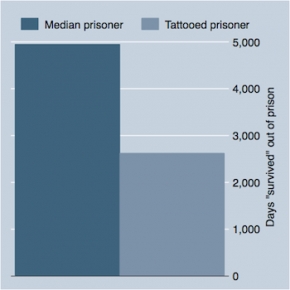
Research finds that “someone lasts 5,000 days (about 14 years) before finding themselves back in the cooler,” but “a tattooed ex-con lasts half that”:

[Researcher Kaitlyn] Harger compares people with different types of tattoos: dish_tattooedprisoners those that can easily be seen, and those that cannot. People with tattoos on the face, head, neck or hands go back to prison 714 days earlier than other tattooed ex-offenders. Having a visible tattoo is the real problem for employers.

What’s the cost of all this to the hard-pressed American taxpayer? Uncle Sam pays roughly $30,000 a year to house one prisoner (though this figure varies wildly from state to state). About 600,000 prisoners are released each year, 70% of whom have tattoos. Tattooed types return to prison earlier: that translates into an extra cost of $5.5 billion per year (a little less than the budget of the Federal Prison System, which houses 200,000 prisoners). Tattoo removal can cost thousands of dollars. Even so, free removal for every prisoner would be sensible economics.

Update from a reader:

As you have often pointed out, correlation does not equal causation. The data in Kaitlyn Harger’s research might lead one to assume that face tattoos are causing a higher rate of recidivism. I suspect that the reverse is true. Face tattoos are very common in gangs. The recidivism rate for gang members is high because they go back to that life when the get our of prison. Tattoo removal will not wipe away all of their connections and affiliations. They are not career criminal acts because they have face tattoos; they have face tattoos because they are career criminals.

Paternity Pays

Claire Cain Miller discusses new findings showing that having kids furthers men’s but not women’s careers:

This bias is most extreme for the parents who can least afford it, according to new data from Michelle Budig, a sociology professor at the University of Massachusetts, Amherst, who has studied the parenthood pay gap for 15 years. High-income men get the biggest pay bump for having children, and low-income women pay the biggest price, she said in a paper published this month by Third Way, a research group that aims to advance moderate policy ideas. … [M]uch of the pay gap seems to arise from old-fashioned notions about parenthood. “Employers read fathers as more stable and committed to their work; they have a family to provide for, so they’re less likely to be flaky,” Ms. Budig said. “That is the opposite of how parenthood by women is interpreted by employers. The conventional story is they work less and they’re more distractible when on the job.”

Update from a reader:

Hi Andrew, welcome back! I have no doubt that paternity pays, at least in the corporate world, and need look no further than the phrase I most despise when used in a business setting: Family Man. I can’t tell you how many times I’ve heard, following a hire or a promotion, “Bill’s a great guy, a family man”. It doesn’t matter if Bill is a good father/husband, just that he is one. You will never hear, “Jill is a great gal, a family woman”. Family Man = Stable, solid, dependable. Family Woman = More devoted to family than career. This is why it pays to be a dad.

Why Are So Many Russians Dying?

Masha Gessen is perplexed why they are “dying in numbers, and at ages, and of causes never seen in any other country that is not, by any standard definition, at war”:

Sometime in 1993, after several trips to Russia, I noticed something bizarre and disturbing: people kept dying. I was used to losing friends to AIDS in the United States, but this was different. People in Russia were dying suddenly and violently, and their own friends and colleagues did not find these deaths shocking. Upon arriving in Moscow I called a friend with whom I had become close over the course of a year. “Vadim is no more,” said his father, who picked up the phone. “He drowned.” I showed up for a meeting with a newspaper reporter to have the receptionist say, “But he is dead, don’t you know?” I didn’t. I’d seen the man a week earlier; he was thirty and apparently healthy. The receptionist seemed to think I was being dense. “A helicopter accident,” she finally said, in a tone that seemed to indicate I had no business being surprised.

The deaths kept piling up. People—men and women—were falling, or perhaps jumping, off trains and out of windows; asphyxiating in country houses with faulty wood stoves or in apartments with jammed front-door locks; getting hit by cars that sped through quiet courtyards or plowed down groups of people on a sidewalk; drowning as a result of diving drunk into a lake or ignoring sea-storm warnings or for no apparent reason; poisoning themselves with too much alcohol, counterfeit alcohol, alcohol substitutes, or drugs; and, finally, dropping dead at absurdly early ages from heart attacks and strokes.

After running down a variety of possible explanations, she draws on the work of economist Nicholas Eberstadt to suggest the answer might be a lack of hope:

While he suggests that more research is needed to prove the link, he finds that “a relationship does exist” between the mortality mystery and the psychological well-being of Russians:

Suffice it to say we would never expect to find premature mortality on the Russian scale in a society with Russia’s present income and educational profiles and typically Western readings on trust, happiness, radius of voluntary association, and other factors adduced to represent social capital.

Another major clue to the psychological nature of the Russian disease is the fact that the two brief breaks in the downward spiral coincided not with periods of greater prosperity but with periods, for lack of a more data-driven description, of greater hope. The Khrushchev era, with its post-Stalin political liberalization and intensive housing construction, inspired Russians to go on living. The Gorbachev period of glasnost and revival inspired them to have babies as well. The hope might have persisted after the Soviet Union collapsed—for a brief moment it seemed that this was when the truly glorious future would materialize—but the upheaval of the 1990s dashed it so quickly and so decisively that death and birth statistics appear to reflect nothing but despair during that decade.

Update from a reader:

I wanted to point out that the Masha Gessen article you posted on Russia’s population is rife with errors. Please see this link that outlines many of them. Frankly, that article from Gessen should have been much better, as she is a very capable writer who has always written from unique viewpoints. That piece though was simply a bucket list of all the tired and false cliches that have consistently colored Western perceptions of recent Russian history. We cannot imagine that Russian’s have higher life expectancies than under that ardent democrat Yeltsin, because Putin is a bad bad man who is corrupt! But the reality is different.

It’s So Personal: Wendy Davis

A reader writes:

No doubt I’m not the first of your readers to bring your attention to this story, but just in case: Democratic candidate for Texas governor Wendy Davis has revealed that she had two abortions for medical reasons. I thought you all might be interested because of your previous coverage of late-term abortion.

Aman Batheja and Jay Root have details:

[Davis’s new book] reveals that Davis terminated a pregnancy in 1997 during the second trimester due to the fetus having an acute brain abnormality after Davis received multiple medical opinions suggesting that the baby would not survive. Davis describes in heart-wrenching detail how the experience crushed her. “I couldn’t breathe. I literally couldn’t catch my breath,” Davis wrote of her reaction when she first learned the diagnosis. “I don’t remember much else about that day other than calling [husband] Jeff, trying to contain my hysterical crying. The rest of it is a shocked, haze-filled blur.”

The doctor said that the baby wouldn’t survive to full term, and if she did, she would suffer and probably not survive delivery. “We had been told that even if she did survive, she would probably be deaf, blind, and in a permanent vegetative state,” Davis wrote.

Jessica Valenti praises Davis’s candor but defends women who stay quiet about abortions:

[W]omen’s abortions are none of your business – not even those of a public figure, not even one who became an international figure because of abortion rights. We shouldn’t have to explain ourselves or justify our life decisions: our abortions are ours alone.

Research shows that talking with people about issues like abortion helps to lessen stigma around terminating a pregnancy. But why must women splay their most intimate moments out into the world in order for people to understand how basic and necessary abortion rights really are?

And Sarah Kliff reminds us that Davis, while her situation was more extreme than most, is far from unusual for having terminated pregnancies:

Talking about abortion is rare — but the actual experience isn’t. More than one in every five pregnancies —  21 percent, excluding miscarriages —  are terminated, according to the Guttmacher Institute, a non-profit research organization that supports abortion rights. Each year, 1.7 percent of American women between 15 and 44 have an abortion.

Researchers at the Guttmacher Institute published separate research in the journal Obstetrics and Gynecology, estimating that if the abortion rate from 2008 held, 30 percent of American women would have obtained an abortion by time they turned 45. One in 12 women, at the 2008 rate, would have had an abortion by age 20, and a quarter of all women under 30 would have terminated a pregnancy.

Update from a reader:

Wendy Davis is disingenuous, or is it disingenuous liberal media? The two abortions Davis revealed that she had would NOT have been prohibited by the Texas abortion bill she filibustered. An ectopic pregnancy can be considered life threatening or at least a severe medical complication and, in any event, typically is discovered well before the 20 week limit of the bill.  Her second aborted pregnancy, “during the second trimester” anywhere from week 14 to week 26, (a) may not have been prohibited as prior to 20 weeks; and (b) as a severe and irremediable fetal defect would not have been prohibited by the bill.

Not to mention that, as a gubernatorial candidate, she went back on her opposition, claiming now to be for a ban on abortion after 20 weeks, subject to, provided that, blah, blah, blah … causing the left to explode.

Another:

Your update from a reader has a spurious line of reasoning. HB2 doesn’t just ban abortions after 20 weeks – that may be its least controversial aspect! It temporarily (and possibly permanently) closed more than half of the abortion clinics in the state because of restrictions meant to do just that. In its most restrictive interpretation it will leave 13 million Texas women with 7 clinics to serve their needs, down from 42 before it passed.

Sometimes I wonder if casual anti-choicers understand that you cannot get any kind of abortion in a regular OB/GYN practice, even if your abortion is perfectly legal and intended to save your life. Her opposition to the bill is because it restricts access to a basic medical procedure for all women who need it, no matter their reason. If Wendy Davis in 1997 was not able to physically get to a clinic for treatment, she would have had to continue with that pregnancy for who knows how long – one she knew to be doomed. Living every day in torture. This is what your reader wants? Her story and her opposition to the law strike at the heart of the It’s So Personal series.

The Gay Women’s Health Crisis

by Dish Staff

Well Being Gallup

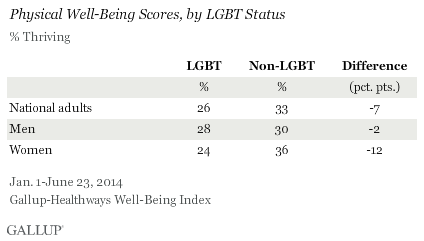
Shannon Keating flags a recent Gallup survey on well-being that shows “queer women lag behind straight women where queer men do not lag behind straight men as much – or even at all”:

Differences in physical well-being between straight and queer men, for example, are too small to be statistically significant; the overall deficit in physical well-being for the LGBTQ community at large is driven entirely by the low scores of queer women (24 percent to straight women’s 36 percent). Gallup indicates that reportedly high levels of smoking and drinking among lesbians and bi women could be a potential contributor to the discrepancy. I’ve seen from accompanying girlfriends on many a smoke break outside of bars how cigarettes and alcohol remain an obstinate fixture of queer girl culture.

Further, where queer men assess their communities with close to as much contentedness as straight men, queer women feel less connected to where they live than their straight female counterparts. Just 31 percent of queer women feel they are thriving in terms of community involvement, safety, and security, a full 9 percent less than straight women.

A recent national survey from Stop Street Harassment helps explain why queer women feel unsafe. The major finding – that two-thirds of American women have experienced street harassment at some point in their lives – is bolstered by two smaller key findings: Seven in 10 LGBT people have experienced street harassment by age 17, compared to 49 percent of straight people, and 41 percent of people of color say they experience street harassment regularly, compared to just a quarter of white people.

Relatedly, a reader flags this item:

A federal study to determine why 75 percent of lesbian women are obese and gay men are not has totaled nearly $3 million. … Researchers at Brigham and Women’s Hospital have come to several conclusions since studying “the striking interplay of gender and sexual orientation in obesity disparities,” which is slated to last until 2016. They have determined that gay and bisexual males had a “greater desire for toned muscles” than straight men, lesbians have lower “athletic self-esteem” that may lead to higher rates of obesity, and that lesbians are more likely to see themselves at a healthy weight even though they are not, the Free Beacon reported.

Update from a reader:

It astonishes me that anyone can look at those numbers and only see a crisis for gay women. True, they are the worst off by a big margin – I am not trying to minimize the main point of the article at all. But almost as shocking is the 6- to 8-point gap between men and straight women. Why is it not even mentioned that men generally are much worse off than women in this regard? (At ~5% of the female population, the lesbian numbers would bring women’s overall score down by about half a percent.)

Possibly because the suffering of men tends to get erased in favor of focusing on the suffering of women? Just saying, the fact that the male population as a whole is significantly less healthy than the female is also a big. fucking. deal, and one that affects far more people in absolute numbers. I guess us dudes are just so privileged to get to live sicker and die sooner.