Hathos Red Alert

Yes, there is now an online video channel for the former half-term governor. (Conor watches so you don’t have to.) The subscription costs ten five times the Dish’s. Not even Roger Ailes can cramp her style now. Twitter? Well … #PalinTVShows is going strong:

Update from Rob Tisinai’s Facebook page:

“The Sarah Palin Channel, which costs $9.95 per month or $99.95 for a one-year subscription…” Which will actually be 6-month subscription when she quits halfway through.

Update from the math department: I screwed up yet again on a very basic math calculation. I’m like Montaigne …

Mental Health Break

We might end up making an executive decision and declare this one the best cover song ever:

Update from a reader:

How dare you put Cartman’s “Poker Face” ahead of the epic “Come Sail Away” from the Chef Aid episode.  The video doesn’t exist, but the rendition alone is pure gold:

Creepy Ad Watch

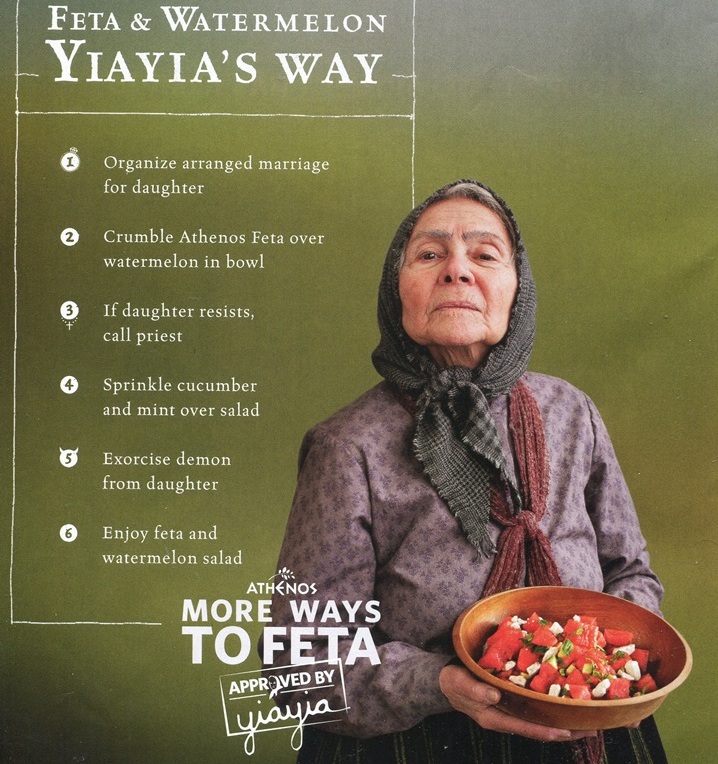
yiayiaad827

A reader flags it:

I received my August Bon Appetit magazine and as usual, eagerly sat down to read it as soon as it was delivered. I was dumbfounded when I came across this advertisement. To me, it seems like an overt case of ethnic stereotyping. I can understand the use of a traditional “yiayia” figure to advertise Greek food products, but to also have her include arranged marriage and exorcism on her to-do list seems outrageous. And oh yes, there are others ads in a similar vein – apparently in one, the yiayia calls her granddaughter a “prostitute.”

When I went to Athenos website and Facebook page, I am clearly not the only person who is offended by these ads. Athenos’ explanation (and boilerplate response to Facebook posts) is that they “didn’t intend to offend anyone” and were trying for a lighthearted approach, using a character “set in the old ways.” Apparently that means the traditional yiayia is a disapproving grump, putting her seal of approval only on the Athenos food items. As one of the Facebook commenters (with a Greek surname) said: “The only thing my yiayia would force anyone to do is eat a big plate of food.” I don’t know what is more offensive to me – the ad campaign, or Athenos’ dismissive “we didn’t mean to be offensive” responses.

Update from a reader:

I’m half-Greek (on my mother’s side) and HAD a Yiayia. Although my Yiayia was born in Greece, she emigrated when she was still a teenager and was Americanized enough in her thinking that she didn’t try to arrange marriages for her daughters, although HER marriage was, in fact, arranged by her family. Also, I have been to Greece and visited the very small village where my maternal grandfather grew up, and I can certainly envision contemporary Greek Yiayias who spent most of their lives living in that environment coming across pretty much like the Yiayia in the ad.

However, even if that were not true, I think the point of the ad is that “Feta and Watermelon Salad” would be something that a traditional Yiayia would approve of. Frankly, I think the ad is amusing, and as someone who loved his own Yiayia I can’t for the life of me understand what is so offensive about it.

One more thing, I am not at all sure that MY Yiayia would approve of Watermelon and Feta salad. It’s certainly not something that she ever served as far as I can remember. In fact, my sense is that she might actually be MORE LIKELY to disapprove of the Feta and Watermelon Salad than she would be to disapprove of arranged marriages.

Truvada And Women

It’s been a telling facet of the debate so far that the potential for the drug among women has been absent. This is often the case with AIDS drugs – the gay white rich men pioneer the treatments and only then do others get in on the action. But in some ways, it seems to me, the liberating potential of the anti-HIV drug is even greater for many women, especially in the developing world. A huge factor in their risk profile is the fact that their sexual partners often refuse to use condoms, and, in patriarchal societies, women are put at risk. Truvada might help shift that power differential. Two steps that could speed that process:

WHO needs to quickly issue guidance on PrEP for all of the populations that can benefit. truvadaThe data are strong enough to warrant this move, as the U.S. Centers for Disease Control and Prevention recently showed with its guidance that recommended that doctors consider oral PrEP for anyone at high risk of HIV infection … Gilead Sciences Inc., the maker of Truvada, needs [also] to move swiftly to secure regulatory approval in countries where PrEP is most needed. This starts with the countries that hosted clinical trials, where, tragically, PrEP is now out of reach. In two of those countries, South Africa and Thailand, Gilead recently filed for approval. This is an important and welcome step but the process needs to happen much faster and in more places. That requires both more aggressive efforts by Gilead and the willingness of national regulatory authorities to quickly review and approve the company’s applications.

The sooner the better. Update from a reader:

As a biomedical journalist, I have written about HIV for 20+ years. The US is the only place where regulators have approved a Truvada indication for PrEP; that label indication is not approved in Africa, Europe, even Canada. So it is appropriate to deal with PrEP in the context of the US. The CDC estimates that women constitute 20% of new infections and 24% of persons living with HIV in the US. The only data we have on who was prescribed PrEP was presented at ICAAC last September. In the first year after approval, 1774 persons started PrEP; 48% were women.

So it is decidedly NOT true that rich white gay men have been getting PrEP at the expense of other less favored socio-demographics.

Mental Health Break

Breaking the fourth wall:

Looking at you – Movie Montage from Brutzelpretzel on Vimeo.

Update from a reader:

A quick note: The vast majority of these clips are not really “Breaking the Fourth Wall.” They are simply POV shots, showing what one of the characters in the film is seeing. It’s an effective technique for helping the audience put themselves into the mind of one of the characters. But true breaking of the fourth wall is the direct acknowledgment of the audience. You are not being put in the position of a character; you are being asked to conspiratorially join in the movie.

My favorite versions are malevolent in nature; many remember several shots like this in the Austrian and American versions of Michael Haneke’s Funny Games, as one of the young killers turns to the camera and asks the audience their opinion. But my favorite comes in Atom Egoyan’s Felicia’s Journey as repressed serial killer Bob Hoskins slowly walks through his home, I believe up some stairs, presumably on his way to kill a young victim. And then he pauses, and looks directly at the camera for an uncomfortable moment, before continuing on. Essentially he was indicting us in his crimes, there are no passive observers.

Treating Prostitutes Like Children

Elizabeth Nolan Brown sees the Swedes doing so:

Many areas have adopted or are considering what’s known as the “Swedish” or “Nordic Model,” which criminalizes the buying, rather than the selling, of sexual services (because, as the logic goes, purchasing sex is a form of male violence against women, thus only customers should be held accountable). In this nouveau-Victorian view, “sexual slavery” has become “sex trafficking,” and it’s common to see media referring to brothel owners, pimps, and madams as “sex traffickers” even when those working for them do so willingly.

The Swedish model (also adopted by Iceland and Norway and under consideration in France, Canada and the UK) may seem like a step in the right direction—a progressive step, a feminist step. But it’s not.

Conceptually, the system strips women of agency and autonomy. Under the Swedish model, men “are defined as morally superior to the woman,” notes author and former sex worker Maggie McNeill in an essay for the Cato Institute. “He is criminally culpable for his decisions, but she is not.” Adult women are legally unable to give consent, “just as an adolescent girl is in the crime of statutory rape.”

From a practical standpoint, criminalizing clients is just the flip side of the same old coin. It still focuses law enforcement efforts and siphons tax dollars toward fighting the sex trade. It still means arresting, fining and jailing people over consensual sex. If we really want to try something new—and something that has a real chance at decreasing violence against women—we should decriminalize prostitution altogether.

Previous Dish on the Swedish model here. More Dish on prostitution in Europe here and here. Update from a reader:

I completely agree with the excerpts you posted from Elizabeth Nolan Brown. It is indeed a problem in many areas of feminism currently. Fighting for equality in all the “good” ways – like undoing all the ways they have been held back by being treated like children or less important or less intelligent – yet many feminists refuse to accept any of the “bad/negative” aspects of not being treated like children.

Anti-Zionism And Anti-Semitism

Pro Palestinian Demonstrations Are Held Throughout Europe

Some of the protests against the Israeli assault on Gaza have veered definitively into the realm of rank Jew-hatred. The NYT has a decent round-up of the worst today, and it’s especially troubling in France. As the world responds to Israel’s latest incursion in Gaza, Brendan O’Neill remarks on what he sees as the ever-thinning line between anti-Zionism and anti-Semitism:

[I]n the latest rage against Israel, it isn’t only the Israeli state or military that have come in for some loud flak from so-called radicals – so have the Israeli people, and even the Jews. In Paris on Sunday, what started as a protest against Israel ended with violent assaults on two synagogues. In one, worshippers had to barricade themselves inside as anti-Israel activists tried to break their way in using bats and planks of wood, some of them chanting ‘Death to Jews!’. Some have tried to depict such racist behaviour as a one-off, a case of immigrants in France losing control. But on that big demo at the Israeli Embassy in London last week some attendees held placards saying ‘Zionist Media Cover Up Palestinian Holocaust’, a clear reference to the familiar anti-Semitic trope about Jews controlling the media. On an anti-Israel protest in the Netherlands some Muslim participants waved the black ISIS flag and chanted: ‘Jews, the army of Muhammad is returning.’

His theory as to why this happens:

Why does being opposed to Israel so often and so casually tip over into expressions of disgust with the Israeli people and with the Jews more broadly? It’s because, today, rage with Israel is not actually a considered political position.

It is not a thought-through take on a conflict zone in the Middle East and how that conflict zone might relate to realpolitik or global shifts in power. Rather, it has become an outlet for the expression of a general feeling of fury and exhaustion with everything – with Western society, modernity, nationalism, militarism, humanity. Israel has been turned into a conduit for the expression of Western self-loathing, Western colonial guilt, Western self-doubt. It has been elevated into the most explicit expression of what are now considered to be the outdated Western values of militaristic self-preservation and progressive nationhood, and it is railed against and beaten down for embodying those values.

Koplow, meanwhile, flags some nasty Jew-bashing in Turkey:

Ankara’s mayor Melih Gökçek, fresh off the heels of tweeting out pro-Hitler sentiments, urged his government yesterday to shut down the Israeli embassy in Ankara, referring to it as “the despicable murderers’ consulate” and stating that “they are 100 times more murderous than Hitler.” Not to be outdone, Bülent Yıldırım, the odious head of the “humanitarian relief NGO” IHH – the same NGO that organized the Mavi Marmara flotilla – warned Jewish tourists (yes, he said Jewish rather than Israeli, and yes, that was deliberate on his part) not to show their faces in Turkey and threatened Turkish Jews that they would pay dearly for Israel’s actions in Gaza. …

I get the anger and frustration, and I see it personally from Turkish friends on my Facebook feed and my Twitter stream, who are furious with Israel not because they are Jew-hating anti-Semites but because they deplore the mounting civilian death toll in Gaza, which they see as disproportionate and excessive. … But there is a world of difference between criticizing Israel out of a deeply held difference of opinion versus comparing Israelis to Hitler, equating Israel with Nazi Germany, throwing around the term genocide, openly advocating violence against Israeli nationals and property, and threatening Jews over Israel’s behavior. It is completely beyond the pale, and anyone who cares a lick about liberal values should be denouncing it loud and clear without qualification.

Amen.

Update from a reader:

The Dish cites the incident outside the Synagogue de la Roquette, which has been basically debunked/seriously disputed – the President of the synagouge himself confirming the details of this alternative report, on video.

(Photo: A Pro-Palestinian demonstrator holds a placard with the symbols ‘Swastika equal to Star of David’ during a demonstration on July 17, 2014 in Madrid, Spain. By Pablo Blazquez Dominguez/Getty Images.)

Shifty Work Conditions

McArdle contemplates the current state of part-time labor:

Unfortunately, the weakness in the labor market has coincided with yet another market development: scheduling software and technology that allows retailers to manage their workforce as another just-in-time input.

Workers are asked to input blocks of hours when they will be available; the software then crunches through everyone’s availability and spits out a schedule that takes account of everything from weather forecasts to the danger that a worker will go over the maximum number of hours to still be considered part time. Obviously, you can’t string together multiple jobs this way, because each job requires that you block out many more available hours than you will actually work. Meanwhile, Steve Greenhouse reports on even worse practices that I hadn’t heard of: requiring workers to be “on call” at short notice or scheduling them for shifts and then sending them home if business looks light.

In this situation, no matter how hard you are willing to work, stringing together anything approaching a minimum income becomes impossible. That makes it much more deeply troubling than low pay.

Update from a reader, who brings up unions:

This is why anyone who works at a part-time job in a non-union shop is essentially a wage slave.

My company – a major grocery chain – uses similar software for scheduling, but union rules specifically rule out “on call” employees, or sending employees home during unexpectedly light business without their consent. In addition, it is strictly against the rules – and grounds for a grievance – to schedule an employee outside their available hours.

Thus many of our employees can work multiple jobs – several spend three or four days with us and another two or three with another employer (the only stipulation being it cannot be a competitor, obviously). Some even work making deliveries for our suppliers on their “off days”. It also means working moms can schedule themselves to be home when the kids arrive from school or daycare, students can reliably schedule college classes without worrying about work conflicts, etc.

Without union rules, none of this would be possible.

Superhero Social Justice

Kevin O’Keeffe relays the big news out of the comic book world:

Continuing the trend of diversifying their lineup of heroes, Marvel announced on last [week’s] episode of The Colbert Report that the next Captain America will be Sam Wilson – currently known as The Falcon. … It’s the second big change for Marvel’s Avengers this week. On Tuesday, the women of The View announced that the next Thor would be a woman. Like with Thor, the new Captain America isn’t an off-shoot series – this is the primary Captain America, and the first black Captain America to officially hold the title.

Freddie sighs at those he believes are confusing symbolic firsts for real progress:

The glee with which these changes have been met, contrasted with the bleak state of structural change and economic justice, will tell you pretty much all you need to know about a certain strain of contemporary American liberalism. We’re mere weeks away from a Supreme Court decision where an alliance of religious crazies and corporatists was able to remove a legal provision requiring employers to pay for emergency contraception, but don’t worry, ladies! You too can now be portrayed as a heavily-sanitized version of a minor god from a long-dead pantheon. Black Americans continue to lag national averages in a vast number of metrics that depict quality of life, and in some of them have actually lost ground, but never fear. The guy portrayed punching people while wearing red white and blue spandex will now be black.

Lighten up, Freddie. Progress comes in all forms, big and small. And it’s often the small cultural changes, added together, that have the most lasting impact. Ta-Nehisi put it best, in a post written four years ago, reacting to the news that Captain America was headed to the big screen:

One thing that makes me sad–I wish they’d been ballsy and made Captain America black. … The subtle power of a black Captain America–in the age of a black president–really could be awesome.

Also awesome:

So far, the Hollywood version of Captain America hasn’t made the same move as Marvel, but here’s hoping. Meanwhile, Danny Fingeroth explains the business logic behind these sort of decisions:

[T]he challenge for comics is how to retain the existing audience and also grow new readers. How do you keep the attention of someone who has read thousands of stories and also take advantage of the visibility and familiarity that the movies and TV shows have brought to the characters? (Interestingly, in recent years, more girls and women have started reading superhero comics again, perhaps lured to the comics by the popular movies and TV series.) One of the answers is to make seemingly radical changes in a character, such as having Thor become a female (or to have a black man become Captain America). The Internet buzz indicates that as many fans are outraged by the gender switch as there are those who are intrigued.

But Liz Watson remarks that “slightly unconventional decision—from casting Heath Ledger as the Joker to putting pants on Wonder Woman—is met with a level of feverish debate normally reserved for schisms within the Catholic Church”:

The equivalence between comic books and scripture is telling of how seriously canon is taken by these fans. To violate the status quo is akin to sacrilege.

The irony is that a format characterized by the boundless scope of imagination is ultimately extremely conservative when it comes to risks with character or story. Major developments like deaths or marriages are almost always undone, via fantastic contrivances ranging from deals with the devil to time-travel. Characters are de-powered, murdered, raped, aged up and down, and yo-yoed between universes with an alarming lack of fanfare. It’s the same problem suffered by long-running soap operas, where catastrophes are regularly smoothed over or forgotten in order to keep the premise going. At least on soap operas, actors leave over contract disputes or pass away. In comics, the stories can go on indefinitely. As such, the limitless nature of comic book fantasy is used, by and large, to keep limits in place.

Related Dish here on the recent move to introduce the first black woman as a major character to the Star Wars franchise. Update from a reader:

Great to see Marvel Comics finally catch up with the times, and finally catching up with DC Comics. However, like most things in the comic world, don’t expect this to be new normal. Don’t expect that Sam Wilson will be Captain America for 30 years, unlike DC’s Jon Stewart, an African American who’s been a Green Lantern for over 3 decades. Hell, for readers of a certain age group, Jon Stewart is the REAL Green Lantern due to having a prominent role in the acclaimed Justice League animated series. Or let’s not forget that Wonder Woman has been a pillar of DC’s “Trinity” (Superman, Batman, Wonder Woman) for over 6 decades, and has been headlining her own comic book for over 70 years.

There’s no doubt that the comic book industry (and its fandom) has a long way to go. Misogyny is still rampant, and there still exists an undercurrent of racism. But I think the current hagiography regarding Marvel does a disservice to the industry as a whole. Comic books have been at forefront of social issues from the very first Action Comics, when Superman was a crusading populist who was willing to kill slum lords, through Green Arrow having to deal with teen a sidekick who was a heroin addict (Green Lantern vol. 2, #85, August 1971, “Snowbirds Don’t Fly”), to an openly gay Golden Age superhero (Alan Scott, the original Green Lantern from the ’40s).  Did you also know that one of Green Arrow’s other sidekicks was HIV-positive? Google Mia Dearden.

If I’ve learned anything from my decades of reading comics, it’s that the more things change, the more things stay the same. Steve Rogers will be Captain America again, Thor will be male again, and we’ll wait another 5 years for some great barrier that was broken earlier to be broken again.
The View From Your Obamacare, Ctd

A reader has a jaded view:

It’s nice to see some of the stories you post about how much the ACA has helped people. The President Obama Visits Boston To Talk About Health Carestories where people mourn for those who refuse it and need it are sad. Allow me to present you with a third type, the people who aren’t eligible due to system bugs.

Yep. Jack and shit for my family. I tried to sign up, since my wife and kids’ coverage ended in May and the ACA won’t cover them. We aren’t rich. We’re lower-middle class, according to the federal poverty line, but out of red state Medicaid income levels. I tried the site – nothing but errors. I spent an hour or more on the phone and neither the persons I spoke to or their supervisors understand why they can’t process it for us. I could call my senator or congressman, but I doubt Lindsey Graham or Trey “Benghazi” Gowdy will investigate.

I’m disabled and currently get Medicare. Prior to May, my wife, two small kids and I all received Medicaid.

It was my secondary provider and the only coverage for my wife and kids. My wife had been in school full time and started working two jobs at the end of last year – one ultra low-paying factory job and another seasonal government position. A few months later she was offered a permanent position at the government agency. Our income went from close to the poverty line to significantly higher than that. Not wealthy or even upper middle class, but not subsistence level either. Our income increased and I didn’t want to accept benefits fraudulently, so I called up Medicaid and told them about the income change (not easy to do since the state has minimized the number of social workers) and they set coverage to end that month.

Next I use the ACA website calculators and make sure we are eligible. I try to process an application and there are tons of errors. This is on the federal site. My state (South Carolina) didn’t do anything regarding ACA exchanges. I then call up the ACA support line. He walks the app through the same way I just did and it says my family isn’t eligible. Nothing. He puts me on hold for long periods to consult supervisors. Nothing. My family’s coverage ended, we meet all criteria for coverage, we are all US citizens – born and raised here. Nothing.

No explanation. No assistance. Nothing. They couldn’t figure out why. We are eligible to get coverage outside of the yearly switch period due to loss of coverage according to the rules and staff. So we meet the requirements but the computer hates us.

Anyway, glad it’s working for someone I guess. Must be nice.

Update from a reader:

I’m confused about one notable detail – the writer mentions a wife who recently started a permanent government position. If this is a Federal position, the writer and the kids would almost certainly be eligible under the FEHB (Federal Employees Health Benefit program) – the full family coverage is more somewhat more expensive than individual plan, but very likely a pretty reasonable deal out of the wife’s paycheck.

If this were a state position – or certain (fairly common) local government positions – I think the family would be eligible for the different options available under the South Carolina’s Public Employee Benefit Authority coverage. It looks to me that the deals here are a bit more expensive than the options under the FEHB options, but that’s a pretty quick peek.

Only wrinkle I’d be able to imagine seems a little bit arcane/improbable to assume: if the wife were divorced and there were a former spouse that had a divorce decree requiring the wife to provide coverage, that might be an issue, since SCPEBA only allows one spouse to be covered, and the divorce decree’s mandate might trump the current spouse’s coverage.

In any case, I think that the wife checking with her benefits administrator about expanding coverage from individual coverage to full family coverage would be a more economical strategy than trying to insure the spouse or spouse and children under a separate ACA plan. Hopefully, this sort of request would be pretty common and straightforward for the wife’s benefits admin.

The original reader follows up:

Those options for federal workers don’t apply because it’s a union job and the contract provides for some weirdness. She can join the union any time but can’t get healthcare until she’s been working her contract for a year. Even then she wouldn’t be eligible for most of the other normal federal benefit programs like life insurance until she is “converted” to a career position.

Welcome to the new United States Postal Service. Career-track mail clerks and carriers begin in a position that pays similar to career posts or even more, while having virtually no other benefits except annual leave (paid time off). The USPS will pay for a large portion of our insurance premiums come next year, but until then we are out in the cold.

The family is in great health with the exception of me (here’s a plug for CIDP – Chronic Inflammatory Demyelinating Polyneuropathy – similar to MS). We were broke with insurance and now we’re less broke with the possibility of being broke again if a medical situation arrises.

It’s disappointing, but hey, my 2nd grader was doing algebra two years ago and his little sister is on the same path. They’ll be in college by 12 or 13. I can still type, knock on wood. Sometimes you win, sometimes you lose. I count myself lucky if anything this nation manages to do is actually aimed at helping me. If it doesn’t hit the mark, at least Obama tried.

(Photo by Yoon S. Byun/The Boston Globe via Getty Images)