Our Deep Divide Over Guns

A couple weeks ago, Adam Gopnik claimed that “the majority of Americans agree that there should be limits and controls on the manufacture and sale and ownership of weapons intended only to kill en masse.” Lisa Miller disagrees:

Americans are perhaps more divided on the issue of guns than they’ve ever been. In 2014, just 47 percent — less than half — of Americans said that gun laws should be “more strict,” according to Gallup, down from 58 percent after the Newtown shootings and 78 percent in 1990, the year James Pough killed ten people, most of them at a General Motors office, with a semi-automatic rifle.

Forty-two percent of Americans have a gun in their home, a percentage that has fluctuated by about 10 percentage points over the past generation but is not so far from the proportion that owned guns in 1960: 49 percent. Yes, according to a year-old Rasmussen poll, 59 percent of Americans favor a ban on semi-automatic weapons, like the one Adam Lanza used in Sandy Hook. At the same time, 70 percent of people say they’d feel safer living in a neighborhood where owning a gun was allowed. “The majority is there,” writes Gopnik, but nearly every shred of evidence points the other way: Despite what would seem to be its obvious benefits, a majority on gun control has thus far been impossible to muster, even in the aftermath of the Newtown shooting. …

To frame the gun debate, as Gopnik does, as sane versus insane, with gun-control advocates, such as himself, as those “who actually want to reduce the number of gun massacres” and pro-gun forces as both (his language) dishonest and unscrupulous “prefer[ring] an attachment to lethal symbols of power” is to misunderstand the issue — or to miscast it to support his fictional notion of a consensus of right-thinking people like himself.

And nowhere are the murky, volatile, and heartbreaking conflicts within the gun debate laid bare more than in Newtown. I spent a good deal of time there in 2013, reporting a story about the aftereffects of the shooting, and was surprised to find so much sensitivity — and so much disagreement — around the subject of guns. There was no consensus. The town priest, ostensibly a strong moral voice in town, shied from articulating a principled allegiance to one side or the other. Even in a place where 20 children had died at the hands of a madman with a gun, the most basic questions of how to prevent a reoccurrence hit the rawest of nerves. No one wanted to say where they stood for fear of offending a neighbor who might feel another way. On the question of assault rifles, “I don’t want to demonize anyone,” said a parent whose child was in the school that day and lived. He had become an activist for stronger gun laws, but he lives in town, and his pro-gun friends were as devastated by the events of December 14, 2012 as he was.

Update from a reader:

The Beltway consensus seems to be that meaningful gun control is no longer possible in the U.S. But there is lots of room for change that can protect lives. Here in WA state, we passed Initiative 594 in Nov., that closes the gun show and online sales loophole. We had hundreds of passionate volunteers working on this initiative, and backing by deep pockets both here and outside the state, people like Bill Gates and Nick Hanauer. Now we are mobilized to pursue additional legislation to keep guns away from the mentally ill, hold parents responsible when their underage kids use guns in crimes, and inform people when confiscated guns are returned to those they had filed restraining orders against. There is pride that we beat the NRA at their own game, and this is now a state-by-state battle.

The NYPD’s Record On Chokeholds

German Lopez voxplains a new set of findings:

The report, by the NYPD inspector general, looked at 10 cases involving chokeholds between 2009 and 2014. The Civilian Complaint Review Board recommended the most serious penalty in nine of 10 cases, but the NYPD reduced the punishment to lesser penalties — or none at all — in the cases that have been carried out to completion.

The NYPD’s guidelines explicitly ban the use of chokeholds no matter the circumstance. But the inspector general found police officers, in a practice called “particularly alarming” by the report, sometimes used chokeholds “as a first act of physical force in response to verbal resistance.”

Friedersdorf is troubled:

Consider one of those incidents:

In a Nov. 19, 2008, incident, a 15-year-old detained on robbery charges alleged he was choked by a sergeant while handcuffed to a rail inside a Bronx precinct house. CCRB substantiated the allegation based on another teenage witness in the station and the sergeant’s account.

Then-Commissioner Ray Kelly decided to impose the following punishment: no punishment at all.

New York City is policed on the theory that if small transgressions against law-and-order go unpunished, the ensuing disorder will result in a city where more serious crimes like homicide are more common. The NYPD flagrantly failed to police itself as officers engaged in violations of chokehold policy. Predictably, the tactic persisted. Yet later, when a chokehold contributed to Garner’s death, the cops disclaimed responsibility. They don’t want to be policed using the logic of their policing.

More incidents from the IG report highlighted here. The embattled mayor is downplaying the report, which, by the way, doesn’t include Garner’s fatal encounter. De Blasio’s nemesis, union boss Patrick Lynch, was true to form, calling the inspector general’s findings “anti-police bias”. And the police commissioner?

[Bill Bratton] believes better training can give cops better alternatives, and reduce not just the use of chokeholds but the chances of chokehold-related tragedies like the death of Eric Garner. … And Bratton is vehemently opposed to one step, proposed by the City Council — to make chokeholds illegal. “You cannot make it illegal because then it is really putting cops at risk,” Bratton told me in December. “Because there’s going to be times when they’re in one of these street fights, if they feel that they’re at risk of losing and they’re worried about themselves being overcome. Cops are authorized to use force appropriate to the threat.”

And this time cops should have no doubt about whose side Bill de Blasio is on. “Oh yeah, the mayor clearly understands that there are going to be instances where a cop is going to use a chokehold in a life-or-death situation,” Bratton says. “In that case, anything goes.”

Meanwhile, Caroline Bankoff checks in on the stoppage:

At the end of last week, Bill Bratton declared the NYPD work stoppage “over in the sense that the numbers are starting to go back up again.” “I anticipate by early next week that the numbers will return to their normalcy,” he added. The New York Times reports that the numbers do seem to be behaving as Bratton predicted: “In total, officers made 4,690 arrests in the week ending on Sunday, police statistics showed, according to a precinct commander who saw the numbers. The number is below the 7,508 in the same week in 2014, but above the 2,401 made between Dec.

Update from a reader:

The post regarding the recent report by NYC’s Civilian Complaint Review Board is quite misleading. A full report is available in this pdf. A crucial point that is being overlooked by many is as follows:

In its more comprehensive report on chokeholds issued in October 2014, CCRB reported that from 2009 through June 2014, CCRB received and disposed of 1,082 complaints alleging 1,128 chokehold allegations by NYPD officers. Of the 520 chokehold allegations that it investigated fully, CCRB substantiated ten chokehold allegations.

Thus, the CCRB was able to substantiate around 0.9% of the chokehold allegations during a 5-year period. I will grant you that a harder look should have been taken at those cases and perhaps some additional training might be helpful. But we all need to remain mindful of the big picture here and lay off of the sensationalism. Less than 1% is a microscopic number in a city the size of New York with a police force of over 30,000.

When Film Is Your Filter

David Shariatmadari reviews Flicker, the new book by neuroscientist Jeff Zacks that looks at “the influence of moving images on our perception of reality”:

Zacks sets out the wealth of experimental evidence which shows that a filmed version of events will likely override our knowledge of the facts. Not only because superstimuli are so compelling, but because we’re not very good at remembering the sources of information that inform our opinions. Was that in the local paper or did my friend tell me about it? Did I learn that from a history book or from watching Cate Blanchett in Elizabeth? Was I watching Osama bin Laden in the film Zero Dark Thirty or in a documentary? The political implications are huge, if not entirely unexpected: Hollywood can win hearts and minds at the expense of the truth.

In a November review of Zacks’ book, Noah Berlatsky expanded on that last point:

Why do people have such trouble distinguishing fact and fiction? The answer, Zacks argues, is that our brains are model-building machines. “The hard-core version of the model-building account,” he explains, “says that when we understand a story just by reading it, we fire off the same neural systems that we use to build models of the real world.” Zacks tried to validate this model by using fMRI scanning while people watched films—and what he discovered was that when, for example, a character on screen reaches for an object, the fMRI showed activity in the area corresponding to motor hand control. Because of these and related experiments, Zacks is convinced that “memories of our lives and memories of stories have the same shape because they are formed by the same mechanisms.” He concludes: “It is not the case that you have one bucket into which you drop all the real-life events, another for movie events, and a third for events in novels.” Your model-building brain “is perfectly happy to operate on stuff from your life, from a movie, or from a book.”

That’s “a big part of the appeal of narrative films and books,” Zacks argues. “[T]hey appeal to our model-building propensities.” But it’s also why we have trouble separating out what’s real and what’s fiction. Human brains use models to understand reality, and it doesn’t matter whether the model is labeled “fiction” or “fact.”

Update from a reader:

I am sort of embarrassed to say I know MUCH more about the presidency of Jed Bartlett and the government of his day than I have known about any in real life. The West Wing sent me to the dictionary and the encyclopedia to see which things were real and which were for dramatic effect. I learned a bunch about the real government because of that show, so I guess it’s ok, but yeah.

The Mysterious World Of Female Ejaculation, Ctd

It just got a little less so:

Researchers are now saying that squirting is essentially involuntary urination.

Female ejaculate is technically the small amount of milky white fluid that’s expressed when climaxing, New Scientist explains. Squirting, on the other hand, results in a much larger gush of a clear fluid, which comes from the urethra, the duct where urine is conveyed from the bladder. The findings, which combine biochemical analyses with pelvic ultrasounds, were published in the Journal of Sexual Medicine on Christmas Eve.

More details from that New Scientist piece:

To investigate the nature and origins of the [milky white fluid purportedly from the Skene glands], Samuel Salama, a gynaecologist at the Parly II private hospital in Le Chesnay, France, and his colleagues recruited seven women who report producing large amounts of liquid – comparable to a glass of water – at orgasm. First, these women were asked to provide a urine sample. An ultrasound scan of their pelvis confirmed that their bladder was completely empty. The women then stimulated themselves through masturbation or with a partner until they were close to having an orgasm – which took between 25 and 60 minutes.

A second pelvic ultrasound was then performed just before the women climaxed. At the point of orgasm, the squirted fluid was collected in a bag and a final pelvic scan performed. Even though the women had urinated just before stimulation began, the second scan – performed just before they climaxed – showed that their bladder had completely refilled. Each woman’s final scan showed an empty bladder, meaning the liquid squirted at orgasm almost certainly originated from the bladder.

A chemical analysis was performed on all of the fluid samples. Two women showed no difference between the chemicals present in their urine and the fluid squirted at orgasm. The other five women had a small amount of prostatic-specific antigen (PSA) present in their squirted fluid – an enzyme not detected in their initial urine sample, but which is part of the “true” female ejaculate

As a parting thought, Salama “believes every woman is capable of squirting ‘if their partner knows what they are doing'”. You can head to YouTube for that. Previous Dish on the subject here. Update from a reader:

Thank you for officially ruining female ejaculation for me. I cringed when I read the first sentence of your post and realized that all those years I was getting peed on and loving it. Dammit. Good thing I was always coming from swim practice and had my swim goggles handy!

Another:

I would dearly love to read the grant proposal for that research. Especially the informed consent form.

An Annual Dry Spell

dish_drynuary

John Ore explains Drynuary, the tradition of giving up alcohol for the month following New Year’s:

Make no mistake: If you like drinking, Drynuary is hard, and it’s supposed to be. I’m not particularly religious, but I appreciate the Lenten aspect of giving up something I enjoy for an extended period of time just to say I can. (My birthday falls during Lent, so no way am I giving up drinking then.)

Drynuary forces us to consider the the role alcohol plays in our everyday lives, especially when its absence is the most obvious or stark. My wife and I don’t hibernate for a month, sipping herbal teas and avoiding glances at the stemware and the three neglected beers left in the fridge. There are still the NFL playoffs, and the college football championship, and concerts and recreational beer-league ice hockey. Our first Drynuary we met friends at a sports bar to watch football, and the amount of club soda we downed led to plenty of speculation that we were expecting. Ive been the designated driver for post-snowboarding pub crawls and I’ve had to explain to business associates why I’m not having wine with dinner while traveling for work. Half of the point of Drynuary is to live your life as you normally do, just without drinking.

For last year’s Drynuary, Jolie Kerr created a guide for the uninitiated:

If it’s so hard, doesn’t that mean you have a problem?

Yes and no. But more no than yes. Think of it this way: If you decided to give up chocolate for a month—or sourdough bread, or Irish butter, or picking at ingrown hairs, or whatever it is that you love most in this world—it would probably suck. You would probably say, “Gosh, this is hard!” Would that mean you had a problem with chocolate or sourdough bread or Irish butter or picking at ingrown hairs? Maybe. But probably not.

And what about the health effects of a month on the wagon? Amy Guttman looks at what happened when staffers at New Scientist experimented with foregoing drinking for five weeks:

Dr. Rajiv Jalan, a liver specialist at the Institute for Liver and Digestive Health at University College London, analyzed the findings. They revealed that among those in the study who gave up drinking, liver fat, a precursor to liver damage, fell by at least 15 percent. For some, it fell almost 20 percent.

Abstainers also saw their blood glucose levels — a key factor in determining diabetes risk — fall by an average of 16 percent. It was the first study to show such an immediate drop from going dry, Dr. James Ferguson, a liver specialist at Queen Elizabeth Hospital Birmingham in England, told us last year.

Update from a reader:

I really enjoyed your post on Dryanuary. As it happens, I do the same thing – go 30 days or more without consuming any alcohol – but I do it in August, instead of January. I like to joke that I am “giving my liver a break” before football season starts, but it’s become a tradition that I’ve maintained for over a dozen years now.

I originally gave it the boring name of “abstinence month,” but several years ago a friend of mine my friend started calling it “Tomadan,” a portmanteau of my first name and the Islamic holy month of fasting. And the name has since stuck so that now all my friends understand “Thomas can’t drink with us tonight because he’s on Tomadan.”

It’s not always easy. There are times when the Texas heat is such that there is nothing more I want than an ice cold beer. But I’ve always managed to resist, and at the end of the month I come away with a feeling of satisfaction that makes that first beer of football season taste so much better.

Plus, I’m a little thinner and my wallet is a little fatter.

(Photo by Flickr user Apionid)

Nous Sommes Charlie, But Do We Really Want To Be? Ctd

https://twitter.com/RaniaKhalek/statuses/553261940223778818

Update from a reader on the above image:

That cartoon looks bad, but if you understand the French, the meaning seems to me to be actually anti-racist. “La GPA” is “la gestation pour autrui,” or in English “surrogate motherhood.”  The point of the cartoon is that when wealthy white couples pay poor women of color to be their surrogates, they are exploiting them. The point is somewhat bluntly and crudely made, but not at all offensive to my sensibilities. Others may differ, I suppose.

Jordan Weissmann urges us not to be afraid to criticize Charlie Hebdo‘s over-the-top (and often lame) humor even as we stand in solidarity with the victims of Wednesday’s terror attack:

So what should we do? We have to condemn obvious racism as loudly as we defend the right to engage in it. We have to point out when an “edgy” cartoon is just a crappy Islamophobic jab. We shouldn’t pretend that every magazine cover with a picture of Mohammed is a second coming of The Satanic Verses.

Making those distinctions isn’t going to placate the sorts of militants who are already apt to tote a machine gun into a magazine office. But it is a way to show good faith to the rest of a marginalized community, to show that free speech isn’t just about mocking their religion. It’s hard to talk about these things today, when so many families, a country, and a profession are rightfully in mourning. But it’s also necessary.

In Arthur Chu’s viewCharlie often violated satire’s unspoken rule to “punch up, not down”:

I mean, Muslims in France right now aren’t doing so great. The scars of the riots nine years ago are still fresh for many people, Muslims make up 60 to 70 percent of the prison population despite being less than 20 percent of the population overall, and France’s law against “religious symbols in public spaces” is specifically enforced to target Muslim women who choose to wear hijab—ironic considering we’re now touting Charlie Hebdo as a symbol of France’s staunch commitment to civil liberties.

Muslims in France are clearly worse off overall than, say, Jean Sarkozy (the son of former president Nicholas Sarkozy) and his wife Jessica Sebaoun-Darty, but Charlie Hebdo saw fit to apologize for an anti-Semitic caricature of Ms. Sebaoun-Darty and fire longtime cartoonist Siné over the incident while staunchly standing fast on their right to troll Muslims by showing Muhammad naked and bending over—which tells you something about the brand of satire they practice and, when push comes to shove, that they’d rather be aiming downward than upward.

The firing of Siné indeed showed a shameful double standard. Jonathan Laurence’s concern is that the chorus of “je suis Charlie” will play into the hands of the far right and normalize nastiness toward Muslims:

When the shock and sadness recede, it will become apparent that despite hashtags to the contrary, not all French “are Charlie Hebdo.” Numerous Catholic and Muslim groups offended by their cartoonists regularly filed lawsuits for incitement of racial or religious hatred against the newspaper—including after they republished the Danish prophet cartoons. Despite the understandable temptation to enter into a clear-cut opposition of “us versus them,” we can only hope that other political leaders will emerge to urge caution and respect while rejecting the murderers with every fiber of their being. It would be an unfortunate irony, and a distortion of these satirists’ legacy, if “politically incorrect” became the new politically correct.

Dreher asks whether Americans would be so quick to say “je suis” if the victims were from an organization we were more familiar with:

I can’t speak for French sensibilities, obviously, but here in America, it’s easy for us on both the Left and the Right to join the Je suis Charlie mob, because it costs us exactly nothing. Nobody here knows what Charlie Hebdo stands for; all we know is that its staff were the victims of Islamist mass murder, of the sort with which we are all familiar. We know that this murder strikes at one of the basic freedoms we take for granted: freedom of speech, and freedom of the press. Feelings of solidarity with those murdered souls are natural, and even laudable.

But what makes it kitschy is that we love thinking of ourselves standing in solidarity with the brave journalists against the Islamist killers. When the principle of standing up for free speech might cost us something far, far less than our lives, most of us would fold. You didn’t see liberals wearing “I Am Brendan Eich” slogans; many on the Left think he got what he deserved, because blasphemers like him don’t deserve a place in public life. Nor did you see conservatives brandishing “I Am Brendan Eich” slogans, because they feared they might be next.

Hear hear. Beutler, for his part, doesn’t think we need to praise Charlie in order to stand against terrorism:

The massacre in Paris has awakened a liberal tendency to valorize all objects of illiberal enmity. If an Islamist kills a westerner for a particular blasphemy, then the blasphemy itself must be embraced. We saw something similar just last month when countless Americans, rightly aggrieved by the extortion of a U.S.-based movie company, became determined to find reason to praise a satirical film they would’ve otherwise panned. This is clearly not always the correct reaction to terrorism or extortion. Here, liberals can learn a lesson from Second Amendment absolutists who nevertheless condemn open-carry demonstrations in fast food restaurants.

Likewise, Drum objects to the Dish’s framing of decisions by the WaPo and other news outlets not to republish Charlie’s cartoons as “capitulations”:

Anyone who wishes to publish offensive cartoons should be free to do so. Likewise, anyone who wants to reprint the Charlie Hebdo cartoons as a demonstration of solidarity is free to do so. I hardly need to belabor the fact that there are excellent arguments in favor of doing this as a way of showing that we won’t allow terrorists to intimidate us. But that works in the other direction too. If you normally wouldn’t publish cartoons like these because you consider them needlessly offensive, you shouldn’t be intimidated into doing so just because there’s been a terrorist attack. Maintaining your normal policies even in the face of a terrorist attack is not “capitulation.” It’s just the opposite.

But the WaPo is a news organization, and these cartoons are at the heart of the news story of the Western world right now. News outlets can post the Charlie cartoons simply to show what all the fuss is about, without endorsing the images in the slightest. But as Dan Savage rightly asserts, they refuse to do so out of fear – the kind of fear that terrorists thrive on. The Dish, as it happens, has never posted anything from Charlie Hebdo outside the context of Islamists threatening or attacking them, mostly because their satire isn’t terribly good. Several years ago we posted a few cartoons from Carlos LaTuff before discovering that he’s a vile anti-Semite and that many of his cartoons reflect that (though not the two we posted), so we have since refused to feature any of his work. But if LaTuff became part of a news story like Charlie Hebdo has, we would certainly post his offending cartoons – like we did earlier this afternoon. Stephen Carter gets it right:

Many news organizations, in reporting on the Paris attacks, have made the decision not to show the cartoons that evidently motivated the attackers. This choice is sensibly prudent — who wants to wind up on a hit list? — but from the point of view of the terrorist, it furnishes evidence for the rationality of the action itself. Killing can be a useful weapon if it gets the killer more of what he wants. Terror seeks to raise the price of the policy to which terrorists object. In that sense it’s like a tax on a particular activity. In general, more taxes mean less of the activity. If you don’t want people to smoke, you make smoking more expensive. If you don’t want people to mock the Prophet Muhammad, you kill them for it. The logic is ugly and evil, but it’s still logic. …

The terrorist knows what scares us. He believes he also knows what will break us. Our short-run task is to prove rather than assert him wrong. In the long run, however, the only true means of deterrence is the creation of a new history, in which the terrorist is always tracked to his lair, and never gets what he wants.
Who Won’t Republish Charlie’s Cartoons? Ctd

A reader makes a good point:

In general, I completely agree with the notion that the offending cartoons are newsworthy and should be published (I recently changed my Facebook photo to the “kissing a Muslim man” Charlie Hebdo cartoon precisely to make that point). But I do want to call attention to one major difference about out about the various media outlets that Christopher Massie refers to. “Legacy” organizations have journalists working on the ground throughout the world while newer digital outlets generally don’t. I wouldn’t be surprised if the primary factor in the decision not to publish those cartoons was protecting the safety of  reporters and safeguarding their ability to continue reporting from around the globe.

If BuzzFeed and Slate had journalists and photographers on their payroll working in Riyadh, Jakarta, or Damascus, I’m not convinced those organization would be so quick to reprint the offending images. It’s a heck of a lot easier to post a cartoon of a crying Mohammed when you’re in Manhattan than if you’re working for a news bureau in Cairo.

Update from a Dutch reader:

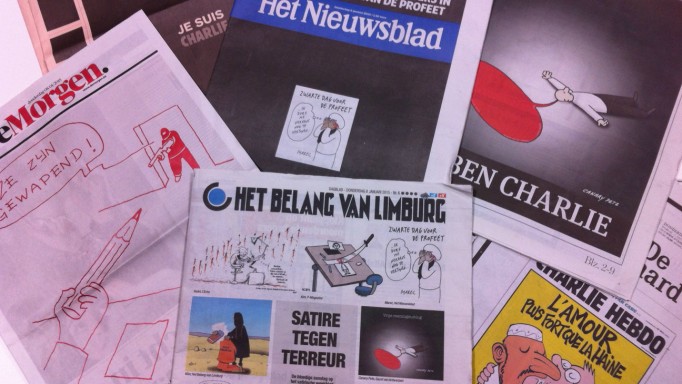
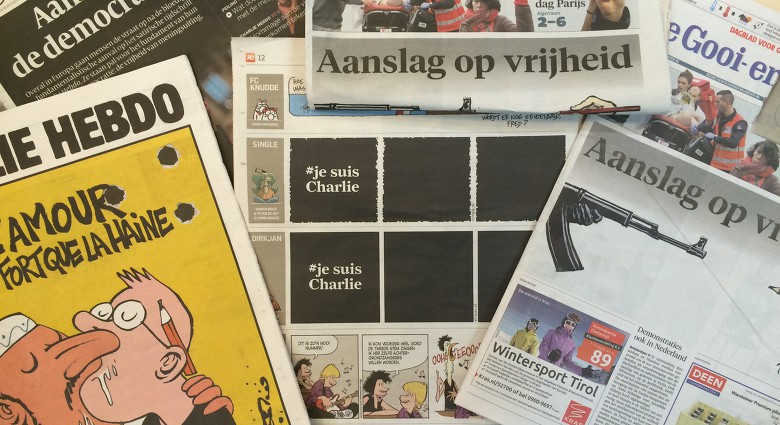
I have to call bullshit on that. Here are some Dutch front-pages from the day after:

dutch

And Flemish front-pages:

flemish

So plenty of Dutch and Flemish newspapers had Charlie cartoons on their front-pages, and all had them inside. And from Germany:

german

And here’s a slideshow of other front-pages from around the world. You think those papers have no international correspondents?

Not publishing insulting religious cartoons is a typical American problem. I read a comment somewhere in the Dutch or Flemish media that suggested that since America is so much more religious than Europe, mockery of religion in general is a no-go area in the US. And that’s true. There is no serious mockery of religion in the US. Bill Maher may be the exception to that rule, and see how much crap he gets for it. The sharpest criticism of religion comes from Stephen Colbert, a devout Catholic himself.

Remember the mess when South Park wanted to show Muhammed in an episode? No-go, said Comedy Central.

Though Matt and Trey were able to get away with this crap-fest in lieu of Muhammed:

Another reader points to a notable exception in the US:

I hate to burst the first reader’s bubble about legacy new orgs, but Bloomberg News has reporters all over the world and in the places the reader mentioned, and it published every one of the “offensive” cartoons. Here’s the main one I’m thinking of, and other images have run with various stories Bloomberg writers have covered on different aspects of what’s going on.

And as we noted earlier, the WaPo did in fact publish a Charlie cover featuring Muhammed, in the opinion section. Money quote from Fred Hiatt:

I think seeing the cover will help readers understand what this is all about.

Precisely.

The View From Your Winter Freeze

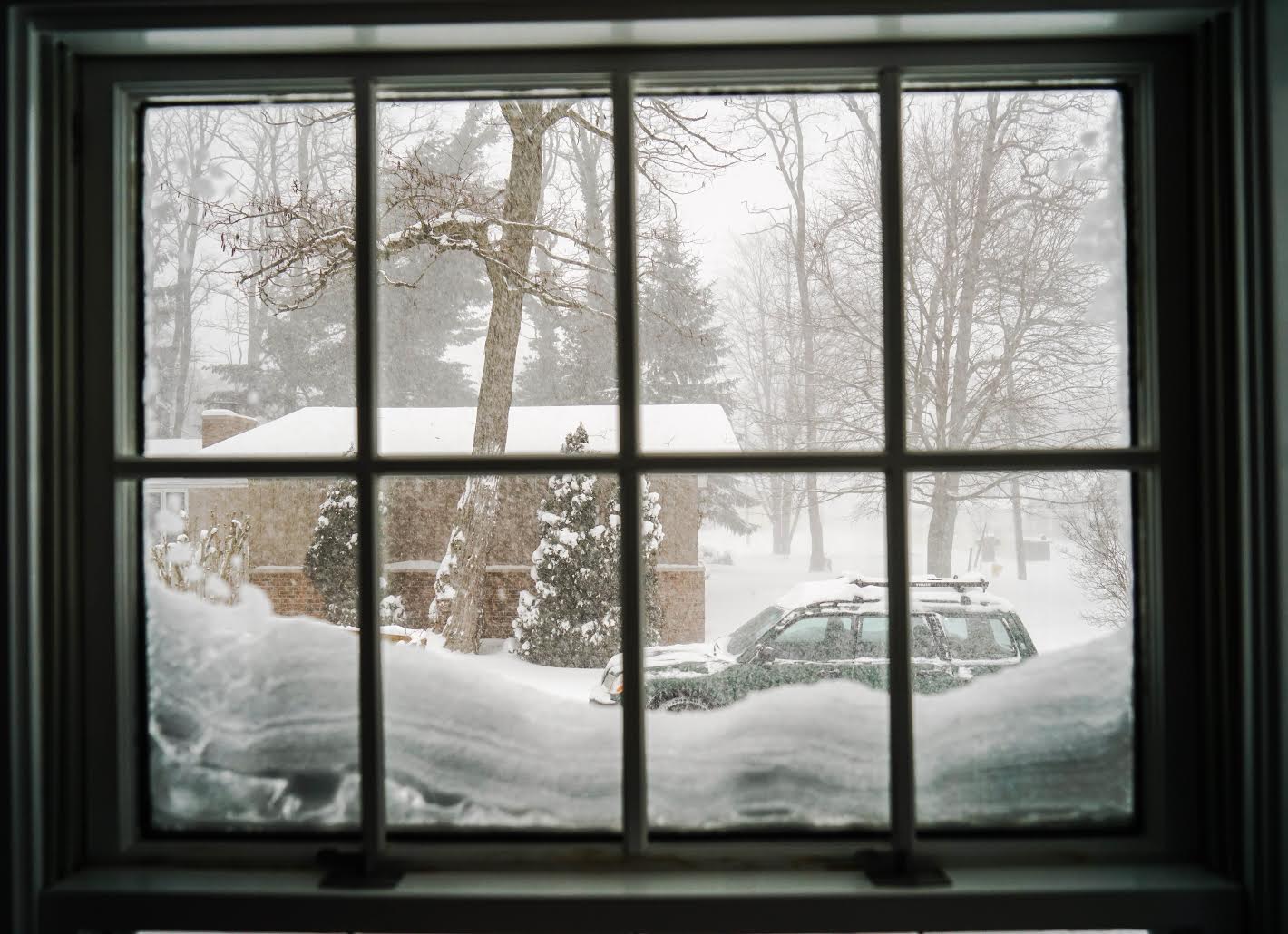
Winnipeg, Manitoba at 2-50pm

Winnipeg, Manitoba, 2.50 pm.

Many more after the jump:

It's a blizzard in Norton Shores, Michigan.  About 4-45pm

“It’s a blizzard in Norton Shores, Michigan. About 4.45 pm”

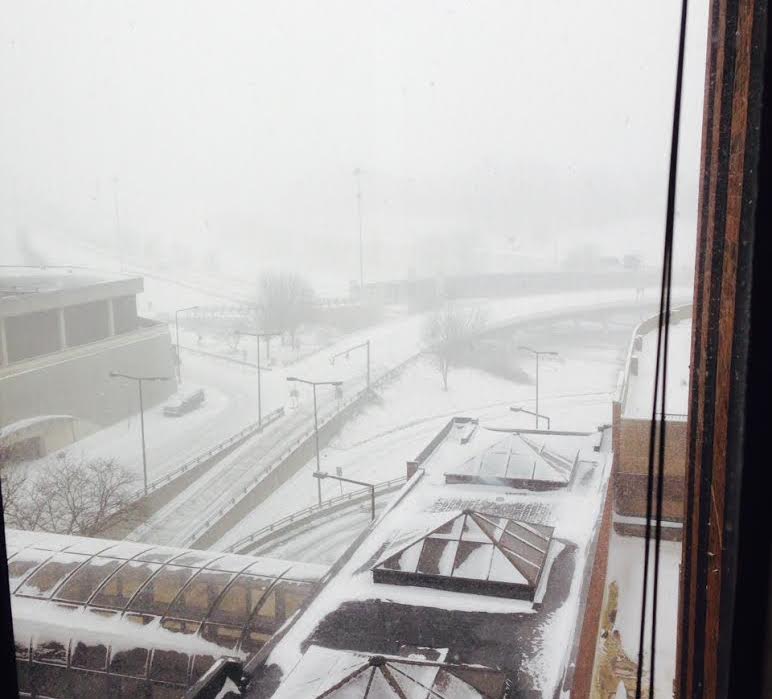
Akron-OH-1242pm

Akron, Ohio, 12.42 pm

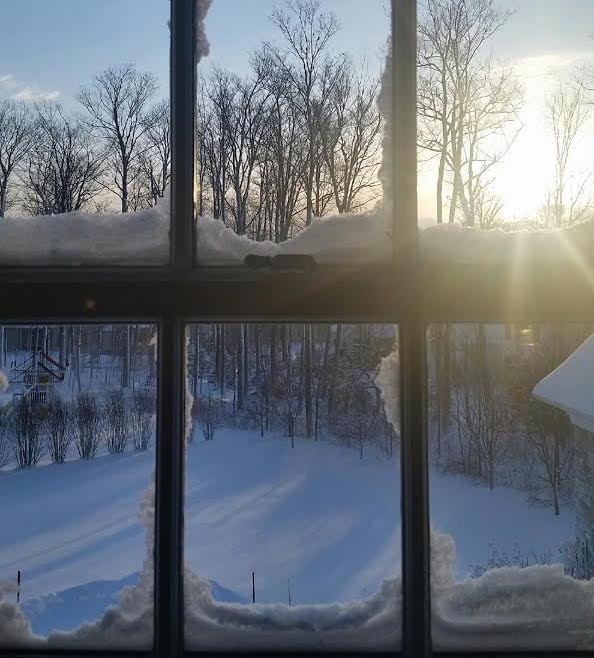
West Hartford, Ct, 4PM

West Hartford, Connecticut, 4 pm

Providence, RI-957am

Providence, Rhode Island, 9.57 am

buffalo-8am

Clarence, New York, 8 am

Essex Junction, Vermont 12.06 pm

Essex Junction, Vermont, 12.06 pm

Queens-901 AM

Queens, New York, 9.01 am

It's fucking cold today in New Haven, CT. It's pretty, like Siberia is pretty.

“It’s fucking cold today in New Haven, CT. It’s pretty, like Siberia is pretty.”

Update from a reader:

stop-whining

“It’s pretty, like Siberia is pretty.”

*snort*

Memo to the East Coast: Stop whining.

Another retorts:

Proud New Yorker here – that would be the state, but not the city – and thus certifiable East Coaster. Am I supposed to be impressed that it’s 4°F in Wisconsin? Dude, yesterday it was -18°F in my hometown, and that was warm for the area:

NCPR-temps

Get a grip, Midwest.

PS — I hope Andrew feels better soon!

Les Limites De La Liberté

B60MfNeIgAAnudL-540x272

Judah Grunstein discusses how France’s conception of “free speech” differs from the more robust American version:

Both France and America make the sanctity of free speech a core principle. But at various times over the past 14 years that I have lived here in France, I have been called on by my American friends to “translate” just what the French mean by “free speech.” In particular, they have been perplexed by the willingness to place limits on speech and, relatedly, religious expression here. This first became visible in the context of the law against wearing veils in public schools and government buildings. More recently, it arose when the government banned the one-man show of the ostensible comic Dieudonné, due to offensive jokes about the Holocaust and gas chambers.

Put simply, in France, racist and anti-Semitic speech, as well as historical revisionism regarding the Holocaust, is illegal, as is all speech that can be considered an incitement to hate. That is something that very few Americans understand—or approve of.

Jonathan Laurence notes a crucial caveat to France’s hate-speech protections: they’re not extended to Muslims:

The last lawsuit to be filed against Charlie Hebdo in 2014 was declared ineligible only because Islam doesn’t qualify for the special legal regime that criminalizes blasphemy against Christianity and Judaism in the Alsace region. And the British Muslims in 1989 wanted authorities to invoke British blaspehemy laws, not the shar’ia, to sanction Salman Rushdie’s novel – but there too Islam did not qualify for protection.

Greenwald calls out hypocrisy among those defending Charlie Hebdo on the basis of free speech, and passes along some cartoons – of which the one above is the least offensive – that he suspects we would not be so quick to defend:

[I]t’s the opposite of surprising to see large numbers of westerners celebrating anti-Muslim jews_image081-540x702cartoons – not on free speech grounds but due to approval of the content. Defending free speech is always easy when you like the content of the ideas being targeted, or aren’t part of (or actively dislike) the group being maligned.

Indeed, it is self-evident that if a writer who specialized in overtly anti-black or anti-Semitic screeds had been murdered for their ideas, there would be no widespread calls to republish their trash in “solidarity” with their free speech rights. In fact, Douthat, Chait and Yglesias all took pains to expressly note that they were only calling for publication of such offensive ideas in the limited case where violence is threatened or perpetrated in response (by which they meant in practice, so far as I can tell: anti-Islam speech).

The Dish, of course, is an equal opportunity republisher of trash, as long as it’s relevant and newsworthy. In a sharp post, Sullum argues that France’s hate speech laws indirectly enabled Wednesday’s violence:

I am not saying yesterday’s massacre can be blamed on France’s hate speech laws. Although at least two of the perpetrators were born and raised in France, there is no evidence that they cared about the content of these statutes or that they needed any additional justification beyond their own understanding of Islam. But it is hypocritical and reckless for a government that claims to respect freedom of the press to criminalize images and words based on their emotional impact. Although such laws are defended in the name of diversity and tolerance, it is the opposite of enlightened to invite legal complaints aimed at suppressing offensive messages.

Instead of facilitating censorship by the sensitive, a government truly committed to open debate and freedom of speech would make it clear, in no uncertain terms, that offending Muslims (or any other religious group) is not a crime. Sacrilege may upset people, but it does not violate their rights. By abandoning that distinction, avowed defenders of Enlightenment values capitulate to the forces of darkness.

On the other hand, as Luke O’Neil notes, there’s plenty of free speech hypocrisy to be found right here in the USA:

[T]he self-professed most patriotic citizens in this country harp on our military’s presence in countries like Afghanistan and Iraq, insisting that, if not for these brave soldiers, the very foundation of our culture—our speech freedoms—would collapse overnight. Yet those who question the unwavering justness of any action by the American military are often invited to shut their mouths, or given directions to the nearest port of exit. It wasn’t that long ago that entertainers like the Dixie Chicks were being roundly denounced and taken off the air for having the temerity to question our country’s wars.

Nick Gillespie is sad to say that he “will not be surprised if the Charlie Hebdo massacre has the effect of increasing support for hate-speech laws in the United States “:

Many Americans who don’t particularly care about freedom of speech may look on the carnage and conclude it makes sense to avoid such scenes by stifling expression. Social Justice Warrior types will take another long look at Jeremy Waldron’s 2012 book, The Harm in Hate Speech, and gussy up their interest in controlling thought and social interactions with philosophical language and social-scientific “rigor.” Conservatives, sniffing out a possible way to screw liberals and libertarians, may rediscover The Weekly Standard’s case for censorship and decide, hell, it makes a lot of sense. Aren’t Christians the folks who are picked on in America and treated unfairly by the media and intellectuals? It’s always “Piss Christ” and never “Piss Mohammed,” right?

Which makes it more important not simply to show solidarity with the dead and wounded in France but to rehearse the arguments for unfettered trade in ideas and speech.

Update from a reader, who remarks on the cartoon seen at the top of the post, created by the anti-Semitic Carlos LaTuff:

This is a completely false equivalency, and really gets to the heart of the cultural gap at play. To secularists like the cartoonists at Charlie Hebdo, Mohammed is a man like any other, he is no prophet, he is aggrandized by a religion, and is therefore a legitimate target of satire, just like the the Pope, or Jesus, or even the Dalai Lama if one is so inclined. The Holocaust was systematic genocide based on religion/ethnicity. I’m not saying that jokes against the Holocaust should be off limits, there should be no limits.

A better choice would be a “Cartoons of Jesus, or Moses, or John the Baptist” in the place of the “Cartoons of Holocaust.” (If you did, you would be as likely to find the Westerner laughing at both. Unless it is Bill Donahue, who is incapable of laughter.) You simply cannot equate the murder of millions to making fun of a religious figure. One is a group of real human beings. The other is an idealized version of a person who claimed God spoke to him in a cave.

The reason for drawing Mohammed is less about a specific set of religious beliefs, it is about, (forgive me), forbidden fruit. Don’t tell me not to take a taste of that apple, or draw that picture. There is something wonderfully defiant in the human spirit when told we cannot have, or do something. I’m grateful to the cartoonists who were killed for having that spirit, and expressing it.