Ray Rice Returns

Over the weekend, news broke that his suspension from the NFL had been overturned. Caroline Bankoff explains the sequence of events:

Along with the NFL Players Association, Rice appealed his suspension. In a double-jeopardy-type defense, Rice said he told [Roger] Goodell exactly what happened in the elevator during a meeting held after the first video was released, which meant that the release of the more graphic footage should not have resulted in a second penalty.

Meanwhile, Goodell maintained that the second video showed a “starkly different sequence of events” than those described to him by Rice. (Among other things, Goodell claimed that Rice told him that he had merely slapped Janay and that she subsequently fell into a railing and knocked herself unconscious, but that story didn’t appear anywhere in the records of the meeting.) In the end, former federal judge Barbara S. Jones sided with Rice.

Scott Lemieux comments:

Yes, if the NFL had a competently designed system of punishment, knocking a woman unconscious would not merit a significantly lower suspension than using recreational drugs.  Nonetheless, the NFL did not have such a system when Rice committed the offense (and, for that matter, doesn’t now, but anyway.)  The idea that Rice should retroactively receive a greater punishment than Goodell thinks a domestic offender should get in a standard announced after the fact because he “lied to Goodell” is absurd on its face.  And the absurdity is compounded by the fact that it’s vastly more likely that Goodell is lying than Rice is.

Kevin Drum also warily approves of the decision:

Ray Rice committed a crime. We have a system for dealing with crimes: the criminal justice system. Employers are not good candidates to be extrajudicial arms for punishing criminal offenders, and I would be very, very careful about thinking that they should be.

Kavitha A. Davidson has more on the labor angle:

The ruling in no way exonerates Rice. It is not an excuse for his actions or a sign that his brutal beating of his wife was not deserving of stiff punishment. It’s not a commentary that domestic violence discipline is out of the NFL’s purview. It’s not even an explicit acknowledgement that Ray Rice deserves a second chance to play professional football.

Rather, this ruling is purely an indictment of the entire NFL disciplinary process.

Ed Morrissey considers Rice’s future in football:

Rice will play again, even if it’s next year and on a team that doesn’t care about bad publicity. That would make the Oakland Raiders and the Washington Redskins the two most likely options for Rice, the latter of which got bad PR just for tweeting out a Happy Thanksgiving message yesterday. If that’s all it takes for the social-justice warriors to come unglued, having Rice in the backfield won’t make matters any worse than they already are.

Make no mistake: if a team signs Rice, then every time the anti-domestic violence ad runs during an NFL game, people will scream about the hypocrisy the team that signs him is demonstrating. And the critics won’t be entirely wrong, either.

Mike Barnicle offers a note of pessimism:

Roger and the NFL will now have to face the severe consequences of their incompetence or indifference toward the crime of domestic abuse: A few days of embarrassing publicity.

That’s it. That’s all that’s going to happen. Nothing more.

How come? Because the National Football League is a cultural and economic powerhouse. It dominates Sunday in America. And Monday night. And Thursday night too. It is a cash cow, handed billions by TV networks and rewarding its sponsors with huge ratings and ever growing revenues. It has enough clout to force presidents to change their schedule to speak to the nation about minor topics like the economy or war and enough arrogance to ignore for years the physical damage the game has done to its former players.

Update from a reader, who points to a new piece from “Janay Rice, in her own words.”
You Get The Policing You Pay For

Keli Goff confronts the “sad truth is that we as a society don’t expect, nor do we encourage, our best and our brightest to become police officers”:

According to a 2006 report by USA Today, “In an analysis of disciplinary cases against Florida cops from 1997 to 2002, the International Association of Chiefs of Police found that officers with only high school educations were the subjects of 75% of all disciplinary actions. Officers with four-year degrees accounted for 11% of such actions.”

Police Chief Magazine similarly published findings that indicate that officers with bachelor of arts degrees performed on par with officers who had 10 years’ additional experience. And yet police departments have struggled to toughen up their educational requirements in part because recruiters are concerned that the relatively low pay offered by most entry-level law enforcement jobs would not be enough to attract college graduates. (According to the Bureau of Labor Statistics, the median salary of those on the police force nationwide is $56,980, but that number includes the highest paid detectives.) Of course this is another part of the problem.

We want men and women in law enforcement who treat their jobs as police officers, as what they are: some of the most important jobs in our country that carry a great responsibility. Yet we pay them on par with postal workers.

Update from a reader:

I can’t say it’s all that surprising though. Substitute the word “teacher” for “police officer” and you can find the exact same issues being discussed. I don’t think it’s a coincidence, and it’s not a stretch to say that this is all because of the decades-long campaign against organized labor, especially public employee unions. Labor has been dominated (defeated?) in other areas of the market and this is one of the last sectors to hold out. Cops and firefighters aren’t targeted as explicitly as teachers – it’s not as easy to pull that off politically – but it shouldn’t be surprising that people want the best quality in the their teachers, police, and firefighters, but they don’t want to pay for it. They have been trained to be suspicious and resentful of anyone who “takes” their tax dollars.

I know that unions and some union members give the rest a bad name, but this will get worse before it gets better as we continually and systematically demonize public spending and investment, especially in these areas.

Another reader doesn’t think higher pay is necessarily the answer:

Problem is, even in high-pay departments, you get serious problems. The pay for Seattle recruits is $4602/month. The base pay – not counting overtime – for officers from the day they are sworn in is $69k/year. Halfway through their third year this is up to $80k, and at five years it’s already $90k. Link here. And let us not forget the amazing benefits and job protection, or the fact it’s safer than ever to be a cop.

And yet, Seattle’s police recently got a scathing review by the DoJ, and the most recent mayoral race featured the issue of what to do with the department. The new mayor moved quickly. This leads me to believe that increasing pay isn’t a magic bullet, or even that it’s going to seriously solve the problem.

When The Self Settles Down

Melissa Dahl observes that William James’ 1890 text The Principles of Psychology “is thought to be the first time modern psychology observed the idea that personality settles down, or stabilizes, in adulthood.” She points to the work of Paul T. Costa Jr. and Robert McCrae that seems to support that insight:

Costa and McCrae’s work has found that from about age 18 to 30, people tend to become more neurotic, more introverted, and less open to new experiences; they also tend to become more agreeable and more conscientious. After age 30, these same trends are seen, but the rate of change dips. “It’s not that personality is fixed and can’t change,” Costa said. “But it’s relatively stable and consistent. What you see at 35, 40 is what you’re going to see at 85, 90.”

This makes intuitive sense: It’s maturity he’s speaking of, really. In the body, physical maturity happens rapidly throughout childhood and adolescence, and then stabilizes once you’ve reached your adult height, for example. If at least half of personality has a biological basis, it makes sense that it would follow that developmental arc, too. And if many of our character traits are also influenced by our environment, well, think of all the changes that occur in adolescence and early adulthood: college, first jobs, first loves, frequent moves. Speaking (very) broadly, life tends to settle down in the 30s, so it makes sense that our personalities do, too.

“There’s nothing magical about age 30,” Costa said. “But if you look at it from a developmental view, you can see the wisdom of [William James’s provocative statement].” In adulthood, as our lives become more constant, “it’ll take some relatively powerful change in the environment” to change our behavior.

Recent Dish on life at mid-life here. Update from a reader:

I happened to read (again!) Patrick O’Brian’s Master and Commander last week. The passage below struck home, and now I see that it turns James’s science into poetry. It’s Dr. Maturin reflecting on a friend and former Free Irish co-revolutionary, James Dillon, whose personality has darkened with age, a life of secrecy, and increased responsibility as a naval officer:

What is more, it appears to me that this is a critical time for him, a lesser climacteric – a time that will settle him in that particular course he will never leave again, but will persevere in for the rest of his life. It has often seemed to me that towards this period (in which we all three lie, more or less) men strike out their permanent characters; or have those characters struck into them. Merriment, roaring high spirits before this: then some chance concatenation, or some hidden predilection (or rather inherent bias) working through, and the man is in the road he cannot leave but must go on, making it deeper and deeper (a groove, or channel), until he is lost in his mere character – persona – no longer human, but an accretion of qualities belonging to this character. James Dillon was a delightful being. Now he is closing in. It is odd – will I say heart-breaking? – how cheerfulness goes: gaiety of mind, natural free-springing joy. Authority is its great enemy – the assumption of authority. I know few men over fifty that seem to me entirely human: virtually none who has long exercised authority.

Why Doesn’t Ferguson Happen Abroad?

Lethal Shootings

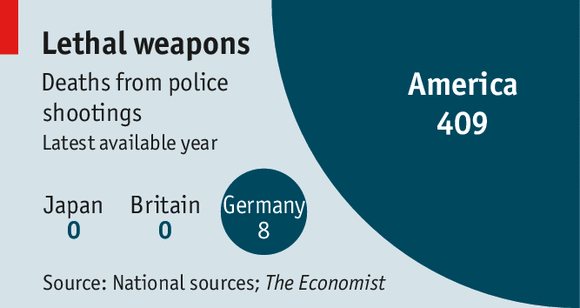
Yglesias connects police shootings to gun prevalence:

Ferguson is in many ways all about race and racism. But this chart reveals an important sense in which it’s not about that at all. If you know anything about the UK or Germany, you’ll know that these are not even remotely societies who’ve eliminated the problem of racism. If anything, having struggled with it for less time than the United States, they’re even worse than we are. Where they outperform us is in drastically reducing the civilian death toll without ending racism or entrenched poverty or any of the St. Louis area’s other problems.

A well-armed population leads to police shootings of the unarmed in two ways. One is that police officers have to be constantly vigilant about the possibility that they are facing a gun-wielding suspect. Cleveland police officers shot and killed a 12 year-old boy recently, because they not-entirely-unreasonably thought his toy gun was a real gun.

The other, more relevant to the Michael Brown case, is that when civilians are well-armed, police have to be as well. That turns every encounter into a potentially lethal situation.

Ed Krayewski thinks this theory too simplistic:

Matt Yglesias says the cops’ assumption Rice’s toy gun was real “wasn’t unreasonable.” For someone that spends a lot of time arguing from authority, he doesn’t hold the “experts” to a high standard. You can’t be deferential to cops’ judgment AND not expect them to make better judgments and then blame anything other than your attitude on the police violence that predictably follows. Boys, and girls, have been playing with toy guns for decades and somehow cops used to be able to handle it without arresting or shooting children.

Waldman joins the conversation:

The most common explanation is that since we have so many guns in America, police are under greater threat than other police. Which is true, but American police also kill unarmed people all the time — people who have a knife or a stick, or who are just acting erratically. There are mentally disturbed people in other countries, too, so why is it that police in Germany or France or Britain or Japan manage to deal with these threats without killing the suspect?

This is where we get to the particular American police ideology, which says that any threat to an officer’s safety, even an unlikely one, can and often should be met with deadly force.

Adam Ozimek suggests some reforms:

First, remove collective bargaining for police officers entirely. They should be employed at will, and should be able to be fired without any arbitration whatsoever. Workplace protections can be good for workers, but retaining the public’s trust in the police is far more important than making police officer be a nice job for someone.

Second, if a police officer shoots someone who is unarmed they should be fired even if they can prove they reasonably felt threatened. Self-defense can be a good reason to not bring criminal charges against a police officer for shooting someone, but it’s not necessarily a good reason to let them keep their jobs. The near constant stream of cases of police being too quick to shoot suggest their incentives right now lean too strongly towards shooting first and thinking later.

Update from a reader:

The graphic you posted puts US police killings at 409. It turns out no one knows what the number is for sure, but it is likely much higher, at least 1000 per year.

Being A Cop Has Never Been Safer

Shackford reflects on the revelation that last year was an all-time low for killings of police and a 20-year high for killings by police:

It’s an important reminder when Cleveland police kill a 12-year-old boy carrying a toy gun. It’s an important reminder when we see stories that police have killed more people in Utah over the past five years than any other form of violence outside of domestic conflict. Police have killed more people in Utah since 2010 than gangs or drug dealers. Obviously, it’s a positive that fewer officers are being killed in the line of duty, just as it’s a positive that crime trends are heading down. We should be worried, though, if police internalize the idea that this increase in their own shootings is what is keeping them safe in the field and not the general drop in crime.

Nick Wing adds that “Bureau of Labor Statistics list of the 10 most-dangerous professions doesn’t include law enforcement officer”:

The BLS said law enforcement accounted for 2 percent of total U.S. fatal on-the-job injuries in 2013, with 31 percent of those injuries caused by homicide. Other studies on the deaths of officers in the line of duty also showed police were far less likely to be killed in 2013 than they had been in decades. According to a count by the Officer Down Memorial Page, which collects data on line-of-duty incidents, there were far fewer deaths last year than in more than 40 years.

A 2013 tally by the National Law Enforcement Memorial Fund showed 100 officers died in the line of duty last year, the fewest since 1944. Traffic-related fatalities were the leading cause of officer deaths in 2013. The report found that “firearms-related fatalities reached a 126-year low … with 31 officers shot and killed, the lowest since 1887 when 27 officers were shot and killed.”

Ingraham points out that the true number of individuals killed by police is unknown:

It’s particularly worth noting that the FBI data on justifiable homicides is widely understood to be substantially undercounted — some states don’t participate in the FBI’s data-gathering programs at all, and others don’t tally justifiable homicides separately. So while the figures above are useful for generating a trend, the actual national numbers are considerably higher.

Ellen Nakashima provides more details on the subject:

Federal officials allow the nation’s more than 17,000 law enforcement agencies to self-report officer shootings. That figure, [Wes] Lowery reported, hovers around 400 “justifiable homicides” by law enforcement each year. Several independent trackers, primarily journalists and academics who study criminal justice, insist the accurate number of people shot and killed by police officers each year is consistently upwards of 1,000 each year, Lowery reported.

Update from a reader:

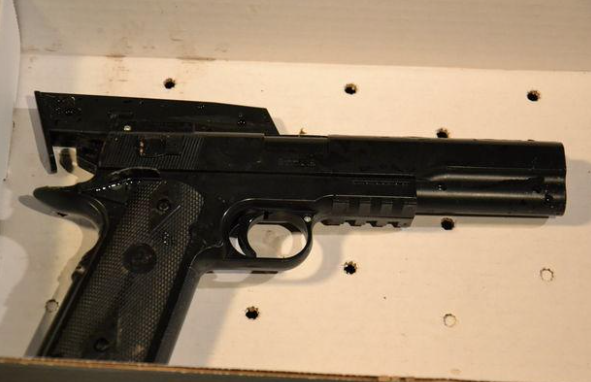
Please stop writing, or allowing people to write, that the gun the boy in Cleveland was carrying was a “toy” gun or a “fake” gun. It was a BB gun that looked very much like a semiautomatic pistol.  Maybe you can post this picture and let readers decide:

cleveland-gun

What To Make Of Ferguson? Ctd

Many readers comment on the story of the week:

After reading some of Darren Wilson’s testimony, I couldn’t help but automatically think of two separate posts I have read on the Dish before – this one, which talks about a study that finds how whites think black people are magical/supernatural, and this one, about how whites, and especially the police, overestimate the ages of black kids. Both of these studies could have some insight into Wilson’s thinking as he unloaded his clip into an unarmed black teenager, whom he described as looking like a “demon” and able to charge through bullets.

Another continues along those lines:

The rhetoric Wilson used may or may not have been “dehumanizing”, but those were the words of a police officer who was so terrified that he didn’t employ any other means of defusing the situation other than with deadly force, and he came to that conclusion in less than 90 seconds. If Wilson truly believed Brown was a “demon”, he had no business wearing a badge or carrying a gun, just based on the complete panic conveyed in his own words. The conduct of the entire Ferguson PD this whole time was that of a police force that held the citizens of the community with deep contempt, so it’s not surprising that Wilson approached this situation immediately as a worst-case scenario. It’s not even a racial reaction in my opinion; it’s a systemic failure of community policing and police training. Given Wilson’s previous run-in with the community where he displayed neither judgement or emotional control, what happened with Brown looks inevitable in hindsight.

Another dissents:

Andrew, I’m begging you for the second time, please don’t make comments about firearms anymore. How can you say Wilson had “no need” to shoot Brown that many times? The reason law enforcement went to high-capacity handguns and dumped the six shooters is because of the ability of people to withstand multiple gunshot wounds and continue fighting  (or shooting.) The catalyst for this approach was the 1986 Miami shooting in which to FBI officers were killed AFTER they had shot two bank robbers multiple times.  The robbers eventually died of their wounds, but in the meantime, they kept firing and killed the agents. Officer Wilson adhered to his training: shoot until the suspect is on the ground.

Another makes the same argument and adds:

I consider myself a leftist in good standing, but frankly, Mike Brown is to the Left what Benghazi is to the Right.

Preconceptions are everything. Facts don’t matter. Logic doesn’t matter. There’s a narrative of racist-white-cop-kills-harmless-black-kid, and no matter what uncomfortable fact intrudes, like that so many “witnesses” admitted they didn’t actually see what they told the media they saw, the narrative must go on. Because racism.

Another is roughly on the same page:

Maybe lethal force wasn’t necessary, but science has proven that Brown turned and moved back toward Wilson (at least 20 feet) and was not shot from behind. There was undeniably an altercation at/inside the police cruiser. Does the fact that one man is alive and one is dead skew the way those facts are interpreted? Absolutely. But there exist certain physical certainties that strongly suggest this was not cold-blooded murder.

I agree entirely that this should have gone to trial and realize that, statistically, nearly everything reviewed by a grand jury does. I agree that the fact Wilson will never even face charges is a mark of shame on the legal system. But I don’t get the sense that the people who are furious about this, whatever their race, are clamoring for a trial they’ll never see; it seems to me they’re clamoring for a conviction they feel they’ve been cheated out of. To the detriment of all of us, that belief is yet one more fault line that fractures and splinters us and renders impossible the hard, uncomfortable discussions we still need to have about race in this country.

Some strong pushback from an African-American woman:

While I appreciate your always-nuanced analysis, a few points of dissent: First, Michael Brown was not a “criminal”, as he had not been charged and convicted of anything. He was accused of petty theft, which is a misdemeanor. But alas, your facile use of the word speaks to the ease with which Black men are labeled as such, so as to be quickly demonized.

Secondly, you seemingly contradict yourself, because Balko’s article makes clear that this is not an environment where the police are protecting and serving but instead harassing and self-serving. I am in no way justifying assailing a police officer (or anyone for that matter), verbally or physically, but you are not a young Black man living in what is still ostensibly the South and facing harassment for just being. I challenge you to invite Black males to tell you their stories of police harassment. How many times they have been detained, cuffed, kicked and threatened with death because they fit a profile, looked suspicious or were just somewhere some cop didn’t think they belonged? Yes, this is in America.

Thirdly, seriously: “And yes, primordial racial feelings may well have been part of the mix.”? He described him as a “demon”, “Hulk Hogan” even. Have you not seen the recent study that shows that White people in fact do see Blacks as super-human?

You are surely not ignorant, Andrew, but there is an interminable, sometimes slight, sometimes massive burden that comes with Blackness that you seem wholly oblivious to. That 12 year old that was shot in Cleveland was sitting on a swing playing with a fake gun. Two things happened due purely to his Blackness: police were called and he was murdered. Full stop. The Black man shot in the stairwell of his building in NYC for just existing while Black because a cop got scared.  And that’s just since Monday.

Clive Bundy assails and threatens federal officers and gets invited on Fox News. Eric Frein plans and carries out an attack on state trooper barracks, killing one and seriously wounding another – again brought in alive. Ted Nugent scares the shit out of me with his racism, misogyny, anti-government and gun-humping ways, but yet he’s a hero to many White people and no one seems to have shot him yet either. White people have feared, reviled and vilified Blackness since they first laid eyes upon us. The codification and justification of our enslavement, disenfranchisement and murder is beyond primordial; it is part and parcel of what has made America and the Western world. Ferguson is just another eruption in this racist legacy and reality.

Update from a reader:

I agree with those who are stating that Officer Wilson was, at least, poorly trained and may not have been fit to be an officer in the first place.  Like many justifiable police shootings, it didn’t have to go that way.

But on of your readers claimed that, at most, Brown was guilty of petit theft, which is a misdemeanor.  This is incorrect.  Brown not only stole from the convenience store, he assaulted the business owner who tried to stop him from stealing.  This assault escalated Brown’s theft to a strong-arm robbery, which is a second-degree felony in the State of Missouri.  And it was Brown’s commission of this felony that began the chain of events that led to his death.  He had nobody but himself to blame for that – not Officer Wilson, not the prosecutor, and not racism.

The Dish Mug Is Here! Ctd

mugs

A reminder from our announcement post:

This navy-colored coffee mug is very high quality, holds a generous 15oz, and, during our caffeine-addled test phase, it proved very durable. So the sturdy mug should last a long time in any Dishhead’s kitchen or office (and yes, it’s microwave and dishwasher safe – we tested that too). As a serious coffee-addict, I love it.

The Dish mug can be yours for $15 plus shipping and handling. Just click here [sold out] and follow the simple prompts to order yours today. We only have a limited number of mugs for sale, so get yours before someone else does.

From a reader who snatched one up:

I’m a big Dish fan and just ordered one of the mugs. But a question: any reason why the shipping cost is so steep?  It added another 2/3 of the cost to the total, which seemed pretty excessive.  $26 for the mug – as great as it is – seems a bit crazy.  Just typing that makes me question my order a bit.

It was a deal-breaker for another reader:

I filled out the order form and then got to the checkout phase and saw that the shipping cost is $10.53! To Vermont? Are you kidding? Fuggedaboudit. No mug for me.

photo-13We really wish we could offer lower shipping and handling costs. But the Dish isn’t Amazon or Zappos, and we aren’t selling mugs in the kind of bulk that allows for greatly reduced shipping rates. The Dish mug and packaging together weigh two pounds, so that’s a big factor. And of course all coffee mugs are fairly fragile in transit, so going with the cheapest, flimsiest packaging wasn’t an option. If you were to walk into a UPS store and try to ship these mugs the exact same way, it would actually cost more than we’re charging.

Our partners at American Solutions for Business get a discounted rate from UPS and have passed those savings along. A special shout-out to Phil Grosse for guiding us through the whole process and doing his best to get us the best deal possible. He’s a long-time Dishhead who emailed us last February when we were floating the idea of merchandise, which has been a learning experience for all of us.

We hope the mugs themselves – which really are high quality and built to last – will make them worth your hard-earned money. And don’t forget to email us a photo when it arrives; you might see it appear on the blog. Update from a reader:

I had trouble with the website, so I emailed American Solutions.  Got a response almost immediately … tried again; still glitchy.  So I called Phil (he sent the email with the phone number).  After a wonderful conversation – he lived on my street in Redwood City back in the ’70s! – he filled out the order for me and sent me the confirmation. I’m so looking forward to my mug, and I just wanted you to know how helpful Phil was.

(Photo of the Dish mug endorsed by world-class performers Dina Martina and Janis Ian)

It’s Not Easy Seeing Green, Ctd

This embed is invalid


A reader sees a missed opportunity:

“We tend to focus far too much on outward symbols (like Prius driving) in judging whether people are energy conscious.” How could you post that quote from Chris Mooney without referencing the Prius scene from South Park?

Seen above. Another reader:

There are differences between being energy conscious, conserving energy, and energy consumption.  In the scenario presented, what is missing are reasons for driving the number of kilometers.  If the Prius driver has a profession where he/she must drive 28,700 km per year, then one could argue that he/she was being both energy conscious and energy conserving, even though the energy consumption is greater. On the other hand, if the SUV driver were truly energy conscious, he/she would drive a more efficient vehicle to conserve more energy even if the limited distance was for energy conservation.

Another provides a longer critique:

It’s not clear what the actual amount of gas/emissions are used by the Prius (at 48mpg – I’m not converting to kpg right now!), and the SUV at something like 15mpg.

At first blush, the Prius is more than likely getting at least double the mileage so the Prius driver is using less fuel, right? Not that I disagree with the premise of the study. Or, the conclusion.

The hybrids and Priuses are certainly getting more credit than they may deserve. Here in northern Virginia we have a section of US Interstate (I-66) that is HOV only for all lanes in both the morning (into DC), and the afternoon (outbound), in order to cut back on massive traffic; primarily not allowing cars with single drivers. They somehow decided years ago to allow hybrids the luxury of driving the HOV lanes with just single occupants for some unknown reason not at all related to actual traffic on the road. I’d say you see at least 30% of the cars on that road during HOV hours with one occupant. Of course, when you ponder the process what you see is a fuel-saving/carbon-reducing vehicle getting a benefit on a capacity road issue. Strange, isn’t it? I guess the planners just assume that since you get better mileage, you don’t congest roads?

Lastly, the mileage of a car isn’t the most important factor when taking into account fuel usage and carbon emissions – it’s people miles per gallon burned. A single driver of a Prius getting 49mpg is less efficient than my wife and I commuting into DC together in my 32mpg Nissan Versa: we are getting 62 people miles per gallon, they are getting 49 people miles per gallon. And, we are two people in one car – not a bunch of singles.

Carpooling, or multiple riders per vehicle, is far more important than just mpg, but I don’t think people consider that when buying and driving.

Update from a reader:

Something that doesn’t come up much in discussion like this is the following. Folks talk about electric and hybrid cars (anything that uses a charger to fill up the batteries) as if the power source stops at the battery. But that electricity doesn’t just magically appear at the wall socket. It’s generated somewhere by some process that uses some other energy source to provide it.  Depending on where you are, that could be, yes, solar, wind, or hydroelectric or even nuclear generation.  More likely it’s from plants burning fossil fuels: natural gas, fuel oil, or – dirtiest of all – coal.

So. Whatever bright future shines ahead of us, that electric car which does not have a local fossil fuel source – gas or coal in the tank burned locally in the car, but it is still, for the foreseeable future, a fossil fueled machine.  It may be displaced several steps away from its energy source, but it’s energy source remains the same.

Another responds to that reader:

True as far as it goes, but it’s far easier to control emissions at a power plant than at millions of vehicles. Also, as a dirty power source gets replaced, it has an immediate effect on all the vehicles that derive power from it.

Why Being Trans Could Cost You The House

Christin Scarlett Milloy couldn’t get a mortgage approval, because she couldn’t get a photo ID, because she’s transgender:

I sat on the phone and patiently explained why I can’t provide photo ID. Because I don’t have any. Because the government has destroyed all my previous ID documents and refused to replace them on several occasions. Because I am transgender. Yes, really. No, I don’t think it’s fair, either. Yes, a lot of people are surprised it’s so hard for us, but there it is. No, I really don’t have anything at all. Mmm, OK. Call me back. Goodbye.

We looked into other ways I could prove my identity. It turns out, there aren’t any. What if I show the dozens of letters back and forth between me and the government, where officials explain that my identity is not in question, but they still won’t send me new ID, because I refuse to check “male” on the application form? Apparently that doesn’t count.

How about expired government-issued ID? Back from a simpler time, when the government and I agreed on what my gender should be. I have that; it even has my photo and my old name on it. (Old-name ID presented alongside a legal ”change of name” certificate is considered valid to identify a person by their new name.) But alas, it’s against the rules to accept expired ID, even under exceptional circumstances.

Update from a reader:

Thank you for continuing your coverage of trans related issues. However, don’t you think that the headline that you wrote is over the top? Would you lend money to someone that did not have a proper ID? Seriously. Trans or not, that is nuts. It sounds like real estate lending pre-2008.

The Strangeness Of Our Love Of Our Pets, Ctd

A reader is moved by this post:

I have sat in the waiting room of my vet’s office three times a week for the last two months, waiting while my beautiful Maine Coon gets subcutaneous fluids for his failing kidneys. I have seen an entire cross section of the population – all ages, all economic levels, many races, and definitely an abundance of both genders. It has been so heart-opening for me to watch people with their sick pets. There is an attachment that I don’t even see as I sit in the pediatricians office. The look of sweetness and aching pain on the faces of owners as they try to comfort their dog or cat is a lesson in pure love.

But what has struck me is the realization of that universal desire to love and be loved, to need to be cared for and to want to care for others. From the cranky old man in tears over his sick poodle to the hassled moms with the limping giant dog and crying toddlers, to the teenager cradling her sick cat fearing maybe the first loss in her life, the love and the care is the same. It’s such a beautiful window into our humanity. It has been quite the gift to my life to see it all.

Another reader shares his own relationship:

Thank you for sharing the post on pets and recovering from addictions. While I have some doubts about the efficacy of dolphin or wolf therapy (especially as a primary component of therapy), I can testify that pets can, and for me have, played a very helpful role in my ongoing treatment.

In March of this year I was at the end of my rope with depression and anxiety, had been feeling emotionally and physically isolated and was drinking too much. I tried to kill myself, and fortunately, had second thoughts and instead reached out to family for help. In the days immediately following I began a course of medication and therapy, as well as abstaining from alcohol. The first few weeks were, as you’d expect, tough. My primary focus was on taking my meds, making my therapy appointments and maintaining sobriety. But as I began to put pick up and reassemble the other parts of my life (like going back to work) I received a call from my brother-in-law one Saturday asking me if I wanted to get out of the house and go with him to the local animal shelter.

I did not have any intention of adopting a cat when I walked into the shelter. I was going with my bogey in a boxbrother-in-law because he and my sister were looking for a kitten. It was maybe a month after my suicide attempt, so I figured going with him would at least get me out of the house for a few hours. As soon as we walked into the room with the younger cats and kittens, he was chirping and mewing at us from his crate, rubbing up against the sides to be petted. All of the other cats/kittens remained sleeping or seemed a little skittish. But not this little black cat. He didn’t quite meet what my brother-in-law and sister were looking for, since he was a he and he was a little old to truly still be considered a kitten. But we asked if we could take him out of the crate and pet him. He was great, continuing to make his little cat chirps and purrs while batting at our hands.

I went home that day and mentioned to my mom what a great little cat I had seen. I told her that if I was going to get a cat, I’d want one like that. She and my father and I discussed it, and we all decided that, why not get a cat? If I liked this one so much and could provide him with a good home, why wouldn’t I adopt him?

So the next day I went back to the ASPCA, filled out the paperwork and within a day or two, I was taking the little guy home. Since that day in April, the cat, who I named Bogey, has become such a positive influence on my life and my recovery. Taking care of him provides a structure to my days, companionship in the moments where I feel lonely, but above all, and I cannot say it any better than you did; “[he can] break my spell of narcissism.” Bogey gives me something to care about and for every day that is bigger than me. There have been nights where I might be tempted to drink, and see him, and decide not to for his sake – not for mine.

I still am on medication and I still see my therapist each week. But I have 260 days of sobriety and without attempts at self-harm, and I don’t know if I could say that if I didn’t have that little face looking at me every day and his weird (he is a cat, after all) fits of insanity to make me laugh. Thank you for letting me share this.

Update from a reader:

This thread really hits home. I put my 13-year-old Belgian Malinois down in early June. Less than two weeks later, our newest and third dog Casey, who had been with us just over the year, went out one day and never came back. Three weeks ago we adopted a new dog to keep Miss Annie company. (One is never enough.) Today I called my vet to bring my oldest feline friend Tux to the vet tomorrow to say goodbye. I love my pets but damn, it’s been a rough year.

For much more along those lines, check out what was perhaps our most popular thread last year, “The Last Lesson We Learn From Our Pets“.