Just What The Economy Ordered?

Rep. Chris Van Hollen claims that Obamacare will lower unemployment:

How Douthat thinks about the labor market effects:

The bigger the effect, the more likely that the people dropping out aren’t just, say, parents cutting hours to spend more time at home while the other spouse works full time, but people we should want to be attached to the workforce, for their own long-term good and the good of the economy as well.

Which is why it’s appropriate that the new C.B.O. projection of 2 million to 2.5 million job-equivalents disappearing has inspired more disquiet and debate than the old projection of 500,000-900,000 … because it’s a sign, however provisional, that the costs of Obamacare’s workforce effects might exceed the benefits. I don’t see liberals reckoning seriously with that possibility, and I think they really should.

Kliff talks to economists about the ACA’s impact on employment:

“On the one hand, when you expand a program where eligibility is based on income, that means if people increase their income, they could lose eligibility. That may create a disincentive to find a job,” says [Harvard University health economist Kate] Baicker, who was a member of President George W. Bush’s Council of Economic Advisers from 2005 to 2007. “But if health insurance makes people healthier, it might give them extra resources that could increase their ability to hold or search for a job. People have made arguments in both directions.”

Ryan Avent chimes in:

The argument that the ACA will be good for the economy centres on the view—not at all absurd—that insured workers will be healthier and therefore more productive over a longer working life, that insurance related job-lock will become less of a problem and productivity will rise as a result of better job matches, that reduced dependency on employer-provided coverage will encourage entrepreneurialism and risk-taking, and that constraining health-care cost growth will either raise real wages or make it more attractive to hire or a bit of both.

Now you can argue that on reasonable guesses about how these effects play out, effective labour supply still declines, relative to the pre-ACA trend, as a result of Obamacare. What you can’t say, first, is that they are irrelevant and, second, that they are included in the CBO analysis. In fact, what you should say is that they are relevant and are not included in the analysis.

John Cassidy qualifies the CBO’s projections:

In exploring some of these effects, the C.B.O. was making a valuable contribution to the public debate. But its actual figures are merely informed guesses about what might happen in the next few years, and they shouldn’t be taken too seriously. Obamacare is so big and so new that we can’t be sure what impact it will have. In coming up with the estimates that two million jobs will be eliminated by 2017 and 2.5 million will be eliminated by 2024 (or the equivalent in hours worked), the C.B.O. relied on academic studies of previous policy changes, such as changes in tax rates and alterations to the eligibility requirements for Medicaid. These studies may provide a reliable guide to how Obamacare will play out—or they may not. If we’re not comparing apples to oranges, exactly, we’re certainly comparing Granny Smiths to McIntoshes. And, in any case, the conclusions of the studies differ.
Memories Of Molestation, Ctd

Another reader shares his story:

I just wanted to offer my two cents on one particular aspect of the Woody Allen case. Many of his defenders point to the allegations that Mia Farrow “coached” Dylan before she spoke to the police. The edits in Dylan’s video testimony certainly suggest that Mia was at least talking to her and shaping her testimony, which could lend credence to the claim that the molestation was “invented” by Mia. But my experience as a victim of sexual abuse could suggest a different motivation.

My old sister and I were sexually abused by my father when we were very young. Our parents separated when I was two weeks old, and on weekend visits with my father, he would do many inappropriate things, similar to the actions that Allen has been accused of.

Inappropriate touching, yes. Penetration, no. The custody battle went on for years, and, of course, these allegations of abuse were a major factor in it. And yes, my mother coached me and my sister. She discussed what wording I would use when testifying before a judge. But she didn’t do this because the allegations were her invention. She coached me because she had already run into many sexist judges who were liable to take my father’s side in the matter. She coached us for the same reason every lawyer coaches their client before taking the stand: to make sure they communicate what they want to and to ensure that their words are not misinterpreted.

I’m not convinced of Woody Allen’s guilt, and I also understand the institutional hatred that a mother can instill in her children towards her ex-husband. And I’m sure that “invented abuse” and “implanted memories” are real things. But the coaching of a nervous, vulnerable child before they testify in a case that they really don’t understand is not evidence of either.

Previous readers on molestation here.

Clinton’s Achilles Heels, Ctd

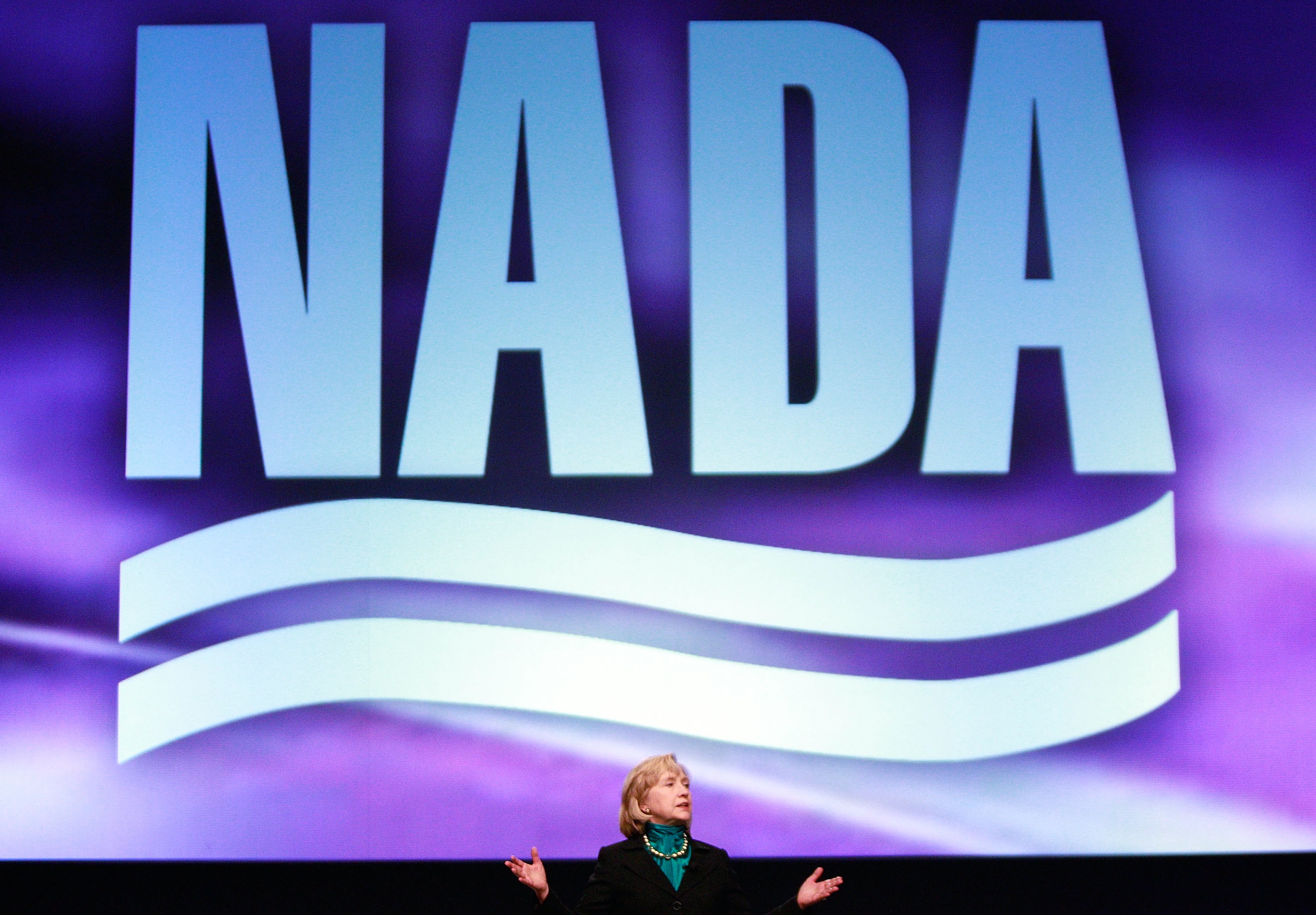
Hillary Clinton Addresses National Automobile Dealers Association Convention

A reader gets more specific than the previous one on Clinton’s record in New York:

According to my research at GovTrack, during her time as a Senator Hillary Clinton sponsored three bills that become law. They were:

S. 3145 “A bill to designate a portion of United States Route 20a, located in Orchard Park, New York, as the Timothy J. Russert Highway.”

S. 3613 “A bill to designate the facility of the United States Postal Service located at 2951 New York Highway 43 in Averill Park, New York, as the “Major George Quamo Post Office Building”

S. 1248 “Kate Mullany National Historic Site Act”

She renamed a road, a Post Office, and created a National Historic Site dedicated to a labor leader. Not exactly a huge body of work.

Weak. Lame. Another reader:

The responses to your query about Hillary are so depressing. I’m a woman and a huge capital-F Feminist, and I refuse to support someone JUST BECAUSE she’s a woman. That’s the stupidest, lamest, most self-defeating thing ever. I want to support someone who is the best person for the job, and hey, if that person is a woman, bonus! My early support for Obama was mostly about Obama, but secondarily because Hillary was emerging as the front-runner and that worried me. A lot.

I followed the 2008 race very carefully, for both personal and professional reasons. I read probably four hours’ worth a day of campaign coverage. (That’s how I found the Dish by the way – you’d keep coming up in searches early on, when not many other people were writing about Obama.) Hillary’s campaign was a MESS, in a way that reflected very badly upon her as an executive.

I don’t know who will emerge as the Democratic candidate in 2016 – I don’t see a lot of great options right now. But I really, really hope it won’t be Hillary, for two reasons. One, I don’t think she would be a good candidate. Two, and more importantly, I don’t think she would be a good president.

Another questions the premise of the discussion:

Do we really need a president (or candidate) that has a string of successes on “signature issues?”

No. What we need is an effective management from someone who can bring together both sides to advance the business of this country. Although we seem to have forgotten, that is what government is ultimately about. Success on big-focus policy issues in this day and age comes from narrow partisan achievements in one-sided political climates (See, e.g., Perry in TX, Walker in WI) or sacrifices overall improvement for narrow advancement (See, e.g., the Obama White House in the last year). The country is in desperate need of a president who believes in the value of good government and tries to, and can, improve the overall effectiveness of government for all people, rather than tear it down and rebuild it in some esoteric image. Now I’m no Hillary apologist (I voted for Obama, twice), but she seems like the type to advance the mission and effectiveness of government rather than focus it on myopic “policy initiatives”.

Another is on the same page:

Perhaps it doesn’t matter what her specific legislative/political/personal accomplishments are. A push-back against criticism of Obama is often (and I believe fairly), that he is merely the executive leg of a system of government. Our system of government is built to have checks and balances, and unless he or she has (super)majorities in Congress and the Senate, the President is never in a position to unilaterally impose their will or agenda. Again, this is something that gets brought up on places like this very website to produce a defense of Obama. He’s in charge of setting a tone and pushing an agenda, but sometimes that’s all that he can do.

So maybe Hillary’s specific accomplishments aren’t even the most important part of her resume. Maybe her status is indeed more important. As other’s have said, she is likely to be a little more of a fighter than Obama. She’s extremely popular and a well-liked figure. If she can set a tone that allows Democrats in Congress and the Senate to push Immigration Reform/Climate Change proposals/gun control/expand health care, and other items, then I think most Democrats who vote for her will be very happy.

Another takes it one step further:

I believe part of Hillary’s appeal lies in the precise fact that she does NOT have a signature accomplishment. After the failings of the Obama administration in the activity of governing (think the botched healthcare rollout, inability to effectively engage Congress), I think people are looking for someone who will be a competent administrator, without all sorts of new flashy policies. Clinton’s appeal is that she seems to be on top of her portfolio and can manage the details of governing, even without big accomplishments to point to. And part of this has to do with Obama’s own failings – after voters saw such promise in him during the 2008 election, the intervening period has really taken away the magic of his “change” message. Perhaps, in the end, Clinton’s 2008 approach of emphasizing “experience” over “change” is what will allow her to win in 2016.

And to Democrats, this has particular appeal. After 8 years of the Obama presidency, they are going to be seeking someone to lock in and secure the changes he has made – particularly with regard to healthcare and executive branch policies on things such as the environment and military policy. A Clinton presidency which can competently administer these policies will make it even harder for them to be rolled back at a later date.

Yep, that’s the strongest case for Democrats: that she’ll basically entrench Obama’s legacy the way George H.W. Bush did Reagan’s. By doing nothing.

(Photo: Former U.S. Seceratary of State Hillary Clinton speaks at the 10th National Automobile Dealers Association Convention on January 27, 2014 in New Orleans, Louisiana. According to reports, Clinton said during a question and answer session at the convention that the biggest regret was the attack on Americans in Benghazi. By Sean Gardner/Getty Images)

Who Has The GOP Got?

Larison fails to see the logic of a Jeb Bush candidacy:

There’s no doubt that Bush could raise a lot of money, but other than that what is the argument for his presidential campaign? He hasn’t disavowed anything his brother did in office, and as far as we know he doesn’t disagree with his brother on any major issues. He is more likely to defend his brother against critics. That may be understandable as a matter of family loyalty, but it isn’t going to win him many supporters. It would be exceptionally easy for the Democrats to argue that Jeb Bush wants to return to the policies of his brother, and those policies–and their failures–are one of many reasons why the post-2008 Republican Party remains so unpopular and distrusted by the public.

Sabato has Walker at the top of his list:

We continue to like Walker’s combination of Blue state electoral success and conservative bona fides, but let’s face it: We have little idea how he would handle the crucible of a national campaign.

That is just unknowable at this point. Walker’s potential as a candidate comes in part because, as a governor, he doesn’t have to weigh in all the time on divisive national issues — something he won’t necessarily be able to get away with in 2015 if he becomes a candidate. It seems like an odd comparison, but Walker might end up being like Gov. Rick Perry (R-TX), who had all the makings of being a great candidate until he actually became one. Tim Pawlenty (R), the former Minnesota governor whose shiny candidacy went up in smoke quickly, is another comparison that Walker and his allies surely wouldn’t welcome. And of course Walker needs to win reelection — we rate him a solid favorite but he’s not likely to win by a big, Christie-esque number — or all this talk is moot. We like Walker’s potential as a candidate, but just because he tops our list doesn’t make him the frontrunner: This is a very big and fluid field.

Drum instead calls Paul Ryan the favorite:

[W]ho are his big competitors? Chris Christie is toast. Marco Rubio is inexperienced to begin with, and then muffed his chance for statesmanlike glory when he staked his reputation on immigration reform and came up empty. Jeb Bush can’t even get his mother’s endorsement. Scott Walker is getting buzz, but he strikes me as having too much baggage. Rand Paul and Ted Cruz are novelty candidates, not to be taken seriously. And although I used to think Bobby Jindal might have a chance, he’s had a rough past couple of years.

“With My Daddy In The Attic”

Weird, isn’t it, that song-writer Dory Previn would write a song with that title:

In 1968, Farrow had an affair with the conductor and composer Andre Previn. Previn’s wife, the songwriter Dory Previn, discovered the affair when Farrow became pregnant with Andre Previn’s child. Dory divorced Andre, and shortly afterwards Farrow married him. At this time Dory Previn released an album of songs that included “With My Daddy in The Attic,” which appears to be an incest fantasy about a girl and her father having trysts in an attic.

And then there are the lyrics. A reader adds:

Yes, Dylan Farrow’s anguish and pain can be reconciled that the evidence at the time showed that she was being coached and that there was no physical evidence of abuse with her current anguish.  It is simply that children – and adults – can be led to create memories that are not true.  Here is a listing of the daycare hysterias that have swept the country. Here is an academic paper on the issue on the case of Kelly Michaels.

In almost all of those cases, the child was led into making false accusations and what happened is that those accusations became their memory. They still suffer as victims of child abuse, but their stories have long-since been discredited.  They did suffer child abuse, but it was not at the hands of the accused, but at the hands of the accusers.  Yes, I do think that Mia Farrow is the abuser in this case, not Allen.  Her daughter was the victim of her venom.

This version reconciles all known facts.  Yes, a tragedy, but one made worse now by your – and many other – careless accusations against Mr. Allen.

I am a feminist who worked in the anti-rape movement in my 20s and used to think that one should “believe the women” and “believe the children” as a matter of course.  The subsequent history of false accusations starting with the daycare panic, and extending into the adults accusing parents of child abuse through therapist suggestions. You simply don’t seem to be aware of this possibility, which suggests a hole in your education, and without bringing it up as a possibility, you are being irresponsible to Mr. Allen.

I am very much aware of that possibility. The tragedy in this case is that we have to choose between child abuse by one parent and child abuse by the other. The only thing we can really know is that Dylan Farrow is in extreme pain, and that she deserves our respect and tenderness for that reason alone.

Clinton Fatigue?

Drum is worried about it. I’m already exhausted. Masket is unconcerned:

Is there any evidence that voters “get tired” of politicians? I don’t want to get into the whole literature on what governs presidential elections, but the simple answer is no. Candidates tend to Clinton Global Initiative Annual Meeting In New Yorkdo better if the economy is growing while their party holds the White House (or if the economy is drowning while the other party holds it). Prolonged wars can hurt their party, as can perceived ideological extremism. But overexposure?

The big case here would be Ronald Reagan, who did his first film in 1937, 43 years before getting elected president. (Okay, maybe he wasn’t “in the public eye” until “Knute Rockne All American” in 1940, but still.) But Drum discounts Reagan’s film career, so maybe we shouldn’t start the clock until Reagan begins doing his conservative speeches for General Electric in the late 1950s. That’s still over two decades before becoming president. His record warning about the dangers of Medicare was recorded in 1961. And keep in mind that in 1984, after being in the public eye for nearly half a century, Reagan won one of the biggest Electoral College landslides in history.

But before he got the nomination, he’d never been the Establishment front-runner with a 50 point lead over his nearest rival. The problem for Clinton is that a) she’s not a very compelling public speaker or shrewd campaigner (she was handed the New York Senate seat on a nepotistic platter and got creamed by an upstart in 2008); b) she has close to no record of substantive achievements at any point, as First Lady, Senator and secretary of state; and more critically c) she is perched on an impossibly high pedestal which all but cries out for someone to knock her off it – either in the primaries or the general.

I think she may be the weakest and the strongest candidate for 2016. I don’t think that’s a great combination for a campaign.

(Photo by Getty)