Why We Don’t Have Comments
Check them out below this National Journal piece on the still dominant presence of white men in American public life.
Republicans Endorse Obamacare Lite, Ctd
Here’s something quite striking about the Republican alternative to Obamacare:
A preliminary (non-C.B.O.) score shows that it insures slightly more people than Obamacare and reduces the deficit, relative to current law, by $1.4 trillion over the next ten years… How does it accomplish this feat, you ask? Well — it pushes people buying on the individual market toward cheaper insurance plans with much narrower physician networks, and it reduces the tax subsidy for employer-provided insurance more substantially than Obamacare’s Cadillac tax would do.
Which is why I think such alternatives can and should be explored (and might even have had a chance of making it into the bill if the GOP  hadn’t had a psychic meltdown almost as soon as Obama took office). But, of course, this means that many more people may have to switch doctors under Obamacare Lite than under Obamacare Classic. It also means that businesses will be hit hard with more taxes once their cushy subsidy, unavailable to those in the individual market, expires. Now I’m quite sympathetic to both ideas. If we’re going to cut costs, something like the former is vital; if we’re going to create a more viable individual market, then corporate taxes will have to go up. But haven’t Republicans been trashing Obamacare on precisely those grounds – that you have less choice over your doctor and that there’s a hidden tax increase in all of this?
Donald H Taylor has a must-read on all this. Money quote:
Narrow network plans don’t bother me one bit (I thought everyone wanted to reduce costs!), but the ad machine that is trying to give the Republicans the Senate in 2014 is demagoguing something that is a feature and not a bug of the plan put forth by Republican Sens. Burr, Coburn, Hatch.
Indeed. Because the GOP has not been a conservative party these past five years, but a raging, irrational id, it has opposed Obamacare on any grounds, including liberal ones. They hate it because it may restrict some patient choice, but they hate it because it allegedly spends too  much money. My advice: pick one. And the one to pick is the maximal extended coverage with the maximal cost controls. Burr-Coburn-Hatch tries to do this – and may fall between two stools, merely proving Obama right. But the Republicans cannot run on repealing Obamacare when they are effectively proposing to fine-tune it. And they cannot run both on maximal patient choice and lower costs.
They have to choose. Finally, as with immigration, they are being forced to admit that their most practical vision is not that far apart from what Obama has already enacted or proposed. Their bluff is finally being called as they have to present themselves as an alternative governing party and not just a cable entertainment company.
Yes, I’ll go there. Meep meep.
The Money In Wealth
Earlier this month, Ryan Avent examined Thomas Piketty’s new book, Capital in the Twenty-First Century, which Tom Edsall unpacked this week:
What Mr Piketty conveys most powerfully, in my opinion, is the fact that economics was once centrally concerned with the question of distribution. It was impossible to ignore in the 19th century! Not least because economists of a market-oriented disposition and those more sympathetic to Marx both wondered whether capitalism was capable of generating a sustainable distribution of the gains from growth. We are all used to sneering at communism because of its manifest failure to deliver the sustained rates of growth managed by market economies. But Marx’s original critique of capitalism was not that it made for lousy growth rates. It was that a rising concentration of wealth couldn’t be sustained politically.
In a follow-up, he responded to Piketty’s critics who point out that inequality is shrinking globally. Yglesias added:
It’s true that it would be a mistake to get excessively hung up on any particular summary statistic of inequality. But the broad facts that stagnating living standards in rich countries are coinciding with a falling share of national income going to the bottom 80 percent or so of the population aren’t in serious dispute and they’re not “compensated for” in any policy-relevant sense by the success of Chinese development policy.
Drum’s suspects that taxes are going to rise on the rich:
My view is that the second half of the 21st century—assuming we manage not to blow each other up or fry the planet to a cinder—is likely to be an era of fantastically high growth thanks to robotics and artificial intelligence. That also produces problems related to the distribution of income, but they’re rather different from Piketty’s.
But in one sense it doesn’t matter. Piketty’s solution to the problem of this mismatch between growth and capital returns—which he considers an inevitable consequence of capitalism—is redistribution and plenty of it: “The only way to halt this process, he argues, is to impose a global progressive tax on wealth….an annual graduated tax on stocks and bonds, property and other assets that are customarily not taxed until they are sold.” That’s probably the eventual answer to the robotics revolution too. So regardless of which fork we take in the future, higher taxes on the rich seem pretty likely.
Millman wonders how such a tax work since “the incentives for a given state to cheat are simply too large – any state that had a lower tax on wealth than the cartel would attract enormous inflows of capital.”
Quote For The Day
“OMG, you would rather have had a COMMUNIST MUSLIM in charge of your va*ina? Lady (and I use the term lightly), you ain’t seen NOTHIN’ yet until that muslim YOU put back into office AGAIN completes his task of destroying this nation, the muslims take control and YOU, Ms. Female voter, LOSE all the freedoms you now enjoy, including the female’s right to VOTE! Sheesh, what low-information voters have done to this country…” – a commenter at Breitbart.
I usually avoid crazy commenters but this one had a certain kick to it.
Calculating The Coup Odds
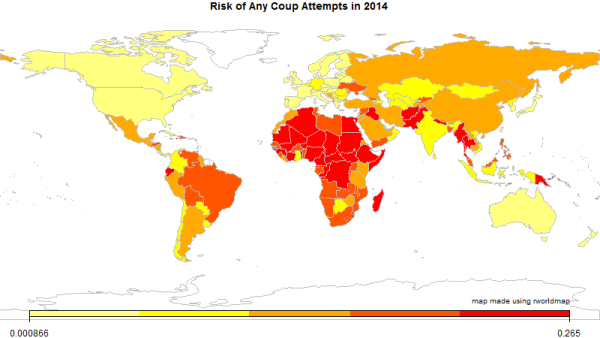
Opening with the caveat that “Coup attempts rarely occur, so the predicted probabilities are all on the low side, and most are approximately zero,” Ulfelder maps where they’re most likely to happen this year:
From cross-validation in the historical data, we can expect nearly 80 percent of the countries with coup attempts this year to be somewhere in that top fifth. So, if there are four countries with coup attempts in 2014, three of them are probably in dark red on that map, and the other one is probably dark orange.
Fisher takes a minute to “appreciate the luxury many countries have of not worrying about coups”:
A lot of democratic as well as authoritarian states, rich as well as poor, have strong enough rule of law and institutional norms that they don’t have to worry about coups. Ulfelder’s model predicts only a 0.15 percent chance in the United States; many Western democracies show similar scores. So do some countries experiencing political turmoil, such as Greece and Cuba (0.14 and 0.21 percent risk, respectively). Iran, for all its problems and political infighting, only rates a 1.43 percent chance of a coup. That’s probably great news for the United States: even if we don’t like the Iranian government, it’s preferable to chaos, and a government that can negotiate without worrying about a military coup has a freer hand to accept any U.S. nuclear deal.
Colleges Are Slow Learners
Declaring the Golden Age of higher education over, Clay Shirky wants the academic world to face reality:
The number of high-school graduates underserved or unserved by higher education today dwarfs the number of people for whom that system works well. The reason to bet on the spread of large-scale low-cost education isn’t the increased supply of new technologies. It’s the massive demand for education, which our existing institutions are increasingly unable to handle. That demand will go somewhere.
Those of us in the traditional academy could have a hand in shaping that future, but doing so will require us to relax our obsessive focus on elite students, institutions, and faculty. It will require us to stop regarding ourselves as irreplaceable occupiers of sacred roles, and start regarding ourselves as people who do several jobs society needs done, only one of which is creating new knowledge. It will also require us to abandon any hope of restoring the Golden Age. It was a nice time, but it wasn’t stable, and it didn’t last, and it’s not coming back.
La Vie En Rouge
Exploring the evolution of color perceptions, Elijah Wolfson considers how our ability to see red sets us apart from other mammals:
Most mammals, including most primates, are dichromatic, meaning they can only detect two color wavelengths: green and blue. Certain primates, though, have evolved to see a third: red. It turns out that these primates—humans, chimps, gorillas, and orangutans, to name some—all have one thing in common: bare-skinned faces. Based on this trend, experts have hypothesized that the development of trichromatic vision was, in fact, the result of an evolutionary advantage that certain primates had over others: namely, that it helped our ancestors better understand the emotional states, socio-sexual signals, and threat displays of their brethren.
The upshot was huge. Once we could actually see the red that coursed through our veins, it became a secondary communication tool: ovulating females would redden in the face and in their sexual organs to signal sexual readiness; angry males displayed dominance by reddening in the face. Modern humans might still get red in the face while angry, but we’ve also branched out to using signaling tools like cocktail dresses and soccer jerseys. While the medium has changed, the message remains: displaying red means you’re serious.
The Internet Increases Inequality?
Bill Davidow fears so:
Doing some of the obvious things like raising the minimum wage to fight the effects of the Internet will probably worsen the problem. For example, it will make it more difficult for bricks-and-mortar retailers to compete with online retailers.
Surprisingly, the much-vilified Walmart probably does more to help middle class families raise their median income than the more productive Amazon. Walmart hires about one employee for every $200,000 in sales, which translates to roughly three times more jobs per dollar of sales than Amazon. Raising the minimum wage will also make it more difficult to bring manufacturing jobs back to the U.S. The Internet is not the sole force driving income inequality in the U.S. Our languishing education system is a major contributor to the problem. But two things are certain: the Internet is creating many of those in the ultra-wealthy 1%; and it forces businesses to compete with capable international competitors while providing the tools so that businessmen can squeeze inefficiency out of the system in order to remain competitive.
The View From Your Window

Boulder, Utah, 4.05 pm

