An Extreme Rx

“Bioprospectors” are exploring deep-sea trenches, acid lakes, and other extreme environments in the hunt for tomorrow’s antibiotics:

Lechuguilla_Cave_Pearlsian_GulfThe organisms that flourish in the comfort zone of Earth’s biosphere make up only a fraction of life on our planet. Outside what we consider the habitable regions – in the desiccated soils of deserts or buried beneath thick ice or rock – creatures not only survive, but thrive, at extremes of temperature, salinity and darkness. … It wasn’t until a few years ago that we began to realize that these adaptations could also be turned against some of our nastiest medical foes. Fungi discovered in the acidic lakes of Lechuguilla Cave in Carlsbad, California – whose metal-infused waters should have stymied all life – tipped us off (see diagram). One hardy strain of Penicillium produces a compound that inhibits the growth of lung cancer cells. Another compound, berkelic acid, isolated from fungus and bacteria found living in the toxic water of an open-pit mine, slowed ovarian cancer cell growth by 50 per cent. The hunt was on to unearth more of nature’s extreme medicines.

(Photo of Lechuguilla Cave by Dave Bunnell)

Boehner’s Opening Bid On Immigration

At the House Republicans’ annual retreat on Thursday, John Boehner released the much anticipated draft (pdf) of the party’s immigration reform “standards,” outlining what reforms the GOP leadership would be willing to enact, and under what conditions. Molly Ball examines the core issue raised in the one-page document:

There’s a lot of important nuance here surrounding the controversial citizenship question. Undocumented immigrants, their families, and their advocates have two basic and related priorities. First, can they stay in the country without fear of deportation? The language here suggests Republicans want most of them to be able to do that, though the “triggers” part gives people pause. (Border enforcement is already at record levels, and the Senate bill would devote still more resources to it.)

Second, can they eventually become U.S. citizens? The language here suggests Republicans would let them do that too, by getting in the same “line” as all the foreign residents who have applied to enter the U.S. legally. That’s the difference between “no pathway” and “no special pathway”: The former would, in advocates’ view, create a permanent second class of resident non-citizens, while the latter would merely mean a very long wait.

Beutler also sees the “pathways” issue as the biggest stumbling block:

Nebulous wording and wiggle room is where a lot of politics happen, and its totally possible that this all comes down to framing a picayune technical dispute over how and when the 11 million end up becoming citizens as the difference between amnesty and not amnesty.

But it’s also possible that Republicans will make legalization precluding citizenship, or making citizenship effectively unattainable, their final offer. And I’m not sure Democrats and advocates have adequately grappled with the bind that would place them in. Obviously it would be a major negotiating failure for reformers to entertain an idea like this publicly. And it would be a genuinely unjust outcome in the sense that the 11 million would be treated secondarily to the rest of their fellow taxpayers under the law. And it would be a sub-optimal political outcome for the Democrats’ demographic politics.

For all these reasons, reformers have typically refused to go there.

On the other hand, Byron York thinks the enforcement triggers are “the key to the whole thing”:

It is not an exaggeration to say that the future of immigration reform in Congress depends on whether Republican leaders mean what they say in that single sentence.

If they do, and the GOP insists on actual border security measures being in place — not just passed, not just contemplated, but actually in place — before illegal immigrants are allowed to register for legal status, then there will likely be significant Republican support for such a bill. (It might well be a deal-killer for most Democrats, but that is another story.) If, on the other hand, GOP lawmakers wiggle around the clear meaning of the principles’ last sentence to allow legalization to begin before security measures have been implemented, then the party will be back to the same divisions and animosities that have plagued Republicans since the terrible fights over immigration reform in 2006 and 2007.

Considering the long odds of a total overhaul in the current political climate, Ed Krayewski advocates “a smaller, more focused bill that deals with the human cost of poor immigration policy”:

Concerns about illegal immigrants seeking to abuse the welfare system are largely unfounded, but could be alleviated by offering expedited legal status for illegal immigrants willing to forgo access to the welfare system. Every illegal immigrant I know (quite a few) has said something along those lines; they want to be legal in this country and couldn’t care less about getting welfare. They want to work, and ought to be allowed to.  To that end, immigration reform should make it easier for employers to hire the employees they want without having to worry about running afoul of immigration law. If this kind of narrower immigration reform couldn’t garner the support it needs to pass, reform supporters ought to consider a concession that could dampen opposition: making it easier to deport illegal immigrants convicted of violent crimes, and perhaps even banning such immigrants from ever returning to the US. Again, most illegal immigrants would be ok with this: they are law-abiding people just as upset by illegal immigrants who drink and drive and hit and run as legal immigrants and US citizens are.

The statement omits another major angle of the debate:

One point these principles don’t mention is that a working legal immigration system is essential to resolving unauthorized immigration. The solution to America’s problem with unauthorized immigration does not lie with more restrictions, less lawful immigration, and more restrictions on the freedom of Americans.  The solution lies with deregulating our immigration system, allowing more immigrants to come lawful on green cards and guest worker visas, and minimizing the government’s role in picking immigrant winners and losers.  The market can do that far more effectively than a government agency, regardless of all the shiny new fences, border drones, and invasive government databases they command.

Allahpundit considers Boehner’s political calculations:

Sean Trende of RealClearPolitics started tweeting in total mystification after the statement was released as to why the GOP would be pushing amnesty now, of all moments. If they were dead set on doing this before the midterms, he reasoned, why not do it last year, to give conservative anger more time to cool before the big vote? Failing that, why not wait until next year, after the midterms, since no one expects the Latino vote to be decisive this fall? I have no answers to the first question but you know my answer to the second. I think Boehner’s afraid that if they wait another year, until the GOP holds the Senate as well, conservative expectations for a “tough” Republican-written law will be so high that the backlash when they fail to come through will be even more bitter than it’ll be if they do it this year.

In a follow-up post, Beutler notes another reason the GOP is wary of reform:

If Republican leaders were serious about doing immigration reform anyhow, the sensible thing to do would be to ditch the vindictive crap and just pass something like the Senate bill. But the elephant in the room here is that even pragmatic Republicans are nervous about the prospect of creating millions of new voters, the majority of which would probably be Democrats. And that augurs poorly for Republicans passing anything this year at all.

For that reason, Waldman doubts anything will come of this:

Now it’s true that in the wake of the government shutdown and the various debt ceiling crises, House conservatives have slightly less power to force the rest of the GOP to bend to their will. But only slightly. One thing hasn’t changed: the average House Republican still comes from a safe district where the only real threat to his job is a primary challenge from the right. He knows that his primary voters are people who watch Fox News and listen to conservative talk radio, where they hear things like Laura Ingraham telling them that jingoistic Mexicans are trying to take over America, which is why “your language [that’d be English] is gone,” while Rush Limbaugh rails at the Republican immigration principles as the wolf of “amnesty” in sheep’s clothing. Today’s Drudge Report featured a graphic of John Boehner in a sombrero, and it wasn’t a compliment. As one Southern Republican member of Congress told Buzzfeed, “If you go to town halls people say things like, ‘These people have different cultural customs than we do.’ And that’s code for race.”

A Flaccid Drama

As the wieners just won’t quit on Game Of Thrones, Justin Moyer has a long, hard look at Looking:

[W]hen the HBO series Looking concludes in six weeks, viewers of the most ambitious television show starring gay men ever produced will almost certainly not have seen the essence of (gay) male sexuality: the erect penis.

This is inexcusable. While it’s possible that Looking’s lack of rigid man meat is part of executive producer Andrew Haigh’s understated personal aesthetic, history suggests that the real blame lies with the network.

While ostensibly breaking barriers by producing a gay show for a general audience, HBO’s failure to spotlight members at attention shows the network is bowing to censorious TV convention—and perpetuating a disturbing fear of queer people.

This dick-shyness is not, as you might expect, a legal necessity. A 2012 Supreme Court decision suggested that the Federal Communications Commission’s ability to police broadcast television may be legally shaky, but regardless, cable networks were already liberated. That’s right: Though it can bluster about it, the FCC has no real say in what HBO, Showtime, Cinemax, et al. put on the air. Yet, even as a faux load of jism splattered a cast member of Girls last year, the flesh cannon that shot it inexplicably remains a TV taboo. Why?

Will Jeb Run?

Sean Sullivan calls that the biggest unanswered question about the 2016 GOP race:

There are two simple reasons why. 1) No other top tier Republican has the potential to alter the landscape of the primary as broadly as the former Florida governor. 2) No other top tier Republican has broadcast as much genuine uncertainty about his plans.

Hollande Visits Britain

Sometimes, you just miss home:

Monsieur le President est un cookie smart. Donc, il used le plus vieux trick dans le livre: il began par droning on pour ages et ages about les choses incroyablement boring, par exemple l’économie, et les projets d’infrastructure, et la France. Tres clever! Les journalistes anglais would soon être fast asleep!

But, non!

Mais then, désastre – dans le forme d’un journaliste du Télégraph, Monsieur Christopher Hope. “Est-ce que vrai que votre rumpy-pumpy a made la France un laughing-stock?” a dit cet rogue impertinent. “Est-ce que vous still having une affaire avec Julie Gayet, et do vous wish elle était ici maintenant?”

Monsieur Hollande wrinkled son nez, as if un fly a landed sur it.

Reality Check

Obamacare Unfavorable

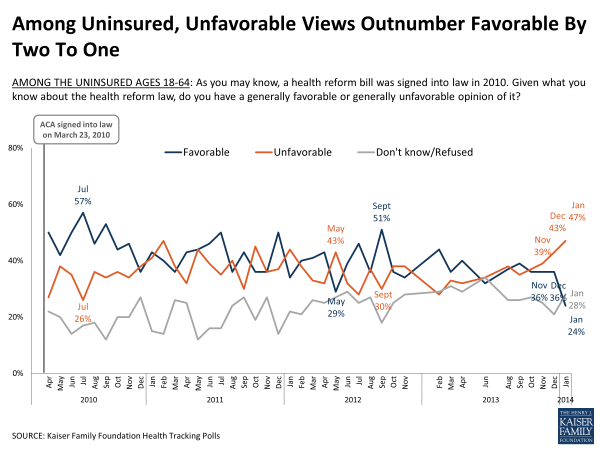
Suderman parses Kaiser’s latest numbers:

[T]he [above] latest monthly tracking poll from the Kaiser Family Foundation finds that opposition to the law amongst the uninsured has actually increased since December … This is the group of people the law was, in theory, supposed to benefit most. And yet even as the most prominent benefits start to kick in, their support is dropping. It’s possible, of course, that this could turn around at any time. But it’s not a very good sign for the future popularity of the law.

I too was gobsmacked by this result. But then you look and ask what the respondents actually think Obamacare is. And you get this result:

Roughly four in ten adults overall, and about half of the uninsured, are not aware that the law provides financial help to low- and moderate-income Americans to help them purchase coverage, gives states the options of expanding their Medicaid programs, and prohibits insurance companies from denying coverage based on pre-existing conditions.

That is such a massive indictment of the president’s messaging it beggars belief. Half of the uninsured have no idea that Obamacare offers them money to buy health insurance! WTF? No wonder the popularity of the law remains mired.

Look: the cognitive dissonance is real. But so is the ignorance. Obama’s approach to selling the ACA has been that of a classic defensive-crouch liberal. He sees the low popularity and decides not to tout the law so much. And by failing to tout the law effectively, relentlessly, persistently and clearly, he simply enables the ignorance-based opposition to grow.

Kliff notes how the media have also simply responded to this mood, rather than explaining the fuller story:

For many Americans – particularly the 68 percent who get coverage through their work, Medicare and Medicaid — the launch of the exchanges probably doesn’t affect their coverage situation. … So what’s driving the negative opinions of Obamacare? The Kaiser survey does point to one potential culprit: negative news coverage. More Americans say they’ve seen stories about people having bad experiences with the Affordable Care Act than good ones.

Waldman puts these numbers in perspective:

We spend so much time talking about politics that it’s easy to forget that politics are not an end in themselves, they’re a means to an end. Liberals advocated for comprehensive health insurance reform for so many decades not because it was politically advantageous (at some times it was, and at other times the voters didn’t seem to care), but because it was right. The fact that so many millions of Americans had no health security up until now was a moral obscenity. The ACA is beginning to fix things—slower and less completely than we might like, but it is a beginning. And if it never becomes the political boon you were hoping for, it was still the right thing to do.

Drum’s analysis:

27 percent now say that Obamacare has “negatively affected” someone in their family. That’s crazy. Even if you subtract the baseline of 18-19 percent who have been saying this all along, that’s an increase of nearly ten points over the course of 2013. Unless you take an absurdly expansive view of “affected,” this is all but impossible. Obamacare simply doesn’t have that kind of reach.

But we’ve been though a recent period in which every co-pay increase, every premium increase, and every narrowing of benefits has been blamed on Obamacare. These things have happened every year like clockwork for the past couple of decades, but this year it was convenient to blame them on Obamacare. Combine that with the PR disaster from the website rollout, and a whole lot of people now believe that Obamacare is hurting them.

Sticky Status

Economist Gregory Clark’s book The Son Also Rises traces social mobility rates over hundreds of years using surnames and concludes that government interventions aimed at increasing mobility have little effect. In an interview, Clark suggests that, because socioeconomic status is so hard to change, it may make more sense to focus on raising the minimum standard of living instead:

We already live in societies of massive social intervention in terms of the provision of education and health care. Yet we have not been able to raise social mobility rates above those of the pre-industrial era. Even the most interventionist societies such as Sweden have such low social mobility rates.

But if we’re learning that we can predict the majority of people’s outcomes at conception, that should lead us to reexamine our assumption that whatever income distribution comes out in society is fine. Because if it’s the case that a lot of this is determined before someone enters the game, it weakens the case for letting the market determine the distribution.

You’d be much more likely to favor a society with much less inequality. And that’s where Sweden’s system does provide advantages over the U.S.’s. They haven’t changed mobility rates, but they’ve changed the consequences, strongly, of ending up at various points in the distribution. It’s a much better place for people who end up at the bottom of the distribution.

Yglesias makes related points, arguing that the bipartisan obsession with equal opportunity “makes no sense whatsoever as a social objective”:

[W]hether the focus groups like it or not, an opportunity to climb is no real answer for people at the bottom. A perfectly fair race is, in at least one important way, the same as a rigged race: Both have a first-place finisher and a last-place finisher. The question of what happens to the person at the bottom genuinely matters. Whether you want to phrase that in terms of the gap between the bottom and the top—inequality, as such—or simply look at the absolute condition of the people at the bottom, you can’t escape the conclusion that outcomes matter, and not just in terms of procedural fairness. Today, even poor people are able to take advantage of things like electricity and antibiotics that were rare or nonexistent 100 years ago. That’s the kind of opportunity that matters—the opportunity for everyone to enjoy a better life. But over the past generation, progress has been slow for the nonrich. And over the past 10 years, it’s been essentially absent.

Wait: Hillary Can’t Give Bill A Job?

Yesterday, I wrote:

If Hillary wins, Bill should be secretary of state. A formal role on the world stage is far preferable to an informal role on the inside fucking everything up.

Carpenter wishes this were possible:

[Hillary] probably would [appoint Bill], were it not for the Federal Anti-Nepotism statute of 1967, which bans such eminently sensible acts as a chief executive appointing whomever he or she deems best suited for the executive’s trust and convenience.

From the text of the law in question:

A public official may not appoint, employ, promote, advance, or advocate for appointment, employment, promotion, or advancement, in or to a civilian position in the agency in which he is serving or over which he exercises jurisdiction or control any individual who is a relative of the public official.

So we have a uniquely nepotistic and dynastic democracy in fact, but a law forbidding its being made explicit, and thereby formally accountable. Yep: sounds like America.